Tuesday, 30 September 2025

Pictures from Porto ………… and a bit of street furniture from around the corner

Or as we often say in our house … “a wall of sardines, date stamped, and a bit of street furniture brought to you by Fucoli-Somepal”.

A wall of sardines, 2025

Now I have no idea sitting here in Chorlton as to why these tins of sardines each bear a different date, other than you can search for the year you were born and take home the contents ready to eat on the anniversary of your birth.

And that was the assumption of my pal who sent over the image on his trip through the Portuguese town of Porto.

SANEAMENTO, 2025

That said there will be someone who has taken a similar picture and has the knowledge of just why a company would date stamp their tins of sardines.

Happily, I am more at home with the metal street cover which bears the words SANEAMENTO which is Portuguese for sanitation, and underneath it Fucoli which is the company that makes such essential street items.

Their web site announces thatAt Fucoli-Somepal, we pride ourselves on providing durable and long-lasting ductile iron products for wastewater applications. Our expertly engineered solutions are designed to perform exceptionally well, even in the most challenging conditions”.  Added to which their products are “100% made in Europe”.*

This Porto “ductile iron product” is a grand addition to my collection of street furniture which extends way beyond street covers to include stink poles, vending machines, and ghost signs, as well as redundant telephone kiosks, Lucy Boxes, and streetlamp posts.


The list is endless, and pretty much covers anything which at some point in time has occupied a street corner, plastered on a wall, stood on a pavement or the middle of a road or just outside a shop.**

A Lucy Box, 2021

Once they did the business but progress has reduced them to rusting, neglected and forgotten bits of our history.

Like those Lucy Boxes which according to my I Spy Lucy Boxes, site, a "Lucy box" is a name applied to boxes, about 3 feet high, about 2 feet wide and about 18 inches deep, which are to be found on pavements throughout the city.   

Such boxes were originally used in connection with the tram network and then with the trolley bus network; and as part of the general electricity supply network; and for telephone purposes”.***

To these I could add horse troughs and finger posts.  

For those who like me who were born in the first half of the last century, the horse trough were a common sight still fulfilling their purpose of offering drinking water to thirsty horses which pulled the milk floats and assorted carts and wagons. While finger posts with their destination indicators pointing in different directions remain far more attractive than those giant metal signs in day glow colours. 

And looking at this vending machine from the middle decades of the 20th century it is hard to remember that there was a time when you could get cigarettes, chocolate, chewing gum and even milk and orange juice from a machine which required to to do no more than put your money in a slot and pull the right lever.

No complicated battery of buttons to assist in making a choice between a bewildering selection and which requires a card rather than a few coins.

But then as now there was always that danger that the machine refused to give you anything ..... reminding me of that old sad lament ...."here I stand, paid a penny and only ......".

All of which is a long way from Porto in Portugal and so given that we have shifted in time and space, I shall close with this wonderful sign from the age of the old Manchester trams.

It is undated but I think will come from the 1930s or 40s.

Tram sign, undated

And I wonder if it will have a longer life than the sign to the lavatories in a department store in Manchester I collected yesterday.

2025
Well we shall see.

Location; on any street, shop wall at anytime in the last two centuries.


Pictures; wall dated stamped sardines, and a bit of street furniture brought to you by Fucoli-Somepal, 2025, A Hardy & Padmore of Worcester Lucy Box, 2021, from the collection of Andy Robertso the forgotten machine in Deal, 2016, courtesy of Liz and Colin Fitzpatrick, Manchester Corporation Tramways, date unknown, from the collection of Allan Brown

* Fucoli-Somepal, https://www.fucoli-somepal.pt/EN/produtos/produtos/agua-residuais-saneamento#

**Street furniture, https://chorltonhistory.blogspot.com/search/label/Street%20furniture 

*** I Spy Lucy Boxes , http://www.historywebsite.co.uk/articles/lucy/lucyboxes.htm


The canal, some lost buildings and a moment from 1978

 This is Canal Street in 1978, and for me and those friends who went to the old College of Commerce it is  familiar scene.

Canal Street and the Rochdale Canal, 1978

Now the blog doesn’t do nostalgia, it is a pernicious and deceptive trick, where the sun always shone, Wagon Wheels were always big, and people left the doors unlocked.

The fact is that there was never  a perfect golden time, and if people did leave their doors unlocked it was simply because there was nothing in the house worth stealing.

The canal, 1955

That said, the picture does conjure up nostalgic memories.  By 1978, my student days at the College were six years in the past, I was gainfully employed, and still finding lots of time to wander the streets of the city, with a camera and heaps of historical curiosity.

But perhaps because I walked Canal Street so many times I don’t think I ever photographed the canal from this angle.

David Ward-naden did, and it is a perfect piece of history.  Beyond the bridge and to the right the buildings which fronted London Road and have long gone, as has the cark park of the college which was behind that white wall.

David reminded me that this has once been an arm of the Rochdale Canal which serviced a series of warehouses, one of which in the early 1970s was converted into the library of the college.

And that in turn led me back to a series of stories I did of that spot, and in particular of Back Canal Street and Little David Street which ran parallel to Camp Street.  

Only Little David Street still exists and it is now just an alley which at present id fenced off.  Back in the early 19th century the two streets which ran off Chorlton Street terminated at the edge of the canal arm.*

In 1841, 81 people lived in 22 of the 28 back to back properties which had been built as one up one downs at the beginning of the 19th century.

The area, 1955

Here lived a mix of families who earned their living as labourers, textile workers with the odd craftsmen.

The properties were swept away and replaced by a new commercial building, but as late as the 1950s, the canal arm was still in use, and the site was not cleared until the middle of the next decade when the College of Commerce was built.

That too has now gone, with the old tower block redeveloped for residential purposes, and a new block standing on the site of the old car park.

Such is the passage of time over 40 or so years.

Location; Manchester

Pictures; Canal Street and the Rochdale Calana, 1978, from the collection of David Ward-naden British Waterways narrow boats, proceeding to Hassall's Warehouse, Ducie Street, leaving Chorlton Street Lock, 1955, m54248, courtesy of Manchester Libraries, Information and Archives, Manchester City Council, http://images.manchester.gov.uk/index.php?session=pass

*Lost and forgotten streets of Manchester .... nu 64 Little David Street, a lost canal a cafe and a plan, https://chorltonhistory.blogspot.com/search?q=Little+David+Street


Monday, 29 September 2025

Sad stories of the deaths at Sally's Pond..... out on Turn Moss …….

This is the newspaper report on the death of Samuel Wood, for which Chris Geliher sent over to me about an hour ago.

Manchester Evening News, 1887

Chris added that “I came across this and thought it might be of interest to you Andrew if you haven't already seen it. It comes from the Manchester Evening News and is dated July 14th 1887”. 

Now I hadn’t and the story drew me.

Sally's Hole, Sally's Pond, 1958
Sally’s Hole was a pond on Turn Moss, whose name is lost centuries ago but the popular understanding was that a young woman named Sally downed in the water and that the death was suicide.

It is a place I often write about.”*

Today despite being filled in sometime in the 1960s the location can still be found just off the old carter’s track that leads out across the meadows to Stretford.

It surrounded by trees and overgrown vegetation and get there just as the light is fading and it sems a foreboding place which even in summer is dank and dark, and standing there offers up an unsettling feeling where anything is possible.

Alas the trees and vegetation are relatively new and instead through the 19th century and beyond the pond was in an open space with views in all directions, but even so it had a reputation as a place not to linger.

Travis Street, 1916
But linger I did  and began looking for the three named individuals who played a part in the story.  Woods, turned out to be Samuel Woods who was living on Travis Street in 1884 and paying a weekly rent of six shillings which was a cut above most of the rents paid.  

The street is still there running from Fairfield Street to London Road, but all the houses have gone, and today it is bordered at one end by part of the Mayfield Railway station and with the rest being grass verges hiding a series of nondescript car parks.

And so far that is about it for Mr. Wood, sadly the genealogical platforms show that he shares no one who has claimed his as a relative.

And another account, 1887
As for Henry Mellor he was 21 when he came across the body and described himself as a “gardener domestic” living with his parents on Chorlton Green.

PC Hobden has yet to come out of the shadows, but his records may be in the archives of the Greater Manchester Police Museum, and there is more on Henrry Mellor.

And I bet the two of them will have talked about the incident and in doing so rekindled the scary mystery of Sally’s Hole.

Leaving me just to thank Chris, who turned up another press cutting which allows a little more detail and the chance of more researc,

Picture; Sally’s Field, J Montgomery, 1958, copied from a 1945 photograph, m80104, Travis Street, 1916, m10665, courtesy of Manchester Libraries, Information and Archives, Manchester City Council, http://images.manchester.gov.uk/index.php?session=pass

*Sally's Hole,  https://chorltonhistory.blogspot.com/search?q=sally%27s+hole


Stories of demolition part 2 ……. Manchester 1971

Sometimes you come across a picture which is not  just a record of an event, but offers up so much more.

So here we are with an unnamed building somewhere in the heart of the city going through the last stages of its demolition.

The fittings have gone, along with the doors and even some of the fire places, leaving it a precarious place for the demolition teams, who seem to thrive on the chaos, the smell of  dust, broken plaster, and the odd surprise.

Location; Manchester

Picture; demolition, 1971, courtesy of Manchester Libraries, Information and Archives, Manchester City Council, http://images.manchester.gov.uk/index.php?session=pass


The lost Eltham & Woolwich pictures ...... no.18 the Plaisteds

A short series on the pictures of Eltham and Woolwich in 1976.

For four decades the pictures I took of Eltham and Woolwich in the mid ‘70’s sat undisturbed in our cellar.

But all good things eventually come to light.

They were colour slides which have been transferred electronically.

The quality of the original lighting and the sharpness is sometimes iffy, but they are a record of a lost Eltham and Woolwich.

Location; Woolwich


Picture; Woolwich circa 1976, from the collection of Andrew Simpson


Sunday, 28 September 2025

Stories of demolition part 1 ……. Manchester 1971

Sometimes you come across a picture which is not just a record of an event, but offers up so much more.


So here we are with an unnamed building somewhere in the heart of the city going through the last stages of its demolition.

Most of the fittings have gone, and along with one whole side of the building, exposing all that is left.

Fireplaces appear suspended in midair, empty doorways lead no where and even the act of walking across a floor is no longer possible

Location; Manchester

Picture; demolition, 1971, courtesy of Manchester Libraries, Information and Archives, Manchester City Council, http://images.manchester.gov.uk/index.php?session=pass


The lost Eltham & Woolwich pictures ...... no.10 the ferry or the tunnel?

A short series on the pictures of Eltham and Woolwich in 1976.

For four decades the pictures I took of Eltham and Woolwich in the late ‘70’s sat undisturbed in our cellar.

But all good things eventually come to light.

They were colour slides which have been transferred electronically.

The quality of the original lighting and the sharpness is sometimes iffy, but they are a record of a lost Eltham and Woolwich.

Location; Woolwich

Picture; Woolwich circa 1979, from the collection of Andrew Simpson

Saturday, 27 September 2025

Calling on the past with a package of Manchester stories

I was wearing my light weight raincoat..... I was neat, clean, had my note pad and  two pens and I looked the part.  I was what I should be a dedicated researcher and proud of it.  I was calling on Ron in Central Ref with the promise of some priceless history.

Well as an introduction to a story I think Raymond Chandler did it better in 1939, but then I wasn’t about to unravel some rather unpleasant crimes and equally unsavoury characters.*

Instead I was on a mission to collect some picture postcards from Ron who wanted them to go to a new home.

Now in Raymond Chandler’s novel the prize was four million dollars but I rather think Ron’s picture postcards will do for me.

They are after all a double prize for any historian, offering a picture of a place at some moment in time long before now, and because more often than not there is a fascinating message on the back they offer up names, addresses and events.

All of which can be followed up.

So on an unremarkable postcard of Wilmslow Road, young Bertha Geary had written to her friend “we heard the flying man,” who turned out to be a French pilot taking part in the 1911 Daily Mail All Round Britain Air Race” and because she included her own address I found her.

She had been living on School Lane, was just 13 and that day had set off with her parents for a walk.

But for most of us it will be the picture on the front and for me it doesn’t have to be an image from a century ago.

This one of Piccadilly Gardens from 1970 is as intriguing as any from the more distant past and reminds me of that other much favoured quote “the past is a foreign country they do things differently there.”**

And for many this will be a scene which is so unfamiliar as to be a foreign place, and yet the photograph was taken in 1970 and the gardens only got their makeover very recently.

It is a treasure of an image and makes me wonder what Ron has for me.

Location, Manchester

Picture; Piccadilly circa 1970 from the collection of Sally Dervan

*”I was wearing my powder-blue suit... I was neat, clean, shaved and sober, and I didn't care who knew it. I was everything the well-dressed private detective ought to be. I was calling on four million dollars.”  The Big Sleep, Raymond Chandler, 1939

**“The past is a foreign country they do things differently there."  The Go-Between, L.P. Hartley, 1953

Looking for the man behind the book .......... Mr Jefferson and The Woolwich Story

Now I have become fascinated by Mr Jefferson who wrote a history of Woolwich which was published in 1970.

Woolwich in the 1940s
So far all I l know is that he lived in Eltham from the 1920s and was President of the Woolwich and District Antiquarian Society.

He may have been a teacher and certainly the style of his book suggests someone who was easy at communicating complicated and detailed stories of the past in a simple and direct way.

But I have made a start by joining the Woolwich and District Antiquarian Society which at £10 is a small price to pay for an entry into such an august body.

And that really for now is all I have to say other than if there is anyone who knew Mr Jefferson or has some information on him I would love to hear from them.
In the meantime I shall go and ask the Eltham Society who may also be able to help.

Location; Woolwich & Eltham

Pictures; Woolwich circa 1930s-50s, courtesy of Steve Bardrick.

Friday, 26 September 2025

Hay making in Chorlton ............ or almost


Now here is an image which could have been so easily taken in Chorlton.


Hay Making in Furness Vale, date unknown
The picture is labelled on the reverse "Haymaking, Furness Vale" but the date and location are not recorded although the buildings in the background look familiar.

Now it is a scene which could so easily have been taken here in Chorlton,.

And given that 56% of the land here was pasture and meadowland and that some of the 40% of arable land was used for growing barley I rather think these men and boys could have so equally stepped off one of our own fields.

Man with pipe and rake
What I like about this picture is the way that George Tomlinson has isolated sections of the image  and  explains the sorts of detail most of us would pass over.

So  "the man in the centre carries a large wooden handled rake. Behind him can be seen the ownership plate on the cart. The name is Charles Saxby of Disley.  Saxby was owner of Furness Vale Printworks".

All of which puts the picture into a context and demonstrates the power of local knowledge to unlock a photograph

But as I often say it is not for me to lift another’s research so to see all of George’s comments you will have to visit the site at http://furnesshistory.blogspot.co.uk/2013/04/haymaking.html?utm_source=feedburner&utm_medium=email&utm_campaign=Feed:+FurnessValeLocalHistorySociety+(FURNESS+VALE+LOCAL+HISTORY+SOCIETY)

And for those in Chorlton who wondered where we are in Furness Vale, David Easton who kindly gave me permission to use the image, says, "The location is probably Lodge Farm in Furness Vale which was owned at the time by Mr. Saxby".

Location; Furnes Vale

Picture; courtesy of the Furness Vale Local History Society


The Bella Napoli on Kennedy Street ............ where we learned to love pizza

Now I won’t be alone in having fond memories of the Bella Napoli on Kennedy Street.

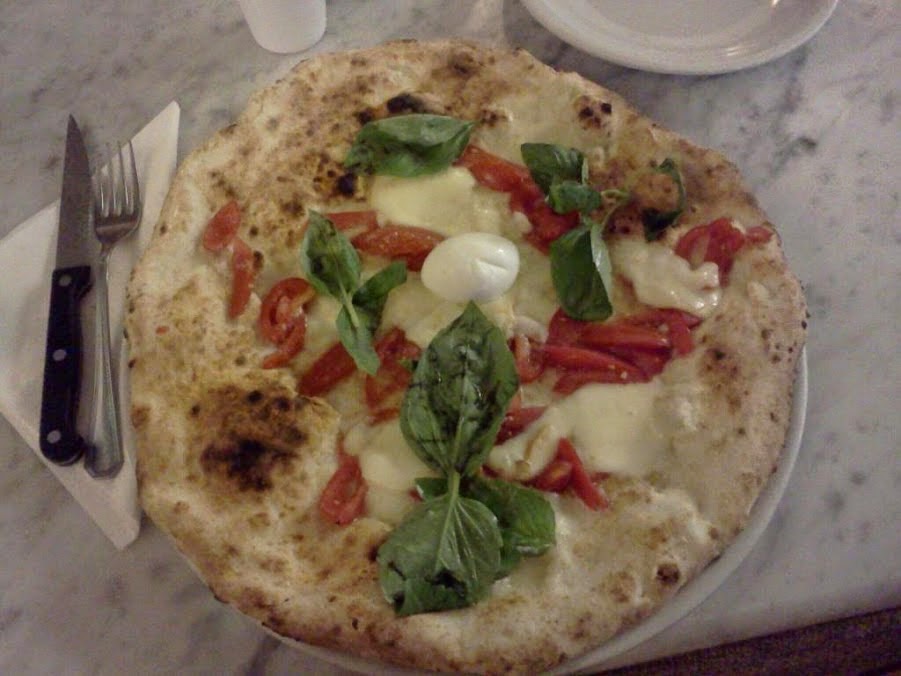
Neapolitan pizza, 2017
It opened in 1973 just three years after the Isola Bella and we were there pretty much from the beginning, and carried on going throughout the 1970s.

Since then I have eaten pizza in Naples, tried the Metre Pizza, sampled Bob Amato’s special from his wood burning oven in the garden, and regularly bought slices from the Chinese takeaway in Varese.*

But it was at the Bella Napoli that I had my first pizza.

Back then it tended always to be the quattro stagioni, accompanied by a glass of wine and followed by chocolate ice cream.

I can’t remember how we came across, it probably on one of our wanders around town, and it was our place, which we shared with family and friends but remained “our place.”

It was situated on the corner of Kennedy Street and Clarence Street, you entered by a small door beside which was that illuminated glass window made up of the bottoms of wine bottles.

You went down a flight of stairs where there were a dozen tables with red table tablecloths, and a bar with I think the oven beyond that.

At the back was the entrance to the lavatories which were shared with the Isola Bella and above you there were a set of large pipes which I always assumed were to do with the ventilation.

The other end of Kennedy Street, 2017
The menu came on a large piece of white card with a picture of Vesuvius and list of half a dozen pizzas.

It was simple, cheap and friendly.

Once when I was with a works colleague who was a linguist and attempting to show off his Italian he spent a full five minutes conversing with the waiter in Italian only to discover the waiter was Spanish.

Such are the silly moments that stick in your memory and despite these and many other memories I have no pictures of either the outside or the interior.

But someone will, and in the fullness of time I hope will share them.

And it was while I was browsing the net for pictures that I came across an article from the Manchester Evening News recording the death of the owner of the Bella Napoli.

And from the Pizzeria I Decumani****
This was Evandro Barbieri who arrived in Manchester from Milan in 1958 aged 21.  He began work as a waiter in the Midland Hotel and in 1970 opened the Isola Bella, followed by a series of other Italian restaurants.**

If I look hard enough I will I suppose find out when it closed but that won’t do anything for my memories, so I don’t think I will bother.

Instead I shall think also of the cannelloni which in those red and cream ceramic dishes,and which if you weren't careful was so hot it burned your mouth.

Later long after the Bella Napoli had gone we would take each of the older kids for a special birthday meal at an Italian restaurant, each had their own favourite.

For Ben it was the Isola Bella, for Josh Bella Italia and for Saul that one on the corner of Deansgate and Blackfriars Street.

It's pity they couldn't have shared Bella Napoli.

Location; Manchester

Picture; Naples in 2017 from the collection of Saul Simpson, Kennedy Street, 2017 courtesy of Andy Robertson and a pizza from the Pizzeria I Decumani


*Pizza, https://chorltonhistory.blogspot.co.uk/search/label/Pizza

**Tributes to Italian pioneer 'who brought pizza to Manchester', Todd Fitzgerald, December 14 2012, updated January 24 2013, http://www.manchestereveningnews.co.uk/news/greater-manchester-news/tributes-to-italian-pioneer-who-brought-698919

****Pizzeria I Decumani, Via dei Tribunali, 58 80138 Napoli Italy‎ +39 081 557 1309

Home Thoughts of Woolwich ....... no. 1 ….. the badge

Sometimes it is as simple as a badge, which after 40 years brings back a bit of history.


Having left Well Hall in 1969 for Manchester, I only visited the Tramshed on brief visits home, but it was a popular place for our Elizabeth.

Location; Woolwich

Picture; the badge, circa 1970s, from the collection of Andrew Simpson

Remembering Sparks the garage on Chorlton Green

Now here is one of those lessons in how history can pretty much fall off the edge of the counter without any one much noticing.

We are on Chorlton green sometime in the 1970s looking across at Sparks the garage.  Like most people I just took it for granted and was not even aware that once this had been one of our farm houses.

And somehow despite passing through the green all the time I failed to clock that Sparks had shut up shop, and what had once been the garage offices had been returned to residential use or that where once mechanics had toiled over leaky engines, broken exhausts and crunched side panels there were now flats and houses.

So for anyone who never knew or worse still had forgotten here is a picture of the garage.

Location; Chorlton-cum-Hardy, Manchester

Picture; Chorlton Green circa 1975 from the collection of Tony Walker

Thursday, 25 September 2025

A History of England in 25 Poems ...... on the wireless today

The idea of using the writings of authors, playwrights  and poets to help describe the history of a country is not new, but I am enjoying Radio 4's  Book of the Week with Catherine Clarke's A History of England in 25 Poems " to explore the ways in which poetry has shaped English identity".*

The first three poems were broadcast this week and the fourth is due today.

And that really is it, other than to quote the sleeve notes from the book which tells me that  "This is the history of England told in a new way: glimpsed through twenty-five remarkable poems written down between the eighth century and today, which connect us directly with the nation’s past, and the experiences, emotions and imaginations of those who lived it.

These poems open windows onto wildly different worlds – from the public to the intimate, from the witty to the savage, from the playful to the wistful.

They take us onto battlefields, inside royal courts, down coal mines and below stairs in great houses. Their creators, witnesses to events from the Great Fire of London to the Miners’ Strike, range from the famous to the forgotten, yet each invites us into an immersive encounter with their own time".*

And my copy is on order from Chorlton Bookshop, which having ordered yesterday I am told should be with me today or tomorrow.

*A History of England in 25 Poems by Catherine Clarke, BBC Radio 4, https://www.bbc.co.uk/programmes/m002jspr

**A History of England in 25 Poems, by Catherine Clarke, Penguin Books, £20

Stepping out in the Woolwich foot tunnel in 1916

I can’t say I enjoy using the foot tunnels under the Thames.

There would have been a time when walking under the river using the Woolwich or Greenwich tunnel was an adventure.

But then I was only 10 and like the Underground these days if there is a surface alternative I will take it.

It may mean using a bus on a congested road in the rush hour but I prefer it.

Looking back I am surprised I was so nonchalant at the illuminated sign at Rotherhithe warning of “MEN WORKING ON THE PUMPS” and thinking what that meant for the short journey to Wapping.

And the same unease resurfaced when I read that the refurbishment of both the Woolwich and Greenwich tunnels included work to reduce leakage, improve drainage as well as installing new lifts, CCTV communication facilities and signage.

Of course the tunnels are quite safe but at 67 I shall continue to use the ferry or take the longer route and cross by bridge up river.

That said this 1916 image of the Woolwich foot tunnel from the collection of Kristine Bedford perfectly captures how I remember the place.

The tunnel was “built by Walter Scott and Middleton, opened on 26 October 1912 [and offered] a free 24/7 alternative to the ferry crossing, which was periodically suspended during bad weather.”*

Now whenever I used it I was pretty much on my own and that long walk with the echoing sound of my own feet, the light and the stone pavement stretching out for nearly a third of a mile was always an experience.

Added to which there was that slow incline down and the then the slight rise which indicated that the journey was nearing its end.

Once upon a time just before six in the morning and at the end of the day it would have been a much busier place, particularly when the ferry was not running, but this empty scene is how I remember it and given my disinclination to wander underground it will remain a memory.

Picture; Woolwich Foot Tunnel circa 1916, courtesy of Kristina Bedford

*Woolwich Through Time, Kristina Bedford, 2014, Amberley Publishing,

When East Manchester became Eastlands


Now there will be those who accuse me today of just taking a few pictures of east Manchester and coming up with some not very subtle sentences to connect them together.  

And that is not so far off the mark.  Yesterday I was reflecting on the changes that overtook the area in just over a decade and half and today I want to continue the theme.

We washed up on Butterworth Street in the January of 1973 and I suppose made a little bit of history.  We and the other five couples were all students or husband and wives of students who attended Manchester Polytechnic which had taken over six flats in the complex that had once housed the Mill Street Police Station, Fire Station and Ambulance Station.  Only the police remained and the six flats which had once been home to the families of fire fighters were now the first residential accommodation run by Manchester Poly.  So in a sense we were making history, while all around us something of a bigger bit of history was unfolding.

East Manchester was one of the centres of industrial production.  Here was the colliery, gasworks, chemical plants, and iron and steel foundaries bounded by the canal and railway lines, and because all these places of enterprise needed a work force here too were the rows of terraced houses, corner shops and pubs.

We arrived just as the area was changing.  Bradford Colliery had closed in 1968 and at the same time many of the old terraced houses were being cleared to make way for the large block of flats close to Grey Mare Lane.

Gazing out across the market at the decks of flats at night was I have to say an impressive sight and reminded me of ocean liners out at sea.  But Fort Beswick had a much shorter life than the terraced houses it had replaced and came down just twenty or so years after they had gone up.  Even at the time they presented a grim appearance in daylight and the idea that families with very young children would be comfortable or safe on the top decks of the block now seems a little absurd.

But there were still plenty of the old traditional houses around and what contributed to their demise was the swift deindustrialization of the area.  In 1951 72% of Britain’s working population was engaged in manual labour* and here in east Manchester they had their pick of places to work.

Just up the New Road was Clayton Aniline, with its tall chimney which belched out different coloured gasses at different times and turned the sky different shades.  Then there were the wireless works up by Philips Park, the canal, the railway lines and countless small lock workshops along with the gas works and the big engineering factories down through Openshaw and into Gorton.

Despite the closure of the colliery in 1968 there was much still working when we arrived five years later. But just a decade and a bit after that much of it had gone. The area was renamed Eastlands and ambitious plans were drawn up to make it the centre of our bid for the 1996 and 2000 summer Olympic Games.  Neither submissions were successful but it was where Manchester hosted the 2002 Commonwealth Games with its exciting new stadium on the site of the old Bradford Colliery.

In a rather odd twist of coincidence my eldest son found work during the Commonwealth Games at the stadium which had been built almost on the spot where just thirty years earlier I had lived.  Nor was this all, for his journey to work along the Ashton Old Road took him close to where I had worked.

I went looking for both sites recently.  The scaffolding yard on Pottery Lane is an open space, and Butterworth Street and our block of flats is just hardcore under Alan Turing Way.  Although I did find a tiny stretch of the road that ran between Mill Street and Butterworth Street along the side of our block, not a blue plaque I grant you but all that is left of when we were there, and of course in a bigger way a little bit of what was there when Eastlands was East Manchester and there were factories, and foundries and much else that was industrial.

Pictures; Courtesy of Manchester Libraries, Information and Archives, Manchester City Council, Butterworth Street, Luft M 1991, m55776, Grey Mare Lane, 1962 Hotchin, F, m15440, Grey Mare Lane, Hotchin, F, m15450, Grey Mare Lane flats, Milligan, H, 1971, m12519, http://images.manchester.gov.uk/index.php?session=pass

Wednesday, 24 September 2025

Faces from a Library …..Chorlton stories across a century

I bet few people look up at the guardians on their columns at the entrance to Chorlton Library.


Afterall they are high and a century and bit of Manchester weather has done much to erode some of their features.

But there they are, and yesterday I wondered just who they were.*

The practice of Medieval craftsmen working on the great cathedrals of Europe often chose fellow work mates as models offering up all manner of comic and rude depictions of what they might do on top of their columns.

And that led me to ponder were ours modelled on real people, perhaps even Chorlton residents or just stock faces turned out almost on a conveyor belt by a craftsmen mile away and just imported in.

At present I don’t know, and yesterday I wasn’t even sure if we were dealing with just a couple of faces repeated around the columns, and being totally honest assumed there were but three which might be six.

But then Sally at the library did what I should have done on Sunday and carefully studied all of them, which revealed that there are four per column, and all the faces are different, which led me to revisit the library and capture them all.


And I am glad I did.

I may be no closer to knowing who they were but at least I know them better.


Silly history but like so much of what engages me about the past they have slid out of the shadows, and that is good enough for me.

Location; Chorlton Library

Pictures; Faces from a Library, 2025, from the collection of Andrew Simpson

*So……. who were the Chorlton Six?, https://chorltonhistory.blogspot.com/search?updated-max=2025-09-23T03:00:00%2B01:00&max-results=7

Looking for a glimpse of the 1970s from Piccadilly Railway Station ...... a SELNEC bus, some vanished buildings and a slice of Black Forest gateau ......... nostalgia doesn’t get any better

Now if you are of a certain age this will be a pretty familiar scene.

It is one I saw countless times as I walked down from the station towards Piccadilly Gardens.

At first glance it isn’t that different from today but the old bus in its SELNEC livery and the buildings in the far distance behind the Joshua Hoyle warehouse on the left place us sometime in the 1970s.

And if that wasn’t enough the message on the back firms up the date because it is a request to John Dees at Piccadilly Radio to play a song by John Holt who was a reggae singer from Jamaica.

What I especially like about the photograph is that it is a picture of Manchester which I can instantly relate to.

Unlike all those old faded black and white and sepia images from the beginning of the 20th century this is from my time.

If pushed I could tell you where I had been and where I was going while walking down the station approach and who I was with and even where I was living.

Of course for many looking at it today it is as remote as those old photographs from 1900.

And even for me it is a full forty and something years ago which just about sets a shiver going through me and makes me think of just how things have changed in four decades.

Back them the height of sophistication was the cassette tape, which played discreetly while entertaining friends to a meal which started with prawn cocktails, finished with Black Forest gateau and was accompanied by a bottle of Blue Nun.

The debate on the Picc-Vic underground connection rumbled on, and no one had yet got round to putting some rickety chairs on a street corner, serving up some tapas and over expensive wine and calling it cafe society.

Location; Manchester

Picture; Approach from Piccadilly Railway Station, circa 1970s, from the collection of David Harrop 

Sunday night in the Lloyds ............ memories of the 1970s

Standing outside the pub in 1979
The first in a short series which looks at what Chorlton was like in the recent past.

Today Lorna remembers the Lloyds Hotel in the 1970s.

Back then the pub still retained its small more intimate set of rooms where if you wanted you could have one of those quiet evenings almost to yourselves with just the regular visit from the waiter who could be summoned from the bar by the push button on the wall.

Those of us who went in there will also remember the staircase which gave access to the upstairs and it was there on Sunday nights that Lorna remembers in this piece she wrote for the blog.

"I remember the Lloyds in the early 1970's when Bill Caroll was the landlord and ruled the pub with a "rod of iron". 


Sunday night upstairs in the top room was very popular and people went in early to make sure they got the best seats in order to listen to the variety of live singers (no karaoke then) who turned up voluntarily each week. 

Highlight of the night was waiting to see who would be 'top of the bill'. 

It was usually Bill, who was an ex policeman, or Jimmy Gale, who were both very good singers. 

Little Jimmy would get everyone in the swing by singing Mardi Gras where all would join in with great gusto. 

Good memories.

I should add that Sunday night always finished with the same two songs where everyone linked arms and sang together. First 'Strolling' followed by 'I'll See You In My Dreams'"

It would be nice to hear other stories about the Lloyds. I am trying to remember the name of the piano player. A Mr Quinn from Keppel Road used to step in now and again, but he was not the regular . Mr Quinn was piano player in the Royal Oak

Lorna has promised to go looking for pictures and they are important because all too often it is photographs of the inside of pubs which seldom survive.

And in the meantime perhaps it will spark off other memories we can share.

Location; Chorlton-cum-Hardy

Sunday in the Lloyds by Lorna Davies, 2015

Picture; the Lloyds Hotel, 1979, from the collection of Tony Walker

Stories of the Great War from Eltham and Woolwich ............. nu 4 a fitting memorial

How we chose to remember the Great War was varied.

Some families erected their own memorial plaques in the local church, or parish graveyard subscribed to collective tablet or fashioned their own very personal tribute.

Private Shepherd
The one for young John Edmund Shepherd who died on May 30 1915 aged 19 during the Gallipoli Campaign is made of paper on card and measures 37.5 cms by 24.5 cms.

It carries the flags of the six allied nations either side of an oval insert which contains his picture and has the simple inscription “Duty Called, Duty Done, He Died a Noble Death.”

During 1919 discussions on the form of memorials that should be adopted by the churches led to “a crucifix at the ‘Church in the Square’ for all visitors to the Market to see, a Cross of Sacrifice at Eltham Parish Church, another crucifix at Holy Trinity, Southend Crescent with the Gallipoli Memorial inside the church and at Christ Church, Shooters Hill combined with a cross, that unique milestone.”*

The milestone had originally been erected by the New Cross Turnpike Trust and was adapted to carry a powerful memorial.**

The Shooters Hill Milestone
But for some a more fitting mark of remembrance would be the creation of a new hospital to replace the small cottage hospital which stood close to the Red Lion on Shooters Hill.

It had been opened in 1890 and like the one in Eltham had dome sterling service.

There had been plans for a new hospital in 1912 but these were postponed during the war.  But with the end of the conflict preparations began again and in an age before the NHS much of the cost would be met by subscriptions and fund raising.

In 1920 the Building Committee having visited a number of hospitals accepted plans for a design which would be completed in three stages staring with accommodation for one hundred and twelve beds and admin block and ancilliary buildings.

The ground was broken in February 1923, two years later the foundation stone was laid and in 1927 the hospital was opened under the title,

The Woolwich and District Memorial Hospital with the first patients being received in March 1928.

"In 1948 it joined the NHS as a general hospital.

In 1953 a new Out-Patients Department was opened by Princess Marina, Duchess of Kent, who was Patron of the Hospital.  The X-ray Department was completely refurbished in 1955, with two new X-ray sets installed.


The memorial at Eltham
Although originally dealing with general cases, by 1965 the Hospital began to specialise in surgery.   It had a Casualty Department, but it was felt that its facilities were too limited to deal with the increasing number of road traffic accidents in the area.  
In 1969 the Department closed when the new Accident Centre opened at the nearby Brook General Hospital.  The acute wards were transferred to the Brook General Hospital and St Nicholas' Hospital in Plumstead.

In the 1970s  the Memorial Hospital became a geriatric hospital, with 128 long-stay beds.  A Day Hospital was built in 1975." 

Since at least 2005, it has been run by the Oxleas NHS Foundation Trust and mainly functions as a day centre for the elderly while also offering facilities for psychiatric patients.

Pictures; the Shepherd memorial courtesy of David Harrop, and the Shooters Hill memorial stone and Eltham memorial from the collection of Ryan Ginn

*The Woolwich Story E.F.E. Jefferson, 1968


Tuesday, 23 September 2025

When you never quite lose that love of the River

Now I miss the river, which given that I never lived that far away from it is not surprising. 

In the park, 1907
Like many I saw its transformation from working waterway to a river bordered by new developments that seemed to reach to the sky.

I don’t have a rosy nostalgic view of the Thames.  For those who worked on and lived by it, the river was a hard and at times capricious companion.

But sitting on the concrete wall across the road from the Cutty Sark pub on a warm summer’s evening was magic.

As dusk turned to night the conversations around us were interrupted by the occasional banging together of the moored barges caught in the wake of a passing pleasure craft.

And over the water you could just catch the noise of a party going on with snatches of music which were lost as the vessel disappeared into the dark.

Looking out across the river, 1907
Even now that smell of ozone takes me right back to games on the beech outside the Tower of London in the shadow of Tower Bridge and that stretch of sand in front of the Naval College.

These combine with more grown up ones of sitting watching the traffic in the dinner hour during the time I worked for Glenvilles Food near the tunnel.

Leaving me only to remember the moment, me, Jimmy O’Donnell and John Cox sank in the oozy, oily Thames mud, just beyond the steps that led down from the foot tunnel at Greenwich.

It was sometime around 1959 and we had the long walk home and the thought of the difficult set of explanations needed to cover the ruined shoes and socks.  To my eternal shame I blamed the other two, something which got me off the hook but which the passage of time has never let me apologise for.

So that just leaves me to comment on the picture dated 1907.  We are in the gardens by the river on the noth side.

Location; the River Thames

Picture; the Embankment, North Woolwich Gardens, circa 1907 courtesy of Kritina Bedford from her book Woolwich Through Time, 2014

One stone statue ........ late of Park Brow Farm and the Assize Courts ............ looking for a new home

Now I have a soft spot for this chap.

He once resided in the garden of Park Brow Farm down on St Werburgh’s Road but originally had sat high up on the old Assize Courts in Manchester.

How it got from one to the other involved one of Mr Hitler’s bombs which did for the courts and led eventually from  a stone mason’s yard to the farm.

He wasn’t a small thing and I have every bit of respect for the men who got him from the ground up to the top of the courts and equally to Oliver Bailey who along with his dad and brother wrestled with the object in the garden of the farm.

Oliver remembers that “when we off loaded the beastie using the front loader on an old grey Ferguson tractor, despite having a one ton counterweight on the back we had to sit people on it to keep the back wheels on the ground but fortunately it was only a short distance.”

By the time it had arrived in Chorlton it had lost two small horns “where the lighter patches are on its head but they were broken off, possibly during removal so there were two small square plugs to show where they had been.”

And then with the sale of the farm in the 1980s the statue was on off on another adventure.

All of which may seem trivial stuff but I think not.  Its journey from the grand law courts to a garden is fascinating in itself and points to that simple observation that there are stories everywhere and in this case part of the fun has been tracking down the history.

I grant you it doesn’t involve some great event of a deep State secret but it offers up a close up of mid 19th century public sculpture mixed with the dram of the Blitz and that wonderful almost eccentric wish of the part of someone to preserve it.

All of which just leaves me to reveal where it went next.

But like all good detective stories that will have to wait.

Location the Assize Courts, Park Brow Farm and another place

Picture; stone statue, circa 1980s,  from the collection of Tony Walker

Miss Olga Hertz another story from Tony Goulding

Last month Andrew Simpson posted a story of the work of this remarkable woman which prompted me to research her background.

Olga Hertz was born in Glasgow on 19th November 1851 the fourth of the four daughters of Theodor Hertz and his wife Mary Amelia (née Steinthal).   Her father was a wealthy iron merchant (1) who was born in Hamburg, Germany; her mother was born in Eccles, Lancashire in 1825, the daughter of German immigrants Ludwig and Ernestine Steinthal. By the mid-1840s the Steinthals had returned to Germany as it was in Hamburg, Germany that Olga’s parents married on 4th March 1846.

Theodor Hertz died in Glasgow on 15th May 1872. Following her bereavement his widow, Mary Amelia returned to her home city of Manchester, with her three unmarried daughters. (2)  In the first instance they lived next door to her brother Henry Michael Steinthal at Oak Mount, Oak Drive, Fallowfield in a property owned by Sir Joseph Whitworth, the fabulously wealthy engineer and philanthropist. In November 1886 the family moved to 49, Palatine Road, Withington, Manchester and this was to remain Olga’s home for the next 60 years. She was still living at this address when she died on 27th December 1946. Her estate was valued for probate at £62,956 -12s- 8d. (the equivalent today would be £2,142,439).

Due to her family’s extreme wealth Olga never had to seek paid employment, however she did work tirelessly on several public bodies. The Manchester Rate books of the mid 1880s record her as the secretary of the Ardwick and Ancoats District Nurses Home on Ardwick Green, Manchester. It was, however, her work as a Poor Law Guardian for the Chorlton Union detailed in Andrew’s piece for which she is best remembered. As part of this work Olga set sail from Liverpool on 3rd June 1909 aboard the Laurentic bound for Montreal, Quebec, Canada to check on the welfare of some of the children sent there by the Chorlton Union as part of the British Home Children scheme. Olga’s feminism was manifested in the demands that women should take full part in public bodies. In this capacity she often shared a platform with Margaret Ashton the first woman to be elected as a councillor for Manchester City Council. The two women likely became friends; the1921 census return further suggests this was the case as it shows Olga as a visitor at Margaret Ashton’s residence, Church Aston Manor, Newport, Shropshire.

  Two of Olga’s maternal uncles remained in England and became prominent Manchester citizens. The already referred to Henry Michael Steinthal was a textile and general merchant with interests in Bradford and Manchester and a director of The Manchester Fire Assurance Company.  He was variously in business partnerships with his brother-in-law Theodor Hertz and both his son Edgar Frederick and his son-in-law Frederick Francis Benjamin Zimmern. In his retirement he moved to Scarborough, Yorkshire where for a time he had a “tile and floor cloth” manufacturing business. He died at Myra Lodge, Alexandra Park, Scarborough on 3rd January 1905.

Henry Michael was also active in public life serving on a variety of civic bodies; he was a "visitor" to the Manchester Royal Infirmary, a member of the Royal Manchester Institution the precursor of the city's Art Gallery and one of the three joint treasurers of Indian Mutiny Relief Fund.

The “Hollies” as a convent school. 1959

His home, “The Hollies”, Oak Drive, Fallowfield, Manchester later became a Catholic Convent School also called “The Hollies”

 The second uncle was Rev. Samuel Alfred Steinthal who as a Unitarian minister was for a time assistant to Rev. William Gaskell (Elizabeth Gaskell’s husband) at the Cross Street Unitarian Chapel, Manchest

The original Cross Street Chapel circa 1835
At the elections for Manchester City Council in October 1908 which saw Margaret Ashton returned for the Withington ward Rev. Steinthal was the seconder of her nomination.

Pictures: - The Hollies 1959 (m65697) from Manchester Libraries, Information, and Archives, Manchester City Council. https://creativecommons.org/licenses/by-nc-sa/4.0/ Cross Street Chapel circa 1835 from Wikipedia in the public domain.

Notes: -

1) The family’s wealth is indicated by their entry in the 1861 census showing they employed 6 servants.

2) Olga’s three older sisters were, Louisa Elizabeth, who married in Scotland prior to the family’s move to Manchester, Alice Ernestina, and Amelia Theresa.

Like Olga neither of the last two ever married.