Thursday, 3 September 2026

What did the Norman’s Ever do for Us? ….. all day on the wireless today

Well, they were either a marauding band of super gangsters who stole a country, or just another group who crossed the seas to come settle and make a contribution.

Of course, like all the other collections of people from the Neolithic through to 1066 they left their mark in a heap of ways.

And that is what BBC Radio 4 is going to explore today.

It’s already started with segments on the Today Programme and will march on across the day with a few repeats tonight.

The background to all this is the arrival of the Bayeux Tapestry to the British Museum and the official opening of the exhibition to the public.

The great, the good and others have already had sneak previews, and yesterday the King and Queen, the French President and our Prime Minister were invited to gaze on that famous tapestry which is in fact an embroidery not a tapestry. 

It came home in July and had a resting period but is now ready to be seen.is coming home.


I remain ambivalent at the event but that was for another blog and others I wrote back in July.*

So for now thank you BBC Radio 4 for what promises to be a memorable day for anyone who likes their history ….. even if it’s the Normans.

The first up will be What did The Normans Ever Do For Us? BBC Radio 4, when “Historians Dr Eleanor Parker, Professor Levi Roach and Alex Burghart MP, writers Kate Mosse, Muriel Zagha and Jade Cuttle trace how the Normans shaped British history and culture”.**


Followed by a heap of wireless articles.

And all available all day and on BBC Catch up by following the link.

Leaving me just to include from BBC Culture 'Chest-thumping machismo': The Bayeux Tapestry' reveals the bloody, bawdy truth about the Middle Ages.****

Postcards or comments to the blog will be welcomed on that question of were the Normans a marauding band of super gangsters who stole a country, or just another group who crossed the seas to come settle and make a contribution?

Pictures; bits from the Bayeux Tapestry, Ticket site, British Museum site 

** What did The Normans Ever Do For Us? BBC Radio 4, https://www.bbc.co.uk/programmes/m0030zjy

***Norman Day, BBC Radio 4, https://www.bbc.co.uk/schedules/p00fzl7j

**** 'Chest-thumping machismo': The Bayeux Tapestry, BBC Culture, https://www.bbc.co.uk/culture/article/20260820-the-medieval-manosphere-of-the-bayeux-tapestry

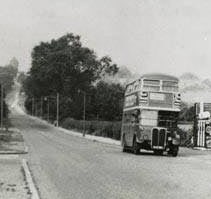
On Shooters Hill ………………… with We Anchor in Hope

Now I have no memory of the pub We Anchor in Hope.

But then when I roamed over the woods and down Shooter’s Hill and on to Welling, I was still well under the age when “dirty beer” was an attraction.

Still I am very pleased that Brian sent this picture over this morning, because it captures perfectly this stretch of the old road as I remember it.

The picture postcard is undated, but I am guessing we will be sometime in the late 1940s into the following decade and a bit.

That said there will be an expert on London buses who will be able to offer up chapter and verse on the date this one plied its route.

As to the pub, here too I am out of my comfort zone and a trawl of my limited London directories has yet to turn up any information.

Still, I am pleased to say it is still there today and is part of the Green King chain which manages many of the pubs I have researched and written about.

There will be those who are sniffy about such chains, advancing ever the cause of the independent brewery or landlord.

Which just leaves me to thank Brian,  appeal for more information, and point out before someone does that We Anchor in Hope is actually at 320 Bellgrove Road, Welling, DA16 3 RW

And to add this is  a fine shot of the old road climbing west.

And quick as a flash, Brian having read the story of his picture postcard, added a link to a bit more background.

But as ever I shall not lift someone else's research and instead just point you to the link.**


Location Welling

Picture; Shooters Hill, Welling, Kent, date unknown, from the collection of Brian Norbury

* We Anchor in Hope,  https://www.greeneking-pubs.co.uk/pubs/kent/we-anchor-in-hope/

**We Anchor in Hope, Belle Grove Road, East Wickham, Welling, https://pubwiki.co.uk/KentPubs/EastWickham/AnchorinHope.shtml

It happened here in Chorlton and also in Didsbury .............. National Baby Week .... July 1917

Just a century ago a crowd assembled on the Rec opposite our house on Beech Road and listened to Mrs Jane Redford, Mr Peach and Miss Place of the Manchester & Salford Day Nurseries speak in support of National Baby Week.

The week long campaign aimed to rouse “a universal determination to prevent the unnecessary wastage of infant life, [focusing on] all the causes which make for the high rate of infant mortality. 

According to statistics 80,000 babies under a year old die every year in the United Kingdom of which 50,000 might have been saved.”*

Now this is all the more remarkable when you consider that we were by that summer in to year three of the Great War.

A war which had already caused thousands of causalities and although the organisers did not know it was about to deliver even more as the British army launched the Third Battle of Ypres, commonly known as Passchendaele which would in its three months result in the deaths of 244,897 British and Commonwealth  soldiers.

The celebration began with processions through Chorlton and Didsbury both led by “a band and numbers of green and white banners.”

The Didsbury procession which was "followed by a meeting addressed by Miss Margaret Ashton and Mr C T Needham M P and others included Red Cross nurses and munition workers."

By contrast the Chorlton march was made up entirely of  “small children with a few mothers and big sisters to look after the babies and large crowds turned out to watch.”

Sadly no photographs have come to light and I have no idea what Mrs Jane Redford or the others said in the Rec on that Saturday afternoon.

But Mrs Redford was an important figure both in Chorlton and the City and her personal papers may still be available.

She had been active for over 30 years serving on various public bodies including the Board of Henshaw’s Blind Asylum and as a Poor Law Guardian for the Chorlton Union where she had campaigned for the provision of trained nurses for workhouse hospitals.

And in 1910 after winning a municipal election here in Chorlton, she became not only our first woman councillor but also the second woman elected to Manchester City Council.

And she spoke on the Rec opposite our house which really was a bit of history which happened here.

Location; Chorlton-cum-Hardy, Manchester

Pictures; the Rec circa 1910 from the Lloyd Collection and Mrs Redford, date unknown courtesy of Lawrence Beedle

*Baby Week Opening of the Campaign in Manchester, Manchester Guardian July 2 1917

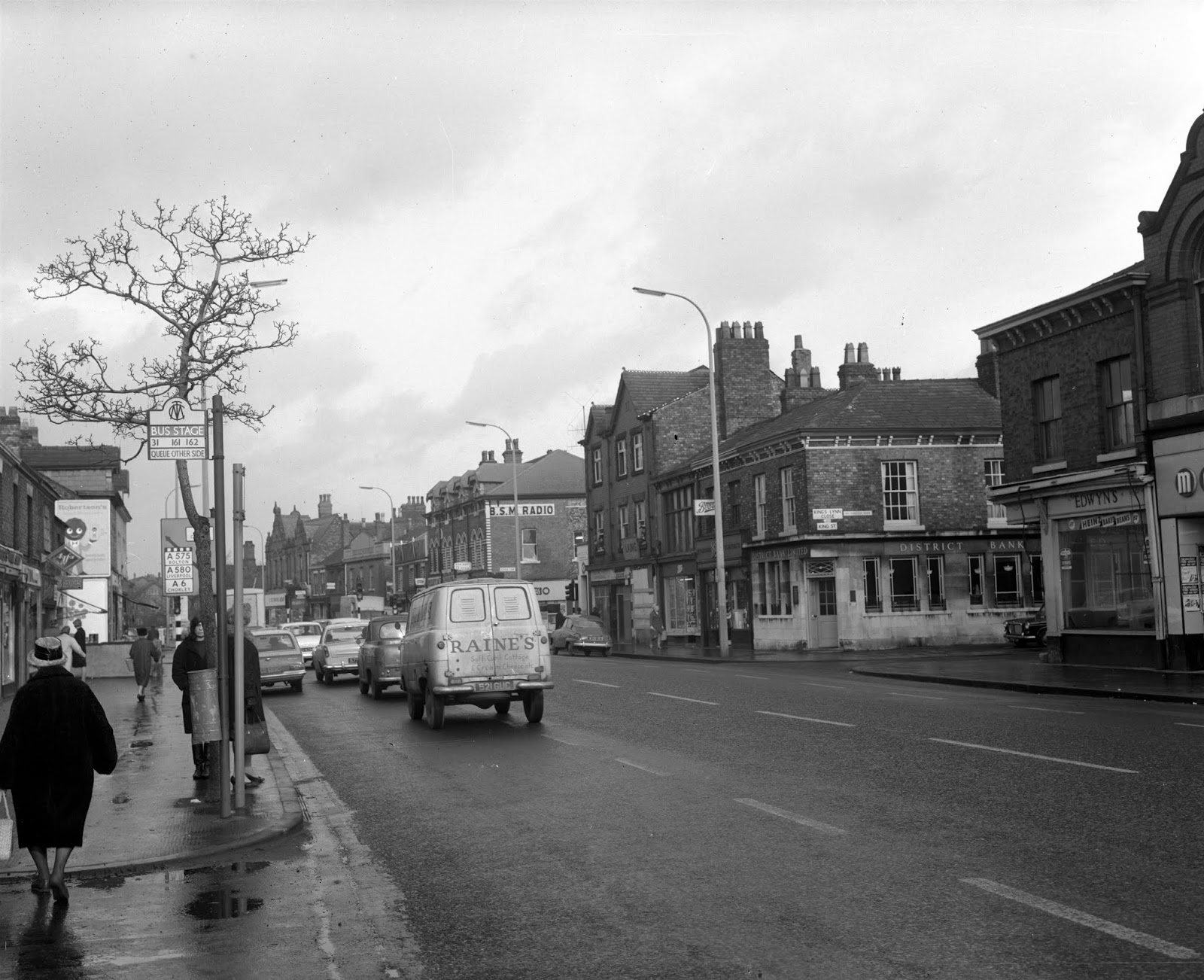
Who moved that bus stop? …………. and other challenges to my memory ….Didsbury …. 1967

It started with a conversation with my friend Barbarella about the lost shops of Didsbury, and in particular, the stretch from M&S to the Santander Bank.

I casually mentioned the photo shop close to the bank and then doubt set in as to whether it had been there back in the 1970s, when I waited for a bus, or indeed if it was still there a few decades later.

Now, I know there is one there today, but thought it might have moved from where I remembered it.
 So as you do I checked out the site on street google and while there is a photo shop, there is no bus stop, and there hangs my dilemma, because for years I stood at that bus stop and would often give up on the bus and go in and buy some film.

These were the decades when I still used smelly film, developing them and printing them at home, along with a sideline in colour slides, which with trial and error led me to prefer Agfar film.

But as so often happens the absence of that bus stop led me to question my memory.

And then  Barbarella restored my memory with “Now it’s opposite the Coop and the next one just passed Saints and Scholars”, which was confirmed almost immediately afterwards when I came across another picture from 1967.


There was the bus stop, and more importantly there was the camera shop, complete with Agfa sign.

I did then go looking at the bus routes on the destination board, which even I thought points to me really needing to get out more, but if you want to give the full flavor of Didsbury in the 1960s, you must dig deep.

That said my guide to bus routes for 1969, shows that none of the three services were running by then, which make me wonder if there was a second bus stop with more services and which of the three went into town, and which headed towards Barlow Moor.

Someone will know, and they may also be prompted to share their memories, sparked perhaps by the picture of Wilmslow Road in 1969.

We shall see.

Location; Didsbury

Picture; Wilmslow Road, 1967, "Courtesy of Manchester Archives+ Town Hall Photographers' Collection", https://www.flickr.com/photos/manchesterarchiveplus/albums/72157684413651581?fbclid=IwAR35NR9v6lzJfkiSsHgHdQyL2CCuQUHuCuVr8xnd403q534MNgY5g1nAZfY

Wednesday, 2 September 2026

Will the real William Frank please step forward ……..

Now for a decade and more I have been hunting for Mr. William Frank who gave his name to two small streets off Great Marlborough Street in Chorlton on Medlock.

Great Marlborough Street, 2019
Once upon a time they consisted of 14 back to back houses but long ago were subsumed in to a finishing works leaving the streets as access points into the building, although at ground level it was still possible to make out the brick arches over the cellar windows and doors.

It was common practice and vanity that builders and property speculators would leave their name for ever in the names of the streets they built.

But for a long time, I couldn’t find William Frank, reposting a story about the area in which they were located.

This was the notorious Little Ireland, which Dr. Kay, Frederick Engels and a heap of other social commentators write about during the first half of the 19th century.

And in response to that story Geoff Ashworth left a comment that “Mr. William Frank, who owned these properties, lived in luxury in Plymouth Grove”, adding that “you also find how much was charged to live in these hovels, and how much they were valued at. Prior to 1860 they also had rented cellars. 1869 rents.”  

Geoff wrote that wonderful book on the rivers of Manchester which is still much sought after.*


Frank Street and William Street, 1844
So armed with this new bit of information and Geoff’s suggestion that I look at the Rate Books, I found Frank Street and William Street. 

In 1836 Mr. Frank owned ten properties, spread out across Frank Street, and William Street.  Those on Frank Street commanded rents of between 2s 5d and 3s 3d.  Now assuming the other properties brought in roughly the same sort of rents he was making well over £60 a year. 

The Rate Books indicate that there were other owners of houses on these streets, and the earliest entry appears to be 1834 which might give us a date for their construction.

As for William Frank his ten properties conferred on him the right to a vote in Parliamentary elections and his name crops up in three Poll Books, from 1836, 1837 and 1840.  

The same books give his address as Baxter Street in Hulme, but also suggest a relative who was a Thomas Frank.  He too had a vote by virtue of owning houses on the same two streets, as well as Spear Street and Oxford Road.  By 1840 Thomas disappears from the Poll Book and Frank appears yo have inherited his properties on Spear Street.

Poll Book for South Lancashire, 1836
Now in my defence a decade ago the Rate Books were not online and a trip to Central Ref to view them on microfilm was a full day’s work. 

So William Frank has come out of the shadows.

But only just.  I have yet to track down Baxter Street, and the one reference I can find lists him in 1851 living as a lodger at 99 Duke Street in Hulme.  He described himself as an “Estate Agent, and a widower who was born in Guisborough in Yorkshire.

Leaving me just to record that it may have been his son Samuel who occupied Plymouth Grove.

Pictures; Little Ireland, 1844, from the OS of Manchester & Salford, 1844, courtesy of Digital Archives Association, http://digitalarchives.co.uk/ extract from the Poll Book for South Lancashire, 1836, and Great Marlborough Street, 2019, from the collection of Andy Robertson

*Ashworth, Geoffrey, The Lost River of Manchester, Willow Publishing, 1987

A shop before its time and a family search abandoned


It was one of those shops which with its quirky concept and interesting objects should have done well on Beech Road.

Take an everyday object past its sell by date and no use to any one and turn it into something different, but I guess it was an idea ahead of the retail trend which now dominates the place.

Now I just assumed that number 19 Beech Road had always had a shop, but not so. Back in 1911 it it was a domestic property the home of Mrs Edith Elizabeth Edwards and her three step sons and Amelia Seel their domestic servant.

I rather think there is a story here which in time with dogged patience I might uncover. Edith was a widow and her husband had died sometime between 1909 and 1911. They were in the house by 1903.

The 1911 census was signed and so I guess filled in by her eldest step son William Pettitt Barrie. And here the mystery begins. The census return declares that Edith had no children.

And yet go back just ten years and there is Edith E Barrie living with her three sons, unmarried sister niece, nephew, a boarder and servant on Stretford Road. She describes herself as a 32 year old widow who was a “Shopkeeper Confectioner Dealer” and her sister as “living on own means.” 

And back another ten and Edith is living with her husband William daughter Elsie and the 36 year old companion Mary A Biggins at 2 Wharf Road, Sale.

It is at this point that you begin to question whether there is something not quite right about crawling over someone’s life and beginning to draw conclusions. And so I won’t.

Perhaps it is enough to draw the more general conclusion that the period was still one where many could die young and be left a widow. Not only did it happen to Edith twice but also to their domestic servant Amelia Seel who at 51 had also lost her husband.

Picture; from the collection of Lawrence Beedle

Back on Pound Place a long time before now

Pound Place was always somewhere I tended to walk past and looking down it now I can’t even remember what stood on the site of the Council Offices.

I have written about  it in the past not least because of its old cottages which once occupied the site and because part of it was the village pound or pinfold which was used to accommodate stray animals and.*

Now a few photographs of Pound Place from the beginning of the 19th century have survived, but today I thought I would feature another of those drawings by Mr Llwyd Roberts who was living in Eltham in the early 1930s.

During his stay here he drew many pictures and some of these appeared in the Kentish Times in 1930 and were reprinted in Old Eltham sixty-six years later.

Picture; Pound Court, Llwyd Roberts, circa 1929-30, from Old Eltham, 1966, courtesy of Margaret Copeland Gain

*Pound Place, http://chorltonhistory.blogspot.co.uk/search/label/Pound%20Place

Tuesday, 1 September 2026

Summer days in south Manchester No 3 the Chorlton Peace Festival 1984

It is an event I have visited before, but it is well worth another outing.*

It was at the height of the second Cold War when there was a growing feeling that the world was a less safe place.

Relationships between the two super powers had entered a more hostile phase. This was only in part due to the election of hard line politicians in the west and the elevation of equally conservative leaders in the Soviet Union but also to events across the world where the USA and USSR were engaged in a new round of support for proxy governments.

What made it all the more dangerous was that a new generation of nuclear weapons and their delivery systems had come on stream just as the Cold War deepened and hardened.

The US cruise missile which was being deployed in Britain and West Germany took just 15 minutes to reach its targets in the USSR while American Pershing missiles and the Russian equivalent took just 4 minutes from launch to detonation over the cities of Europe.

So there we were in the Rec on a hot day listening to music, engaged in some politics but above all just relaxing with friends and family.

And having posted the story someone left a comment who helped organise the event and reminded me that there had been a badge designed for the event, which I have, and decided to update the piece with a picture.

It was a designed by Jim De Santos.

Location; The Rec

Picture; from the collection of Tony Walker, and Andrew Simpson

*Dangerous times and peaceful protestshttps://chorltonhistory.blogspot.com/2019/03/dangerous-times-and-peaceful-protests.html


Eltham from the pen of Llwyd Roberts ....... nu 2 St Mary's School 1929

Now I am a great fan of the work of Mr Llwyd Roberts.

He was during the 1920s and 30s our artist in residence and during that time produced a heap of line drawings of Eltham and the surrounding area.

Some were reproduced from old photographs while others  were as he saw them at the time.

This is St Mary’s School which dates from 1928 in a building which was in its time both an academy  for young gentlemen and before that a private residence.

According to Mr Roberts, this was "the convent chapel and St Mary's Diocesan Orphanage garden are replaced by the pavement in the now widened High Street.  The nun's house on the left has gone.  St Mary's School in its present form was founded in 1928."

And if you want more I suggest you follow the link.*

Picture; Eltham Parish Church; drawn circa 1929, Llwyd Roberts

* St. Mary's (Eltham) Community Complex, http://www.stmarys-eltham.co.uk/history.php

Lost and forgotten streets of Manchester nu 34 ............... the one most people forget

Today Back South Parade is the access and exit route for the big NCP car park and even before the scaffolding went up most people would agree it was a drab and uninviting street.

Back in 1903 it could at least boast a series of business ranging a shipping warehouse and print works to the Turkish Baths which traded under the name of “Herriott’s Turkish Baths Limited for ladies and gentlemen at 10 South Parade, St Mary’s Deansgate” and extended back on to Back South Parade.

This of course being a story from 2016, will acknowledge by now that the scaffolding will have come down. 

I hope.

Location; Manchester

Picture; Back South Parade 2016 from the collection of Andrew Simpson