Showing posts with label Burton Road. Show all posts

Thursday, 8 January 2026

One bedsit …. the lost tennis courts …… and those dream homes …..

Number One Malvern Grove is an unimposing house on the corner of Burton Road in West Didsbury.

1 Malvern Grove, house and garden 2022
And it was where I lived for six months in my student days in 1970.

I say unimposing but once it was the smart home of Mr and Mrs Simpson, their two children and Katherine Williams who was 23, from Everton and was employed as a “general servant”.

I know the property was there by 1896 and with a bit of digging should be able establish when it was built and perhaps date the rest of the homes on this small cul-de-sac.

And with a bit more diligence it will be possible to list most of the households from when it was built through to 1911 when the Simpson’s were there and on to when it became a series of bedsits.

It had ten rooms and two cellars, and I occupied one of the back down stairs rooms which might have once been the kitchen. It was a small room furnished as I remember with a bed, a table, two chairs an electric ring and one of those water heaters which held a pint and bit of water and ate electricity.

That ground floor rear room, 2022
Like all crummy bedsits I have lived in it was basic, cold, with walls covered in woodchip and painted in multiple coats of emulsion.   All very cheap and not very cheerful.

Added to which there was that lingering smell of 10 different evening meals permeating the place and the bone cold hall.

And here I stayed for just six months, at a time when I could have been very lonely were it not for some of the other residents who took me under their wing.  

They made sure that most nights I accompanied them across the road to the Old House at Home and took pity on a student ensuring that only occasionally was I allowed to buy a round.

At the time I never thought about the house or its history, instead I was captivated by the two 1960s “dream houses” just two doors away along the Grove.  They resembled exactly properties which had featured on the back of Kellog’s Corn Flakes boxes and had been part of an advertising competition which offered up the prospect of winning one of these “dream houses”.

On cold winter nights with all their house lights on they looked inviting and comfy with the promise of warm evenings in front of a television in the company of a happy noisy family.

Albemarle Lawn Tennis Court, 1958

Over the years I have gone back, and the ghosts are still there from the lad who lived in the cellar, his mate “Strain Chocker” and the policewoman who lived upstairs.  They  mix with the memory that most Saturday night’s the population of the house doubled.

What I didn’t know was that just a few yards down what had been an unmade road was the Albemarle Lawn Tennis Court. It shows up on the 1958 OS, had two courts, a club house and an adjacent building.  The courts were accessed from Abberton Road, and the path is still there although it has been incorporated into the side garden of one of the houses.

Student days, Chatham Grove, 1970, Mike, John, and Lois
They may still have been there in 1970 I just never went to look, but now are a bit of new build called Stow Gardens, and my dream houses have gone.

All of which could have burst my bubble.  But then it is over half a century since I called Malvern Grove my home and along with the tennis courts the pub is no more and as is the house on Chatham Grove where a friend spent a time and we celebrated his birthday, with cake and tuna and sweetcorn salad.

The afternoon was memorable if only because at the age of 19 I had never had either tuna or sweet corn.

And of course back then I had no idea that the family who I shared the house with me were also called Simpson.  Not that I see any significance in that .... long ago I realised just how many Simpson's I occupy the planet with.

So that is it.

Except to say there must be people who remember the tennis courts, like me spent happy nights in the Old House, and who knows may also have lived in 1 Malvern Grove and perhaps even knew "Strain Chocker"

We shall see.

Location; Burton Road

Pictures Malvern Grove, 2022, courtesy of Google Maps, Albemarle Lawn Tennis Court, 1958, OS map of Manchester & Salford, 1958, and Mike John & Lois, Student days, Chatham Grove, 1970 from the collection of Lois Elsden

Tuesday, 15 April 2025

All you might ever want to know about Withington Baths …. and more

It’s perhaps a bold statement by me but having just read the draft of “The story of an Edwardian public swimming baths in south Manchester”, by David Rydeheard I think it’s justified.

The varied roof-scape of Withington Baths
So, to use a line from an old advert “its got the lot” with chapters covering its history from 1904 to its proposed closure in 2013, the campaign to save it  and its renewal under the stewardship of “Love Withington Baths”, which has a dual status as a private limited company and a charity.

There is a fascinating chapter on its engineering history and another by Simon Green on the restoration of the building, as well as a section which describes other swimming baths in the area and has an extensive set of references.

But for me as a social historian I was drawn to the chapter on the place of the baths in Withington community which includes the memories of people who used the place, as well as period newspaper reports and photographs with pictures of the restored bits from tiles to windows and the original 1910 design plans.

The chimney of the Baths, 2025

David tells me that the book “will be going to the printers this coming week, and will then be available for purchase, online at Withington Civic Society (contact@withingtoncivicsociety.org.uk) or at our outlets, including Withington Library.

Withington Walls, Details from a mural by Skeg, at the rear of the Baths
So, that is it.  

Looking forward to its publication and the offical launch of the book which will be  at the 10th birthday party of the new Baths managmement, over the weekend of the 14th-15th June.


Location; Withington Swimming Baths

Pictures; from the collection of David Rydeheard

Wednesday, 9 June 2021

Adventures on Burton Road and beyond ………..the silly story

As adventures go it was all pretty mundane and over in less than an hour.

Adventures by tram, 2021

But for someone who has not ventured into Didsbury from Chorlton for a long time it was a bit of a change.

I could blame the virus, but that really was only an issue until I had had the two vaccinations, and then it was just sheer laziness.

So with an appointment at the drop in centre out of the way, it was the slow meandering walk up Burton Road towards the metro stop.

The sun was promising to crack the paving stones, a few couples were already sampling coffee, and others seemed to be about to join them having done the morning school run. 

A shopping experience, 2021

But most of the shops were closed, leaving me to gaze at their displays and yet again ponder on Burton Road’s transformation from small ordinary street full of traditional shops to that mix of cafes, restaurants and “interesting retail experiences”.

In the 1970s I remember that the cutting edge of cosmopolitan dinning was the Canadian Charcoal Pit, which after a night in the Old House at Home was where you ended up.

And because I lived on the corner of Burton Road and Malvern Grove the burger or “dog”, wrapped in its tinfoil would still be warm when I got home.  

If I am honest it was the corn relish and the tomato variant which made the meal.

There may have been other restaurants and takeaways in 1970, but I don’t remember them, and within a year I had moved on, although not before I returned to the house in the September of the following year, and with nowhere to live, slept in the cellar on a settee for a few nights.

And then it must have been a full decade and a bit before I was back on Burton Road which had undergone that retail change, which was fine if you wanted Victorian antique lace, or an Art Nouveau lampshade, but not if you were after a lb. of potatoes, four old fashioned screws and a gallon of paraffin.

The shop with the lot, 2021

I might be wrong,  and the transformation may have been later, but I am confident someone will correct me.

Leaving me just to reflect that the stretch of Wilmslow Road, from Barlow Moor Road down past the old Police Station, has retained more of those old traditional retail businesses, although like so many high streets it has its fair share of charity shops, which seem more upmarket than those you might find in other parts of the city.

Location; Didsbury

Pictures; Burton Road, Burton Road Metro stop and Wilmslow Road, 2021, from the collection of Andrew Simpson


Monday, 1 June 2020

In the Orion on Burton Road ....... with memories of Mr. Norbury, the Crimean War and that last goal

Now you might be forgiven for wondering why our new book on the pubs and bars of Didsbury should have a chapter on Withington but it does.

And I am quite happy to say that we have included the four which will still serve you a pint, a packet of scratchings and a warm welcome, along with another four which exist only in the memories of some pub goers.

Of the four which still do the business, I could have chosen the Red Lion, but that would be to do what everyone would do, so instead I have chosen the Orion.

It is one of those pubs, and I say this in a nice way, where time has pretty much left it alone.

So, while there may be the requisite television screens and a range of bright tiles along the side of the bar it is still, a “down-to-earth, no-nonsense drinking shop”. *

On our last visit, which just happened to be a Thursday afternoon, the place was full of men of a certain age, most of whom were already past their 21st birthday when England won the World Cup back in 1966.

Their preferred drink was Holt’s Best Bitter, and the talk turned on the favourite to win at Doncaster the following day, and in what round had Henry Cooper felled Muhammad Ali in their 1963 fight.

And I don’t doubt that these bar room conversations wouldn’t have changed over much in the 150 years since the Orion had been opened by John Hamnet Norbury, who built two houses on a plot he had bought in 1867.

One of these he converted into a beer shop, installing his parents as the proprietors who worked the beer shop alongside a grocery business, and he settled into the other.

According to one source Mr. Norbury sold the beer shop on to the brewer Broadbent in 1875. **

This I suspect will have been Clowes and Broadbent who in 1863 were based at 109 York Street in Chorlton-on Medlock and later moved to 136 York Street proudly advertising themselves as the Clowes and Broadbent Steam Brewery. ***

They chose not to change the name Orion, which may have been in deference to Mr. Norbury who named the beer shop after the ship he had served on during the 1850s.

This was the second Royal Naval ship to carry the name Orion and there would be another three. ****

And as you do, I became fascinated by Mr. Norbury who was born in 1837 in Withington.

In 1855 he joined the Royal Navy and was posted to HMS Orion.  His service record shows that he signed on for ten years and the start of his engagement was April 10th. *****

Now that date is significant because HMS Orion had only been completed the month before and set sail for trials in the February of 1856.

She was at the cutting edge of naval technology having been planned as a sailing ship, she was redesigned to take steam.

She took part in the Crimean War, being posted to the Baltic, later sailed across the Atlantic visiting Havana and Canada, was present at the Fleet Review at Spithead in 1856 and completed her final posting in the Mediterranean in 1860 before going out of service the following year.

The romantic in me likes to think that years later, sitting in the bar of his beer shop John entertained his friends and customers with stories of his time at sea and it is quite remarkable that we can follow the naval career of an Ordinary Seaman across the world in the mid-19th century.

But that is not quite all.  We know his first child was born in Cornwall in 1859 and that his second was born in Withington eight years later, which fits with the end of his naval career which looks to have been 1861, when HMS Orion was decommissioned.  By the April of that year John and his family were settled in Withington on Burton Lane.

And he seems to have prospered, because in 1861 he described himself as a labourer, but within a few years is listed as a stone mason and builder.  So, it is just possible that he built the two houses, one of which became the beer house.

By 1881 he had replaced his father behind the bar of the Orion but had left by the following year, and I rather think the brewery also gave up the beer shop at the same time. They, like John appear in the rate books for Withington in 1882 but there after are missing.

Now there is much more …………. But for that you will have to buy the book, which is available from us at www.pubbooks.co.uk 

*WhatPub, https://whatpub.com/pubs/MAS/4351/orion-withington

**A walk through the history of Withington, Withington Civic Society, 2014
***Slater’s Street Directory 1863, and 1876

****HMS Orion, 1787-1814, fought at Trafalgar, 1805, HMS Orion, 1854-61, HMS Orion, 1879-1913, HMS Orion1912-1922, fought at the Battle of Jutland, 1916, HMS Orion 1934-49

*****Royal Navy Register of Seamen’s Services, 1848-1939

Friday, 8 May 2020

Solving the mystery of the lost Didsbury school ...... and its war memorial

Yesterday I was on Burton Road with a series of pictures taken by Barbarella of the former church and its war memorial.*

The war memorial, 2017
Over the years I have written about both.**

But until yesterday I always assumed that the memorial had been erected by the church, but according to one source, it had been relocated from St Mary’s to what was St Luke’s Mission Hall”.***

Now I quite naturally concluded that St Mary’s was another church, but a search of the directories drew a blank.

So while there were a few churches of that name none were listed in the Directory for Didsbury, and given that most of the young men came from our township, it threw up a mystery.

But mystery’s are to be solved, and St Mary’s turned out to be a school on what was once Chapel Street, and is now Whitechapel Street, behind Barlow Moor Road and Wilmslow Road, with its church on Queens Road.

The former Church Northern Grove, 2020
The school appears on the 1893 OS map and in 1911 it was listed as “261 mixed and infants; average attendance 122, Charles Ayres, master”.

And that rather at present seems to be that.

There is no reference to the school in the records kept by the Archive and Local History Library and so far I have turned up just the one image of the former school taken in 1973, by which time it had been converted into industrial use.

Sadly the building has now gone,  replaced by a set of apartments.

The former school, Whitechapel Street, 1973
I shall go on looking for its story, but for now I will close with Charles Cyril Futvoye of Clyde Road, who is on the memorial and will have gone to the school.

He enlisted in 1916 aged 22, giving his occupation as “Motor salesmen” and he was assigned to the Army Service Corps.

His bother George had also enlisted just two years earlier and was one of the Manchester Pals, belonging to the 20th City Battalion of the Manchester’s.

Both had been to University and had served in the Officer’s Training Corps.

George survived the war, but Charles did not.

And I wonder if George was present when the memorial was moved from St Mary's to St Luke's.

Which is a way of saying I got the connection with the school wrong, and for that I have to thank Maureen Stephenson who responded to the original story with, "The following information is from Pam Siddon's booklet West Didsbury - A Walk on the West Side. Hopefully, it will solve the St. Mary's mystery. 


Queen's Court, site of St Mary's Church, 1956
On the opposite side of the St. Aidan;s United Reform Church, on Palatine Road was a St. Mary's Church, St. Mary's was demolished in 1929.

St. Mary's had been built in when the parishioners of St Luke's on Burton Road became very resentful at having to attend services there. The road was badly lit, the pavements dirty and hardly anyone lived nearby. 

In 1888 they held a meeting and agreed to build a temporary church on Palatine Road. 

St. Mary's was a wooden structure of pitched pine with a corrugated iron roof which was always known as 'The Iron Church'. The organist and choirmaster, Samuel Lamford, was the music critic of 'The Manchester Guardian'. (Andrew, the church may have been on the site of the present day Queens Court flats?)"

I can't explain its but it appears on the 1893 OS map and  is still there on the 1933 OS, but has gone by 1956, when the present flats are recorded on the site.

All of which just leaves me to thank Maureen and appeal for pictures of the church

20th Platoon of E Company, 20th City Battalion of the Manchester's 1916
Pictures; the war memorial Burton Road, 2017, from the collection of Andrew Simpson, , Burton Road, 2020, from the collection of Barbarella Bonvento, the former St Mary’s school, 1973, J F Hughes, m21570, courtesy of Manchester Libraries, Information and Archives, Manchester City Council, http://images.manchester.gov.uk/index.php?session=pass 
 and the 20th Platoon of E company, 20th City Battalion of the Manchester Regiment, Manchester City Battalions Book of Honour, 1916

*Feeding centres, a war memorial and the British Mountaineering Council ….. doing the essential walk and making it historic .... no. 11, https://chorltonhistory.blogspot.com/2020/05/feeding-centres-war-memorial-and.html


**Stories from a Didsbury war monument, https://chorltonhistory.blogspot.com/2019/03/stories-from-didsbury-war-monument.html

***War Memorials, https://www.tapatalk.com/groups/warmemorials/st-mary-s-church-school-t5140.html

Thursday, 7 May 2020

Feeding centres, a war memorial and the British Mountaineering Council ….. doing the essential walk and making it historic .... no. 11

Now when you set off on one of your “essential walks”, the chances are something will turn up and surprise you.

The former church and war memorial, 2020
And much the same happened to me today when Barbarella sent over a series of pictures from her walk through West Didsbury.

She was drawn to that old church on the corner of Burton Road, and Northern Grove.

I have had a stab at researching its story.

I know that back in 1903 it was the Christ Church Mission Hall with a Sunday School of the same name beside it.

And I also know that eight years later it had undergone a name change, so while the Sunday School was still Christ Church Sunday School the Mission Hall was now known as St Luke’s .

But that is pretty much it, except for the war memorial which has featured on the blog before*.

 What I didn't know until today is that the memorial had been moved from St Mary’s Church, and for that I have to thank a site which has researched all the names on the memorial.**

Leaving just one reference to the church on the Church of England Heritage Record.***

But undaunted there are always the little bits of stories which offer up something interesting.

The home of the British Mountaineering Council, 2020
Since 2017 the building has been the office of the British Mountaineering Council, which was formed in 1944, has 75,000 members and briefly flirted with a name change to Climb Britain but dropped the idea just two months after it announced the rebrand in the face of stiff opposition.

And in the absence of any detailed information on the church I thought that was it, but, no, there is more.

In 1941 the building was designated one of the “33 rest and feeding centres for the reception of homeless people”, who had been “bombed out”.  According to the Manchester Guardian “considerable progress has been made of late in the securing of necessary beds, bedding and equipment in centres which are centrally heated and possessed of the necessary lavatory and other accommodation requisite where large numbers are congregated”.****

One of the 33 Rest & Feeding Centres, 1941
On a happier note, seven years earlier the Sunday School Hall had played host to The West Didsbury Dramatic Society who were “a recent formation but whose ambition is high”.****  The play was The Rising Sun, which recounted the struggle of a family run shop in the face of competition from the “big store”.

And despite the grimness of the plot and the lack of stage space and equipment, the newspaper’s critic commented that it was a success.

All of which means that the next time I pass the old church building, I shall ponder on it’s current use and the part it played in Didsbury’s history.

Location; West Didsbury

Pictures; Burton Road, 2020, from the collection of Barbarella Bonvento

* Stories from a Didsbury war monument, https://chorltonhistory.blogspot.com/2019/03/stories-from-didsbury-war-monument.html

**War Memorials, https://www.tapatalk.com/groups/warmemorials/st-mary-s-church-school-t5140.html

*** Church of England Church Heritage  Record; https://facultyonline.churchofengland.org/church-heritage-record-west-didsbury-st-luke-624171

****Manchester’s Rest and Feeding Centres, Manchester Guardian January 3, 1941

*****Heijerman’s Rising Sun at Didsbury, The Manchester Guardian, April 9, 1934

Thursday, 26 March 2020

Another ghost sign on Burton Road, West Didsbury

Now as ghost signs go I concede this isn’t one of the most exciting.

It lacks a name or any interesting detail which could lead you off to find out more and all I can say is that it is on the gable end of a group of shops on Burton Road

But it is a ghost sign because the newsagent and stationary has long gone.

Back in the early 1970s I lived just off Burton Road and may well have bought a paper there but I can’t remember and I suppose that is the importance of ghost signs.

They have long ago vanished and most of the businesses have been forgotten so these painted adverts are all that is left of a little bit of our history.

In time I will go looking at the street directories and see if I can locate the date when this one operated and who it belonged to.

In 1911 there was a James Bancroft at number 116 who was listed as a stationer, but his shop was in the middle of the row and while he may had had the commercial gumption to take up space on the side of the block I cannot be certain.

Now there may well be someone out there who will be able to date the sign from the style of lettering, stranger things have come my way over the last few years of posting stories on the blog.

In the meantime I shall just content myself with a reflection on the changing nature of Burton Road.

I remember it as a typical south Manchester Road with shops which dealt with essentials.

Apart from the Charcoal Pit most were your everyday shops specialising in groceries, fruit and vegetables, bread and a mix of hardware produce ranging from paraffin to oil sheets.

A decade later it had begun that transformation into what you see today with clothes shops interesting and quirky design things and of course plenty of bars and restaurants.

In that sense it predates our own Beech Road, and prompts me to that observation that if you want a piece of Victorian antique lace here is the place to buy it, but don’t come looking for a Ib of apples or carrots.

But that is a tad unfair, there is a Co-op store opposite and a convenience shop on the corner of Nell Lane.

And of course the pattern of most people’s shopping has changed.  We might yearn for that local green grocer’s and bewail the absence of an independent bakery but I suspect will still do a weekly shop at a supermarket.

I lasted longer than many continuing to shop on Beech Road buying all our fruit and veg from Murial’s and almost everything else from Bob’s Italian deli next door.

In the case of Murial this extended to a weekly account and a cash back service long before most shops on Beech Road took card payments.

That said few can now make a living from the traditional retail businesses of food, hardware, and even selling newspapers which leaves the shops open to other services.  And as much as I lament the passing of those traditional shops on Beech Road and Burton Road at least the premises are not empty and what they deal in is interesting and fun.

And by the next time I am on Burton Road I hope I will have tracked down our Newsagent and Stationer.

And within a few minutes of this story going up my friend Sally added "the newsagents as I remember it was called Gibsons. That was in the 70s . Bancroft's was further up towards Nell    Lane and I remember Mr and Mrs Bancroft very well . Their shop was on the same side as Gibsons , opposite the bakers Lyngrays"

So even a ghost sign can come back to life, ... well sort of.  Thanks Sally.

Picture; from the collection of Andrew Simpson

Friday, 28 February 2020

Remembering that lost institution which was the Launderette…….. on Burton Road with Gudrun

Farewell Launderettes, everywhere. 

We knew you well, spent many a wet Sunday morning watching other people's clothes twisting and tumbling amongst the soap and bubbles.

In the hour and ten, we wondered just how sensible it had been to wash a pink and yellow leotard with the white office shirts, and above all tried each week to summon up the courage to talk to the bar maid from the Midland.

We won't see your likes again.

You dominated the middle decades of the last century, saw off the Laundries, and offered many lonely bed sit people a warm place in which to share the smell of soap suds and the rumble of those hot air driers.

And now most of you have gone, including Gudrun’s which after a decent interval of mourning gave way to Proove, the Italian pizza place.

Picture; Gudrun Launderette, Burton Road, circa 2014, from the collection of Steve Marland

Wednesday, 24 April 2019

Back with that ghost sign on Burton Road and memories of "sweet shops galore"

Now I like returning to stories, especially ones where people pick up on what I have written and take the tale just that bit further.

Today on Burton Road, 2014
So yesterday I posted about a ghost sign on Burton Road, and I half expected that my friend Sally would be able to tell me more.

She grew up just off Burton Road and more over went to school with the son of the chap who ran the shop which once proudly displayed the sign on the gable end.

"The newsagents as I remember it was called Gibsons.

There were so many sweet and cake buying opportunities in that area its a wonder all of the children were not morbidly obese, but we weren't, because we played lots of rounders and Rally Vo and we had Chopper bikes.

Back in 1962
On Burton road , just in the stretch between Nell Lane and Cavendish Road , there was Bancroft's, Lyngrays, Gibsons, Duwe's another shop (that was actually two shops) and sold greetings cards and stationary in one bit, while the other side was called 'The Chocolate Cabin' and sold the sort of boxes of chocolates you only really saw at Christmas .

If you dared to turn the corner onto Lapwing Lane, there was Smiths and Bennetts , both newsagents and sweet shops.

And a short walk up to ‘the terminus ‘ at the top of Lapwing Lane would bring you face to face with chocolate machines , where you could get those square bars of Cadburys Fruit and Nut..

And still in 1962
Under the veranda at the Terminus was also Inmans newsagents ... More opportunities to get rid of your 'spends.' "

And along with these priceless memories she dug up a series of pictures which complimented mine and showed Burton Road back in 1962, which is pretty much how I still remembered it a decade later just before it began to change into what we know now.

But that is another story which of course I hope Sally will tell.

And in 1995
In the meantime having wandered down Burton Road it looks today and in 1962 I decided to visit just once more sometime in 1995.

By then the big hoardings on the gable end had gone and there was our sign which of course is still there today and where we started the story.

Sadly the newsagents is no more an in the course of the last two years has been a restaurant offering up different cuisine.

And that pretty much is that for now.

Picture; the ghost sign on Burton Road in 2014, from the collection of Andrew Simpson and in 1962, by J F Harris, m42962 & m42961  and in 1995 by M Luft m21519, courtesy of Manchester Libraries, Information and Archives, Manchester City Council, http://images.manchester.gov.uk/index.php?session=pass


Monday, 15 April 2019

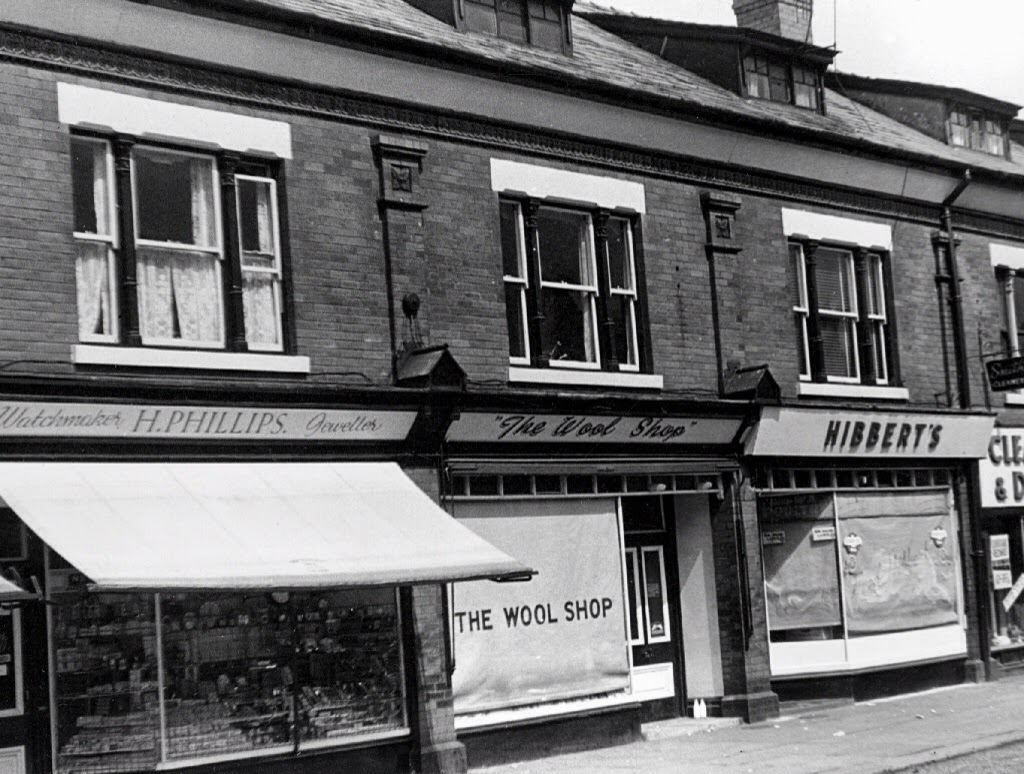
At the wool shop on Burton Road ....... another story from Sally Dervan

I have my own "Wool Shop” memories of the one on Burton Road, West Didsbury. 

The buuton tin
I think it was owned by a brother and sister, but it was usually the lady who served us.

The shop door had a bell, and it would sometimes take quite a while for anyone to come out of the back of the shop. We would stand there very politely, and not speak or touch a thing until the proprietor appeared.

I loved the wool shop, both my mum and nana were very keen knitters and what they knitted (at the time these memories are from) was usually for me.

I wouldn't always be the wearer of what they knitted even if it was for me, because they also knitted for the whole army of dolls that I owned!

The wool shop did have a particular smell, and one that was familiar to me as the daughter of a carpet shop owner, because the smell was proper wool, not nylon stuff

On Burton Road
Before we bought the wool, we needed the pattern. The patterns were in a whole shelf full of binders at the side of the counter.

Each pattern was in a plastic sleeve and I used to like the slapping noise that the patterns made as we flicked through them.

I remember the glass counter in the shop that was full of buttons. I had a fascination for buttons that has always stayed with me.

Even now, if you put a tin of buttons in front of me I can sit for hours looking through them. Old buttons each have their own story and I remember my Mum and Nana would reuse buttons, so if clothes were being discarded.

Then the buttons would come off and be saved for putting onto something else. I could easily be wearing a cardigan as a child with buttons that had come from one of my mum’s cardigans when she was the same age.

A young Sally with buttons and Father Christmas
Actually buying new buttons was a rare treat, but if we were buying buttons as well as wool then we would select them through the glass counter as if they were jewels, and the wooden tray would then be slid out from the counter for the buttons to be more closely inspected.

I remember some really fancy little buttons, lambs, bunches of roses and even some that were shaped like little post boxes that went on one of my brothers cardigans in the 1970s.

To my shame I must report that, when I was very small, most if the buttons on my clothes were the size of saucers.

This was because of one attempt by me, witnessed by my nana, to shove a stray button up my nose. It took years for me to win back that trust! I have a very early photo of me, trying to escape from Santa's knee at Lewis' - the buttons tell their own tale!

© Sally Dervan

Pictures; from the collection of Sally Dervan and Nos 238-240 Burton Road, 1962, J F Harris, courtesy of Manchester Libraries, Information and Archives, Manchester City Council, m09736, http://images.manchester.gov.uk/index.php?session=pass

Monday, 8 April 2019

Watching the changes on Burton Road in just a year

I won’t be alone in remembering an older Burton Road, but even by 1969 the place was changing and soon those traditional shops selling everything from bananas, elastic garters, and paraffin would be gone.

Peter’s painting perfectly captures that new busy Burton Road and since he painted it the big green off license has gone, which makes the picture as much a piece of history as the earlier one which dates from around 1900.

Then as a year ago there was a grocers shop on the corner with Nell Lane and the row of shops beyond were varied and interesting.

Of course what they sell has now changed reflecting the way we shop.

So in 1911 Miss Ettie, the tobacconist  along with Harry Cayton the butcher occupied the parade with a  cycle shop, hair dressers along with a ladies outfitter, a dyers and cleaners and Madame De Korti artists’ material dealer.

Today there is more of uniformity about the stretch which has more than its share of fast food outlets and restaurants.

And on the opposite side the school has become a set of offices, and the West Didsbury Public Hall a supermarket. All of which hides more than a little history, for it was in that public hall in 1902 that the Amalgamation League was formed.

There were those who judged that Didsbury along with Chorlton-cum-Hardy, Withington and Burnage would be best served by joining the city of Manchester instead of going alone.

Despite the League small membership the attractions of such a merger we not lost on the ratepayers of four townships who voted to join in the January of 1904.

And now it has changed all over again as I discovered yesterday.

Having just spent a bit of time in the walk in centre on Nell Lane and opting to catch the tram home I passed
what was Mr Walker Clavert’s  grocery shop in 1903, an off license in 2014 now a restaurant.

Paintings; corner of Burton Road and Nell Lane  © 2014 Peter Topping, Paintings from Pictures,
Web: www.paintingsfrompictures.co.uk
Facebook:  Paintings from Pictures

Pictures; Burton Road, October 2015, from the collection of Andrew Simpson, and  the same spot circa 1900 courtesy of Paul O’Sullivan


Tuesday, 26 March 2019

Stories from a Didsbury war monument

The Memorial West Didsbury, 2017
Now I have to confess I never read through the names of the men on the war memorial on Burton Road in West Didsbury, but my old friend David Harrop did, and because of him I now know something of Charles Cyril Futvoye of Clyde Road.

He enlisted in 1916 aged 22, giving his occupation as “Motor salesmen” and he was assigned to the Army Service Corps.

His bother George had also enlisted just two years earlier and was one of the Manchester Pals, belonging to the 20th City Battalion of the Manchester’s.

Both had been to University and had served in the Officer’s Training Corps.

Charles Cyril Futvoye, 2017
George survived the war, but Charles did not.

He died in the Curragh Military hospital of pneumonia on March 17th, 1916, just two months after he had enlisted.

 He is buried in Southern Cemetery along with his father who was interred three years later.

I doubt I will ever come across a photograph of him, although his Attestation Papers record that he was six feet in height and weighed ten stone.

There is a picture of his brother with the 20th Platoon of E company, but as yet there is no way of telling which George is.

Platoon 20, E Company, 20th City Battalion,The  Manchester Regiment, 1914
So, for now, that is it, but I am pleased that I now know a little about one of the names on that war memorial.

And perhaps someone in Didsbury will take up the research and look into the others commemorated on the monument.

Location, war memorial, Burton Road, Didsbury


The family grave, 2019
Pictures; the war memorial Burton Road, 2017, from the collection of Andrew Simpson, and 20th Platoon of E company, 20th City Battalion of the Manchester Regiment, Manchester City Battalions Book of Honour, 1916, family grave, in Southern Cemetery, 2019, from the collection of David Harrop

Sunday, 4 February 2018

A night at Proove on Burton Road, eating pizza and reflecting on what has gone before

Now I wonder what Mrs Jessie Owen, who sold tobacco on Burton Road would have made of pizza.

To be fair she was selling her tobacco back in 1911 and I doubt that she would have ever eaten pizza.

All of which is a shame because her shop today is occupied by Proove who make a fine pizza.*

They also serve up some of my favourite street foods, including Pizza Fritta and Croccheè.
Croccheè originated in Sicily and is made from mashed potato and egg, covered in bread crumbs and fried, while Pizza Fritta is made by sealing the toppings between two layers of pizza dough and deep frying until crispy.

I first had Pizza Fritta at Rosa’s home in Varese, north of Milan and I was instantly hooked on it.

Rosa is from Naples which is where the fried pizza comes from and now whenever we go back to the city it is always something I order.

But yesterday I had a mushroom pizza while Tina went for one with several toppings made to order.

And while we waited, we passed the time talking to the staff, many of whom like Tina are Italian and so the conversation ebbed and flowed touching on Naples, and Rome and some tiny villages tucked away in the north.

We had gone in during the late afternoon and already the place was busy, and by the time we left was becoming very busy which is always a sign that the food and the service is good.

So, that just leaves me thinking about Mrs Jessie Owens, who in 1911 was 35 years of age, had been married for fifteen years and had two children.

She owned and ran the business while her husband was a commercial traveller for a soap manufacturer, and like many, she employed a servant, who was young Elizabeth Simcock from Cheshire.

In time I will find out more about both the Owen family and Miss Simcock and will go looking for a picture of the shop.

Sadly the only one I have of the stretch of Burton Road which included that tobacconist, just misses off Mrs Owens shop, but no matter, someone will turn up with a photograph along with others who have also eaten pizza at Prooveor its companion restaurant in Sheffield.

We shall see.

Location; West Didsbury

Pictures; pizza, courtesy of Proove and Burton Road, date unknown, from Didsbury Through Time, 2013, Andrew Simpson & Peter Topping


*Proovewestdidsbury@proove.co.uk 160 Burton Road, West Didsbury, Manchester M20 1LH  0161 669 9061

Thursday, 12 March 2015

Down on Burton Road just a century apart

I won’t be alone in remembering an older Burton Road, but even by 1969 the place was changing and soon those traditional shops selling everything from bananas, elastic garters, and paraffin would be gone.

Peter’s painting perfectly captures that new busy Burton Road but for those curious as to what it was once like here is the same spot in the early 1900s.

Then as now there is a grocers shop on the corner with Nell Lane and the row of shops beyond it is as thriving now as they were then.

Of course what they sell has now changed reflecting the way we shop.  So in 1911 Miss Ettie, the tobacconist  along with Harry Cayton the butcher occupied the parade with a  cycle shop, hair dressers along with a ladies outfitter, a dyers and cleaners and Madame De Korti artists’ material dealer.

Today there is more of uniformity about the stretch which has more than its share of fast food outlets and restaurants.

And on the opposite side the school has become a set of offices, and the West Didsbury Public Hall a supermarket. All of which hides more than a little history, for it was in that public hall in 1902 that the Amalgamation League was formed.

There were those who judged that Didsbury along with Chorlton-cum-Hardy, Withington and Burnage would be best served by joining the city of Manchester instead of going alone.  Despite the League small membership the attractions of such a merger we not lost on the ratepayers of four townships who voted to join in the January of 1904.

Paintings; corner of Burton Road and Nell Lane  © 2014 Peter Topping, Paintings from Pictures,
Web: www.paintingsfrompictures.co.uk
Facebook:  Paintings from Pictures

Picture; the same spot circa 1900 from the collection of Paul O’Sullivan

Sunday, 6 July 2014

So how has Burton Road in West Didsbury changed in a century?

Now I was recently on Burton Road and came across a ghost sign which appeared on the blog a few days ago.

And given that I have neglected Didsbury of late I decided to go looking for some old images of West Didsbury.

This is one of my favourites and was chosen for that book on Didsbury which came out last year.*

It dates from the early decades of the 20th century and the road does not appear to have changed that much.

That said like many places in south Manchester there has been a revolution in retailing on Burton Road

The old familiar traditional shops selling everything from food to paraffin and newspapers have disappeared in favour of small quirky enterprises offering trendy clothes, furniture and above all restaurants and bars.

It has happened here on Beech Road and happened even earlier on Burton Road.

I could of course go into detail but will leave you to read the book.

Picture; Burton Road circa 1900 courtesy of Paul O’Sullivan

*Didsbury Through Time, Peter Topping & Andrew Simpson2014