Showing posts with label Italian Food. Show all posts

Monday, 9 February 2026

When me and Leonardo da Vinci walked the same way

Yep ….. it is a little-known fact that me and that Italian master of all things were vegetarians. *

Roast peppers
That said some clever traveller of obscure knowledge will correct me with arguing he merely advocated it.

Either way it got me reflecting on my choice which I took over four decades ago.

There wasn’t one burning reason for giving up meat it just happened and I have never missed meat or fish nor regretted the decision.

And in so doing I have discovered those great meatless cuisines of the world which have their roots in an abhorrence to eating living things and the more basic one that in most peasant communities’ meat was a very expensive item, and almost out of reach of many.

I can’t say I have been a vociferous advocate but when challenged I have stepped up to the mark.

And of challenges there have been many.  Most are cheap jibes thrown out in expectation that they are witty and clever comments but are in fact banal uttered by people who would be better employed cataloguing their collection of dried worms.

Moreover, they miss the rich variety of dishes that are out there.

Pasta, garlic and chilli

My favourites are invariably those from southern Italy an area which as late as the 1960s was far poorer than the northern regions of the country.

Pasta and beans
Roasted peppers, aubergines cooked in a heap of different ways and those old staples of pasta, beans and chickpeas.

Of all these my go to choice is simply pasta and olive oil with perhaps a bit of garlic and chilli thrown in and sometimes some homemade tomato sauce.

And what I find amusing is that it is often the deriding meat eaters who fall on these dishes.  Which takes me back to an event many years ago.  

We were in the Sangam in Didsbury and sharing our table were a mix of meat eaters and vegetarians, and by bad luck the vegetarian starters came first, which everyone fell upon and all pronounced excellent.  

Sadly, the arrival of the meat starters left some of us with nothing more to eat and reduced to watching.  The added insult was the comment from one meat eater that she was finding it difficult to finish her starters because of the number of our dishes she had already consumed.

                                                             Green beans
At which point I should really launch into a description of the history of vegetarianism but it is out there for all to read.*

Instead, I will venture into that dark area of convenience foods and share my own non animal convenience.  I don’t eat many but will when lazy fall on those alternative sausage and burgers.  It’s not that I am wanting pretend meat it’s just simply that they are quick.

It was as George who ran Sunflowers on Beech Road once said to me, “why should meat eaters have all the convenience foods”.

Tivall convenience

Location; where ever there are vegetarians

Pictures; from the collection of Andrew Simpson

*History of vegetarianism, https://en.wikipedia.org/wiki/History_of_vegetarianism

Friday, 9 January 2026

One hundred years of one house in Chorlton ....... part 161 .... avocado, sweetcorn, mango and a dollop of Vesta curry

 The continuing story  of the house Joe and Mary Ann Scott lived in for over 50 years and the families that have lived here since.*

Five foods on the plate, 1948

I wonder how many of these would have featured in the diet of Joe and Mary Ann during their time in the house.

To be fair they were here for just under 60 years and as Britain’s eating habits changed during the 20th century, they may have encountered all five.

But I wonder because by 1970 I had only come across peas and beetroot. True as kids we did get pasta, but it came served with milk and sugar and was a treat, so I guess it doesn’t count.

Mango, 2022
And me, and Joe and Mary Ann won’t be unusual in the absence of peppers, pasta and sweetcorn.

In my case I can remember the first time I came across sweetcorn, pasta, mangoes and even curry.  It was as a student in 1970 that I first had sweetcorn, and a good few more years before I ate pizza, and pasta and not till the 1990s that mango and avocado featured on my plate.

As for curry, in the late 1960s that was courtesy of Vesta Curry, that mix of rice, dehydrated chopped beef and vegetables in a spiced curry sauce.  The boil in the bag rice was cooked while the “other” bits were added to water in a saucepan and simmered away for about fifteen minutes.

Mum replicated this with a home-based mince version which was heavy on raisons, light on the curry powder and came with heaps of rice.

The pizza you make at home, 2024

My first experience of an authentic curry would wait until I was a student in the 70s and went for the three course businessmen’s meals which most Asian and Chinese restaurants offered up at lunchtimes for the staggering price of just three shillings, [15p].

Avocado, 2022
Even more exotic were the salads from the Ceylon Tea Centre in St Peter’s Square, where cold spiced rice vied with bowls of diced fruit, shredded carrot and portions of peppers, peas and meats which were oceans away from the plates of tomato, cucumber on limp green lettuce of my youth.

Leaving the delights of  pizza and pasta to the Bella Napolli on Kennedy Street in the mid 1970s.

Now there is a point to all this which is less a nostalgic trip and more a reflection of just how fast our eating habits changed, under the impact of raising living standards, the push to processed foods aided by advertising, supermarkets  and the hunt for new products from the world’s cuisines to which can be added the fridge and home freezer.

All of which made it possible to move away from the daily trip to the grocer, the butcher, the fishmonger and green grocer, to shopping for the week, secure in the knowledge that it would remain fresh  and allow you to offer up more “interesting” meals along with the quick convenience foods like fish fingers, and that amazing invention of the TV dinner.

Pasta and borlotti, 2023
Mum discovered TV dinners in the mid-1960s ....all you wanted for a roast meal or fish supper in a tin tray which you heated in the oven. They were expensive, tasted awful but mum liked the idea of novelty.

Happily, it was a passing fad and we returned to deep fried corn beef in batter, plates of peeled Italian tomatoes and bacon which vied with potato pancakes and potted beef and fish sandwiches.  To which I can say other sandwiches were available of which sugar, apple and banana ones were popular.

But our Elizabeth reminded me of a whole set of meals that mother made from scratch from soused herring, heaps of pies and puddings and cakes to die for.

That said sweetcorn, mango and avocado were not on the list and nor I suspect would they have walked through the door when Joe and Mary Ann lived here.

Location; Beech Road

Pictures; five foods on the plate, Meta Givern’s Modern Encyclopedia of Cooking, 1948, Chicago, Mango fruits – single and halved, and Ivar Leidus, 2022, the copyright holder of this work, hereby publish it under the following license: w:en: Creative Commons, You are free: to share – to copy, distribute and transmit the work to remix – to adapt the work and pizza and pasta dishes, 2024, from the collection of Andrew Simpson


The simple pasta .... with tomato sauce, 2021

*The Story of a House, https://chorltonhistory.blogspot.com/search/label/The%20story%20of%20a%20house

Wednesday, 10 September 2025

Stories from the back streets of Naples ……. and a Neapolitan cookbook

There are many different categories of poverty, from not having the means to heat the home, provide food for the family or secure a decent education for your children.

Down a Neapolitan street, 2018

And up there with them is the absence of running water, which at the very least can mean a tedious frequent trip up and down stairs to the neighbourhood tap and at worst a long walk to a communal pump. 

With buildings that reach to the sky, 2019

Today, we take fresh and clean running water for granted.  It is one of those key steps forward in the provision of public health during the late 19th and early 20th century.

In my own family I would have to go back to my great grandmother and the 1870s and 80s, to be able to record stories of the communal water tap in the shared courtyard, and to my grandparents in the 1920s who shared an outside lavatory.  

But progress was in the air and by the time I regularly visited them three decades later, the lavatory had become their personal one, even if it was still located outside at the bottom of their yard.

And then in a casual conversation with Rosa who was born in Naples in 1940 I was reminded that drawing water from a tap in her home was as alien to her as it had been for great grandmother.

We had just had pasta for dinner, and as I went to start washing up, Rosa pointed to the huge saucepan of “pasta water” and suggested I use it to wash the pots and plates.

It struck me as odd, but it was still warm, and more to the point had I been back in Naples in 1940, I wouldn’t have entertained wasting water ….. not if it meant going down and coming back 4 flights of stairs with a fresh supply.

A Napoli Si Mangia cosi

From there the talk drifted to one of the cook books which has sat in our house for over 20 years.  It was published in 1986 and is entitled A Napoli Si Mangia cosi', which means In Naples you eat like this.

It was one of the things Rosa gave Tina when she left home to come to Britain a full 35 years ago.

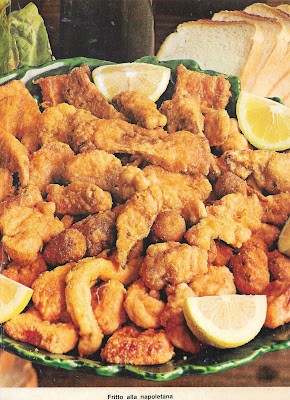
Fritto alla napoletana
It is much used, held together in part by sellotape and a book I occasionally flip through.

Now, I can’t speak or read Italian, despite many embarrassing attempts, and so having looked at the pictures I would put the book back.

What I didn’t know was that it is not written in Italian, but in Neapolitan which for some Italians can be as incomprehensible as any foreign language.

And even now she will often say to me this is the Italian for something, but in Naples we would say …….

All of which leaves me to decide if I should give up on Italian and go straight for Neapolitan.

We shall see.

But I now know that Fritto alla napoletana is a selection of vegetables and zucchini flowers dipped in batter and fried.

Pictures; from A Napoli Si Mangia cosi' and Naples Street, 2018-19, from the collection of Saul Simpson and Balzano

Wednesday, 15 May 2024

Cooking with Nana ….. potato pancakes

 Yesterday I made potato pancakes.

The humble potato
Now there shouldn’t be anything unusual about that.

They are after all just a mix of grated potatoes, egg, flour and flavouring which you fry up.

And to spice things further you can always add onion or apples.

Not that my German grandmother added such things.

She stuck to the simple potato, flour and eggs and cooked them to perfection.

Mother tended to be a tad heavy handed and sometimes hers departed from the thin crispy variety with an ossy centre and became bigger and heavier.

Either way they were a staple dish in our house and often came inside two slices of bread, compounding their calorific content.

Pizza
But we knew no better, and potato pancake sandwiches sat beside, apple sandwiches, sugar sandwiches, and bread with dripping and bread with meat or fish paste.

And for 63 of my 74 years, I have on and off attempted to replicate the perfect potato pancake.

Sadly, always with little success.  It never occurred to me to look up a recipe, just followed what I thought Nana and mum did it.

Had I followed a recipe I would have spotted the binding agent of the egg.

And the rest as they say is easy peezy.

They now sit beside those other favourites of home made pizza, parmigiana di melanzane, heaps of pasta dishes, and that triumph of gooey potato pleasure which mixes slices of cooked potatoes, mozzarella cheese topped with tomato sauce.

                                                Lasagna

Historically what all of them have in common is that they are peasant food, low on meat and high on cheap products easily available.

Pesto and pasta
In the case of potato pancake which can be found across middle Europe the challenge and the fun is what goes in, from onion to apple or whatever is available.

Like pasta and pizza they are easy to make,  are filling but offer up all sorts of variants.

And that is that.

Other than to say what was once simple peasant food has been transformed or as the Italian side of the family would say stolen.

That simple pesto sauce which accompanies pasta and is just a mix of fresh basil, pine nuts and cheese with lashings of olive oil is now to be found in salads, and sandwiches.

But sometimes adaptions do work, and the new kid on the block which is red pesto, made from sundried tomatoes is a favourite.

But why should I be surprised .... because the simplest peasant foods were always up to be adapted as food supplies changed. 

Pizzoccheri della Valtellina
And sometimes the oddest simple ingredients make stunning dishes.

So Tina's mum who is from Naples long ago embraced a northern Italian dish, which is Pizzoccheri della Valtellina, which put simply is a mix of pasta, potatoes, savoy cabbage and spinach and three types of cheese. Pizzoccheri is a type of short wide tagliattelle made from a mixture of buckwheat flour and wheat flour. The buckwheat gives the pasta a brown speckley look which I have to say was different.

She cooked the potatoes and cabbage together and then layered these with the cooked pasta and the diced cheese with more grated cheese on top and bakes for about 15 minutes.

I have to confess that greens do not do much for me. I guess it dates back to overcooked green cabbage which was served up in my primary school. Even now I have vivid memories of the agony of forcing it down under the stern gaze of the dinner lady wanting to be anywhere than facing this plate of torture.

But her  Pizzoccheri is very heaven.

More pizza

Our Saul has always made a heap of different pesto's depending on what "green ingredient" he can put his hands on .

Potato pancake
In the same way pizza that classic street food has evolved and on the way has been been claimed by lots of nationalities, but at home in Italy and here in Chorlton we are all agreed pineapple ain't a good topping.


Pictures, potato pancakes, pizza, and parmigiana di melanzane from the collection of Andrew Simpson

Sunday, 17 September 2023

Eating Neapolitan on King Street West ……. and coming across a bit of history

We found Capri’s by chance and what a stroke of luck.

Tina is Italian and is very picky about eating Italian food which often disappoints but not yesterday when we dropped into Capri’s on King Street West.

It helped that the food was authentic Neapolitan, which is where the family come from, and in conversation with the owner and his daughter it turns out that they are from the very next suburb to where Tina’s mum and dad were born and grew up.

But it was as ever the food which made the visit.  Tina went for the Spaghetti alle Vongole which is pasta with clams, garlic, chilly, parsley and datterini tomatoes and I had Pasta all ‘Arrabiata which is tomato sauce, parsley, garlic and fresh chilly.

They are the dishes Tina grew up with and the ones her mum cooks regularly.

We had been in town visiting the two exhibitions at Central Ref** and debated where to eat and slowly meandered past several Italian restaurants, as well as a few which are our favourites, but on that day none quite fitted the bill.

Still Tina fancied “some fish and pasta” and so we pushed on to King Street West, which as a historian is one of those forgotten areas of the city which included a gas works and the Shambles.

Now you won’t find New Shambles or Pork Lane, they disappeared along with the meat markets which ran from Deansgate back to Butter Lane during the 19th century.

The Shambles in 1849
They were the Bridge Street Market which fronted Deansgate down to New Shambles and then the delightfully named, Pork and Carcase Market which stretched from New Shambles to Butter Lane.

And even before the markets vanished Pork Lane had became Pork Street.

But with redevelopment the street vanished for ever under a series of buildings and befitting the areas new character New Shambles became a continuation of Southgate.

All of which is a bit off the track.


So, I will return to Capri’s which opened in November when the owner decided to start up his own business after working in various Italian restaurants.

At which point I could fall back on pictures of the food and a listing of the menu, but where would the fun be in that when you csn go online and explore the food for yourself?*

Pictures; Pictures of Capri, 2023, from the collection of Andrew Simpson, Butter Lane, and Back Bridge Street, 2016 from the collection of Andrew Simpson and the Shambles in 1849 from the OS for Manchester & Salford, 1849, courtesy of Digital Archives Association, http://digitalarchives.co.uk/

*Capri's, https://caprismcr.co.uk/

** Curry Mile, https://chorltonhistory.blogspot.com/search/label/Curry%20Mile

and

Manchester Ship Canal, https://chorltonhistory.blogspot.com/search/label/Manchester%20Ship%20Canal

Monday, 17 April 2023

Don’t throw the pasta at the wall mum ……. you’ll make a mess in the hall

So, ….. pasta nights in our house were always accompanied with mum throwing the spaghetti at the wall.

Is the pasta cooked?
Well, when I say the spaghetti, I mean a strand of the stuff following that very British tradition that you determined whether the pasta was cooked by seeing if it stuck to the wall, and if it did then it was cooked.

Even at the tender age of eight this seemed to me a little daft when you could just extract one strand and taste it, but that was the received mantra of how pasta was cooked back in southeast London in the 1950s.

On a bad day it left a heap of the stuff on the floor and a smeary mess on the wallpaper.

And when I told the Italian side of the family that this was what we once did, the howls of laughter were matched only by the incredulous looks from the assembled crowd.

This however was nothing compared to the collective response when I went on to confess that the spaghetti was cooked with milk and sugar. 

I tried to retrieve the situation by suggesting that the dish was a pudding, but alas the damage was done.  In the same way that putting pineapple on pizza or the practice of adding fish fingers as a topping.

Pasta e fagilli

There is no defence.  But it started a trickle of memories, like the use of small bottles of olive oil bought from the chemist and used on the hair or even as a form of suntan lotion.

I would be well into my twenties before I started cooking with olive oil or dribbling it over a salad, and even older before I realized the unending variations in pasta shapes.

More that it could be served in heaps of ways which didn’t involve tomato sauce.

Along the way I discovered the cookbooks of Elizabeth David and Claudia Roden, as well as roasting peppers and serving up dandelions as a salad.

But then I grew up in the 1950s, and while I can’t remember it I was four before sweet rationing ended, and much older before the growing consumer revolution with supermarkets, TV food adds and a plethora new foods opened up a world which challenged boiled beef and carrots with tinned fruit salad and carnation... not that there is anything wrong with either.  Although as a veggie l will pass on the beef.

Along the way mother experimented with TV dinners which came already made and just need heating up, boil in the bag Vesta curries, and Angel Delight.

Happily I now make pasta with chilli and olive oil, and have tried heaps of Italian and Greek puddings with a mix of results.

But all a little more exciting to make and eat than Pecks potted shrimp paste or fried corned beef in batter.

Shopping for heaps of fruit and veg in Esselunga, in Varese, 2023

Pictures; from the collection of Andrew Simpson and Balzano


Wednesday, 5 April 2023

Green or Red?……….. the pesto decision …… on this night

Now if I am honest there is no choice.


The Italian side of the family are very dismissive of red pesto, in much the same way as that discussion about pizza toppings, which consigns pineapple and other fruits to the bin without even a second thought.

But Tina was in Italy and so I  engaged in making both red and green pesto.

Each takes only minutes to make, can be stored for a while and are perfect with pasta, although Tina and her mum shudder at the use of pesto on pretty much anything else, and rail against the fashion in adding it to all sorts of dishes.

And here is the really big confession I prefer red pesto.

So tonight  I have made my favourite pesto, accompanied by some Neapolitan songs.

And then I shall sit down with the DVD of Benvenuti al Sud, eat the pasta with red pesto and be happy.

Well as happy as you can be.

Location; our kitchen

Pictures; Esselunga shopping bag, courtesy of Esselunga*, and the produce from our near by shop, 2019 from the collection of Andrew Simpson

*Esselunga, https://www.esselunga.it/cms/homepage.html/

Friday, 10 March 2023

Zeppole …. a saint …… and an empty plate

So, yesterday Rosa made zeppole.

It is a favourite and consists of butter, eggs, and flour which when mixed are put through a piping bag to make the desired shape and then deep fried and finished off with a dusting of sugar.

Sometimes she will add home made custard, but last night they were presented just as twisty sugared donuts and they vanished as quickly as snow in the winter sun.

The art is to mix the eggs into the butter dough while it is still warm, otherwise it is a very hard job to get the mix to come together easily.

And that was the basic mistake Rosa made when she first came to Cambridge from Naples in 1960.  

She and her husband Simone were economic migrants welcomed as valued additions to the workforce, and stayed for a decade, working in the local hospital and briefly as domestic servants.

That first Cambridge attempt led Rosa to write home asking her mother what went wrong.

Today it would be a phone call or a virtual conversation, but not so 63 years ago. 

And so instead of a 5-minute chat, the follow up corrections took weeks to arrive.

In the same way our dad well into the 1990s always wrote to his brothers, including the weekly airmail one to uncle Charles in South Africa.

By contrast like most people, I rarely write to family or friends, committing the business to the phone, or social media.

Likewise I doubt I would have eaten zeppole when I was growing up, which like so much of the food I now take for granted had to wait decades to be widely consumed in Britain.

They are pretty much typical of Italian cuisine but are most popular in Rome and Naples where Rosa will have eaten them from childhood.

Now, Rosa makes zeppole all the year round, but she told me that they are really a specialty made on St Joseph’s Day which is March 19th.

So, we were a tad early, but none of the family complained.

And having posted a picture on social media, my Canadian cousins recognized them as cruellers and friends offered up variations from Spain and elsewhere.

But then the idea of frying dough and adding sugar or something sweet is as old as the hills, and reminds me of that Neapolitan fried pizza, which is a story for another time.

Location; everywhere

Pictures; zeppole, 2023, from the collection of Andrew Simpson

Saturday, 25 February 2023

Thinking ice cream ……….. and throwing in more than a bit of history

Now yesterday I reflected on the Italian tradition of taking cakes and pastries when visiting family and friends.


And today, prompted by a programme on the wireless celebrating The Ice Cream Van, I am thinking of that other great Italian activity of going for an ice cream.*

Not for our family, the block of “Neapolitan” bought from the newsagents or the multi flavoured tubs which are on offer in supermarkets, but the real thing.

For which a visit to the local shop is more than just buying an ice cream, but becomes a trip out, which then turns into a debate on which to have, and whether to go for two flavours, or trust that someone in the family will share a bit of theirs, in return for some of yours.

We did that trip several times last week, either to the one at the top of the road or as a special excursion into the town centre.

But the real pleasure comes when you are on holiday and take that promenade along the seafront, which always ends in an ice cream.

So for all those who have enjoyed such a treat, there is today’s piece, The Ice Cream Van: A Celebration, from The Food Programme in which “Dan Saladino and his dad Bobo (a former ice-cream man) talk Mr. Whippy, 99s and Screwballs. Together Dan and Bobo (who also used to work in restaurants) have explored the wonders of pizza, and looked at the rise of 'Spag Bol,' Now they turn their attention to the history, science, and magic of ice-cream on wheels.


Featuring John Dickie (author of Delizia and The Craft) and Polly Russell (British Library) on the history of ice cream.

Graphic novelist Matthew Dooley (who drew the image for this edition) talks about his book Flake, a drama set in the world of ice-cream vans.

Produced and presented by Dan Saladino”.

It is a delightful celebration of all things ice cream, with lots of social history thrown in.

Location; the Wireless

Pictures; Italian ice cream from Sapori di Sicilia, Varese, 2020, from the collection of Andrew Simpson

*The Ice Cream Van: A Celebration, The Food Programme, Radio 4 https://www.bbc.co.uk/programmes/m000mj2x


Friday, 18 November 2022

So will the real torta di patate reveal itself …………..

Now this is torta di patate, or so I thought it was.

We have always just called it Italian potato pie, which goes nowhere near a translation other than it includes potatoes.

It has been a mainstay of my cooking since the early 1980s and is made by layering cooked potatoes, mozzarella and black pepper with a tomato sauce topping, and comes out of the oven with that crisp reddish surface before collapsing into a gooey cheese mix on the plate.

On a cold winter’s night it is one of those comfort foods which stand along side mashed potatoes, mushy peas and bubble and squeak, and is not for those on a diet.

I found it in the first Italian cookbook I bought which was one of a series published by Marks and Spencer.*

I bought into the lot from Mediterranean Cooking, Christmas Cooking and The St Michael All Colour Cookery Book.  

They were cheap to buy, simple to read and made good food, and I still use them today long after I went up market with some of Marks’s posher food books and before  branching out to the well-known celebrity cooks from Floyd, to Delia and Claudia Roden.

And I now cook  Torta di patate for the Italian side of the family, but here I ran into a mystery, because none of them have ever eaten it, or certainly not as torta di patate, which my Italian wife makes and consists of mashed potato, cheese and for those of us who are not veggie comes with a selection of meats including prosciutto as well as eggs.

It too is a firm favourite with our kids and is always an option on the table at Christmas.

Of course, when you look at the ingredients of both dishes it is easy to see that what we are dealing with are variations on peasant food, filling, cheap and replicated across the world.

They walk along side my favourite aubergine dish, Parmigiana di melanzane which Rosa who is from Naples makes a mean version, while my Greek friends continue to sing the praises of moussaka.

Today we are comfortable with these and many other dishes, but I always reflect on my own journey which now embraces aubergines which I came across for the first time in my 30s.

But then I spent my early years with dripping, sugar sandwiches and the exotic Vesta curries of which there is nothing wrong with.

Location; our cook books

Pictures; Torta di patate, 2022 from the collection of Andrew Simpson and cover of Italian Cooking, 1982

*Italian Cooking Anne Ager, 1982

Saturday, 24 September 2022

Mrs. Ercolina Montabone … an Italian restaurant and unfinished story

Now this is 181 Oxford Road and is as close as I will ever get to Mrs. Ercolina Montabone who ran the Frascati Café Restaurant.

Frascati now a pub, 181, Oxford Road, 1956
I can trace the business back to at least 1901 when it was run by her husband, Vittorio Emmanuele Montabone.

It is one of those stories which came about because of a request from a friend interested in another Italian restauranter who 3 decades later was running his own restaurant also on Oxford Road.

But being Italian he was detained as an enemy alien in 1940 and died when the ship he was on was torpedoed in the same year by a German U Boat.

And in carrying out the preliminary search I came across Mr. and Mrs. Montabone and given we have an Italian side to the family I was hooked.

In all there are just ten documents which tell their story, ranging from one reference to the Masons, one court document, two census returns, a newspaper story along with their death certificates,  listings in two directories and their probate .

Not much I know for two lives lived out at the beginning of the last century, but there is enough to challenge those Brexiteers who are uncomfortable with anyone wanting to make a new start in this country.

And they were immigrants, with Vittorio Emmanuel coming from Italy and Ercolino from Switzerland.

I was hoping to find a reference to their naturalization as British citizens, but while this hasn’t come to light,  Ercolina did at some point gain that status which she duly recorded on the 1921 census.

The same census shows that the Montabone’s employed staff who were born in Italy and in Switzerland, a practice which stretched back over 20 years.

They lived above the business, and were still there when Ercolina died in 1923.  Her husband had preceded her fifteen years earlier and both were buried in Southern Cemetery.

An Italian thank you, 1918

Of the remaining documents, there are three that caught my interest.  The first was an entry in the book of Masons which shows that Vittorio joined the Manchester lodge in 1899, and a court document for 1908 showing that he was called as a witness and was paid 5s to cover his return rail fare from Manchester to Liverpool.

Both of which point to just how far he had integrated himself into British society.

But it is the last of the three that offers an insight into their origins, and it comes in the form of a newspaper article recording that Ercolina had been thanked by the “Royal Italian Consulate" for contributing £6 17s from collections she had raised which went towards the fund "for Refugees from the Invaded Provinces of Ventia”*

And that is it. 

There is a listing for the Frascati Hotel in 1961, but no indication of the owners or the manager.

But the building has now vanished under what became part of a retail unit which also included the University Chaplancy.


Location; Manchester

Picture; Frascati now a pub, 181 Oxford Road, H.W. Beaumont, 1956, m03860,  courtesy of Manchester Libraries, Information and Archives, Manchester City Council, http://images.manchester.gov.uk/index.php?session=pass


Thursday, 23 June 2022

Sapori di Sicilia …….. the Flavours of Sicily

Now I like the Italian custom of taking cakes and pastries when visiting family and friends.

A selection of the pastries

Last week at Rosa’s when the family gathered on the Sunday, Johnny brought a tray full of them.

Inside the shop

And yesterday, when we decided on breakfast out, we gravitated to Sapori di Sicilia, which is on the Viale Belforte 68, 21100, in Varese.

The area is a mix of residential properties, a range of everyday shop, including a supermarket and some industrial units.

My favourite is always a bombolone which is a doughnut filled usually with custard, jam, or chocolate, and for me it is always custard.

But these you can get almost anywhere, while at the Sapori di Sicilia, they specialize in Sicilian food, and along with a range of wonderful pastries there are piles of savory ones not unlike our own pasties.

And of course ice cream ....

And of these the one they make filled with a mix of rice and vegetables, is just perfect.

So that is it, I could say more, but I won’t.

Location; Varese


Pictures; Sapori di Sicilia, Varese, 2020, from the collection of Andrew Simpson


Friday, 1 April 2022

A fish finger, a pizza and a certain day in April

Now if you are serious about pizza, there are certain toppings which are beyond the pale. 

Of these I class pineapple, beetroot and chocolate as abominations, and while at the end of the day it is anyone’s choice what to place on their pizza, I stick to that simple rule that tomato, cheese and basil are best.

To which I can add fried pizza, but for me it has to be the simplicity of the traditional Neapolitan pizza that wins out.

So, I was intrigued when a friend of a friend posted a picture of “Pizza Bastoncini di pesce”, which if my google translate is correct is Pizza Fish sticks.  The accompanying caption reads “Here comes the pizza with fish sticks”, suggested it was following a request and would be available on April 1st.

And here of course alarm bells should have rung, but when pineapple can find its way onto a pizza why not fish fingers?  

At which point I have to say that before I became a vegetarian, I would happily eat fish finger sandwiches.

But maybe not so, because back in February La Repubblica carried the story “From joke to reality: pizza (frozen) with fried fish sticks”.*

Going on to explain, that the German food company Dr. Oetker, had bowed to customer requests on Twitter to introduce the new pizza line after it had announced two years ago on April Fool's Day that “the pizza with fish sticks” would be on the shelves of German supermarkets from 1 April.

The new pizza that raises more than an eyebrow , and which has already sparked not exactly benevolent comments from the Italian community in Germany, will be produced by Dr. Oetker in collaboration with Capitan Iglo (Findus) regarding the six fish sticks. which will rest on a base 'topped with tomato sauce, a mixture of mozzarella and Edam and spinach', as explained in a note which adds that 'the spices complete the Mediterranean-maritime recipe'*

So, a slow burn silly story or a reality?

I shall have to ask the Italian side of the family to go and check out the new range in the local Esselunga supermarket, and in the meantime trawl the net for more information on Dr. Oetker's new product.

We shall see.

Picture; Neapolitan pizza, 2017, from the collection of Saul Simpson, and Fish sticks, 2022, courtesy of Alessandra Natali

* From joke to reality: pizza (frozen) with fried fish sticks by Jeanne Perego, La Repubblica, February 18, 2022, https://www.repubblica.it/il-gusto/2022/02/18/news/pizza_con_bastoncini_di_pesce_fritti-338265785/#:~:text=%22This%20is%20no,world%20of%20distribution.

Saturday, 12 March 2022

When the lad from Chorlton made a Neapolitan Margaretta in a Polish pizza oven

We often joke that our Saul learned how to make pizza in one of those small Neapolitan pizzeria’s  you come across down a side street off a busy main road.


They are the places only  frequented by a loyal local clientele and a few tourists in the know.

We have eaten at more than a few over the years and have never been disappointed.


All of which takes me back to Saul’s pizzas which stand equal to many of those we have had, and despite my best efforts mine have never come close to his.

We were talking just the other day and out of that conversation came the news that he had bought a pizza oven.

Now, Saul lives in an apartment in the heart of Warsaw, and there is no way that even a small wood burning pizza oven would fit or pass a safety check from the local municipal authorities.

So, instead he bought an electric four-minute oven which judging by the results looks pretty neat.

Eric from Swansea will no doubt tut, but we can’t all have the luxury of a purpose-built pizza oven and a ready supply of wood.


Leaving me just to reflect on the internationalism of food which some Brexiteers would rather deny.

For here is our Saul who was born in Chorlton making pizza in a Polish pizza oven admired by the Italian side of the family who were from Naples.

Location; Warsaw


Pictures; the magic pizza oven and the pizzas, 2021, from the collection of Saul Simpson