Showing posts with label Piccadilly Gardens. Show all posts

Monday, 3 August 2026

Taking Eminent Victorians for granted ……. statues

Now the debate on who we continue to commemorate from the last three centuries rolls on and rightly so.

Prince Albert ..... thinking of Victoria? 2019

It is a discussion which gets to the heart of our past as we reflect on Britain’s involvement with the Slave Trade and Slavery, along with those we choose to see as significant and of course on those who made and wrote our history.*

Not that this is new, reinterpretations of historical events, and people goes on all the time, and one of my favourite such revisions is the book Eminent Victorians by Lytton Strachey published in 1919, which examines the lives, record and reputation of four “Victorian greats”. ** 

James Fraser, looking down on the markets, 2019
They were Cardinal Manning, Florence Nightingale, Thomas Arnold and General Charles Gordon.  

Today only Florence Nightingale will be familiar to many people, but back at the end of the 19th and the beginning of the 20th centuries the other three were up there on that pedestal of the good and the inspirational.  

And only Florence Nightingale survived Mr. Strachey’s forensic reexamination of their careers, in what at times is a savage, witty and cynical account.  

Just how savage, witty and cynical he could be I leave you to judge, from the end of his chapter on General Gordon, which having surveyed Gordan’s life and the campaign to avenge his death concludes that “General Gordan had always been a contradictious person – even a little off his head, perhaps, though a hero; and besides he was no longer there to contradict .... At any rate it all ended very happily – in a slaughter of twenty thousand Arabs, a vast addition to the British Empire, and a step in the Peerage for Sir Evelyn Baring”.**

There will be those who will turn their gaze on those public statues here in Manchester, and in the fall out from the Colston case Manchester City Council began weighing up the continued justification for  the presence of some of those “worthies” on our streets and square.*

Sir Robert Peel, 2019

And so drawn purely at random from some of the collection I have taken over the years here are three.

I make no judgements and leave it to others to add sound historical comments and only reflect that these long gone worthies are ingored by most, are the subject to occasional paint vandalism and at certain times of the year look down on the Christmas markets.

Pictures; Prince Albert, James Fraser, Bishop of Manchester, and Sir Robert Peel, Manchester, 2019-20, from the collection of Andrew Simpson

*On that statue of Mr. Colston …..…and thoughts on Annie Kenney, the Sheffield Women of Steel and Totò, https://chorltonhistory.blogspot.com/2020/06/on-that-statue-of-mr-colston-and.html

**D Day ...... AD 43 .......Portrait Of An Age ..... and the death of General Gordan, https://chorltonhistory.blogspot.com/2020/05/d-day-ad-43-portrait-of-age-and-death.html

*** Eminent Victorians, Lytton Strachey, 1918


Monday, 27 July 2026

"I had forgotten how black the town hall was" .......... pictures from Linda

The thing about old picture postcards is that there is usually a story which goes with them.

Albert Square, circa 1960s
Often that story is the message on the back, or the recipient which if you are lucky will lead to more stories.

Most of the ones in the collection have been picked up over the years with no extra information about the person who chose it in preference to another, or anything about them.

So it is a rare treat to be handed two picture postcards, by someone I know and who offered up a bit of back story.

These two are instantly recognizable, and will bring back plenty of memories, with some looking closely at the detail to compare with the same scene today.

Usually I would throw in my own observations, but where would the fun be in that?  Far better that I leave that to you.

Piccadilly Gardens, circa 1960s
Instead I shall close with Linda’s own comments on the postcards.

“As I couldn’t make my monthly trip to Holmfirth yesterday I sorted out some paperwork and came across these two postcards.

The one of Albert square is a Bamforth card with a deckle edge.

Their building near the bus station was sadly derelict for years but has recently been converted into flats and looks so much better.

I had forgotten how black the town hall was. Used to park in the square twice a year when I took my children into town to buy their shoes”.

Location; Manchester

Pictures, Albert Square, and Piccadilly Gardens, circa 1960s/1970s, from the collection of Linda Rigby

Saturday, 7 February 2026

A park bench, a Radio Station and a reggae singer ............. Piccadilly Gardens sometime in the 1970s

Now as soon as you post a picture of Piccadilly Gardens you can be confident there will be a deluge of comments.

Most favour the old layout and I have to say I am one of them.  In my case it is a mix of nostalgia and a preference for a more formal set of displays.

All of which I know in these cash strapped times is hard to maintain but the present expanse of grass flanked by the concrete slab does little for me.

We will all our own vivid memories.

One of my most vivid ones is walking through the gardens on a summer’s morning.

A few people had taken up a bench but they were there for just a few minutes before going on to work.  The air was still fresh, and the cool morning air had the promise of a hot day to follow.

Fast forward a few hours and the place would have been full of lunchtime visitors, grabbing an hour in the sun with a set of sandwiches and catching up on the gossip with friends.

All of that is old hat so instead I shall finish with the message on the back which was sent to John Dees at Piccadilly Radio.

It was one of two that he received from our sender who left no name but again was writing about John Holt the reggae singer.

Now I know from an earlier picture postcard that he was her favourite artist.

There is no date or postmark on the reverse of the car, but I think it will have been taken earlier perhaps in the 1960s.

Location; Piccadilly Gardens


Picture; Piccadilly Gardens, circa 1960s, from the collection of David Harrop


Monday, 8 December 2025

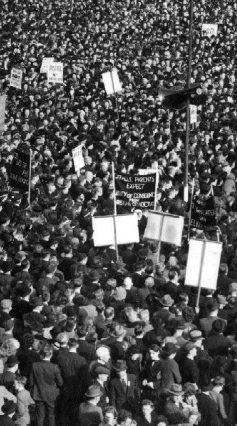
A demonstration …… and the search for a story …. Piccadilly 1943

Sometimes you come across an image that sets you off on a search for answers.

And this picture taken in 1943 in Piccadilly  is just one of those.

The caption is enigmatic to say the least, just, “Piccadilly Catholic demonstration, educational reform 1943”

I can’t get an exact date and none of the placards reveal much as to why so many Catholics assembled in the centre of Manchester at the height of the last war.

The Manchester Guardian failed to cover the event, and I have yet to trawl the local papers.

But this was during the discussions and the Parliamentary debates about what became the 1944 Education Act which “raised the school leaving age, transforming education into a continuous process from nursery to adult and aimed at suiting all talents” *

And while the Government was intent on retaining church involvement in education there arose the issue of funding for new denominational school buildings to replace many that were too small, too old and no longer adequate.

The cost of which was very high and could only be achieved by Government funding.

The White paper of 1942 had observed  “that the Churches with a financial problem greater in extent and no less urgent than that in respect of senior children. This is a problem which they have shown themselves quite unable to meet in recent years and which they are less than ever likely to be able to meet after the war.

51. If large numbers of children are not to be deprived of healthy and decent school conditions to say nothing of equal educational opportunities there is no disguising the fact that, unless a considerable number of voluntary schools are to be brought to an end and replaced by new provided schools, some further assistance from public funds must be found towards the maintenance and improvement of the premises, where such improvement is possible. 

Discussions carried on in recent months with the many interests concerned have satisfied the Government that there is a wide measure of agreement that voluntary schools should not be abolished but rather that they should be offered further financial assistance, accompanied by a corresponding extension of public control which will ensure the effective and economical, organisation and development of both primary and secondary education”.**

All of which alarmed some in the Catholic Church and led to protests including one held at The Hippodrome in Salford on September 12th 1943, which the Manchester Guardian reported “an audience of 2,500 called by the Roman Catholic Parents’ and Elector’s Association passed a resolution demanding the provision of public funds of school buildings where Roman Catholic children can be instructed in accordance with the wishes of their parents”.***

The issue was resolved but that is for another story.

In the meantime I wonder if our Piccadilly protest was linked to that meeting.

Answers on a postcard.

And answers there have been, with a promise from Lawrence Gregory to offer up more information on the issues surrounding the protest.

And Lawrence also pinpointed the event to October 10th, 1943 which was a Sunday, commentating that the demonstrators came from across the North West making up a protest of 50,000 on what was a "beautiful sunny afternoon".****

All the more remarkable given the travel restrictions and difficulties due to war time rail services and that "thousands of Catholics from this Diocese were away on active war service".

Added to which I have Bill Sumner to thank for correcting me for suggesting the demonstration occurred in Piccadilly Gardens, "they are actually on the bomb site behind the gardens where hundreds of buildings were burnt out or destroyed by the services to prevent further spread of fire due to incendiary bombs. 

The Piccadilly Gardens were surrounded by concrete air raid shelters as seen in the background and vegetable gardens for food rations instead of flowers".

Location; Piccadilly, 1943

Picture; “Piccadilly Catholic demonstration, educational reform 1943” m07352, courtesy of Manchester Libraries, Information and Archives, Manchester City Council, http://images.manchester.gov.uk/index.php?session=pass


*The Schools, Manchester Guardian, December 19th, 1943

**White Paper Educational Reconstruction, 1943 pages12-13, https://www.education-uk.org/documents/official-papers/1943-wp-educational-reconstruction.html#03

***Roman Catholic Schools White Paper Protests September 13th, 1943, from the Almanac, 1944

****Henry Vincent, Bishop of Salford, 1943


Saturday, 16 August 2025

When history is just a series of adventures

Now I do take history seriously, both in the research and in the writing but as someone once said “always have a bit of fun everyday”

Sir Robert Peel and friends, 2016

And today in the company of Peter Topping I am off on some historical adventures, collecting the pictures to support  our new tram book.

This will be the fourth in the series, The History of Greater Manchester By Tram.  It is a unique, perhaps quirky way to tell the history of Greater Manchester by using all 99 stops on the eight routes of the tram network.*

The Milk Maid, 1906
I write about the history of each of the stops and the surrounding area, and Peter produces a collection of original paintings of significant places and buildings.

And together they make up a history or the region.

So today we are off to Piccadilly Gardens, the Railway Station and New Islington, pausing to make the pictures which fit the stories.

They include the memorials, the old BBC building, with a look at the new Mayfield Gardens and that nightmare for motorists which is Stoney Brew.

We will even take the train from the Railway Station to the first stop on any of the lines, just to come back and check just how much the skyline behind Piccadilly has changed since I regularly made the journey half a century ago. 

And for those in the know I want to find the exact location of the Milk Maid on Parker Street while Peter wants to stand where students once painted a trail of footsteps from Queen Victoria’s statute to the site of the public lavatories..

So silly adventures in a good cause.

The books are available at £4.99 from Chorlton Bookshop, the shop at Central Ref, St Peter's Square, or from us at  www.pubbooks.co.uk

Location; Piccadilly Gardens, the Railway Station and New Islington

Pictures; Sir Robert Peel and friends, Piccadilly, 2016, and The Milk Maid, from a 1906 picture postcard from Tuck and Son, courtesy of Tuckdb, http://tuckdb.org/about 

*A new book on the History Of Greater Manchester By Tram, https://chorltonhistory.blogspot.com/search/label/A%20new%20book%20on%20the%20History%20of%20Greater%20Manchester%20by%20Tram


Friday, 20 June 2025

Piccadilly Gardens ....... the early years nu 3 a plan for a new civic attraction .... 1920

Now if you are of a certain age the old Piccadilly Gardens will be a special place and even now generate a lot of heated debate about the present site.

A plan for the gardens, 1920
So here over the next few days are stories of the early years of those gardens.

In the Middle Ages it was nothing more than a site used to excavate clay for building and was simply known as “daub holes,” but in 1755 it became the home of the Manchester Royal Infirmary which continued to offer up medical care until 1910 when the hospital relocated to Oxford Road.

And then for the next twenty years the debate raged about what to do with this hole in the ground at the very centre of the city.

And it was indeed a hole in the ground which had been left over from the demolition of the old MRI leading one journalist to comment “the place has remained year after year a good imitation of a rubbish heap or the ruins of some volcanic upheaval.”*

And before the gardens ..... a hole in the ground 1917
The proposals ranged from an Art Gallery, to a tramway terminus and an underground railway centre and for a while part of the site was occupied by Manchester’s Reference Library.

But in 1920 the City Council decided to convert the site “into a pleasant garden. 

The existing hollow in the centre of the site is to be utilized for a sunken garden on the Dutch style and its banks will slope up to a border of flowering plants.”*

The gardens opened in the September of 1921 and in a revealing comment from one of the speakers the new civic attraction was planned only as a temporary measure until a new art gallery was constructed on the site.

Well that’s a twist in the story I didn’t know about.

Location; Manchester

Picture; the proposed gardens in 1920 from the Manchester Guardian, October 1920, and detail from a picture postcard of Piccadilly , 1917, from the collection of Rita Bishop

*After Sixteen Years : A Garden for Piccadilly; Manchester Guardian, October 23 1920, courtesy of Manchester Libraries, Information and Archives, Manchester City Council, http://images.manchester.gov.uk/index.php?session=pass

Friday, 13 June 2025

One milkmaid ….. 14 telephone boxes …. heaps of pigeons .... and some flower beds ……… Piccadilly Gardens

 Everyone will have their bit of Piccadilly.

Deckchairs, and flower beds in the sun, circa 1955
For most it will be the sunken gardens with the rows of wooden benches, stunning floral beds and of course the pigeons.

To which you could add afternoom musical performances, the lunchtime invasion of office workers and the banks of telephone kiosks which stood guard on three of the fours sides of the Gardens.

Mine is sitting in the Milk Maid looking out onto the bus station with the gardens beyond.

It specialized in milk shakes, along with frothy coffee and sweet things.

The bar was light, spacious and had a figure of a milk maid picked out on the tiled side wall.

A Milk Maid, 1906

I doubt many others will remember the place.

Or so I thought but over the last few days people have messaged me with their own fond memories.  “Pancakes”, “frothy coffee” and “wonderful ice creams”, seem to be uppermost in what many remember, along with calling in after shopping or waiting to get the bus home. 

And for one it was “tomato soup with a swirl of cream followed by a cake” which characterized the place.

We frequented it in the early 1970s, usually after a day at the College of Knowledge on Aytoun Street.  What we had is lost in time, but I guess it would have been during my frothy coffee period.

Piccadilly Gardens, 1963
I do remember the tiled figure of a giant milk maid on one of the walls.

Just when it opened and when it closed I have yet to discover and I still travel in hopes that someone will have a picture.

And that image will form part of the chapter on our next book in the series, "The History of Greater Manchester By Tram” which tells the story of our city region, using the 99 stop along the eight routes of the Metro tram network.*

Books one and two began in the suburbs of south Manchester, rolled into the heart of the city and finished at Exchange Square.  Book three picked up the stories and explored the route from Market Street via Shudehill to Victoria Railway Station.

The next crosses the city out from Piccadilly Gardens to Piccadilly Railway Station, New Islington, and Holt Town finishing at the Etihad Stadium.

And this is  the one I am currently engaged in, which will also feature Piccadilly Radio, the wartime allotments, the YMCA building along with the library, and the grand plans which were floated to use the site after the hospital had been demolished.

Piccadilly, 2024
Not forgetting the bus station, Lewis’s, and the destruction brought by the Manchester Blitz, which in turn left the area full of car parks till the arrival Piccadilly Plaza.

All of which will just be in that first chapter, leaving plenty of history to uncover about the railway station, Ancoats, Holt Town and that area which is now home to a football team but which for a year was where we lived, surrounded by the remains of Bradford Colliery, Clyton Aniline and assorted workshops.

But for today it is the Milk Maid, and another request for memories, pictures and perhaps even a souvenir menu, taken and saved in a cupboard.

Location; Piccadilly

Pictures; Piccadilly on a sunny day in the 1950s, from the cpllection of Suzanne Morehead, The Milk Maid, from a 1906 picture opostcard from Tuck and Son, courtesy of Tuckdb, http://tuckdb.org/about  Piccadilly Gardens from Leisure and Pleasure in the Open Air, Parks Committee, Manchester Corporation 1963, Piccadilly, 2025, from the collection of Andrew Simpson

**A new book on the History Of Greater Manchester By Tram, https://chorltonhistory.blogspot.com/search/label/A%20new%20book%20on%20the%20History%20of%20Greater%20Manchester%20by%20Tram

Monday, 26 May 2025

Of telephone kiosks, dodgy bedsits and Piccadilly Gardens

If there is one place in the city guaranteed to generate a debate along with many bittersweet, backward memories its Piccadilly Gardens.

Picadilly Gagrdens, 1969
Once an open space with a pond, and then the site of a hospital, it became after much discussion the sunken gardens so many people remember with fondness.

But its redevelopment at the beginning of this century was met with a mix of sadness at what was lost and anger at what many feel was a soulless expanse of grass, and grass for that matter which didn’t work.

But leaving aside that controversy, I have become fascinated by this picture of the Gardens.

It isn’t one of the usual shots, and you can see, why…………. It doesn’t show the sunken garden or the floral borders, and unusually it has been taken in the winter.

One Piccadilly, 2019
But I like it, partly because it commands fine views of the buildings in the distance which are now lost forever behind One Piccadilly, but also for those telephone boxes.

You have to be of a certain age to appreciate the importance of a telephone box.  In that faraway pre mobile time the public phone was the way of getting in touch with other people.

And no more so than on property day when the Manchester Evening News published the list of vacant flats and bed sits.

The first edition hit the newsstands at midday and within minutes the kiosks around the gardens were filled with people trying to secure a property.

Those telephone boxes, 1969
It always amazed me how quickly the lines were engaged and how any one managed to secure a property, given the headlong scramble to talk to landlords.

Of course, back then much of the accommodation was for more basic, and we put up with some dreadful places, of which having a shower in the kitchen and the lavatory in the cellar were regarded as quite normal.

I remember the acres of woodchip on the walls, if you were lucky, but more often the landlord had used liberal coats of magnolia over the existing patterned wallpaper.

Added to which, every room smelt of a different deodorant, and the bone cold hall was always awash with junk mail, and election material, addressed to residents who had long ago departed.

One Piccadilly, and a tram, 2019
All of which makes my memories of the Gardens just a little different from those of warm mid days sitting on the benches with sandwiches taking in the sun and the passersby.

Location; Piccadilly Garden


Pictures; Looking across at the gardens, 1969, Courtesy of Manchester Archives+ Town Hall Photographers' Collection,
https://www.flickr.com/photos/manchesterarchiveplus/albums/72157684413651581?fbclid=IwAR35NR9v6lzJfkiSsHgHdQyL2CCuQUHuCuVr8xnd403q534MNgY5g1nAZfY, and One Piccadilly, 2019 from the collection of Andrew Simpson


Saturday, 21 December 2024

My Manchester ..... Piccadilly Gardens and beyond

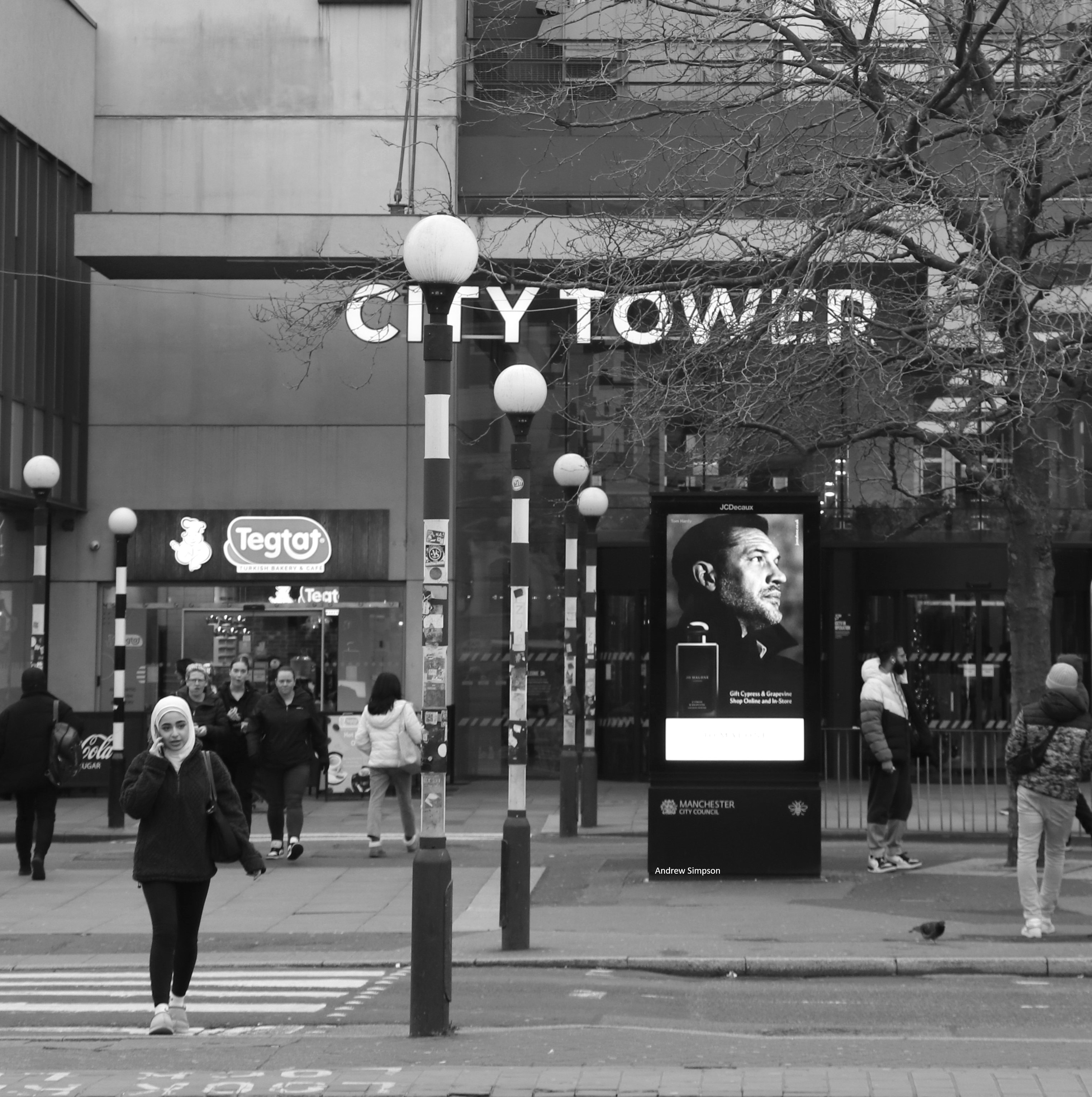
 Pretty much all life passes through Piccadilly Bus station.


And I know it's a claim that can be made for any big transport hub, be it a bus station, railway termininus or city centre tram stop.


But on that December grey morning with the Christmas markets waiting for customers, I was on the edge of the gardens looking across at City Towers and remembering just how busy it has been during all the years I have been here.

And that amounts to 55 years.

And that is it.

Location; looking out from Piccadilly Gardens

Picture; Busy at City Tower, 2024, from the collection of Andrew Simpson


Sunday, 1 December 2024

Piccadilly Gardens ....... the early years nu 4 on a warm summer's day in 1956

Now this just captures a carefree summer’s day in Piccadilly Gardens back in the 1950s.

It was taken in 1955 and pretty much has the lot.

The two stylish young women attract some but perhaps not that much attention.

For whatever reason the two  men in suits stare away while the chap next to them is lost in his newspaper.

So it is down to the woman in the hat and two others to glance at the passing of those stylish young women.

There will be many who remember sitting in the sunken gardens during their break from work, and when I washed up in Manchester in 1969 this was still a popular way of passing the hour on a sunny day.

My friend Sally came across the image in the digital archive collection but when I went looking for the picture the site had gone down which is a shame because I would like to think thee may have been some extra information.

And as ever it is the tiny detail that draws me in.

My Nana had a hat just like and mum had the identical sun glasses which also reminded me of her usual spectacles which were pink plastic with wings at each corner.

Thinking back they were exactly like the fins on those ever so large American cars that sum up the style of the 50s.

As were those big while plastic ear rings designed to look like flowers.

Which brings me back to those two elegantly dressed young women.

In time when I can access the Manchester collection site I may discover that this was a fashion shot but it is equally likely that it was just a random shot on a hot summer’s day.

Either way it is one to treasure.

Picture; courtesy of Manchester Libraries, Information and Archives, Manchester City Councilhttp://images.manchester.gov.uk/index.php?session=pass


Saturday, 16 November 2024

Two pictures …. a memory …… and a lost landscape

 Memories fade and eventually are lost and so these two images of Manchester on August 1st, 1957, are a powerful reminder of what the city was once like.

Two for one, a panorama of destruction, 1957

Both pictures were taken from the old BBC Building in Piccadilly and look out across the Gardens towards the Town Hall and the business sector.

Looking towards Portland Street, 1957
I would arrive just twelve years later, and Manchester had already shed many of those temporary car parks which were former bomb sites, replacing them with new builds of concrete and glass.

And while I was born and grew up in London, I can remember similar scenes.  

As kids we played on bomb sites and occasionally came across lost treasures pulled from the ground. 

Those open spaces would soon be home to cars and later still towering blocks of offices.

All of which makes me think my generation will be the last to remember that time when the last war transformed our cities and towns leaving acres of prime development sites.

But also, had created those gaps between houses where a single bomb had obliterated a home. In some cases, giant timbers were still in place shoring up the properties on either side, or the remaining houses had been given a skim of cement.

And so back to the two pictures.  

Piccadilly Gardens, the bus terminus and the future  hotel site, 1957
It is fascinating now to view the sheer scale of the devastation in just one part of the City and likewise what appears to be the random nature of the bombing, and what survived.

I won’t be alone in seeing pictures published in the early 1970s of the bits of Back Piccadilly ablaze from end to end which back in 1940 the censors deemed likely to undermine morale.

Now some I know will focus on the soot clad surviving buildings or wax lyrically about the former Piccadilly Gardens which is OK but detracts from pondering on the scale of the war damage, and the relative speed of the rebuild.  Added to which there is that very personal elephant in the room which for me is that simple observation that if you can remember such scenes, you are indeed very old.

Ah well such is the dichotomy from being a baby boomer with one foot in the late 1940s and early 1950s and the exciting and changing times of the decade to come.

Location; Piccadilly Gardens, Manchester, 1959

Pictures; Piccadilly from the BBC Building, August 1st, 1957, courtesy of Manchester Libraries, Information and Archives, Manchester City Council, http://images.manchester.gov.uk/index.php?session=pass


Tuesday, 12 November 2024

In Piccadilly Gardens in the summer of 1970

Now this will bring back memories.

And in the way of things there isn’t much more to say.

You either miss it and mourn its passing or have embraced the new Gardens with the concrete slab and expanse of sterile grass which despite all efforts never seems to be that green or that full.

As a public place I have to say the new Piccadilly is not one of our finest open spaces and the Wheel does little to enhance it.


But then I guess there were those back in the 1920s and 30s who muttered at what had been done to the old hospital site.

There is nothing wrong with change but sadly in the case of the Gardens something  more intimate and gentle has been lost in favour of a  brutal and plain expanse.

Location, Manchester

Picture; Piccadilly circa 1970 from the collection of Sally Dervan

Sunday, 8 September 2024

It's all in the changes .......

Just how many changes do you clock over 55 years in one city?

New and old, Exchange Square, 2024

It is of course a silly question because all places undergo some change and for most of us those changes can be quite imperceptible and do rely on a good memory.

That said the lazy will just resort to one of those then and now books but that is cheating, and anyway most such publications report on a series of transformations across a century and more.

Added to which they take just one place and show one change, when the fun is to remember the series of instalments which have nibbled away at somewhere you have come to know..

Corn Exchange & Triangle, 2024
So yesterday I was in Exchange Square, reflecting on a time before the metro tram, before the Urbis building and indeed before both the Arndale and the square itself.

Looking across the square down towards the river it is very difficult to conjure up that this had once been a place of narrow streets, half closed courts and large numbers of warehouses, and commercial properties which vied with offices, restaurants and pubs.  

Here could be found Blue Boar Court, Bulls Head Yard, Cock Pit Hill and Sun Entry some of which narrowed to twisty entries which disappeared into buildings before reappearing on a new street.

Many of the properties were destroyed during the bombing raids of the last world war, and so while the courts and streets were still there many of the buildings had gone.

The transformation was piecemeal during the redevelopment from the 1960s and again after the 1996 IRA bomb.

Piccadilly Plaza, 2024
And in the same way there will be all too many who remember the slow demise of the old Piccadilly Gardens.  

During the 1950s into the 60s it was a favourite place of office workers, shoppers and kids who sat on the benches in the sunken area, took into the municipal floral displays and just watched the city get on with things.

The later reincarnation of the open space has had few friends but at least that concrete wall has come down.

And on another positive note, it has also opened the statue of Queen Victoria, although I am less convinced about the fast-food encampment further along the square.

Standing beside Her Majesty I was struck by the view of the old Piccadilly Hotel with its restaurant in the air.

Changes from Piccadilly Gardens, 2024
Back in 1969 when I arrived in Manchester the hotel with its neighbouring tower and the striking Chinese style-roof of Bernard House struck me as the epitome of the modern when set against all the Victorian and Edwardian buildings which just said old.

I might say shouted the future which chimed with all that was exciting about the 1960s.

But then I was just 19, and yet to become a fan of the Town Hall or all those soot covered relics of the 19th and early 20th century.

Happily, 55 years on I have matured and have come to see that those very buildings were expressions of Manchester’s confidence at over half a century of innovation built on cotton and engineering, and best summed up constructing the first passenger railway and then that equally daring enterprise which was the ship canal.

A bit of a hotel, 2024

But that isn’t to gloss over the dark side of rapid urbanization characterised by mean streets, closed courts where the sun rarely penetrated to lighten the substandard housing, or the lack of sanitation and the absence of clean drinking water.

What was once ... the new, 2024
All of which can be found in history books, and which some would argue were replicated again by the rush to develop new social housing in the 1960s and 70s based on the high-rise towers and deck access properties.

Many of those have now vanished or been modified leaving places like Hulme to have gone through its first housing boom in the 19th century, its second in the decades of the next century and yet a new transformation in the 1980s and 90s.

Which brings us back to where we started with 55 years of change.

Location; Manchester

Bridgewater Hall, 2024

Pictures; of the city, 2024, from the collection of Andrew Simpson

Sunday, 9 June 2024

Snaps of Manchester number 4 Piccadilly in the late 1920s

Now I can’t be sure but I think we are looking at Piccadilly sometime before 1932.

It is difficult to be sure but I don’t think that the Ryland’s Building which is now Debenhams’s is there near the centre of our picture and if that is the case then this can be no later than 1932 and possibly sometime in the 1920s.

Like all the images in this collection owned by Sandra Hapgood there is much in the clothes and the vehicles to suggest this is the time frame.

Of course I might have missed some vital clue which can pin point the date and prove me wrong.

Either way it is one of those snaps of Manchester that I have been featuring.  Each of them is not by a professional and all of them were I think taken quickly while on the move and as with so  many snaps they are very personal, meant as a reminder of a day out or to share with family and friends.

And that is both their charm and their value because all of them are not the usual scenes of the city.  Instead they are shot from odd angles or concentrate on places seldom visited by the professional.


Picture; from the collection of Sandra Hapgood.

Thursday, 6 June 2024

Piccadilly Gardens ....... the early years nu 1 The YMCA Hostel 1917

Now if you are of a certain age the old Piccadilly Gardens will be a special place and even now generate a lot of heated debate about the present site.

The YMCA Hostel, 1917
So here over the next few days are stories of the early years of those gardens.

In the Middle Ages it was nothing more than a site used to excavate clay for building and was simply known as “daub holes,” but in 1755 it became the home of the Manchester Royal Infirmary which continued to offer up medical care until 1910 when the hospital relocated to Oxford Road.

And then for the next twenty years the debate raged about what to do with this hole in the ground at the very centre of the city.

Detail of the hostel
And it was indeed a hole in the ground which had been left over from the demolition of the old MRI leading one journalist to comment “the place has remained year after year a good imitation of a rubbish heap or the ruins of some volcanic upheaval.”*

But more about that new civic addition later for now it is this building which has caught my easy.

It comes from a picture postcard which was sent by George to his mother who lived in Peckham in south east London.

George writes home
As yet I know nothing more about George or his mother but I given that my early years were spent not too far away from their family home I shall going looking for them.

I know That George's father was a corn seed dealer and young George worked in te business, but what was doing in Manchester is unclear.

And George doesn’t give too much away.

He writes that he “will be writing a letter to you tomorrow” and that he had been to two theatres last week and was planning to visit another.

And that  takes us back to the picture of the YMCA hostel.

I had no idea that it existed on the site and must have been an additional one to the large and impressive YMCA on Peter Street which opened in 1911.

It must date from after the demolition of the MRI and had gone by 1920, so it will be down to Central Ref and a trawl of the directories to pin down its short history.

Interior of the hostel, date unknown
But Bill Sumner has saved me a visit to the archives, because almost soon after the story was posted he came back with the information that this YMCA was also known as the Khaki Club and "although meant for soldiers recuperating from wounds and/or shell shock, any servicemen at home on leave were welcomed and it became a popular club."

Now I knew that the YMCA had a presence in Heaton Park where battalions of the Manchester's were camped so this makes perfect sense.

Detail of the interior
And once again shows just how shared knowledge helps tell the story of the past.

And Bill also found a fascinating article about the club and a story both of which I leave you to read by following the link.**

All of which just leaves me to report that the sign to the right of the picture reads "Manchester City YMCA Khaki Club and Hostel."

Location; Manchester

Picture; the YMCA Hostel, 1917 courtesy of David Harrop and interior of the hostel from the collection of Bill Sumner.

Tomorrow; a war time use for the Gardens

*After Sixteen Years : A Garden for Piccadilly; Manchester Guardian, October 23 1920, courtesy of Manchester Libraries, Information and Archives, Manchester City Council,

**100 years ago: Canadian chancer jailed for ‘posing as Royal Navy Captain to pull women’Tony Flynn Salford Online