Showing posts with label Poland. Show all posts

Wednesday, 26 August 2026

Half twelve in the Rynek Starego Miasta .... thinking about history ... and talking about Polish food

Now it was just past midday and after a morning in Warsaw’s old town we were hungry.

In the square, 2026

And as you do, we wandered into the Market Square which was laid out at the beginning of the 14th century at the start of the city’s story.

Since then, it has experienced heaps of history. At one time it was the capital of a superstate which as the Polish Lithuanian Commonwealth stretched from the Baltic to the Black Sea.

Helping the tourists, 2026
But those glory days were marred by Poland’s partition in the 18th century at the hands of Prussia, Russia and Austria, the moment of freedom while the brief period of independence after the Great War was ended by the dark days of the Nazi occupation, and Soviet dominance.  During that Nazi occupation the Market Square was pretty much destroyed in the Uprising.

Today the square is a bustling place full of locals and tourists and because everyone needs to eat a selection of restaurants occupy part the open space.

There wasn’t much to choose between any of them, so we joined the queue which looked to be the shortest and it turned out to be ok.  

Like its rivals the menu was heavily orientated to fish and meat, which came in enormous portions of which schnitzel seemed the most popular choice.

I feared as one of the veggies in the group I would be at a disadvantage but there was pierogi which is a traditional Polish dish of dumplings which were filled with cheese, and mushrooms and topped with sour cream. They came with a salad of shredded carrot, cabbage and beetroot.

 Schnitzel in the square 2026 

And were the choice of our neighbour who interestingly started their meal with a platter of cheess and fruit.

The conversation drifted from that starter to the different pierogi I had already encountered and settled on schnitzel which as everyone knows is a thin slice of meat which is breaded and then fried.  My Wikipedia tells me that “it is popular in many countries and is made by using veal, pork chicken, mutton, beef or turkey”.*

And here the discussion took a turn because a few years ago our Saul found some very large mushrooms in the forest and Julia never one to waste food transformed into a meatless Schnitzel.

Giant mushroom, 2025


Mushroom Schnitzel, 2025
Alas I was not there to share the cooking of the wild mushrooms, but I wish I had.  But there will always be another time.


Location; Rynek Starego Miasta, Warsaw

Lunctime in the Square, 2026

Pictures, of the Market Square, the restaurant and the customers, 2026, from the collection of Andrew Simpson, and that mushroom and Schnitzel, 2025, Julia ICE Czajkowska

* Schnitzel, https://en.wikipedia.org/wiki/Schnitzel

Tuesday, 18 August 2026

Trams across Warsaw

I like trams.  


And that affection stretches from the old tall and stately looking Corporation trams which for over half a century trundled across our towns and cities to their modern sleek counterparts.

Here in Britain, we did away with trams and instead embraced the motor-driven bus and that hybrid which was the trolley bus.

But many European cities and towns retained their trams and while the ravages of the last world war destroyed the cars and the rail network when peace returned the authorities turned back to them.  

In some cases, investment was slow but today they are an essential part of the transport scene.

All of which is a lead in to my visit to Warsaw and my opportunity to explore its fleet of red and yellow trams.


My Wikipedia
tells me that "The Warsaw tram network is a 146.2-kilometer (90.8 mi) tram system serving a third of Warsaw, Poland, and serving half the city's population. 

It operates with 726 cars and is the second-largest system in the country. 

There are about 25 regular lines, forming a part of the city's integrated public transport system organized by the Warsaw Transport Authority. 

Since 1994, the system has been operated by the municipally owned company Tramwaje Warszawskie sp. z.o.o.*

Now I can well believe that there 726 cars travelling the 25 lines, because where ever we were in the city we encountered them with our Josh happily opting to use them in preference to taxis.

That said he did take the occasional bus but preferred the trams.

At which point I could write about the history of the service which began in 1866, and which had its ups and downs, with low investment, it’s almost total destruction during the war, and the ill advised post war policy of relying on oil from the Soviet Union to power a fleet of buses so that Polish coal could be exported for hard currency and not used to generate electricity.


Even after the collapse of communism, investment was slow and it was not till 2005 that real money was spent to purchase new rolling stock and modernize the system.

Happily, today the trams whiz across the city.

Location; Warsaw

Pictures; Warsaw trams, 2026, from the collection of Andrew Simpson

*Trams in Warsaw, https://en.wikipedia.org/wiki/Trams_in_Warsaw


Tuesday, 13 January 2026

Uncertain times ……… when nasty bits of history don’t go away

I suppose every generation at some point comes to terms that with uncertain times, threats become real and the unthinkable becomes a prospect to be prepared for.

Poland, 2026
This is a Polish guide which today slipped through the letterbox of our kid who lives in Warsaw.

The title is "Poradnik bezpieczeństwa", subtitled "Przeczytal;przecwicz! zachowaj!" which translates as "Safety Guide Read it! Practice it! Keep it!"

And given that Poland neighbours Ukraine which continues to defend itself from Russian aggression the message is clear.

For my generation it was the Cold War and the very real threat that the superpowers would plunge the world into a nuclear war.

It was a very real threat that never really subsided from the 1950s onwards and had a second visitation in the 1980s.

I can remember the Civil Defence Drills, the short public information messages on the telly showing how RAF bombers could be in the air in under 4 minutes and the sheer horror of the Cuban Missile Crisis.  

All of which resurfaced in the 1980s when with growing tensions between the USA and the Soviet Union a new set of nuclear warheads were developed on a new set of delivery systems.

Britain, 1957

That second Cold War resulted in the little booklet "Protect and Survive" which was delivered to every household across the country and was accompanied by television adverts.

Britain, 1940
So grim were the outcomes of a nuclear exchange of weapons and so helpless it seemed were the prospects of survival when you lived in a city that most of didn’t even open the booklet.

That said the preparations made during the run up to the Second World War did save heaps of lives.

My parents and grandparents will have worked their way round those preperations and regulations, carrying gasmasks, observing the blackout and in the case of dad leaving his job as a coach driver and to take up eseential war work in the north east. 

As far as I know Dad never joined the Home Guard, but others in the family will have done.

In time I will get to know what is inside the Polish document.

But history suggests it will make grim reading.

Pictures; Poradnik bezpieczeństwa, Polish Ministry of Defence, a civil defence poster produced in 1957 by the Central Office of Information (INF 2/122)Civil Defence is Common Sense, National Archives, https://www.nationalarchives.gov.uk/education/resources/fifties-britain/civil-defence-common-sense/ Rifle Training for War, a textbook for Local Defence Volunteers by Captain Ernest H. Robinson, 1940

Wednesday, 4 October 2023

Bela Hazan and the Jewish Resistance ...... stories from History's Secret Heroes

History's Secret Heroes is one of those programmes I dip into and I am glad I dipped this week.*

It was broadcast on Monday and can be accessed by followng the link.*

"Poland, 1941. Bela Hazan, a young Jewish woman, secures an undercover job at the Gestapo headquarters. She is about to go undercover to fight against the Nazis.

Helena Bonham Carter shines a light on extraordinary stories from World War Two. Join her for incredible tales of deception, acts of resistance and courage.

A BBC Studios Podcast production for BBC Radio 4 and BBC Sounds.

Producer: Amie Liebowitz

Executive Producer: Paul Smith

Written by Alex von Tunzelmann"

*Bela Hazan, https://www.bbc.co.uk/programmes/p0fqnkht

Monday, 26 June 2023

Lessons from a stamp album …… no. 1 ….. this is who we are

Now I know it is stating the obvious to say that postage stamps can and are political.


Like coinage they aim to say something about a country, whether it is the leader, its system of government or its achievements.

I still have a collection of British postage stamps to commemorate the Battle of Hastings and the Battle of Britain.

Although some may ponder on why Britain wanted to commemorate a battle in which the Norman French were victorious, but some one will have an explanation.


And that leads me to a short series based on the collection of stamps from our Stella, who having salvaged my stamp albums of the 1950s, went on to make her own during the 1970s and 80s.

Like many of the family treasures they came north from Well Hall after father died, and for a while sat in the cellar which on reflection was not the kindest of places.


Forty years in a dry but cold cellar allowed some of the lose stamps to get stuck together, but others fared better.

And so here are some of those stamps which she bought from dealers, coming in small packs which retailed at 15p a sheet.

To start the series I have selected some from the former communist states of Poland and the USSR, which carry a very overt political message.

That said I do have to confess I went for the Polish stamps first  for another reason than our Julia is Polish and along with our Saul lives in Poland.


Enough said.

Location Poland and the USSR,, 1970s, 

Pictures; stamps from Poland and the USSR, 1970s, from the collection of Stella Simpson


Sunday, 25 June 2023

Postcard from Warsaw

Now, sometimes you just get lost in a story.


It seemed easy enough, or so I thought.  

The German on the picture postcard would be easy to translate.

But not so.  

The translation, if I have got it correct reads “Germans innocent in World War”.  The message on the back is undecipherable but I guess will not shed much light on the words on the front.

The post card was sent in the June of 1916 from Warsaw which had been occupied by the German army since the August of the previous year.

And would remain in German hands until November 1918.


I suppose we a dealing with a piece of propaganda but whether this was the message that was intended by the person who sent it is now lost.  

It may be that they were attracted by the lilies which according to one source “portray love, ardor, and affection for your loved ones”.*  An idea reinforced by the words above the portrait of the you women which reads, “Flower language: Lilies”.

Until I can work out the message on the back I am left with  the post marks, one of which appears to be a military one, referring to "Landstr Juf Batl. Burg IV 85", and the other carries the location “Warschau” with the date June 28th, 1916.

There is one last clue and that is the name of the picture postcard company who are listed on the back as R&K, and that this one was 2654/1.  But I fear trying to find information on a German/Polish company a century and bit after the event will lead nowhere.

Location; Warsaw

Pictures; message from Warsaw 1916, from the collection of David Harrop

*Lilies, https://en.wikipedia.org/wiki/Lilium#Symbolism

Tuesday, 25 April 2023

The picture ….. the school …… and a forest

So, when two of your kids own and run a school in a forest outside Warsaw, there are always pictures.


“Pines is a British Forest School based on the Scandinavian all weather school model and pioneered by British OCN trained Forest School practitioners. 

Our ethos is bred from the belief that risk taking and independent led learning are necessary to successfully support the development of young people. 

Our core principle places community at the centre of everything we do. 

We focus on the relationship between our learners and the natural world whilst promoting holistic learning. 

This approach guides our learners toward becoming knowledgeable, creative, intelligent, independent, confident, resilient and compassionate individuals who care for the world around them.

Pines offers learners the opportunity to take supported risks appropriate to themselves and the environment, safely at our inclusive Forest site. 

We use a range of learner centred processes to create a base for development and learning. 

We spend 100% of our time outside, working closely with individuals across a range of abilities and age groups, creating a community that cares for environment as well as each other.”.*


Location;  Gmina Żabia Wola, Poland  


Picture; Fire, 2023, courtesy of Pines Forest School

*Pines Forest School, https://www.pinesforestschool.pl/

**Pines Forest School, https://www.facebook.com/pinesforestschool/


The Warsaw Ghetto: History as Survival ....part 1...Oyneg Shabes ... one to listen to

Yesterday, today and all week.

"The extraordinary archive that secretly recorded daily Jewish existence in the Warsaw Ghetto – brought to life 80 years on from the Warsaw Ghetto uprising.

Umschlagplatz Memorial on Stawki Street, Warsaw, 2006
Through the Warsaw Ghetto's short, terrible life, historian Emanuel Ringelblum led a group of writers to secretly chronicle life for its inhabitants. 

The project became history as survival. Anton Lesser narrates this new 10 part series. Episode 1-Oyneg Shabes. How the archive began. With Elliot Levey as Emanuel Ringeblum.

In the middle of Europe, in the middle of the 20th Century, a half million Jewish men, women & children were herded into a prison city within a city. Walled off & surrounded by the German occupiers. 

How do you tell the world about your life and fate? Historian and activist Emanuel Ringelblum devised & directed a clandestine archive- codename Oyneg Shabes (Joy of the Sabbath) chronicling every aspect of existence. 

He recruited over 60 'zamlers' or gatherers to write, collect & compile thousands of pages-diaries, essays, poems, photographs, statistical studies, art, ephemera -a historical treasure that was buried even as the Ghetto was being extinguished so that the world might read and understand. Listen to their stories

Episode 1-Oyneg Shabes. In 1943, with most of the ghetto's inhabitants already murdered historian, Emanuel Ringelblum looked back on the history of the history.

And Markers in remembrance of where the Warsaw Ghetto wall used to stand 2018
Narration by Anton Lesser with Elliot Levey. Featuring the voices of Lily Fair, Leah Marks, Alfred Molina, Andy Nyman, Carl Prekopp & Tracy-Ann Oberman Translation by Elinor Robinson. Historical adviser Samuel Kassow. Written & produced by Mark Burman.

For more information on the Oyneg Shabes/Ringeblum archive go to the website of the Jewish Historical Institute,  https://cbj.jhi.pl/ *

Pictures; Umschlagplatz Memorial on Stawki Street, Warsaw, Cezary Piwowarski, I, the copyright holder of this work, hereby publish it under the following licenses: GNU head Permission is granted to copy, distribute and/or modify this document under the terms of the GNU Free Documentation License, Version 1.2 or any later version published by the Free Software Foundation; with no Invariant Sections, no Front-Cover Texts, and no Back-Cover Texts. A copy of the license is included in the section entitled GNU Free Documentation License. 

And Markers in remembrance of where the Warsaw Ghetto wall used to stand in German-occupied Poland, 2018, Samotny Wędrowiec, I, the copyright holder of this work, hereby publish it under the following license: w:en:Creative Commons attribution share alike. This file is licensed under the Creative Commons Attribution-Share Alike 4.0 International license.

*The Warsaw Ghetto: History as Survival ....part 1...Oyneg Shabes, BBC Radio 4  https://www.bbc.co.uk/programmes/m001l94l

Saturday, 19 November 2022

One family …………. three locations

Berries in Chorlton, snow in Warsaw and sunshine in Salford.

So, Chorlton at midday, Warsaw, at 8.48 am and Salford 2 minutes later.


Location; Chorlton, Warsaw, Poland


Pictures; Berries in Chorlton, snow in Warsaw and sunshine in Salford 2022, from the collections of Andrew, Saul and Ben Simpson


Monday, 28 March 2022

Who stole Poland?

 Now this is a programme I will be listening to today.

Obliterated from the map. The Invention of...Poland Episode 1 of 3, BBC Radio 4.*

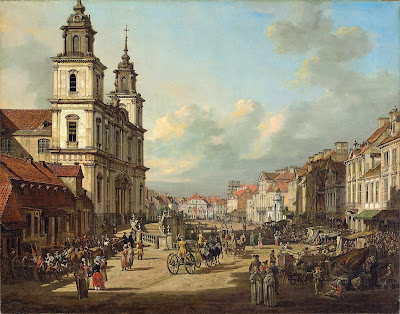
Church of the Holy Cross in Warsaw, 1778
“Long before Putin tried it on, long before the Soviet Union as well, Ukraine was controlled by somebody else - the old Polish-Lithuanian Commonwealth. In the first of a new series, Misha Glenny and Miles Warde travel to eastern Poland to find out more.

It's a tale of terrifying power politics, when an ancient European kingdom was sliced up like a cake. Beginning in Krakow, they travel by train and tiny bus in an arc around the south east to the Renaissance city of Zamosc, near the border with Ukraine.

With contributions from Norman Davies, Adam Zamoyski, Professor Natalia Nowakowska, Bartek Ziobro of Krakow Explorers and Olesya Khromeychuk of the Ukrainian Institute in London.

Official Coat of Arms of Poland
This is the latest in the How to Invent a Country podcast series which has previously travelled to Germany, the USA, Scandinavia and Brazil.Presenter Misha Glenny is a former BBC Central European correspondent and the author of McMafia.

Produced for BBC Audio in Bristol by Miles Warde"

And more Polish stories by following the link.

Pictures; Church of the Holy Cross in Warsaw, 1778,Bernardo Bellotto, and Polish - Lithuanian Commonwealth at its greatest extent in years 1619 - 1621, 2018, Praca własna na podstawie, https://commons.wikimedia.org/wiki/File:Poland-Lithuania_1714.svg  author Tonhar,  licensed under the Creative Commons Attribution 3.0 Unported license and official Coat of Arms of Poland

* Obliterated from the map. The Invention of...Poland Episode 1 of 3, https://www.bbc.co.uk/programmes/m0015v82

**Poland, https://chorltonhistory.blogspot.com/search/label/Poland


Thursday, 14 October 2021

A bit of Polish history revealed ........ The Polish-Lithuanian Commonwealth ..... on the wireless

 Now, my knowldge of Polish history is pretty much confined to the period from the late 18th century to now, so this edition of In Our Time was a revealtion.

Warsaw, 1778

It is streaming now and will be avaibale soon, by following the link. link.

"Melvyn Bragg and guests discuss the republic that emerged from the union of The Polish-Lithuanian Commonwealth.

 At first this was a personal union, similar to that of James I and VI in Britain, but this was formalised in 1569 into a vast republic, stretching from the Baltic to the Black Sea. 

Kings and princes from across Europe would compete for parliament to elect them King and Grand Duke, and the greatest power lay with the parliaments. 

When the system worked well, the Commonwealth was a powerhouse, and it was their leader Jan Sobieski who relieved the siege of Vienna in 1683, defeating the Ottomans. 

Polish - Lithuanian Commonwealth, 1619-1621

Its neighbours exploited its parliament's need for unanimity, though, and this contributed to its downfall. Austria, Russia and Prussia divided its territory between them from 1772, before the new, smaller states only emerged in the 20th Century.

With Robert Frost, The Burnett Fletcher Chair of History at the University of Aberdeen, Katarzyna Kosior, Lecturer in Early Modern History at Northumbria University, and Norman Davies, Professor Emeritus in History and Honorary Fellow of St Antony’s College, University of Oxford

Producer: Simon Tillotson"

Location; The Polish-Lithuanian Commonwealth

Pictures; Church of the Holy Cross in Warsaw, 1778,Bernardo Bellotto, and Polish - Lithuanian Commonwealth at its greatest extent in years 1619 - 1621, 2018, Praca własna na podstawie, https://commons.wikimedia.org/wiki/File:Poland-Lithuania_1714.svg  author Tonhar,  licensed under the Creative Commons Attribution 3.0 Unported license.

*The Polish-Lithuanian Commonwealth, In Our Time, Radio 4, https://www.bbc.co.uk/programmes/m0010f8z  

Tuesday, 14 November 2017

In Warsaw on Saturday November 11 .....

We are on a street in Warsaw on what turned out to be a cold day on November 11 which in Poland is Independence Day.

Up there at the top of the picture is that pink smoke, and like all good pictures there is a story.

And the story I discover later is that the Far Right were on the march.  Over the years they have stolen the day and use it to highlight their nationalist views.*

Not good.

Location Warsaw


*‘White Europe’: 60,000 nationalists march on Poland’s independence day,  Matthew Taylor, the guardian https://www.theguardian.com/world/2017/nov/12/white-europe-60000-nationalists-march-on-polands-independence-day