Showing posts with label When history meets essential walks. Show all posts

Tuesday, 31 January 2023

That mystery in Fog Lane Park, …..

Now as bandstands go the one in Fog Lane Park was not the most attractive examples of a civic bandstand.

The former bandstand, 2020
I grew up with those elaborate iron ones which adorned the parks in my bit of south east London, and have since started collecting them.*

In that pre television, pre cinema and pre wireless age bandstands offered a place to meet, sit and enjoy live music, although by the 1950s when I was growing up they had become less popular.

And many were already sad looking rusty old affairs, which would soon be swept away.  Ours lost its fine iron pillars and decorative bits
 followed by the demolition of the brick platform.

The bandstand in 1962
So  complete was elimination of these bandstands that within a generation their very existence would be all but forgotten.

So, when Barbarella out on a Sunday walk she happened on the circle in Fogg Lane Park,and was mystified, and I have to say so was I.

I toyed with the idea of a former bowling green, but dismissed it for obvious reasons, and speculated that it might have been the site of a pond.

But, rather than stay with speculation I looked up the OS map for 1959, which clearly shows a bandstand at the Parkville Road entrance.

And quick as a flash found a 1962 picture of the bandstand.

The bandstand in 1959
I don’t know when it was built, but the park dates from 1926, and I guess that it was erected around that time or a little later.

Its design resembles the open-air theatre in Chorlton Park which was laid out in 1928.

Which just leaves me to thank Barbarella, and scoop up a description of the park from Didsbury Civic Society.

"Fog Lane Park is off Fog Lane. Didsbury.  It was purchased in 1926 by the Council and was one of first public parks in Manchester.

It is said that Fog Lane Park earned its name from a grass, commonly known as 'Yorkshire Fog' which still grows throughout the park.


The site is comprised mainly of grassland and woodland, but also contains two small lakes, shrub beds, scattered trees, rose gardens and a sensory garden and children's play areas. 

The park is particularly suited to football, having several pitches and a large grassed area.


Welcome to the park, 2020
Fog Lane has an area dedicated to the growth of wildflowers. 

These attract wildlife such as butterflies, dragonflies and a large selection of insects.  In turn, these provide food for a wide variety of birds which visit the park and are then encouraged to nest.  

These include mallards, moorhens, Canada geese, kestrels, wood pigeons, coots and the occasional heron, plus the latest additions - ring-necked parakeets.

 The park has a variety of trees and shrubs, including dawn redwood, silver birch, laburnums and flowering crabs, as well as a number of unusual specimens which have reached maturity, including hornbeams, alders, poplars, Norway maple and Indian bean.

 The park is mainly used for children’s recreation, dog walking, personal fitness including organised health walking, Saturday and Sunday league football and for educational purposes, by school groups, church groups and scout/brownie groups.

 Fog Lane Park Bowling Club and the Friends of Fog Lane Park actively work with Manchester Leisure to improve and promote the site.”**

Location; Fog Lane Park

Pictures; Fog Lane Park, 2020, from the collection of Barbarella Bonvento, Bandstand, Fog Lane Park,1962, m58046, courtesy of Manchester Libraries, Information and Archives, Manchester City Council, http://images.manchester.gov.uk/index.php?session=pass, and Fog lane Park, 1959, from the OS Map of Manchester & Salford, 1959

*The Bandstandhttps://chorltonhistory.blogspot.com/search/label/Bandstands

***More on Fog Lane Park, Didsbury Civic Society, https://www.didsburycivicsociety.org/fog-lane-park

Thursday, 21 July 2022

The Manchester pawnbroker and his fine cottages in Didsbury ….. doing the essential walk and making it historic .... no. 5

This is Warburton Street in Didsbury, and if you should care to walk it, it won’t take long.

Warburton Street, 2020
In fact, it will be but a matter of moments to walk its entire length from Ogden Street to Wilmlsow Road.

In happier times that short walk would have lasted a tad bit longer if you had called in to Morten’s the Booksellers, followed by a meal in the restaurant next door, and finishing at the two  gift shops which are positioned at either end of the street.*

Warburton Street, 1911
The row of shops looks old, and as you do I decided to peel back their stories.

In 1911, those same properties were home to “Jn Crompton & Sons, paint stores", at number 2, William Richardson, platelayer at number 4, and Mrs. Emma Smith at number 6, who was listed as “householder”, and was a launderess, while finally at number 8 was Mr. Schofield who was a “night soil man” who worked for Manchester City Council.

While on the opposite side there lived a gardener, a hairdresser, two labourers along with the stables of the Midland Railways.

All of which is a neat cross section of the working resident of Didsbury, and by extension of the occupations of many who lived in Manchester.

Four decades earlier and those occupations were rooted in the land with a mix of agricultural labourers, and gardeners, along with a charwoman and domestic servant to cater for the wealthier.

Warburton Street and Hardman Street, south of the National School, 1845
But with a nod to the future one man described himself as “winder in a cotton factory” and another as "a grocery porter.”

Go back another twenty years to 1851 and along with those agricultural workers there were two of Didsbury’s last cotton weavers.

The census returns for the middle decades of the 19th century show that families were large, with anything between five to six people crammed into what were just two up and two down properties.

And using the Rate Books it is possible to track back and find not only the tenants but also the landlords.

In 1911 the entire south side of Warburton Street which consisted of our five houses, along with Hardman Street and Ogden Street were owned by a Charles Haynes who took home £147 from just these streets.

Mr. Haynes's stamping ground, 1851
In time I shall go looking for him, but for now I am content to explore the life of his father, Richard Haynes, who was born in 1802, married Harriet Farrington in 1821, aged just 19, and by 1848 was operating as a Pawnbroker at 30 Pump Street which was off London Road.

For the next decade and more he plied his trade on Pump Street and also Minshull Street, before moving to Didsbury.

A move which in part might have been motivated by his growing property empire, which he may have built.

Pump Street, 1850
Just when that was is as yet unclear.

The first entry in the Rate Books for Warburton Street is 1849, but they appear on the tithe map four years earlier, and Mr. Richard Haynes was in business by 1841, so he might well have accrued enough capital to sink his money into property.

And nothing quite surprises me about the man, because back in 1841 he is listed as a baker working from Back Acton Street, which was off Pump Street and ran parallel with London Road.

Just when he escaped the city and the murky world of pawnshops is unclear, but by 1861, he and Harriet are at number 3 Hardman Street, in a house which commanded fine views of the fields all the way down to Didsbury House, with the added bonus that his growing property empire was just a minute’s walk away.

Hardman Street with Warburton Street and the National School, 1854
And so assured was he of his new position in Didsbury society that he described himself as a “Proprietor of Houses”, and all reference to him in Manchester is absent from the records.

Location; Didsbury

Pictures; Warburton Street, 2020, from the collection of Andrew Simpson, Back Pump Street, 1851, from Adshead’s map of Manchester, 1851, and Hardman Street, 1854, from the OS map of Lancashire, 1854, , courtesy of Digital Archives Association, http://www.digitalarchives.co.uk/


*Orchard Interiors & Gifts 2, Warburton Street, No. 4 Dine & Wine, 4 Warburton Street, E.J. Morten Booksellers, 6 Warburton Street, Harriet and Dee, Cards and Gifts, 8 Warburton Street

Friday, 30 April 2021

Writing the history of Covid ............ remembering the loss

It is of course far too soon to write the history of the Pandemic.


We are still in the midst of the thing, and the full story with all its twists and turns, along with much that still sits in the shadows await historians of the future.


They may have the distance and the perspective to pass a judgement on how it came about, the degree to which national governments and international agencies responded in an effective way and the long term impact of this terrible year.

So I won't attempt any such account, instead I will fall back on another of those occasional series which looks to chronicle the pandemic moments.

These have included the pictures taken by people on their lockdown  “essential walks” and examples of how we have started to commemorate those who have died.

A few week ago it was the Covid Wall on the south bank of the River Thames, which was recorded by Paula Griffin.*

And today there are two pictures from David Harrop.


The first is of the memorial tree in Southern Cemetery, and the second is David’s own contribution which can be seen in the Remembrance Lodge of the cemetery, and which includes not only a reference to the present pandemic but to the work of nurses during the last two World Wars.

And there is more which includes medals, photographs, and other memorabilia from both of those conflicts, some of which relate directly to people who are buried in the cemetery.

Location; Southern Cemetery

Pictures; Pictures from the Pandemic, 2021, from the collection of David Harrop.

* The Covid Memorial Wall …………. London ….. today, https://chorltonhistory.blogspot.com/2021/04/the-covid-memorial-wall-london-today.html


Thursday, 28 May 2020

Telephone Exchanges…….. doing the essential walk and making it historic .... no. 26

I have to say, I thought telephone exchanges were as dead  as the telegram, and VHS recorders.

But not so, as Barbarella’s picture of this one in Northenden testifies.

In my defence, I have always taken them for granted, and just assumed the onward march of how we communicate with each other had rendered them obsolete.

At which point I pause for all the technical experts to explain a]why I got it wrong and b] why telephone exchanges are still needed


Location; Northenden

Picture; in Northenden, 2020, from the collection of Barbarella Bonvento

Wednesday, 27 May 2020

Passing the ghost bank ....... doing the essential walk and making it historic .... no. 25

Now I am back with that ghost bank. 

It is  one of those buildings that I have never given much thought to, but it caught Barbarella's eye recently on a walk, and she sent over a series of pictures, adding, "This used to be a physiotherapy centre, about twenty years ago. Lapwing Lane"

It is the former bank on Lapwing Lane and I must have passed it countless times, and on occasion stared at it from the window of the restaurant opposite.

I did once try to take some pictures but the light was wrong and I gave up which is a shame because I might have been inspired to dig down in to the history of The Mercantile Bank of Lancashire.

But Barbarella's pictures have caught it perfectly.

As yet I haven’t found out much other than it merged with the Lancashire and Yorkshire Bank in 1904 which merged with the Bank of Liverpool and Martin in 1927 which subsequently changed its name to Martins and in turn merged with Barclays in 1969.

But there will be someone out there who knows all about the bank and in time will be in touch.

In the meantime I know that our building dates from 1903, which means it had a brief existence as the Mercantile Bank.

Such are the exciting times of the banking world.

And since I posted this Richard has dug deeper and discovered that the Mercantile Bank Of Lancashire Ltd was "founded in 1890 with a head office at temporary premises in Guardian Buildings, Cross Street, Manchester, with capital of £1m, its early growth reflected the continuing industrial prosperity of Manchester.

The completion of the Manchester Ship Canal resulted in over 200 new accounts, and on 30 June 1891 the bank reported a net profit of £2,806.

Several branches were opened in the Manchester area, as well as others across Cheshire, Derbyshire, Staffordshire and Yorkshire.

In 1900 branches were acquired on the Isle of Man by amalgamation with the Manx Bank.

Soon after, however, the Mercantile Bank began to run into difficulty, partly due to the effect of the Boer War on investments.

The board of directors saw that as a relatively small bank, they could only survive by further amalgamation.

In the early part of 1904, several meetings were held with the Lancashire and Yorkshire Bank, and on 1 July the business of the Mercantile Bank was transferred to the Lancashire and Yorkshire Bank."*

And in turn the Lancashire and Yorkshire Bank merged with he Bank of Liverpool and Martin in 1927.

Pictures; former Mercantile Bank of Lancashire, 1903, from the collection of Barbarella Bonvento, 2020

*Barclays Bank PLC, https://www.archive.barclays.com/items/show/5305

Tuesday, 26 May 2020

Street furniture …….. doing the essential walk and making it historic .... no. 24

I have to confess to liking and collecting street furniture, be it an old coal hole cover, a 19th century water trough, umpteen different types of postboxes or the humble road sign.


All of which I have written about on the blog over the years, and today I can add a new one, which was sent over by Barbarella, who added, “Urban furniture, they don’t make them like they used to!"

And I have to agree, which in this case appears to be an old fashioned streetlamp with a slightly more up to date light shade.

There will be someone out there who can date the lamp post, and explain its place in the pantheon of streetlamp design.

We shall see.

Location; Didsbury

Picture; Didsbury street furniture, 2020, from the collection of Barbarella Bonvento

*Street furniture lost and saved, https://chorltonhistory.blogspot.com/search/label/Street%20Furniture%20lost%20and%20saved

Monday, 25 May 2020

Relics of our industrial past …….. doing the essential walk and making it historic .... no. 23

Now, here is a story yet to be explored.

Barbarella came across this impressive brick viaduct on her walk yesterday along the Mersey on the border between Didsbury and Cheshire.

It clearly has seen better days and despite my confidence earlier this morning I have not tracked down its history, despite staring at maps of the area dating from the late 19th and early 20th centuries.

But someone will know, and offer up chapter and verse, from which I can go back and delve deeper.

To which John Anthony Hewitt has responded with "That would have been part of the Manchester Central to London St Pancras main line railway, closed in 1969. Apart from Central station, other stations closed had included CCH, Withington & WD, Didsbury, H. Mersey, Cheadle Heath and Hazel Grove"

And looking at the 1900-1910 OS map for Cheshire, a line does cross the Mersey at that point.

And I suspect this one will rumble on ..... well I hope so.

Leaning me just to wallow in that wonderfully sad lament for the passing of all things, .....The Slow Train, Flanders and Swann.*

Location; Didsbury, Cheshire border

Picture; that viaduct, 2020, from the collection of Barbarella Bonvento, and extract from the OS map of Cheshire, 1900-1910, courtesy of Digital Archives Association, http://digitalarchives.co.uk/

Sunday, 17 May 2020

Always look up …….. ....... doing the essential walk and making it historic .... no. 22

Andy’s essential walk took him across Stockport this week and as ever it was the bits of buildings others ignore that he found interesting.

And today it was the detail high up on the front of a shop which caught his fancy.

Back when the shop was built, the stone feature with its date were pretty much a standard addition and I guess were produced in their thousands, with variations which conformed to the company’s individual identity.

I went looking for the chain which owned this one, thinking it might have been a co-op, but as yet haven’t identified it.

But someone will, and may even come up with a picture of the shop on opening day in 1913, or soon afterwards.

Today it is still a shop dispensing groceries and much else.

Location; Stockport


Picture; the shop 2020, from the collection of Andy Robertson

Saturday, 16 May 2020

The View …….. ....... doing the essential walk and making it historic .... no. 21


Now when Andy sent this one over from his latest “essential walk” he gave nothing away, just the title …. The View.

And I rather think I shan’t say anymore, other than to offer up the clue …. a museum.

Location; Stockport

Picture; the View; 2020, from the collection of Andy Robertson

Thursday, 14 May 2020

Losing a bar and avoiding the gladiators ....... doing the essential walk and making it historic .... no. 20

Now here I have to admit I am cheating.


This was not Barbarella's essential walk in 2020, but her holiday in Rome, long before the virus and travel restrictions.

My own pictures of the "Eternal City" are filed under a collection of odd titles which are not easily found and so I was happy when Barbarella offered up these.

This as everyone will know is the Tiber and back in the early 1950s, somewhere along here was that floating bar which featured in Roman Holiday.  The film remains a favourite of mine, partly because it is a daft romantic story, but also because the backdrop is Rome in 1953.

And as you do each time we watch it; we do the touristy bit of picking out the places we know and reflecting on how different they look today.

So, I will mutter about the tons of euro coins we have thrown in the Trevi Fountain and Tina will yet again tell me about the man, the ice cream and the Spanish Steps.

But despite a series of walks along the Tiber I have never found that floating bar., although the boat on the water in her picture looks promising.

On the other hand, Barbarella must have chosen the only day when the Gladiators were not out and about at the foot of the Colosseum posing for pictures with tourists.

I don’t begrudge anyone a living, but paying a shedload of money to stand beside Eric from Morecambe and Lib from Milan dressed in a plastic breastplate and helmet, with a bendy sword from the Euro Shop, doesn’t capture the historic moment of the Colosseum.

Well that is it …… I could wax historical on the river and the amphitheatre, but their stories are too well known.

Location Rome

Pictures; The Tiber and the Colosseum, from the collection of Barbarella Benevento


Wednesday, 13 May 2020

The sign above the door ....... doing the essential walk and making it historic .... no. 19

Now I blame  that fashion in pub sinage, which aimed for simplicity.

Out went the old hand painted pub signs for a corporate logo and with it came a rebranding which saw the centuries old name discarded for a themed name.

But at least the Ploughon Heaton on Moor Road has retained its carved stone above the door and the inscription below it.

And that dear read is the story ... gaze and appreciate.

Location; Heaton Moor


Picture; The Plough, 2020, from the collection of Andy Robertson

Tuesday, 12 May 2020

Tom Mix, the African Queen and Woodstock … at the Savoy in Heaton Moor ….. doing the essential walk and making it historic .... no. 18

Always ready to capture the moment, Andy was in Heaton Moor for his essential walk, commenting, “Now today I actually did quite a bit of walking. There are many grand houses, too many to photograph.  Most of the walk was Heaton Moor Road”.

But he still added a lot of photographs to the collection, including the Savoy, “opened 1923 and still operational”.

And according to my Kinematic Year Book for 1928, “The Savoy Heaton Moor Road. - Props., Kenny and Harrison. Man., E, Mallin.  

Two changes weekly.  Price, 6d to 1s 3d. Phone Heaton Moor 114.  Station, Heaton Chapel. LMS”

Location; Heaton Moor

Picture; Savoy, 2020, from the collection of Andy Robertson

Monday, 11 May 2020

A breath of the 1930s on Palatine Road ……………doing the essential walk and making it historic .... no. 17

Now I have always been intrigued by Queens Court, on Palatine Road, which looks out of place amongst the grand old Victorian and Edwardian houses, and the more modern blocks of flats, which stretch down from Lapwing Lane and on towards Wilmlsow Road.

They have a stylish presence, with their arched exterior staircases which marks them off as different and very bold when they were built sometime in the 1930s.

I say 1930s, because I have always thought they reflected that period.

And now I know that they were at least there by 1939, and possibly earlier.

They are on the site of St Mary’s Church which ran along Queens Court Road and Palatine Road.

The church closed in 1929, and I suspect sometime in the next decade our flats went up.

The search for a date for the flats was one of those little detective exercises which involved trawling past copies of the Manchester Guardian looking for any reference to the buildings.*

In 1945 in the local magistrates courts a resident of one of the flats who was described as a married woman in an “extremely good financial position” was cleared of an accusation of theft, while in 1940, an “Aircraft Examiner” was “Charged under two charges of the Official Secrets Act [in a case] heard in camera”.  

“He was also charged with aiding and abetting a German Refugee from Nazi oppression to commit an offence under the Aliens Order.”

And a year earlier the newspaper carried an advert "Queens’ Court, Palatine Road, West Didsbury 2 only Entirely Self Contained   4 roomed Maisonettes”

Now I have Barbarella to thank for the pictures, because she tailored her essential walk of the day to include Queens Court following a request by me.

Location; Didsbury

Pictures; Walking Palatine Road, 2020, from the collection of Barbarella Bonvento

*Manchester Guardian, July 15th 1939, Jul 6th 1940, March 28, 1945

Sunday, 10 May 2020

Modernity ….. doing the essential walk and making it historic .... no. 16

I have to confess I have never studied these fine houses on Lapwing Lane, but they are impressive and typical of the houses which began to go  up in the first half of the 20th century.

Lapwing Lane, 2020
They were part of Barbarella’s essential walk yesterday and I began to wonder when they were built.

They do not appear on the OS map for 1893, but are there  forty years later.

A trawl of the directories for 1911 show five properties along the stretch from Palatine Road, to Wilmslow Road, with names like The Chalet, Woodside, Larena, Cranleigh, and Limehurst.

But just where along the road these were situated I have yet to find out, but some may still have those names on the gateposts, so it is down to a little detective work.

Lapwing Lane, 1893
So that is it for now ……. leaving me to reflect that these were the future of Didsbury back at the beginning of the last century.

And as ever, complimenting two maps is that  that old essay title "contrast and compare".

It was an exercise beloved of teachers of English when I was growing up in the 1950s and 60s.

It may have been designed to get us to think, analyse and describe, but I suspect many were just time fillers.

Still I enjoyed writing them.

Location; Didsbury


Lapwing Lane, 1933
Pictures; Walking Barlow Moor Road, 2020, from the collection of Barbarella Bonvento, and Lapwing lane,, 1093, Hall Street, from the OS map of South Lancashire, 1893, courtesy of Digital Archives Association, http://digitalarchives.co.uk/ and Lapwing Lane in 1933the OS map of Manchester & Salford,  1933


Old fashioned shopping ….. doing the essential walk and making it historic .... no. 15

In this age of supermarkets and online shopping, I like the way you can be reminded of how we used to shop.


Location; Cheadle

Picture; Parry the Watchmaker, 2020, from the collection of Andy Robertson

Saturday, 9 May 2020

Ivy Cottage ……………… doing the essential walk and making it historic .... no. 14

Now I like Barbarella’s picture of the entrance to Ivy Cottage, on Barlow Moor Road.

The entrance, 2020

And as you do I went looking for its story.

It appears in the 1911 directory for Manchester and Salford as “Ivy Cottage Mission Hall”, and one source offers a date of 1901 for the establishment of this Evangelical place of worship.

The church, 2020
Strangely I have not found any other reference to it.

I vaguely remember doing some research years back, and came across an account of a Didsbury resident holding services in his own house on Barlow Moor Road, which was called Ivy Cottage.

And the historic records confirm that a James Green was living at 18 Barlow Moor Road in 1901 which was just north of Pine Road.

He described himself as a “day gardener”, was 58, from Bramhall, and shared the cottage with his wife, Mary, two daughters, and a Mr. Joseph Benson.
Two years and the directory lists the Mission Hall alongside the Green’s cottage.

Mission Hall, date unknown
They are still there in 1911, in what was an eight roomed property, which they were now sharing with one of their daughters and her husband.

All of which is fine, but a tad confusing as Ivy Cottage Church id on the other side of the road.

So, I suspect that at some point between 1911, and 1933 when a hall appears on the OS map for that year, the present hall was constructed on the opposite side of Barlow Moor Road.
Well we shall see.

Location; Didsbury

Pictures; Walking Barlow Moor Road, 2020, from the collection of Barbarella Bonvento

The Cheadle tithe barn ….. pretending to be something else ….. doing the essential walk and making it historic .... no. 13

So, I can quite see why Andy passed over this building when he sent a collection of the pictures from his latest “essential walk”.

The Hall, 2020
As he said “I didn't send this one, as I thought it was just a dilapidated old shed.  

Turns out it is Depleach Hall, a grade 2 listed building. I also enclose a picture of the interior in 1935 from British Listed Buildings. It is on the corner of Charlotte Street.”

All of which just leave me to add a little of its history, which I hasten to add I lifted directly from Historic England.*

Inside the Hall, 1935
“Tithe barn, now vacant. C17 but much altered in the C20. Cruck-framed with a red sandstone plinth, rendered walls and a slate roof. 3 bays, one storey with C20 porch at front and brick addition to rear. 

Large space obscured only by C20 partitions and a suspended ceiling. Elevations appear to be largely of the C20 although the render may obscure an earlier structure. 

Ornate C19 pierced bargeboards. 2 closed cruck trusses are partly obscured by a suspended ceiling”.

The Hall, 1935
Location; Cheadle

Pictures; Depleach Hall, 2020, from the collection of Andy Robertson, and the hall in 1935, courtesy of British Listed Buildings**

*Historic England, https://historicengland.org.uk/listing/the-list/list-entry/1260399

** British Listed Buildings, https://britishlistedbuildings.co.uk/101260399-depleach-hall-cheadle-and-gatley-ward#.XrOz5ahKiUk

Friday, 8 May 2020

Some pubs, an old church, and an intriguing industrial building in Cheadle ….. doing the essential walk and making it historic .... no. 12

Now, if you are going to do “an essential walk”, Cheadle is a place not to pass up.

I have only visited it but briefly, and missed the church, both pubs and pretty much everything else which Andy photographed.

He does have a discerning eye for historic buildings, and having fallen on a guide to the listed buildings of Cheadle I have a story.

My only visit to Cheadle was by a circuitous route, which involved the tram, a bus and bit  of walking, because not having a car, I resorted to public transport and took the long journey.

All of which started with the tram from Stretford to Altrincham, a bus to Cheadle, and because I was going on to School Hill,  a short walk to Wilmlsow Road and another bus stop.

None of which has much to do with Andy’s listed buildings, other than I saw some of them on my adventure.

The George and Dragon, 2020
The George I saw, which I now know is late 18th century and is “a public house in rendered brick on a stone plinth, with a bracketed eaves cornice and a slate roof.

There are three storeys and five bays.

In the first bay is a carriage entry with a segmental arch and a keystone.

The fourth bay contains a doorway with paired Ionic columns and a canopy, and in the fifth bay is a canted bay window.

The other windows are sashes, and at the rear is a round-headed stair window”.*

The White Hart and St Mary's, 2020
I also did clock St Mary’s with its lych gate dating from 1883, but was unaware that the church goes back to the 16th century, “was rebuilt and restored in 1859–62, and restored again in 1878–80 by J. Medland Taylor.

It is in stone with a stone-slate roof, and is in Perpendicular style.

The church consists of a nave with a clerestory, north and south aisles with chapels, a south porch, a chancel with a north vestry, and a west tower.

The tower has three stages, diagonal buttresses, a clock face, and an embattled parapet with gargoyles. The porch has crocketed pinnacles and the doorway has a Tudor arched head”.

I missed the White Hart which and more to the pint a small industrial building on Hall Lane, which Andy took a picture of, and which set me looking for it in the historic record.

On Hall Street, 2020
It appears on the OS map of Cheadle for 1900, and back then ran out towards Charles Street, which along with Andrew Street consisted of 62 terraced properties.

All of these have now gone, and in their place is a small open space, and a set of garages.

I suppose the 62 houses were no longer fit for purpose, and the small park must be a very pleasant place on a sunny day.

And I doubt they would ever have been considered for listing as of historic interest, but with their passing a small bit of Cheadle's history has gone.

Hall Street, 1900
They date from sometime after 1875, were well established by 1900 and had gone a century later.

Location; Cheadle

Pictures; Cheadle, 2020, from the collection of Andy Robertson, and Hall Street, 1900,  from the OS map of Cheshire, 1900, courtesy of Digital Archives Association, http://digitalarchives.co.uk/

*Listed Buildings in Cheadle and Gatley, https://en.wikipedia.org/wiki/Listed_buildings_in_Cheadle_and_Gatley


Thursday, 7 May 2020

Feeding centres, a war memorial and the British Mountaineering Council ….. doing the essential walk and making it historic .... no. 11

Now when you set off on one of your “essential walks”, the chances are something will turn up and surprise you.

The former church and war memorial, 2020
And much the same happened to me today when Barbarella sent over a series of pictures from her walk through West Didsbury.

She was drawn to that old church on the corner of Burton Road, and Northern Grove.

I have had a stab at researching its story.

I know that back in 1903 it was the Christ Church Mission Hall with a Sunday School of the same name beside it.

And I also know that eight years later it had undergone a name change, so while the Sunday School was still Christ Church Sunday School the Mission Hall was now known as St Luke’s .

But that is pretty much it, except for the war memorial which has featured on the blog before*.

 What I didn't know until today is that the memorial had been moved from St Mary’s Church, and for that I have to thank a site which has researched all the names on the memorial.**

Leaving just one reference to the church on the Church of England Heritage Record.***

But undaunted there are always the little bits of stories which offer up something interesting.

The home of the British Mountaineering Council, 2020
Since 2017 the building has been the office of the British Mountaineering Council, which was formed in 1944, has 75,000 members and briefly flirted with a name change to Climb Britain but dropped the idea just two months after it announced the rebrand in the face of stiff opposition.

And in the absence of any detailed information on the church I thought that was it, but, no, there is more.

In 1941 the building was designated one of the “33 rest and feeding centres for the reception of homeless people”, who had been “bombed out”.  According to the Manchester Guardian “considerable progress has been made of late in the securing of necessary beds, bedding and equipment in centres which are centrally heated and possessed of the necessary lavatory and other accommodation requisite where large numbers are congregated”.****

One of the 33 Rest & Feeding Centres, 1941
On a happier note, seven years earlier the Sunday School Hall had played host to The West Didsbury Dramatic Society who were “a recent formation but whose ambition is high”.****  The play was The Rising Sun, which recounted the struggle of a family run shop in the face of competition from the “big store”.

And despite the grimness of the plot and the lack of stage space and equipment, the newspaper’s critic commented that it was a success.

All of which means that the next time I pass the old church building, I shall ponder on it’s current use and the part it played in Didsbury’s history.

Location; West Didsbury

Pictures; Burton Road, 2020, from the collection of Barbarella Bonvento

* Stories from a Didsbury war monument, https://chorltonhistory.blogspot.com/2019/03/stories-from-didsbury-war-monument.html

**War Memorials, https://www.tapatalk.com/groups/warmemorials/st-mary-s-church-school-t5140.html

*** Church of England Church Heritage  Record; https://facultyonline.churchofengland.org/church-heritage-record-west-didsbury-st-luke-624171

****Manchester’s Rest and Feeding Centres, Manchester Guardian January 3, 1941

*****Heijerman’s Rising Sun at Didsbury, The Manchester Guardian, April 9, 1934

Wednesday, 6 May 2020

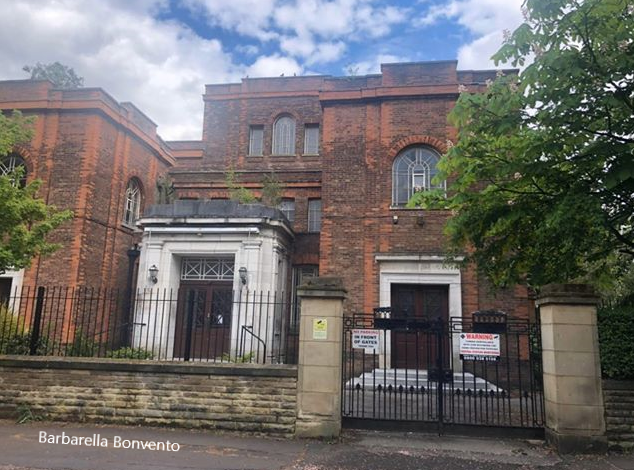
In West Didsbury with the Synagogue ….. doing the essential walk and making it historic .... no. 10

Now I am really enjoying the pictures Barbarella is sending of her essential walks, and today is no exception.

Her Sunday walk began in “Didsbury ending in Chorlton near the M&S- Leon fabrics, and then back via Southern Cemetery”.

And along the way there was the  Shaare Hayim Synagogue which is an impressive building, located on Queenston Road and extending down Old Lansdowne Road.

“It dates from 1927 and is a Grade ll listed building.

Originally, it served the needs of the Withington Congregation of Spanish and Portuguese Jews, which had previously been located on Mauldeth Road in Withington, and which was formed in 1904.

In 1997 the congregation merged with the Sha'are Sedek Synagogue which worshipped on Old Landsdowne Road and was formed in 1924.


Both congregations are from the Sephardic tradition which originated in the Iberian Peninsula, North Africa and Middle East.

The merger resulted in the demolition of the Old Landsdowne Synagogue and the development of the site for residential properties, which allowed the funding of the renovation of the Queenston site”.*

Location; Didsbury

Pictures; Walking in West Didsbury, 2020, from the collection of Barbarella Bonvento

*Chorlton-cum-Hardy Churches, Chapels, Temples A Synagogue and a Mosque, Andrew Simpson & Peter Topping, 2018, pages 160-165