Showing posts with label Manchester in the 1940s. Show all posts

Sunday, 20 September 2026

The forgotten story ………. a little bit of squatter history in Alexandra Park

Now the story of how the military buildings in Alexandra Park were taken over by squatters in 1946 has faded from memory.

The squatter movement was a direct response to the shortage of accommodation after the war much of which was because of war damage but also because some properties had been deliberately left unoccupied by their owners.

The campaign was nationwide and in London was co-ordinated by the Communist Party.

Here in Manchester the first successful squat was at “the gun site near Alexandra Park which housed one family at 8 p.m., but by the following day contained a community of over 20 families and all available huts were occupied.  

Among the first to arrive was Mr. E. Brent, a Dunkirk veteran and survivor of the sinking of the Lancastrian.  

Like Mr Herbert Pendleton, who was first on the field he had brought his wife and child from lodgings and was delighted to be in a place of his own.”*

Within a day the occupants "were visited by a butcher and a milkman and while conditions were primitive and the buildings lacked electricity” two huts have running water, one even boasts a bath and for the others there is a tap in the grounds.”

By the following week the occupants had elected a committee to look after the interests of community and collect money against future demands for rates and other charges, preparation were being made to bring in electricity and just eleven days after the squat began the residents were paying the Corporation rent.

For Mrs S. Middleton this amounted “to eight shillings a week for the hut where she lives with her husband now a clerk and their six year-old daughter, Jean.”**

In the great sweep of the park’s history the story of Mr and Mrs Middleton, and the Brent and Pendleton families may not amount to much, but they remain a forgotten episode which may now provoke a series of memories about that event.

And that would be something given that to date all we have are four newspaper reports and three pictures of a family and their home.


Pictures; outside one of the homes, 1946, Walters, m07247, inside the home, 1946, Walters, m07249 and m07248, courtesy of Manchester Libraries, Information and Archives, Manchester City Council, http://images.manchester.gov.uk/index.php?session=pass

*A Sergeant Major ‘scares’ Salford Squatters, Manchester Guardian, August 17, 1946

** Another Squatters ‘ Victory', Manchester Guardian, August 28, 1946

Tuesday, 15 September 2026

Of horses, an RAF Band and a night at the Cheetham Assembly Rooms in November 1944

Now I wonder just how packed the Cheetham Assembly Rooms were, when the “Full RAF Rhythm Band” played on the Saturday of November 25 1944.

1944
Or for that matter whether the audience knew that part of their 10 shilling ticket entry was going to the Little Horses Charity Fund.

And that set me thinking about the charity and its need for money, particularly when the world was engulfed in a war that would ultimately see the death and displacement of millions, when members of the armed forces were at that moment fighting on mainland Europe and in the Far East and when the surrounding streets bore the scars of nights of German bombing.

I had never come across the Little Horses Charity but a search showed that there were quite a few charities devoted to the welfare of horses as well as other animals, one of which had opened a hospital for animals injured in air raids during the war.

At which point there will be a few who offer up detailed accounts of those welfare organizations particularly
those given over to horses which had a wretched time during the 19th and early 20th centuries when so much of our transport relied on horse drawn vehicles.

1959
I suspect there will also be a few with stories of the Assembly Rooms which opened in 1857 and lasted almost a century before it closed because if declining numbers, and according to one site was bought in 1960 with the intention of turning into a tyre warehouse.*

Now that was an ignominious ending for such a grand place, but its final chapter was perhaps even sadder, for after that century which saw concerts, soirees and late night suppers, it was demolished, with the site becoming first a petrol station and now a car wash business.

1965
All, a long way from the night when “Miss Stitt came as the White Cat and Miss Goldie as the owl in the ivy bush, ....... and Mr Bradshaw as a time-traveller, dressed as ‘a gentleman of the early twentieth century’” during the event arranged by "twenty bachelors of Manchester for 450 ladies and gentlemen on January 19th 1870".*

Leaving me just to thank David Harrop who provided the advert, and comment on the two pictures of the Rooms just before the end.

"Removed to Waterloo Road" 1965
Look very closely and on the second can be made out the notice announcing that “Fitzsimons Tyres Removed to Waterloo Road” and on the first the old telephone kiosk from which members of the band may well have phoned loved ones in the interval.

I doubt that there will be anyone who can offer up a memory of that November night, but I bet there will be quite a few who have other stories of the Assembly Rooms in equally magic nights.

Well I hope so.

Location; Cheetham Hill Road

Pictures; poster advertising the dance, 1944from the collection of David Harrop and the Assembly Rooms in 1959, R. Mirza, m16437, and 1965, W. Kay, m16303, courtesy of Manchester Libraries, Information and Archives, Manchester City Council, http://images.manchester.gov.uk/index.php?session=pass

Monday, 14 September 2026

Out on Bury Road in 1949 ..............

Now, I like this picture, for lots of different reasons.

It was taken just a few months before I was born, out along Bury Old Road.

One day I will go looking for the firm Cornall of Bury, but for now I am content to study the old-fashioned lorry and the three men staring back at me.

Flat caps, overalls and long coats were the order of the day, over the sleek corporate uniforms supplied to transport workers today.

And the rest as they say is for you to discover, leaving me just to point to the bucket of water at the rear of the lorry on the pavement.

Location; Bury Old Road


Picture; Lorry, Bury Old Road, near Heaton Park, February 21st, 1949, from the collection of Allan Brown


Sunday, 13 September 2026

When St Mary’s Hospital in Manchester moved out to Prestbury

I came across David’s story of Collar House in Prestbury and its role in the last world war as an annexe to St Mary’s in Manchester.  He kindly let me reproduce it here.

St Mary's in 1939
Amongst his many activities is the Furness Vale Local History Society and his own blog site, Bricks, both of which are well worth visiting.*

"I was born at St Mary’s Hospital yet my place of birth is recorded as Macclesfield which was where my parents lived at the time.

A little research on the internet has given me some background to the story. 

Faced with the possibility of air raids, the St Mary’s Hospital Board chose to close their City Centre maternity wards. Collar House in Prestbury was owned by the Moseley family who were then living in Wales and in 1939 was rented by the hospital as an annexe. 

This was a large house with extensive grounds. It had its own water and electricity supply as well as a laundry. It was converted to hold 45 beds and had maternity wards and nurseries as well as a theatre, dispensary and accommodation for 30 staff. Nearby Prestbury Hall and Adlington Hall were also to become hospitals. St Mary’s remained at Collar House until 1952 when the maternity wards returned to the City. 

During those 13 years, more than 14000 children were born at the three Prestbury hospitals. Originally a farm, Collar house dates from before 1780 and has been occupied by a number of different families. 


Collar House, date unknown

Collar House, much extended is now occupied by Beaumont Nursing Home.

A book by Mary E. Roberts has been published on the history of Collar House and is available from Waterstones.

The pages of the Manchester Guardian add a little more to the history of this wartime annex of St Mary’s Hospital. The Guardian of 9th December 1939 reported that Collar House had received its first maternity cases that Monday. It was described as a pleasant Cheshire mansion.  

The board of St Mary’s had decided to evacuate cases from a 'dangerous' to a 'safe' location after some deliberation. “Suitable cases” were to be transferred to Prestbury by ambulance leaving more complex cases for treatment at Whitworth Park Hospital.

At the outbreak of war the board appointed Miss D. H. Stuart to Matron-in-Charge. Fifty staff with were initially transferred to Blackpool together with medical equipment. It was soon realised that expectant mothers were unhappy to leave their neighbourhood and the scheme was phased out.


In January 1945, The Guardian reported that the Prestbury Hall Maternity Home had been due to close in a short time. 

The Manchester Public Health Committee, faced with an acute demand for maternity beds had decided that St Mary’s Hospitals should continue running this home for a short time in conjunction with Collar House. 

In March 1946, The Guardian reported that the Public Health Committee had recommended the purchase of Collar House for the sum of £9750. The cost of running the home was £12732 and annual income from patients £4500 leaving a deficit of £8232. The hospital had a capacity for 800 patients a year.

In December 1952 the Ministry of Health had decided to return Collar House to its owner. This would result in a loss of 40 beds. St Mary’s had 82 beds at Whitworth Street and this reduction would threaten its position as a teaching hospital.

In June 1957, a bus crashed in London’s Oxford Street, killing 7 and injuring a further 12. Among the fatalities was Miss Forbes-Graham, matron of Collar House Hospital who was on a week’s leave.  She had worked at St. Mary’s since 1929 and was involved in the evacuation of children from Manchester in 1939.  

She became Sister-in-Charge of Collar House Hospital and continued as Matron when the hospital transferred to the Macclesfield Hospital Group in 1952.


Perhaps that 1946 purchase did not proceed for the 1952 article suggests that it was still being rented, although Collar House remained as a hospital into the 1970’s as part of the Macclesfield Hospital.

I have not seen any reference to any annex of St Mary’s in North Manchester other than the Blackpool episode.  Collar House was used as a convalescent home in the 60’s. I have not as yet found any reference to any other use that Macclesfield Hospital found for the building.

There are several references to Collar House on the internet. One website states categorically that this had been the home of Sir Oswald Mosley, leader of the British Union of Fascists. 

Not very well researched for the Moseley family of Prestbury did not even spell their name in the same way as Sir Oswald."

© David Eastman November 2013

Pictures; St Mary’s Hospital A P Morris, 1939, m53220, courtesy of Manchester Libraries, Information and Archives, Manchester City Council and Collar Hospital from the collection of David Eastman

*Furness Vale Local History Society, http://furnesshistory.blogspot.co.uk/ & Bricks, http://brickcourse.blogspot.co.uk/

Saturday, 25 July 2026

Now …… you can wait for a bit of the past .... then two turn up at the same time …….. outside Manchester Cathedral

So, here are two bits of how we lived.

Both have now long vanished.

The last Manchester Corporation tram completed its last journey in January 1949, months before I was born.

As for the public urinal, I have no idea when it closed, but like the tram it is now just a memory, which I may have used, but have no idea when it ceased.

The statue of Oliver Cromwell went in the 1980s so maybe it went then.

Location; Manchester Cathedral

Picture; Two trams and a urinal, date unknown, from the collection of Allan Brown

Sunday, 15 February 2026

And the lights go back on in Manchester ………. August 17th, 1945*

The caption in the Manchester Guardian on that day in the August of 1945 simply reported “’Manchester Town Hall flood lit for V.J. Day’ A firework has just been sent up from the great crowd in Albert Square.”


Now for those who don’t know V.J. Day’ signalled the end of the war against Japan and followed on a few months after the defeat of Nazi Germany and the close of the European war.

Of course, to be strictly accurate the lights had gone back on ending the blackout on April 30th.* 

But as the Manchester Guardian reported elsewhere in that edition “The floodlit spectacle of London is naturally much grander this time than on V.E. nights”, which I suspect reflected the greater time to organise an event.

Victory in Europe Day had been almost a spontaneous outburst of joy after six long and bitter years of war.

Sadly, there was much more to the original photograph, but the passage of 80 years and the poor storage left the picture much battered.


Location; Albert Square, Manchester

Picture; Victory High Lights In Manchester, The Manchester Guardian, August 17th, 1945 

Friday, 13 February 2026

When the unthinkable had to be embraced ….. invasion 1940

I don’t know how I would have conducted myself had I been alive in 1940, after the Fall of France, and the imminent threat of a German invasion.

Firing postions, 1940
If like now I was 75, I might just have been able to fall back on my own military knowledge gained perhaps from a spell in the Volunteer reserve, and may be during the Great War.

Of course, if I was younger, I suspect that knowledge would have been quite limited.

Either way I guess I would have been apprehensive and if I am honest a bit scared.

But I hope I would have joined the Local Defence Volunteers which everyone knows as the Home Guard.

It was an armed civilian militia and was active from 1940 till it was stood down in 1944, by which time 1.5 million local volunteers had joined its ranks.

Most people today are familiar with the force and may veer towards the comic portrayal of them through Dad’s Army.  Young men and old men, as well as those unfit for military service, who trained with broom sticks and homemade bombs and created their own armoured cars.

But that is not to ignore the commitment and determination of citizens who fully lived up to that line “cometh the hour, cometh the man”, which of course is not to dismiss those women who served in the forces, drove ambulances, and other “first response” groups.

The degree to which the Home Guard made itself ready is witnessed by the many handbooks, most produced by ex- soldiers which were practical guides to warfare for the civilian.

Home Guard Drill, 1940
Rifle Training for War, a textbook for Local Defence Volunteers by Captain Ernest H. Robinson, ran to four editions during July 1940, while Home Guard Drill and Battle Drill by John Brophy was reprinted eleven times between November1940 and August 1943.

They were cheap and small enough to fit into a pocket to be read in the lunch hour or in the evenings.

I have a copy of each, along with the more interesting, New Ways of War, by Tom Wintringham, who in in the forward to his book argued “that war is not a difficult mystery” to be left to soldiers.  Today it is the duty of all citizens of a democracy to understand the business of fighting for a People’s War [which] is the only effective answer to Totalitarian War”.*

He had fought in the Great War, gone to Spain at the outbreak of the Spanish Civil War, later joining and commanding the British Battalion of the International Brigade.

After Spain with the outbreak of the Second World War he volunteered for the British army who rejected him because he was a Communist.

A new way for the Home Guard

Not daunted he opened a private Home Guard training school at Osterley Park, London which taught the skills of guerrilla warfare, but again because of his political views he was side-lined by the army, and he resigned from the Home Guard in 1941.

How to do it, 1940
There is much more including his founding of the Common Wealth Party, received 48 percent of the vote at the Midlothian and Peebles Northern by-election in February 1943, previously a safe Tory seat.

In the 1945 general election he stood in the Aldershot constituency, the Labour Party candidate standing down to give him a clear race against the incumbent Conservative MP His wife Kitty stood in the same Midlothian constituency that he had come so close to winning two years earlier, but neither was elected.

After the war Wintringham and many of the founders of Common Wealth left and joined the Labour Party, suggesting the dissolving of Commonwealth.**

Leaving me just to set myself the task of reading his short book New Ways of War, and perhaps comparing it with the other two handbooks.

Pictures; from Rifle Training for War, a textbook for Local Defence Volunteers by Captain Ernest H. Robinson, 140, and New Ways of War, Penguin Special, 1940

* Tom Wintringham,  New Ways of War, Tom Wintringham, Penguin Special, 1940

** Tom Wintringham, https://en.wikipedia.org/wiki/Tom_Wintringham


Monday, 8 December 2025

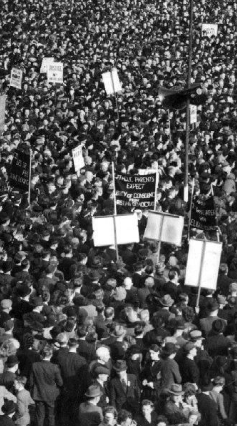
A demonstration …… and the search for a story …. Piccadilly 1943

Sometimes you come across an image that sets you off on a search for answers.

And this picture taken in 1943 in Piccadilly  is just one of those.

The caption is enigmatic to say the least, just, “Piccadilly Catholic demonstration, educational reform 1943”

I can’t get an exact date and none of the placards reveal much as to why so many Catholics assembled in the centre of Manchester at the height of the last war.

The Manchester Guardian failed to cover the event, and I have yet to trawl the local papers.

But this was during the discussions and the Parliamentary debates about what became the 1944 Education Act which “raised the school leaving age, transforming education into a continuous process from nursery to adult and aimed at suiting all talents” *

And while the Government was intent on retaining church involvement in education there arose the issue of funding for new denominational school buildings to replace many that were too small, too old and no longer adequate.

The cost of which was very high and could only be achieved by Government funding.

The White paper of 1942 had observed  “that the Churches with a financial problem greater in extent and no less urgent than that in respect of senior children. This is a problem which they have shown themselves quite unable to meet in recent years and which they are less than ever likely to be able to meet after the war.

51. If large numbers of children are not to be deprived of healthy and decent school conditions to say nothing of equal educational opportunities there is no disguising the fact that, unless a considerable number of voluntary schools are to be brought to an end and replaced by new provided schools, some further assistance from public funds must be found towards the maintenance and improvement of the premises, where such improvement is possible. 

Discussions carried on in recent months with the many interests concerned have satisfied the Government that there is a wide measure of agreement that voluntary schools should not be abolished but rather that they should be offered further financial assistance, accompanied by a corresponding extension of public control which will ensure the effective and economical, organisation and development of both primary and secondary education”.**

All of which alarmed some in the Catholic Church and led to protests including one held at The Hippodrome in Salford on September 12th 1943, which the Manchester Guardian reported “an audience of 2,500 called by the Roman Catholic Parents’ and Elector’s Association passed a resolution demanding the provision of public funds of school buildings where Roman Catholic children can be instructed in accordance with the wishes of their parents”.***

The issue was resolved but that is for another story.

In the meantime I wonder if our Piccadilly protest was linked to that meeting.

Answers on a postcard.

And answers there have been, with a promise from Lawrence Gregory to offer up more information on the issues surrounding the protest.

And Lawrence also pinpointed the event to October 10th, 1943 which was a Sunday, commentating that the demonstrators came from across the North West making up a protest of 50,000 on what was a "beautiful sunny afternoon".****

All the more remarkable given the travel restrictions and difficulties due to war time rail services and that "thousands of Catholics from this Diocese were away on active war service".

Added to which I have Bill Sumner to thank for correcting me for suggesting the demonstration occurred in Piccadilly Gardens, "they are actually on the bomb site behind the gardens where hundreds of buildings were burnt out or destroyed by the services to prevent further spread of fire due to incendiary bombs. 

The Piccadilly Gardens were surrounded by concrete air raid shelters as seen in the background and vegetable gardens for food rations instead of flowers".

Location; Piccadilly, 1943

Picture; “Piccadilly Catholic demonstration, educational reform 1943” m07352, courtesy of Manchester Libraries, Information and Archives, Manchester City Council, http://images.manchester.gov.uk/index.php?session=pass


*The Schools, Manchester Guardian, December 19th, 1943

**White Paper Educational Reconstruction, 1943 pages12-13, https://www.education-uk.org/documents/official-papers/1943-wp-educational-reconstruction.html#03

***Roman Catholic Schools White Paper Protests September 13th, 1943, from the Almanac, 1944

****Henry Vincent, Bishop of Salford, 1943


Thursday, 27 November 2025

Tram jam, ........ waiting for the shift to end at Trafford Park


The caption is not over helpful.  Just “Car 929, AEI Trafford Park.”  

But I guess we will be sometime in the late 1930s or ‘40s.

The photograph perfectly captures that moment just after the end of the shift at AEI.

The long line of trams waits for the workforce which is just appearing through the factory gates.

This was the period when Trafford Park was still a major industrial centre.  In 1945 75,000 people worked there and produced everything from bricks to electric cables, and food.

All of which is well documented, so instead I shall concentrate on the detail.  The first of the workforce is out of the factory and hurrying to catch the first tram.  It is a scene captured countless times in photographs and news reels from the period.

What is missing are the hundreds of of people who any minute will appear on their bikes, reminding us that this was still the time when the cycle was a cheap alternative to the tram or bus.  And of course what we won't see in any great numbers are workers driving home in cars.

I had hoped that the products in the shop might give a clue to a date.  But Robin cigarettes were being marketed at the beginning of the last century and were still being produced in the 1950s, long after our line of trams had gone to scrap heap.

But the shop front in its way is also a comment on the period.  Look closely and almost all of the products being advertised are cigarettes or tobacco.

A timely reminder that this was still a time when smoking was common place and when the upstairs of the bus or tram would be blue from the tobacco smoke.

Much of which would be from the roll up which like the tram is almost a thing of the past.


Picture; from the collection of Allan Brown

Saturday, 2 August 2025

Rational Rationing down at the gas showrooms with Miss Arscott of Whalley Range in 1940

Now this is one of those little bits of history which deserves to be brought out and explored.


It is another advert from my friend Sally who unearthed it from a back edition of the Manchester Evening News and dates from January 1940.

At first glance it is just a trailer for a cooking demonstration, but there is much more.

We are of course at the beginning of the Second World War and the country is once again coming to terms with food rationing, hence the very practical title of “RATIONAL RATIONING.”

The speaker was Dr. C. Arscott who was headmistress of Whalley Range School.

She had overseen its opening in 1939 and would be still be in post decades later.*

And Dr. Arscott was assisted by a team of cookery demonstrators who will have been familiar with the gas showrooms and similar events from before the war.

Manchester Corporation as part of the campaign to promote both the use of gas and electricity had hosted regular demonstrations during the 1930s.

So there you have it.

Picture; from the Manchester Evening News, January 1940, courtesy of Sally Dervan

*I am, yours sincerely, Miss Christine Arscott.... a story from Sally Dervan, http://chorltonhistory.blogspot.co.uk/2015/06/i-am-yours-sincerely-miss-christine.html

Saturday, 18 January 2025

The envelope that told the story of the Manchester Blitz

Now of all the records, the photographs and stories of the Manchester Blitz this little envelope is as powerful a reminder of the destruction that was heaped on the city on the nights of December 1940.

It was sent to W Marsden of 11 St Mary’s Gate but was returned to the Vicarage in High Wycombe, and the various official stamps tell the story.

It had been sent on August 20 1941 but according to the stamp the building was “Gone No Address” and to confirm the fact there was a hand written message “War Damage of property.”

Now number 11 was entirely destroyed during the Manchester Blitz along with all of the buildings opposite on the south side from Deansgate up to Cross Street.

I have yet to track down William Marsden.  I know that in 1911 the address was listed as the Union Bank of Manchester but more than that will need more research.

That said even in wartime the Post Office was more than efficient returning the letter just two days.

All of which just leaves me to go back and look at the directories for 1940 to be exactly sure what business was being conducted just before the blitz and also to look for who was living at the Vicarage.

Location;; Manchester


Pictures; from the collection of David Harrop

Friday, 17 January 2025

Now …. just what is the story behind 100 Vera Lynn 78s?

The answer is several ……… and they all start with David Harrop who bought all 100 from an auction house in Heaton Mersey.


The records come from an estate in Oldham, and while I haven’t the full list, the ones I have seen include, “Goodnight Children Everywhere”, “More and More”, “Jealousy”, “There’s A New World Over the Skyline”, "Nearest Thing to Heaven”, and my favourite “C’est La Vie”.

None of which are her famous ones.  

That said I bet "We'll Meet Again", “The White Cliffs of Dover", "A Nightingale Sang in Berkeley Square" and "There'll Always Be an England", are there, and David will find them.

In the meantime, it’s just the six, all of which he photographed and sent over in an email.  I don’t have a date for any of them and despite finding versions of them on You Tube sung by Dame Vera, neither these or the site devoted to the lyrics of each song have offered up a year.

All that is except for Jealousy which she recorded in 1942.


Of course, someone will know, and will direct me to the place where the songs and their dates are listed, so that at present isn’t the story.

Instead it’s the sleeve covers which have caught my interest, because each of the six comes from a different record shop.

This I know because the names and addresses of the shops are printed on the sleeve cover.

And so I have been going on a Cook’s Tour across Manchester, from the Talkeries at 213 Deansgate, to The Elite Gramophone Depot, at 115 Manchester Road in Chorlton-cum-Hardy, and out to 653 Oldham Road in Newton Heath, where Manson’s claimed to be “The House of Music”.

There was also A Frank’s Ltd, the Gramophone Salon, with premises at 95-97 Deansgate and 46 Market Street, and E, Pennington Gramophone Specialist who sold his records from 1164-1168 Chester Road., Stretford.


Leaving me just Mazel Record Library on London Road which some will remember, and may well have visited to peruse the “40,000 records in stock”.

And when David has compiled the full list of stockists from the 100 78s, we will have a priceless record of shops from the 1940s into the following decade.

Added to which as some of them proudly display the date they were established we can begin to track the history of the gramophone shop across Manchester

All of which can be matched against the directories which contain the names of all such businesses from the late 19th century up to 1969.

What strikes me above all, are the descriptions, running from Gramophone Depot to the Gramophone Salon and the name the Talkeries, which hint at beginnings in the early 20th century and must even by the 1940s seemed outdated.

So that for now is the story …….. not Dame Vera, or the powerful songs, which evoke the war years, but the humble record shop of which there will be more stories to follow.

Location; Manchester

Pictures; sleeve notes from the records of Vera Lynn, 2020, from the collection of David Harrop

Thursday, 8 August 2024

From a factory canteen “somewhere in Britain.”


You have to be a certain age to remember Worker’s Playtime and Music While You Work and even older to have participated.

Both began during the war years and both ran on into the 1960s.  They started as a way of entertaining the workforce and were part of that bigger drive to maintain moral during the war.

They also reflected that more collective style of entertainment where cinema audiences would regularly take part in sing-along’s with the words flashed up on the screens, or in the dance halls where young couples would form up in a procession for the odd dance.

Not that we should be over surprised.  After all in many of the northern towns and cities it had been  the practise that when almost all the factories closed for the wakes holiday many of the workforce went off to the same holiday resort.

And I suppose in the interests of war time morale it made sense to capitalise on this and use it to forge a common sense of unity.

You see it also in many of the films of the period, particularly those dealing with people who were thrown together by the necessities of the war.

In Millions Like Us made in 1943 it was an aircraft factory while The Way Ahead followed a group of civilians conscripted into the army.

What both have in common is that they are about ordinary people from very different backgrounds and parts of the country who have a common purpose.

That common purpose was best expressed in the film Mrs Miniver.  It was an American film made in 1942 but set in a Kent village just after Dunkirk.  Here ordinary people  confronted with fear and danger rise to the occasion.  Mr Miniver using his small pleasure boat takes part in the rescue of the British Army from the beaches of Dunkirk, his wife confronts a German airman and the class barriers in the village are broken down.

And it finishes in the church with a sermon.  The building is in ruins and the village has come together to mourn the loss of those killed in an air raid.

The local inhabitants assemble at the badly damaged church where their vicar  affirms their determination in a powerful sermon:

“ We in this quiet corner of England have suffered the loss of friends very dear to us, some close to this church....... There's scarcely a household that hasn't been struck to the heart. And why? Surely you must have asked yourselves this question? Why in all conscience should these be the ones to suffer? Children, old people, a young girl at the height of her loveliness? Why these? Are these our soldiers? Are these our fighters? Why should they be sacrificed?

I shall tell you why. Because this is not only a war of soldiers in uniform. It is the war of the people, of all the people. And it must be fought not only on the battlefield but in the cities and in the villages, in the factories and on the farms, in the home and in the heart of every man, woman and child who loves freedom. ....... This is the People's War. It is our war. We are the fighters. Fight it then. Fight it with all that is in us. And may God defend the right.”

And so back to where I started and those two wartime radio programmes.

Music While You Work had begun in the June of 1940 and was a daytime radio programme of continuous live music.  It was broadcast twice a day on workdays and consisted of music from light orchestras, dance bands and military bands.

Worker’s Playtime began a year later in 1941 and was broadcast at lunchtime, three times a week from a factory canteen “somewhere in Britain.”  It was a mix of music and comedy and featured many of the most popular acts of the time.

Much of the humour played on the everyday niggles of war time, so when in the September of 1942 Gert and Daisy (Elsie and Doris Waters)* did a lunchtime session they made light of such things as the quality of the food and that old standby the gas mask which was guaranteed to get a ready response.

“I’ve just had a row with the fishmonger, it’s the fish he sold me, just smell this” 
“Oh it’s a bit on the turn, on the turn is that.” 
“On the turn its half way up the plate”

“What you carrying your gas mask around for?  
“You don’t do that at home.” 
“Well I’ve got to carry the shopping home in something”

And the usual mix of light humour which could have been heard on music halls across the country.
“Is your face dirty or is it my imagination?” 
“Well my face is clean but I don’t know about your imagination.” 

And, “Listen to this from the newspaper, ‘Dear Betty I’ve been walking out with my young man for 20 years.  Do you think it would be alright to kiss?'
After 20 years you wonder if they can remember what they are walking out for.”

Both shows survived into the post war period but a decade later they seemed a little old fashioned and a bit to reminiscent of a time gone by.  So Workers Playtime finished in 1964 and Music While You Work three years later.

And I have to admit by the time I was in my teens I too rather thought they were old hat, but with the passage of time I can see the purpose they played, the affection they were regarded in and just how entertaining some of them still are over 70 years later.

Pictures; Women in an ordinance factory, 1951, m08082, and textile workers, 1931, m 59215, courtesy of Manchester Libraries, Information and Archives, Manchester City Council, and groups of workers and hospital staff from North Shields, some of whom like my father had been conscripted in war work as a driver, from the collection of Andrew Simpson, and front cover of the DVD version of Millions Like Us

Gert and Daisy - Won't We Have a Party, 1942 British Pathe, http://www.youtube.com/watch?v=MQ_md44bOfQ

Tuesday, 18 June 2024

Remembering Byrom Street in Manchester in the 1950s

Byrom Street, 1944
It is easy to over romanticise life in the narrow streets of places like Castlefield, Hulme and Ancoats in the middle decades of the last century.

There was certainly a sense of community and a willingness to stand by each other, but that can’t really compensate for homes which long ago had passed the test of decent places to live, areas dominated by noisy factories and the smell of all sorts of industrial workshops and where there was very little in the way of open spaces, grass and flowers.

Many of us are aware of the awful conditions of parts of Manchester in the 19th century but pass over those middle decades of the following century.

Not only were many of the worst properties still standing but the war had put on hold the slum clearance plans as well as actually creating a housing shortage.

So today I want to concentrate on the memories of Lisa’s mum who was born in 1946 and grew up in Byrom Street just behind Deansgate.

Today it is a mix of new inner city living, and swish office blocks.

Some of the first new residential properties were built at the southern end of Byrom Street in the 1970s soon after the courts and alleys filled with houses from the late 18th and early 19th centuries had been cleared away.

The more elegant town houses of John Street and part of Byrom Street have now all become offices and exist beside new commercial properties which have gone up at the beginning of this century.

Byrom Street, 1965
But back in the 1940s and into the 60s this was still a residential area and even after the families moved out little really changed till the developments of a decade ago.

“My mother was one of 14 children. Mum was born at St Mary’s hospital on 15th November 1948, making her their 9th child.

The family lived in the middle of 3, 3 storey houses on Bryom Street overlooking where the playground once stood on St John’s gardens.

My grandparents lost their first born, a son named Joseph when he fell into the canal close to their home. The child was just 3 years old at the time.

He couldn't be saved as his leg became trapped in some discarded machinery which had earlier been thrown in. My grandma worked as a live out housekeeper for a doctor’s family on St John’s Street & my grandfather worked on the railway.

My mum attended Atherton Street School with some of her siblings whilst the others attended St Marys School.

Life was a struggle so Wood Street mission would invite the family to their Christmas parties where mum & her siblings got a gift from Santa.

My grandfather did like a drink & spent many hours in a pub called the Ox* which I think may still be there. [on Liverpool Road]


Byrom Street, 1947
The family had to move around 1957 when the houses were being pulled down.

Mum said they topped & tailed with 4-6 sleeping in each double bed with my grandparent’s coats as covers. 

The fire would only be in use once my grandfather was home and he was always given the best foods. 

However he did protect each of the children & wouldn't let anyone say a wrong word against them.”

*The Ox was the Oxnoble pub named after the Oxnoble potato which was landed at Potato Wharf close by

Pictures; Byrom Street in 1944, City Engineers Department, m78877, Byrom Street, left hand side, 1965 J Ryder, m00691, and Byrom Street, early Victorian shops, 1947 T Baddeley, m00659, courtesy of Manchester Libraries, Information and Archives, Manchester City Council, http://images.manchester.gov.uk/index.php?session=pass


Friday, 5 April 2024

At Victoria Station ............... on the morning of December 23 1940

This is platform 16 in Victoria Station on the morning of December 23 1940 just hours after the all clear had sounded on what had been the first night of the Manchester Blitz.

Now the story is pretty well known and so rather than retell the events of the two nights with the dismal record of death, and the destruction of property I will just linger on these two pictures.

I wasn’t there and given that the events were 77 years ago there will be few who were.

But the photographs vividly convey the damage, from the collapsed and twisted metal to the empty roof devoid of glass.

And of course there would have been that powerful smell of smoke which got everywhere and would cling to your clothes long after you had left the scene.

The images come from the collection of David Harrop and were I think press photographs.

Of course there will be people with up todate pictures of Victoria Station but I leave it up to them to post them as a comparison

Pictures; Victoria Station, December 23 1940 from the collection of David Harrop

Sunday, 10 December 2023

Ghost signs from a long ago conflict


The caption is less than revealing and merely states that it’s Oxford Road, Site of Students Union.

.Now I am a little puzzled because the student’s union building on Oxford Road was put up in 1958, and opened by Harold Macmillan, all of which is a little confusing but will no doubt be sorted out by someone who knows more than me.

My interest lies elsewhere and it is in the buildings themselves.  First I have to say they were grand looking houses, and back in the 19th century were the homes of the comfortably well off.  But I guess by the 1950s had seen their best, although perhaps with some tender care and attention they would have “come up nice.”

For me, toady it is the hand painted sign n the wall that has attracted my attention.

EWS stood for Emergency Water Supply and is a reminder that during the last war an air raid might not just destroy buildings but punch big holes in the roads underneath which were carried the utilities, including water.

And the loss of a water main during an aerial attack could be the difference between containing fires and just watching them burn.

These signs were still very much in evidence when I was growing up but it’s now sixty-eight years since the end of the war, and most of the buildings that carried that EWS have been pulled down, and even where that’s not the case the signs will have long since faded and joined the many other ghost signs whose stories have all but vanished.

Picture; Students Union Oxford Road, 1960, m03829 courtesy of Manchester Libraries, Information and Archives, Manchester City Council, http://images.manchester.gov.uk/index.php?session=pass


Wednesday, 9 August 2023

The Chorlton mysteries …….. which stubbornly keep their secrets

Sometimes despite a heap of research the stories just don’t come together.

Bomb damage, Manchester, 1941
And so, it is with a family of four who “were killed by enemy action in March 1941” and the mysterious link between a house in Chorltonville and the Nazi propagandist, Lord Haw Haw.

Both stories emerged from conversations during the week and in their different ways both seemed promising avenues of research.

The Smith family are buried in Southern Cemetery in the consecrated section T close to Barlow Moor Road, and a search of the City Council’s burial records list them as Eliza, Joseph, Ada and May.

I haven’t seen the grave yet, but Ed passed over the details and wondered where they may have lived.

I thought the bomb maps might offer up a location for their home, but that does depend to some extent on knowing where to look.

Barrage Balloon, 1940, Chorlton
Alas so far, I can’t find them on the 1921 census or the 1939 Register and while there is a reference to an Eliza Smith born in 1866, I can’t be sure this is her.

Nor do they appear in the list of dead killed on March 11th or the following day in one data base.*

Now given the confusion of war I fully accept that some records went missing, but it just ads to my failure.

And in the same way I haven’t been able to make a link between a house in North Meade and Lord Haw Haw, which was the was the “nickname applied to William Joyce, who broadcast Nazi propaganda to the UK from Germany during the Second World War. 

The broadcasts opened with "Germany calling, Germany calling", spoken in an affected upper-class English accent”. **

The possible link was suggested by one of our guests at the recent book launch, who said her mother had maintained that there was a connection between the house and the Nazi who had been an active Fascist in the 1930s before fleeing to Germany just before the outbreak of the war. ***

The census returns for 1921 and the 1939 Register threw up different people living at the property but as yet I can’t trace a connection to either the British Union of Fascists or to William Joyce.

The Meade, circa 1930
Nor so far I have come across a reference to Joyce in Manchester, despite trawling the Manchester Guardian, but then he was “Director of Propaganda for the British Union Of Fascists” and as such spoke at meetings around the country, so it is possible he appeared at a BUF meeting in the city or the surrounding area. ****

Now I not arrogant enough to suppose that just because I failed someone else will not be more successful, which lays down a sort of challenge.

But for now that is it, other than to record that Chorltonville appears unvisited by Goggle Maps which would have been a quick way of refreshing my memory of the said house on North Meade.

Chairs as weapons, Rotherham, 1936

So, we have all learnt something, apart from those residents of Chorltonville who already knew that Goggle Maps has not wandered down its leafy ways.

The Meade, 1913

Location; Manchester

Pictures; Blitz bomb damage, 1941, m08608, Fight at fascist Meeting, 1936courtesy of Manchester Libraries, Information and Archives, Manchester City Council,  http://images.manchester.gov.uk/index.php?session=pass barrage balloon on the Rec circa 1941 from the collection of Allan Brown, and the Meade, 1913, and circa 1930s from the Lloyd Collection

*Luftwaffe Over Manchester, The Blitz Years 1940-1944, Peter J C Smith, 2003, Neil Richardson

**Lord Haw Haw, https://en.wikipedia.org/wiki/Lord_Haw-Haw

*** The book …. some poems … a cake and the mystery of Lord Haw Haw in Chorltonville, https://chorltonhistory.blogspot.com/2022/11/the-book-some-poems-cake-and-mystery-of.html

****Fight at Fascist Meeting Chairs as Weapons, Manchester Guardian February 14th 1936