Showing posts with label St John Street. Show all posts

Monday, 20 May 2024

The secrets of St John Street

Now I discovered St John Street about a month after this picture was taken and became captivated by these 18th and early 19th century houses. 

South side of St John Street, including number. 11, 1969
And a lot of other people have also been fascinated by them and you can see why because in a city which is constantly reinventing itself these are a link to a time when Castlefield was being developed.

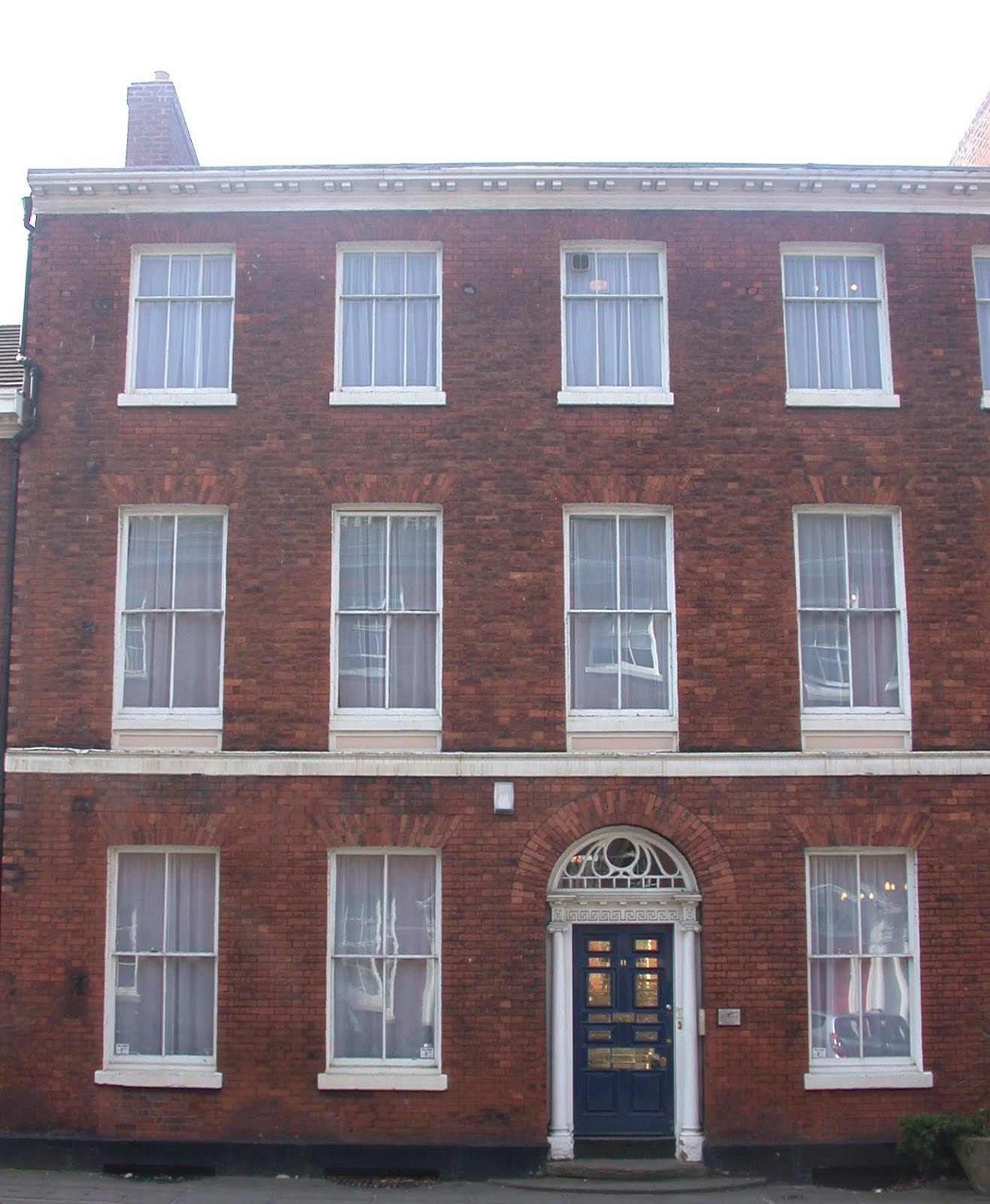
Added to this over the years I have become intrigued by one house in particular, which is number 11.

This was the home of the Holt family who built the house in the early 1790s and occupied it well into the middle of the following century.

They had made their money from making the wooden engraving blocks used in calico printing, went on to own an extensive portfolio of properties in the surrounding streets and in the 1830s settled in a fine house in Chorlton-cum-Hardy.

South side of St John Street, including number. 11, 2011
The first to make the move to the country were James and Hannah Holt who were followed by their children and grandchildren.

And during the writing of the Story of Chorlton-cum-Hardy I not only got permission to tour number 11 but was given access to the deeds.

The 1969 image of the street have been unearthed by who came across it while engaged in a new project working on the Town Hall Photographer's Collection Digitisation Project, in the Central Library, which currently is Volunteer led and Volunteer staffed.

The negatives in the collection are dated from 1956 to 2007 and there are approximately 200,000 negatives to be digitised at three minutes a scan.

There are a dozen or so in the small collection and what struck me is that in those that contain people all of them are dressed in jackets and ties and in the case of women all carry those handbags.

But for me the other surprise was that modern bit of building which ran from the double fronted number 11 back towards Deansgate.

Detail of St John Street, 1969
I remember at the time thinking how out of keeping it was with the sweep of elegant period houses.

And then I guess sometime at the turn of the century I noticed that the spot was now occupied by a row of imitation 18th century properties.

For a while I was puzzled and almost doubted that they were relatively new, but Neil’s picture confirms my memory.

Pictures; St John Street, 1969, courtesy of Manchester Libraries, Information and Archives, Manchester City Council, http://images.manchester.gov.uk/index.php?session=pass and in 2011 from the collection of Andrew Simpson

Friday, 23 February 2024

My back buildings ........ posh places with history

Now there is no doubting that 11 St John Street in the heart of the city was a pretty impressive address and it was the home of the very wealthy Holt family.*


It had been built around 1794 and despite some very modest cottages on Camp Street and the surrounding streets it was still  open countryside with fields west all the way down to the river, and the same south to the canal basin at Castlefield.  This was very much living on the edge of the city.

And the rear of the house, has always fascinated me, with that tall window which dominated the central staircase giving views down on the surrounding streets.

Views which included the mean and cheap poperties of Camp Street and its courts.

All of which were in direct contrast to John Street and especially number 11 which was the only double fronted property on John Street.

The Holt's were very comfortably well off, and by degree each generation decamped to a a fine country house in Chorlton-cum-Hardy

Location; Manchester

Pictures; 11 John Street, 2022, and 2010, from the collection of Andrew Simpson

*The Holt Family, https://chorltonhistory.blogspot.com/search/label/The%20Holt%20family

Thursday, 3 June 2021

Who wouldn't want to live at 11 St John Street?


Now there is no doubting that 11 St John Street in the heart of the city was a pretty impressive address and it was the home of the very wealthy Holt family.*

It had been built around 1794 and despite some very modest cottages on Camp Street and the surrounding streets it was still  open countryside with fields west all the way down to the river, and the same south to the canal basin at Castlefield.  This was very much living on the edge of the city.

True along the river there were some dye works and beyond the Duke’s Canal** a small lime works but that was it.

And even as late as 1819 there was still open land down to the river and across to the canal.  But I rather suspect the writing was on the wall.

The Byrom family had entertained high hopes that the area would be developed along the lines of St John Street with fine late 18th century town houses but it was not to be.

And the coming of the Liverpool and Manchester Railway across the Irwell and part way up Liverpool Road sealed the fate of the area.  Soon it would be warehouses and lots more mean and small cottages which would dominate.

So in a sense it is a surprise that the very wealthy Holt family stayed there as long as they did because they didn’t leave for their very fine estate in rural Chorlton until the mid 1850s, by which time all those fields west down to the river, and south to the canal basin at Castlefield were built over and were either mean small and basic working class cottages or warehouses and timber yards.

Now to be fair, John Holt had to wait till his father died to inherit the pleasant Beech House, but there were other places.

Still when you see the inside of number 11 you can see why perhaps they continued in the heart of the city.

The pictures were taken with the kind permission of the manager, Liz Wilson who actually lived on the top floor back in the 1960s.

Now much of the grandeur has vanished but something of the style and comfort is still apparent and remember from that big bay window which spread across two floors the Holt’s could have views the one up one down properties of Holt’s Place, James’s Place and John’s Place.


Location; Manchester


* Now the contrast is with Span Court and partially enclosed court of six back to back houses in the next street https://chorltonhistory.blogspot.co.uk/search?q=Spam+Court

** The Bridgewater Canal

Pictures; from the collection of Andrew Simpson

Monday, 26 April 2021

A little bit of Deansgate in Thornham

Now, for most of us history doesn’t get any better than when you can touch something from the past.

St John's Church, 1924

And when that something comes from a building which was demolished 90 years ago it just gets better.

The romantic in me remains fascinated at being able to hold an object which some one else long ago was familiar with.  

And it works on several different levels.  

First there is that link with a different time and possibly someone whose outlook and experiences were so different from my own, which sets off that imaginative trail of wondering who they were, and how their life turned out.  

Added to which there is that fanciful idea that somewhere will be that person’s fingerprints.

Interior of St James', 2021

But being realistic I know the chances of any fingerprints still being on the object are pretty remote, while trying to conjure up a past life is not very historical.

Still, I was quite excited when Mark Johnson responded to a story I posted on Deansgate, with “Is that the tower of St John’s Church - there are many items from St John’s Church installed in my church at St James Thornham near Royton and Rochdale - including the congregation pews and the historic wardens pews?”

And then proceeded to add some pictures, including at my request one of the exterior of the church, with the comment, “Pews from St John’s Deansgate including the historic Wardens Pews.  

St James Thornham was consecrated in 1928 which coincided with the sad demolition of St John’s Deansgate.  Sadly, St James’s  was never completed and is missing the Bell Tower, North Aisle and original vestries.”.

Interior of St James', 2021

But what a bonus, to have a collection of church furniture dating back to the late 18th century.

St John’s was established in 1769 and demolished in 1931. Its site is now that of St John's Gardens, situated between Lower Byrom Street, Byrom Street and Quay Street.*

My copy of The Stanger’s Guide to Manchester, published in 1850,  …. tells me that as well as having a peal of bells and a clock, “the church contains three galleries, in one of which there is a very good organ”, a collection of stained glass including “two coloured windows … under the south gallery which were brought from a convent at Rouen in France”.

Interior of St James', 2021

The “first marriage was not until 1804 … and the times of the service  on Sundays, are at half-past ten, and half-past six.”

So, while I will never now be able to attend either of those Sunday Services, a visit to the church of St James Thornham near Royton sems a neat link with the past.


Location; Manchester & Thornham


Interior of St John's 1994

Pictures; St John Street, and St John’s Church, 1924, Phipson-E-A, Watercolour, m80190, courtesy of Manchester Libraries, Information and Archives, Manchester City Council, http://images.manchester.gov.uk/index.php?session=pass and pews in at St James Thornham near Royton and Rochdale, 2021, from the collection of Mark Johnson, and the interior of St John's, 1894, H E Tidmarsh, Manchester Old and New, Vol 11, William Arthur Shaw, 1894

* St John’s Church, Manchester, https://en.wikipedia.org/wiki/St_John%27s_Church,_Manchester

**The Stanger’s Guide to Manchester, H.G. Duffield, 1850, pages 27-28