Showing posts with label London in the 1950s. Show all posts

Monday, 31 August 2026

One 1951 Festival ….a sliding Doors Moment …. and Mr. Feinstein of New York and New Haven

I have no recollection of the Festival of Britain.

Cover to the Guide Book, 1951

Somewhere beyond the Festival buildings was me, 1951
It was held in the summer of 1951 and looking at this picture postcard taken from across the River beyond the Festival buildings and out into southeast London there will be me.

I was just 20 months old, and we were living on Lausanne Road in Peckham

But given that it was summer, dad would have been working away and whether mum went on her own or with me I have no idea, and the passage of time has obliterated any chance of finding out.

My Wikipedia tells me that “The Festival of Britain was a national exhibition and fair held throughout the United Kingdom in the summer of 1951. 

Funded chiefly by the government at a cost of £12 million, it was intended to give the British public a sense of recovery and progress after the devastation of the Second World War, and to promote British science, technology, industrial design, architecture and the arts. 

It proved immensely popular, with more than ten million paid admissions to its six main exhibitions, and helped reshape British arts, crafts and design for a generation”. *

Within a decade of its opening, I was wandering the former site as a curious young kid with heaps of spare time, and later still as a teenager I would be drawn to the Royal Festival Hall and a host of concerts.

The Hall was opened in May 1951 and was part of the Festival of Britain.

Festival collection, 1951
The Skylon, 1951

At which point it would be easy to slide into telling the Festival’s story but there are very good accounts already in print as well as documentaries and that wonderful 1956 film The Long Arm which starred Jack Hawkins and featured the Festival Hall still shinny and new.

So, I shall be content with more images drawn from the back catalogue of Tuck and Sons picture
postcards of the Festival and instead wander off on a Sliding Doors moment which as every one knows who has seen the 1998 film of the same name, explores the idea that there can be mundane but pivotal moments which hold the possibility of a change in the course of a person's life.

Mr. Feinstien's offer, 1951
Now I don’t want to over exaggerate the Sliding Doors moment but contained in those Tuck cards was one addressed to a John Quinn of 271 New Litchfield Street, Torrington, Connecticut with an invite to visit “our store” to see “the distinguished collection of new woollen and gentleman’s accessories for 1951”.

The card was post marked London and dated August 29th, 1951.

And of course I was drawn in, but there began the problem, because the handwriting was bad and at first it was impossible to decipher Mr. Quinn’s address and I was forced back on a search of all streets in Torrington beginning with the word New, which proved to be a success, and gave me New Litchfield Street.

271 New Litchfield Street, Torrington, 2019
Armed with the address, Google Maps provided a street and a house.  

Now I can’t be sure that number 271 in 2019 is indeed the same property which Mr. Quinn occupied sixty-eight years earlier, but if it was, he was living in a three-storey timber clad house set in its own grounds, and surrounded by other houses of a similar design.

The curious in me is tempted to dig further into the story of Torrington, write to the town council and ask for assistance, and maybe I will strike lucky.

Torrington is a former mill town along the Naugatuck River Valley with a population of 35,000 which is just 6,000 more than when Mr. Quinn called it home.  

It has a Republican Mayor, can claim thirteen sites on the National Register of Historic Places and a water course called the Gulf Steam which rises in the Appalachian Mountain region of Torrington.  Added to which amongst its list of notable people is the abolitionist, John Brown.

All of which is worthy of more research and is not bad for a Sliding Doors Moment.

But I was puzzeled as to why Mr. Quinns’ picture postcard was over printed with the name Fenn Feinstein with offices at 9 E. 49th Street., New York and 264 York Street., New Haven on what was a bog-standard card printed in England. 

But the answer lies in the name of the man who sent the picture post card.  

He was Jack Feinstein and according to the John F. Kennedy Presidential Library and Museum the “Frank Brothers was a prestigious New York City retailer and custom tailoring establishment that reached its peak influence in the mid-20th century. ”.**

264 York Street, New Haven, 2025
Of which there is more but for that you will have to follow the link.

Alas their New York store has gone but the New Haven one is still there and is an elegant building reflecting the firm’s stature as a business dealing in the “sophisticated and sometimes flamboyant Ivy League style, the brand was often associated with high-end menswear alongside names like Brooks Brothers and Dunhill. 

The firm was recognized for its custom-tailored suits and high-quality ready-to-wear items, including footwear and silk shirts.” **

Leaving me just to observe that while the postage stamp was removed, I can offer up one from another picture card posted the day before and bound for Belgium.

Location, London, 1951, Torrington, 2019 and New Haven, 2025

Postage stamps for the sending, 1951
Pictures; The Festival of Britain emblem, designed by Abram Games, from the cover of the South Bank Exhibition Guide, 1951, the collection of picture postcards of the Festival of Britain from Tuck and Sons, courtesy of DB Tuck, https://www.tuckdbpostcards.org/, and 271 New Litchfield Street Torrington, Connecticut, 2019, and 264 York Street., New Haven 2025, courtesy of Google Maps

*The Festival of Britain, https://en.wikipedia.org/wiki/Festival_of_Britain

** John F. Kennedy Presidential Library and Museum, https://jfk.artifacts.archives.gov/people/3552/frank-brothers--fenn-feinstein/objects


Saturday, 27 June 2026

This Is London ........ a unique guide to the London of 1959

Now I have no idea why I never got a copy of This Is London.*

Cover of This is London
I guess that there are only so many books that you can get for Christmas, and with the Eagle Annual and the odd history book that was enough.

Not that I think I would fully have appreciated it back then when I was only ten all of which is so different now.

It is a witty, informative guide to the London I knew as a child and is full of marvellous images in the style of the period and these alone take me back nearly sixty years.

But it is also the humour which shines through and marks it as something original.

It starts with a page of brown sludge with the occasional splash of yellow accompanied with “Well, this is London. 

 But don’t worry, it is hidden in fog like this only a few times a year in winter. Most of the time it looks- like this!”

And that is the start of a wonderful series of bright colourful and exciting paintings of London with a text to match.

All of which is a riveting read and one that has now become a history book in itself.

So much so that the new edition which was published in 2004** has updated some of the entries,  pointing out for instance that “Today the Billingsgate fish market is located in the Docklands, a rejuvenated section of the London Docks.  It moved there in 1982.”

Now that move passed me by and while I have no doubt it was for the best I have vivid memories of the market, the over powering smell and the debris left on the streets on a Saturday morning only hours after the traders and the fish had left for shops across the city.

Three million passengers are carried daily in Underground trains
It is just one of the moments which bounced out of the past along with those electric milk floats, old Routemasters and a river which was still a working river full of ships from every corner of the world unloading their cargoes under the shadows of tall cranes and massive warehouses.

All of which I remember and for those like my own lads who never knew that London, Mr Sasek’s book has it all.

And so as you would expect I have gone looking for other editions in the same series which included, Paris, Rome, New York, and San Francisco.

In time I might order up the reprints of New York, and San Francisco, but at present I am content to wait for the arrival of This is Rome which was originally published in 1960 and reprinted in 2007.

Like This is London it has an page of updates which will be fun to match with the original text and my own memories of a city we regularly return to.

Now ever one to respect copyright I held off posting and substitute the same story but with images drawn from the collection.

However after contacting the publisher it appears at present no one knows who owns the copyright to the illustrations, so as the blog is no commercial and this is about encouraging everyone to buy read and share the booksof Mr Miroslav I can't think anyone will object, but if they do I shall revert to the original.

And for those intrigued by the books there is a site dedicated to the author and his books.

Picture; cover from This Is London, and Underground train page 42 courtesy of Universe Publishing

*This Is London, Miroslav Sasek, 1959

**Universe Publishing, a Division of  Rizzoli International Publications, New York, www.rizzoliusa.com

***This is M Sasek, http://www.miroslavsasek.com/index.html

Thursday, 28 May 2026

Melting tar …… a busy butterfly ….. and a long lost adventure

Now the thing about getting old is that there seems to be heaps more time for the memories of the past to invade the doings of a busy day.

Shallow ponds and lazy streams, 2018 
And once that flight of nostalgic fancy starts to run its course it is easy to reflect on how your experiences of 60 odd years ago diverge from those of your kids or grandchildren.

I say that, but much of what our sons did when they were younger are only now being revealed as in their own bouts of nostalgia, they share stories of daring dos which they wouldn’t dare to have admitted to when they were 10.

Some of those stories do resonate.  Their adventures on the meadows on long summer days, chime in with my own, when armed with just a warm bottle of lemonade and a day stretching ahead of us, we wandered off in search of adventures in some faraway park, or along a stretch of the Thames.

Often it was at the end of a train journey or the limit of a Red Rover bus pass, and it usually involved a quiet suburban spot, unhindered by other people. 

One such place was at the end of a railway line, and rather than explore we just sat on the platform.  

There were no trains, no passengers and the only sound was that of a lazy insect collecting pollen, mixed with that distinctive smell of mown grass, which competed with the equally powerful smell of the oil-soaked wooden railway sleepers cooking in the sun.

We must have sat there for hours before boredom and the empty bottle of lemonade prompted us to move on.

The spot where we played  with the hot street tar in 1958
These of course can be replicated by our kids, but those of exploring bombsites have gone as is the simple pastime of watching the tar slowly melt on a hot summer’s day sitting on the side of the road and carefully making patterns of the black oozy stuff with a discarded lolly stick.  

Today the street surface doesn’t melt, and the lolly sticks are no longer there in abundance.

And in the same way those Clean Air Acts of the 1960s have happily done away with the heaps of polluted air which in turn gave us the smog’s which meant we got sent home early from school making our way along roads devoid of landmarks.

Nor today are there those thick sooty deposits on trees which when you climbed them left your hands and clothes grubby and grimy.

But enough of such nostalgic tosh.

Smog's and fogs, 1953
Our grandchildren I hope will never have to use bomb sites as playgrounds or come home with soot smeared clothes.

These they can leave to their imagination fed by granddad’s tales of aimless adventures on long ago summer holidays in that place called the 1950s.

I might try and pretend this is all about the historical context, but perhaps it is just a nostalgic wallow.

Location; nostalgia land

Pictures; Shallow ponds and lazy streams, 2018 from the collection of Andrew Simpson, the spot where me and Jimmy O' Donnel played in with the hot street tar in 1958, from the collection of Liz and Colin Fitzpatrick, 2015, and Nelson’s Column during the Great Smog of 1952, N T Stobbs, licensed for reuse under the Creative Commons Attribution-ShareAlike 2.0 license.


Friday, 20 June 2025

Sweet Thames Flow Softly*


The Thames Flows Down is another of those wonderful children's books written in the 1950s.

It was the companion to  A Valley Grows Up by Edward Osmond.*

The Thames Flows Down was  written by Laurie Osmond and  illustrated by Edmund and tells  the story of the River Thames from its small beginnings to the point when it flowed into the sea.

It is a  mix of history and geography, with the added bonus that it was written in the 1950s and perfectly captures the river and London at a point in time now long gone.

This is my river, that working waterway, when there were still warehouses on the south side facing the Tower of London, and when the docks still provided serious work for many families.

As a child I remember it all and even in the 1960s have memories of barges gently banging together on the tide beside the Cutty Sark pub on long summer evenings.

All of which may seem romantic tosh but it is about the Thames and its impact on those who lived along its banks and relied on it for work long before it became a mere backdrop for luxury flats and flash office blocks.

So I will close with the final words taken from Laurie’s book which pretty much sums up the flow of that river beside which I was born at Lambeth on the south side of the river  which was home for my  first 19 years.

“Back in the quiet reaches of the Upper Valley the Thames still pours steadily seaward through tranquil meadows, where owls are screeching and night jars churr in the trees.  Otters hunt and play, vixen steals for her cubs.


Over the pulsing heart of London an orange glow stains the sky.  The dark, running water is bright with reflections from the City’s embankments, yellow lamplight from bridges pierces the blackness of the tide-race round the piers.  

A police patrol boat slides silently upstream.  A light over Westminster tells that Parliament is still sitting, and along the wharves cranes still work for ships that must make the punctual tides.”


Back in the 1980s I wrote to Mrs Osmond seeking permission to use some of the illustrations from the books in history lessons and she kindly granted permission.

Sadly both books are out of print but maybe one day the O.U.P., will republish both books.  I hope so.

Pictures; from The Thames Flows Down, Laurie Osmond

The Thames Flows Down, Laurie Osmond, O.U.P., 1957

*Sweet Thames Flow Softly* by Ewan Mccoll, https://www.youtube.com/watch?v=zmn5pOxb2iM

**A Valley Grows Up http://chorltonhistory.blogspot.co.uk/search/label/A%20Valley%20Grows%20Up

Pictures; from The Thames Flows Down, Laurie Osmond

Friday, 13 June 2025

The story of one house in Peckham number 5 ............ an adventure out beyond Deptford

The story of one house in Peckham over a century and a half, and of one family who lived there in the 1950s.*

The river, 1977
It is just one of those things that when I look back to the Peckham of my child hood the sun always shone and there were plenty of days when it was so hot that the tar at the side of the roads would go sticky.

And on such days like that with breakfast eaten, the day stretched out and adventures beckoned.

When I was older we would go down to Queens Road Station and take a train to where ever two shillings return would take us.

Sometimes we struck gold and explored new places refreshed by Tizer and a packet of fruit salads and on other less successful jaunts the journey ended by a dismal canal with the threat of rain and a feeling of supreme disappointment.

But in the summer of 1959 trains were for the future, instead Jimmy O’ Donnell, me and John Cox set off down Queens Road and on to Deptford with no clear idea of where we were going other than a vague plan to  reach Greenwich Park where Jimmy said there was and a bit of sandy beach by the river.

And still the memory of that walk has stayed with me along with the discovery of Blackheath all of which became even better as we walked through the park to stand beside that statute of Wolfe with the Thames and all London laid out before us.

Walking to the foot tunnel, 1977
It could all have been even better, had we made the right choice at the Cutty Sark, and found that bit of sandy beach.

Instead at the foot tunnel we made the wrong decision.

Having reached the entrance to the foot tunnel we took the steps down to the waterside and on a whim turned upriver and wandered beside the beached barges only to sink into ozzy oil soaked mud.

None of us sank deeper than our ankles but we were terrified and had to be rescued which added to the shame but was nothing compared with the long walk home and the knowledge that explaining how we came to be covered in a mix of Thames mud and oil would require a fair bit of imagination.

To my lasting shame I blamed Jimmy and John.  It was a lie I have carried with me a full 55 years only owning up to Jimmy recently.

Looking back of course it could have been worse but I rather think not very much worse.

And of course that was pretty much how it was back then.

You knew the bits of Peckham to avoid which still left vast areas to be explored from the Rye back across to our own park on Telegraph Hill and down into edgy Deptford.**

In between there were more parks, plenty of bombsites and Nunhead Cemetery a place best visited in the late afternoon when the officials were busy but a place to be out of before dusk.

Pictures; looking down Greenwich, and out across the Thames at Woolwich, 1977 from the collection of Jean Gammons

*The story of one house in Peckham, http://chorltonhistory.blogspot.co.uk/search/label/The%20story%20of%20one%20house%20in%20Peckham

**Peckham, http://chorltonhistory.blogspot.co.uk/search/label/Peckham


Sunday, 11 May 2025

At the Tower of London in the summer of 1955 and other childhood memories

Outside the Tower with Nana, 1955
I can’t say I remember this day at the Tower of London.

It would have been I think in the summer of 1955 and Nana would have been on one of her all too infrequent visits to London from Derby.

This will have been the first time I visited the place and pretty much set me on a love affair with the Tower which I have never lost.

Within a few years of this picture, I was doing the trip on a Saturday with anyone who would come with me and often on my own.

The journey began at Queens Road railway station which was an adventure all in itself.

The platform was up a tall flight of stairs past a nondescript booking counter which even then seemed past its best, and from the cracks in the wooden boards of the platform you could see down to the ground below.

The train took you into London Bridge past rows of houses, backstreet garages  and warehouses and the unmistakable landmark of the Peak Frean biscuit factory with that overpowering sweet smell which hung in the air even on a cold January day.

And then the terminus at London Bridge, the river and down that dark flight of stone steps to Lower Thames Street and the magical walk past Billingsgate to the Tower.

Peak Frean, 1891
Now Saturday morning was a good time to walk Lower Thames Street, the porters and traders had finished up and the street cleaners were out in force tidying away the refuse from the early morning trading which left bits of fish strewn across the road.

Even now I have not lost the memory of that all pervading fish smell which along with the stone sets in the road and the twisting side streets were almost as they had been a century before and with not much imagination could place you back in the same spot in the time of Pepys.

This of course was just a prelude to the Tower itself, which on a Saturday back in 1959 was free to children which was an opportunity I exploited to the full.

Perhaps it’s one of the down sides of my character that I could and still can revisit a place week after week, do the same tour, stop at the same places and continue to be totally absorbed in all there is to see.

The Tower, circa 15th century
And like most of us it was also the sheer excitement of touching the stones and climbing the narrow spiral staircases of the White Tower that transported me back to some moment in the high Middle Ages.

Then there was that musty cold and sometimes dank smell that came out of the stone work along with the absence of much natural light in some of the towers which added to the sense that here you were walking history.

Now they say you should never go back and on occasion returning to some magical place of my childhood has been a disappointment which somehow spoils what I remember.

Of course I try not to wallow in nostalgia and I am fully aware that the developers, the City of London and the custodians of the Tower were never going to let my childhood memories get in the way of their view of progress.

The River, the bridge and Lower Thames Street, 1872
So the Tower is far busier than I remember, the walk from the station over the river and along Lower Thames Street resembles little of what I saw as a child and the cranes, ocean going ships with the warehouses that flanked the river are now as much a bit of the past as is the swirling fog, costermonger’s cries and the smell of the fish market.

Ah well as they say nostalgia ain’t what it used to be.

Pictures; a young Andrew with Emilie Hall at the Tower, 1955, from the collection of Andrew Simpson, the Peak Frean poster derived from Kennington's painting The Toy Shop, of 1891. Wikipedia Commons, The White Tower, a depiction of the imprisonment of Charles, Duke of Orléans, in the Tower of London from a 15th-century manuscript. The White Tower is visible, St Thomas' Tower (also known as Traitor's Gate) is in front of it, and in the foreground is the River Thames.
late 15th century from a manuscript (British Library, MS Royal, 16 folio 73) of poems by Charles, Duke of Orléans (1391–1465),  Wikipedia Commoms and detail of the River Thames and Lower Thames Street from the OS of London, 1862-72, courtesy of Digital Archives Association, http://www.digitalarchives.co.uk/

Tuesday, 4 March 2025

Travels with a box of toffees to the Tower of London and beyond

The quality of the images is a bit iffy, but they perfectly recreate the London I knew when I was growing up.

London Bridge , 1956
They come from the book, London by Cyril Bunt which was published in 1956 in a series called Journeys Through Our Early History.

Mr. Bunt wrote a lot of books in the 1950s and most were aimed at children as is this one, which recreated the city as it might have been in Saxon time.

And here I have to admit that of all the periods of the past, the Saxons and Vikings rank pretty low on my step ladder of interesting periods in history.

Still, Mr. Blunt did  a good job of making Saxon London believable, and in the process filled the book with a series of interesting illustrations of London life in the Dark Ages.

But what really drew me in, were the pictures of the city in 1956.

True, they may have dated from a few years earlier, but they were close enough to set my memory running.

Cranes, and boats and cars, 1956
It starts with the skyline which is not dominated by tall commercial blocks reaching to the clouds, but by nothing taller than a church spire.

While the river is still a busy working place with cranes, warehouses, and ocean-going ships.

During the 1950s I regularly walked over London Bridge, usually on a Saturday as the start of an adventure which often ended at the Tower of London, but which would also take in  the fish market and the equally smelly little streets around the Monument.

Never underestimate the excitement of setting off armed with just your pocket money of 2/6d, and knowing after you had paid the price of the return to London Bridge, the rest was yours too spend on whatever came your way.

This involved a packet of Poppets*, which were always bought at the same slot machine just outside London Bridge Railway Station.

Now when you are ten, there are plenty of adventures you want to share with your friends, but the Saturday morning trips were best done without the distraction of others, partly because I never quite knew where I was going to end up, but also because to share the walk got in the way of my imagination.

And there was plenty of scope for that in those twisty streets around Billingsgate.

Walbrook, 1956
Get there early enough and the workmen were still cleaning the streets of discarded fish and ice, which gave off that distinct smell.

Even more exciting was the Tower itself which was free to youngsters on a Saturday, and no matter how many times I went, each dollop of the Castle’s history was new all over again.

On a particularly hot sunny day there was the option of going down onto the beach in front of the Tower at low tide, and while there was still sand, it was strewn with the debris of the river, from lumps of wood, broken bottles and unpleasant things which had once been alive but were no longer.

The River at King's Reach, 1956
Alternatively, there was always the aimless walk around the city, which by degree might end up at St Paul’s, the Embankment or eventually Trafalgar Square.

All of which was a long way from London Bridge, but then there was always a bit of that 2/6d which could be used to buy a journey on the Underground.

Looking back, those adventures lasted but a few years, and the move to Well Hall offered up different things to do.

And when I did retrace my steps a decade or so later, so much had changed that the magic was lost.

Location; London

Pictures; London in 1956, from London, Cyril Bunt 1956 

*Poppets were  soft centered toffees, which came in a small red carton.  They came on to the market in 1937 and wee made by Payne’s in Croydon, and to my surprise  are still manufactured today.


Thursday, 23 January 2025

Sandcastles and deck chairs beside the River Thames at the Tower of London

It is one of those odd things about growing old that you do begin to question your own memories.

I was telling a friend about building sandcastles beside the Thames in the shadow of Tower Bridge and because she was more than a little sceptical I did just begin to think that I had invented it.

But no I was right.  In 1934 1,500 barge loads of sand were deposited on the stretch of beach in front of the Tower.  It was such a success that during the first five years thousands flocked to sit on the sand beside the river.

By the 1950s when I too played there it was a little less attractive and you were likely to pull up some rather smelly things while building your sandcastles.

But it was still fun.

Sadly it closed in 1971 because it was thought the river was too polluted.

Now I have to say that this surprises me given that when I was growing up we were told that if you fell into the water it was an automatic stomach pump and a spell in hospital.

Twenty years earlier when the beach was opened children swam in the river, paddled in front of their parents and the only concern was if they got out of their depth.

All of which is a lead into the picture of the beech with the Tower behind it and a total absence of sand.

Location; London

Picture; The Tower from the River, from the series London Town and City, issued by Tuck & Sons, date unknown, courtesy of Tuck DB, http://tuckdb.org/

Friday, 3 January 2025

The London of 1949

The Pool of London in 1909
This is the Pool of London in 1909.

Fifty years later given a few changes and a bit of bomb damage and it is pretty much as I remember it.

Fast forward another half century and I doubt that  either me or the photographer would recognise much beyond the bridge and the Tower.

All of which is not so much a trip down memory lane, but an introduction to some of the films I got for Christmas.

Of these it is Train of Events and Pool of London I want to write about.  Both were made in 1949 and are very much of the period.

The Thames, the cranes, ships and the Tower, 1909
Train of Events starred Jack Warner and was one of those disaster morality movies, where a collection of little dramas are acted out in advance of a train crash and yes the murderer and the thief do not survive the crash.

In Pool of London a fairly ordinary crime story is given bite with the exploration of one of the first inter racial relationships in a British film.

Both reveal a wonderful slice of London life on the edge of the 1950s.  Here are trams, bomb sites, the rather shabby side of a post war London and plenty of scenes now lost forever.

In that respect they are fascinating social commentaries and perfectly capture the period I grew up in.

The river was still a working river, Tower Bridge opened and closed regularly during the course of a day, the trains were all pulled by steam locomotives and there were references to rationing, shortages and the last war.

Trafalgar Square, 1955
Not that this is some rosy, cosy nostalgic trip.

The interiors of the houses remind me of how little there was in terms of affluence for most people, and there is that prevailing sense that this is still the era of make and mend.

It was also a time of blatant racial prejudice and intolerance towards “living over the brush” and one where some at least had not yet managed to forgive our former enemies.

So watching the two as I did yesterday was both a pleasure and a lesson in history.  I am too young to remember the old trams but here they were, along with some old 1949 television programmes and some fine scenes of the river, the city as well as Blackheath and Greenwich.

Now for a historian and a Londoner that can’t be bad.

Pictures; The Pool of London, 1909, from the series London, and Trafalgar Square, 1955 from the series London, both marketed by Tuck and Sons, courtesy of Tuck DB, http://tuckdb.org/

Saturday, 28 December 2024

Walking the streets of London’s East End in 1953

Today I am enjoying "Nigel Henderson’s Streets" which is a collection of the photographs he took in East London between 1949-and 1953.

It is a Christmas present from our Ben and Lindsey who knowing that I grew up in southeast London though it would make an old man very happy.

And of course it does.  

I may have only been four in 1953, but the scenes depicted by Mr. Henderson are little different from those I remember a few years later in my patch of Peckham, New Cross, and Deptford and later still in Woolwich.

At which point I could repeat the glowing introduction from the book on Mr. Henerson’s skill and his background.

But the pictures in the book will do that, so instead I will just reflect that as someone born in the first half of the last century these images are ones I can relate to from my own patch of London, and indeed from the streets around city centre Derby where I was dispatched for long summer holidays.

One of my favourites must be the Wig stall at Petticoat Lane taken in 1952. Amidst the bustle and interest of possible customers there is the woman perfectly framed between the model heads displaying their wigs.

There are plenty of others which match this one for the insight into street life, but there is such a thing as copyright, and I am a fierce defender of the right of the artist to retain control of his work.

So that is it.

Nigel Henerson’s Streets, Photographs of London’s East End 1949-53 Edited by Clive Coward, Tate  Publishing.

Pictures; from Nigel Henderson’s Streets


Sunday, 15 October 2023

Memories of the dentist in the 1950s

When it’s your turn to visit the dentist and lose a tooth it still pretty much comes down to a dentist and a pair of pliers.

That said it isn’t the awful passage of terror that I remember it as a child.
And that is the theme for today.

My dentist was all that I could ask for.
He calmly talked me through the process, breaking down each part of the minor operation and was clear about how long it would all take.

This was all to the good given that I was there for two extractions and a filling.

And in the course of the conversation he made one very interesting observation and that was that it is the generation now in their 50s and 60s who tend to be the most nervous, and that chimed in with me.

We were  the first children to experience dental care on the NHS and as good as the NHS was some at least of the practices of the period have left their mark.

It began I remember in the waiting room of what had once been a part of the local work house.

The brick walls had long ago been painted in a mix of green and cream but there was no mistaking that this was a 19th century building, with stone floors and wooden benches.

And when it came to the extractions there was first the application of the gas with the leather and rubber mask.  This was effective I have to say, but even now I can recall slowly coming round feeling sick as everything in front of your eyes rolled and tumbled like a set of dice.

Not that I have any compliant about the actual care which certainly at the school dentists clinic was excellent.

On the other hand I well remember the dentist somewhere in New Cross who smiled at my mother when she pointed out that one of my front teeth was overlapping another and casually commented “that I was a boy so it didn’t matter, but if I had been a girl that would have been different.”

This was another time when according my dentist one patient recalled that her dentist had smoked throughout the consultation and extraction.

All of which is even less surprising when you discover that in the 1930s some in doctor’s waiting rooms there were cigarette machines.*

And before we become over smug there will always been the judgment of future dentists who may well shudder at the idea that once upon a time teeth were drilled and extracted and pain relief administered by a needle.

Picture; Dental Practice on Hyde Road, 1958, F Hotchin, m27263, Moston Lane, 1959, L Kaye, m33570
 & Market Street, City Engineers, 1908,  m78288, courtesy of Manchester Libraries, Information and Archives, Manchester City Council

*Before the NHS BBC documentary 1988

Friday, 14 July 2023

The story of one house in Lausanne Road number 19 ............. bold new designs and a bit of Formica

The story of one house in Lausanne Road over a century and a half, and of one family who lived there in the 1950s.*

Now I would just love to know what mum and dad made of the new household designs which were featured in Woman’s Own for January 12 1956.

I can't remember if it ever crossed the front door but they would not have escaped the exciting new ideas for transforming their early 20th century house into one which fitted with the 1950s.

Looking at them today they seem quite ordinary and just a little old fashioned but back then they were at the cutting edge of all that was new and innovative.

The basic designs were all there two decades earlier but were way out of reach of most working people.

But by the mid 50s that was changing.  Mum was already making inroads into our old fashioned house  coming up with the ideas and dad delivering.

It was partly as a result of the growing prosperity, along with new mass produced materials like plastic and Formica and the ever present offer of hire purchase, which meant for a “few pounds down and the rest over easy instalments” bits of the new life could be pretty much within the reach of every one.

All of which marks the 1950s off as more of a mould breaker than perhaps “the swinging 60's.”

Here were bold new colours, exciting fabrics and designs which relegated the old heavy furniture in many peoples’ dreams to a place in a museum along with the odd dinosaur and other ancient relics.

Of course like most families how ever much we may have wanted to embrace modernity it was still the case that much in our house was a mix of the new and much that was old.

The furniture was Utlity, and some at least of the bedding had come down from Gateshead when my grandparents died.

But there was still the striking yellow pine dressing table and the flying ducks, although in our case mum had gone for something slightly up market and the ducks were a tad more robust but they stood on the wall happily facing the old star mirror and the classic print of the Chinese Woman.

Pictures;  adverts  from Woman’s Own, January 12 1956

*The story of one house in Lausanne Road, http://chorltonhistory.blogspot.co.uk/search/label/The%20story%20of%20one%20house%20in%20Lausanne%20Road

Friday, 28 April 2023

The Lost Adventure ......... the eight year old and the disused railway line

All I have left are some vague memories, but they have persisted with me for nearly sixty years, and I can’t shake them.

We will have been no more than ten and maybe younger, and as we all did in those days we roamed free over our bit of south east London.

It might be east towards Blackheath and Greenwich or out beyond Peckham into Dulwich.

Back then the extent of our adventures were governed by how far we could walk, although within a few years that had become the whole of London and beyond with the help of a Red Rover and Southern Region.

On this particular day we had come across a disused railway track which I think was somewhere around Nunhead, and the game was to walk along the stone parapet of the road bridge over the line.

I chose not to do the walk of chance, but we were all so close friends that no one thought the worse of me for declining.

For a while that disused railway track became our playground and we would walk along its bed, climb up the slope of the cutting and look for discarded treasure.

But time is cruel to such hidden hideaways and within a few months it was all but forgotten and we had moved on.  Partly I suspect because it was some distance from where we lived and in my case I was never quite sure how to get there on my own.

And anyway even a gang of lads in short trousers, dirty knees and torn jumpers, eventually tire of a long straight piece of ground.

Now sixty years on I have wondered where it was and so todayI roamed over google street maps, carefully scrutinized the OS map for 1872 but found nothing.  Neither did an online search for the disused railway lines of south east London prove any more fruitful.

Of course the line may well post date 1872 and it may now be lost under redevelopment.

Here in Manchester many of our old abandoned tracks have become the route for the new tram network.

But I won’t give up looking and next time I am home I might try and track that adventure of sixty years ago.

And within ten minutes of posting the story, Kathy Penney wrote to me, "Try at the top of Athenlay Road. As you turn left in to Merrtins Road there are the remnants of a stone bridge and if you take the next right it leads you in to Brenchley Gardens. I think the line there ran all the way up to Crystal Palace, but sadly was axed by Beeching. 

There was a time you could walk the route up to Crystal Palace but I think there are a few new developments in the way now.

I think if you look at the London, Chatham & Dover Railway or LCDR who established the Highline railway at Crystal Palace in, may have been the 1850's, you should be able to see the route it took. Good luck".

And this I will do!

Location; south east London

Picture, from the collection of Andrew Simpson

Monday, 24 April 2023

In Trafalgar Square in the summer of 1950

Now before someone accuses me of nostalgia I will just point out that my fascination for the past takes me in many different directions.

And yes I have been reflecting on the London of my youth over the last few days.

So here is Trafalgar Square in 1950 just a year or so after I was born and while I have no memory of the place when the picture was taken I don’t suppose it changed much during the next few years when I was regularly taken there.

It is one of those things that if you grew up in London sooner or later you would be taken to the sights by out of town relatives.

My uncle George took me every year to see the Christmas lights and I have photographs of me and my grandparents doing the tourist trail when I was very little.

All that said, I have never really liked Trafalgar Square.  

It always strikes me as a crowded restless space which had the added danger of receiving unfortunate presents from passing pigeons.

To my great disappointment the fountains were not always on and I never lost that sense that you were on an island surrounded by noisy and smelly cars buses and lorries.

But that is rather churlish for somewhere which many people enjoy, so instead I shall concentrate on the photo from the collection of Tuck and Son who marketed picture postcards.

In 1950 there were still horse drawn wagons and carts on our roads, enough for people not to even give them a second glance.

The fountains were full on that summer’s day and just like today the traffic was busy.

Picture; Trafalgar Square, 1950 from the collection of Tuck & Sons, courtesy of Tuck DB, http://tuckdb.org/


Friday, 30 December 2022

A train set and a brave new world

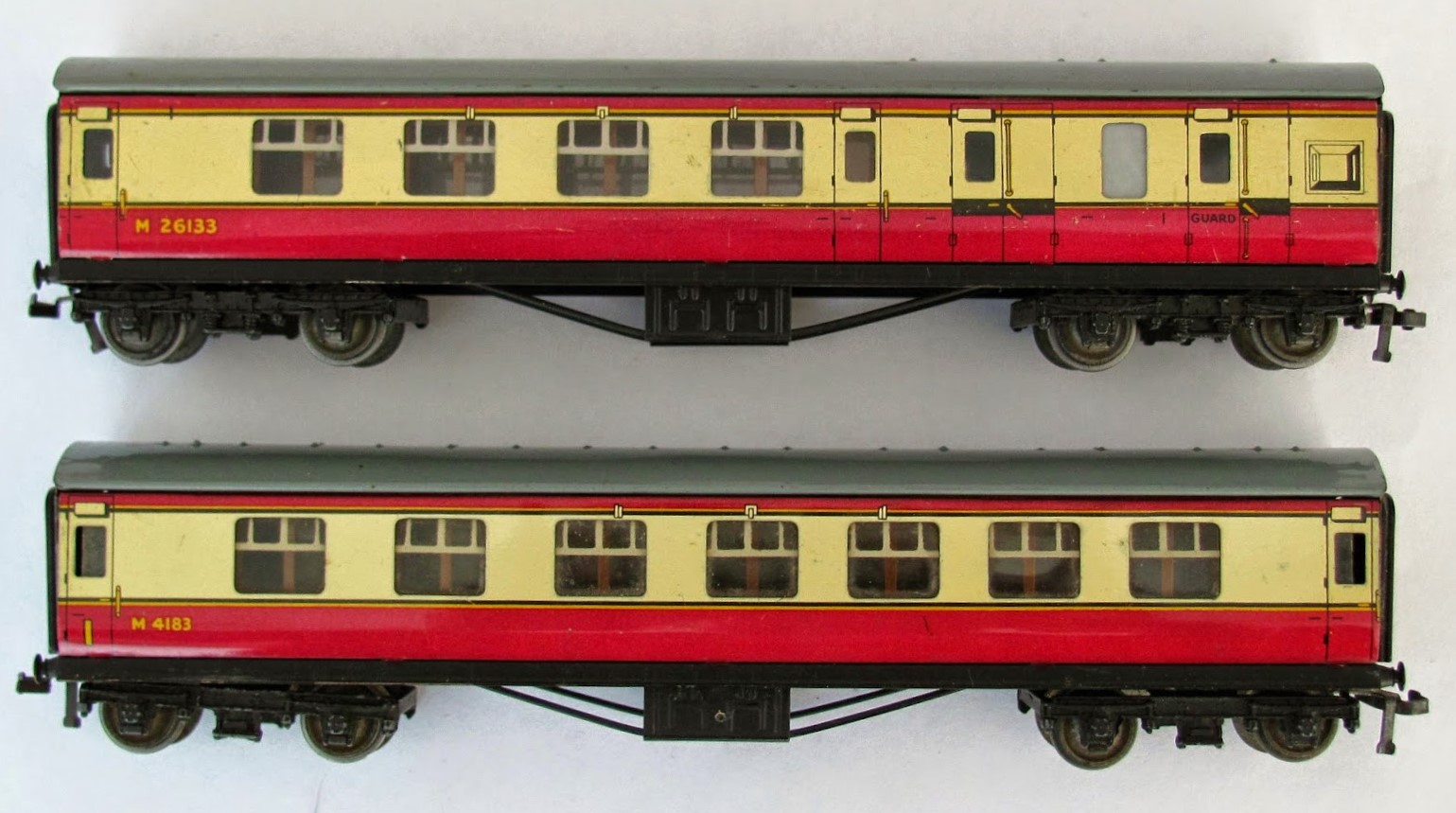
Now they were made of tin, often had features painted on and by later standards were pretty simple, but the train sets of the 1950s were and remain pure pieces of magic.

Ours stretched over a converted table tennis table and dad had run all the wires for the signals and points underneath and with something like three circular tracks,  branch lines off as well as rail sidings it was impressive.

We or I should say dad had built it up over a few years and the sheer size of the layout, the locomotives and carriages, fright trucks, stations and trackside furniture made it something that even now I look back with pleasure.

I am guessing that the first bits of the train sets were laid out around my seventh birthday which would make it just a decade after the end of the last world war when rationing was still a strong memory and the scars of the nightly air raids were still all around us.

But the evidence of a growing prosperity which was trickling down even to our family was there for all to see.

Around the same time we got our first television and Dad was driving coaches on main land Europe for those who wanted the sort of holiday that they could not have aspired to in pre war Britain.

There was full employment a National Health Service, free at the point of need and the beginning of an ambitious programme to rebuild our schools.

Of course there was also the hardening of the Cold War, a series of colonial conflicts and much that still made Britain seem a stuffy place compared to a decade later and yet looking back now there was a lot that was new, innovative and exciting.

I didn’t see it at the time but I rather think my parents felt that confidence that the post war prosperity was here to stay and the Means Test, and the lines of the unemployed were over.

Dad had moved to London in the late 1920s and mum twenty years later and both would have benefited from an economy which was on the move recovering far more quickly from the Depression than the North East and the Midlands where they had grown up.

And by the 1950s a train set, a television, and before the end of that decade a washing machine and fridge were all things we took for granted in our house.

All of which makes that train set a marker for how Britain was changing

By the 1970s into the 80s  for some that prosperity and automatic access to consumerism would start to be eroded, but that was a long way from me as I ran the Duchess of Montrose with its red and yellow carriages around the old table tennis table.

Pictures; courtesy of Ken Jaggers, http://www.jaggers-heritage.com/

Sunday, 4 December 2022

Looking east along the River …………. past a forest of cranes

This is the view from London Bridge that I remember.

And it was a scene I thought was lost forever, leaving me just a memory of that forest of cranes, and ships that had crossed the oceans to unload goods as varied as fruit, ball bearings and much more.

Now I know there are heaps of pictures of the Thames when it was a busy industrial waterway, but not this view, which was one I saw, as I walked over London Bridge in the late 1950s and 60s.

I regularly travelled up from Peckham and later Well Hall on the train, alighting at London Bridge Railway Station, and by degree making my way over the river, down those stairs at the northern end of the bridge and then along Lower Thames Street, past Billingsgate Market to the Tower of London.

It was a Saturday trip I did quite frequently, almost always on my own, with the aim of submerging myself in the history of this bit of London.

The Tower was always the object of the trip, but there was always so much to see, and in the case of the old Peak Freens factory to smell as well.

And to this day, the equally powerful smell of the fish market bounces back from my memory and reminds me of the image of bits of abandoned ice and fish bits which lay in the gutter before they were cleared away.

On the odd occasion I get home, and equally rarer moment that I retrace my steps over the river at London Bridge, that old scene of the warehouses, ships and cranes is difficult to recreate.

So, I was pleased that John King shared his picture of the Thames from the bridge which he took in 1968, and its companion taken over 40 years later.

Together they encapsulate the changes which have taken place along the river.

And here I am the first to say I don’t do nostalgia.  The Thames could be a cruel place, and those who made their livelihood along it, did back breaking and dangerous work, often for a pittance, while life in the terraced houses and tenements behind the warehouses could be a constant struggle to make a home clean, and safe in buildings which were long past their sell by date.

But given all of that, I miss that view, east over the water to Tower Bridge and the docks.

Location; London

Pictures; the River Thames, 1968 and 2011, from the collection of John King

Tuesday, 4 May 2021

The story of one house in Lausanne Road number 20 ............. adventures, parks and Wapping Station

The story of one house in Lausanne Road over a century and a half, and of one family who lived there in the 1950s.*

Telegraph Hill Park 2007
So just what do you do on a summer’s day in 1959 when the rain is coming down like stair rods?

The answer I suspect was not much.

This of course was before day time telly when the best you could hope for was a morning with a pile of old comics dodging the request to go to the shops.

But on the days when the sun shone hot enough to crack the paving stones and made the road side tar runny, then that was the time for adventures.

And given that I was nine that could mean a whole shedful of things.

Saturday’s would be down at Queen’s Road railway station seeing just where you could go for two shillings return but a tad less if you wanted to factor in sweets and a drink.

Sometimes you struck gold and others were grim.

But in the middle of the week with little more than sixpence it was pretty much wander the streets looking for some old haunts and discovering new ones

And most of the time it was the parks.

Where not to have fun, 2007
For reasons I don’t remember Rye Lane Park was not one of the places we went to regularly although I can remember ending up at Goose Green on East Dulwich Road with its small collection of 1950’s play furniture much of which would be deemed unsafe today.

A more happy play ground was Pepys Park which had all that a nine year old could want.

It began with that vast expanse of grass which stretched away from the entrance and which  at the top along the Pepys Road side provided a secret rat run where you could creep through bushes and trees undetected from view.

But my favourite must have been the small dusty enclosure which might once have been a pond but long ago had been turned into a play area with that hollowed out tree trunk which became everything from a tank to the conning tower of a submarine.

Occasionally we might venture up to the top park but there wasn’t much there.  True the views down across London were spectacular, and there was the water fountain but that was it.

Added to which this was one of those invisible boundaries which marked off the familiar and safe, beyond which we rarely went.

And even though I ended up at Samuel Pepys I can only think I wandered into Brockley a handful of times and Deptford no further than the swimming baths.

In some ways it was safer to take off up into town and while Queens Road was one passport New Cross Gate and the Underground was another.

Tower Hill, 1955
It began with riding the Circle line and progressed to the full Tube empire, but for most of the time it was  one bit or another of central London which meant I had a pretty good knowledge of the place by the time I was 11.

But all such things come to a close and by the time we moved out of Peckham new interests and new attractions drew me away from those simple jaunts.

And today most of those adventures are lost although I still delight my own grown up children with that trip from Rotherhithe to Wapping under the Thames with that illuminated sign “Caution Men Working On Pumps.”

Back then I thought nothing of it; today it would scare me stiff but then thinking about my kids I have to admit I never gave them the degree of freedom allowed us.

Pictures, Telegraph Hill Park, 2007 from the collection of Colin Fitzpatrick and London on Tower Hill, Judge, courtesy of Mark Flynn Postcards, http://www.markfynn.com/


*The story of one house in Lausanne Road, http://chorltonhistory.blogspot.co.uk/search/label/The%20story%20of%20one%20house%20in%20Lausanne%20Road