Showing posts with label Chorlton people. Show all posts

Wednesday, 1 July 2026

Wattle and daub cottages in Chorlton

The story of how we lived here in the first half of the 19th century.


There may still have been upwards of fifty wattle and daub houses in the 1840s in our township.

They were constructed from a timber framework with walls made of branches woven together and covered with a mixture of clay, gravel, hay and even horse hair and topped with a thatched roof.

Samuel and Sarah Sutton brought up their 2 children in one of these cottages. Their home was one of two adjoining cottages situated on the Row and in every sense looked the rural part.

The white walls and wooden beams were partly obscured by ivy and the front door was approached through a small country garden. Behind the house and away from the view of strangers stood the privy and the back garden where the Sutton’s grew fruit, vegetables and flowers.

 There would be currant and gooseberry bushes, raspberry canes, rhubarb and mix of vegetables which made an important contribution to the family income and were often home to chickens and even a pig.

Such houses were easy to build and equally easy to maintain, but there could be disadvantages to living in them. The porous nature of walls meant they were damp and crumbling clay meant endless repairs.

According to a later Parliamentary report “Many of them have not been lined with lath and plaster inside and so are fearfully cold in winter. The walls may not be an inch in thickness and where the lathes are decayed the fingers may be easily pushed through. The roof is of thatch, which if kept in good repair forms a good covering, warm in winter and cool in summer, though doubtless in many instances served as harbour for vermin, for dirt, for the condensed exhalations from the bodies of the occupants of the bedrooms....”


Floors made of brick or stone were laid directly on the ground and were almost invariably damp, and in the worst cases reeked with moisture. Once the brick was broken, the floor became uneven and the bare earth exposed. This might be compounded where the cottage floor was below the ground outside or the floor level was uneven which caused problems of drainage. Even the proudest wife and mother must have been reconciled to damp and dirt which were the result of such floors.

The only heating would come from the open fire which might have been combined with a cooking range. On damp days when the coal or wood was wet the smell would permeate every room in the house. During the winter months the unheated bedrooms were particularly unpleasant places. On the coldest nights ice would form on the inside of windows.

Cottages of this design were often limited to four rooms, and some may have had only two, with the family living downstairs and sleeping on the upper floor. In some cases access to the bedroom was by ladder rather than stairs and in many cases bedrooms were left open. One surviving cottage in Chorlton from the eighteenth century did have a staircase which opened out to a big bedroom giving little in the way of privacy.

As for sanitation this would have been equally primitive. Nationally the rural picture was grim with privies often draining into open channels which themselves got blocked with refuse and so flowed too slowly to allow the waste to disperse.


Picture; Sutton’s Cottage circa 1892, photograph from the Wesleyan Souvenir Handbook of 1895 in the collection of Philip Lloyd

Wednesday, 11 March 2026

Sarah Sutton, a life lived out on the Row

There are no pictures of Sarah Sutton, nor to my knowledge has she left a diary, or anything which might tell me about her life.

She was born in 1821 in Withington and lived with her husband in a wattle and daub cottage on the Row*. She died in the same cottage 70 years later. Her husband Samuel was a farm labourer which was about what most people did here in Chorlton in the first five decades of the 19th century.
Sutton's Cottage 1892

Unlike the wives of the well to do or even some of the farming families she had no servants to help her.

In the spring of 1851 she had two children under the age of eight, was married to a labourer and had the added responsibility of an infirm father in law.

So tracking her working day is a good start to understanding the daily routines of running a house.

Keeping a wattle and daub cottage clean was no easy task. Plaster walls tended to crumble, the roof of thatch could be home to vermin, and the stone or brick floors were damp and in need of constant sweeping.

The interior will have been similar to these pictures from a one up one down brck cottage which stood on Maitland avenue until the 1930s.

Her day would begin at six in the summer and not much later in the winter months. One of the first chores was the collection of water. This might come from a well or the pump in the Bailey farm yard opposite. She may also have used the fish pond on the Row, which was next to her cottage. In having a supply so close Sarah was lucky, for other people on the Row the regular daily journey back with a bucket of water would be a much longer journey. And this simple task would be mirrored across the township and beyond.

Downstairs room Maitland Cottage circa 1930
Water was needed for cooking drinking and washing and there would be a number of journeys to collect it. 

The next task of the day would have been laying and lighting the fire. This may have used wood or possibly coal. 

But traditional wattle and daub fire places were large and not suited for burning coal which needs a smaller fire place and an efficient flu to draw the flame. The compromise was to reduce the size of the fire place which would allow the use of coal now readily available from the Duke’s Canal.

The move from wood to coal may have been underway during the 1850s and while no one was selling the fuel in the township in 1851 there were a number of coal dealers recorded a decade later.

Once the fire had been made and breakfast served, there were beds to be aired, plates washed and the floor swept. Rugs and mats were taken out and banged against the wall, and even before the floor was swept and scrubbed in damp weather the stone flags had to be scrapped with a an old knife blade to loosen the trodden in mud.

But this simple task could only be done after Samuel had gone off to work and her son John who was seven to school. This left baby Ann who was just one and would have required frequent attention. It is likely that Sarah could have relied on one of her neighbours living in the same row. The midday meal needed preparing and if her husband was working too far away his meal would have either been prepared before he left or taken out to him which might have fallen to her son John.

Downstairs room Maitland Cottage showing boxed staircase circa 1930
Most rural families like the Suttons had a diet heavily based on vegetables. 

Some of these were available from the cottage garden, including the all important cabbages and potatoes as well as onions, carrots, parsnips and broad beans.

They were lucky enough to have an orchard behind their home and there may have been opportunities to collect some of the windfall.

 And like many cottage gardens there were also currant and gooseberry bushes, raspberry canes and rhubarb. Gooseberries were ready by June and were popular in the north where there were competitions and societies.

Sarah would also have grown some flowers and one that has survived and still grows on the site of her cottage is greater celandine. It has beautiful yellow flowers and like many that Sarah and others would have grown also had medical properties. Greater celandine is toxic but according to various sources in the right doses can be used for therapeutic uses. She may well have used it as a mild sedative to treat asthma, bronchitis and whooping cough along with other complaints including warts. But it is toxic nature and so not one to try at home.

It still grows on the site at the corner of Wilton and Beech Roads and may be one of the last survivors of our cottage gardens. My botanist fried David Bishop spotted it some time ago and wrote about on his blog.


In the back garden there may have been an area reserved for keeping chickens. Eggs could be expensive and keeping chickens not only avoided having to buy them but could be a small extra form of revenue. So in

1851 the price of a dozen eggs ranged from 4d [2p] in the summer to 8d [4p] later in the year. The family pig was another means of supplementing the family diet and might provide meat for up to seven months. It would be bought in the spring from a local farmer who might wait to the animal was killed and the meat sold before receiving payment in the autumn. This was the only way that some families could afford the cost of a pig which might be between 20s and 25s [£1-£2.25p].
Site of Sutton's Cottage, 2010


But it is unlikely that all their needs could be met from what they grew. Much research has shown that at best the garden supplemented the food they bought. But some might be gathered for free.

There were many wild fruits and plants across the township for the collecting. Wine might be made from a variety of flowers as well as fruit and for those who knew where to look there were rich sources of plants which could enhance cooked dishes.

Pictures; Sutton’s Cottage circa 1892, photograph from the Wesleyan Souvenir Handbook of 1895  and interior of the cottage on Maitland Avenue in the collection of Philip Lloyd, the site today of the cottage on the corner of Beech Road and Wilton Road, from the collection of Andrew Simpson


*The Row is now Beech Road


Tuesday, 10 March 2026

Mrs Jane Redford, Manchester's second woman councillor


I have been staring at this picture for some time.

It was taken on October 7th 1911 at the opening of Chorltonville, and somewhere amongst the worthies is Mrs Jane Redford.

She had been born in 1849 so we are looking for a woman aged 62 which narrows the search a little.

She is there because she was one of our elected city councillors having been elected the year before and in the way that these things work she was about to contest the seat again in the November.

So perhaps this was not so much civic duty as another one of the many public engagements that fall to a politician about to fight an election.

But this is perhaps to do Mrs Jane Redford a disservice. She had been active for over 30 years serving on various public bodies including the Board of Henshaw’s Blind Asylum and as a Poor Law Guardian for the Chorlton Union where she had campaigned for the provision of trained nurses for workhouse hospitals. All too often the workhouse authorities had relied on old and illiterate inmates to tend the sick.

Important as these contributions were it is her role as a city councillor which is more significant because her election in 1910 made her just the second woman to be elected to the council.

What is in some ways more remarkable is that she was not a member of the main political parties and seems to have had little in the way of an organisation behind her.

She described herself as a Progressive Candidate which had less to do with radical politics and more to do with all fashioned rate payer concerns.

Her predecessor Harry Kemp had campaigned as a progressive on the platform of advancing “good government” which involved “exercising a rigorous protest against extravagance” and “preserving as far as possible the residential character” of Chorlton.

But, and here is the interesting thing it came with a progressive take on the need for “adequate Schools, Libraries, Open Spaces, Public Baths and everything which counts for the better health and morality of the people”

And Mrs Redford echoed this in her own election address of 1911 which highlighted her record on the Education, Libraries and Sanitary Committees along with a degree of success in checking “the building of houses on the Chorlton side [of Longford Park] in order that Chorlton people may have easy access to this new park.”


It is also there in her concerns over the Carnegie grant to build a new library which she felt should have been delivered “through the ordinary means of municipal enterprise.”

Now the normal rate payer position and certainly that of her fellow Chorlton councillors along with Alderman Fletcher Moss was “for acceptance of the gift,” which perhaps marks her out as more than just a guardian of careful council spending.

And in turn points back to her wider concerns for the welfare of people.


She argued strongly that the Education Committee should experiment with vocational training and in particular training girls for domestic service which “was of all the occupations for girls that which was not overcrowded and so [they would be able to] enter service at once and claim a proper wage, instead of commencing work and gaining a precarious livelihood by cleaning steps.”


Of course it is easy to be cynical about the role of vocational education and I for one spent years arguing the need for a well balanced curriculum for young people which didn’t just push them into manual work without offering them the opportunity of a broad and challenging set of subjects.

And this seems to have been what motivated her, because while advocating the pilot scheme to train young girls she was keen that the Education Committee work with the Post Office to widen the career prospects of telegraph boys, who “were only engaged for a certain number of years as messenger carriers and when they had to find work other than that of a purely causal character the task was not a very easy one” 

The plan was provide “two or three hours instruction each day, so that when their career as telegraph boys ceased they might be better equipped to secure other and perhaps more lucrative appointments.”


Now I think it might be fair to argue that she did not embrace a clear political position which might mark off from say the vision of the new Labour Party but likewise this was no conventional rate payer politician. She had expressed her growing concern at the lack of school provision both here in Chorlton and across the city and was very active in the movement for women’s health.

There is more to find out about Mrs Redford and also stories to tell of other women who campaigned in their trade unions and local Labour Party branches for the vote, improved social conditions and a better deal for ordinary people but they are for later.

Location; Chorlton-cum-Hardy, Manchetser

Pictures; The opening ceremony of Chorltonville, from the Lloyd collection, picture of Mrs Jane Redford from her election address by kind permission of Lawrence Beadle


References; Manchester Guardian, Harry Kemp and Jane Redford's election addresses.

Saturday, 7 February 2026

The Booth family .............. a new family for a New Chorlton


I have been trying to clear up a few little mysteries about the Booth family who lived here on Manchester Road during the time when the township went through its most dramatic transformation.

This was when we leapt from being a small rural community into a suburb of Manchester and those tall rows of terraced and semi detached properties in long roads went up catering for the middling people who worked in the city but still wanted to live on the edge of the countryside. The Booth family saw all of that and despite still being here in the early 1940s I lose them after The Great War.

I came across Aaron Booth some years ago when I added four of his photographs to the collection.  They were taken in the summer and winter of 1882 of Martledge which was that part of the township from the four banks down to the Library.

And that was pretty much it.  I knew he and his family lived at Sedge Lynn which was an impressive Victorian house on Manchester Road and that he was businessman.

Then as you do I became more curious.  They were one of those new families with money behind them and business interests in the city who had made their home here just as the housing boom of the 1880s was about to take off.

We can track the family across the city from 1861 and during the next twenty years they lived in a succession of comfortable addresses on the edges of the city finally moving to Sedge Lynn in the November of 1881.
Before that date the evidence trail is a little vague but I am fairly confident that Aaron married Emma in 1853 and their first child was born two years later followed by another ten children.

These were the years when the family firm prospered.  In 1861 his packing company employed four men and seven boys and over the next few decades his work force increased as did the number of premises.  So while in 1863 he was located on the corner of South Street* and Albert Square by the 1890s he was listed at “3 & 6 Hall street, 20 Oxford st, St Peter’s, 12 St Peter’s square and 1 & 47 Lower Mosley Street.”

And by 1911 at the whole corner of Oxford Street and Lower Mosley Street as well as Hall Street and Chepstow Street.  On his death in 1912 he left £1,827 in personal effects.

All of which suggests that they were a comfortably well of Victorian family.  Sedge Lane was a detached house which in 1881 stood in splendid isolation in what was pretty much open land.  To the rear were the Isles a mix of ponds, tiny streams and fields which stretched up to Longford Hall, and to the west and east they were bordered by farms. It had had eleven rooms as well as a bathroom and kitchen and commanded an annual rent of £28.

And I have no doubt that they participated in the life of the community.  Aaron was an amateur photographer and it is reasonable to suppose that the rest of the family filled their leisure time with all sorts.  The 1911 Kemp’s Almanac for Chorlton boasted a host of cultural organisations from operatic and drama societies to a range of sporting ones and the city with its theatres was less than 15 minutes away on the train.

The children either followed their father into the family business or took up that increasingly suitable occupation for young women of teaching.  All of the girls lived at home and so is tantalizing to speculate on whether they taught in the local school or one of the new academies or crammers which were opening up across Chorlton to cater for the young middle class.

In a grimmer way they were also typical of the period.  Emma was just 49 when she died, and two of the children died even younger at 21 and 22.  In all ten of the family are in Southern Cemetery.  They were buried there between 1881 and 1942 in two plots close to Nell Lane.

But two of the children are not there and so far have eluded me as has the identity of the Miss Booth who originally made available the four 1882 photographs.  And then there is the mystery of where they lived after the Great War.  Aaron died in 1912 but there is evidence that they were still there at Sedge Lynn a little later, but by 1919 or 1920 they had gone.  This much I can be confident of because by 1920 the new impressive Savoy cinema had opened on the site of Sedge Lynn.

In the way of things some of the mysteries will be solved.  Out there in a parish magazine or in the local press will be a reference to them and when I next get into Central Library there will be the electoral registers which may place all of the children in the years after 1928, so still a lot to go on then.  And on the next fine day I will take myself off to the cemetery.

Which just leaves one last loose end.  In May 1969 the company Shepley Booth & Associates Ltd was wound up in Birmingham.  I have no way of knowing the connection but I am sure there is one, as each of the male sons of Aaron and Emma were given Shepley as a second name, so one more mystery.

And here is an addition which has only just occurred to me and changes the date of when I thought this picture was taken. As late as 1894 what we now call Nicolas Road was a thin strip of land with trees, running back from where the old bit of Manchester Road joined Barlow Moor Road ad onto open land.  At this stage Oswald Road stopped just beyond Vincent Avenue.

By 1907 it is shown as a path and possibly an unmade road with houses roughly where the Health Centre is.

All of which changes the date of the picture which I had always assumed was 1882 which is the date on a similar print but there in the distance is what I think is Oswald Road School which was completed in 1908.  Just goes to show!

Pictures; Sedge Lynn the Lloyd collection, the work place of the Booth family on the corner of Oxford Street and Lower Mosley Street, circa 1900 from Goads Fire Insurance Maps, courtesy of Digital Archives, http://www.digitalarchives.co.uk/ and 47 Lower Mosley Street where the Booths were also listed in 1895, photograph by H W Beaumont 1964, Courtesy of Manchester Libraries, Information and Archives, Manchester City Council m02925

*now Southmill Street

Thursday, 5 February 2026

It started with a picture and became a story.......... Charles Ireland

The Palais de Luxe, circa 1928
It started with a picture and became a story.

The picture was of the Palais de Luxe Cinema on Barlow Moor Road and is not one I had seen before.

In that usual way of things it was in the possession of the archives and public records centre of East Dunbartonshire Council and got there because the fine iron and glass canopy which fronted the cinema had been made by the Lion Foundry in Kirkintilloch.

The story unfolded as the archivist and I sought to resolve the copyright issue of the photograph.

Ms Janice Miller was keen for me to see the picture but quite rightly was concerned that this might contravene the 70 year rule on copyright usage.

The photograph was by C Ireland and may have been taken around 1928 and that was all there was to go on. He might have been a local photographer or one especially commissioned by the Lion Foundry who came down from Scotland or just possibly one of those travelling photographers who captured local scenes to be converted into post cards.

Now both of us were fully prepared for a disappointment. After all we had just a name which is not much to go on.

But a Charles Ireland ran a photographic shop at 25 Lower Mosley Street in town during the first decade of the last century and continued in business there to at least 1927. The same set of telephone directories also revealed that by 1921 he was living at 76 High Lane here in Chorlton.

It is one of those amazing things about detective work that once the first secrets of a person’s life come to light others bubble up in front of you.

He had died in 1930 aged 63, left £5,330 to his widow and was buried in Southern Cemetery. He had been born in Newton in Manchester in 1867 and by 1891 the family were living here on St Clements Road.

This seems to have been a step up. The family home on Oldham Road in Newton was at the heart of an industrial area. Just to the north was the large carriage and wagon works of the Lancashire and Yorkshire Railway and to the south and east there were brick works cotton mills, bleach works as well a glass works.

25 Lower Mosley Street, 1964

Charles’s father Edward was in partnership as a pawnbroker although he also described himself as a photographer, and by 1891 this appears to have been his sole occupation.

There were as yet few photographers listed in the directories for Manchester in the 1880s and they are still described as artists.

By 1895 he had opened the shop on Lower Mosley Street which Charles still ran until the late 1920s.

The family continued to prosper and by 1911 they have moved to that large detached house on the corner of Edge Lane and Kingshill Road.

76 High Lane, date unknown

As ever the romantic in me fastened on the fact that in 1913 Charles married his photographic assistant. Edith May Hindley was 32 years old and like him had been born in Newton.

Sometime perhaps around 1918 they moved into 76 High Lane which had been the home of the artist Tom Mostyn the artist.

 It is still there having benefited from the addition of the large upstairs window and studio which I guess was the work of Tom Mostyn and which Charles in turn may have used.

I have yet to visit the grave in Southern Cemetery but it is on my list of things to do. Here he was buried along with his father and mother in law, his sister and finally in 1948 his wife

So far no other pictures accredited to Charles have turned up but they will. His working life stretched back over 40 years and the picture of 76 High Lane may even be his although sadly there is no date and the quality is pretty poor.

But I travel in hope that out there in a collection I will come across more of his pictures. Ms Janice Miller and the East Dunbartonshire archive can only be the first.

Location; Chorlton and Manchester

Pictures; the Palais de Luxe cinema, circa 1928 GD10-07-04-6-13-01 Courtesy of East Dunbartonshire Archives, 25 Lower Mosley Street by H W Beaumont 1964 m02915, Courtesy of Manchester Libraries, Information and Archives, Manchester City Council, & 76 High Lane, date unknown, from the Lloyd collection

Saturday, 16 August 2025

A house with a story

Now we all have favourite buildings but this is not one of mine.

And yet there is a remarkable story here which takes us back to the early years of commercial photography and the Ireland Photographic Studios which began up in Newton Heath as a side line and became an important family business in the centre of Manchester.*

The Ireland family prospered as commercial photographers and eventually settled here in this house.

The business was taken over by Charles Ireland whose father began the studios and he briefly lived in the house which is now the Buddhist Centre on High Lane but was once the Art School of Tom Mostyn.

So there you have it.

*It started with a picture, https://chorltonhistory.blogspot.com/search/label/Charles%20Ireland


Picture; from the collection of Andy Robertson

Tuesday, 2 January 2024

Selling the contents of Hough End Hall in the January of 1849

The Hall in 1910
Now I am back at Hough End Hall, that Elizabethan manor house.*

Strictly speaking it was in Withington but is so close to the border with our township that every historian since John Booker in 1853 has included it in their accounts of Chorlton.

It served as a fine home to the grand Mosley family until it was sold to the Egerton’s in the mid 18th century who rented it out to tenant farmers.

Some of these we know more about than others, and today it is the turn of Henry Jackson who was there during the 1840s and perhaps earlier.

He crops up in the census return the tithe records and the rate books and will still have been remembered by many when Thomas Ellwood wrote his series of articles about Chorlton in the winter and spring of 1885-6.

His was one of the bigger farms in the area, covering 220 acres and employing five labourers some of whom lived in the Hall.

And by one of those wonderful strokes of luck we have an inventory of the farm equipment which came up for sale on his death in 1849.

Executors of the late Mr Henry Jackson, of Hough End Hall, in Chorlton-cum-Hardy, in the county of Lancaster, to Sell BY AUCTION, on Tuesday, February 6th 1849, and following days, until the whole is disposed of the truly Valuable STOCK OF DAIRY COWS, HORSES, HUSBANDRY IMPLEMENTS, PRODUCE, &c. 


The Hall in 1895
Consisting of 17 high bred calved and in calf cos, eight draught horses, gears, for fourteen horses, sets of ploughing tackle, sundry odd gears, hackney saddles and bridles, six carts with six inch wheels and iron arm, one cart with narrow wheels, timber dobbin, two milk carts on springs, with harness complete.

One excellent gig and harness, several ploughs, double ploughs, cultivators, scarifies, seed and other harrows, winnowing machine, sieves and riddles, stack sheets, and poles, pair of smiths’ bellows, vices, anvils, a great variety of smiths’ and joiners’ tools, a large quantity of old iron, ladders dung, wash and wheelbarrows, thrashing machine, an variety of husbandry implements necessary for carrying on an extensive farm; one fat pig, poultry, ducks, boilers and fixtures, tankards &c.  

The produce comprises about 300 thraves of wheat, 600 thraves of oats, 80 thraves of horse beans, 100 tons of hay, 100 loads of potatoes of various sorts, 30 tons of Swede turnips. &c.  

The sale to begin each day at eleven o’clock, and the whole to be sold without reserve.  The cows, hay and part of the hay on the first day.  The horses, corn, and remainder of the produce the second day.  The reminder of the implements, &c on the following days.**

*Hough End Hall, http://chorltonhistory.blogspot.co.uk/search/label/Hough%20End%20Hall

**Manchester Guardian January 20 1849

Pictures; the Hall looking west courtesy of Nora Templar 1910 and in 1895 from the Wesleyan Handbook, from the Lloyd Collection

Sunday, 10 December 2023

Chorlton in 1798

I am back with a little bit of Chorlton from 1798 looking again at some online records from Ancestry.

This one is the Land Tax Redemption for 1798, which was a tax based on the value of someone’s home.  So here we have the names of the people who lived in Chorlton in 1798 with whether they owned or rented the property and how much each house was worth.

It is a remarkable document, because it takes us back into the 18th century.  Now there are the parish records detailing the births, deaths and marriages for the township as well as the Egerton and Lloyd estate papers but here we have some of the financial details of our people a full 40 years or more before the 1841 census and the rate books and tithe survey.

There are many of the familiar names that crop up throughout the 19th century and a few new ones.  Some are quite clearly on the cusp of doing better while others will fare much the same four decades later.

And of course it is their economic standing which will be so revealing as well as their relationship with the Egerton’s and Lloyds who between them owned most of our land.
It should be possible to locate some of the properties and compare values with the rate books and tithe records for the 1840s onwards and compare the township with other nearby communities.

All of which I think is pretty neat.

Picture; the township just twenty or so years after the 1798 tax record, from Greenwood’s map of Lancashire, courtesy of Digital Archives, http://www.digitalarchives.co.uk/

Tuesday, 5 December 2023

On a sunny day in the garden of Hough End Hall circa 1900

I doubt I will ever fully know who these three young people are who stare back at me from the garden of Hough End Hall.

Nor will I be able to accurately date the moment the picture was taken.

But one of the girls will be the daughter of Samuel and Sarah Ellen Lomax who took on the tenancy of Hough End Hall sometime in 1895.

The Lomax family had lived in the Hall from 1849 when they had taken over both hall and the farm on the death of Henry Jackson and Samuel had moved in on the death of his uncle in 1895.

So that begins to provide a possible date because Mr and Mrs Lomax had four children.

These were John born in 1888, Ethel Mary in 1891, Constance Amy in 1899, and Eveline in 1910.

None of our three look to be much older than twelve and possibly younger which would place them in the garden sometime at the beginning of the last century.

Of course it is impossible to know which of the three was Ethel Mary, or if one of them was actually her sister Constance Amy.

But it is a start and has reawakened my interest in the hall which dates back to 1596.*

It had been the family home of the Mosley’s till the mid 18th century when it was sold to the Egerton’s who in turn rented it out to tenant farmers.

In the 1840s it was occupied by Henry Jackson who farmed 220 acres beyond the eastern boundary of the township.

This made it one of the largest farms in the area, and Jackson employed 13 labourers, nine of whom lived in the hall.

It was still an impressive sight, leading one observer in 1853 to write that its
“ ivy-covered walls, its clustered chimneys and its gabled roof, present a picturesque and pleasing appearance.”**

Nor did the ivy or its more functional purpose as a farm obscure its classic Elizabethan design.

It was built of brick with three stories. The centre piece was flanked by a bay or arm at each end and a little advance bay in the centre which gave it the characteristic E shape.***    

The large communal areas were later partitioned off into smaller rooms and the census of 1911 describes Hough End Hall as having eleven rooms.****  

It was best reached along the tree lined lane from the Barlow Moor Lane.  The traveller would have a clear view of the hall from some distance away but just as they reached the last few yards the full majesty would be revealed.

A low stone wall either side of the gate gave way to a large open area beyond which partly hidden by hedges and trees stood the main building. Someone, perhaps even Henry Jackson himself had grown the hedge into an arch above the gate.

Hough End Hall is strictly not in the township and yet every historian of Chorlton from John Booker in 1853 has included it in their accounts.

Nor could we escape its presence back in 1847.

Walking from Park Brow down Nell Lane and standing on the low bridge over the Brook, the Hall would be clearly visible.

Not that this would have been the most impressive of views.  This northern side was partly hidden by farm buildings at the back and side.

And I guess to see it at its best was to stand directly infront of the place.

So there is lots more here to explore, including more on Henry Jackson and the Lomas family and as they say wait and watch this space.

Pictures; Hough End Hall in the 19th century from the Lloyd collection, and the collections of Rita Bishop and Philip Lloyd

*Hough End Hall, http://chorltonhistory.blogspot.co.uk/search/label/Hough%20End%20Hall

**Brooker, Rev John, A History of the Chapels of Didsbury and Chorlton, Chetham Society, Manchester, 1857, page 167, Google Books edition, page 190

***The most detailed description of the Hall can be found in the Victoria County History, A History of the County of Lancaster, Volume 4, Townships; Withington 1911 pages 288-293 and available on online at www.british-history.ac.uk

****A ground floor plan exists from 1938


Friday, 17 November 2023

“heating and hammering” the story of the Clarke family who worked the smithy on Beech Road for over a 100 years

The memory of the blacksmith on Beech Road has yet to fade from living memory.

There was a smithy here from the early 19th century and I guess even earlier. From at least 1830 the mysterious job of heating and hammering was carried out by William Davis, but more about him later in the year.

Today I want to concentrate on the Clarke family. John Clarke took over the blacksmiths on the Row* in October 1860. I know this because I have a copy of the sale transaction he made between himself and the widow Elizabeth Lowe. He paid £55 for the “Goodwill, fixtures about the forge. Also the pig sty and wooden shed.....”


It is a remarkable document for many reasons. Not only does it shed light on what was in the smithy but it is in Clarke’s own handwriting which makes it one of only two dozen or so personal records from the period to have survived. But there is more.

 This was a time when many were still illiterate and Elizabeth Lowe was one of these. Just a decade before in 1851, 45% of the women who were married gave a mark rather than a signature on the marriage certificate.

The Clarke family were to remain on the Row well into the 20th century, and their shop would have been at the heart of the rural community.

 John Clarke and before him William Davis supplied the needs of the village, repairing broken tools, forging new ones and shoeing horses.

When he was hammering and heating at his forge on the Row he acted as a magnate for people. Some coming to collect a repaired tool or bringing a horse which was in need of a new shoe would stop and pass the time of day.

And there were always requests to personalise a farm tool. This might mean making a left handed scythe or widening or narrowing hoe blades used to chop out weeds. Then there would be the endless procession of labourers needing tools sharpened from bill hooks and scythes to axes and all the other types of edged tools. In the process William might well replace the broken or split staves

And all the time, gangs of children attracted to the smithy by the red hot metal and frequent shower of sparks would stand and stare rooted to the spot. Majorie Holmes remembers being late for school in the 1930s because she, like countless young people before her had been lost in the magic of the smithy.


But as busy as they were they could still pose for a photograph, and so sometime in 1913 John’s son Charles stood outside the smithy and had his picture taken.

 He was 55 and still lived beside the forge. He had been married for over 26 years and he and his wife Sarah had five children. 

The two boys had followed their father into the trade. In the 1911 census John described himself as a plumber, and Charles the younger son as a blacksmith striker.

Lillian the eldest of the daughters described herself as a machinist while Ethel worked in a laundry and Florence was still at school..


One of the boys was also active in the Chorlton Brass Band and in the summer of 1893 was also photographed when the band played at Barlow Hall. Sadly he was to die in Gallipoli in June 1915 aged 23.

Pictures; sale of the smithy October 1860, picture of Charles Clark, 1913 Courtesy of Manchester Libraries, Information and Archives, Manchester City Council, picture of Charles Clark, DPA 328.18, Courtesy of Greater Manchester Archives, and photograph of Charles Clarke junior 1893 from the collection of Allan Brown


*Chorlton Row was later renamed Beech Road

Tuesday, 26 September 2023

H.D. Mooorhouse and a chain of cinemas

I don’t suppose many people in Chorlton today know of H.D. Moorhouse, and yet in the early decades of the 20th century he was responsible for setting up a chain of cinemas across the city and beyond.

And of course the point of the story is that his first cinema was here. It was the Pavilion opened in 1904 and acquired by Moorhouse in 1909.

Like many early cinemas it hedged its bets and continued to offer variety acts and in the June of 1910 it offered a bill of variety including the Whips. By then it had become the Chorlton Theatre and Winter Gardens and stayed open through the inter war years.

By then Moorhouse had established a cinema circuit and had acquired the Palais de Luxe on Barlow Moor Road. It had opened in 1915 and was part of the circuit from 1939 until 1956, although it may have struggled on for another two years before closing and becoming a supermarket.*

Hubert Douglas Moorhouse was born in Kendal in 1879 but grew up along the Ashton Road in Openshaw. By 1911 he was living with his parents at 61 Wilbraham Road which was an eight bed roomed house along the stretch from York Road towards Brundretts Road.


Picture; the Chorlton Theatre and Winter Gardens, from the Lloyd collection

*Hornsey, Brian, The Cinemas of H.D. Moorhouse and the H.D.M. circuit, Fuchsprint, 2001,

Saturday, 10 April 2021

Oswald Field, five cottages, a slice of rural Chorlton, and a bit of a mystery part 3


I think this will be the last of the stories on Oswald Field.

Over the last few days I have walked its field boundary, explored the five cottages and tried to discover something of the people who lived there.

But I am content to end with the man who owned the five cottages and just over three acres of land, most of it at Oswald Field but a little on the Row* close to the blacksmith just before the road ran into the green.

And here is the mystery that I have alluded to for despite owning property which qualified him to vote in parliamentary elections he appears not to have owned his own house living instead as a lodger in several homes and variously described himself as a cordwainer [shoemaker], and retired gardener while on his will he is called a labourer and left effects of under £200.

He was born in Great Warford in Cheshire in 1783.  There were Bracegirdle’s in Great Warford in the 1840s and 50s.  One was a farmer, another a book seller and another was a weaver.  Now the place was small enough for him to be related but at present it is an avenue of research I shall leave to someone else.

More promising is his connection with Methodism.  He was at one point superintendant at the Sunday school and some at least of the people he lodged with were Methodists as were two of the men who proved his will.

And it may be that this also gives a clue to when he arrived here in the township.  He is not mentioned as part of the early Wesleyan congregation during the 1820s and the first documented mention of him is 1840 but we may just be able to push that date back.  John Hall who had owned the five cottages on Oswald Field died in 1838 and like Charles was a Methodist.  If the properties passed to Charles on John Hall’s death then either he was already here or settled here around that time.

The income from all the properties and land amounted to £54 a year which is not a substantial amount and will explain why he worked variously as a cordwainer, gardener and labourer.

I doubt that we will ever know his prime occupation and it maybe that some were seasonal or dictated by circumstances.  In the June of 1841 he had been lodging with Joseph Brundrett who was a shoemaker and a decade later he gave his occupation as the same while in 1861 when he was living at Clough Farm he described himself as a retired gardener.

And yet as a man with a vote he was one of a small and significant section of the community.  There were only 27 of them entitled to vote in 1840 out of a total adult population of 341 and given that only men could vote this marked him out as one of only 18% eligible to participate in Parliamentary elections.

And as a Methodist he made up a large proportion of those who could vote in all the elections from 1832 through to 1854. In 1835 just over a quarter of the electorate were Methodists.

They were a close knit group who married into each other’s families lived close together and no doubt discussed the issues of the day.

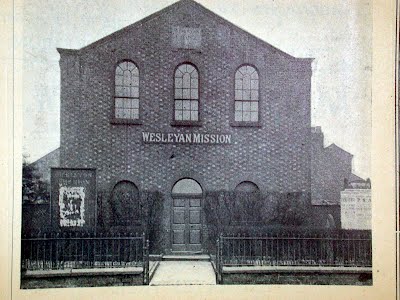
Sadly nothing that Charles said or thought has survived, but we do have his likeness.  It was published in the Wesleyan Church Souvenir Bazaar Handbook for 1908.

It shows a man with a mass of white hair, but even this presents a mystery.  The name below the picture is of a James Bracegirdle, which I take to be Charles.  Again I might be wrong, but there is no record of a James in the township either in this period, or for the rest of the 19th century.  So I guess this must be he, or it may just be another mystery to add to the rest.

Picture; Charles Bracegirdle & the Wesleyan Chapel from Wesleyan Church Souvenir Bazaar Handbook for 1908, courtesy of Philip Lloyd 

*The Row is now Beech Road and his acre of pasture land is today the site of the gated poperties

Thursday, 6 December 2018

Just how many historians can you find in Chorlton?

Now I am fully prepared to admit that other parts of the city have their fair share of historians, but that said Chorlton has a lot.

Michael Billington, 2018
Not all live or lived in Chorlton but it is an impressive list, and never wanting to be churlish or exclusive I have featured all of them, going back to the Reverend Booker who wrote his book in 1853.*

And today I want to add two more who while they live here have written about other places.

I have known Michael Billington for almost 40 years, during which time we have swapped information, appeared together at presentations, and supported each other in our writing enterprises.

Added to which Michael taught one of our children.

His book on the Story of Urmston, Flixton and Davyhulme was published earlier this year, and is the first substantial book on the area since 1898.

It draws on a variety of sources to tell the story of these three areas.

And along with the development of the the areas there are case studies focusing on some of the people and the companies which have contributed to the history of Urmston, Flixton and Davyhulme.

My own favourite is the story of Simpson's ... makers of all things meat and pies. **

The other historian is Graham Phythian, who writes extensively on a range of historical topics from football, the Manchester Blitz, and Peterloo.***


Manchester At War, is "based on transcripts of recorded interviews with senior civilians and former members of the Armed Services, this is an invaluable first-hand record of what it was like to live under the shadow of war.


The everyday hardships and heroism are recalled: the Blitz, rationing, the Home Guard, evacuees, war work, and the American presence prior to D-Day. Despite all the tragedy and difficulties, the Mancunian spirit shines through with frequent dashes of unquenchable humour.


Richly illustrated, and filled with true narratives of the courage and unbreakable spirit of the people of Manchester during those tumultuous years, this book looks at how the city fared during the Second World War, played her part in victory, and how the day-to-day life of her people was affected.

And of course in a year that has seen much media and public interest in the events of Peterloo, there is Graham's book on the subject.

All four books are available from Chorlton Bookshop.

Location; Chorlton

Picture; Michael Billington and book, 2018, from the collection of Peter Topping

*Chorlton Historians, https://chorltonhistory.blogspot.com/search/label/Chorlton%20Historians


**The Story of Urmston, Flixton and Davyhulme, Michael Billington, 2018


***Manchester At War, 2014, Manchester & Salford Blitz , 2015, Peterloo, 2018

Tuesday, 11 September 2018

"over the Mersey at Jackson’s Boat and on to Baguley Moor and Hale Moss and after having botanized there ....returned to Manchester at dusk, all pleased with our day’s excursion” Richard Buxton in Chorlton


“one of the hottest and driest summers that I can remember, and there had been no rain in the neighbourhood for two or three months; but on the day appointed for our meeting, very heavy rain came on about five in the morning. I should not have thought of stirring out of doors; but, having made the appointment, I thought it just possible that my friends might come, and I would not on any account disappoint them. We all went in the rain, through Manchester to Chorlton-cum-Hardy. After staying at the last named place sometime the weather changed and a fine day ensued then over the Mersey at Jackson’s Boat and on to Baguley Moor and Hale Moss and after having botanized there ..... returned to Manchester at dusk, all pleased with our day’s excursion”

It is almost impossible to know when Richard Buxton walked the meadows of Chorlton and botanized the day away with his friends. But I guess it must have been sometime in the 1820s. We were still a very rural community and there would have been plenty to see and record. And record Buxton did, for he was one of those remarkable working men who were self taught, became an expert on botany, wrote books and struggled against poverty before dying obscurely. “I am well aware” he wrote “that a narrative of the life of a poor man like myself .... is anything but interesting.” and yet it has proved to be so.

Which is why over the next brace of weeks I want to tell his story. He was born in rural Prestwich grew up in Ancoats just as Manchester was becoming the “shock city of the Industrial Revolution” and died as he had lived in poverty.

I was introduced to Buxton by my old pal David Bishop who is a passionate botanist and has patiently explained nature to me over the years. It was David who lent me the book Buxton wrote in 1849. For a self taught man his Botanical Guide to the Flowering Plants, Ferns Moses and Algae found Indigenous within Sixteen Miles of Manchester is both a wonderful record of what there was to see but also a testament to his interest and tenacity.

In a world where reading and writing are taken for granted, it is easy to gloss over the fact that at the age of sixteen he was illiterate, and had to set himself the task of learning to read. What is all the more remarkable is that having mastered the spelling book and the narrative of the New Testament he realized he needed to know not only how to pronounce the words but their exact meaning. And so “By this means I was enabled not only to read, but also to understand the meaning of what I read, and to speak it correctly.” All the more remarkable given that his working day lasted from six in the morning till eight or nine at night.

The result is a book that has stood the test of time and one that botanists still use as a hand book.

Picture; Junction of Gore Brook and River Mersey J Montgomery 1963 based on an earlier picture, m8014, Courtesy of Manchester Libraries, Information and Archives, Manchester City Council

Sunday, 5 August 2018

Memories of distant wars ........ Quetta Afghanistan 1886 revisiting old stories during June


It is easy to forget the reach of the British Empire in the 19th century.

But I was reminded recently when I revisited the parish church yard. 

Amongst the few remaining tomb stones is that of the Dean family, which is all the more remarkable given that the Dean’s were not rich or famous but by an accident theirs was one of the headstones saved when the church yard was landscaped at the beginning of the 1980s.

In their way they tell the story of the township. Old Henry Dean had farmed an acre of land in the 1840s on what is now St Clements Road just north of the Horse & Jockey for which he paid the Lloyd estate £10 a year.He and his wife had been born here in the 1820s.

For whatever reason later in the following decade they had moved down to Brownhills Buildings on what is now Sandy Lane and he described himself as an agricultural labourer, later they were living in what were then the new terraced houses on Stanley Grove, close again to the green. His sons played in the brass band and are recorded on the 1893 photograph when the band played at Barlow Hall.

But what caught my attention was the entry on the family headstone recording Henry’s second son,
James Dean late 2nd Battalion Lancashire Fusiliers who died and was interred at Quetta Afghanistan August 23d 1886 aged 27 years.


Now Quetta had been captured by the British during the second Afghan war and leased to the British from 1883. Today it is in Pakistan. Now a lot more research needs to be done to reveal the full story of James Dean but I think a start has been made. The family headstone is just south of the lych gate against the wall and is just a short distance from its original resting ground opposite the entrance to the old church

Picture; detail of the Dean headstone, from the collection of Andrew Simpson

Tuesday, 17 July 2018

78 Manchester Road, and a story ......... the Wood family


It is an ordinary looking house and past its best, sandwiched between the petrol station and supermarket on one side and a restaurant on the other, but 78 Manchester Road has caught my imagination.

I must have passed it lots of times and not even given it much of a thought. I remember one of the houses in the row was a photographer’s shop and for years there was a faded picture of a baby in the window.

But it holds a story. And it is one of those stories that has come together in bits and in its way says a lot about how we were, what Chorlton has become and offers that sense of continuity that comes from families staying in the same place for generations.

In 1911 number 78 was home to the Wood family but this was only fairly recent.

For a large part of his life James Wood had lived at Red Gates Farm which stood on the site of the present library. It had been there from at least the 18th century and I have followed its history through the first half of the 19th century when the tenants were the Whitelegg family.

Now I have to be honest and admit I wasn’t very interested in it after William Whitelegg ceased being the tenant in 1855. But like many of our farms it was still being worked into the 20th century. By then it was the home of Thomas and Mary Wood.

And like all of these things as soon as you delve into their lives so a whole new part of our farming past emerges. In 1881 Thomas described himself as “assistant farmer” living at Red Gates Farm, but if I have understood this correctly he was working for Elizabeth Kenyon who was a market gardener and at lived at Marsleach House which was demolished sometime in the 1890s or during the first decade of the following century and was on a large plot of land bordered by Selbourne, Manchester and Keppel Roads and so was almost directly opposite Red Gates. The Kenyon’s were an old Chorlton farming family and can be traced back to the early 19th century.

Red Gates had grown in size from 46 acres in 1841 to 62 by 1871 but in all probability was smaller by the turn of the 20th century. And I guess James had foreseen that the land was not his future and instead had become a clerk.

He had married Florence Cooke in 1905 and I guess this was when they moved to number 78. The farm was to disappear by 1914 and sometime between 1911 and 1921 the family moved to Romily and in the way of things that houses has also survived.

But what ties the family to Chorlton are a series of postcards they exchanged between 1904 and 1938. They are of the mundane and ordinary things of life which make them so valuable. Here are updates on family visits and of their health with Fred “being a prisoner with his face” which has “made him look quite pale,” along with descriptions of holiday weather and birthday greetings. And above all there are the references to farming, with John reporting that the farm was in the middle of harvesting and an acknowledgement of help at the forthcoming harvest festival in the old church.
There is something quite complete in these two messages which echo that way of life that had gone on for centuries in the township. First the frenetic activity of getting the crops in followed by the celebration that it had been achieved.

It is easy today with food available from around the world in the local supermarket to forget that on the success of the harvest hung not only the prosperity of the community but in a very real sense whether they ate well or not which is perhaps a fitting way to end the story of a family which had lived in Chorlton for half a century, and leaves me just to thank Carolyn Willits who has shared her family postcards with me and reflect that she also lives here in Chorlton.

Pictures; from the collection of Carolyn Willits

Monday, 25 June 2018

Living in Sibson Road, more from the lives of those who lived in Chorlton in the 1930s

Another story from Sally Dervan

This story starts with me looking through a box of old photographs and finding a photo of my nana and grandad sat under the pier at Blackpool.

The funny thing is, in almost every one of my childhood memories, my Nana always comes as "one of a pair" but the other half of the pair was not usually my Grandad.

My Nana and her sister Lily were as different as chalk and cheese, despite this, in later life they spent most of their time together. Their bickering was constant and their outlook on life, poles apart.

Lily was anxious, a "worrier” where my nana was practical, down to earth and seemed to shrug off problems.

As a child , my mum was very fond of "Auntie Lil " she would turn to her rather than to her own mother for comfort and a sympathetic ear , knowing that my Nana would be very likely to tell her to "shape herself " rather than  give a hug or any sort of comfort .

Two very different people who had some spectacular rows but always supported each other when life dealt them a bad hand.

At certain times in their lives, one would prove to be just what the other needed.

All though they lived most of their lives in Manchester, the sisters were actually born far from there, in Coolfin Street, Belfast, Northern Ireland.

Lily (or Eliza Jane as she was christened) was born in 1908 and my Nana, Ethel in 1910.

When they were young children they moved with their parents and four brothers and sisters, "over the water” to Manchester, where their father, Fred, had obtained a position as an overseer of a commercial laundry. The family lived in a "two up two down" house in Thompson Street Levenshulme, with their mother Minnie supplementing the family income by working alongside her husband as a laundry assistant.

In 1930 when she was 22, Lily met David Ridgway at a dance. David was a clever young man, from Flora Street in Hulme, similar back to back terraced housing to Lily's home in Thompson Street.

The pair were about to take a step up, David got a good job and on their marriage in 1931, they settled into semi detached suburbia, buying a house off Sibson Road in Chorlton.

This spacious semi with a long back garden must have seemed like heaven to Lily after the sooty streets of Levenshulme. Lily set about the task of "homemaking” with enthusiasm.

One of her first purchases being a pair of matching fireside chairs .Their brown upholstery and elegant “Art Deco" curved wooden arms made them both stylish and comfortable.

I have no doubt that Lily and David envisaged many happy hours sat either side of the fire in their chairs in the years to come.

Sadly that image of domestic bliss was never to be, with the advent of war; David joined the Royal Air Force Volunteer Reserve, progressing to Pilot Officer.

Tragically, David was shot down and killed, over France on 16th September 1943, aged 35 and his remains laid to rest far from home, in Pont Audemer Communal Cemetery in France.

Lily remained in the Chorlton home they had shared together until her death in 1998, aged 90. I remember their house fondly from childhood, always neat and tidy with a kitchen pantry that was as cold as any modern fridge, and a white duck as vicious as any guard dog that lived in the back garden.

And in the little used front parlour, the room kept "for best" stood two fireside chairs.

© Sally Dervan

Pictures; from the collection of Sally Dervan

Sunday, 27 July 2014

Putting the pieces together, the story of James and Sarah Molloy

I do have to admit that one of the most exciting sides to researching and writing about history is when almost out of the blue stories come together.

It was while I was exploring that picture of Miss Wilton’s private garden on the green which was about to be made a public space in 1897, http://chorltonhistory.blogspot.com/2012/02/miss-wiltons-private-garden-story-of.html that I came across the Molloy family who lived just a few doors down from Miss Wilton.
There they were in the 1891 census in that house which stands beside the modern Horse and Jockey looking out on to the green. It is not as old as the block which houses the pub but it was there by the 1840s.

In the spring of 1891 they were living with their four children in that house. This much I had picked up from the census return for that year and I suppose that would have been that. I finished the post by wondering how their four children would have taken to the opening up Miss Frederica’s garden given that it would have been a playground and garden by their front door.


But then I remembered coming across a photograph of James Molloy’s business premises at 35 Barlow Moor Road along with his trade card. He was a plumber but given that Barlow Moor Road is very long and that there was no date on either the picture of the card just assumed that it was at the Didsbury end of that long road and was no concern of a Chorlton historian.

And there I was so wrong. In the 1891 census James described himself as a plumber and the sign above the door of the house by the green is advertising “James Molloy Plumber”. The following census a decade later has the family at 35 Barlow Moor Road which is on that stretch from the junction of Wilbraham Road heading south towards Needham Avenue. By this census one of the four children who posed in the picture a decade earlier had died. This would have been a tragedy for any family but for the Molloy’s it was only one of six such awful events. Sarah Molloy gave birth to eight children but only two were alive by 1911.

35 Barlow Moor Road was a seven bed roomed property and the photograph shows it had a yard at the back. Using the street directories for 1911 and counting back from Needham Avenue it was the 13th property next to Suffield the watch maker’s shop. All of which should make it easy to locate but hasn’t been so. Photographs of the period do not match exactly what is there today and so I gave up.


Instead I concentrated on the picture and the trade card. Standing and appearing to supervise must be James Malloy while amongst the pipes and felt are two of his employees. Seldom do we find people on pictures which we can identify but this is one. And his trade card is equally illuminating.

James Molloy was no jobbing plumber, he was not only a “registered sanitary plumber” but was also an “authorised gas and water fitter” and hired out gas cookers.

Gas cookers had become increasingly popular from the 1880s and Manchester Corporation through its Gas Committees had pioneered rental schemes from 1884. In 1935 they had showrooms at 140 Deansgate and 116 Wilmslow Road. The design of the more basic models is little different from today, with an oven which could take 4 shelf settings, a top with the gas rings and a toaster above that.
In 1929 the Gas Committee had sold five and half thousand cookers and rented out another 1,798. *

And somewhere within this trade fitted our James Molloy

Pictures, from the collection of Tony Walker

* How Manchester is managed, Manchester Corporation, 1935,