Showing posts with label Peckham in the 1950s. Show all posts

Saturday, 23 May 2026

Treasures from adventures in Peckham and Greenwich .............

To this day I wonder what happened to the gas mask and the replica18th century cap gun we found on our adventures.

Andrew Simpson, 1959
They weren’t found on the same day and now almost sixty years after the discoveries I have no clear idea of when we actually came across them.

We found the gas mask in a row of derelict houses on Queens Road up past the station.

I always thought that the block had been the victim of the Blitz, but it is more likely they were just awaiting demolition having done seventy or so years and were too tired to be saved.

And on what was a grey indifferent winter’s day with the light fading Jimmy, me and John Cox went exploring in the houses.

I remember they were still pretty much intact and somehow we got inside, wandered around and came across a pristine gas mask, still in its box.

It had that shinny look as if it had just come off the production line, with not a mark or scratch.

The filter I remember was white and there was a green painted strip around the black nozzle and I have no idea what happened to it.

It will have been the prize of the day but who took possession of it or what they did with it is lost.

Walking the tunnel, 2017
I do know that the cap gun stayed with me for a while and may have lingered around the house till we moved out to Eltham.

It had been found on one of our regular walks through the Greenwich Foot Tunnel, somewhere midway when the incline ends and you start to see the other end.

As adventures go it was always one of the good ones.  Aged ten there was the slight thrill at being under the River with all that water above you, and more often than not you were almost on your own, making the place just that bit scary.

Looking down to the Greenwich Foot Tunnel, 1977
Added to which there were the echo of your voices and then the sound of strange footsteps which would take an age before you could identify the person they belonged to.

Sometimes that led to the guessing game. Grown up or kid, male or female, old or young?  There were endless permutations and it lasted as long as it took for the mystery person to appear or how soon we bored with the game.

Finally there was the exit into that other place and having got there we felt obliged to stay in the small park and gaze out back across the river towards home.

But mindful that we were on someone else’s turf the stay was always short.

The Woolwich Foot Tunnel, 1978
What I do find curious is that we never used the Woolwich Foot Tunnel, that had to wait until the family moved to Eltham, and with the counter attraction of the Ferry, walking under the Thames was never going to happen.

By which time my Peckham adventures were over.

But in rediscovering them I remembered one last find, which came from the old Gaumont on Peckham High Street.  It wasn’t one I often went in preferring the ABC on the Old Kent Road but it was there that I found a shed load of those old film cuttings, which were small but when held up to light revealed an image.

The trouble of course was that there was little chance of ever re-sequencing them and in a matter of months they were thrown away. Just when I had come across them is also forgotten but I do know that the cinema closed on May 15th 1961, bowing out with Norman Wisdom in the “Bulldog Breed”and “The Final Dream”.

Such are the discoveries made on adventures.

Pictures; the foot tunnels, April 2017 from the collection of Neil Simpson, Looking down to the foot tunnel, 1977 from the collection of Jean Gammons, Andrew Simpson, circa 1959 and the Woolwich Foot Tunnel, 1978, from the collection of Andrew Simpson

Monday, 3 November 2025

In search of an adventure out of Peckham ............. foot tunnels and a strange find

Now the thing about adventures is that there should be no rules, no preplanning and just an optimistic expectation that it will all turn out alright and along the way you will have some fun.

Woolwich Foot Tunnel, 1916
That said it is always best to go with someone to share the fun and when you are just ten years old it makes for a bit more safety.

After that it’s all pretty much how it turns out.

And the day we found the foot tunnel was just one of those. Now I know there are two, starting with the one at Greenwich which was finished in 1902 and the Woolwich one completed a decade later.

But it would be years before I came across Woolwich and anyway Greenwich had so much else to offer, which is how we had come across  the tunnel in the first place.

It had started with the usual exploration of the big park starting with the views from General Wolf’s statute across London and the debate about whether to take the windy path beside the Observatory or  just run down the steep hill.

That done it was a short hop and a skip to the Cutty Sark.

But the Cutty Sark cost to get in and so as you do we wandered to the river and there was the entrance to the tunnel.

None of us knew what to expect, but it was open, it was free and that spiral staircase was just an invitation not to be turned down.

Today at 73 I doubt that I would have set off along the white tiled tunnel but 63 years ago here was the adventure.

Looking down to the foot tunnel, 1977
We were not sure where it would take us, or  how long it would take but there was something quite compelling about making the journey.

It was partly the way the tunnel stretched off into the distance with no end in sight, with just the long line of lights in the ceiling and the gentle incline of the pathway which slopped ever downwards.

On that first foray we encountered just one person, whose footsteps we heard heading towards us long before we saw them.

But we did find a toy duelling pistol.  It had lost some of the bits to make it work and its plastic butt was only half intact but here was a prize which could not be ignored.

So it came home with us.

Who carried it on that long walk back from the park through Deptford and past New Cross Gate I can’t remember, or for that matter why it finished up in Lausanne Road, where it stayed as a trophy of that adventure.

I wish I still had it but it went when we left Peckham along with those adventures.

Picture; Woolwich Foot Tunnel circa 1916, courtesy of Kristina Bedford from  Woolwich Through Time, Kristina Bedford, 2014, Amberley Publishing, and Looking down to the foot tunnel, Greenwich 1977 from the collection of Jean Gammons

Tuesday, 9 September 2025

When a comic story holds more than a truth .............. stories from the Eagle

Now I have no recollection of post war rationing after all I was only four when it was finally abandoned.

But there will be plenty who not only remember it but will have stories of its impact on their daily lives.

Some of them will also have been regular readers of the Eagle comic which began in 1950 and continued into the following decade and here is the connection because running through several of the stories beginning with the first was how at a critical moment the Earth’s government was forced to introduce food rationing.*

Now even though I have read and re-read the stories countless times it never quite occurred to me that older readers of the Eagle would have vivid memories of both wartime and post war rationing.

That first Eagle story  was followed by the Red Moon Mystery when the planet was threatened by a rogue planet which had once destroyed all life on Mars and caused havoc before it was destroyed, which was repeated later by other stories which saw the earth’s population forced to be evacuated from their homes and ultimately  off the planet.

And when it wasn’t a natural disaster of sorts then there were always evil galactic nasties out on inter planetary domination of which the worst was the Mekon a not very nice dictator from Venus and his army of followers whose slavish devotion to their leader and ruthless behaviour would have been all too familiar to a generation that had been children during the last world war.

Of course such events are the stuff of good adventures and in slightly different forms will have appeared before and since but for those of us growing up in the 1950s they were pretty much a backdrop to the real thing.

Location; The 1950s

Pictures; from Eagle Comics in the collection of Andrew Simpson


*The Venus Story, April 14, 1950 – September 28 1951

Friday, 24 January 2025

Waiting for the tally man

There is always a tally man.

The name may change, and so to the description of the business.

We knew it as “tally” but others will remember it as “the never never” or “HP” and today it’s simply  “credit.”

But the process was pretty much the same and consisted of the opportunity to buy goods in advance of the full payment up front.

Now I am not being sniffy about this.

For my family and for many others if we wanted to share in that new consumer boom of the 1950s and 60s, we pretty much were forced into putting down the deposit and paying monthly.

In our case it was a chap with a van who came round each week collected a small regular payment, brought back the shiny catalogue and if mother had decided on something he would bring it out of the said van.

I have completely forgotten the chap’s name which might have been Terry and until recently I had also forgotten the name of the firm which was John Blundell Ltd, but also seems to have traded as Edward Evans and maybe also the Hartlepools Mutual Trading Company Ltd.

But as you do in going through some old family stuff there, dating back to the 1960s were the payment cards.

There are no dates on any of the cards, but we were round 116 and our payment day was “day 6” which I suppose was a Friday and was always in the evening.

The weekly sums paid back range from 4 shillings up to a £1 and mother never seemed to miss a payment which given that a £ in 1964 was still a substantial amount of money was a serious commitment.

I have no idea when it began but Terry or his name sake was already a feature of the weekly routine in the late 1950s when were still in Lausanne Road and carried on when we moved to Well Hall.

From memory Dad always paid on the nail for the big domestic items like the washing machine, telly, and wireless and so the tally man was there for those items of clothes, bedding and shoes.

And these were always in demand given that there were five of us all at school.

The down side of the system was that it was no cheaper than credit today.

So the “Terms” on the card announce that “5p per week for every £1 in value or as arranged, Payments may be used as a deposit on a later purchase [and] Special terms arranged for Furniture and Cycles.”

Added to which of course many of the clothes items may well have been almost worn out before mother had finished paying for them.

But that was the price you paid, and while some more virtuous than me will mutter “we always saved up for and then bought” I have to point out that there was and still is not an option for many.
Not that this is a rant, or a reflection on the power of consumerism, just a reflection on how we lived prompted by the discovery of some old credit card payment books.

Location; Eltham, New Cross, Peckham and pretty much everywhere.

Pictures; tally Payments Cards circa 1964, from the collection of Andrew Simpson

Monday, 4 March 2024

Walking down Kender Street looking for the cocoa works and finding a lost cinema

It will be something well over half a century since I last walked down Kender Street and even now it’s the smell of cocoa which is the first thing that comes to mind.

Kender Street, 1872
We lived at number 14 for about a year and a bit back in 1950 into ‘51 and for most of that decade and into the next we regularly  went back to visit one of mum’s friends.

And Kender Street was also one of those alternate routes from Lausanne Road up to the public library on New Cross Road, the wool shop and mum’s other favourite haunt the private lending library.

Now I went looking for all those places recently and of course the passage of fifty five years has not been kind to my child hood memories.  The cocoa works along with number 14 and a big chunk of the street have gone as have the library, the wool shop and much else.

And so comprehensive has the change been that I did begin to question just how much I remembered.

Undaunted I turned to a set of historical maps running from 1872 till 1954.

Most are online courtesy of Southwark Council* and they offer a pretty neat picture of the area over 80 or so years.

Now I couldn’t confirm the cocoa plant but I was struck by the number of industrial units ranging from a print works, and iron works to a cooperage and engineering plant.  Most were developed in the years after 1872 and plenty of them were still there around Kender Street and Pomeroy Street in the early 1950s.

Of course having spent years living in east Manchester which retained its heavy industry until the 1980s and only saw the colliery close in 1968 I shouldn’t have been surprised.

What I did find fascinating was the lost cinema on Queens Road which I only discovered from one of those old maps.**

This was the Ideal Cinema House which stood between Kender Street and Pomeroy Street.

It had opened in 1914 as the Queens’ Cinema House, changed its name a year later to the Queens’s Road Cinema and in 1916 was renamed again the Ideal Kinema and when it was bought by Naborhood Theatres Ltd around 1935 becoming the  Narborhood Cinema.

And there in its 790 seat theatre audiences could have thrilled to Tom Mix, Charlie Chaplin and enthralled at the first talkies.

Alas it’s time as the Narborhood were numbered.  It was destroyed by German bombs in 1940 and the remains demolished the following year which I suspect was why I knew nothing of its existence.

All of which just points to that simple observation that if you want to revisit your childhood, best do it with some maps, and the odd history book.

Of course there may be someone who has a picture of the old cinema and even of the cocoa plant, and may be even the Eno’s Fruit Salt Works on Pomeroy Street whose wall also backed on to the gaden of nu 14 Kender Street.

Now that would be something.

And to confirm that memory, Margaret Nash commented, "That brings back memories. My two brothers used to work at the cooper age in Pomeroy Street, it was called Bennet's and I think made barrels.  As kids we used to hang around the cocoa factory until someone came out and gave us some cocoa which we mixed with some sugar and made a dip".

Now I winder why I didn't think of that!

Picture; Kender Street !872, from the OS for London 1872, courtesy of Digital Archives Association, http://www.digitalarchives.co.uk/ 

* Southwark Historical mapping
http://maps.southwark.gov.uk/connect/southwark.jsp?mapcfg=Historical_Selection&search=26%20LAUSANNE%20ROAD%20SE15%202HU


**Naborhood Cinema, 277-281 Queen's Road, Cinema Treasures, http://cinematreasures.org/theaters/31141


Thursday, 1 February 2024

The story of one house in Lausanne Road number 40 ............... "I can see Bognor"

The story of one house in Peckham over a century and a half, and of one family who lived there in the 1950s.*

Today 50 or more years on I have no idea where “I can see Bognor” came from.

All I do know was that we were on some swings somewhere and as the swings went higher and higher that was what we shouted.

But why Bognor is now lost in time.

And those  playground cries were pretty common back then.

Some like Bognor were instantly made up while others were more complicated and inventive.

Of these there was the playground rhyme which told a story using the titles and characters of popular TV Westerns.  It may well have been inspired by that 1959 song Delaware which had references to fifteen states of the United States, beginning with the question “Oh what did Della wear boy? and offering the answer “She wore a bran new Jersey.”

Our TV version may have been a skipping rhyme appropriated by us lads, but as hard as I try I can’t remember any of it.

I have on firmer ground with the games we played which ranged from “fag cards” to marbles and cap bombs.

Most of these had seasons of which conkers was the obvious but marbles and cap bombs and even hoola hoops  seemed to have their moment in the year.

Of course some were tied to that part of the year when it was dry and sunny but most I suspect were dependant on a new delivery from Hong Kong.

Once in the shops they played out their time until they were either broken or replaced with a new fad.

Now of all of these it was “fag cards” that I was most ambivalent about.  It took me time to master the skill but even then I was never that good at flicking them or managing to hit the card which rested on the wall so I tended to lose more than I won.

Added to which I never saw the attraction in collecting the dog eared and grubby cards that had been in half dozen pockets and the subject of endless playground games.

I preferred collecting them as brand new items  and going in for the occasional deal to swap one rare card for another.

I say fag cards but by the 1950s they were mostly from boxes of tea or like Flags of the World bought over the counter from our newsagents on Mona Road.

I can’t remember how much but it was probably a penny for which you got the card and a slice of pink bubble gum.

All very simple activities and ones I tried introducing to my lads when they were young which pretty much made them the only kids growing up in the 1980s and 90s to have lived the 50s.

It worked, although I have to say it ranked a little lower than the fads of the 1980s which saw a certain toy reappear in the 1990s and again just a few years ago.  So like their dad my three have already begun revisiting their youth.

But they were lucky even I drew the line at Bognor.

Pictures; Flags of the World, courtesy of Flags of the World,http://www.deanscards.com/c/716/1956-Topps-Flags-of-the-World, cap bombs taken from http://www.samstoybox.com/toys/CapBombs.html,  and the model of Raphael, Ninja Mutant Turtle from the collection of Josh Simpson

*The story of one house in Lausanne Road, http://chorltonhistory.blogspot.co.uk/search/label/The%20story%20of%20one%20house%20in%20Lausanne%20Road


Tuesday, 16 January 2024

Stories of balaclavas and adventures .......... out on the edges of Peckham and New Cross


Now if you have never read The Balaclava Story, and the Christmas Party by George Layton then it’s time to do so.*

They are set in the north of England in the post war period and chronicle the all too funny and at times sad escapades of Norman and his school mates.

I first read them soon after they were published in 1975 and instantly saw a connection with my own childhood in south east London.

I identified then and still do with Norman and the opening lines of The Balaclava Story ..............

“Tony and Barry both had one.  I reckon half the kids in our class had one.  But I didn’t.  My mum wouldn’t even listen to me.

‘You’re not having a balaclava!  What do you want a balaclava for in the middle of summer?’

I must’ve told her about ten times why I wanted a balaclava.

‘I want one so’s I can join the Balaclava Boys ....’

‘Go and wash your hands for tea, and don’t be so silly.’ She turned away from me to lay the table, so I put the curse of the middle finger on her.  This was pointing both of your middle fingers at somebody when they weren’t looking.”*

And many of us growing up in the late 1940s into the 50s will have had similar experiences, although in my case I did get the balaclava.

In fact I pretty much got one every year from when I was four till vanity and the teenage years banished them to the back of the wardrobe.

They were essential wear not only because they kept you warm but once the thing was on your head, you could be Ivanhoe, Lancelot or the good knight who occasionally featured in Robin Hood.

That said sometimes the pattern or mother’s knitting did not deliver which usually meant they were tight to put on or just too loose.

Of the two I could put up with the struggle of pulling it over your head but the loose ones tended to mean that they sagged exposing your chin and made you look daft.

Mine were usually grey or brown wool and because the mail hoods worn by a knight were a metallic colour then grey was always the preferred choice, but never underestimate a mother’s quest for value and quality over historical accuracy.

But at a pinch even a brown one would pass muster on those cold Saturdays when you wandered off in search of adventure and a new park.

There were usually three of us although sometimes the lad that lived in one of the basement flats close to the fire station would join us.

Not that we ever called ourselves the Balaclava Boys, although I did once ask mother to help out with some badges which she did by cutting out round cardboard discs attached by cello tape to safety pins, but they never caught on I suspect because she chose to call us the “Slugs” and emblazoned them across each badge in different coloured ink.

Still the thought was there and unlike the tale of Norman’s balaclava there was a happy ending.

Pictures; cover from the Fib and other stories, George Layton and 'The balaclava helmet' Pattern for a balaclava helmet From Essentials for the Forces Jaeger Handknit 1940s With ear flaps to enable good hearing during telephone operations (or for use with a mobile phone). The Victoria & Albert Museum, circa 1940s, http://www.vam.ac.uk/users/node/14309

*The Fib and other stories, The Balaclava Boys George Layton, 1975

** The Balaclava Story

Saturday, 2 December 2023

Painting Peckham and South Kensington ….. 64 years ago

It was in 1959 when Howard Love recorded some of south east London while attending art college.


And knowing that I was born in Lambeth and spent my early years in Peckham he has begun sharing some of his pictures with me, which instantly transport me back.

The first I think is Rye Lane, which I last visited in 1963 when Joans and Higgins still dominated the shopping experience of many, and that model shop on Bleinham Grove under the railway station.

Wandering back down Rye Lane in the December of 2021 is to be confounded by long forgotten memories and a landscape I only barely recognise.

Still despite the departure of Joans and Higgins, I was pleased to see it features in one archive and has its own Facebook site.*

And in the same way Howard’s second picture offers much for some one born in the first half of the last century.

We are in South Kensington Station, circa 1959, with its wooden ticket office, and machines for tickets, when the price of an Underground trip was charged in pennies.

All of which comes with that distinctive smell that enveloped you and was a mix of warm dust, oil.

Leaving me just to thank Howard and Ann Love who happily pass over their art work for me to write about.

And reflect that it's so exciting to view these images of my youth and more importantly in the form of sketches and paintings.

Location; Peckham and South Kensington Station

Pictures; Peckham and South Kensington Station, circa 1959, from the collection of Howard Love

* A peek inside Jones and Higgins, Southwark Heritage Blog, https://southwarkheritage.wordpress.com/2021/02/17/a-peek-inside-jones-and-higgins/


Sunday, 15 October 2023

The story of one house in Lausanne Road number 34 ............ that lost model shop on Blenheim Grove and model planes, ships and soldiers I have made

The story of one house in Lausanne Road over a century and a half, and of one family who lived there in the 1950s.*

Airfix, 1959
Now it will seem daft but for the last few years I have wasted time looking for the model shop near the station on Rye Lane.

It was one of those powerful childhood memories which wouldn’t go away and that I suspect is because I am part of the Airfix generation.

From when I was about seven for almost a decade I would buy and make up the plastic kits of planes, ships and figures, and as our train set got ever bigger there were all the Airfix railway accessories, from houses, to signal boxes, and of course the station.

And depending on the amount of money I had it might be anything from the simplest of kits to the impressive ones which came in a box and might take days to make.

Looking back I suppose I was part of that last age group who spent hours making things and who on another day might also be collecting train numbers, “fag cards” or hunting out stamp collections.

It was what you did in the 1950s.

Soviet Tank
Nor was it just the simple act of construction, for afterwards came the painting and finally the application of the transfers to the wings and side of the plane or the heraldic design to the sails of the old ships.

It was a painstaking exercise and one that could then be extended by hanging the aircraft from the ceiling or making an elaborate display which combined planes tanks and military figures.

And if I am honest I have never lost that fascination for model making which began all over again when my sons were at an age when I could go into a model shop and not feel a bit of a nerd.

Of course 1940 Spitfires and Hurricanes were later  replaced by War Hammer but the essentials were the same.

They were made of plastic, needed assembling and then had to be painted which meant that  during the 1980s and into the 1990s I found myself thinking again about the model shop by the station.

But its exact location was lost until by chance I shared my search with someone who lived on Blenheim Grove and the rest as say  they became an exchange of memories and of models bought and made.

All of which was a bit reassuring because there is nothing worse than a childhood memory which cannot be verified.  It gnaws away making you begin to doubt a whole set of memories.

So that is one that has been solved and that has let the memories flood back.

On a Saturday afternoon the shop which would be crowded and you had to negotiate the glass cases in the middle of the shop while staring up at the selves and cabinets which ran up to the ceiling all full of made up models.

Model Zone Manchester, 2015
And of course there was nothing like seeing the finished thing to entice you to part with your money.

Over the years I must have made half a dozen Luftwaffe Stuka, Me 109s, along with Spitfires, Hurricanes and a whole host of planes from both world wars and from each of the competing countries.

But as I sit back more than a little pleased at finding that old model shop it is tinged with the discovery that the one here in Manchester that I spent many hours visiting with each of the lads has closed.

So as one set memories resurfaces another batch is lost.

Pictures; Small Airfix models, 1957 by Pantoine (talk | contribs) 2006, Permission is granted to copy, distribute and/or modify this document under the terms of the GNU Free Documentation License, and Airfix model of an unpainted Soviet T-34/85 tank in 1/72 scale, 2008, Wolcott (talk) from Airfix, https://en.wikipedia.org/wiki/Airfix, and Modelzone Deansgate Manchester, 2015 from the collection of Andrew Simpson

*The story of one house in Lausanne Road,  http://chorltonhistory.blogspot.co.uk/search/label/The%20story%20of%20one%20house%20in%20Lausanne%20Road

Saturday, 14 October 2023

Confessions of an Airfix collector ........... and much more

Now even when you are ten, the sun doesn’t shine everyday of the summer holidays, and equally there can be plenty of grim grey days stretching through spring and into winter.

Two Roman soldiers 1974
And this being the late 1950s, there was no back to back television to watch and so on slow Sundays with all your friends away at Butlins, the days could lay heavy.

But it being the day after I got my pocket money there was always the plastic Airfix model to complete.

They came in different sizes, ranged from small battleships to large complicated Second World War aircraft and could be guaranteed to fill part of a day.

Once assembled, there was the painting, followed by the application of transfers and then hours where my imagination brought the Lancaster bomber or Panther tank to life.

With enough of them it was possible to create a scene filled with planes, vehicles and those little figures which Airfix also sold. One such recreation took over the top of a dressing table which had been covered in an old sheet, dyed green with bits of hedge and trees taken from our big model railway set.

But that wasn’t all because long before the model had been bought there was the endless visits to the shop gazing at what was on offer.

Much battered, 1974
For me three stand out.  There was the one near London Bridge Railway Station, another just off Peckham High Street and finally the one in Well Hall.

I spent hours just looking, especially at the very big expensive ones.

Of course the completed ones in the window always beat my attempts hands down but that never stopped me trying to emulate them.

But the moment comes when music, girls and clothes take over.

That said I never quite lost my fascination for making plastic kits, and in my early years as a teacher, keen to bring history alive in the classroom, I returned to Airfix.

The sock darner .... a world we have lost, 1900
Once the figure or model had been made it went into a glass cabinet at work, coming out to illustrate a history story or the finer point of medieval armour.  They sat beside a Viking oyster shell, some Roman coins and a heap of other very old everyday objects.

But not one to be over precious and authenticity, I fell on a battered open top sandal which in design was exactly like similar ones worn across the hotter parts of the Roman Empire.

And not for the first time I found myself mix historical truth with a fib.
Today almost sixty years after I first embarked on my love affair with Airfix I have but two models left, both dating from my time as a teacher.  They are battered, missing bits but I can’t get rid of them.

Picture; Airfix model of Julius Caesar, 1974, from the collection of Andrew Simpson

Tuesday, 10 October 2023

It really did happen ...... Boy Boy Jones and Millie the Mole ........ The story of one house in Lausanne Road no. 52

Now the story of Millie the Mole and Boy Boy Jones has lived with me ever since I was told about the pair.

The back of Lausanne Road, circa 1955
They  lived in our house in the 1950s and according to cousin Mary he drove the getaway car for a smash and grab gang.

I first featured them in The story of one house in Lausanne Road over a century and half, and of one family who lived there in the 1950s.*

I was too young to remember them but they were just some of the people who rented rooms in my parent’s house on Lausanne Road.

Now this was the period just after the last world war and housing was still in short supply, and most people lived in rented accommodation.

It was the age of the private landlord and “living in rooms” was commonplace.

Ours was a tall terraced house built sometime in the last quarter of the 19th century. It had nine rooms spread out over three floors, with cellars and a long garden.

I don’t know how many lodgers we had at any one time, but until the arrival of my twin sisters in 1955, there was just mum dad and me. So after accounting for the three downstairs rooms and the bath room, this still left enough for a collection of paying customers.

The back in 2010
But back dear reader to Millie the Mole and Boy Boy Jones. Now smash and grab raids were at the cutting edge of big time crime.

The gang would choose a suitable jewellers and using a brick and pick axe handle smash the window, grab the loot and escape in the waiting car. Boy Boy Jones was the driver.

A career which came to an abrupt end when he drove off during a raid, leaving the gang to struggle along a crowded Peckham High Street, with assorted diamond rings, a necklace and several watches.

Needless to say their progress was somewhat hampered by the loot and the Saturday shoppers and they were caught.

Boy Boy Jones remained free which was not necessarily a good thing for Millie, who according to cousin Mary their relationship  was tempestuous at the best of times and led on "one occasion to Boy Boy arousing the street as he dangled her out of one of the upstairs windows by her wrists".

From the front, 2007
As stories go it caught my imagination and has fascinated me ever since.

But with all good stories there is always that nagging doubt about the veracity of the tale which with the
passage of over sixty years is now lost in time.

Or so I thought until Gerry responding to the story yesterday commented, "I knew BoyBoy Jones he was my mates older brother their family home was Tustin Street. 

He always drove a big American car. He was the only person I'd ever seen with an old white fiver. 

Wasn't around much as he spent some time at Her Majesty's Pleasure. If it's the same one, and it seems to be, his name was Arthur, I know he was infamous as a getaway driver and he was a nice bloke to us kids ”**

And that is that.

Picture; Lausanne Road circa 1955 and in 2010 and in 2007, from the collections of Andrew Simpson and  Elizabeth and Colin Fitzpatrick

*The story of one house in Lausanne Road, http://chorltonhistory.blogspot.co.uk/search/label/The%20story%20of%20one%20house%20in%20Lausanne%20Road

**Gerry Gough, 2017

Sunday, 8 October 2023

Adventures out of Peckham no. 2 ....... Abbey Wood and beyond

I have tried to remember what we did when we got hungry on an adventure, back in that golden time of the late 1950s.

We would have been on anyone of a set of “daring dos” which would have taken us from Lausanne Road up to Nunhead Cemetery, or across to Greenwich Park and in the fullness of time and with the help of a Red Rover out to the far reaches of the city.

Most would have started after breakfast and by the time you have washed up by the Cutty Sark or in deepest Holborn or faraway Abbey Wood, getting back for lunch was not going to happen.

I do have vague memories of the bread loaf and bag of chips, which involved buying a loaf and eating the inside which then became the place to put the chips and a second meal.

But that all supposed we had the money and that there was a chip shop to visit, which was certainly not going to be the case in snooty Holborn or leafy Epsom.

So, in answer to my question I have to say I can’t remember.

That said many of the trips out from Peckham and New Cross are still with me, and none more so than the ruins at Abbey Wood.

We will have done the journey on the bus or buses, and it will have been inspired by Jimmy who always seemed to know of these places, although how we got there could be problematic, but we always got there.

Of the three of us I was most attuned to the history of the site but the challenge of walking the walls, hiding behind the taller ones, and acting out a medieval battle, pretty quickly pushed the serious stuff away.

It always seemed to be that the grass had only just been cut which left us covered in the stuff which stuck like glue.

Eventually a combination of hunger, thirst and boredom would set us off on the way home.

Of course back then most parks and public places still had working water fountains, although one I remember stubbornly refused to yield any water.

It was one of those tall pointed ones made out of brown polished stone, had a plaque proudly announcing its date of erection with the names of those civic dignitaries who attended the opening ceremony but was as dry as the desert.

Its stone trough was full of leaves covered in dust with the odd sweet wrapper and the hint that it had once been home to some furry thing and if it had had drinking cups they were lost a long time ago.

Such setbacks we took in our stride and never mentioned when were asked what we had done that day.

Nor if memory serves me did we vouchsafe what we had eaten

Location; south east London

Pictures; Other Kid's Adventures, Manchester in the 1970s, from the collection of Andrew Simpson

Saturday, 7 October 2023

Just what do you do with an old tin of dried milk and sixty brass rods? .............. back in Dad's cellar in Lausanne Road

It’s odd how little bits of your parents stick to you and become part of how you see the world.

Now I fully except that physical appearance is the luck of the draw and some of us will be the spitting image of Dad while others will provoke jokes about the milkman.

Likewise the politics, music and tastes of our parents often provoke a massive swing in the other direction made more bizarre as the onset of middle age draws you back in part to a consensus.

But for me at 73 it is that tendency to save things which I know “will come in handy” but as yet have no idea exactly what that will be.

So there I was at six this morning emptying the last of a box of cereal into a bowl for Tina and without thinking carefully folded the waxed paper from the inside and set it aside with the card board box.

They will join a shed load of other bits of waxed paper and cereal boxes all neatly stored in a corner of the cellar.

All of which was my dad. He had shelves of old nuts, bolts, screws and nails all carefully wrapped in oiled paper to prevent them rusting and stored in those big tins which once held dried milk and dated from the 1940s.

These I could understand but the sixty copper spikes still in their card boxes from the Anacoda Works in Salford were a bit harder to fathom.

They had been made sometime in the 1920s and were there in Dad’s shed seventy years after they had been packaged and sent south.

But I suppose the answer is simple enough for like my grandparents he came from a time and a class which never threw anything away and who could indeed turn the odd bit of waste into something very useful.

And so with the passage of time I saw the potential for rocket ships made from those cereal boxes which our Ben lovingly played with for hours, never having mastered the word “Blast off” preferring instead “Blist off.”

Nor was he alone for both Josh and Saul in turn enjoyed their own versions of space ships along with powered cars for school projects made from a washing up bottle, some old toy wheels, and an elastic band which drove a big black propeller salvaged from some discarded Christmas gift.

Now I grant you they all looked a tad Heath Robinson but there was a magic in seeing them evolve and somewhere in the cellar a few have survived much to the pleasure of all the lads.

As for the brass rods which were designed as aerials for an early wireless they became in the fullness of time one of the objects I used in teaching history along with the wooden darning mushroom and much else from Dad’s storehouse of “useful things.”


Pictures; darning tool, from the collection of Andrew Simpson, and the tin of National Dried milk by Oxfordian Kissuth, Photographer and columnist, Germany and England. And available at WIKIMEDIA Commons,http://commons.wikimedia.org/wiki/User:Oxfordian_Kissuth

Tuesday, 18 July 2023

The story of one house in Lausanne Road number 50 ............. remembering breakfast

The story of one house in Lausanne Road over a century and a half and of one family who lived there in the 1950s.*

Now I know it had to happen but even so I was not prepared for the day when one of the staples of our breakfast tasted nothing like I remembered them from my childhood.

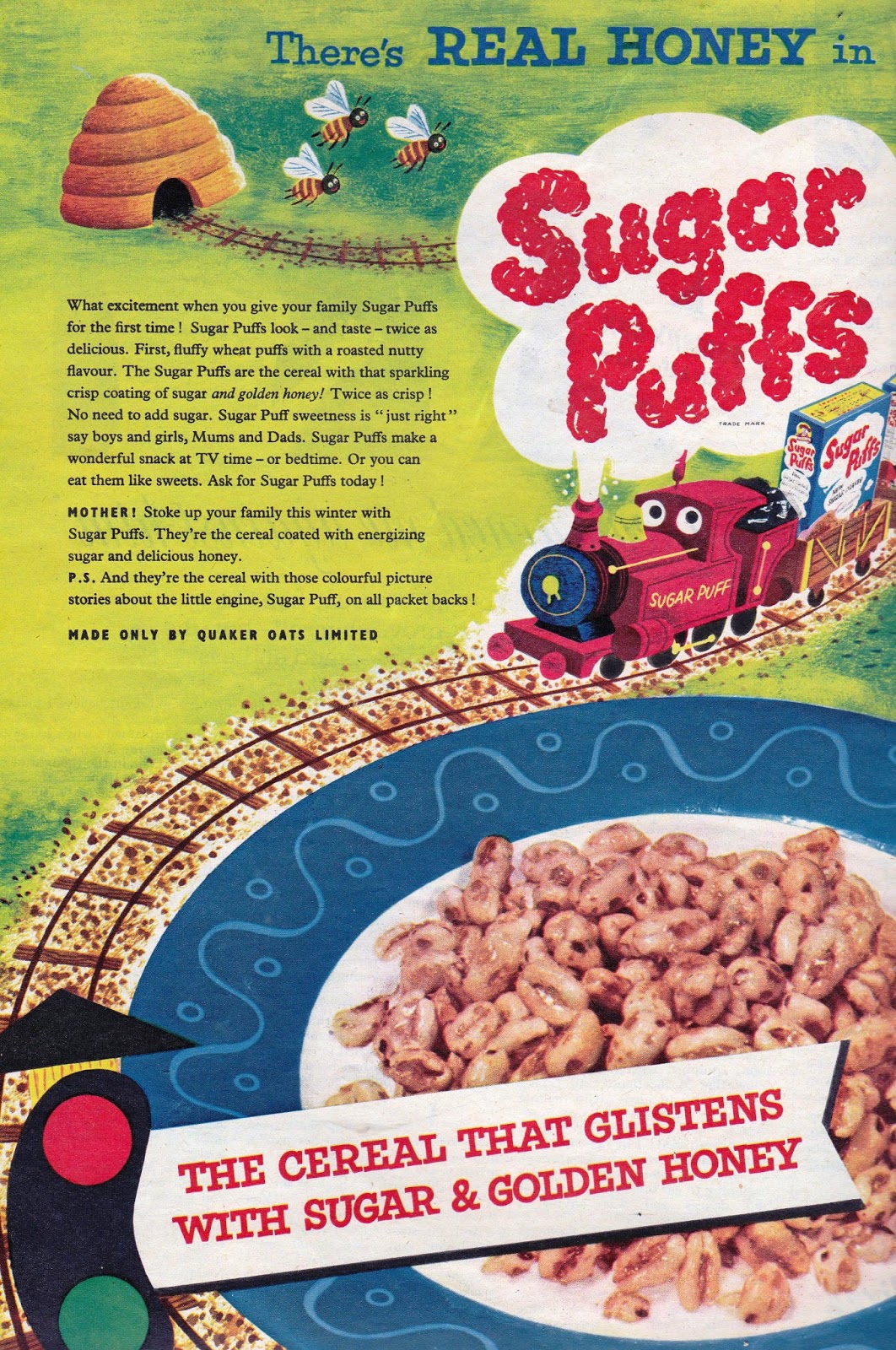
On a whim I had bought a packet of Sugar Puffs and while there was nothing wrong with the product my taste buds refused to recognise them.

Of course there is nothing surprising in that, we will all have had to accept that with the passage of time the food we ate as kids is different.

At which point I won’t fall back on the obvious comment about the size of Wagon Wheels, the failure to find Jublies in the shops or the first time I drank Tizer.

Instead I am reflecting on what I ate for breakfast back in the 1950s and more importantly how it had been influenced by my parents.

Again there is nothing very surprising about that.  As a kid you pretty much ate what you were given, influenced to a degree about by the advertising hypes that came with the television age.

So the attraction of Sugar Puffs was the little products that came with the cereal.  They ranged from tiny plastic racing cars to divers who were supposed to bubble in the fish tank and on one occasion a Sherlock Holmes set of mini detective gadgets.

But even given all that for me breakfast was and is a very personal thing and a meal much influenced by dad.

Long ago he had rejected the habit of eating porridge which as he added salt instead of sugar seemed a pretty sensible thing to leave behind.

Instead it was toast which was left to go cold and hard and eaten with butter or butter and ginger marmalade.

And now seventy or so years after I first ate it like that it’s just how I have my toast which of course raises that bigger point of what we inherit from our parents.

The physical ones are just the luck of the draw but what fascinates me are the habits, mannerisms and cultural outlooks which we absorb.

So from mum I got my politics which had been formed for her in the grim years of the 1930s and grew out of that desperate time of the Means Test, mass unemployment and making do on a pittance.

Along with the politics came a restlessness which expressed its self outlandish projects like the time she decided to breed rabbits and the fish pond she built on her own in the back garden of Lausanne Road.

All of these I have written about in the past and continue to shape who I am.

She too loved writing and had published a series of one and three act plays aimed particularly at women’s groups.

What made mum’s plays just that bit different was that the nature of the groups meant that there had to be few parts for men which added a greater challenge to the plot lines and the writing.

And now like many of my age I have come to reflect on what I have absorbed from mum and dad and conclude that it was far more than I had ever thought.

So breakfast will be toast and ginger marmalade and a day of writing about the past.

As for the Sugar Puffs, they now go under the name of Honey Monster Puffs and the little railway engine pulling its carriages has gone from the packet replaced by a Honey Monster.

There is still the promise of a gift but sadly they no longer taste the same but that will be me.

Location; Peckham, London

Pictures; products from the 1950s, from the collection of Andrew Simpson

*The story of one house in Lausanne Road, http://chorltonhistory.blogspot.co.uk/search/label/The%20story%20of%20one%20house%20in%20Lausanne%20Road

Friday, 14 July 2023

The story of one house in Lausanne Road number 19 ............. bold new designs and a bit of Formica

The story of one house in Lausanne Road over a century and a half, and of one family who lived there in the 1950s.*

Now I would just love to know what mum and dad made of the new household designs which were featured in Woman’s Own for January 12 1956.

I can't remember if it ever crossed the front door but they would not have escaped the exciting new ideas for transforming their early 20th century house into one which fitted with the 1950s.

Looking at them today they seem quite ordinary and just a little old fashioned but back then they were at the cutting edge of all that was new and innovative.

The basic designs were all there two decades earlier but were way out of reach of most working people.

But by the mid 50s that was changing.  Mum was already making inroads into our old fashioned house  coming up with the ideas and dad delivering.

It was partly as a result of the growing prosperity, along with new mass produced materials like plastic and Formica and the ever present offer of hire purchase, which meant for a “few pounds down and the rest over easy instalments” bits of the new life could be pretty much within the reach of every one.

All of which marks the 1950s off as more of a mould breaker than perhaps “the swinging 60's.”

Here were bold new colours, exciting fabrics and designs which relegated the old heavy furniture in many peoples’ dreams to a place in a museum along with the odd dinosaur and other ancient relics.

Of course like most families how ever much we may have wanted to embrace modernity it was still the case that much in our house was a mix of the new and much that was old.

The furniture was Utlity, and some at least of the bedding had come down from Gateshead when my grandparents died.

But there was still the striking yellow pine dressing table and the flying ducks, although in our case mum had gone for something slightly up market and the ducks were a tad more robust but they stood on the wall happily facing the old star mirror and the classic print of the Chinese Woman.

Pictures;  adverts  from Woman’s Own, January 12 1956

*The story of one house in Lausanne Roadhttp://chorltonhistory.blogspot.co.uk/search/label/The%20story%20of%20one%20house%20in%20Lausanne%20Road

Thursday, 16 March 2023

What price child care? ……….. Peckham 1959

I can’t be sure just when mum and dad used the P.H.C. Kindergarten, but it will have been sometime in the late 1950s.*

The cost of childcare, circa 1959
We lived on Lausanne Road and my four sisters were all born in quick succession from 1955 through to 1959, and we left Peckham in the spring of 1964.

So, the window will have been short, if that is they ever did use the place.

I have no memory of it, and at one point our Stella and Elizabeth spent afternoons at the nursery in the Peckham Heath Centre on St Mary’s Road.

This I know because it was my job to collect them after school, an onerous task, partly because it deprived me of hanging around with friends  in the playground of Edmund Waller, and also because I had to push the double pram home.

A chore which culminated in me forgetting one day and getting stick from mum

All of which is an introduction to a flier for the “P.H.C. KINDERGARTEN”, which operated from Norfolk House on Queens Road.

It is a fascinating little document, which details the fees charged, the requirements expected of parents, as well as the children, who “must be between the ages of 2½ and 5 years….. the Kindergarten runs from Monday to Friday each week starting at 9.30 a.m. until 12.30 p.m. [and] the cost is 5/6 per week or 6/6 for two children, [which] must be paid each Monday morning, or by the term if preferred. 

Where a child is absent for a complete week fees will be reduced to 3/- per week (4/-)".  

Our Stella, Elizabeth and Jill, circa 1962
An additional charge of "3d per week for Biscuits. Plimsoles or soft shoes must be won, parents are welcome to participate in the kindergarten, and infectious illness must be notified”.

And as you do I went looking for Norfolk House which is still there just two doors down from the corner of Lausanne Road.

It was there by 1872, and maybe before that, and in its 147 years it has been many things, from a residential property to a social club.

I know that just before the Great War, it was empty, and on the outbreak of the next world war, it was occupied by the Brown family.

Mr. and Mrs. Brown recorded their occupations as "Stewards at the Conservative Club and their son was a compositor".

They already had some experience of running a club, having managed the Earl Cowper public house on Ipswich Road in Colchester, where they were pulling pints in 1911.

Just as now working in the licensing trade could be precarious and Mr. Brown described himself as “Publican and Hay Trusser”.

Norfolk House, 2022
There may well be people out there who also used the Kindergarten or will know just what happened to Norfolk House since the last war and when it became a social club.

I searched for the club, found a telephone number and endeavoured to find out its history.

But despite explaining who I was, and what I was trying to do, the chap on the other end of the line put the phone down on me.

I did come across an article in the Peckham Peculiar but alas there was no reference to the Kindergarten and so I will plod on looking for clues.**

Leaving me just to comment that Dad never one to waste paper did a series of sums on the back and down the side of the flier.  

A list of sums, circa 1964
There are few clues as to what the calculations were about other than a reference to"Furniture removal", "Curtains" and "Odds and ends" which came to £544 -14-0, which may be linked to when we left Peckham for Eltham. 

But that is a story for another time.


Location; Queens Road, Peckham

Pictures;  the flier from P.H.C. Kindergarten, date unknown, our Stella, Elizabeth, and Jillian, 1962, from the collection of Andrew Simpson, and Norfolk House, 2022, courtesy of Google Maps

*Searching for the story of Norfolk House on Queens Road ………. stories from the 1950s and 60s, https://chorltonhistory.blogspot.com/2019/03/searching-for-story-of-norfolk-house-on.html

**Welcome to the Club, Peckham Peculiar, July 2nd, 2015, https://peckhampeculiar.tumblr.com/post/123016271414/welcome-to-the-club


Monday, 16 August 2021

The story of one house in Lausanne Road number 26 .......... Wishy Washy, a wet November playtime in Edmund Waller and a history lesson

Me circa 1956
The story of one house in Lausanne Road over a century and a half, and of one family who lived there in the 1950s.*

Now I often wonder what happened to Wishy Washy.

He worked at Glenton’s on Brabourne Grove and got his nick name because he did the night shift in the summer washing the coaches ready for their turn around in the morning.

I never knew his real name, and doubt that many did.

Only now with the passage of time have I made the connection with the pantomime Aladdin which in 1861 first featured Widow Twankey and her son Wishy Washy who was Aladdin’s brother but had no more than a walk on part in the early shows.

I remember him as a thin man of medium height who lived with his mum off Evelina Road.

But it was his train set that captured my imagination, that and his tendency to take a short cut across the railway track to get home that bit quicker.

Dad took me to see it once and it was magic.  The train set filled a back room of the house and all the accessories from the stations, out houses and landscape had been made by Wishy Washy.

Edmund Waller School, 2007
It had a profound effect on me, but now nearly 60 years later I cannot picture the man, the train set or the house, only that memory of walking to Evelina Road one winter’s night with my dad.

And I suppose that is the trouble with childhood memories, they are at best just a momentary snatch of things, vivid enough at the time to stay with you but too flimsy to tell you more.

Like the day the workmen put in those big heavy metal radiators at Edmund Waller School.

Of course the details are lost but I remember the open fireplaces in the classrooms and one particular wet playtime in late November when I passed the time with a second hand copy of the Eagle comic watching the steam gently rise off the jumpers of some class mates who had been daft enough to get caught in the downpour which had flooded the playground.

Orak Speaks to Andrew, November 1956
The comic was all engrossing but was a one off and it would be another thirty years before I came across the set covering the story and caught up with that moment on a wet day in November 1956 and finished the story.

And it has opened up a shedful of memories of that classroom, a few of the teachers and snippest of lessons long forgotten.

Edmund Waller was a Board School built to a proven design which delivered a building which was warm in winter and cool in summer with windows mounted high enough up the wall to deliver great shafts of sunlight but too high to look out of.

Now that made the school perfect.  As someone who spent his career in schools built in the 1950s I yearned for the solid brick built schools of the late 19th century.

The architects of the post war period may have thought they were doing something bold and new with designs which used masses of glass, but they never had to work in them.  In winter they leaked heat and in summer turned the rooms into infernos which did nothing for concentration.

The Eagle, 1956
Added to which the distractions of a net ball game in the playground proved fatal to an explanation of the causes of the Great War.

But a tleast the classroom walls then and in my time as a teacher were places to advertise the achievements of students, although the walls of class 3b seemed for ever dominated by rows of multiplication tables and key spellings.

Forty years later the fashionable and expensive experts brought into tell us teachers how to do a job we had been doing for twenty years and more hit on the idea of visual learning all of which Miss Prentice had mastered all of those decades ago.

And that in a round about way brings me back to Wishy Washy who like Miss Prentice knew what worked and what would captivate an eight your old.
Pictures;

Pictures; me circa 1956, Edmund Waller School, 2007, Colin Fitzpatrick, and The Rogue Planet, Eagle, May 25 1956 Vol 7 Nu 22, from the collection of Andrew Simpson

*The story of one house in Lausanne Road http://chorltonhistory.blogspot.co.uk/search/label/The%20story%20of%20one%20house%20in%20Lausanne%20Road