Showing posts with label Manchester & the Second World War. Show all posts

Wednesday, 7 February 2024

“Can I do you now Sir?* .............. lost memories of wartime productions at the Palace Theatre

October 30 1944
I doubt that I will ever meet any one who sat in the Palace Theatre during late October and early November 1944.

And that is a shame because I would love to know what they made of “WE’RE COMING OVER” which the programme announced was “A Musical Tour de Forces.” 

In 14 scenes the production took the audience from The E.N.S.A. headquarters at Dury Lane to a street in Lisbon, a hotel in Cairo and by degree a ship in the Mediterranean, the Opera House in Naples and “Somewhere behind the lines,” before finishing at the Camp Show at the Eighth Army Folies.**

There was music, comedy and a lot more and I wish I could find out more about it.

Just a few weeks earlier the Palace had played host to Ivor Novello in “The Dancing Years” “A Musical Play” featuring Ivor Novello, Veronica Brady, and Roma Beaumont.***

From Dury Lane to North Africa
The story was set  in Vienna in pre-1914 and shifted to 1938 following the life of a penniless composer and his love for two women.

And as you would expect from a production of the time the two women come from totally different social classes.

One was an innkeeper's daughter and the other an opera singer and the story unfolds against the backdrop of the growing presence of the Nazi Party in pre war Austria.***

It had opened in March 1939, closed at the start of the war and reopened in 1942 running for 969 performances finishing in July of 1944 when it took to the road and began a three week stint at the Palace from October 10.

It is unlikely I would have across either production had I not been looking at a collection of theatre programmes owned by my friend David Harrop.****

By their very nature theatre programmes have a short life.
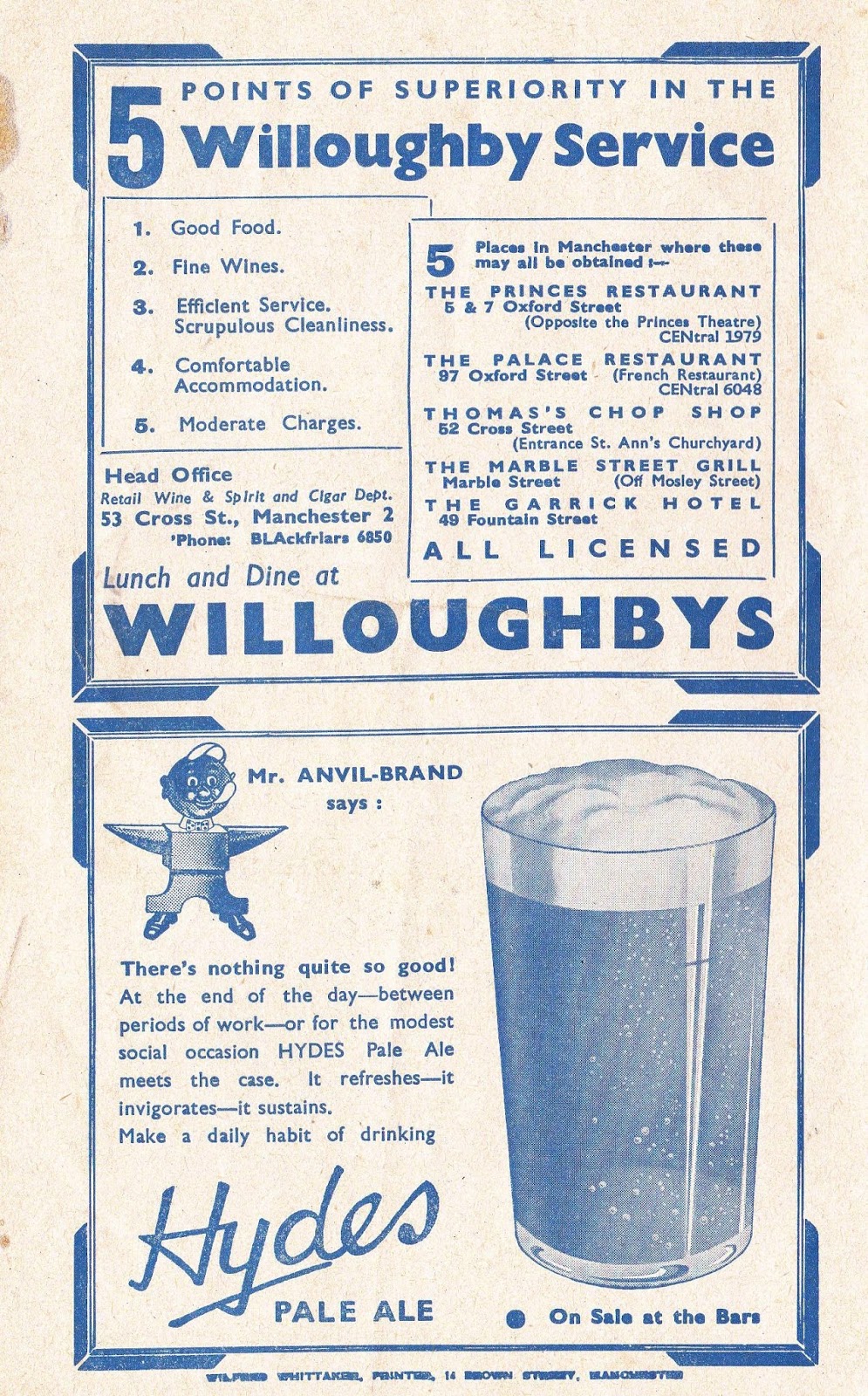
Adverts from 1944
At best they are kept safe for a while but eventually succumb to a bout of spring cleaning and most get lost on the bus going home or thrown out the following day.

And like all such material many carried adverts which are themselves a priceless insight into the Britain of the 1940.

So these are a real find and point once again to that simple observation that you find the past pretty much anywhere, and having found it lets you go off looking for more.

Wartime productions like these were not only good entertainment but played their part however small in maintaining morale.

And that brings me back to “WE’RE COMING OVER” which I think will have celebrated and show cased the talents of The Entertainments National Service Association or ENSA which was set up in 1939and provided entertainment for the British Armed forces during the Second World War.

Concert party Normandy, July 1944 just weeks after the D Day landings
Performers included Robert Rietty, Gracie Fields, George Formby, Wilfrid Brambell, Joyce Grenfell, Adelaide Hall, Paul Scofield, Rebecca Cantwell, Dora Bryan and Vera Lynn.as well as Laurence Olivier and Sir Ralph Richardson who  performed Shakespeare's plays for the troops in a six-week tour of Europe.

Often they performed close to the front line and appeared in every theatre of the war.

But that as they say is for another time.

Pictures, theatre programmes 1944 from the collection of David Harrop, and an ENSA concert party entertaining troops from the steps of a chateau in Normandy, 26 July 1944, Midgley (Sgt), No 5 Army Film & Photographic Unit, from the collections of the Imperial War Museums, This image was created and released by the Imperial War Museum on the IWM Non Commercial Licence. 

* Can I do you now Sir? Mrs Mopp, catchphrase from the radio series “ITMA”, “It’s that Man Again” BBC Radio, 1939-1949
** E.N.S.A., http://en.wikipedia.org/wiki/Entertainments_National_Service_Association
***The Dancing Years, http://en.wikipedia.org/wiki/The_Dancing_Years
****David Harrop, http://chorltonhistory.blogspot.co.uk/search/label/David%20Harrop


Monday, 5 June 2023

Letters should be addressed ....... Prisoner of War Post, Stalag XVIII.A. Germany .... stories of a P.O.W.

 It’s always in the detail, so while you need the “big picture” which places everything in the past into a context, it’s the little bits which give meaning to the grand sweep of history.


And this letter to a Mrs. Hirst of Caldecott Road Higher Blackley is no exception.  It was sent by the Red Cross at the beginning of April 1945 and concerned her son Frank who was a P. O.W. in Germany.

The Red Cross was “very glad that your son’s camp address is now known [and] letters should be addressed to him as follows, Prisoner of War Post, Kriegsgefangenenpost, Gnr. Frank Hirst, British Prisoner of War No: 9611 Stalag XVIII.A. Germany”

Stalag XVIII.A was in the southern part of Austria near the town of Wolfsberg.

Just when he had been captured is unclear, but his family will no doubt have been relieved that they had a contact point to send letters.

And to know that he was entitled to Red Cross parcels which went via Geneva to the camps.  

Mrs. Hirst also received a leaflet which detailed the contents of a typical parcel which" are specifically planned to supply what is most needed in the Prisoner of War Camps.”

These included biscuits, cheese, jam, milk, and cold beef, and variations provided by the Indian Comforts Committee of the Indian Red Cross Society and contained “curry, lentils, certain spices and rice”.

Added to these there were supplies of tobacco, cigarettes and soap.

The leaflet also offered advice on what to include in the letter as well as information on how prisoners could correspond with family in Britain.

But and there always is a but the Red Cross acknowledged that due to “the present conditions in Germany, the dispatch of all individually addressed parcels to prisoners of war had been suspended by the G.P.O.  for the time being, but the International Red Cross Committee at Geneva will continue to deliver Red Cross food parcels to all camps”.


This was after all the closing stages of the war. The western allies were fighting their way across Germany, while the Red Army was moving to occupy Vienna and capture western Prussia.

All of which meant that on that April day the war in Europe had just over a month to run.

As yet I don’t know what happened to Frank Hirst, when he was liberated and how his life after the war played out.

He was born in January 1921, had an elder brother and his parents ran a fish and chip shop from 75 Milton Street in Southport.  

They were from Huddersfield and by 1939 had moved to Higher Blackley.  

By then his father appears to have given up battering fish and described himself as a “power loom woollen weaver, unemployed”.

In time more about the family will come to light, but for now it is this letter which offers up so much detail about the fate of P.O.W’s and which will have relevance to anyone who had a relative captured by the Germans in the last world war.

Location, Southport, Manchester, and Austria.

Pictures; Red Cross letter, 1945, courtesy of David Harrop.

Thursday, 6 October 2022

Army Book 64 .... one young soldier ......and a story

Now, as we all know you can pretty much find stories about the past in all sorts of things, and today I came across a Soldier’s Pay Book.

Army Book 64, 1941
To give it it’s full title it is Army Book 64, Soldier’s Service and Pay Book and it belonged to C. Petrie who served in the British Army from June 1941 till 1946.

And I have never seen one.  

Had I been just six years older, I might have been called up and done my 18 months National Service with the armed forces, and a pay book would have been an essential part of my kit, which according to the instructions at the front of the book I was “always to carry on my person”.

So, looking through the book courtesy of Mr. Petrie’s son has been a fascinating insight into just what the book offers up.

As you would expect it lists his physical characteristics, his enlistment, details of training undertaken, the name of his wife, and home address, along with his religion, the vaccination’s he was given and the number of times he went on leave.  

And I know that of the 23 occasions he was granted leave all but three were accompanied by a free travel warrant.  More chilling but necessary was the inclusion of Army Form B. 2089, which gave details of how to fill in in a “Soldier’s Will" with a template.

Making a will, 1941

Happily, his family never had to call on it.

I have seen army records from the Great War, which include much of this information but never ones for the Second World War and so it is indeed a fascinating document.

Mr..Petrie and his comrades 1942
His son Anthony has added “I have my Dad’s paybook l which he used to keep in a big metal container along with a few of his army photos and his army revolver and a pouch of bullets.  

How he managed to sneak those items out when he was demobbed, I don’t know.  

I can only assume that security was quite poor as the government attempted to demob millions of men as quickly as possible. 

There are a few army photos and on this one dad is 4th right 2nd row from the front.

Going on Leave, 1942-1944
Pages 6/7 of the pay book lists records of leave given and as my sister was born on 15th July 1944, we can trace the time of her conception as being during the seven days leave in October 1943 on page 6.  

Page 11 lists his and his next of kin’s address, which originally was 82 Neale Street in London and crossed out.  

Before and during the war, my mum shared a flat at Neale St with her sister who both arrived in England in 1937 aged 13 and 15, with their older brother, Mike aged 20.  Mike was enlisted and fought in Italy at Monte Casino.  

My dad joined them at Neale St in 1942 after they were married.  My nephew (who lives in Barnet)  and my son recently visited Neale Street and took a photo at 82 Neale St which survived the blitz and the planners. 

When the V1 and V2 rockets started to hit London, my dad suggested that the mum, her sister and my should move to the safety of Manchester and they settled at Parkfield Street, Rusholme, or Packfield Street as was listed by the reporting soldier in dad’s passbook.  

Training, 1942-1944
No doubt my dad’s thick Cypriot accent confused the soldier making the change.  His poor English was a problem that was to later haunt me as when he went to register my birth, my Christian name should have been spelt Antony, without the ‘h’ – the Greek spelling and Petri, without the ‘e’- also the Greek spelling.  

The registrar entered both names incorrectly on my birth certificate as Anthony Petrie – the English spellings and my dad’s written English was not yet good enough to correct him.   

My dad arrived in England in 1935 and within two years it must have been fairly apparent that war was imminent.  

He could have simply returned to Cyprus and saw out the war in Cyprus which apart from a few food shortages was untouched, but instead stayed and ended up spending six years in the army.  I’m pretty certain that I would have been on the first boat back to Famagusta”.

Pictures; Mr. Petrie’s courtesy of Army Book 64, 1941 – 1946 and unit picture, undated, courtesy of Anthony Petrie

Tuesday, 19 May 2015

Memories of leaving Manchester as an evacuee in September 1939 ..... in conversation with Bevan Taylor

“There was no chance to say goodbye to my parents, the buses arrived and we were off to London Road Station and three months in the country as evacuees.”

Poster, 1940
This almost throwaway comment by Bevan Taylor will have been replicated thousands of times across Britain during the early September of 1939.

Since Guernica in the Spanish Civil War there was that powerful idea that the “bomber would always get through” and so even before the outbreak of war preparations had been made for the mass removal of children and expectant mothers out of the danger areas.

The evacuations began in early September, experienced a lull during the Phoney War when some children returned home and picked up again after the Fall of France and the beginning of the Blitz.

But there were enormous regional variations with cities like Manchester and Liverpool evacuating large numbers of children while other urban areas sent fewer to neighbouring towns and villages.

Bev and his friends from Burnage High School were sent to two villages outside Leek in Staffordshire.

It had begun  in the spring of 1939 when his parents attended a meeting at the school “which they assumed was about Air Raid Precautions, and while there signed a form which it became clear gave permission for me to be evacuated.


Children evacuees on a bus, 1940
There were approximately 450 other lads whose parents had done the same, and we were all told to arrive at school with a packed bag.

Now I turned up with one of those fibre suitcases while my friends had rucksacks, and I did envy them those rucksacks.

We didn’t know what to expect but perhaps not just to be put in the school playing field under the supervision of some prefects.  

There was nothing to do except play cards.

At the end of the school day we were sent home, only to return the following day for more of the same.


North Manchester Grammar School Boys, 1940
In all we had four days on the playing field and I can say I’d had my fill of playing cards by the end of it.

And then on that fifth day, Friday September 11th some double-decker buses drew up outside the school

We were told we weren’t going home and with that we trooped aboard the buses and went off to the station and from there by train to Leek and on again by bus to the village of Longsdon.

There wasn’t much to the village.  I remember the church,the corner shop,  a telephone kiosk and a hall belonging to the Women’s Institute. 

I had teamed up with my friend and we reckoned that we would accept the first person who offered to take us because we didn’t fancy being there all day.

As it was we didn’t have to wait long because about half an hour after we arrived a severe looking man with dark eyes, wearing a bowler hat and carrying an umbrella walked up to us and said ‘Would you like to come with me?  

He gave my mate his briefcase and umbrella and me the bowler hat and then with us on either side of him we walked off out of the hall and up the road to a house opposite to Salt’s farm."

Next; three months with the Peacock family

In conversation with Bevan Taylor May 8 2015

Picture; Don’t do it Mother, Ministry of Health, 1940, and was scanned and released by the Imperial War Museum on the IWM Non Commercial Licence, Evacuation of School Children on a Bus, 1940 m09910  and North Manchester Grammar School Boys off to Bakewell, 1940, m09927  courtesy of Manchester Libraries, Information and Archives, Manchester City Council, http://images.manchester.gov.uk/index.php?session=pass