Showing posts with label Manchester in the 1900s. Show all posts

Sunday, 23 August 2026

Lost and forgotten streets of Manchester ........ nu 81 Roman Entry

This is Roman Entry.

Roman Entry, 2017

It connects Church Street to what has variously been known as Roman Street and Back Alley and long ago lost even its name.

Now I must have passed Roman Entry many times over the years and not even given it a glance and even less ventured down what is a very narrow thoroughfare.

Roman Entry, 1910
But then why should I?

On any busy day taking time off to explore a dark and dismal alley might well seem a waste of time.

These days however I have the time and have also rediscovered my sense of curiosity for back alleys, narrow passages and forgotten streets which offer the promise of all sorts of history.

In the case of Roman Entry, it is there by 1793 and will in all probability be much older.  From the 1840's if not earlier part of the alley was enclosed and formed part of a building.

Looking at the records, subsequent buildings were built on the site incorporating the entry.

In 1910 the building was home to the hosiery business of F.C. Lowcock ad earlier still was listed as a Boot and Shoe warehouse and before that as various types of “manufactury” back into the 1850’s, and even was shared a linen manufacturer and an artificial flower maker.

And with a bit more research using the rate books we might be able to discover the uses for that building back into the late eighteenth century.

We shall see.

Location; Roman Entry

Pictures; Roman Entry, 2017 from the collection of Andrew Simpson, and in 1910, by J. Jackson, m01696, courtesy of Manchester Libraries, Information and Archives, Manchester City Council, http://images.manchester.gov.uk/index.php?session=pass

Friday, 21 August 2026

Poverty…. gas masks ….. going to the flicks …. and a night in Chorlton ….. stories from Madeline Alberta Linford

Madeline Alberta Linford was by any measure a remarkable woman.

Madeline Alberta Linford, 1921
At just 22 in 1917 she was writing for the Manchester Guardian, at 27 she had reported on the famine and typhus outbreak in Poland followed by on-the-spot reporting from Austria, and Germany.

In the same year she was chosen to create to create a page "aimed at the intelligent woman", defined by C. P. Scott  as discussing issues such as "domestic economy, labour-saving, dress, household prices, and the care of children".*

And she remained the only woman journalist on the Manchester Guardian till 1944.

During the war she was also night picture editor, combining it with voluntary war work.

She “wrote a biography of Mary Wollstonecraft, published in 1924, and five novels: Broken Bridges (1923), The Roadside Fire (1924), A Home and Children (1926) Bread and Honey (1928) and Out of the Window (1930)”.* 

To all of this she also championed other women writers.

I first came across Ms Linford when Tony Goulding wrote about her life for the blog back in 2023.** 

It is a comprehensive account of her life and particularly her time in Chorlton on Claude Road and Wilbraham Road and is an excellent starting point.

My interest was reignited after a chance conversation with Cllr Mathew Bentham whose friend now lives in her old house in Chorltonville.

August 1917
As you do, I went looking for her articles in the Manchester Guardian. 

Alas her stories on Poland, Germany and Austria have yet to turn up, but there were plenty of articles spanning her years as a critic reviewing plays, and films as well as those reporting on contemporary issues.

Reading them for the first time over a century since they were produced, they offer up a fascinating insight into Britain during the early and middle decades of the last century.

And there were some surprises, not least that in 1917 both here and in Hollywood films were being made in colour.

Her review of Annabel’s Romance in the August of 1917 at the Deansgate Picture House begins with that simple observation that “A coloured film is still rare” **, while five years later she playfully remarked that the colour effects in A Study in Scarlet made “Faces as expressionless as though a sponge had wiped the life out of them”.****

Deansgate Picture House, 1928

But for me it is her articles on hospitals, shopping and the impact of the war which bring the 1920s and 30 bouncing into life.

December 1922
Like the piece on the Manchester Babies’ Hospital in Burnage Lane, written in 1922 which is both informative and written with style.

She visited in late December when “the hospital is in party dress [with] its Christmas decorations which are simple and consist of silvered twigs latticed across windows with robins perching on them, trails of pink almond blossom, and bright ballons tugging at their strings.”*****

But this is 1922, in that time before the NHS when poverty is the main reason why the fifty-bed hospital is full and why “the fifty cots could be filled over and over again”.

“All of them are suffering in some way or another from malnutrition.  They come from the most destitute homes in Manchester where their poor little bodies have been the victims of ignorance, poverty and in a few tragic cases, of actual neglect … where all the good things of life are short”.

Manchester Babies’ Hospital, 1962
“Children of six months weighing only six pounds; newborn babies whose weight barely reaches three pounds. 

The wards are full of them, lying with terrible apathy in their cots, their faces wizened and furrowed like those of the very aged, and their waxen fingers as helpless as broken ones. Anyone who since the war has visited the infant welfare centres of Berlin or Vienna will find the tragedies all over again in this Manchester hospital.”

And because rickets marches with poverty “the conservatory has been turned into a semi-open-air ward for rickets”.

Equally telling is the admission of just how much money is needed to maintain and advance the care. So, while “The Babies’ Hospital is full of plans for the future and a laundry is now being built and X-ray department is one of the great needs [with] it is hoped an extension to enable another twenty babies to have their shire of skill and kindness but for these schemes as well as the ordinary everyday running of the hospital money is badly needed”.

It is a powerful piece of reporting which comes with the style of an accomplished writer and so she begins by locating the hospital in a “big old house of the type of successful businessmen built for their families half a century ago. One can imagine it furnished in mahogany and rep with steel engravings of ‘Pilate’s Wife’s Dream hanging in the hall and camellias cherished in the conservatory”.

That same playful way of writing is evident in a series of articles she wrote in the run up to the first war time Christmas of 1939.

Set against the novelty and danger of going out in the blackout, and the surprise that the shops almost had a prewar feel about them the ever-present conflict is not far away and includes a delightful and humorous take on what the fashionable woman looks for in a bag to contain her gas mask.

July 1947
And along with all the serious and the not so serious comes a review of our own “Chorlton Repertory Theatre Group which has been an enlivening feature of Chorlton-cum-Hardy and the neighbouring suburbs”.

Written in in the summer of 1947 it reviews the group’s “choice of plays, performed in the Public Hall ranging from Shakespeare to Noel Coward and to farces which had caught the fancy of West End audiences” and focused on “The Letter” by W. Somerset Maugham.

It is a well balanced and I think affectionate report and offers up the names of some of the actors.  These include Harry Littlewood, Gloria Foster, Arthur Spreckley, the producer, and James Lovell who “designed and painted the excellent sets” which might be another story. 

One to read, 2024
But for now, I will just leave you with a suggestion to read a review by Quentin Outram of a selection of Ms Linford’s writing “M.A.L” The Journalism and Writing of Madeline Alberta Linford" edited by Michael Herbert and published in 2024

Pictures; Portrait of Madeline from the Guardian’s photograph of its 1921 editorial staff researched by Tony Goulding, Manchester Babies’ Hospital in Burnage Lane, m15731, 1962 courtesy of Manchester Libraries, Information and Archives, Manchester City Council, http://images.manchester.gov.uk/index.php?session=pass Deansgate Picture House, from Kinematograph Year Book, 1928

Further reading; Outram, Quentin, The Journalism and Writing of Madeline Alberta Linford, Society for the Study of Labour History January 3rd 2023, https://sslh.org.uk/2025/01/03/the-journalism-and-writing-of-madeline-alberta-linford/

Herbert Michael,[ed] “M.A.L” The Journalism and Writing of Madeline Alberta Linford, self-published through Lulu.com and available Society for the Study of Labour History, https://sslh.org.uk/

* Madeline Alberta Linford, https://en.wikipedia.org/wiki/Madeline_Linford

**Madeline Alberta Linford .... another story from Tony Goulding, https://chorltonhistory.blogspot.com/2023/12/madeline-alberta-linford-another-story.html

***A Coloured film at Deansgate Picture House, Manchester Guardian, August 21st, 1917

****A Study in Scarlet, Manchester Guardian, February 24th 1922

*****A Hospital of Cots, The Sick Babies of Manchester, Manchester Guardian, December 29th, 1922

******Chorlton Theatre Group, Manchester Guardian, July 30th, 1947


Sunday, 2 August 2026

The story of a strike and of strikes yet to come, part two .... a Chorlton postcard

On Newton street in July 1911
The Carters came out on strike in Manchester at the beginning of July 1911. 

It was the picture of police escorting a strike breaker which first caught my interest.

But they were not the first or the last during the next few years to withdraw their labour to advance a demand for better pay and conditions.

Early in 1912 the miners had come out following a ballot “in favour of giving notice to establish the principle of a minimum wage for every man and boy working underground,”* and at the beginning of March Manchester Municipal workers voted to follow those of Stalybridge, Salford and Stockport and strike for higher pay.

You can get a sense of the mounting conflict from the newspapers of the period. The Manchester Guardian was quick to comment on the concerns over coal stocks in the Greater Manchester area just weeks after the miners had come out, and carried reports that in Nottingham the bakers and painters were about to go on strike while in Manchester there was serious disruption to the rail network.

Leonard's fears
And here in Chorlton on the day the Guardian reported that 60% of trains from one Manchester railway station had been “knocked off” Leonard wrote to a friend of his worries about his mother’s illness and that “all our staff intend to come out on strike this weekend.”

Now it may never be possible to discover the business that he ran or what happened on Friday March 15th when the strike was due to start, but I shall endeavour to try.

He was “busy making arrangements to fill their places” and thought that “this Coal crisis ..... is a terrible affair.” 

All of which rather eclipsed his pleasure that at the Parliamentary bye-election earlier in the year “our man got in (Good old Blue) turned a liberal majority from over 2,000 to a conservative one of 500, great excitement.”

It is a fascinating glimpse on how people here in Chorlton looked out on the mounting political and industrial unrest and sadly represents the only comment we have so far.

As it was the strikes rumbled on through the year, but more about them tomorrow.

Picture; detail of a postcard sent on March 12th 1912 from the Lloyd collection, detail from the Carter's strike, courtesy of the Greater Manchester Police Museum

*Balllot paper issued by the Miner’s Federation of Great Britain, January 1912


Saturday, 1 August 2026

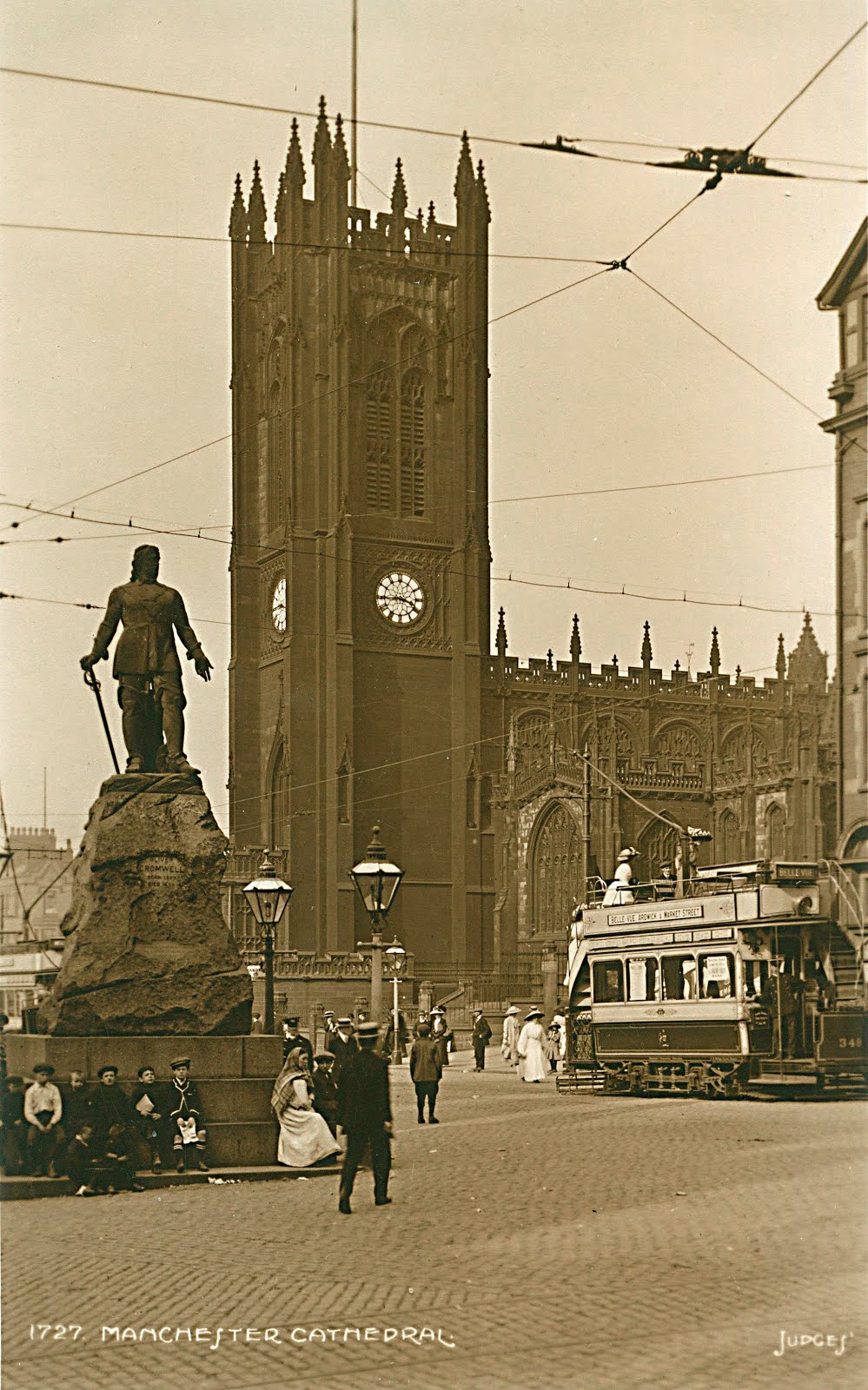
The woman in a shawl at the foot of Oliver Cromwell in the summer of 1914


It’s the last of my Judge postcards. 

Like the others in the series which Fred Judge took in the summer of 1914 it has much going for it not least because it isn’t the standard view.

Instead we have the statue of Oliver Cromwell matched by the Cathedral behind and balanced by the building to our extreme right.

But for me it is also the figures he has captured sitting on the steps.

There is the mixed group of boys including one in school uniform and beside him what might be a paper seller and the others, two of whom are engaged in a game.

And there is the woman in the shawl not at all interested in the camera deep in thought or perhaps listening to the chap next to her.

She is interesting because you rarely see women in shawls in post cards of the period.

They were there in the city and were often the subject of pictures taken on the poorer streets.

She makes a fitting contrast to the more elegant woman with their fine hats and expensive looking clothes off in the distance.

I wish I knew more about her, or for that matter the group standing by the tram, which is heading up to Market Street.

I can’t be sure but I rather think it is a Sunday sometime in the summer, partly because this is from the same series of pictures Fred Judge took around Manchester and may well be the next after the one on Cross Street.

In his photograph of Albert Square from Cross Street the time is just before three in the afternoon and here beside Oliver Cromwell the Cathedral clock is just coming up to a quarter to four.

Which was just enough time for him to stroll down and set up here.
The crowd by and large are oblivious to his presence and just get on with the day, some no doubt heading on to Bell Vue which is the final destination of our tram.


Picture; from the collection of V & G Harris

Wednesday, 22 July 2026

Lost and forgotten streets of Manchester nu 20 ............. Market Place

New Cathedral Street, 2016
Now I like the way that history has a habit of repeating itself.

So here is New Cathedral Street which runs from Market Street to Exchange Square.

Like me there will be many who remember it being cut in the 1990s following the IRA bomb.

But I had totally forgotten that less than a century ago there was a similar thoroughfare that pretty much followed the same route from Market Street towards the Cathedral.

Market Place, 1900
Back then it was called Market Place and continued as Old Millgate before joining Cateaton Street at Cathedral Gates.

In the 1850s a stroll down the two streets would have taken you past the Wellington Inn, the Black Boy and the Falstaff Taverns, as well as offering up the Fish Market, Fruit Market and the Poultry and Meat Market.

A full fifty years later and while some of the buildings and their usage might have changed the route was still as narrow and twisty leading to the Old Shambles.

And for those of a more adventurous or careless approach  running parallel was a short stretch of Corporation Street which gave access to a string of tiny streets and courts with names like Bull’s Head Yard, Blue Boar Court Sun Entry and Paradise Court.

Market Place, 1851
Now none of those have been recreated, they sit under the new Marks and Spencer and Selfridge stores.

But armed with a few old maps and with a bit of imagination you can at least walk along New Cathedral Street and the ghost of Market Place.

And of course at certain times of the year when the outdoor Markets have come to town there is that added bit of interest from the stalls which might just give up a flavour of the area as it was in the past.

Location; Manchester

Picture, New Cathedral Street, 2016, & Market Place, 1900, from Goad’s Fire Insurance Maps, and in 1851 from Adshead’s map of Manchester, 1851 courtesy of Digital Archives Association, http://digitalarchives.co.uk/

Wednesday, 13 May 2026

Looking for the lost ...... one street over time in Ancoats ..... no 2 Homer Street and the Ward family

Now I would like to think that one of these young people could be Ethel Ward.


Students at St Andrews School, 1920
She was living with her parents at number 9 Homer Street and it is just possible she attended St Andrew’s School which was at the end of the road.

Homer Street and in particular number 9 has over the last few days drawn me in and I want to know more.

It was just a few minutes away from Fairfield Street and on a quiet night the Ward family would have heard the distinctive clunk of railway waggons being shunted in the nearby sidings, caught the smell from the river and the dye works and worried that young Ethel might do something daft beside the canal.

Homer Street, 1894
That said I remember my old friend Norman who had been born close by telling me how he had learnt to swim by being thrown in that same canal.

I last visited number 9 in 1851 when it was home to two families.

At that time I knew little about the property but now know that it consisted of four rooms which given that there were seven of them must have made it a squeeze.

Just exactly what the condition of number 9 was like is unknown, but by 1911 it was at least 74 years old having been built as part of the swift development of the area in the early and mid 19th century.*

The class of 1920, St Andrew's School, 1920
The earliest entry in the rate books is 1837 when the block was owned by a Mr Price who is still the owner in 1851.**.

I suspect Mr and Mrs Ward counted themselves relatively lucky because many of the surrounding properties consisted of just two and three rooms and were home to large families.

He was an electrician for Manchester Corporation and as such was a skilled worker.

They had been married for eleven years and Ethel as their only child.

For Ethel there would have been little that could be said to have offered up exciting places to play.

Just a short walk down Phobe Street was a tree lined Recreational Ground which backed on to the river but it was dominated by a cotton mill off to the east and the Ancoats Goods Yard to the north delivering a fair share of noise, smells and if the wind were in the wrong direction no doubt the old cloud of smoke.

Of course there is a danger in letting your imagination over play the industrial scene and I have also to concede that by the time our school picture was taken Ethel would have been fourteen and already working, perhaps in that very textile factory that overlooked the Rec.

St Andrew's Square, 1966
Her home and the rest of the houses on Homer Street had gone by 1938 although the street and some of the surrounding ones continued to appear on maps, but by the end of the century even their imprint had vanished under a site which had various industrial uses and now is a warehouse for Armato Food Products  and it was the current owners who suggested I might be interested in the site.***

Which is almost the end, but I have to add that in wandering the neighbouring streets I did come across a Mr Simpson living with his wife and two boarders in three rooms at number 17 St Andrew’s Street.  He was no relation but I like the way a random search throws up a Simpson.****

Pictures; St Andrew’s School, Homer Street, 1920, m48646, and St Andrew’s Square from St Andrews Street, facing west, 1966, T Brooks, m10604, courtesy of Manchester Libraries, Information and Archives, Manchester City Council, http://images.manchester.gov.uk/index.php?session=pass and Homer Street in 1894, from the OS for South Lancashire, 1894 courtesy of Digital Archives Association, http://digitalarchives.co.uk/

*Homer Street, Enu 12 272, Central, Manchester, 1911

**Manchester Rate Books, 1837- 1851

***Amato Food Products, http://www.amatoproducts.co.uk/

****St Andrews Street, Enu 12 188, Central, Manchester, 1911

Wednesday, 25 March 2026

A little bit of timeless history in St Ann’s Square ...... selling flowers

Now the historian in me knows I should go off and look for the first reference to a flower seller in the square by the church.


In 1979 I did the thing, and took a series of pictures of that flower stall.

At the time and for a long time since I thought there was nothing remarkable about the scene.

And then recently I came across a picture post postcard from 1904 showing a flower stall in the identical spot, added to which someone else came up with an earlier image from 1898.

So that rather begs the question of how long there has been a business on this location and for that matter just how many images there are of flower sellers in St Ann’s Square.

I suspect we shall find out.

And quick as a flash, Jennifer added a comment to the blog which deserved to be added in,
"Hello, hope this information my help your research.  From the late 60s to the mid 70s I worked for the Halifax BS on Deansgate. 

They had an account with the flower stall in St Ann's square. 

The couple who ran it then where brother and sister John & Sally. I think the name on the invoice was Fitzgerald. 

They told me the stall had been in their family for many years. I think the stall was taken over by John's son Roger? and then by his son. John and Sally were lovely 5. 

They advised which flowers were good for the displays and how to arrange them".

Location; Manchester

Pictures; St Ann’s Church, 1978-9 from the collection of Andrew Simpson, and from the series Manchester, marketed by Tuck & Sons, 1904, courtesy of Tuck DB, http://tuckdb.org/


Thursday, 12 March 2026

In St Ann’s Square with the Rotary Photo Company …… sometime in the early 20th century

Now if you wanted proof that St Ann’s Square has always been a busy and fussy place, the evidence is here in this picture postcard.

I don’t have a date, but I am guessing we are sometime in the early 20th century, and a bit of detective work using the names of the shops and street directories will get close to when the picture was taken.

Everyone will pick up on some different bit of the picture, from the line of taxis and the cabby’s hut, to the throng of people parading through the square and that female cyclist.

And then there is another story around the company who published the picture postcard.

I had causally thought that Rotary Photo, EC were a Manchester firm, but not so.

According to that excellent site, Graces Guide to British Industrial History, they were a London business with offices at 23 Moorfields London, with works at West Drayton.

They were established in 1901, as The Rotary Photographic Co and “was a huge publisher of real photo postcards. 

One of their unique novelty postcards was a 1¾ inch x 5½ inch (4.4cm x 13.9cm) photo series of bookmark cards. Most seem to have been posted in the 1903-04 period".

Later in the century they amalgamated with other photographic companies and were still in business in 1947.

Location; St Ann’s Square

Picture; St Ann’s Square, date unknown, courtesy of Steve

*Graces Guide to British Industrial History, https://www.gracesguide.co.uk/Rotary_Photographic_Co

Monday, 2 February 2026

When a picture postcard doesn’t reveal a story ………

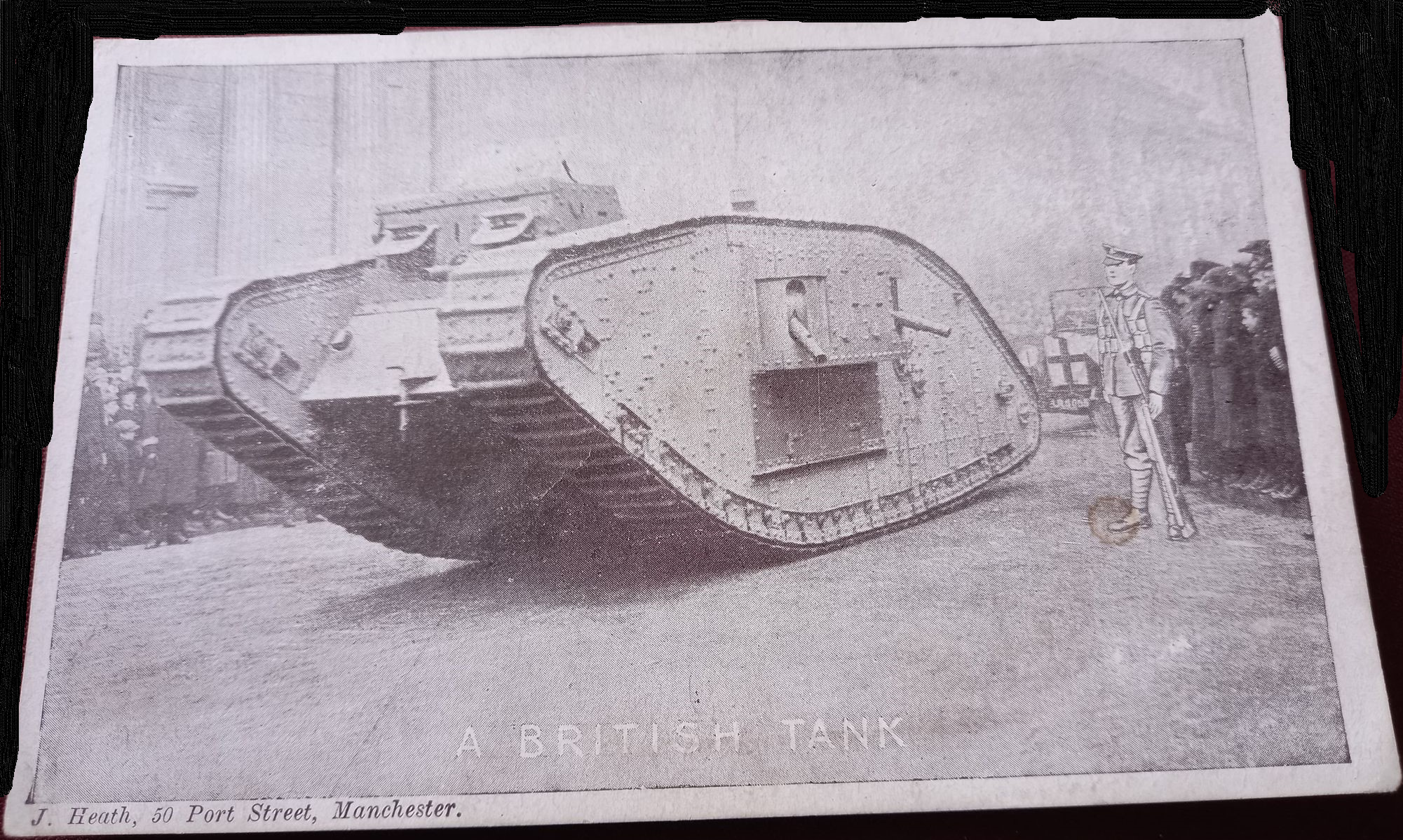
I doubt I will ever discover much about J Heath who inhabited 50 Port Street sometime in the closing stages of the Great War.

Tank in a street, undated
So far, I have only this picture postcard to go on which shows a tank on what might be a Manchester street with a reference to J Heath. 

It is undated and a brief sweep of the media for the period offers up no clues, but if it is Manchester it may have been in conjunction with Tank Bank which was a scheme to raise money for the war effort, and which involved a tank, lots of publicity, and expectation that heaps of money would be raised.

The Tank Bank came to Manchester in December 1917, and in just two days raised £870,444 which the Manchester Guardian proudly declared was more than Liverpool or Sheffield had raised.*

Either way it appears to be a “tank picture” marketed by J Heath, who may have been John Edward Heath who is listed as a printer in 1911 at 27 Newport Street in Rusholme.

But in 1911 the property in Port Street is occupied by a Frederick Armytage who was a confectioner.

All of which leaves me to say it is all still out there to uncover.

Port Street, 1985
Both 27 Newport Street and 50 Port Street still exist and in the case of Port Street has undergone a bit of careful restoration.

I can’t find the pictures I took a few years ago so have fallen back on this one from 1985.

Last year it was a hairdresser’s and 37 years ago was trading as the Salford Sewing Machine Centre, and I bet has been many other things.

Of course the tank might not even be on a Manchester street, and J Heath might have only marketed the card.

But happily someone will know.

And just a few hours after the story went live I had this interesting, informative and thoughtful contribution from Tankmanc,

"Hi. I've been directed to this article by a friend. I'm a) a Mancunian and b) if I might say so, a minor authority on vehicles, armoured or otherwise, of the Great War. 

You might care to have a look at our website. Anyhow, about your postcard. J Heath will be the printer/publisher. I am not certain that the tank is a Tank Bank. 

For a number of reasons, I think it could be a Presentation Tank, one of many that were presented to towns, cities, even villages, around the country as sort of war trophies. From memory there was one at Platt Fields, one at Milnrow, one at Crompton, and several more in Greater Manchester. Unfortunately, there is no number visible on this tank, or we'd be able to place it . 

The background, though, is interesting. There appears to be 4 or more fluted stone columns and part of a building. Putting 2 & 2 together: this could be the colonnade from the old Manchester Town Hall, which in 1912 was moved from King St to Heaton Park. It's still there. Have a google. You'll see what I mean. If that's the case, 

I would say this is not the Tank Bank but a Presentation Tank. What's equally intriguing is why the soldier on the right appears to be hand drawn and superimposed. History repeating itself. I could be wrong, but I'll put this before one or two people who are even better informed than I."

Location; Manchester

Pictures; Tank in a street, undated, from the collection of David Harrop, and 50 Port Street, 1985, M. Luft, 1985, m04948, courtesy of Manchester Libraries, Information and Archives, Manchester City Council, http://images.manchester.gov.uk/index.php?session=pass

*The Tanks Second Try, Manchester Guardian, December 19th, 1917


Sunday, 1 February 2026

Deansgate remembered ................ stories from the Fox Inn on Byrom Street nu 1 .... a beginning

For many Deansgate is just a road which takes you from Knott Mill down to St Mary’s Gate.

The Fox Inn, Byrom Street, circa 1914
If you are lucky and the traffic flow is kind you can do the route in minutes.

If like me you prefer to walk it offers up a shed load of interesting buildings from the old public library between Liverpool Road and Tonman Street past the John Rylands and down to the Burlington Arcade.

And if you turn off and stroll down Liverpool Road towards the Duke’s Canal and Castlefield you will be rewarded with a rich lump of history.

Here was our Roman fort and and small town, the Manchester end of the Bridgewater Navigation, as well as the site of the first passenger railway station in the world and heaps more including one of the first recorded Cholera cases back in the 1830s.

Johhny Lee, young Charlie and Joe Gibbons
And it was a place teeming with people making it in the words of the historian Frank Heaton a “Manchester Village.”  It runs down from Deansgate towards the river, bounded on one side by a set of railway viaducts and on the other by Quay Street.

I first became fascinated by it almost four decades ago and keep getting drawn back.

And in those forty years I have researched and written about the area, walked its streets in the company of friends and conducted guided tours of its history.**

So with all of that behind me I was very pleased when Debs got in touch and supplied this picture of the pub her grandmother was born in on August 26 1908.

William Henry Forth, Doris and Florence Forth and Betty Marr
Doris Brack nee Forth grew up in the Fox Inn on Byrom Street and she recorded her memories of the pub and the area in a series of interviews with Mr Heaton who included some of them in his book.

They are a vivid picture of a vibrant working class area in the years after the Great War.

So over the next few weeks with the help of her granddaughter Debs I will be exploring those tapes and piecing together the story of a community.***

It starts with the Fox Inn and this wonderful picture. I know that standing i the doorway beside her father William Henry Forth are Doris and her sister Florence and their friend Betty Marr and Johhny Lee, her cousin Charlie and Joe Gibbons.

Now that’s a good start.

Location Byrom Street, Deansgate, Manchester

Picture; The Fox Inn, circa 1914, courtesy of Debs Brack

*The Manchester Village Deansgate Remembered, Frank Heaton, 1995, Neil Richardson

**Castlefield, https://chorltonhistory.blogspot.co.uk/search/label/Castlefield

***Deansgatehttps://chorltonhistory.blogspot.co.uk/search/label/Deansgate

Saturday, 31 January 2026

A postcard with a difference, the Cathedral from 1902

I like this postcard of the Cathedral.

It combines a picture of the building along with the coat of arms of the city and an equally attractive image of a ship on the Ship Canal.

And there is a history to it for this will have been one of the last picture post cards to have the message on the front.

Until 1899 picture postcards could only have a small picture and short message on one side with just the address and stamp on the other.  But the regulations were relaxed in 1899 so that companies could produce a larger card with an image on one side and space for the message and address on the reverse.

This was in some part due to the postcard company of Raphael Tuck and Son who spent four years  negotiating with the Post Master General for the change.

The business began with the sale of pictures and frames in 1866 and went to become as a distributor of graphic art printing.

Their first regular series of postcards was issued in 1899, and this may date from soon afterwards.

Now I say that because within a few months of the change in the regulations Tuck had begun to issue the new style of cards.

But ours has the post mark of 1902 which I guess suggests that there were still plenty of the old stock around.

Nor is that all, for the message itself says much about how these early postcards were used.

Betty who sent the card is not interested in any great events, or in communicating holiday news but simply a request to borrow a cwt of coal if “Mr Mr P has not put in the coals.”

And is a reminder that in age before the telephone the post card was the quickest way of getiing in touch.

Picture, Manchester Cathedral, from the series Manchester, a set of three, produced by Tuck & Sons Ltd, courtesy of Tuck DB, http://tuckdb.org/


Friday, 30 January 2026

"Sellers of Sleep" .............


Angel Street, 1901
Sometimes a phrase captures your imagination, and so it is with "Sellers of Sleep", which is a French, term for the owners of those properties which offer up a bed and little else.

I came across the description on a Radio 4 programme about Marseilles, and it perfectly describes those places where the poor and destitute might pay for the chance to sleep under a roof for the night.

They are of course a part of history , and can be found in Ancient Rome, Medieval London and pretty much everywhere.

And it took me back to a story I had written earlier about 44 Angel Street as I wandered down the street in the company of Samuel L Coulthurst who took a series of pictures of the people and their homes including one rare shot of the inside of number 44.

And today I am back having spent my time crawling over the census return for the same street in 1901.

The pictures reveal a row of late 18th and early 19th century houses similar to those which were going up across the city in the boom years as Manchester quickly became “the shock city of the Industrial Revolution”*

Angel Street, May 1898
The south eastern side from what is now Rochdale Road up to St Michaels’s Fields had been built in 1794 and those we can see in the pictures were there by 1819**

What makes Coulthurst’s pictures all the remarkable is that having identified the houses it is possible to discover who was living in them just a few years later.


On Angel Street in 1898
Now I would love to be able to record who exactly was living at number 44 when in the May of 1897 Samuel took his pictures, but I can’t.


The best I can do is identify who was there on the night of March 31st 1901 when the census was taken.

There were thirty two of them all male ranging from William Paxton aged 22 from Wigan who described himself as a street hawker to Thomas Reed from Ireland who at 74 was still working as a labourer.

All  them earned their living from manual work or the slightly more precarious occupation of selling on the streets.

Outside 44 Angel Street, May, 1897
Most were single although a few were widowers and while the largest single group had been born here there were those from the rest of Lancashire, as well as Ireland Scotland and even London.

I try not to be sentimental but you cannot help feeling a degree of sadness that so many of these men well past middle age were living crammed together in a common lodging house with nothing but a few possessions and the knowledge that with old age, sickness or just bad luck the future might be the Workhouse.

History of course has been unkind to them and most will have few records to stand as witness to their lives and so during the course of the next few weeks I want to track some of them and discover what their lives had been like.

In the process I think we will uncover something of that shifting population at the bottom of the income pile and the extent to which they went from one overcrowded property to another.

Sadly the identities of those staring back at us are lost and so who they were and what happened to them cannot be revealed.

Patrick Corner
But that is not completely the case, because I think standing outside number 44 with his flat cap and parcel under his arm might just be Patrick Comer whose name appears above the door and who fourteen years later is still registered at the address on the street directory.

If this is him he seems to have had a varied life.  Born in Manchester sometime around 1850 he was variously a dyer, a joiner and in 1911 was both listed a step ladder maker and a clothes agent.

He never strayed far from Angel Street and can be found on Mount Street which runs into Angel Street and on Rochdale Road close by.

As for the others they are unknown and I doubt would still have been living at number 44 by 1901.

The very nature of these lodging houses meant that the residents were short term stay but we shall see.

Most of Angel Street also consisted of lodging houses and as I trawl the census return they reveal a rich cross section of those at the margins of late 19th century Manchester life.

Inside no. 44 Angel Street, 1897
And they point to number 44 being a tad unusual in that it was entirely male orientated.  The other lodging houses had more of a mix of men and women, married as well as single and some unmarried women with young children who defiantly refused to describe themselves as either married or widowed.

It will indeed be a fascinating exploration of this part of the city.

Now that should be the end but there is just one last discovery, for I have tracked Mr Samuel L Coulhurst.***

He was a book buyer from Salford, born in 1868 and living at number 4 Tootal Road Pendelton and in the fullness of time I think he also deserves a closer look.

Location, Angel Meadow, Manchester

Pictures; Angel Street, 1900, m85543 44 Angel Street, 1897, m08360, 44 Angel Street 1898, m00195, and Angel Street common lodging house, 1897, m08365, S.L.Coulthurst, courtesy of Manchester Libraries, Information and Archives, Manchester City Council, http://images.manchester.gov.uk/index.php?session=pass

*Asa Briggs, Victorian Cities, 1963

**The south east side of Angel Street are missing from Laurent’s map of Manchester in 1793 but are there the following year on Green’s map while the side photographed by Coulthurst show up on Johnson’s map of 1819.

 ***Angel Street, Manchester artist and photographers, Manchester housing conditions, Manchester in the 1900s, Rochdale Road, Samuel L Coulthurst

Thursday, 29 January 2026

Another side to the remarkable Mr Banks, celebrated photographer and now artist

Trade card, 1885
Now somewhere I know I will find at least one of the three “life size busts , painted in oil on canvas, from photographs” of “Messrs, John Slagg, Jacob Bright and Robert Leake.”*

And in the fullness of time I will also unearth a picture of Cheetham Reform Club which was on the corner of Bignor Street and Heywood Street.

It was opened in 1882, and I suppose it was fitting that these three paintings should have been commissioned by the Club because back in 1880  John Slagg and Jacob Bright had laid the foundation stone for the building and with their fellow MP Robert Leake had spoken of the importance of the new club to Cheetham.

Along with a large local crowd there was a "special party" who had made their way from that other Reform Club in the centre of Manchester and had arrived in a hired coach.

Looking at maps of the period it was an impressive pile with a large bowling green set in open spaces on the edge of some densely packed housing.

From the Manchester Guardian, 1882
But the Reform Club was not what drew me into the story that was our old friend the photographer Robert Banks, who rose from fairly humble beginnings to be a well known Manchester photographer.

Many of his public photographs of the city and including lots of public events are still available as are the personal photographic images of people who attended his studios, but until now I had no idea that he also painted.

Selling Valentin Cards 1872
I suppose I shouldn’t have been too surprised given that he was at one time employed by the Oldham Chronicle as an “illustrated artist” and later when he opened his own studio at Uppermill in 1867 he advertised Valentine Cards.

But there is the first reference to something as grand as full scale paintings.

A royal event, 1911
All of which points up that simple observation that there is always more to find out about things and as I finish writing this I have in front of me a photograph by Mr Banks which I haven’t seen before.

It is of the visit of Edward VII and Alexandra for the official opening of the new Manchester Royal Infirmary on Oxford Road in 1909.

Now this is quite surprising given that he was very effective at publishing his own work much of which appeared in souvenir collections soon after the great event had occurred.

And in this I have been lucky in that my friend Sally came across one of these books, “much knocked about, missing its cover and spine but full of wonderful images of Manchester.”

So there you have it, another story on Mr Banks with a side of the man I knew nothing of and the hope that his paintings will emerge from the shadows.

Pictures; trade card advertising Robert Bank’s studios circa 1885 and advert from the Oldham Chroncile, 1872, courtesy of Saddleworth Museum, http://www.saddleworthmuseum.co.uk/, newspaper report from the Manchester Guardian and  the Royal visit, 1909, Robert Banks, m72040, courtesy of Manchester Libraries, Information and Archives, Manchester City Council, http://images.manchester.gov.uk/index.php?session=pass

*Cheetham Reform Club, Manchester Guardian, September 20 1882

Wednesday, 28 January 2026

The remarkable Mr Banks from factory worker to photographer by Royal Appointment

Oldham Street looking towards New Cross
There is something magic about this picture of Oldham Street which dates from around 1900.

And I am not alone in thinking this.  My friend Sally commented that “the image draws you in” and certainly you feel right at the heart of the city on a busy working day.

We are actually just past Hilton Street looking up towards Great Ancoats Street and New Cross.

Off to our right at numbers 56-58 was Abel Heywood & Sons, the booksellers who had in their time published some of the most important books on Manchester.

Beside them at number 60 was Marks and Spencer Ltd and beyond were the businesses of White the manufacturing jewellers whose sign dominated the skyline and the equally impressive sign of Crosby Walker Ltd whose draper’s shop stretched across numbers 82-86 Oldham Street.

In between were a branch of Maypoles’ the grocery chain, a Yates’ Wine lodge, and assorted photographer’s tailors, coffee merchants and confectioners.

My own favourite, at number 62, is the premise of Miss Isabella, servants registry office which is a reminder that this is still the age when even relatively humble homes aspired to at least one servant.

What is all the more  remarkable is the number of photographers who were offering their services in this small stretch running from Hilton Street up to Warwick Street but then photography had come of age and one of its best exponent was none other than Robert Banks who took this picture.

He had been commissioned by the Corporation as early as 1878 to photograph a series of pictures of the newly opened Town Hall and went on to compile sets of albums including the opening of the Ship Canal, the unveiling of Queen Victoria’s statue, and King Edward’s visit in 1909.

Many of these appear in an old and battered book which Sally picked up recently.

The cover and binding had long ago been lost but the pictures were intact and they are a wonderful record of our city just a century and a bit ago.

Here are celebrated some of the great achievements of the Victorian period, from the towering textile warehouses, to the impressive public buildings and in between street scenes of everyday life.

But few now know much about Mr Banks.  Back in 2011 a collection of his images was published by the History Press along with a short biography but the book sadly is now out of print.*

All of which is a shame because his was an interesting life and reflects that classic view of the self made Victorian.

He was born in 1847, his father was a journeyman carpenter, and at fifteen he was employed as a woollen piercer in Upper Mill.  At the age of twenty he was an illustrated artist working for the Oldham Chronicle and in 1867 had set up as a photographer in the High Street at Uppermill.

Reception Room, Town Hall
Now that move of course glosses over a lot because the step from illustrator to photographic studio I doubt could have been easy but at present I have no idea at the capital needed to begin such a venture or how he might have financed it.

Suffice to say that by 1873 he had moved to Manchester, set up home at 73 Alexandra Road in Moss Side and was renting a studio at 73 Market Street.

Over the next thirty years the business moved from Market Street to New Cross, and on to Franklin Street and Victoria Street and in 1903 was at 126 Market Street.

Likewise the family home was variously on Alexandra Street, and later Mytton Street, but the buildings have long since been cleared.

That said it may be possible to locale the studio in Uppermill and there remains the census records from 1861 onwards and the Rate Books along with possible references in the Manchester Guardian.

I rather think I will also contact his biographer just because Mr Banks is an interesting chap who began in a factory and  along the way was given  the title By Royal Appointment.

Pictures; courtesy of Sally Dervan

Contributory research from James Stanhope-Brown

*Manchester From the Robert Banks Collection, James Stanhope-Brown, 2011, the History Press

Monday, 26 January 2026

Out with the photographer Robert Banks on the streets of Manchester sometime before 1912

Now I can be fairly confident that Mr Banks took this picture of Oxford Street sometime before 1912, but more about that later.

In the meantime I shall start with the man himself who had one of those remarkable careers which seemed to epitomise the self made Victorian man.*

He stands alongside some of our other Manchester photographers.**

He was born in 1847, he father was a journeyman carpenter and at the age of 15 he was working as a woollen piecer in a mill.*

And yet within a few years he had become an illustrator on the Oldham Chronicle and at 21 had opened a photographic business on the High Street in Uppermill all of which was but a prelude to a successful career in Manchester.

Having set up business in the city in 1873, he quickly won a series of commissions and as they say never looked back.

During the rest of the century and into the next he photographed many of the most important events that occurred in the city and was quick to issue these in collections for sale.

And never one to miss an opportunity I am told that having taken pictures of the unveiling of the statue of Queen Victoria he made a special journey to Windsor Castle and presented them to the Royal Family.***

But he will also be remembered for a wonderful collection of street scenes like this one of “Oxford Street from Whitworth Street. [Showing] on the left St Mary’s Hospital and Total’s Warehouse, and on the right the Theatre of Varieties and St James’s Hall, with St Peter’s Church in the distance.”

It is a scene few now remember.

St Peter’s Church and the hospital were demolished a long time ago and the elaborate facade of what is now the Palace Theatre disappeared behind those drab tiles in 1957.

And what no one will now  recognise is the building beyond the theatre with its tall clock tower, for this was St James’s Hall, built in 1884, closed in 1907 and briefly reopened as a cinema in 1908 and was replaced in 1912 by St James’s Buildings which still stand on the site today.

Something of what the hall was like can be seen from the Gould’s Fire Insurance Map which dates from around 1900.

But that is enough for now.  My friend Sally has kindly given me more of Mr Bank’s pictures from a collection she bought and I now have a promise of some of his earlier photographs taken in Saddleworth which the Museum there has promised to pass over.

So it rather looks as if there will be lots more of Robert Banks to come.

And as often happens, someone has helped with the story.  Lee Hutchins has written that "St Peters Church in the distance was taken down in January 1907 and St Mary's Hospital to the left was completed in 1901 so taken between 1901 and 1906"


Pictures;, Oxford Street before 1912, courtesy of Sally Dervan and detail of St James’s Hall from Gould’s Fire Insurance Map, courtesy of Digital Archives Association, http://www.digitalarchives.co.uk/

*Robert Banks, http://chorltonhistory.blogspot.co.uk/search/label/Robert%20Banks

**Manchester artist and photographers, http://chorltonhistory.blogspot.co.uk/search/label/Manchester%20artist%20and%20photographers

***from a conversation with James Stanhope-Brown who also told me that sadly there is no reference in the Royal collection to the event.  He has also published Manchester From the Robert Banks Collection, in 2011, the History Press