Showing posts with label Charles Bracegirdle. Show all posts

Saturday, 10 April 2021

Oswald Field, five cottages, a slice of rural Chorlton, and a bit of a mystery part 3


I think this will be the last of the stories on Oswald Field.

Over the last few days I have walked its field boundary, explored the five cottages and tried to discover something of the people who lived there.

But I am content to end with the man who owned the five cottages and just over three acres of land, most of it at Oswald Field but a little on the Row* close to the blacksmith just before the road ran into the green.

And here is the mystery that I have alluded to for despite owning property which qualified him to vote in parliamentary elections he appears not to have owned his own house living instead as a lodger in several homes and variously described himself as a cordwainer [shoemaker], and retired gardener while on his will he is called a labourer and left effects of under £200.

He was born in Great Warford in Cheshire in 1783.  There were Bracegirdle’s in Great Warford in the 1840s and 50s.  One was a farmer, another a book seller and another was a weaver.  Now the place was small enough for him to be related but at present it is an avenue of research I shall leave to someone else.

More promising is his connection with Methodism.  He was at one point superintendant at the Sunday school and some at least of the people he lodged with were Methodists as were two of the men who proved his will.

And it may be that this also gives a clue to when he arrived here in the township.  He is not mentioned as part of the early Wesleyan congregation during the 1820s and the first documented mention of him is 1840 but we may just be able to push that date back.  John Hall who had owned the five cottages on Oswald Field died in 1838 and like Charles was a Methodist.  If the properties passed to Charles on John Hall’s death then either he was already here or settled here around that time.

The income from all the properties and land amounted to £54 a year which is not a substantial amount and will explain why he worked variously as a cordwainer, gardener and labourer.

I doubt that we will ever know his prime occupation and it maybe that some were seasonal or dictated by circumstances.  In the June of 1841 he had been lodging with Joseph Brundrett who was a shoemaker and a decade later he gave his occupation as the same while in 1861 when he was living at Clough Farm he described himself as a retired gardener.

And yet as a man with a vote he was one of a small and significant section of the community.  There were only 27 of them entitled to vote in 1840 out of a total adult population of 341 and given that only men could vote this marked him out as one of only 18% eligible to participate in Parliamentary elections.

And as a Methodist he made up a large proportion of those who could vote in all the elections from 1832 through to 1854. In 1835 just over a quarter of the electorate were Methodists.
They were a close knit group who married into each other’s families lived close together and no doubt discussed the issues of the day.

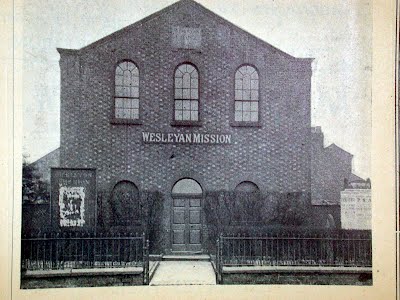
Sadly nothing that Charles said or thought has survived, but we do have his likeness.  It was published in the Wesleyan Church Souvenir Bazaar Handbook for 1908.

It shows a man with a mass of white hair, but even this presents a mystery.  The name below the picture is of a James Bracegirdle, which I take to be Charles.  Again I might be wrong, but there is no record of a James in the township either in this period, or for the rest of the 19th century.  So I guess this must be he, or it may just be another mystery to add to the rest.

Picture; Charles Bracegirdle & the Wesleyan Chapel from Wesleyan Church Souvenir Bazaar Handbook for 1908, courtesy of Philip Lloyd 

*The Row is now Beech Road and his acre of pasture land is today the site of the gated poperties

Friday, 9 April 2021

Oswald Field, five cottages, a slice of rural Chorlton, and a bit of a mystery part 2

Oswald Road

 I  recently walked the field boundary of Oswald Field and today I want to think about the cottages.

There were five of them and they might have looked something like Grantham’s Buildings which stood on High Lane from the 1830s through to the late 1970’s.

I think we can date them from sometime after 1832 and maybe more exactly to around 1835 because in that year a John Hall qualified for a Parliamentary vote here in Chorlton on the strength of owning freehold houses on Oswald Croft.

Five years later the properties appear to have passed to Charles Bracegirdle who is listed in the electoral register for 1840 and with the changed ownership has come a slight change in the name from croft to field.

Red Gates farm, 1845
Now at this point I become a little pedantic.

It is possible that Oswald Croft and Oswald Field are not the same place, but there are no similar properties close by, and the boundary between Oswald Field and High Meadow was in the 1840s known as Oswald Lane, a name it retains till this day.

So I think we can be pretty sure they are one and the same.

But I am not sure of what these five cottages would have been like.

They might like Grantham’s Buildings on High Lane and Brownhill’s Buildings on what is now Sandy Lane have been two up two down properties, but it is equally likely that they consisted of just a single ground floor room with another on top.  There were plenty of one up one down cottages and rows of such across the township.

What I think we can be certain is that they were made of brick.  In the 1840s there were still upwards of fifty wattle and daub cottages but all the new build does seem to have been in brick.  Now I have written about our cottages  and perhaps it is enough to say that they would have been fairly basic, with a brick or slab floor resting directly on the bare earth, a privy and a communal well.

There was a wide disparity in the rents that were paid on the five, with one commanding an annual rent of £16, another £13 and two at £6 and the last at £4.

But I am not sure that this had anything to do with the houses themselves but more to do with the accompanying land.  The higher rented two were described as houses with land while the remaining three were with either “house and garden” or just “house”.

And this fits with the occupations of the tenants.  So Peter Langford who paid an annual rent of £13 in 1845 described himself as a gardener which may mean he derived some of his income from growing food for the Manchester markets.

Certainly he was perceived as a notch up from his neighbours because it is his name which appears as the lead tenant in the properties which allowed Charles Bracegirdle a Parliamentary vote in 1854.

And indeed three years earlier he had described himself as a market gardener on an acre of land.  While others living in the block described themselves as labourers.

Assuming then that the properties were all much the same it might be possible to get some idea of what they were like by comparing rents across the township.

At £6 a year a tenant would have paid 2s 3d or 11p a week while the lower rent of £4 would have worked out at 1s 6d or 7½p a week.  This put them broadly in the middle of the rented properties in 1845.

Rents as % of the total in 1845

Of course this still might hide enormous differences in the quality and repair of the houses but it is a start, and I guess means that our people on the edge of the township were living in homes which were much the same as their neighbours across the township.

And like all our people the length of tenancy seems mixed, some like Peter Langford stayed on Oswald Field for twenty years while others upped and move on in a fairly short space of time which I suspect is another area for some interesting research.

The rate books begin in 1845 and detail landlord and tenant throughout the rest of the century so it should be possible to plot tenancy times.

The last part of the story is still unclear.  Charles Bradshaw died in October 1864 his will was published in the following January and the houses did not them come to auction until the September of 1865.

I don’t know who bought them but I do know they were gone by 1871. I have yet to find out what happened to the tenants or an exact date for their demolition, but that is all possible.  The rate books for the 1860s will reveal when the date of their going and a trawl of the later census returns will show where the tenants settled.

But that is for another time.  Tomorrow I want to pursue the mystery of Charles Bracegirgdle.

Pictures; Grantham’s Buildings High Lane,  m17675, courtesy of Manchester Libraries, Information and Archives, Manchester City Council, http://images.manchester.gov.uk/index.php?session=pass detail from the 1847 Tithe map of Chorlton-cum-Hardy, advert for the auction of the five cottages and land, Manchester Guardian 1865