Showing posts with label The Second World War. Show all posts

Friday, 8 May 2026

“Tonight I will go to sleep knowing that everyone I love will be safe” ......... May 8, 1945, Victory in Europe Day and “the end of the German War”

Homecoming, Bellville, autumn 1945
“Tonight I will go to sleep knowing that everyone I love will be safe.”

Even now that one line entry in a diary has a profound effect on me.

It was written in the late evening of May 8th 1945, at the end of the first day of peace in Europe.*

For some it had been a riotous night of fun, dancing and abandonment, for others a time of quiet reflection on the cost of six years of a hard war.

I don’t know what my parents and grandparents did on that night.  Nana I expect spent some of it thinking of her son who was buried in a cemetery in Thailand and must also have wondered what her native Germany would be like.

She had been born in Cologne a city which like so many was now a desert of rubble, wrecked streets and shattered lives.

Granddad no doubt was in a pub while mum and dad would have been celebrating in their different ways.

It is of course an event fast fading from living memory and will soon join the experiences of those who lived through the Great War as a piece of history only now visited through the films, books, memorials and personal accounts of that earlier conflict.

Celebration, Hallstead Avenue, Chorlton, May 1945
And so here are just a few images of the days following the end of the conflict in Europe.

During the spring of 1945 it was clear that the war was drawing to a close.

In March the Western Allies had crossed the Rhine in to Germany and in April the Red Army was in Berlin.

The death of Hitler on April 30th moved things on and on May 7th in the early hours of the morning the German army in the west surrendered.

Despite no immediate official announcement the news spread that the war was over and later in the day the Government confirmed that Germany had surrendered and that May 8th would be a national holiday and designated it Victory in Europe Day.

The Manchester Guardian reported that here in the city,

“At ten o'clock Albert Square had become a great dancing floor, upon which partnerships were formed on a free and easy plan. Music came from the town hall and reached the crowd through loudspeakers. 


Homecoming, Belleville, 1945
A popular prank was to climb on to the roofs of the air-raid shelters to dance - probably it was the men of the navy who began it. 

But whoever set the example found abundant followers, and presently the girls of the WAAF and the ATS showed a readiness to participate. Without ceremony dozens of them were hauled to the top amid a good deal of cheering. 

Fireworks were occasionally thrown into the air, and there was an unexpected supply of paper hats, streamers, confetti and other carnival accessories which, after years of a paper famine, would have been thought to be unobtainable.” *

And across the country and beyond celebrations were planned and carried out.

I am not sure that our own celebrations happened on that night.

Reunion, Belleville, 1945
These were spontaneous events and what was clearly a formal sit down affair needed planning.

I have every confidence that someone will have recorded the evening in their diary and we will learn the date and perhaps something of the mood in the school hall.

The Government had already said that

“Bonfires will be allowed, but the government trusts that only material with no salvage value will be used.” 

And that “until the end of May you may buy cotton bunting without coupons, as long as it is red, white or blue, and does not cost more than one shilling and three pence a square yard.” 

Strangely for such a momentous event the expressions on the faces of the group seem sombre.

A party, School Hall, Chorlton Green, May 1945
There are a few who are smiling and some who look slightly baffled but the rest just stare back at the camera.

Perhaps the time lag between the victory news and the celebration party was enough for the euphoria to wear off, or maybe uppermost in many people’s minds was the sacrifice in treasure, lives and lost time.

I remember an old friend from Ashton-Under-Lyne  saying to me that her abiding memory of the war was how it "had robbed her of a good six years of  my life.

Instead "of just growing up and having the sort of fun a teenager should have there was always anxiety. 

You were worried about your own safety and that of your family and the knowledge that any boy you grew fond of might be killed.”

And that is perhaps the moment to close.

Pictures; Chorlton in 1945 from the Lloyd collection and homecoming of the Prince Edward Hasting Regiment, Belleville Ontario, autumn 1945 from the collection of Mike Dufresne.

*Manchester Gurdian May 9 1945

Saturday, 14 March 2026

"Back in your arms again"............ reunions in Belleville in the autumn of 1945


I am back in Belleville in the autumn of 1945 with the home coming of the Hastings and Prince Edward Regiment.

The photographs came into the collection from Mike Dufresne who lives in Kingston, Ontario and kindly allowed me to use them.

When I first came across them I mistakenly assumed that he had taken them which may well have added something like 30 years to his age and so an apology is in order.

Mike was quick to point out that “I want you to know I am not the photographer of these photos and I am informing you of this so that you will not credit me as the photographer as I am the owner only.”

Of all the images this is one of my favourites.

Countless photographers have captured that moment of reunion which more than anything marks the transition from soldier back to civilian, from fighter to father, husband or sweet heart.

And this one does it in an unsentimental matter of fact way.   Under the gaze of the officials who look back at the camera with detached expressions one couple embrace while in the foreground a father catches a few fond words with his daughter.

He is totally absorbed by the conversation with just a slight smile at the pleasure of the reunion, and as if to emphasise the moment his hands settle gently on both his daughter and his wife.

Like all good pictures you want to know more.

According to Mike, “the Reg’t arrived home to Belleville Ontario by train and then the same day moved on to the armories at Belleville.”

But what then happened to the returning soldiers and their families?  Did they return to the routines of a quiet Belleville, make good lives and help build the peace?

These are questions which a historian and indeed any one looking at such photographs should ask.

And in time maybe I will have some answers.

Only yesterday one of new facebook friends told me she came from Bellevile and that here her “older brother and sister have talked about the end of the war and the excitement it caused in town.”

So maybe just maybe as more of these pictures are seen again through the blog and the facebook site Vintage Belleville, Trenton & Quinte Region* something of the stories of the day the regiment came home and of the years afterwards will resurface.  I hope so.

Picture; from the collection of Mike Dufresne.

* Vintage Belleville, Trenton & Quinte Region https://www.facebook.com/pages/Vintage-Belleville-Trenton-Quinte-Region/395830067158776

Friday, 13 March 2026

Homecomings, 1945


I think these will be the last of the pictures from Belleville for a while.

Now I do have more from the collection of Mike Dufresne but these two perfectly tell the story of the return of the Hastings and Prince Edward  Regiment from its war in Europe.

The regiment left Canada for Britain soon after the war began and saw action in France, Italy and Holland and returned to Belleville Ontario in the autumn of 1945.

I have featured five of the photographs from the collection and each has its own story or perhaps stories, and while there are more pictures I think these pretty much make closure. 

And like all good photographs after you have taken in the image with these two you wonder what else there is.  Now if truth were known I don’t have a clue what else lies hidden.

For a start I don’t know who any of the people are and nor do I know what happened to them so we are left with just asking questions.

Of the four men one is in civilian clothes and yet he appears to share a bond with the other three.  

So are they comrades, and was he invalided out due to an injury?  

Which begs the question of whether the tiny lapel badge is significant?

The military ribbons on the other three testify to the action they have seen but all that is now in the past, and with all the fuss and noise of a homecoming with the town turned out to meet the regiment these four have sought each other out. 

I would like to know what interests them so much about the flag and the detail one of the soldiers is pointing to and for that matter what is being said.

Perhaps it is just a posed shot but there is something in the gaze of one of the four which leads me to think it is more than just a rehearsed photograph.

In the same way I am drawn to the other picture.  The couple stare in a relaxed way at the camera while around them men disembark from the train.

They seem perfectly at ease on that railway station and what I like about the picture is that you have a sense they have been caught in mid motion stopping just for a minue at the request of the photographer.  

And if it does not seem fanciful you half expect them to move off , thanking the photographer and mumbling something about having somehere to go.

There is much more that I could say about these two but none of it would be based on historical research, so I shall just leave them to their reunion on a pleasant sunny day sometime in 1945.

Pictures; courtesy of Mike Dufresne


Thursday, 12 March 2026

It's the detail that draws you in, another Belleville picture from 1945


I keep coming back to this picture and like all good pictures it raises questions which as yet I do not have answers.

On the surface it is easy enough to see what is going on.

We are at Belleville railway station, Ontario in the autumn of 1945 and the Prince Edward Hastings Regiment have returned from the European war.

Of the two central figures, one is an officer who appears in many of the pictures while the other can be seen in a few of the photographs.  I would love to know what has made them laugh but that sadly is lost.

Beyond them there are other soldiers getting ready to disembark the train.  Some stare directly at the camera, while others seem more intent on getting on to the platform.

But what draws you in is the central figure of the railway employee.  He is one of two and the way they stand is out of kilter with the upbeat mood all around them.

Their heads are bowed and they stand apart from all that is going on.

Now I shall be careful and avoid any sweeping generalizations.

My knowledge of this period of Canadian history is almost nonexistent, which is an awful admission and one I want to address.

But I do have to ask why have they struck that pose?

There are of course many possible explanations, ranging from the shyness of the employees, to company policy about how to behave when passengers are disembarking from a company train, particularly when the press are present.  Or just maybe it is something less pleasant.

Either way my attention is drawn to this tiny little scene and I wonder at the social conventions of the period.

In much the same way as in the film of Doctor Zhivago where there is a scene where the young Zhivago is called to assist on a case of attempted suicide.  It is snowing hard and Zhivago and his professor go inside the house leaving the coachman to sit outside and wait.

Nothing you might think as odd.  But this is pre Revolutionary Russia, and Zhivago has just witnessed a brutal attack by the army on a peaceful street protest.  Added to that, the house call takes place against a backdrop of a social gathering of the wealthy.

The contrasts are all too obvious but I doubt that many pick up on the plight of the coachman who will sit for hours in the snow waiting for his employers.

There will be those I suppose who mutter “he’s going over the top and elevating a sixty second shot into something more than it is” which may be so.

And yet it is the tiny detail that often reveals a host of stories and puts the image into the bigger picture.  Well with this one we shall see.

In the meantime it is another of those unique records of the Prince Edward Hastings Regiment retuning home.

And there is no way that you can escape that sense of excietement on the faces of men who left for Europe in late 1939, saw action in France, Italy and Holland and were now back in Canada.

The collection is in the possession of Mike Dufresne who bought them in an auction and tells me they will be left to the regimental museum.

I can think of no fitting place for them to to end up and is a good reminder that all such images are part of oor collective history.

And it is worth mentioning also that Mike has already begun releasing them to the social network site,  Vintage Belleville, Trenton & Quinte Region.*

Now this I like not least because it means that people who live close by can see them, but total strangers from the other side of the world can also share this little bit of history.

All of which is fascinating, after all it is the stories of the "little people caught up in a big century" which bring the events of that period to life.

Picture; from the collection of Mike Dufresne

https://www.facebook.com/pages/Vintage-Belleville-Trenton-Quinte-Region/395830067158776

Wednesday, 11 March 2026

With The Hastings and Prince Edward Regiment in Belleville, Ontario in 1945

Arriving Home, 1945 

Here are three of those images that pretty much speak for themselves.  

We are in Belleville in Ontario in the autumn of 1945 watching the home coming of The Hastings and Prince Edward  Regiment.

They had shipped out for Europe in the December of 1939, saw action in France in June 1940 and were part of the allied landings in Sicily and mainland Italy in 1943.  In the final months of the war they moved to North West Europe

Marching through familiar streets, 1945
Meanwhile back in Canada in June 1945, a second Battalion of the regiment was mobilized for service in the Pacific but with Japan’s surrender in the August the battalion was disbanded in the November.

Each photograph is a rich source of detail, from the informality of the disembarkation at the railway station to the formal march past.

So often the identities of the people in the pictures are lost but the second soldier in the parade was the Inetelligence Officer Farley Mowatt.

Pictures; by Mike Dufresne, posted on the facebook site, Vintage Belleville, Trenton & Quinte Region

Monday, 9 March 2026

Stories behind pictures, the Hastings and Prince Edward Regiment marches through Belleville in 1945


I like this picture not least because it captures a confused moment when lots of things seem to be going on at the same time.

It is another one of those photographs of the Hastings and Prince Edward Regiment during the parade to mark its return from service in the European war.

The date is 1945 and we are in Belleville, Ontario.  The regiment had shipped out for Europe in the December of 1939, saw action in France in June 1940 and were part of the allied landings in Sicily and mainland Italy in 1943.  In the final months of the war they moved to North West Europe, and were part of the liberation of Holland.

Now I don’t have an exact date for the picture but judging by the leaves on the trees and the presence of so many top coats I guess it will be late autumn.

It is  the platform party with its mix of uniformed men, civic dignitaries and the large wooden figure of a Native American that you notice first.

But it is the little detail that draws you in. So there is the photographer running to get ahead of the troops, and the two young women looking in different directions at events unfolding in front of them.

And then there are the two boys with their bikes almost oblivious to what is going on around them, having their own private conversation while the crowds applaud, the officers salute and the soldiers march past.

It is the sort of picture I would have liked to have taken, and one where you can go off and ponder on each of the tiny scenes.

Did the photographer get the picture he wanted, and what exactly was it that caught the attention of the young woman applauding?  After all she is pretty much alone in looking back while most of the crowd are preoccupied with the line of troops parading past.

And what is it that those boys are talking about?

All the time the soldiers are marching past and some at least of the crowd may have been reflecting on that previous war which took Canadian servicemen to the Western Front.

None of this is of course historically in order.

Speculating without hard evidence is not how history should be told, but on the other hand it is exactly what makes a good picture.

So I shall leave it at that, on a day when the Prince Edward Hastings Regiment came home, and the people of Belleview could celebrate the first autumn of peace in six years.

Picture; Mike Dufresne, posted on the facebook site, Vintage Belleville, Trenton & Quinte Region
https://www.facebook.com/pages/Vintage-Belleville-Trenton-Quinte-Region/395830067158776

Friday, 13 February 2026

When the unthinkable had to be embraced ….. invasion 1940

I don’t know how I would have conducted myself had I been alive in 1940, after the Fall of France, and the imminent threat of a German invasion.

Firing postions, 1940
If like now I was 75, I might just have been able to fall back on my own military knowledge gained perhaps from a spell in the Volunteer reserve, and may be during the Great War.

Of course, if I was younger, I suspect that knowledge would have been quite limited.

Either way I guess I would have been apprehensive and if I am honest a bit scared.

But I hope I would have joined the Local Defence Volunteers which everyone knows as the Home Guard.

It was an armed civilian militia and was active from 1940 till it was stood down in 1944, by which time 1.5 million local volunteers had joined its ranks.

Most people today are familiar with the force and may veer towards the comic portrayal of them through Dad’s Army.  Young men and old men, as well as those unfit for military service, who trained with broom sticks and homemade bombs and created their own armoured cars.

But that is not to ignore the commitment and determination of citizens who fully lived up to that line “cometh the hour, cometh the man”, which of course is not to dismiss those women who served in the forces, drove ambulances, and other “first response” groups.

The degree to which the Home Guard made itself ready is witnessed by the many handbooks, most produced by ex- soldiers which were practical guides to warfare for the civilian.

Home Guard Drill, 1940
Rifle Training for War, a textbook for Local Defence Volunteers by Captain Ernest H. Robinson, ran to four editions during July 1940, while Home Guard Drill and Battle Drill by John Brophy was reprinted eleven times between November1940 and August 1943.

They were cheap and small enough to fit into a pocket to be read in the lunch hour or in the evenings.

I have a copy of each, along with the more interesting, New Ways of War, by Tom Wintringham, who in in the forward to his book argued “that war is not a difficult mystery” to be left to soldiers.  Today it is the duty of all citizens of a democracy to understand the business of fighting for a People’s War [which] is the only effective answer to Totalitarian War”.*

He had fought in the Great War, gone to Spain at the outbreak of the Spanish Civil War, later joining and commanding the British Battalion of the International Brigade.

After Spain with the outbreak of the Second World War he volunteered for the British army who rejected him because he was a Communist.

A new way for the Home Guard

Not daunted he opened a private Home Guard training school at Osterley Park, London which taught the skills of guerrilla warfare, but again because of his political views he was side-lined by the army, and he resigned from the Home Guard in 1941.

How to do it, 1940
There is much more including his founding of the Common Wealth Party, received 48 percent of the vote at the Midlothian and Peebles Northern by-election in February 1943, previously a safe Tory seat.

In the 1945 general election he stood in the Aldershot constituency, the Labour Party candidate standing down to give him a clear race against the incumbent Conservative MP His wife Kitty stood in the same Midlothian constituency that he had come so close to winning two years earlier, but neither was elected.

After the war Wintringham and many of the founders of Common Wealth left and joined the Labour Party, suggesting the dissolving of Commonwealth.**

Leaving me just to set myself the task of reading his short book New Ways of War, and perhaps comparing it with the other two handbooks.

Pictures; from Rifle Training for War, a textbook for Local Defence Volunteers by Captain Ernest H. Robinson, 140, and New Ways of War, Penguin Special, 1940

* Tom Wintringham,  New Ways of War, Tom Wintringham, Penguin Special, 1940

** Tom Wintringham, https://en.wikipedia.org/wiki/Tom_Wintringham


Tuesday, 6 January 2026

The Penny -a-Week Fund …… the Ashton-Under-Lyne Committee .... and a neglected history book

Now the Tiger Kills, was one of the books I bought from Bryan the Book on Beech Road sometime in the 1980s.


It was already almost 40 years old and was one of a series published by HMSO telling the story of the Second World War.

Soldiers of the Indian Divisions, 1944
A modern historian may be careful about their lack of objectivity and the accuracy of some of the detail given wartime censorship, but they remain a fascinating contemporary insight into those six years.

I have a few, but despite their length in my custody, I have to admit to never reading them, and only writing about one.*

But today I brought down The Tiger Kills, which came out in 1944, and was “The story of the Indian Divisions in the North African Campaign”.

‘The first formations to go overseas from India were the now renowned 45y and 5th Indian Divisions.  The story of their deeds up to the destruction of Italy’s East African Empire and the expulsion of the Vicy French from Syria was told in the Tiger Strikes which was published in India in 1942.  [while] the Tiger Kills tells the of the fighting against the Germans by Indian and British soldiers who together composed the formidable fighting formations which went from India to the Middle East.  

The story is one of further successes, of desperate defence and then final victory in North Africa,  [with] their dash and courage in attack, and their steadfastness and tenacity in defence.’”**

So I rather wish I had read it earlier, not least because of its emphasis on the contribution made bu soldiers of whay was then the Empire and now the Commonwealth.

The Penny-a-Week- Fund, circa 1944
Nor is that all, because just inside the book were three sheets of headed note paper for the Penny-a-Week- Fund, H.R.H., The Duke of Gloucester’s Red Cross and St. John Appeal.

According to one source, "it was launched in September 1939 to raise funds for those affected by the Second World War. By 1946 the appeal had raised £54,324,408, which is the equivalent of £7,700,000,000 today, making it the largest charitable fund ever raised in the UK. The proceeds of the fund went to the Red Cross and St John War Organisation.

The fund committee decided to run appeals targeted to particular sections of the community.

The penny-a-week fund was a scheme created with the co-operation of the TUC and Employers’ Organisation to collect a penny week from workers, which was deducted from their wages. The fund raised £17,663,225 (£2.5 billion today) – all in pennies. Its success was credited to the idea of collecting a small amount of money from a large number of people. 

Detail of the Penny-a-Week-Fund, circa 1944
The amount did not make a significant difference to the donor’s weekly budget but the pennies added up to raise more than one third of the entire Duke of Gloucester’s Appeal. 

This was the precursor to payroll giving as we know it today. In 2011/12 £118 million is donated through payroll giving in the UK currently 2, a mere 34 per cent of what the penny-a-week fund collected annually during the war years.”***

I must confess  to having come across it before, and having read about the Spitfire Fund, but like the Great War charities raised vast amounts of money during the six years of the war.

But I am drawn to the Ashton-Under-Lyne Committee, partly because I lived in Ashton in the early 1970s, and so went looking for 51, Hutton Avenue which was home to Jim Timperley, who was the Honourable Secretary of the branch.

Into Battle- British and Indian Together, 1942
He was living in Hutton Avenue by 1939, described himself as a “shop manager, tailoring” had been born in 1910 and was active in the Auxiliary Fire Service.  He was married but as yet the name of his wife has yet to be discovered.****

And the house is still there just up from Beaufort Road a short walk from Stamford Park close to the Sycamore pub, a place we regularly visited.

So that is about it, but presents more research opportunities connected with the Ashton Committee, and The Penny-a-Week Fund, along with anafternoon reading about the contribution of the Indian Divisions.

*The book and the personal story …..... Greece in 1941, https://chorltonhistory.blogspot.com/2020/03/the-book-and-personal-story-greece-in.html

**General Sir Claude Auchinleck, G.C.I.E, C.B., D.S.O., A.D.C., Commander-in-Chief in India

*** British Red Cross: the £7.7 billion appeal that changed British fundraising forever, SOFII,  https://sofii.org/case-study/british-red-cross-the-7.7-billion-appeal-that-changed-british-fundraising-forever

****1939 Register

Thursday, 12 June 2025

Post War Britain with David Runciman

Now this is one I am listening to.

And Now Win the Peace, Labour Party Poster, for the 1945 General Election 

It is the story of Britain after the end of the Second World War.

It covers all the great immediate moments from the victory of the Labour party and the rejection of Churchill just weeks after VE Day.

And goes on look at the Beveridge Report, the Soldier's Vote, Labour's Manifesto, Healthcare for all and much more.

"David Runciman tells the story of one of the biggest shocks in British parliamentary history: the 1945 election and the dawn of a new age".*

The programmes last just 15 minutes on BBC Radio 4 and runs to 20 episodes.

Location; BBC Radio 4

Picture; And Now Win the Peace, Labour Party Poster, for the 1945 General Election, The Labour Party

*Post War, https://www.bbc.co.uk/programmes/p0lg93jb

Friday, 9 May 2025

Jane ……. VE Day ….. and what I found in the cupboard

 It will be over 66 years ago that I came across a copy of the Daily Mirror, which was dated May 8th 1945.

Front cover, May 8th 1945
It had lain at the back of a cupboard drawer in my grandparents’ house carefully stowed away as a souvenir of the end of the last world war.

Like many they had endured the deprivations of six years of war, lost their only son and had lived through the hard peace which followed the Great War.

That copy still exists but is now very fragile and rarely comes out in the daylight.

And today I have been thinking about it and in particular the Zec cartoon which appears on page two and has the caption, “Here You Are Don’t Lose It Again”.

What prompted me to think about the cartoon and the VE Day edition was less the end of the war and instead the Jane cartoon.

Jane was a young woman who often got into scrapes which invariably resulted in her losing her clothes.  She was drawn by the artist Norman Pett and first appeared in 1932 and continued in the Daily Mirror until 1959.

Thinking back to the young 8-year-old who leafed through the pages of the VE Day edition, I can still remember being drawn to Jane.

The May 8th Jane strip was reproduced in Picture Post in the September of 1949 which looked back at the war years and given that this copy was less fragile it was the one I chose to scan, which had the extra bonus of another story.

I can’t date the second one but like the first it follows the unfortunate accidents that come Jane’s way.

In reproducing the first strip all I have done is represent the three frames separately so that the detail is clearer.

Alas the Daily Mirror was not dad and mum’s chosen newspaper, and so I never got to follow Jane, and just before my 10th birthday, she got married to a chap called George and left the paper for a new life.

Leaving me to reflect that despite all the celebrations on that May 8th, the war against Japan continued.

And in a telling addition to the Zec cartoon the paper carried an account with the headline “The war that is still to be won” which went on to describe the work of “analysing cipher telegrams that told of troop movements, campaign plans and battles in the swamps”.

All of which made grim reading along side the news of “the rejoicing floating through the half bricked windows from Whitehall …..to the operational nerve centre of the war that has yet to be won – the war of the million in South East Asia Command”.

More so for my grandparents and my mother whose thoughts were of my Uncle Roger who had been captured by the Japanese in 1942 and whose death would not be made official until the November of 1945.


“Here You Are Don’t Lose It Again”.


Location; May 8th, 1945 

Pictures; Jane in two strips, from Picture Post, September 3rd 1949 and Zec’s cartoon from the souvenir edition of the Daily Mirror, VE Day:  published on May 8, 1945, reproduced with story by Peter Willis, May 2nd 2015https://www.mirror.co.uk/news/uk-news/ve-day-full-edition-daily-5619141

Friday, 25 April 2025

April 25th 1945, a day of liberation and now a national holiday


I am looking at a picture posted by an Italian friend on facebook of a man in a train compartment in the rush hour.

Nothing you might think odd about that except that he has a  gun slung over his shoulder.  I missed it when I first came across the image and was drawn back by her comment and the date.

She wrote that she found “it fitting, [and] particularly laden with meaning,” because April 25th is a national holiday in Italy and marks both the end of what was left of Mussolini’s fascist state but also the end of the Nazi occupation of Italy on that day in 1945.

Signor Prigile, August 14th 1944
And so I guess the picture was a posed comment on the events of that day eighty years ago.

I would like to have used it but in the absence of copyright details for the present it will just have to sit on facebook and what ever Italian news agency issued it.

In its place there is this picture of Signor Prigile, an Italian partisan in Florence taken on August 14th 1944.

British troops had been ordered to avoid fighting the Germans in the precincts of the city of Florence but Italian Partisans, occupying the Fortress Di Basso exchanged fire with the German snipers that remained after the German forces evacuated Florence.

Now like many of my generation I was brought up on a diet of national stereo types and given the close proximity of the war the crude picture of Italians was that all they ate was  pasta and were all to ready to surrender.

It was an image much hyped by the propaganda of the war years and ignored the many brave Italians who opposed the Fascists both before and after they came to power in 1922.

It also ignored those that against their will were conscripted into the armed forces, to fight first in Abyssinia and Greece and later in North Africa and on the Eastern Front.  Nor is much said about  those who were held in Soviet prisons long after the war and those who never returned.

This I hasten to add is in no way a defence of the fascist regime which so brutally eliminated parliamentary democracy in Italy and did nothing to prevent the exploitation of working people.

Rather it is recognition that there were many Italians who opposed Mussolini and resisted as best they could.  And some who risked their lives to protect allied prisoners of war who had escaped and were  on the run from the German Army.

Corso Giacomo Matteotti on an April afternoon
And I often think of that opposition when we are in the Corso Giacomo Matteotti which is one of my favourite parts of Varese.

Here you can find posh clothes outlets, elegant cafes and wonderful food shops ranging from the expensive bakery to ordinary fruit and veg shops a fishmonger and a butcher.

It is named after the socialist MP who denounced the fascists in the Italian Parliament for election bribery in 1924 and was murdered by them just 11 days later.

So I shall be talking to our Italian family later this evening and asking them how the holiday has gone.

And no sooner had I posted this story last year, than Barbarella sent me this wonderful story of her grandmother.

"I am the grandchild of partisans. My grandmother was a “staffetta”, which translate into relay. 

Liberation Day, April, 1945
She was relaying messages amongst partisan groups who were fighting and hiding in the hills around Bologna. My grandmother was called Albertina (I gave this name as a middle name to my daughter), she used to put messages inside the metal bar handles of her bicycle, then putting the handle bit on top. 

Transporting messages between groups and risking her life. Sometimes she used to have some freshly made pasta for them, when she could afford to make it.

Memorial to the Partisan, 2018

What I woman, I am so proud of her. Passed away in 2006, at the age of 94. It is such a powerful story."
of courage.

And this year Barbarello added a link to "Bella ciao", or "Goodbye beautiful"* which was originally an Italian protest song from the 19th century but my Wikipedia tells me "was modified  and adopted as an anthem for Italians resistance movement by the partisans who opposed fascism and the occupying German army.**


Location; Italy

Pictures; Corso Giacomo Matteotti from the collection of Andrew SimpsonSignor Prigile, August 14th, 1944. “This image was created and released by the Imperial War Museum on the IWM Non Commercial Licence. Photographs taken, or artworks created, by a member of the forces during their active service duties are covered by Crown Copyright provisions. Faithful reproductions may be reused under that licence, which is considered expired 50 years after their creation and is in the public domain, Wikipedia Commons.",  Liberation day, 1945, courtesy of Barbarello Bonvento, and war memorial to the Partisan, 2018, Intra, from the collection of Andrew Simpson

Saturday, 28 December 2024

What did Chorltonville do in the last war?


South Drive, 1913
Now I always thought that Chorlton had by and large escaped the damage done to other parts of the city during the last war.

But that was not so and there is plenty of evidence that we got our fair share.*

Some of that evidence came to light in this edition of the Chorltonville News in the form of a compilation of extracts from the minutes of the Association for the war years.***

"In spite of its peaceful location, Chorltonville did not entirely escape the Second World War.  


Nell Lane, 1941
In June 1940 one of the estate workers, Pat Carly Jnr, was called up for military service and left.  An entry in 1944 records that he was then serving in Burma, and would like to take up his job “if he is spared to return”.  

Pat’s departure must have hit the family finances, because in July 1940 his father, also Pat Carly, requested a rise in his wages.  

The Committee agreed to an increase of three shillings and sixpence (about 18p) per week.  Mr Carly again applied for an increase in December 1941, due to war conditions.  

He was given an increase of four shillings (20p) per week, but granted it as a War Bonus – maybe so that it could be withdrawn after the war.

Also in 1940, the Committee was chasing up an application to Manchester Corporation for air raid shelters for the estate, “pointing out that no provision whatever had been made by the Corporation in case of emergency”.

Barrage Ballon on the Rec, 1941
Manchester’s Town Clerk was, apparently, not sympathetic.  He declined to provide the shelters, as the policy of the Corporation was to supply protection only for people caught by an air raid on the streets.  

The Clerk said that “each person who can afford to do so is expected by the Government to arrange for their own protection whilst they are at home”

The Committee accepted this decision, but protected their position by writing to the Corporation stating “that no responsibility can be taken by the Committee in the event of any unfortunate situation”.


The war evidently affected both finances and availability of people.  At the 1941 AGM, the Treasurer reported that the accounts were “as good as could be expected under current difficulties”, but still showed a deficit of over £37.  

The meeting voted a levy comprising a basic charge of 16 shillings, plus 3½d for each linear foot of frontage - under £1.50 for most houses.  

A deputy Auditor had to be found, as the elected Auditors were unavoidably absent.  The minutes do not say the reason, but one was still on “enforced absence” the following year, so presumably had been called up.

In May 1942 the Army erected Nissan huts behind Chorltonville alongside the cobbled lane by Brookburn School.  The Secretary wrote to the Royal Engineers (at Mayfield Rd in Whalley Range) asking whether the huts were for barrage balloons or gun emplacements, “as the Committee were most anxious that the presence of these things would render the Estate a target for the enemy”.

The Royal Engineers suggested he contact the balloon section, so the Secretary went to the local unit at the Recreation Ground in Cross Rd.  The corporal there had no knowledge of the huts and referred the Secretary to the Manchester RAF.  

The RAF replied with the enigmatic statement that the huts’ presence “does not increase the vulnerability of the estate to enemy air attack”.  The minutes do not say whether the Committee was reassured by this.

The Meade, 1913
The Committee was more successful in 1943, applying to the Corporation for extra street lights.  

Lamp posts were not in use because of the blackout, but they noted that the Corporation had introduced a modified form of lighting on some roads.  

They requested that these be introduced to Chorltonville, because of the danger to pedestrians using the roads and footpaths.  The Corporation agreed, and added dimmed lighting around the estate.

Interestingly, there is no note in the minutes recording either VE or VJ Day, but at the 1946 AGM, the Chairman tidily summarised:

“he spoke of the work of the past year, carried out under conditions as in the War, though happily the final Conflict had come to an end.  He continued that this Estate had been maintained under very fair conditions, and proposed that the levy stay the same.”

Pictures; Barage Ballon on the Rec, from the collection of Alan Brown detail from bomb damage at Nell Lane, 1940, courtesy of Manchester Libraries, Information and Archives, Manchester City Council, m09736, and pictures of the ville from the Lloyd collection

* http://chorltonhistory.blogspot.co.uk/search/label/Chorlton%20in%20the%201940s

** http://www.chorltonville.org/index.htm

*** reproduced courtsey of Chorltonville News

Wednesday, 7 February 2024

“Can I do you now Sir?* .............. lost memories of wartime productions at the Palace Theatre

October 30 1944
I doubt that I will ever meet any one who sat in the Palace Theatre during late October and early November 1944.

And that is a shame because I would love to know what they made of “WE’RE COMING OVER” which the programme announced was “A Musical Tour de Forces.” 

In 14 scenes the production took the audience from The E.N.S.A. headquarters at Dury Lane to a street in Lisbon, a hotel in Cairo and by degree a ship in the Mediterranean, the Opera House in Naples and “Somewhere behind the lines,” before finishing at the Camp Show at the Eighth Army Folies.**

There was music, comedy and a lot more and I wish I could find out more about it.

Just a few weeks earlier the Palace had played host to Ivor Novello in “The Dancing Years” “A Musical Play” featuring Ivor Novello, Veronica Brady, and Roma Beaumont.***

From Dury Lane to North Africa
The story was set  in Vienna in pre-1914 and shifted to 1938 following the life of a penniless composer and his love for two women.

And as you would expect from a production of the time the two women come from totally different social classes.

One was an innkeeper's daughter and the other an opera singer and the story unfolds against the backdrop of the growing presence of the Nazi Party in pre war Austria.***

It had opened in March 1939, closed at the start of the war and reopened in 1942 running for 969 performances finishing in July of 1944 when it took to the road and began a three week stint at the Palace from October 10.

It is unlikely I would have across either production had I not been looking at a collection of theatre programmes owned by my friend David Harrop.****

By their very nature theatre programmes have a short life.

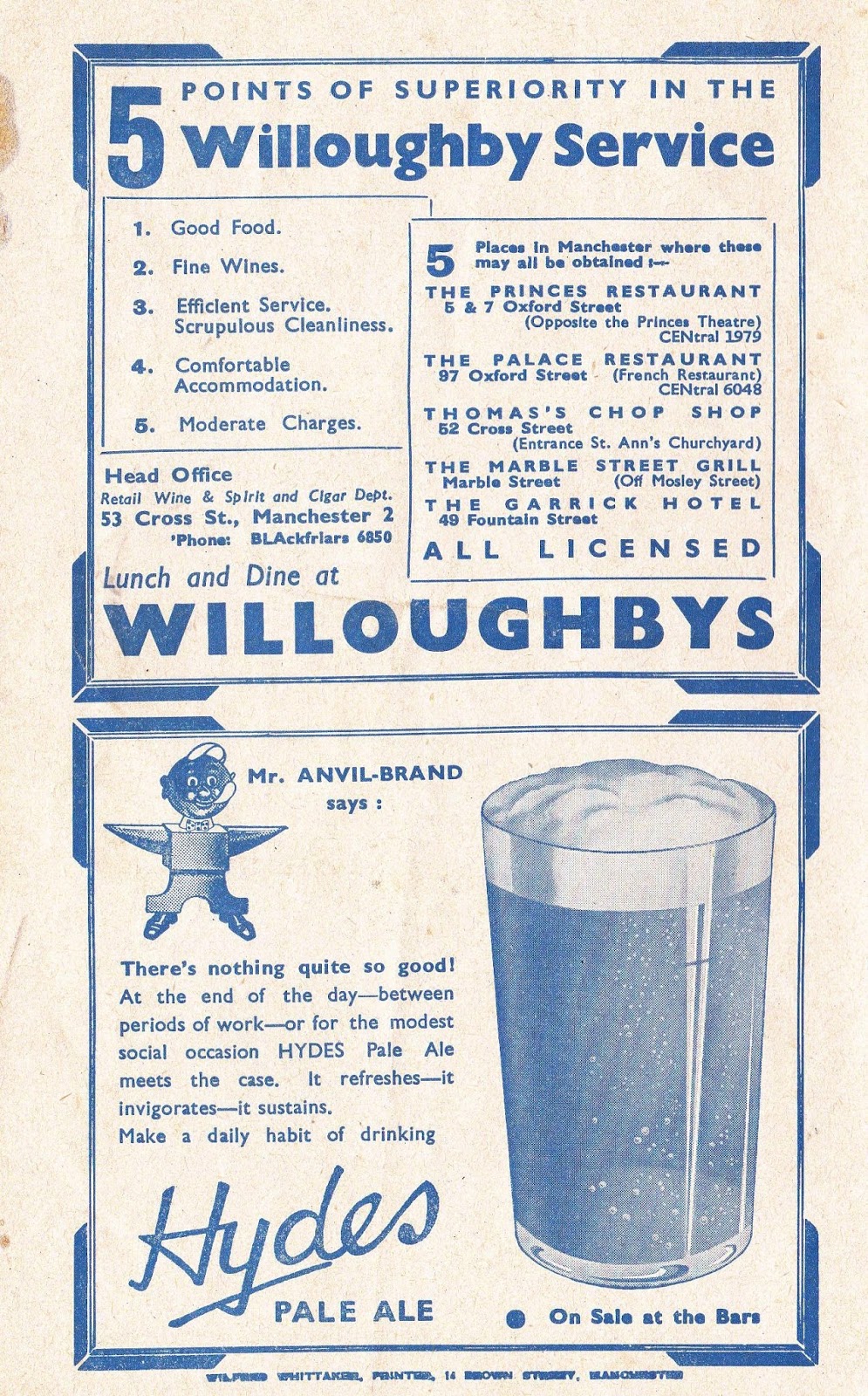
Adverts from 1944
At best they are kept safe for a while but eventually succumb to a bout of spring cleaning and most get lost on the bus going home or thrown out the following day.

And like all such material many carried adverts which are themselves a priceless insight into the Britain of the 1940.

So these are a real find and point once again to that simple observation that you find the past pretty much anywhere, and having found it lets you go off looking for more.

Wartime productions like these were not only good entertainment but played their part however small in maintaining morale.

And that brings me back to “WE’RE COMING OVER” which I think will have celebrated and show cased the talents of The Entertainments National Service Association or ENSA which was set up in 1939and provided entertainment for the British Armed forces during the Second World War.

Concert party Normandy, July 1944 just weeks after the D Day landings
Performers included Robert Rietty, Gracie Fields, George Formby, Wilfrid Brambell, Joyce Grenfell, Adelaide Hall, Paul Scofield, Rebecca Cantwell, Dora Bryan and Vera Lynn.as well as Laurence Olivier and Sir Ralph Richardson who  performed Shakespeare's plays for the troops in a six-week tour of Europe.

Often they performed close to the front line and appeared in every theatre of the war.

But that as they say is for another time.

Pictures, theatre programmes 1944 from the collection of David Harrop, and an ENSA concert party entertaining troops from the steps of a chateau in Normandy, 26 July 1944, Midgley (Sgt), No 5 Army Film & Photographic Unit, from the collections of the Imperial War Museums, This image was created and released by the Imperial War Museum on the IWM Non Commercial Licence. 

* Can I do you now Sir? Mrs Mopp, catchphrase from the radio series “ITMA”, “It’s that Man Again” BBC Radio, 1939-1949
** E.N.S.A., http://en.wikipedia.org/wiki/Entertainments_National_Service_Association
***The Dancing Years, http://en.wikipedia.org/wiki/The_Dancing_Years
****David Harrop, http://chorltonhistory.blogspot.co.uk/search/label/David%20Harrop