Showing posts with label Italy in the 1940s. Show all posts

Friday, 25 April 2025

April 25th 1945, a day of liberation and now a national holiday


I am looking at a picture posted by an Italian friend on facebook of a man in a train compartment in the rush hour.

Nothing you might think odd about that except that he has a  gun slung over his shoulder.  I missed it when I first came across the image and was drawn back by her comment and the date.

She wrote that she found “it fitting, [and] particularly laden with meaning,” because April 25th is a national holiday in Italy and marks both the end of what was left of Mussolini’s fascist state but also the end of the Nazi occupation of Italy on that day in 1945.

Signor Prigile, August 14th 1944
And so I guess the picture was a posed comment on the events of that day eighty years ago.

I would like to have used it but in the absence of copyright details for the present it will just have to sit on facebook and what ever Italian news agency issued it.

In its place there is this picture of Signor Prigile, an Italian partisan in Florence taken on August 14th 1944.

British troops had been ordered to avoid fighting the Germans in the precincts of the city of Florence but Italian Partisans, occupying the Fortress Di Basso exchanged fire with the German snipers that remained after the German forces evacuated Florence.

Now like many of my generation I was brought up on a diet of national stereo types and given the close proximity of the war the crude picture of Italians was that all they ate was  pasta and were all to ready to surrender.

It was an image much hyped by the propaganda of the war years and ignored the many brave Italians who opposed the Fascists both before and after they came to power in 1922.

It also ignored those that against their will were conscripted into the armed forces, to fight first in Abyssinia and Greece and later in North Africa and on the Eastern Front.  Nor is much said about  those who were held in Soviet prisons long after the war and those who never returned.

This I hasten to add is in no way a defence of the fascist regime which so brutally eliminated parliamentary democracy in Italy and did nothing to prevent the exploitation of working people.

Rather it is recognition that there were many Italians who opposed Mussolini and resisted as best they could.  And some who risked their lives to protect allied prisoners of war who had escaped and were  on the run from the German Army.

Corso Giacomo Matteotti on an April afternoon
And I often think of that opposition when we are in the Corso Giacomo Matteotti which is one of my favourite parts of Varese.

Here you can find posh clothes outlets, elegant cafes and wonderful food shops ranging from the expensive bakery to ordinary fruit and veg shops a fishmonger and a butcher.

It is named after the socialist MP who denounced the fascists in the Italian Parliament for election bribery in 1924 and was murdered by them just 11 days later.

So I shall be talking to our Italian family later this evening and asking them how the holiday has gone.

And no sooner had I posted this story last year, than Barbarella sent me this wonderful story of her grandmother.

"I am the grandchild of partisans. My grandmother was a “staffetta”, which translate into relay. 

Liberation Day, April, 1945
She was relaying messages amongst partisan groups who were fighting and hiding in the hills around Bologna. My grandmother was called Albertina (I gave this name as a middle name to my daughter), she used to put messages inside the metal bar handles of her bicycle, then putting the handle bit on top. 

Transporting messages between groups and risking her life. Sometimes she used to have some freshly made pasta for them, when she could afford to make it.

Memorial to the Partisan, 2018

What I woman, I am so proud of her. Passed away in 2006, at the age of 94. It is such a powerful story."
of courage.

And this year Barbarello added a link to "Bella ciao", or "Goodbye beautiful"* which was originally an Italian protest song from the 19th century but my Wikipedia tells me "was modified  and adopted as an anthem for Italians resistance movement by the partisans who opposed fascism and the occupying German army.**


Location; Italy

Pictures; Corso Giacomo Matteotti from the collection of Andrew SimpsonSignor Prigile, August 14th, 1944. “This image was created and released by the Imperial War Museum on the IWM Non Commercial Licence. Photographs taken, or artworks created, by a member of the forces during their active service duties are covered by Crown Copyright provisions. Faithful reproductions may be reused under that licence, which is considered expired 50 years after their creation and is in the public domain, Wikipedia Commons.",  Liberation day, 1945, courtesy of Barbarello Bonvento, and war memorial to the Partisan, 2018, Intra, from the collection of Andrew Simpson

Wednesday, 3 January 2024

The memorial to the Partisan

We are all familiar with war memorials which commemorate the many.

Usually they date from the Great War with a smaller panel for those who fought in later wars.

But here is one with a difference.

It is one man, who was not in uniform but still served his country heroically.

The memorial is a simple affair and stands beside the shore of one of the lakes in Italy.

We came across it by accident last week.

He was an Italian partisan executed by the Fascists on August 4 1944.

It is a simple memorial to a brave man, who gave his life in defence of Italy, and freedom and while it is small and unadorned is a powerful reminder of the sacrifice made by one man.


Picture; war memorial to the Partisan, 2018, Intra, from the collection of Andrew Simpson

Sunday, 1 October 2023

Stories from Naples in the spring of 1944


I am reading Naples '44* and it is one of those delightful moments when history and my fascination for Italy collide.

It’s 1944 and Norman Lewis is a British intelligence officer with the allied armies in Italy.

He landed at Salerno in September 1943 with the American 5th Army and the book chronicles a year of his life in the city of Naples.

It is a closely observed description of life after the war has moved on leaving an aftermath of broken buildings, a desperate lack of food and a breakdown of the usual conventions of morality.

So on a journey to Afragola he saw “hundreds if not thousands of Italians mostly women and children in the fields all along the roadside driven by their hunger to search for edible plants ... they had left their homes in Naples at daybreak, and had to walk for between two and three hours to reach the spot where I found them.”

But there are those vivid little pictures of Neapolitan life which I suspect had been lived out before and after his visit including the family who lived opposite his office and who “carried out a table and stood it in the street close to their doorway.  This was briskly covered with a green cloth with tassels.  Chairs were placed round it in an exact distance and on it were placed photographs, a vase of artificial flowers, a small cage containing a gold finch, several ornate little glasses, which were polished from time to time as the day passed by to remove the dust.”

And around that table they carried on the daily routines of life, from domestic chores to grooming the children, washing and eating.  There were other tables out further along the street and people called out to each other, while a man with “tiny twisted legs was carried out by his friends and propped up in a comfortable position against the wall.”

It is a scene of street life which my parents in law knew well.  Simone and Rosa were born in Naples just before Italy entered the war in 1940 and grew up in the harsh years of that war and the equally hard years afterwards.

Not that this is any rosy nostalgic account of a simple but good way of life.  For many in Naples life was a struggle lived out against a backdrop of poverty which the war made that bit more difficult and led many down darker and more brutal ways of survival.

All of this along with the horror and confusion of the fighting falls out of this book.

But so often it is the carefully observed little scenes that that draw you in, like the “two lean, hip swinging American soldiers, sharing a bottle of wine [who] passed down the street, and the two girls at the table [who] looked up and followed them with their eyes until they turned the corner and disappeared from sight.”

Location; Naples, Italy

*Naples '44, An Intelligence Officer in the Italian Labyrinth, Norman Lewis, 2002, Eland Publishing Ltd, http://www.travelbooks.co.uk/

Picture; from the front cover, designed by Robert Dalrymple 

Wednesday, 7 July 2021

One hundred years of one house in Chorlton …. part 122 ....... Totò Looks For A House

The continuing story of the house Joe and Mary Ann Scott lived in for over 50 years and the families that have lived here since. *


Now I doubt that Joe and Mary Ann watched Italian films, but yesterday was Totò night in the house.

Rosa had arrived over from Milan on Friday, and we had bought in several films by Totò, who like Rosa was from Naples.

He is someone I have written about before, and over the years I have become quite a fan.**

Last night we chose Totò Cerca Casa, or Totò Looks For A House, which was made in 1949 and was the second most popular film of the year.

The sets were pretty basic, the humour fairly slapstick and some at least of the actors might have been better enrolling in acting school, but given all of that it was funny.

And while the plot was at best fairly implausible it did hold some truths.

Like most of post war Europe there was a severe housing shortage and Totò and his family end up in a number of different properties, each more unsuitable than the one before, including a school, a cemetery caretaker's house, the studio of an artist, a large luxury apartment and even the Colosseum before ending up in a psychiatric hospital.


Each location offers up comic possibilities, from a student rebellion led by Totò, to an apparent ghost at the cemetery, and the discovery that the luxury apartment has also been rented out to another family at the same time. 

Behind the humour of course is the very real hardship of people with no where to live.  

Naples was already a hard city to live in and the war made it harder.

Here in Britain there was the same lack of properties, which in turn led to the squatter movement was a direct response tin part to the shortage of accommodation because of war damage but also because some properties had been deliberately left unoccupied by their owners.

The campaign was nationwide and in London was coordinated by the Communist Party.

Here in Manchester the first successful squat was at the gun site near Alexandra Park which housed one family at 8 p.m., but by the following day contained a community of over 20 families and all available huts were occupied. It is a fascinating story and ended with the Corporation accepting the squatters as tenants.*** 


Joe and Mary Ann will I suspect have known about the Alexandra Park squat, and taken a keen interest given that they built decent and affordable houses across Chorlton.


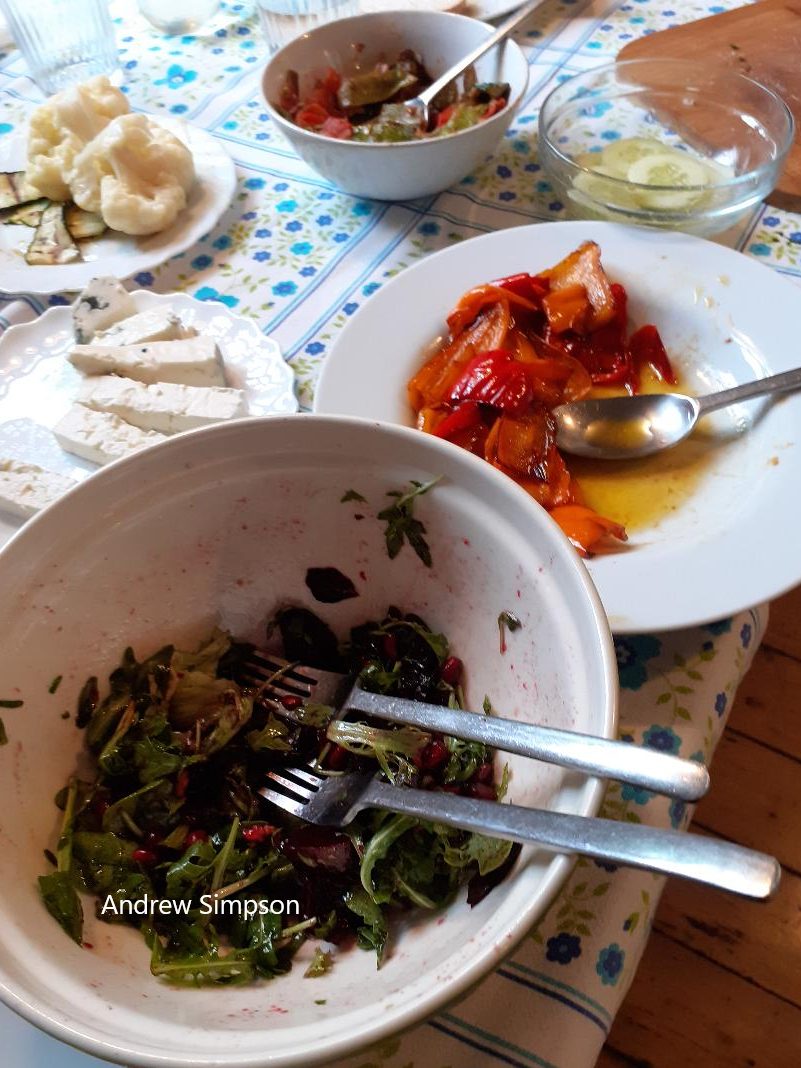
But I have no idea whether they would have enjoyed Totò Cerca Casa or the selection of foods Rosa cooked up that evening, which included peppers, a selection of greens in olive oil and may favourite, a salad made from oranges and dressed with garlic, olive l and chillies.

 Pictures, Totò Cerca Casa, 1949 and a selection of Neapolitan dishes.

*The story of a house, https://chorltonhistory.blogspot.co.uk/search/label/The%20story%20of%20a%20house

Walking the streets of Naples with a comic genius ........ Totò, https://chorltonhistory.blogspot.com/2020/01/walking-streets-of-naples-with-comic.html

Totò 

***The forgotten story ………. a little bit of squatter history in Alexandra Park, https://chorltonhistory.blogspot.com/2020/07/the-forgotten-story-little-bit-of.html


Friday, 5 October 2018

War time Naples, genocide in Brazil and spying in the Balkans, stories from the pen of Norman Lewis


Sometimes without very little effort you get drawn into someone’s life which in the case of Normal Lewis was both a surprise and a pleasure.

In my case it came about in Waterstones which like a lot of people is part of what you do on a Saturday afternoon in between browsing the shops, having a meal and catching a film.

There in the travel section was his book Naples ’44 which describes his year in the city with the allied armies during the Italian Campaign. He was an intelligence officer seconded to the American 5th Army.  During the course of the year he kept a diary which became the book.

It is a closely observed description of life after the war has moved on leaving an aftermath of broken buildings, a desperate lack of food and a breakdown of the usual conventions of morality.

Not that the violence is quite over.  The Germans continue to bomb the city; there are delayed action mines which have been buried in the cellars of buildings as well as bandits, vendetta’s and the casual acts of barbarity inflicted on the civilian population.

Amongst all this there are vivid accounts of life lived out on the streets, the power of superstition and bravery and generosity of the Neapolitans.

All of which I want to return to but right now it is Mr Lewis who fascinates me, more so because his writing career stretched on in to  his 90s, which gives me hope.

So with due deference to his publishers whose account of his life I have lifted directly here is something of the story of this remarkable man.

“Norman Lewis's early childhood, as recalled in Jackdaw Cake (1985), was spent partly with his Welsh spiritualist parents in Enfield, North London, and partly with his eccentric aunts in Wales.

Forgoing a place at university for lack of funds, he used the income from wedding photography and various petty trading to finance travels to Spain, Italy and the Balkans, before being approached by the Colonial Office to spy for them with his camera in Yemen.

He moved to Cuba in 1939, but was recalled for duty in the Intelligence Corps during the Second World War. It was from this that Norman Lewis's masterpiece, Naples '44, emerged, a resurrection of his wartime diary only finally published in 1978.

Before that came a number of novels and travel books, notably A Dragon Apparent (1951) and Golden Earth (1952), both of which were best sellers in their day. His novel The Volcanoes Above Us, based on personal experiences in Central America, sold six million copies in paperback in Russia and The Honoured Society (1964), a non-fiction study of the Sicilian Mafia, was serialised in six instalments by the New Yorker.

Norman Lewis wrote thirteen novels and thirteen works of non-fiction, mostly travel books, but he regarded his life's major achievement to be the reaction to an article written by him entitled Genocide in Brazil, published in the Sunday Times in 1968. 

This led to a change in the Brazilian law relating to the treatment of Indians, and to the formation of Survival International, the influential international organisation which campaigns for the rights of tribal peoples.

He later published a very successful book called The Missionaries (1988) which is set amongst the Indians of Central and Latin America.


More recent books included Voices of the Old Sea (1984), Goddess in the Stones: Travels in India (1991), An Empire of the East: Travels in Indonesia (1993), The World the World (1996), which concluded his autobiography, as well as collections of pieces in The Happy Ant Heap (1998) and Voyage by Dhow (2001). With In Sicily (2002) he returned to his much-loved Italy, and in 2003 his last book, A Tomb in Seville, will be published."

Picture; from the covers of Naples ’44, Jackdaw Cake and Voices of the Old Sea, courtesy of Eland Publishing Ltd, http://www.travelbooks.co.uk/

Wednesday, 6 June 2018

Tonight at 6.15 pm ...... History from Italy ....... 1929-1945 ..... What really did happen?

Now there are many, many, myths and half truths which litter our perception of Italy’s role in two World Wars, and the impact of the Fascist dictatorship of Mussolini on the lives of Italians.

That oft quoted comment that “he got the trains to run on time” is grotesque in its summing up of a brutal regime which punished all dissent and took Italy into a series of military adventures culminating with its entry into the Second World War in 1940 on the side of Hitler.

And while some may mutter it was benign when compared to the horrors of Nazi Germany, this obscures the reality of the dictatorship.

In the same way the jokes about the Italian armed forces may have more to do with the simple fact that many Italians had no desire to fight the Fascist wars than anything to do with the bravery of their servicemen and women.

Indeed the sacrifice shown by the opponents of Mussolini during his rule and the heroism of the partisans in the final years of the war should put those jokes to rest.

Opponents like Riccardo Tonolli who was executed as a partisan in August 1944 and is commemorated by this simple memorial by the lake side in the town of Intra.

So with all this in mind I will be attending the second of two talks by Silvana Serra, on Italy 1929-1945 : What did really happen?

Hosted by the Dante Society, the “talks will aim to broaden the knowledge of - and provide some clarifications on - the dramatic events of the Fascism and the role of Italy in World War II. Events sadly often perceived too simplistically.  

A glass of wine and Italian nibbles will follow. During the social gathering you will have the opportunity to discuss the presentation.

Venue: Cross Street Chapel, Cross Street, Manchester M2 1NL

Date; June 6th 6.15 for 6.30 start

Admission:      members   £ 2.00   /   non-members    £3.00  
 It would be helpful if you could confirm your presence to dante@newfuture.org"

Location Manchester

Picture; war memorial to the Partisan, 2018, Intra, from the collection of Andrew Simpson


Friday, 20 April 2018

History from Italy ....... 1929-1945 ..... What really did happen? ...... the talk May 2nd

Now there are many, many, myths and half truths which litter our perception of Italy’s role in two World Wars, and the impact of the Fascist dictatorship of Mussolini on the lives of Italians.

That oft quoted comment that “he got the trains to run on time” is grotesque in its summing up of a brutal regime which punished all dissent and took Italy into a series of military adventures culminating with its entry into the Second World War in 1940 on the side of Hitler.

And while some may mutter it was benign when compared to the horrors of Nazi Germany, this obscures the reality of the dictatorship.

In the same way the jokes about the Italian armed forces may have more to do with the simple fact that many Italians had no desire to fight the Fascist wars than anything to do with the bravery of their servicemen and women.

Indeed the sacrifice shown by the opponents of Mussolini during his rule and the heroism of the partisans in the final years of the war should put those jokes to rest.

Opponents like Riccardo Tonolli who was executed as a partisan in August 1944 and is commemorated by this simple memorial by the lake side in the town of Intra.

So with all this in mind I will be attending the first of two talks by Silvana Serra, on Italy 1929-1945 : What did really happen?

Hosted by the Dante Society, the “talks will aim to broaden the knowledge of - and provide some clarifications on - the dramatic events of the Fascism and the role of Italy in World War II. Events sadly often perceived too simplistically.  

A glass of wine and Italian nibbles will follow. During the social gathering you will have the opportunity to discuss the presentation.

Venue: Cross Street Chapel, Cross Street, Manchester M2 1NL

Date; May 2nd 6.15 for 6.30 start

Admission:      members   £ 2.00   /   non-members    £3.00  
 It would be helpful if you could confirm your presence to dante@newfuture.org"

Location Manchester

Picture; war memorial to the Partisan, 2018, Intra, from the collection of Andrew Simpson