Showing posts with label Domestic Service. Show all posts

Saturday, 16 May 2026

The case of the missing Domestic Servants ……………..

Now it is one of those received pieces of historical truth, that the age of the domestic servant peeked in the early years of the 20th century.

South Drive, circa, 1900s
Before that date, even the most modest of homes might boast a servant.

After the Great War, the rising cost of living, the advance of labour saving devices, and the growing expectations of “the servant class” combined to shrink what had once been a source of employment for many young people.

All of which I knew from trawling the census returns for Chorlton and many other places.

But I had never gone looking for the hard evidence, and then yesterday rising out of a discussion on a blog story about Chorltonville, I decided to test the idea, and to test it through the records of the estate.

A number of people had questioned whether the residents would have employed servants, given the size of the houses and occupations of those who lived in the properties.

As a project it had much going for it, because there are a limited number of households and they are grouped in a compact and defined area.

Chorltonville from the air, circa 1930s
In the April of 1911 eighteen households on South Drive returned the census form.*

The occupations listed were pretty much what you would expect for the estate, consisting of a high proportion who described themselves as “Commercial Travellers”, a couple of clerical workers, two employers, along with an actor, one manager, and one on “private means”.

Of these eighteen households, six employed a domestic servant, who lived in the home.  Not surprisingly two worked for the two employers, another for the one householder on “private means”, but the remaining there were employed who commercial travelers and a clerk.

It is of course a very limited survey, but what is interesting is that when compared to the 1939 Register which required every householder to supply basic biographical details for all the occupants, none of the six households employed a servant.

In their place comes that familiar term “unpaid domestic duties” or “housekeeper” which in each case refers to a wife,  which of course raises an interesting debate about the role married women.

Other than that, of the full eighteen, only one household listed an individual who was described as a “housekeeper”.

Which just leaves me to report that none of the original six who employed a servant in 1911 were still living in their house by 1939.

So, that is it, other than to say in a quiet time I shall go back to the historical record to push forward our knowledge of servants in the Ville.

Location; Chorltonville

Pictures; from the Lloyd Collection, circa 1900s-30s.

* 1911 census, Enu 11, Didsbury, South Manchester & 1939 Register

Saturday, 27 December 2025

Cleaning, polishing and answering the door ........... domestic service in Chorlton in 1927

I have long been interested in domestic service, ever since I researched the working conditions in rural Chorlton in the first half of the 19th century.*

By the end of that century even the most humble of families sought the prestige of at least one domestic servant.

And in many households there was just the one, who often went under the title of maid of all work and that was exactly what her job entailed.

So in a large house hold where there might gradations of servants from butlers, and housekeepers to kitchen staff and many more in the more modest homes there was but one and she did it all.

Now I have come across descriptions of the work of such servants from the 19th century but here courtesy of Bob Jones is one from 1927.

In that year his mum came across from Yorkshire and began work in the big house on Alexandra Road.

In the fullness of time I will go looking for that house and the family that lived there but for now I shall just leave you with her job description.

I could reflect on the many tasks that had to be undertaken or the degree to which new home appliances like the "vac" and the telephone would change the working day, but perhaps I will just point out that missing day which was the Wednesday, her day off.

Pictures; job description for a maid, 19267, courtesy of Bob Jones

*The Story of Chorlton-cum-Hardy, http://chorltonhistory.blogspot.co.uk/2011/11/the-story-of-chorlton-cum-hardy.html

Wednesday, 24 December 2025

Looking for stories ………. from one house in Chorlton

Now, it has become popular to take a pretty ordinary house and trace its story back in time.

The house, 1959

I have to confess it is something I have done with three of the houses I have lived in over the last seventy years, and more recently the idea has become a successful television series.*

All of which is an introduction to Bamburh House on High Lane.

It featured yesterday on the blog when I began to explore its history.

And I have returned today with part two.  It was to be the story of some of the domestic servants who toiled away in the background rarely recognized, but essential to the well being of the family who employed them.

The idea was partly prompted by my own interest in those “who toiled”, and also from a comment by Sarah, the present owner that “When we bought the house we opened up the attics and there was a bedroom for a maid up there. 

I will dig out the pictures just for your interest because although the staircase carried up to her room she would’ve had to bend  double to get under the roof to enter”.

But as so often happens their stories are harder to piece together, and despite an afternoon wandering the records the four I chose led almost nowhere.

I had started in 1871 when the house was built, with a Miss Taylor aged 23, and young Agnes who was just 14 and employed as a “nurse”, but the enumerator’s handwriting was almost undecipherable, and my best shots led nowhere.

And while a decade later I could at least identify a Sarah A Edwards and John Strawbridge, they too remain in the shadows.

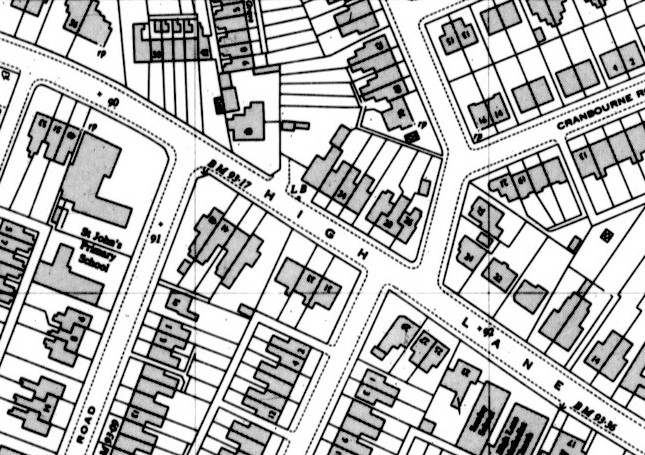
High Lane, 1881, the house marked with an X

Still there are plenty more to look for, and in time I will go looking.

All of which leaves me falling back on the house and exploring a little bit more of its past, which begins with an interesting mystery concerning John Strawbridge who in 1881 is described as a groom, suggesting the then owners had a horse and carriage.  Maps of the period show outbuildings behind the house on the west side, but later census returns make no reference to a groom.

The last census records that in 1911 Mr. Robert Newberry West, who was a surgeon, employed Elizabeth Parker as “cook-domestic” who was charged with maintaining the elven rooms and cooking for Mr. West, his mother and his two siblings.

The house, 1881, marked with an X

I have to say I have been drawn to Robert West, partly because he was born  in Camberwell,  close to where I was born and grew up in south east London and because we can track his progress from London to Chorlton-on Medlock where his father was the vicar at St Stephens and on to Southport where he lived with his widowed mother.  

He married in 1920 at the grand old age of 47, living on Upper Chorlton Road and finally Barlow Moor Road where he died in 1924.


Nor is that quite the end of the story, because like many bigger properties in south Manchester,  Bamburh House finally succumbed to multi occupancy.

Just when this happened is unclear.  

In 1929 the directories show that it was occupied by the Morris family, but a decade later the house was divided in to five flats of which two were unoccupied.  The remaining three were occupied by a sales manager and sales assistant, neither of whom were married, and Mr. and Mrs. Bond and their young daughter. Mr. John Bond was a sales manager for a tobacco and drugs company, his wife Doris was “an assistant hospital nurse” and Rita, their daughter was just 2 years old.

After which the house continued its long association with multi occupancy.  In 1954 it was home to three tenants, and in 1962 to four, and it remained so until Sarah bought the property and returned it to family use, which of course has been a trend across Chorlton.

With thanks to Sarah for allowing me to profile her house and Tony Petrie who supplied the street directories for 1929, 1959, and 1962.

Location; Chorlton-cum-Hardy

The house, 1956

Pictures; the house in 1959, A. E. Landers, m17886, courtesy of Manchester Libraries, Information and Archives, Manchester City Council, http://images.manchester.gov.uk/index.php?session=pass High Lane in 1881, from the 1881 Withinton Board of Health map, courtesy Trafford Local Studies Centre, https://www.artuk.org/visit/venues/trafford-local-studies-centre-6551 and in 1956 from the OS map of Manchester & Salford, 1956

*The story of a house, 

One hundred years of one house in Well Hall 

The story of one house in Lausanne Road

The house on Harrow Road in Leicester

Monday, 22 December 2025

Cleaning the brass and making the beds in Chorlton ........ with Miss Edith Ashworth

 I wonder what Edith Ashworth made of Chorlton-cum-Hardy.


She had been born in Northenden in 1880, and lived with her father and mother and four siblings in a small cottage off Mill Lane.  Her father described himself as a labourer, while her eldest sister was employed as a milliner.

Just opposite their home was the river and the mill, while just a few minutes’ walk to the east beyond Palatine Road were open fields stretching all the way to Sale.

By contrast Chorlton-cum-Hardy was undergoing one of those revolutions which would see large parts of the township transformed into rows of modest properties, catering for the “middling people”, many of whom worked in the city but wanted to live on the edge of the countryside.

Some were professionals, while others were managers and yet more worked as clerks, and secretaries.  They rented their homes, but many still found money to employ a servant, which was always a mark of distinction.

And in the April of 1901 Edith  was working  as a general servant for Mrs. Eliza Jones, at 7 Maple Avenue.

Mrs. Jones employed only the one servant, who and these were often known as “maids of all work” because they pretty much did everything from the cooking and cleaning to turning down the beds and much more, which in the case of Maple Avenue involved looking after nine rooms along with the needs of Mrs. Jones and her two grown up children.


The family had moved into the house when it was built in 1895, and over the next century kept a unique photographic record of the house and the surrounding streets, allowing us to place Edith in the very rooms she cleaned and kept tidy.

Nor was she the only servant in the avenue.  In total there were four servants working in four of the seven occupied houses.  All were “maids of all the work”, and some catered for families much larger than at 7 Maple Avenue.

And like a century earlier when we were still a rural community, none of the four servants were local, three came from Cheshire and a fourth from Stretford.  Some people might be surprised at this, but it was that simple rule, that if servants were local they might well take stories of the household home, and those stories might well become the gossip of the township.

Only in one respect was Edith different from her fellow servants and that was her age.  She was 21, while Mary Ann Jones at number 15 was 18 years old and the remaining two were just 15.

Sadly, there is little more that I can find out about Edith, for like so many of her class, history has not been kind, and so far I have found only one other reference, but it is a tantalizing one, because on March 10th 1904 she sailed from Liverpool to Halifax in Canada on board the Tunisian.  She shared the journey with her 17-year-old sister Florence, and while I know they arrived, the rest as they say awaits further research.

As for 7 Maple Avenue, it stayed in the possession of the family until 1997, and I am indebted to Ray Jones, who is one of the descendants, for permission to reproduce photographs of the house.

Loation; Chorlton-cum-Hardy

Pictures; 7 Maple Avenue, date unknown, courtesy of Ray Jones