Showing posts with label Ann Love. Show all posts

Saturday, 30 May 2026

On Stretford Station with a bit of our railway past

It is 35 years since the last train ran from Stretford station which means that memories of a time before the tram will be fading

Stretford Station, April 1961
I briefly used the station back in the 1970s and had no idea of its history or the railway line.

It had been opened in 1849 by the Manchester South Junction and Altrincham Railway and was in part designed to transport food grown in Altrincham and Stretford into the heart of Manchester and in time would challenge the Duke's Canal as the main means of carrying heavy goods in to Manchester.

I have no doubt it would have created quite a stir.

The men who built the line were viewed at best with suspicion and at worst with fear.  They had a well deserved reputation for hard drinking and rough behaviour which is no surprise given the dangers of the work they undertook.

Central Station, April 1961
And there may well have been a few of  our farm a labourers who were taken on to do some of the least skilled work while some of our farmers and market gardeners would have taken advantage of the line to move their crops to the Manchester markets.

But its impact was also to start a wave of house building along Edge Lane.

The train offered the quickest way into town and allowed those who earned a living in the city to escape to what was still the countryside.

Of course by the time I used the train Edge Lane and the surrounding area had long lost any semblance of countryside, but the station still looked like an old fashioned railway, which is where my fiend Ann comes into the story.

She “found these the other day, tucked away. Stretford station in 1961, and Manchester Central, probably a similar date. I used to travel from Stretford to Oxford Road Station, spending my time on the journey drawing the other passengers.”

And so after sixty-two years a little bit of what an old railway station looked like is here to see again.
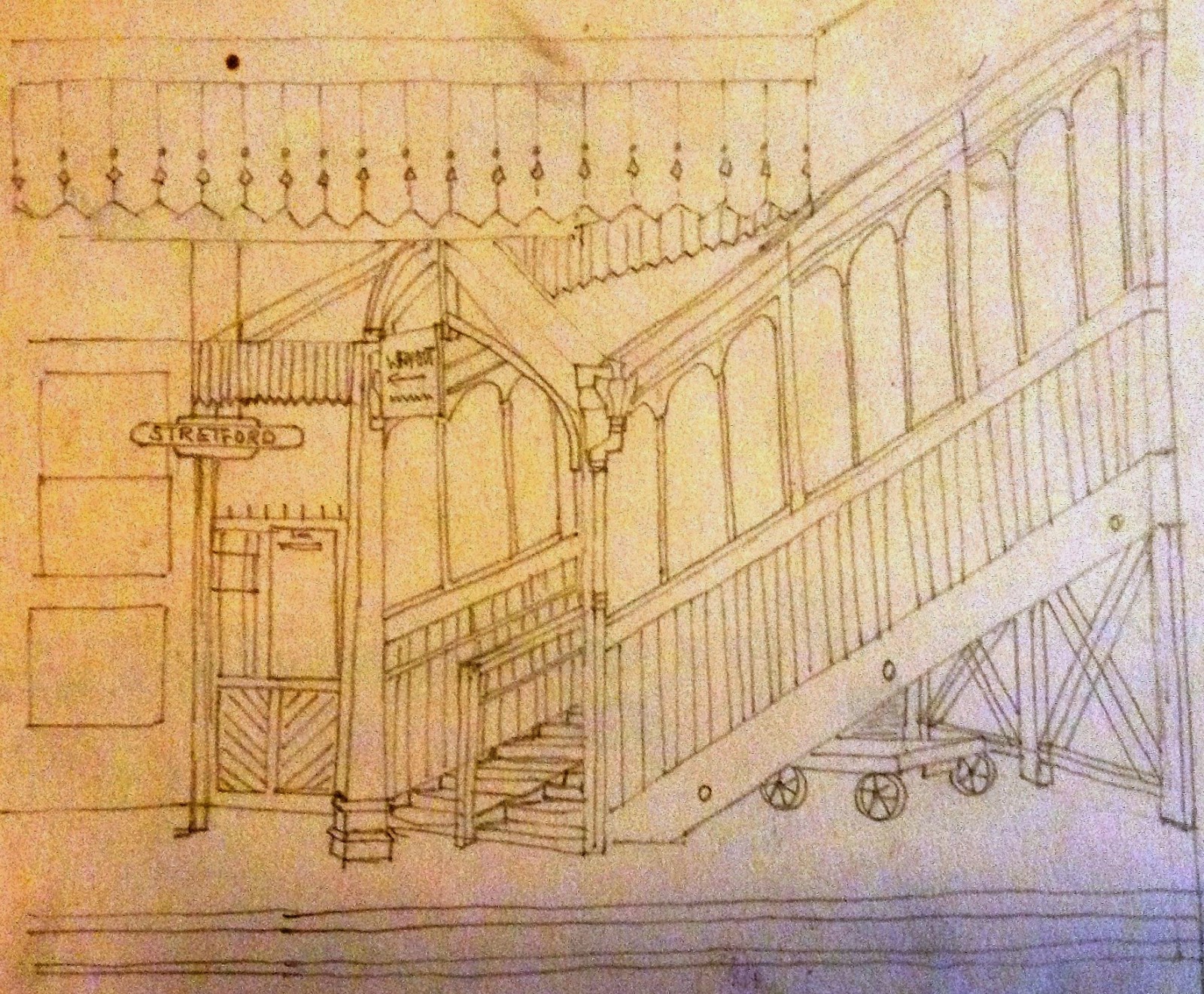
Now that is not so daft given that Stretford has become a Metro Stop with shiny yellow trams and Central having long lost its trains is now an Exhibition Centre.

Pictures; Stretford and Central Stations, April 1961 courtesy of Ann Love

Friday, 29 May 2026

Looking out from Barlow Moor Road in the summer of 1960

There is a singular lack of images of Chorlton during the middle decades of the last century.


Look through the collections and you can find plenty of fine examples of what the township looked like during late 1800s and early 1900s.


Most are from commercial photographers who sold their work on to picture postcard companies, and never missing an opportunity also took plenty of photographs of individual streets, which they then offered up to residents for “a knockdown price”.

But by the 1950s the golden age of picture postcards was drawing to a close, just as cameras became cheaper and more readily available, which ushered in “the snap”.

The snap was usually a very personal image, sometimes a little out of focus and in most cases consigned to a photo album, or the back of a cupboard.


Sometimes the odd one gained pride of place on a fridge or notice board, only to fade with the years and become “tired” from much passing around.

All of which brings me to a set of sketches made by my friend Ann of the Chorlton she knew back in the 1960s.

Ann grew up on Barlow Moor Road at what is now 523 , and as part of various art projects she sketched some of the rooms in the house as well as view out across the back garden.

And include three of Chestnut Avenue, which were made in the summer of 1960 and included “The first house on the right which was an Opticians, when I lived at 523”.

Location; Chorlton

Pictures; Chestnut Avenue, August 1960, from the collection of Ann Love


Thursday, 28 May 2026

Scenes from a lost Chorlton, Claude Road in 1964

Now the old petrol pump stood at the point where Claude Road does a right turn before meeting Reynard Road and running off into the Ville.

For almost all the time I have lived here the space just beyond the pump was waste ground but sometime before 1933 a row of buildings stood on the plot.

Now this I know because they appear on the OS map for 1933-34 as large block stretching east to west with smaller units to the rear.

But I don’t know what they were and until I can look at the directories or rate books for the period I have no idea.

By the 1960s part of the plot was occupied by a garage which can be seen in Ann’s picture.

And that is all I know, but someone will come back with more so I shall just leave it at that for now.

Except to say that these little bits of empty land were all over Chorlton well into the 1980s.

Picture; © Ann Love

Wednesday, 27 May 2026

523 Barlow Moor Road back in 1961

The Stables, 1961
The recent past is a time I take for granted. 

I guess for some of us this is because it really doesn’t seem history.

I was born in 1949, grew up in the 1950s and 60s, came to Manchester in 1969 and began full time work in 1973.

Those decades and the next two are still vivid and familiar periods and I don’t count them as the past, and yet they are and we did do things differently then and this is the starting point for some new stories.

Back in 1961 my friend Ann lived on Barlow Moor Road in one of those large houses facing Chestnut Avenue.  This was number 523 and it was also where her father ran the family undertaker’s business.

The rear of 523 Barlow Moor Road, 1964
At the time Ann was still at school and regularly recorded the house and surrounding streets in a series of pictures for her art classes.

“The ground floor plan was quite unusual, in that there was a very large room on the right at ground level. 

The rest of the house was raised up about 6 feet, so there were steps at the front, back, and inside, above the basement, which stretched under the whole house.

In the garden there were the old stables at the end of the garden which my Dad used as a workshop to make the coffins, and also doubled as a garage.  

Previously it had been numbered 66, and before that 52.”

Looking out on Chestnut Aveneu, 1961
Like so many of our bigger house which has survived being demolished this one has been converted into flats with an extension added at the rear.

I am hard pressed now to remember it as it was which is why I am so pleased that we still have Ann’s painting and line drawings of the property.

They are almost the only record of this bit of Barlow Moor Road from the period and remind me of how things can change without us even noticing.

Over the next few weeks I shall be featuring more of Ann's pictures and it occurs to me that there may be plenty more photographs, paintings and drawings of Chorlton which it would be nice to include.

Pictures; 533 Barlow Moor Road, 1961, © Ann Love

Tuesday, 26 May 2026

Growing up in Chorlton in the 1940s at 523 Barlow Moor Road

Now 523 Barlow Moor Road still stands today although with additions at the rear it has become a property of multi occupancy.

But for most of the 20th century and a bit of the late 19th it was a family home and during the 1940s and 50s it was where my friend Ann grew up.

And as you do I asked her to write about the place, and here,  spread over two parts is her account of one house in a Chorlton we have now pretty much lost.


"523, Barlow Moor Road was a large detached house, set back from the road, with a small front garden, planted with deep red rhodedendrums

The house had four floors, which included attics and cellars, each with at least four rooms.

As both my parents worked from home, and I was an only child, this left me plenty of time to explore the house and garden.


At the side of the house was an old conservatory, and there were several old sheds, and stables which my Dad used as a workshop and garage.

On wet days, I would wander round the house, sometimes venturing up to the attic (Quite a scary place) where there were rooms full of interesting things.

One of my Uncles had tried to set up a business repairing bicycles, and there were frames, and wheels hanging on one wall.

The rest of the room was like a laboratory, with jars, bottles and chemicals laid out on benches..

I spent many happy hours mixing powders and liquids, watching things fizz, but as he'd been trying to make cosmetics, nothing exploded.


Another room was full of furniture, trunks full of clothing and clocks, which I would wind up until they no longer worked.

The third room was used to store old paintings and prints that my grandfather had bought at auctions, plus many old urns and other containers full of ashes, which had never been collected.

My father, as was his father before him, was an undertaker. They made all their own coffins from planks of wood, which were stored in the cellar.

When they were needed, Dad and Grandad would carry the wood down the garden to the workshop, where my Dad would cut it to size,and bend the sides to shape, by scoring the wood and steaming it, holding it in place with clamps.

He would then attach the bottom and sides with nails and glue, which he made in a little 'kettle' from horse bones.

When I was small, Grandad would tell me that they made boats, and he and my Dad would carry me up the garden in the coffins.I thought that was great fun.

There was another large workshop in the house, where my Dad would paint a layer of tar on the inside of the joints of the coffin (to prevent leakage) and my mother would then line the coffins with kapok and cheap taffeta."

© Ann Love, 2014

Pictures; the house in the 1950s, and drawings of the interior and exterior from the collection of Ann Love

Monday, 25 May 2026

Taking the petrol pump for granted ................ and other stories

Today and for the next few weeks I shall be celebrating the humble petrol pump, through the art work of my friend Ann Love.


A few weeks ago I wrote about those pre-war petrol cans which were essential, given the scarcity of petrol stations which forced motorists to carry a supply for emergencies.

They cans came in different shapes and colours and usually bore the name or logo of the petrol company.

And fired by that story Ann told me of an art project she undertook back in 1964 which
described the early history of the petrol pump and was illustrated by her own series of pictures.

I have to confess that I had not really given the petrol pump much thought, but like so many things it is a bit of our history which is easily taken for granted.

The idea had originated in the USA and was brought back to Britain by a member of the AA and in 1919 the AA opened ten filling stations which were staffed by their men in uniform who only sold to AA members.

Needless to say the concept caught on, and Ann went on to document the story through the inter war years and on into the 1960s.

It is a fascinating story but what really draws me to the project are Ann’s pictures which are now themselves a bit of our past.

A few depict petrol pumps and garages which were still standing relatively recently, including a pump at the bottom of Claude Road in Chorlton in south Manchester.

And I bet these pictures will set off a string of memories on the part of readers, who in turn might offer up their images and stories.

There my even be someone who remembers pumping the fuel from the pump by hand, and then checking the quantity in a measuring can, which as Ann observes was justified given that some garage owners fiddled the gauge.

But that is it for now.

Location; everywhere

Pictures; petrol pumps and filling stations 1963-64 from the collection of Ann Love

Thursday, 7 May 2026

That lost magical Chorlton playground ... a man called Gabbott .... and the Curnon Steam Meter

 For as long as I can remember I have been fascinated by a patch of land just a little to the north of Chorlton Brook.

That assemblage of old buildings, circa 1990s
Long after the Barlow Moor Road side had been developed with the cinema, a factory and a row of houses it stubbornly refused to be developed.

Instead, it remained a collection of wooden buildings which by the 1970s had become overgrown and were a mecca for kids who were drawn to the isolated spot as much as for the potential for adventures by the brook.

And as if to signal its presence there was at the entrance an old petrol pump.

Even more odd was that it was reached by walking up Claude Road and was positioned at that point where the road does a right turn, heading west, and then south into the Ville.

Claude Road, 1969
Over the years I picked up the stories from people who played there and wondered with the occupants of 45 or 47 Claude Road which stan either side of the entrance had any knowledge of its history, its use or its owner.

And then sometime in the 1990s the site was cleared, and a row of town houses were built with the un Chorlton name of Rainbow Close.

I always assumed they had been workshops but never pursued the story until this week when Doreen and Rob Lizar lent me a series of pictures they had taken of the buildings, before and during their demolition along with the name of the man who owned the land.  This was a Mr. Gabbot who owned and rented out no. 45 Claude Road which ran along the north site of plot.

Rainbow Close, circa 1990s
The pictures are of course a fascinating piece of our history for a set of buildings which will soon fade from living memory.

But added to the photographs was a trade card for Curnon Engineering Co, at Claude Road Works Chorlton cum Hardy, featuring the Curnon Steam Meter.

And a search of the record brought up that “Curnon Engineering was started by Edgar Parr Gabbott and his grandson is still about. Chas Cook made the steam meter for Curnon while Mr Gabbott was away in France during the First World War but the arrangement seems to have continued until the 1940s”.*

To which that go to guide for all things industrial and machine, Graces Guide to British Industrial History offers up pictures of the machine, a poster, and two addresses for what I assume were the offices of the company. In 1911 these were at 5 John Dalton Street and in 1913 185 Princess Street.**

Curnon Steam Meter, undated

And from the two sites I now know that a Curnon Steam Meter, recorded “accurately the flow of steam in any size of pipe, under any conditions of working, at any degree of superheat, without causing any throttling or necessitating any disturbance of the pipe-line” and was proudly advertised as a British Made Steam Meter”.***

Curnon trade directory, undated
Their offices at 5 John Dalton Street were in the impressive Queens Chambers on the corner of Deansgate.  

It is still there and back in 1911 housed 38 companies and societies over 4 floors, including solicitors, estate agents, accountants and industrial businesses, with the Manchester Sunday School Union, the Manchester & Salford Women’s Trade and Labour Council one of whose secretaries was Miss. Eva Gore-Booth and the National Industrial and Professional Women’s Suffrage Society.

Oddly Curnon are not listed in the trade directory for 1911, and so may have moved in during the course of the year.

This makes sense given that they were according to the trade card established in 1910.

As yet despite a search of company records, I can’t find a clue to when they closed down although thee is a suggestion of 1940s. 

But Rob and Doreen remembered Mr. Gabbott who on a whim would take out his red sports car and drive around Chorlton.

Tracking him down proved relatively easy.  He was born in 1886, and in 1911 described himself as an “Engineering Agent, Scientific Apparatus” and was self-employed.  Having lived in Withington by 1921 he was living with his aged parents at 45 Claude Road, listing his occupation as “Inventor and Maker of Stream Meters and Recording Instrument”.

That pump, 1972
Now sometime in the 1920s the offices for Curnon Engineering are listed at 45 Claude Road, with the earliest date I can find as 1925.

And I can also date the house to sometime between 1900 and 1903 which I think means he will have established the Claude Road Works no earlier than 1903 and no later than the early 1920s.

He died in Sale in 1970 at 16 Beaufort Avenue, leaving £12629, although it is unclear who to.

I wonder if his “Small General Engineering Business” which he described the firm on the 1939 Register was turned over to war essential work but that may be a search too far.

By the 1960s my friend Ann was sketching the site and recorded that at least one of the buildings had been taken over by the Park Motor Company offering up another line of research.

And there may even be people out there who can help with when Mr. Gabbot’s firm closed down.

We shall see.

The Park Motor Co, 1960

Location; Chorlton

Pictures; before, during and after the demolition of the former Curnon Engineering Company’s buildings, circa 1900 and the trade card for Curnon Engineering Co, undated, from the collection of Rob and Doreen Lizar, Claude Road, 1969,  Courtesy of Manchester Archives+ Town Hall Photographers' Collection, https://www.flickr.com/photos/manchesterarchiveplus/albums/72157684413651581?fbclid=IwAR35NR9v6lzJfkiSsHgHdQyL2CCuQUHuCuVr8xnd403q534MNgY5g1nAZfY , street furniture on Claude Road, 1972, m58833, courtesy of Manchester Libraries, Information and Archives, Manchester City Council, http://images.manchester.gov.uk/index.php?session=pas and Park Motor Company, circa 1960 courtesy of Ann Love

* Curnon Engineering Co, https://collection.sciencemuseumgroup.org.uk/people/cp147507/curnon-engineering-company

**Grace’s Guide to British Industrial History, https://www.gracesguide.co.uk/Curnon_Steam_Meter_Co

*** Poster for the Curnon Steam Meter, 1913, Grace’s Guide to British Industrial History from Grace’s Guide to British Industrial History


Wednesday, 6 May 2026

Living at 523 Barlow Moor Road in the 1940s

I am back with the memories of my friend Ann who grew up in a big house on Barlow Moor Road in the 1940s and 50s.

Her parents ran an undertaker’s business and along with descriptions of the house there are some wonderful insights into the work they did

"Like most houses in the 1940's, there was no central heating, and in winter, the only room which was warm was the kitchen. 

This was heated by the 'Range' a small open fire, which heated an oven, and a top oven for pans, and was covered in dark blue tiles. 

There was a trivet to stand the heavy cast iron kettle, and a coal scuttle which needed refilling several times a day, which meant going down the cellar for buckets of coal.  

Each side of the Range was fitted cupboards, and my Mum had her sewing machine in front of the window. 

She had trained as a dressmaker, and had worked in Manchester making and altering dresses, before she was married, and then had become a housewife’, as women did in 1928. 


She told me she had altered a dress for Tallulah Bankhead, (A famous actress at the time) and that it hadn't been cleaned, and smelt of sweat.

Entertainment at the time was the wireless, or the piano, or having friends round to play cards.

There wasn't a sink in the kitchen, but there was a small room at the side called a scullery, where the washing up was done. We didn't get a washing machine until about 1957, so all washing was done by hand, except for large things, like sheets and tablecloths. 

Our Laundry No was 1971, which incidentally became the year of our marriage.


Each Saturday evening at 5-o-clock, there had to be absolute silence, whilst my Dad checked his football pool results. He won 100 pounds one week, and bought my Mum a fur coat.

The workshop at the side of the house was the only room on ground level – all the other rooms were about 6ft above, and were reached by steps at the front and the back. 

There was a door from the driveway which led to a short passage, one side of which had a glazed partition, with the workshop to one side.

This was where Dad would varnish, or wax polish the coffins. Wax polishing was only done on the more expensive coffins, as it was very time consuming, and required several layers of wax being applied and rubbed in, until my Dad was satisfied with the finish. 

Then my Mum would line the coffins with kapok and taffeta.

When business was quiet, Dad would make spare coffins in different sizes, which could be stored in the cellar. They were stacked against the walls, and were perfect for playing hide and seek when my cousins came over to play.  

The door from the driveway was used for deliveries – we had bread, and meat delivered, once or twice a week.


The bread was from bakers opposite the Lloyds Hotel, but the butcher, called Frank came from  Heaton Mersey.

The internal stairs led up to a short corridor with two doors, one leading to the kitchen, and another, with stained glass panels led to the hallway.

In the hall were two doors which led to the front rooms, and a short passage, with a room under the stairs, called the pantry. This just held all the extra china that we used when we had visitors. 

My father had a box which held a most peculiar implement – he had been on a course to embalm bodies, (preserve them) and the box held a sort of pump to remove the blood and replace it with embalming fluid. I can't remember it ever being used, but it sat on a shelf in the pantry.  

The two front rooms were called the dining room, and the lounge. Just to differentiate them I think.

The lounge was used as a billiard room when I was very young, and had a full sized billiard table, but when my grandfather re-married when I was about seven, it must have been sold. and we used the room in the evenings, and when friends came my mother used to play the piano. I had lessons, but didn't get very far, I was much more interested in drawing.

The 'dining room' was used when people came to make arrangements for funerals. There was a large oak table covered in a brown chenille cloth with a fringe, and a carved oak sideboard.

Dad would take down details of the kind o funeral that was required and organize everything.

From the laying out of the body, the type of coffin, the white gown which covered them, the nameplate and brass handles, contacting a minister to take a service, the cemetery or crematorium for the disposal of the body, hiring of the hearse and cars, bearers to carry the coffin (usually the drivers of the hearse and cars) obituary notices in the newspapers, and finally a meal for those who had travelled a long way, often at the Southern Hotel."

© Ann Love, 2014

Pictures; by Ann Love

Tuesday, 5 May 2026

Views from a Chorlton window …… sixty years ago

Yesterday I was looking out on Barlow Moor Road in the summer of 1960 in the company of Ann Love.


Now given that Ann lives in France, and I was in London in that summer of 1960, in the strictest sense we couldn’t be together, but she has shared with me some of the pictures she made.


Having sketched the interior of her home along with the roads around Chorlton, she took to capturing the view from a back bedroom window, across the garden  of her home at 523 Barlow Moor Road.

The images are now with the passage of sixty years quite unique given that what was her garden is now a car park. 

Location; Chorlton

Pictures; 523 Barlow Moor Road, 1960, from the collection of Ann Love

Monday, 4 May 2026

523 Barlow Moor Road, captured in a moment in time in 1960

Now I am back at 523 Barlow Moor Road where my friend Ann Love lived during the 1950s and 60s.

It is still there today but has undergone conversion into flats.

Over the last few months Ann has been sharing her memories of growing up in the house providing a vivid account of everything from the kitchen range to her bedroom along with some wonderful sketches of both the inside and exterior of the house.

And now along with more stories her husband has produced a series of detailed models of the property which perfectly create a large Chorlton house in 1960.

"The basement, or cellar as we used to call it, was reached by a door and steps from the kitchen.

It was always cool, and an ideal place for storage.

Half way down the steps was a wide shelf, where cold meats were kept, on a large platter, then continuing down, there were five rooms.

Firstly there was the coal cellar, this could also be reached by a door on the side of the house next to the workshop.

Once or twice a year the coal cart would arrive, with sacks of coal, the cart would stop in the drive, and the coal man would lift the sacks of coal from the cart and empty them down through the doorway into the cellar.

 We would have to count the sacks s they were emptied, because once the coal was in the cellar, it was just a big heap. The coal men were covered in soot from carrying sacks of coal all day.

All through the winter coal would have to be carried up from the cellar in buckets to keep the range in the kitchen alight.


Under the Dining room was a storage area for food – there was a meat safe, with wire mesh to keep out the flies, and jars and big earthenware bowls with preserves, and preserved eggs in isinglass.

The small room under the hall was full of shelves of tinned goods, corned beef and salmon, and pickles.

Under the lounge were coffins, standing on end, which Dad had made during quiet periods, in case of flu epidemics, and bad weather in winter. 

They were in a variety of different sizes, and good places to play when my cousins came over to play hide and seek!

Under the kitchen was where the planks of wood were stored, before being carried down the garden to be made into coffins. When the house was on fire, this could have been a real problem if it had caught fire."

© Ann Love

Models; Howard Love 2014


Thursday, 9 April 2026

A map, dance lessons in the Con Club and a mystery

Now here is one of those fascinating little bits of history which like so many is the result of nothing more dramatic than turning out a cupboard drawer.

It is a map of Chorlton drawn on linen and takes us back to dance lessons in the late 50s and a friendship.

And because my friend Ann found the map I will let her tell the story

“I was putting something away in a drawer, and came across this map.

When I was 13, I used to go for dance lessons at 'Rogers and Lamont', who used to be in the room above the Conservative Club, on Wilbraham Road. 

I met a boy there, who used to walk me home. He was 16, and worked at a printers in Manchester, and to show me where he worked, he drew me this map on linen.

That was 60 years ago. I wonder if he is still alive?  I'd love to be able to tell him I've still got his map.”

I hope he is too and during the evening I shall go looking for him.

It may lead nowhere but I will enjoy the search.

And of course for anyone with a keen interest in the bus routes of 1956 David was helpful enough to add these to the map.

The 94 and 82 were still running when I washed up here in 1976 and I often took the 82 in the 80s all the way up to Oldham to visit my friend Lois, while the 94 whisked you down Manchester Road along Seymour Grove and off into town via I think Deansgate.

I do have a 1961 bus timetable and map so I shall go and look at that, but I am pretty sure that before the night draws in someone will have been in touch with the routes and times.

And I rather hope this will stir the post and we get some memories of Rogers and Lamont, dance lessons and maybe even David.

Location; Chorlton

Picture; hand drawn map of Chorlton, circa 1956 by David Jones from the collection of Ann Love

Thursday, 30 October 2025

Standing amongst the groceries in Hulme ..... sixty years ago

When you look through the collections of pictures of old Manchester, you seldom find many of the interiors of buildings.

I can think of plenty of reasons why that might be so, but the result is to deprive of us a huge slice of our past.

And so, I was very pleased when my old friend Ann shared a picture she drew in the 1960s, while at Art College.

It is of the inside of her aunt’s shop in Hulme, and it takes me straight back to similar shops I remember from my youth.

These were the corner shops, which seemed to stay open all hours, and were prepared to flout the Sunday trading laws.  I can still remember being sworn to secrecy one Sunday morning when I left the local grocery shop with some product which had been double wrapped to disguise what it was.

Stuff was piled high and  bunches of bananas might share a space, with a several tins of salmon, and a pile of newspapers, while somewhere near the front of the counter would be those open boxes of loose biscuits, which always presented a challenge to see how many you could grab while the shop assistant wasn’t looking.

Added to which there was that smell, which was a mix of the competing foods on display and the bare wooden floorboards.

Location; Hulme


Picture;  Ann’s auntie’s shop in Hulme. Early 1960s, from the collection of Ann Love

Sunday, 21 July 2024

Buying a Chorlton house in 1968 …… never throw away the estate agent’s letters

I say letters but I really mean those property sheets which are still the go to when wanting to buy a house.

Of course, today those details are more likely to be found on the internet and the savvy house hunter will first have gone on those sites specializing in house prices on a specific road, judging the popularity of the location and comparing prices with elsewhere.

But back in the day it was a matter of collecting the property sheets and sifting through them

And if you saved the  details of the ones you bought you have in time a history book, offering up the cost of a house, its size, and number of bedrooms, long with things like central heating, the provision of a garage and how big the garden was.

I last bought a house in the 1980s, but of the three, only one already had central heating and all of them were woefully supplied with power points when I moved in, although they did have a telephone connection.


But the mere fact that central heating and a telephone line were issues only 40 or so years ago shows the expectations we now demand of a house.


All of which is an introduction to these property details which my friends Ann and Howard sent over to me.

Their first house in Chorlton was in 1968 on Devonshire Road, and then a littler on St Webrughs’s.

And the rest I leave you to pour over and make of what you will.

Location; Chorlton

Pictures; property details of Devonshire Road, 1968 and St Werburghs’s Road, 1970s, from the collection of Ann and Howard Love


Saturday, 4 February 2023

The tower by the arboretum ...... and stories of unsettled times ..... the French picture

Now I like Ann’s picture of this 13th century French tower close to where she lives.


Part of the reason is just because I like other people’s pictures, and their insight into what is interesting.

Added to which it is a beautiful photograph, and conjures up a sense of tranquillity which I don’t always feel and according to Ann the tower “is surrounded by an arboretum, which was planted by a wealthy merchant in the 19th century, and is a wonderful place to walk our dog”.

But the details of the tower offer up a far more grim reality, and remind us that across Europe the Middle Ages were an unsafe place.

The windows on the tower are small and the single entrance is equally small and easily defensible.

Many similar fortifications would have had the added precaution of a door way higher up which would haven accessed by a flight of wooden stairs which in an emergency could be destroyed.

So much for tranquillity.

And having read the draft I sent to her, Ann added that this is the Tour du Guesclin, and "When we first came over our French neighbours took great delight in telling us the story that the English, who were in possession of the tower, allowed some French woodsmen in to deliver wood, as they were very cold. 

The French turned out to be soldiers, and slaughtered the English,  and 'there was blood everywhere '! So much for tranquillity.  Time moves on".

Location; France


Picture; Tour du Guesclin13th century, 2018, from the collection of Ann Love. 

Wednesday, 25 May 2022

The Coronation …. the souvenir ….. and Mr. Stephenson at the Barton Arcade

Now I know the forthcoming Jubilee celebrations will not be everyone’s cup of tea, but the story of the coronation 70 years ago remains a fascinating piece of history, not just because of the obvious connection with the throne but because of the huge number of memories and memorabilia that it generated.

Coronation Mug, 2022
So, to the Coronation mug which was given to my friend Ann who lived in Chorlton, and to one of those twisty stories that led back to a Mr. Stephenson and the Barton Arcade.

Ann sent these pictures over and wondered if all children had received a coronation mug.  

She assumed that across the country that was the case, but Howard, her husband who comes from London was never given one.  

He may have been unlucky or his school may have ran out on the day, but at least Ann’s is intact and sits on a shelf in their home in France.

I have to confess I have been meaning to explore the “missing mugs” for a while, but what reignited my interest was the name of the supplier who who was H.G. Stephenson of Manchester.

H.G. Stephenson, 2022
And as you do I idly went looking for the company with no real expectation that after 70 years they would still be in business, but they are, and my Wikipedia tells me “H.G. Stephenson Ltd are an independent distributor of crockery, glassware, cutlery and other tableware, based in Stockport, Greater Manchester, England.

More commonly known as 'Stephensons', the company is owned and run by the fifth generation of the family. Henry George Stephenson established Stephensons in 1860 when he rented a stall in Salford flat iron markets before moving into the newly built Barton Arcade. 

The company moved to Kennerley Works in Stockport in 1967 after 99 years in Manchester”.*

Now, never being one to steal other people’s research if you want more on their story, just follow the link

Leaving me just to say that the company is currently advertising their Jubilee products with the warning that to avoid disappointment they should be ordered before the forthcoming Bank Holiday.**

Barton Arcade, 2012

So, a nice piece of continuity and one that led me back to Barton Arcade, that wonderful Victorian version of the Arndale Centre, which with its mix of glass and iron remains a favourite with many people.

Shopping for the Jubilee, 1977
In the course of time I will go looking for just where they were located in Barton Arcade but I know that in 1911 they were at 24/26 St Ann’s Street opposite the church.

All of which is enough for now.

Other than to reflect that what ever you may think of the monarchy, the Coronation or the Jubilee they remain a rich source of history, from the memories of those who watched or participated to the shedload of objects and pictures that have survived.

As for Howard, he may be consoled if others write in to say they also missed out.

And my old friend Alan did just that with this smashing account of his Coronation souvenir.

"Fascinating, so interesting and takes me right back to my childhood, I was in Hope Hospital, Salford suffering with T.B. 

Our family Doctor had been made Mayor of Salford, Doctor Schlosberg, whose surgery was in Greengate he visited me in hospital and presented me, not with a mug, but instead a Coronation Glass, 

Alan's Coronation Glass, 2022
It was the most brilliant Blue with a Gold rim and filled with chocolates, I was 6 years old, 

It has been with me through at least 8 house moves, It is faded now, a bit like me, but I still have it, 

Thank you for bringing back a lovely memory." 

Other memories gratefully accepted.

Location; Manchester, but not London

Pictures; a Coronation mug, 2022, courtesy of Ann Love, Barton Arcade from the collection of Andrew Simpson, and the 1977 Silver Jubilee Shopping bag courtesy of Sarah Champion's mum, and the Coronation Glass, from the collection of Alan Jennings

* H. G. Stephenson [Stephensons], https://en.wikipedia.org/wiki/H._G._Stephenson

**STEPHENS150NS, https://www.stephensons.com/


Saturday, 19 March 2022

Happy in the Hotel de France ….. once upon a time in the 1980s

I like other people’s stories of where they live, and why they chose that location and not another.

And when they add a series of pictures it gets even better.

So, I was very pleased when my friend Ann emailed me with “these drawings and photos of the beloved Hotel de France”

Adding that “basically it was the reason we moved here.

We had been camping, with our three young children, and on the way back to the ferry, decided to stop for a snack. 

We saw a sign for Grand Fougeray, and there, in the square, was this old hotel.


We walked in, to find the family, the owners, sitting down to lunch, after everyone had left.

We apologised for interrupting and asked if it was possible to have a sandwich.  

Jean Pierre, the son, came over, and offered to open the restaurant for us. (3pm in the afternoon!)

We had a splendid meal, very homely, but delicious, with copious amounts of wine.

Afterwards we had a little walk around the town and decided to stay the night. 


We had two rooms, one for the children, one for us, which having spent the last two weeks sharing a tent was a great relief. 

It was quite primitive, the toilet was a bucket in the corner, but it was like something out of a 1950s film.

The family were so friendly and welcoming that we returned, year, after year, until finally, with early retirement, we had the chance to move over. M Victor, the owner actually found our house for us.

We have been here for nearly thirty years, mostly very happy”.


Now anyone who remembers the food programmes with Keith Floyd in the 1980s and 90s will appreciate Ann’s restaurant

Floyd was a wonderful chef, and television presenter, who could be fun, as well as irreverent and a master at making cooking look simply.

I bet he would have picked up on the Hotel’s menus and highlighted it simplicity, practicality pointing out that it did just what it set out to do ………..tell you what you could eat, with no pretension.

I just wish I had come across the Hotel de France.

Location; Grand Fougeray, Brittany

Pictures; Hotel de France; 1983, from the collection of Ann Love