Showing posts with label Eltham in the 1950s. Show all posts

Saturday, 14 November 2026

Waiting for the coal man

Enoch Royle the coal man circa 1930
There is something very reassuring about hearing the fire and the kitchen range being racked out in the morning.

More so if you are seven and it is one of those cold early December mornings.

Usually in our house dad did this around six just after he had got up and just before he made his breakfast.

It was the announcement that a new day had started and in its way was far better than any alarm clock because it was part of the routine of the house.

It was also combined with that knowledge that it was still early and you could drift back to sleep all warm despite the ice that had formed in the night on the inside of the windows.

Now it is a memory which I suspect will not be shared by many who were born after the 1950s.

The gas fire, 1938
Cleaning out and setting a new fire and maintaining the range were tiring, dirty and time consuming chores added to which bringing up a bucket of coal from the cellar was heavy work and so many opted for gas and electric fires and later still central heating all of which offered easy instant heat at the touch of a button.

That said of course many mining communities continued to rely on the delivery of coal from the NCB and even now once you leave the city and drive into the country there is still that distinctive smell of coal being burned and that lazy pall of smoke lifting from chimney tops.

At which point I must declare that this is no rosy nostalgic reflection on past times, but more a comment on what has been lost in just a few decades.

Along with that fire has gone the coal man and that distinctive sound of the coal thundering down the coal hole into the cellar.

It started with a loud rumble and finished with that after noise as the coal slid and settled, followed by the all pervading smell of the stuff which worked its way up despite both cellar doors being firmly closed.

Well Hall Road, 2014
All of which was something my mother could do without.

She was the first to demand gas fires throughout the house in Peckham and again when we moved to Well Hall.

Not for her the romance of coal and steam.

She would often remark on the end of the steam locomotive as progress pointing out that while they might have thrilled school boys of all ages they played havoc with your clean washing.

And in turn many of us will remember buildings darkened by decades of grime and soot and coming home covered in the stuff after a day climbing trees in the local park.

But each generation has a habit of reinventing the past and so  for the thirty years we have returned to open fires.

True often they were just an addition to the central heating and might be regarded as cosmetic, but now that most of the children have grown up and moved out there is less need to keep the whole house heated, and so we have retreated to the one room in the evening with a blazing fire and just a hint of the central heating across the rest.

The days of teenagers spread out on the three levels of the house all doing something different and doing it away from us have gone.

For many this will still be the fallout from modern living but not here.

From the six o’clock news till the weather forecast four and half hours later we will pretty much be in the one room, stocking that fire, and mildly disputing whose turn it is to venture into the coolness of the  kitchen.

And today with the fire cleaned out and set I just await the arrival of the coal man who comes once a week with two bags of mixed smokeless fuel and bags of kindling.

So somethings have just about come full circle.

Pictures; Enoch Royle and his father on Albany Road, circa 1930s from the Lloyd Collection, advert for gas fires, 1938, from from Your City, Manchester Municipal Officers’ Guild, 1938, a January open fire fire, 2024, Well Hall Road, 2014, Chrisse Rose

Thursday, 5 November 2026

In the kitchen ……………. in 1959

Now I had all but forgotten this metal food processor.

Long before the swish big electric models, most homes had one of these.

Ours was used to mince the meat from the Sunday roast, and I suspect everything else.

It was made of metal, was operated by hand, and sat on the kitchen table.

Unlike this one, ours had a clamp, which meant that when it was not in use it would be stored away, freeing the table for other uses.

And like so many objects from the family home, I have no idea what happened to it.

I do know that in the fullness of time the basic gas cooker on the left of the picture was replaced by a similar model on the right.

Mum and Dad, I recall bought into a Cannon cooker around 1963, which survived the move from Peckham to Well Hall and lasted well into the 1980s.  Its novel feature was that it had the grill above the hob, which at the time we thought was quite neat.

All of which leaves the source for the picture, which comes from Manchester and was one of three featuring the food processor.

I am not sure why they were taken but I suspect they were part of a series focusing on modern kitchens.

In these energy conscious days, I rather think I would like a hand operated model, if only because they were so easy to use.

At which point I am sure someone will provide advice.

And they have, Barbarello pointed out that a modern version is now being sold, and more than a few have pointed out that we called them a "mincer" which I thought was just a name unique to our family.

Then to finish off Chris Payne sent over a picture of his family mincer, which I instantly recognised as the model we had in or house.

Location; Manchester

Picture; the food processor or mincer, 1959,"Courtesy of Manchester Archives+ Town Hall Photographers' Collection", https://www.flickr.com/photos/manchesterarchiveplus/albums/72157684413651581?fbclid=IwAR0t6qAJ0-XOmfUDDqk9DJlgkcNbMlxN38CZUlHeYY4Uc45EsSMmy9C1YCk 

 , and the more humble one, from Chris Payne, 2020

Thursday, 15 October 2026

One hundred years of one house in Well Hall part 10........... from bread and dripping to Museli

This is the continuing story  of one house in Well Hall Road and of the people who lived there including our family.*

Now I suspect pretty much every generation thinks that there’s was the one which has seen the most profound change and I am the first to accept that mine has no monopoly on the new inventions, mould breaking fashions and seminal music.

But there is no doubt that those of us born just after the last war, who started school in the early 1950s and are just beginning to enter retirement have experienced a bewildering revolution in what we eat and how we prepare that food.

I will have been four when rationing was finally abandoned, and in the succeeding decades came to take for granted a huge range of new foods sourced from all over the world and delivered within hours of being harvested.

And of course with all that came a deluge of specialist utensils, ever larger cookers and the microwave.

All of which makes me think back to our tiny kitchen at 294, which was just large enough to take an old battered Cannon gas cooker, and small fridge which nestled either side of the sink.

In their wisdom the architects had provided a largish store cupboard under the stairs and here went the bulk of our dried and tinned food.

And what couldn’t be found the cupboard or the fridge was still bought fresh and eaten on the same day.

But the fridge is the key to the change.

In the 1950s the growing reliance on frozen food would lift some of the drudgery out of preparing food.

Now I still like washing carrots, peeling potatoes and shelling peas but for sheer speed nothing beats opening the packet of frozen peas.

And sixty years ago the adverts for frozen foods focused on that simple message that they were quick to use and because of the way they had been frozen on the day they were harvested were bound to be fresher than the peas and carrots which had made their way from the field via the market to the small greengrocer, whose turn over dictated that the produce might sit for days before it was bought.

Of course few people in 1956 had a fridge let along a freezer which was why the bags of frozen vegetables came in small sizes which were bought and used on the same day.

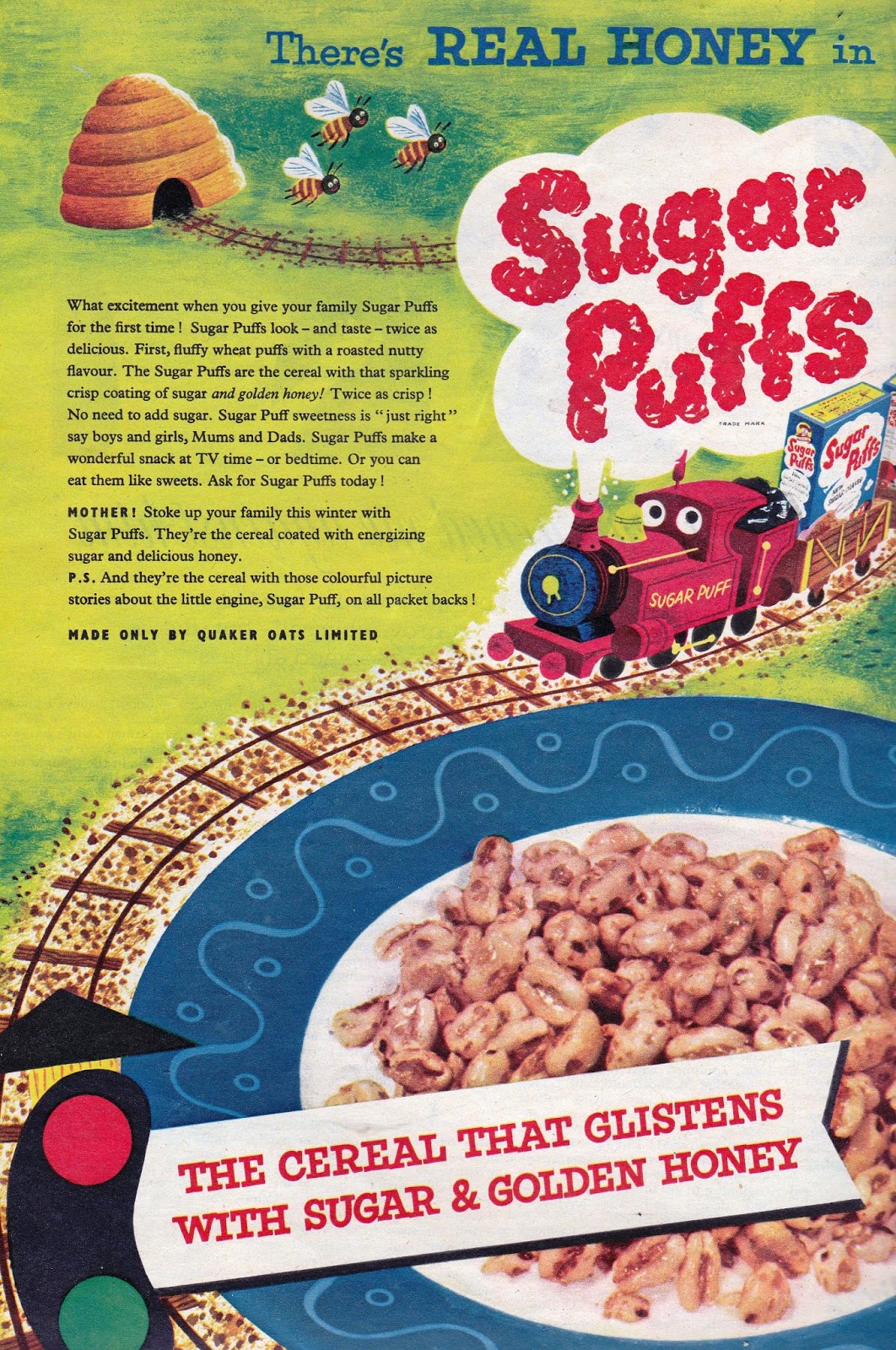
And in much the same way out went the old fashioned breakfast of porridge, eggs, bacon and toast in favour of the breakfast cereal.

Now these had been around since the 1930s, and there are ads in the collection for Corn Flakes and Rice Crispies, but the 50s offered up a new and exciting range, often marketed with a toy or other novelty and clearly aimed at the young.

Mother was quick off the mark to try the "new TV dinners  for one" which came out in the late 50s but equally died a death in our house as too expensive and not that nice.

Instead we reverted to simpler home cooked food but there was no going back on the changes that had happened.

As each of us left to set up our own homes the variety and the quantity of what we bought and ate just kept on growing.

But Dad preferred his tins, and on one memorable evening after I had cooked a pasta dish he smiled and said quietly that "it was good but  didn't really like  food messed about."

Location;Well Hall, Eltham, London


Pictures;  adverts for Birds Eye Foods and Sugar Puffs, from Woman’s Own, January 12 1956

*One hundred years of one house on Well Hall Road, http://chorltonhistory.blogspot.co.uk/search/label/One%20hundred%20years%20of%20one%20house%20in%20Well%20Hall

Wednesday, 14 October 2026

One hundred years of one house in Well Hall part 9........... bold new designs and a bit of Formica

This is the continuing story of one house in Well Hall Road and of the people who lived there including our family.*

I often wonder what  those who lived in our house in the 1950swould have made of the new household designs which were featured in Woman’s Own for January 12 1956.

Of course they may never have taken the magazine but they would not have escaped the exciting new ideas for transforming their early 20th century house into one which fitted with the 1950s.

Looking at them today they seem quite ordinary and just a little old fashioned but back then they were at the cutting edge of all that was new and innovative.

The basic designs were all there two decades earlier but were way out of reach of most working people.

But by the mid 50s that was changing.

It was partly as a result of the growing prosperity, along with new mass produced materials like plastic and Formica and the ever present offer of hire purchase, which meant for a “few pounds down and the rest over easy instalments” bits of the new life could be pretty much within the reach of every one.

All of which marks the 1950s off as more of a mould breaker than perhaps “the swinging 60s.”

Here were bold new colours, exciting fabrics and designs which relegated the old heavy furniture many peoples’ dreams to a place in a museum along with the odd dinosaur and other ancient relics.

And along with all these were those sheets of hardboard, which were cheap and could be applied to everything from period doors to the space in front of ripped out fireplaces.

For a few bob you could obliterate the beautiful features around doors create flat level spaces and add wonders to the fitted kitchens.

In 294 the master bedroom had lost its fire place and in its place a gigantic headboard with drop down drawers and a reddish swirly affect which I thought was the pinnacle of modern design.

But then I was only 14.

Sadly the DIYers responsible had also managed to take out the other upstairs fire places leaving just one small fine cast iron one downstairs.

Now it is pointless to rail against this vandalism.

At the time it seemed new and different and after six years of a bitter and hard war along with the preceding period of grim austerity all this was what we deserved.

And I have to admit I mounted similar attacks in the 1970s on good taste pulling out old features which gave the house its authentic feel and covering the walls with wood chip.

All of which means that I would have been no better in 1956, but just maybe now I might have cherished what was already there and just added the odd new idea.

Location;Well Hall, Eltham, London

Pictures; from Woman's Own, January 12 1956

*One hundred years of one house on Well Hall Road, http://chorltonhistory.blogspot.co.uk/search/label/One%20hundred%20years%20of%20one%20house%20in%20Well%20Hall


Wednesday, 1 April 2026

Rediscovering our recent past the Coldharbour Estate in Eltham sometime in the 1950s

I rather think that we often overlook our most recent past.

There was one history teacher of mine at Samuel Pepys Secondary Modern School who maintained that if wasn’t at least a hundred years old it didn’t class as history.

Now I know what he was getting at but that ignores so much of ore recent past, a past still vivid in the memories of many people.

So today I have decided to look at the Coldharbour Estate some of which will have clocked up sixty-six years of history which makes it older than even me.

The estate is “a large and spacious estate developed on the site of the Coldharbour Farm by the Metropolitan Borough of Woolwich from 1947.  It is sliced in two by a major road, William Barefoot Drive, where the small shopping centre and community buildings are located.

The estate was planned as a ‘garden suburb’, and there are many attractive greens.  From the open space at the Court there is a magnificent view of Eltham Lodge.”*

And there is the St Albans Church, “a small red brick church designed by Ralph Covell in 1953 it has a nice square tower and gently bowed window, and is linked by an arcade to the original vicarage.”*

The estate was not some where I knew well but only because none of my friends lived there so I had no reason to visit it, and when you are sixteen there are far more interesting places that call you over.

So I never went and now forty-seven years on and 230 miles further north I guess I won’t.
But that is not to say I have ignored the place.

Like many other post war developments it was a part of that determined effort to provide decent housing in pleasant surroundings.

And Coldharbour must have been significant enough a place to warrant a set of postcards by Tuck and Sons Ltd.

My favourite is the one of Witherstone Way mainly because of what was written on the back which announces that “The HOUSE MARKED X IS MY HOUSE. La maison c’est chez moi”

It has been dated to 1976 but the card must be older and is in that tradition of local communities getting their own visual record of what they were like, along with that even older habit dating back to the beginning of post card of marking the spot where you lived.

And reminds us that once the image had been created the company continued using it despite the fact that by 1976 the cars and the fashions had moved on a full twenty years if or more.

Pictures; Witherstone Way and St Albans Church and the Mound, courtesy of TuckDB, http://tuckdb.org/postcards

*Spurgeon Darrell, Discover Eltham, 2000

Tuesday, 31 March 2026

Eltham and Woolwich ………… 76 years ago

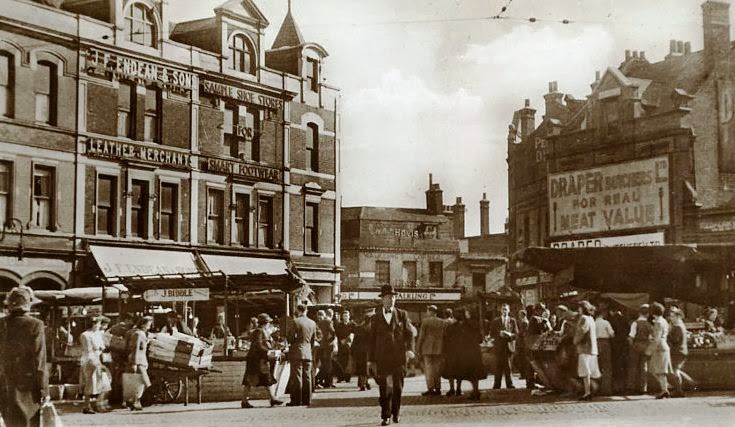
Eltham High Street
The quality of the images is a bit iffy, but that has more to do with me than the originals.  

As our scanner has taken a holiday, I was forced back on taking a picture from a picture, using a camera.

Still they capture scenes which have almost passed out of living memory, because while neither Woolwich or Eltham changed that much during the 1950 and 60s, these three images date from the very early 1950s if not back into the decade before.

And that makes them quite special, but for me there is another reason and that is they come from a book I thought lost.

Hare Street
It is the Official Guide to the Metropolitan Borough of Woolwich, and while there is no date, judging from the images I guess it was produced soon after the last world war.

It is a fascinating book which is now a piece of history.  Along with detailed descriptions of Woolwich, Eltham and Plumstead, there is a wealth of information on the services the borough operated, and a shedload of adverts for firms many of which will have ceased trading ages ago.

These include the Pioneer Bookshop at 3 Woolwich New Road, Court Studio in the Arcade in Eltham, and J.A. Proctor Ltd Builders and Contractors of Plumstead.

Thomas Street
So over the next few weeks I shall be returning to the Official Guide.

Leaving me just to observe that the presence of tram tracks and overhead cables might fix the time to some time before that last tram ran.

Although both rails and cables didn't vanish straight away.

Location; the Borough of Woolwich

Pictures, Eltham High Street, Hare Street and Thomas Street, circa 1950, from the Official Guide to the Metropolitan Borough of Woolwich, Wells of Woolwich

Monday, 30 March 2026

“A single to Well Hall” ...... travelling the tram in the “Last Tram Week”

History comes in many shapes and sizes, from serious books on great events to the humble object which offers up an insight into how we lived.

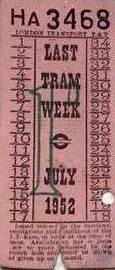
So I am indebted to Lesley, who on the back of a recent tram story told me that she still had a collection of tram tickets her mum bought during the “Last Tram Week in July 1952”.

Now I always get excited about seeing and especially handling bits of our collective past.

Back in the late 1970s I walked away from the excavations at Viking York with a genuine Viking oyster shell.  The archaeologists had unearthed so many that they were being sold in a barrel for 10p each.

On a more studious note, while writing the book on the Story of Chorlton-cum-Hardy in the early 19th century I used the hand written minutes of the local Poor Law Committee.

The volume began in 1834 and ran through to 1852 and I think apart from the chap who wrote up the minutes and perhaps a few others I will have been the only person to turn the pages in almost 170 years.

So looking at Lesley’s tram tickets is a fascinating link with that last week that London Transport ran trams through the city.

I was just short of my third birthday and though there is a family story that Dad took me down to the New Cross Depot, I have no memory of the event.

But like so many people of my generation, those tall stately trams have a lasting romantic pull and have of course now been resurrected by  by fleets of sleek new trams which have returned to many of our cities.

These are more comfortable, and faster but a bit of me would yearn to hop on one outside the old family home on Well Hall Road and rattle up to the High Street and north into Woolwich.

I can’t, so Lesley’s tickets will have to do.

Leaving me just to reiterate that old observation ...... be careful what you throw away for today’s rubbish will be someone’s priceless piece of history in the future.

Location; Eltham

Pictures; tram tickets from “The Last Tram Week”, July 1952, from the collection of Lesley Ross, 2018

Sunday, 29 March 2026

Memories of the Co-op, a tram journey and a live eel

I am always on the lookout for memories of Eltham and Woolwich before today, and so I was pleased when Jean shared some of her childhood ones.

Now if you are of a certain age you will more than likely remember your Co-op Divi number, this you offered up every time you purchased something from the local store.  There were also those light weight brass and tin tokens.

It always seemed to fall to me to slip down Well Hall Road to the RACS for the odd thing which of course meant remembering the number.  But then they went over to those blue stamps which long ago had their day and now I have a card which I hand over at the till.

But enough of me.  Jean also had those Co-op chores.

"I remember the tin tokens my granny used to get from the Co-op in Welling- she always let my cousin and I sort them all out around Christmas time and then she took us both to the Co-op in Woolwich to exchange them for real money. 


I used to love seeing the little brass things whizzing around that Co-op taking cash from one place to another, I suppose. 

We used to get to Woolwich by Trolley Bus - once and only once she took us on to a Tram, I loved every minute of this but Bryan was sick as a dog so the experience was never repeated.  

She always used to tell us as we got on the Trolley Bus that we would have to leave Woolwich by four o'clock as that was when the knives came out. Amusing this, years ago, but not so funny now in the light of that dreadful killing in Woolwich of that poor soldier recently.  


Thinking of Trams reminds me of a story she told me about my Grandfather (one of Granny Morris's sons and the baby on her lap in the old photo I think I sent you). 

He worked in the Woolwich Arsenal and came home to Welling by Tram. 

He loved eels and often bought some live ones in Beresford Market. One day they fell out of the container straight into a lady's lap!!  

Hysterics all round (I would have died)."

Pictures; number 46 tram, courtesy of the Eltham Society on its way to Woolwich circa 1940s and Beresford Square, in the middle decades of the last century, courtesy of Mark Flynn, http://www.markfynn.com/london-postcards.htm

Sunday, 21 December 2025

Back with the Eagle in the 1950s

Now if you were born sometime between the early 1940s and the mid ‘50s, the chances are you were a fan of the Eagle comic.

It is a topic I keep coming back to and the reason is that back then it amounted to the best of British comics.

Its appeal crossed class lines as well gender and if my father was anything to go by attracted an older generation as well.

It came out each week and like other comics of the period had its own Christmas annual which was supplemented by books on some of the other leading characters.

But for me the Eagle Annual which first appeared in December 1950 was a must under the tree and it kept me going through the year, because here as well as comic strips were extended stories articles on sport , history science  and nature.

In between there were practical information on how to make a Kite-released parachute, sending secret messages using invisible ink and making your own printing set.

Never being particularly practical most of these DIY projects rated little more than a second glance.

For me it was the sections dealing with history and the stories which drew me in.

And of the stories it was Dan Dare Pilot of the Future who always was my first choice.

At this point I have to say this is no nostalgic trip. Instead is an exploration of how a popular comic managed at the same to introduce a whole pile of educational information which never led you to think you were back at school.

Nor were the books or comics aimed at the middle class, for there was enough here for any lad like me whose highest aspirations seemed to be a secondary modern school and a future mapped out in one of any one of a number of practical occupations.

The activities were all rooted in things any nine year could do and the stories were  in a world I understood.

And when they were based in space the Wild West or North Africa they were believable.

What is more the science of the future was our everyday life just a little different.

So Dan Dare’s spaceship used dial and buttons and levers, the command structure of Space Fleet including the uniforms which  mimicked the armed forces and of course many of the expressions used were rooted in the language of the 1950s.

None of which should surprise us but allowed every nine year old to feel that this imaginary world was not so far off from their own everyday life.

Of course the Eagle was ruthless in its use of its name which was marketed for all sorts of types and products, but again there is nothing new there.

So that said I shall this evening retreat into that world of the Eagle Annual leaving the cares of the 21st century behind.

Pictures; from the collection of Andrew Simpson

*The Eagle, http://chorltonhistory.blogspot.co.uk/search/label/The%20Eagle


Tuesday, 9 September 2025

When a comic story holds more than a truth .............. stories from the Eagle

Now I have no recollection of post war rationing after all I was only four when it was finally abandoned.

But there will be plenty who not only remember it but will have stories of its impact on their daily lives.

Some of them will also have been regular readers of the Eagle comic which began in 1950 and continued into the following decade and here is the connection because running through several of the stories beginning with the first was how at a critical moment the Earth’s government was forced to introduce food rationing.*

Now even though I have read and re-read the stories countless times it never quite occurred to me that older readers of the Eagle would have vivid memories of both wartime and post war rationing.

That first Eagle story  was followed by the Red Moon Mystery when the planet was threatened by a rogue planet which had once destroyed all life on Mars and caused havoc before it was destroyed, which was repeated later by other stories which saw the earth’s population forced to be evacuated from their homes and ultimately  off the planet.

And when it wasn’t a natural disaster of sorts then there were always evil galactic nasties out on inter planetary domination of which the worst was the Mekon a not very nice dictator from Venus and his army of followers whose slavish devotion to their leader and ruthless behaviour would have been all too familiar to a generation that had been children during the last world war.

Of course such events are the stuff of good adventures and in slightly different forms will have appeared before and since but for those of us growing up in the 1950s they were pretty much a backdrop to the real thing.

Location; The 1950s

Pictures; from Eagle Comics in the collection of Andrew Simpson


*The Venus Story, April 14, 1950 – September 28 1951

Friday, 6 June 2025

Down at Eltham Palace in the summer of 1958

Now I am back at Eltham Palace, a place that first captured my imagination back in 1964 and continues to do so.*

This is the cover to the 1958 Ministry of Works Official Guide-book price One Shilling.

It runs to just 14 pages with four photographs and a map, and of course is a little bit of history in its own right.

When I first wandered around the Hall I don’t think what I saw would have been so different from what the guidebook described.

Now fifty-eight years on I am not so sure.  It has been a long time since I have been there and the Army Education Institute have long gone.

So for no particular reason other than I have the book, here are some of the pictures from that guide and the fun will be deciding if anything you see has changed.

Great Hall from the south, 1958

I can still remember standing under that great timber roof in the hall.

Since then I have come across pictures of the hall from the 18th century when it was used for cattle.

And read about the painstaking work of restoration undertaken in the 1930s.

So I know that next time I am back in Eltham I shall make every attempt to visit the Palace although even here times have moved on.

Roof of the Great Hall, 1958
Back in 1958 the Great Hall was open only on Thursdays ans Sundays from 11 a.m. to 7 p.m. during May to October, and 11 a.m. to 4 p.m. from November to April and admission was free.

Today it will cost you £10.20 if you an adult, £6.10 if you are under 15 but it will be open Sunday to Thursday 10 till 5 in the afternoon.

Pictures; from Eltham Palace, Kent, Ministry of Works, 1958


Friday, 31 March 2017

War Baby ......... stories by Eddy Newport no 31 ........... my first girlfriend,

Another in the series by Eddy Newport taken from his book, History of a War Baby.

Well Hall Odeon
Steve Searl and I would go to the Lido in Charlton Park on hot sunny weekends, sunning ourselves and chatting up girls.

One weekend a lady I knew who worked at Olive Pell’s (I can’t remember her first name she was Mrs Taylor) came to the lido for a swim and she had her daughter with her. Her name was Gillian. A very pretty girl and I took a fancy to her.

So I plucked up courage and asked her for a date to go to the pictures and with the approval of her mother she agreed to go. I met Gillian at the Odeon cinema in Well Hall that night.

She was waiting outside for me. We went in, saw the film, and I came out with my first girlfriend.

I took her home and arranged to see her again. I was in love for the very first time. Gillian and I started to see a lot of each other. Her mother encouraged me to visit her and stay for dinners on a Sunday and to my delight, her cooking was far superior to my mother's cooking I just loved her Sunday roasts.

Gillian liked music and during the week, we went to a pub in Mottingham known as The Dutch House where they had a jazz band playing. This band was lead by Owen Brice trumpeter and played a relaxed style of Traditional jazz that became known as Mainstream jazz. Gillian and I would go there and listen to the band and make a few drinks last the whole evening.

Later on, prior to going home we would go for a walk and have a little kissing and cuddling session, all this was very romantic. I never wanted this relationship to end.

Gillian’s elder sister Susan, was married to a drummer. His name was Ron Hawes and he worked in a butcher’s shop in Plumstead, they lived in the basement flat of the house where Gill lived with her mother and father in Herbert Rd Plumstead.

The Montague Arms
Ron was playing with a rock band in a pub in New Cross called The Montague Arms. Gillian and I went over by bus to New Cross the hear the band play.

They called themselves The Vampires. This band had a lead guitar John Gillard, bass player Dick Thomas tenor sax player Alan Holmes and a guy called Tony (Unc) who sang and played the piano. The music they played was current pop and performed Elvis Presley, Little Richard, Fats Domino and Jerry Lee Lewis hits.

I was very impressed with the band and loved their music. I became a dedicated fan of Ron and his drums and in retrospect, this man made the biggest influence on me in my life as far as becoming a drummer was concerned. Ron regarded himself to be “Cool”.

He adapted a much laid back attitude to life and the only important thing was his music. He was into modern jazz and liked to listen to Dave Brubeck, Dizzy Gillespie, Mills Davis, Charlie Parker, and big bands like Duke Ellington and Count Basie. He had fixed up a primitive form of quadraphonic sound by wiring four speakers to a record player and mounting them one in each corner of the room. A visit to Ron’s would involve in drinking beer and enjoying some jazz music. I was by this time rehearsing with the skiffle group and

Dad
I was still pretending my banjo was a drum. Ron had bought himself a new snare drum and asks me if I wanted to buy his old one and a cymbal. I jumped at the chance and took it on the next rehearsal.

My relationship with Gillian was coming to an end and I blamed my dad for it. I thought I was in love with Gillian and eventually took her home to meet my family. Dad looked at Gillian as his future daughter in law and the poor girl, only just sixteen put off any future relationship with me. So I got the big elbow.

At the time, I was devastated and very depressed. Not only had I lost my girlfriend but I thought I was going to lose my friendship with Ron and his musical mates. Ron said I could still go and see the rock band if I wanted to. I became an unofficial roadie for the band and followed them around on their gigs.

Location Eltham

© Eddy Newport 2017

Painting; The Well Odeon 2014 and The Montague Arms, © 2011 Peter Topping

Web: www.paintingsfrompictures.co.uk

Pictures;  courtesy of  Eddy Newport

Wednesday, 1 March 2017

Growing up in Eltham in the 1950s ......... stories by Eddy Newport no 10 .... night school dancing lessons and a mission accomplished

Another in the series by Eddy Newport taken from his book, History of a War Baby.

I went to a night school in Briset Road that was very near to where I lived.

The school was opened in the evenings and I enrolled to join the dance, table tennis, and radio classes.

These evenings were a good social and educational outlet. I built a valve radio and it worked much to my amazement.

The class I looked forward to was the dancing and it was held upstairs in the top hall. Our dancing teacher would teach us how to dance the quickstep, foxtrot and waltz just enough to get by at a social dance. We were not into taking medals examinations. We had a pianist who played for the dancer’s as well as a record player. The music was on old seventy-eight RPM records. Victor Sylvester and Jo Loss dance bands were the most popular.

During the breaks, some pupils had brought their own pop records to play Rock and Roll and we developed our own versions of the jive, this was much to the annoyance of the teacher who thought it was never going to catch on.

At the end of the term, we had a dance on a Saturday night. I got a ticket for Terry [Schoolmate] and off we went to the dance dressed up in our suits and ties and shiny shoes. The four piece band consisted of our regular pianist with a drummer, trumpet and saxophone player.

These guys played all the dances we had learnt and we had a great time with the girls dancing the night away.

During the evening, the band attempted to play some rock and roll and we had the opportunity to show off our new dance. I was far too shy to ask a girl out and never did, but later on, I was happy to know how to dance properly.

The photo shows the Newport's on holiday at Pegwell Bay, with me aged 15 growing up with a crew -cut haircut and thinking that I knew it all.

Mother with the box brownie camera.

© Eddy Newport 2017

Picture; from the collection of Eddy Newport

Tuesday, 28 February 2017

Growing up in Eltham in the 1950s ......... stories by Eddy Newport no 9 .... new friends and Count Basie

Another in the series by Eddy Newport taken from his book, History of a War Baby.

My stay at the Gordon school was to last for two years.

New friends were made during which I met a boy who was to make a big influence on me David Burt. He had a freckled face and a mop of red hair. He and I became best friends and socialised outside of school.

We would cycle off into the country to explore fields and places sometimes visiting members of his family who lived in Plumstead.

David introduced me to the habit of smoking. He had an uncle who played the drums in a band called Cyril Bodkin’s and his dance orchestra.

My interest in drumming was rekindled as David’s uncle played records by Count Basie, Benny Goodman and Duke Ellington. Duke Ellington’s “Skin Deep” with Louie Bellson playing the drums was a firm favourite.

That was just the best there was in classic jazz drumming. Buddy Rich and Gene Krupa both highly acclaimed drummers in America and an inspiration to any budding drummer. These moments were to spark an interest in jazz that was going to stay with me for the rest of my life.

© Eddy Newport 2017

Picture; from the collection of Eddy Newport

Sunday, 26 February 2017

Growing up in Eltham in the 1950s ......... stories by Eddy Newport no 6 a garden, some vegetables and the rabbit

Another in the series by Eddy Newport taken from his book, History of a War Baby.

Dad became a keen gardener and worked hard to establish a well laid out garden.

He built paths around the bungalow and elevated the   lawn, as the garden was about a hundred foot long he cultivated a vegetable patch at its far end.

I would try and help out, but when it came to digging I managed to drive a garden fork through my boot and luckily the prong went between my toes.

Dad grew mostly potatoes and cabbage.

He did keep some rabbits for a while in a hutch behind our shed.

This was fine until he decided to have one killed for the pot. He could not do it himself, so a friend came round in to do the dispatching. I was fascinated by this. The friend went out to get the rabbit and holding it by its ears did the rabbit chop to the back of its neck. It was not a clean kill and the rabbit made some noise.

Eventually, it was declared dead and brought it into the kitchen where he started to skin it. I was amazed as the organs that appeared from the animal also the blood being collected into a basin. I was not horrified to all this just fascinated by it all. I think it upset Mum and Dad as he soon got rid of the all the rabbits.

© Eddy Newport 2017

Picture; from the collection of Eddy Newport

Saturday, 25 February 2017

Growing up in Eltham ......... stories by Eddy Newport ...... no 5 a new home, a baby brother and a new Queen

Another in the series by Eddy Newport taken from his book, The Newport’s 1951 at No. 58 Rochester Close Kidbrooke SE3...........

Mum
Mother was a woman that everybody wanted to have as a friend. She had an open house for anyone to visit and many did for cups of tea and chats. During that time, her work was cut out with her two boys. Shopping expeditions were to the local parade of shops about a mile away along the Rochester Way.

There was a public house there called “The Dover Patrol” So going shopping there was referred to as “Going up the Dover”.

No such things as supermarkets, these were for the future. The main grocery store was called Perks Ltd and you could get all you wanted, provided you queued up for it. Everything had to be weighed out and put into paper bags.

There was still rationing and our ration books had to have the coupons cut out so to prove that you had had your quota. There was a baker, butcher, hardware, newsagent, fish and chip shop, off-licence and a drapers shop all in a row. One thing I will never forget was the smell of the hardware shop; it was a mixture of paraffin, tar and detergents all mixed together and unforgettable."

I was settling into Ealdham Square School and David was soon to follow. It was soon realised that Rochester Close was not going to be big enough for a growing family. It was possible under the London County Council that tenants could exchange properties if all was agreeable. In the area, there were a lot of council houses being built. Dad and Mum put in for an exchange and managed to do a deal with an older couple living at 98 Birdbrook Rd. And so we moved once more the year was 1951.

The eleven plus examinations were looming the King had died we had a new Queen and her coronation was a near future event. Life was going to change.

Dad
Once we had moved into our new home at number 98 we soon settled down. The big news of the day was the coronation of Elizabeth II at Westminster Abbey on June 2nd, 1952. Dad being in the Saint John’s Ambulance Brigade had a duty to attended to.

He was to stand outside Westminster Abbey. He had a fantastic view of the all that went on. We had befriended our new next door neighbours Mr and Mrs Parsons who had a television set and on the day, we were invited in to see the unfolding events.

Mrs P had set up benches in two rows for the children to sit on. I found the whole thing very boring, the only time it became exciting was when in the distance a black uniformed man with a white bag over his shoulder came into view. He said later that the only causalities he had that day were trying to sober up drunken Lords sipping their hip flasks during the service.

Note:- this photo was taken in the garden of 58 RC. in the background is the main road Rochester Way, that house is still the. taken 1952

Geoffrey born 27th Oct 1951.  Now we are five.

Life carried on in this way until 1951 when another addition was added to our family. On Oct 27th, our brother Geoffrey Alan was born. That night David and I were woken by a lot of activity and told to stay in our beds.

Geoffrey aged 8 months
The midwife was sent for and later a baby was heard crying. We were summoned to our parent’s bedroom and introduced to Geoff. Weighing in at 6 lbs. Mum looked pleased and dad was so proud to have witnessed the birth.

The prefab we lived in was Geoff’s birthplace and is now an open space area (Kidbrooke Green).

I went back some time ago to try and judge the spot where we had our bungalow. I came to the conclusion that if Geoff ever became famous and the country wanted to put up a blue plaque where he was born, they would have to nail it to a park bench.


Mum used to ask Dave and me to do the shopping and take Geoff in the pram to carry it in. I hated this chore.

The embarrassment of pushing the pram was horrendous to me, so I would push it out in front of and let it freewheel for about 10 yards and when I caught up with it I pushed it out again. This was fine until the pram hit an obstruction and it tipped over and Geoff did a somersault on his rains and all the shopping went over the pavement.  It worried me at the time as was relieved that Geoff was strapped into the pram and did not sustain any injury. However, I did not do that again.

I was settling into Ealdham Square School and David was soon to follow.

It was soon realised that Rochester Close was not going to be big enough for a growing family. It was possible under the London County Council that tenants could exchange properties if all was agreeable. In the area, there were a lot of council houses being built. Dad and Mum put in for an exchange and managed to do a deal with an older couple living at 98 Birdbrook Rd.

And so we moved once more.  The year was 1951. The eleven plus examinations were looming the King had died we had a new Queen and her coronation was a near future event. Life was going to change.

© Eddy Newport 2017

Picture; from the collection of Eddy Newport

Friday, 24 February 2017

Growing up in Eltham in the 1950s ......... stories by Eddy Newport no 4 at the bottom of our garden

The Government Training Centre is now the Nelson Mandela housing estate. 

You can see in in the background of my family photo. That was taken in the garden of the bungalow

.At the bottom of our garden was a large fence, the other side of it was a Government Training Centre.

An establishment set up by the government to help men after the war to get some qualifications to acquire skilled jobs like plumbing carpenters, electricians, gas fitters and hairdressing.

The later being the most popular with the local establishment. Volunteers were asked to be victims to the trainees for practicing their hair cutting skills. On Saturdays, the children were allowed in to have their haircuts.

We would queue up at the gate and then taken through to the large room with all the prospective barbers would be waiting. Depending on who you got, and how much experience he had, you either had a good or bad hair cut.

All this was for free so our parents did not worry, too much, as to how us kids looked like when they came home".

© Eddy Newport 2017

Picture; from the collection of Eddy Newport

Thursday, 23 February 2017

Growing up in Eltham in the 1950s ......... stories by Eddy Newport no 3 Lassie and 58 Rochester Close

Another in the series by Eddy Newport taken from his book, History of a War Baby.

This photo shows the garden of 58 Rochester Close. My brother David and next door neighbours daughter Olive Stark, who was the same age as David.

The dog was our pet Lassie and her pups. How she came to join our family is related below.


Dad was still working in Greenwich and cycled to work every day. One day on his way home he was followed by a stray dog. It turned out to be a wire-haired terrier bitch.

Dad brought her into the house and fed her. It was a mystery as to where she came from. He took her to the police station in Eltham and reported her as a stray. She was not claimed by anyone and so she became an addition to our family.

We named her Lassie. She went with us everywhere. We loved her she had a lovely nature, but she also had the roaming instinct and a couple of time we lost her, but because she had a name tag on her collar we got her back.  She had three lots of puppies at various times from different dogs. Dad had to find homes for all of the pups which he did.

Dad about this time enrolled me in the Cub Scouts. The scout hall was adjacent to the church of St James’s in Kidbrooke Park Road. St James’s church had a very tall spire but was bombed during the war and was just a shell of a building.

Next door was a prefabricated building which was used for the services. Mum had Geoffrey christened there and once we reached a suitable age David and I were sent off to the Sunday school.

What I remember of my time in the cubs was good. I enjoyed the games and I was taught a lot of necessary things to get a badge to sew onto my green jersey.

I managed to become a sixer which meant I had two silver stars on my cap. I felt confident and important and good about myself. That was until I went up into the scouts proper and I could not handle the bullying and complexity of what I had to learn there so I left and that was the end of my scouting days.

© Eddy Newport 2017

Picture; from the collection of Eddy Newport

Wednesday, 22 February 2017

Growing up in Eltham in the 1950s ......... stories by Eddy Newport No 2 School and things

Another  in the series by Eddy Newport taken from his book, History of a War Baby.

After my spell in the infants I moved onto the primary school. At this school my reading improves and things started to make sense. I received my first caning from the headmaster. He was a formidable man very tall and had a bald head. He took the morning assembly and we all had to stand and listen to him making his announcements.

During this time, a boy in the row in front broke wind and I and two others thought this to be very funny and started to giggle.

Mr Froom stopped speaking and pointing to us three and were told to get out and wait outside his office. Off we went, very embarrassed, and waited with a sense of fear, as to what was going to happen to us.

Soon he came along and called us into his office and proceeded to tell us off for making a disruption in assembly. He then took out of a cupboard a long thin cane. He asks us to hold out our right hand and with a quick swish and a pain I shall never forget, got a full strike on the palm. Then he did the same to the left hand.

When we got back to our class we started to cry. I went home that night and told my mum and she sent me to bed as a further punishment. I learnt then, that if at any time I got into trouble, I did not tell Mum or Dad about it.

I was punished a few more times whilst I was at that school. One teacher was very fond of the slipper across the backside, and that was really painful. I made some very good friends at Ealdham Square.  My reading was improving and my education started to gel."

© Eddy Newport 2017

Location; Eltham

Picture; from the collection of Eddy Newport

The Newport’s 1951 at No. 58 Rochester Close Kidbrooke SE3.................