Showing posts with label Birmingham. Show all posts

Friday, 26 January 2024

The Deep-Rock Baby Bottle …...... another story by Tony Goulding


This is one of those little stories which are initiated by a find in “The Old Curiosity Shop” otherwise the Oxfam premises on Wilbraham Road, Chorlton-cum-Hardy, Manchester.


This bottle was part of a recent donation and immediately piqued my interest. 

Fortunately, the name H. W. Capenhurst of Birmingham, The Sole Proprietor, was embossed on the bottom of the bottle.

With it being an unusual surname, I was able to speedily locate the relevant entry on the 1921 census which revealed that Harold William Capenhurst was a Mineral Water Manufacturer living at 774, Washwood Heath Road, Aston, Birmingham with his factory 684, Washwood Heath Road. In 1921 he was recorded as a widower residing with his 25-year-old daughter, Doris Mary. 

 Further research revealed he was born in Birmingham on 9th June 1870 and was christened at St. Martin in the Bull Ring Church, Birmingham on 12th December 1870. 

His parents were William Capenhurst, an ironmonger and his wife Hannah (née Arton). As a young man Harold William assisted in his father’s business. His father died on 25th October 1893 leaving an estate of £534-14s-7d (= £57,500 today). 

With his share of the inheritance Harold William, who had just recently married Sarah (née Nicholls) in the September quarter of 1892, began trading as an outdoor beer retailer at, according to the 1901 census, 37, Tilton Road, Aston, Birmingham. 

By the following census, in 1911, he had set up in his Mineral Water Manufacturing business.  Harold William remained at Washwood Heath Road until his death on 4th April 1942.

St. Martin in the Bull Ring, Birmingham
His wife, Sarah, passed away in the December quarter of 1920, shortly after which in the September quarter of 1921 his only child, Doris Mary, married a Customs and Excise Officer, William Arnold Hewitt.

 All of which is quite interesting but what would be fascinating to know is how a “pop” bottle from a local producer in Birmingham ended up in a rubbish tip in Chorlton-cum-Hardy! 

This we will surely never know.


Pictures: - Bottle from the collection of Tony Goulding. St. Martin in the Bull Ring Church from Wikipedia

By Sunil060902 - Own work, CC BY-SA 3.0, https://commons.wikimedia.org/w/index.php?curid=8931102

Saturday, 21 October 2023

Street art ......... the Urinal

Now I have no idea if  this fine example of a Victorian urinal still exists.

I passed it in 1981 during a march against unemployment in Birmingham.

With the distance of time I now have no idea where in Birmingham it was, but someone will know.

Location; Birmingham


Picture; the Urinal, 1981, from the collection of Andrew Simpson

Friday, 20 October 2023

Faces from a demonstration ...... no. 1 ....... at the window

From a distance of nearly 4 decades I have no idea where in Birmingham this was, other than that the demonstration seemed to meander through bits of the city which seemed well off the beaten track.


The year was 1983 and this was one of the large demonstrations organized by the Labour Party to call for action to reverse the growing levels of unemployment which on that Saturday stood at three million.

Location; Birmingham

Picture; Faces from a demonstration, 1983, from the collection of Andrew Simpson

Thursday, 19 October 2023

On finding my uncle …… and losing his wife

Now yesterday I was exploring the story of my uncle, trying to solve several mysteries and reflecting on just how easy it was to disappear in the first half of the last century.*

He was born in 1901, married in 1933 and died in 1953, and for as long as I can remember he was a family secret.

A secret which I only stumbled across when a family tree came to light, after which dad and his three brothers owned up to the story.

Even then they were reluctant to offer much, and for perhaps 30 years I left him in the shadows.

But at 73 I was keen to tie up the loose ends of the family and over the last week I have been searching for him.  A search that took me from Alloa in Scotland to Gateshead and finally a grave in a Birmingham cemetery.

And for now, I think I mined the seam of his life, and while there are still plenty of gaps I am content that I will not find out much more.

The last intriguing piece was the discovery that on the evening of June 19th 1921 he was on holiday in Whitley Bay.  This I know because today I stumbled across an entry in the 1921 census listing him as staying at 26 Marden Crescent in Whitley Bay.

It is a modest looking property just a short walk from the sea and just a tad longer walk to Cullercoats Bay and Long Sands Beach.

He was not alone, for there were five other holiday makers, three of whom were sisters and a couple in their sixties.  Their occupations were as varied as their ages, with a travelling salesman, two teachers a housewife and a Florence Burrows who was listed as doing “House duties”, leaving my uncle who was an apprentice turner for a company in Gateshead.

Their hosts were a Mr. and Mrs. Smith who ran the holiday B&B, and appear to have washed up in Whitley Bay some time during the previous decade. Mr. Smith had been born in Orkney in 1858 and rose in the ranks of the police force before retiring sometime before 1901 and continuing to work as a toll collector.

We will never know whether uncle hit it off with the sisters who were aged between 30 down to 20 and who may have enjoyed the company of this young apprentice.

What is more certain is that his marriage ran into the buffers, and twelve years after he had got married his wife sought a divorce.  She was still in Gateshead, but uncle may already have settled in Birmingham where so far, he has left no record, other than his death certificate and a grave in Yardley Cemetery.

Nor has his wife proved easier to locate.  The marriage certificate allowed me to track her early years and the several homes she grew up in. But apart from that marriage certificate and a court notice referring to the divorce, she has gone missing.

And despite a day looking for her in the 1939 Register and other documents using both her married and maiden name, all has gone silent.

Leaving just one surprise which was that that the young bride lied about her age, which was actually 38 and not 32 as stated on the certificate.

A small deceit perhaps but one which might have been the first step on the road to unhappiness.

I doubt we will ever know.

In the meantime, I shall keep looking.

Location; Whitley Bay, Gateshead and Birmingham

Pictures; family and friends, circa 1920-30s from the collection of the Simpson family.

*Travels with my uncle, https://chorltonhistory.blogspot.com/search/label/Travels%20with%20my%20uncle

Wednesday, 18 October 2023

On losing your uncle …….. travels with a family secret ….the 1921 census part 2

I had hoped that the newly released 1921 census would help with the family secret.

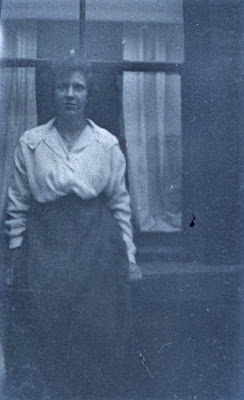
Window girl, date unknown
Most families have one, and we have quite a few, but this one has remained stubbornly in the shadows.

He was one of my uncles who was never mentioned, and I stumbled across him in my 40s, and despite repeated questions to dad and my other uncles little was forth coming.

Father just met my inquiries with a vague comment and quickly changed the subject while Uncle George vouched safe only of a disastrous marriage, and a preventable death in a Birmingham lodging house.

Over the years I have gone looking for the mysterious uncle, and did find references to his marriage in 1933, and his death twenty years later. There are a few photographs of weddings and individuals which may be connected to him, but alas all are undated and unnamed. 

To which uncle George only added that the death could have been avoided if the landlady of the lodging house had been more attentive when his brother contracted an illness.

And that is it, leading to the family speculation that just possibly the marriage was never dissolved and instead he had left the northeast for the Midlands, and his location was never revealed to anyone except the brothers.

For years I have respected that silence, and even now I wonder at invading that closed story, but the 1921 census proved too much.  

After all this census which will be the last till the 1951 census is published has the promise of revealing so much about post war Britain, and especially about the family.

A wedding, date unknown
A decade earlier he had still been living at home, aged ten and was at school, so ten years on I reasoned there might be clues about him, from his occupation and where he might have worked.

But he was no longer in the family home, and so far, appears nowhere else in 1921.

Which is a blow, leaving me just to call up the marriage and death certificate, and hope that I can then follow up on his wife and his final address.

But I suspect he was a man intent on revealing as little as possible.  At present he has evaded electoral registers, directories and even the 1939 Register.

And that in turn makes me think perhaps he has done enough to stay in the shadows.

We shall see.

Location; the Northeast and the Midlands, 1891-1953

Pictures; unknown friends or relatives of the family, dates unknown, from the collection of Andrew Simpson

Tuesday, 17 October 2023

Losing an uncle ……. and discovering much in the search

This is the story of my uncle, and a series of questions which almost 70 years after his death remain unanswered.

The unknown women in the window, undated
At which point I fully accept that one person’s family history is another person’s yawn, but there is enough in the search to find answers which will resonate with others, offer routes to find lost relatives and perhaps make broader comments about the last century.

For most of the time I was growing up I only had a vague knowledge of him, and Dad, and our other three uncles never spoke of him.  And even when quizzed would reluctantly let slide just the briefest of answers and quickly changed the subject.

Later one of them provided a family tree with the “missing” uncle, and another spoke of a disastrous marriage and a death which could have been prevented if his landlady had noticed how ill he had become.

So enough to suggest a few mysterious and pointers to find out more.

He was born in 1901 in Alloa in Clackmannanshire in the Central Lowlands of Scotland, and over the next decade the family moved south, finally crossing the border and settling in Gateshead sometime in the 1900s..

And in that the family were typical, having started their migration south from the east Highlands decades earlier.
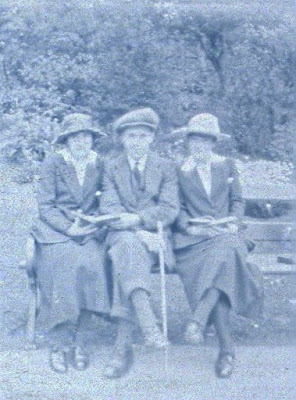
Dad or an uncle with friends, date unknown
But there the trail begins to turn shadowy.  So, while he appears on both the census returns for 1901 and 1911, he is missing from the 1921 census as well as the 1939 Register.  Nor can I find him as yet on any official form, register, directory or newspaper account, until his death certificate dated 1953 issued in Birmingham.

Added to which that death certificate only makes for more mysteries.  It was registered by a Mr. Walter Francis Pountney, who clearly didn’t know our uncle very well, because the age at death was recorded as “about 52” and occupation as “not known”.

And all this despite the fact that Mr. Pountney owned the property.

To be fair it is unclear whether he was living in the house when uncle died.  In 1939 he was registered as occupying the place, but six years later according to the electoral register the house had been given over to multi occupancy, with fifteen residents one of which was his mother.

So, I am not surprised that our uncle ended up in a local cemetery with what appears the cheapest of burial services and no headstone.

Perhaps the brothers only came to know later, which would fit with the little I can surmise, which is our uncle didn’t want to be found.

His wife is recorded in the Manchester Evening News as petitioning for a divorce in the November of 1945  and the official announcement refers to our uncle’s last known address in Gateshead, by which time I suspect he was faraway.  Now whether Birmingham was already that faraway destination is unknown, although I don’t think it was Manchester.

Unknown family friend, date unknown
She was still living in Gateshead and the divorce petition was administered through the Newcastle division of the High Court.

I have her maiden name which was Smith but as yet no date or place of birth, and no parental name.

Those await the arrival of their marriage certificate, ordered up a fortnight ago from the General Registry Office but as yet with postal delays as they are I am still waiting.

So, the trail has gone cold for the minute, leaving just a few observations, starting with the bizarre one that I know more about Mr. Poutney than I do my uncle.

But then this was still a time when it was possible to disappear and pretty much reinvent oneself.  

Apart from a National Insurance Number, there was little to track or identify him.  The requirement to carry or present a National Identity Card had ceased in 1952, and if he avoided hospitals and doctors, he wouldn’t need an NHS number.  

Likewise, if he was careful about the jobs he did, and how he was paid it is doubtful he would have attracted official attention.

And of course, bank cards, online payments and social media were yet to be dreamed up.

Dad, date unknown

So, I think he could have stayed in the shadows, and finding him once he choose to vanish has been difficult.  I know where he lived in Birmingham at his death, and searching for Mr. Poutney took me to the 1939 Register and the house in Birmingham, along with a reference to the electoral register for 1945 living in a street close by to where my uncle had died.  

And armed with that link it was easy to search the same register for the house where uncle was to die in 1953.

All pretty much now hangs on that marriage certificate but that sits somewhere in a sorting office, and until it drops through the letter box our uncle remains in the shadows.

Location; Gateshead, Birmingham

Pictures; unknown family and friends, circa 1920s-30s, from the collection of the Simpson family

Monday, 16 October 2023

Mary Emily Stevens ....... and a unique collection of wartime pictures

I am looking at a unique collection of wartime photographs which belonged to Mary Emily Stevens.

Mary Emily, November 1940

Along with the pictures, there are her medals, her cap badge and her RAF wings.

In the back garden, August 1940
She was born on October 26th 1918, and on the eve of the Second World War War was employed as a shop assistant selling toys.

Her father gave his occupation as “clerk (Wholesale grocery)" and her mother as “Married Domestic Duties”.

So, pretty much an “ordinary family” getting on with their lives in Birmingham, and like so many other young people, Mary volunteered for the services, and joined the RAF.

And that takes me back to the collection of photographs which record her life from the summer of 1940 through to her sudden and tragic death four years later.

The picture album was recently acquired by my old friend David Harrop who has carefully put together a record of Mary’s career which took her, from “RAF Cottesmore, which was a training base for bomber command, to Bridgnorth RAF hospital as an orderly in 1942 and a year later she moved to RAF Millom where in March 1944 she was mortally wounded in an accident.”

Along with several pictures of Mary there are others of nurses and RAF flight crews.

September 1941
That in itself makes it an interesting collection but more so  because as David says “there are few such collections belonging to members of W.A.A.F, and even fewer which also include a set of medals”.

And it is the medals that have thrown up a little mystery. 

In total there are  three, one which is the 1939-45 Star, along with  the War Medal, but the third sheds new light on her career, because she was also awarded the Italy Star which was issued for those who served in the Italian Campaign from 1943 to 1945.

Mary's medals

There is a lot more research to do, and I doubt we will be able to access her RAF records, so at present David has decided to feature the collection on one of his special Facebook sites.*


Over the next few weeks he intends to post pictures from the collection to honour young Mary Emily.

It maybe that someone remembers the family and can add something more.

Sadly the story of the collection and how it came to be on the market is lost.

Order of Service, 1944

David tells me that it passed through two collectors before it came back on the market earlier this year.

I am pleased that he has decided to make the collection more widely known, which is a good thing, and in doing so Mary Steven's short life will be honoured all over again.

And my extension to all those women who served in the services, the Land Army and a host of other war time organisation.

Which included my mother who was also in the RAF.

Pictures; Mary at home in August 1940, at RAF Cottesmore, November 1940, September 1941, and her war medals, courtesy of David Harrop.


*Mary Emily Stevens, https://www.facebook.com/105299108322389/posts/105321781653455/?sfnsn=scwspmo


Sunday, 15 October 2023

History for sale …….. at the local convenience store and other places

Now I wonder how far historians have a duty to share their knowledge free of charge?

Reconstructed section of the Roman fort, Castlefield, 1980s
It is of course a thorny subject.  

On one side stand the professional historians who quite rightly want some financial remuneration for their efforts.

And as someone who has written ten history books over the last decade with another four projects in the pipeline, I have sympathy for that position. 

Added to which it can be an uphill battle combating the actions of those that think it is perfectly alright to “lift” my research and the images I have collected, without any acknowledgement of where they have acquired the material and worse still parading it off as their own. 

My golden rule is that you always acknowledge your sources, and where necessary ask permission to quote someone who is still alive, and never publish anything for which you cannot get that permission.

And if it is out of copyright it is still good scholarship to say so.

Steam Exposition, 1980
But on the other hand …. knowledge is too precious just to be hoarded away or allowed to slip out as a series of drip fed historical nuggets.

All of that said I don’t think there is necessarily a conflict between the two.

Years of diligent research followed up by perhaps a year of carefully writing a piece of accessible prose, deserves financial reward.

But once that book is out the author will go on to publicise it across a number of different platforms, and in the process will reveal the content, the interpretations, conclusions, and the sources.

The interested can then decide whether the material is worthy of taking the next step and buying the book, the film, or going on the guided walk.

Each of my books has featured on the blog, and I have no problem with revealing some of the content, the interpretations, as well as the conclusions, and the sources.

The devil as they say is in the detail, which is still there in the book, or as one of my maths teachers would say …… “it’s the working out of how you got the answer which is important”.

I doubt Herodotus, or Thucydides, Livy or Tacitus shaved off the odd fact or story because the price was not right.  Nor would I think  the Chinese historians Sima Qian and Ban Zhao would have demanded payment upfront for their essays in historical truth.

Replica of the Planet , 2002
But I accept they were either of independent means or writing for a patron which might have freed them from the commercial necessities of asking for payment for their knowledge.

And that leads me to the question of financial remuneration which for most of us is not much.  

Apart from a few “blockbuster” history books and celebrated historians most of us beaver away with little expectation that we will be plastering the walls with gold impregnated wallpaper on the strength of our book sales.

Commercial publishers pay between 8 and 10%, and if the topic is a specialized one the chances are that the readership or market is limited.

Birmingham, 1983

So, we do it because we like doing it, and even when it is the main source of our livelihood, we owe it to the public,  and posterity that we do share our knowledge in a way that is accessible to everyone.


Pictures; Manchester & Birmingham, 1978- 2002, from the collection of Andrew Simpson


Tuesday, 25 April 2023

Standing "on the threshold which leads into the palace of justice”

It was a slow day on Beech Road yesterday, and with little interest in sitting in the garden or watching yet another box set I took to reading a collection of historic speeches.*

Liverpool, 1980
Now, if you want to get out of a low mood, brought on by a combination of the virus, and the political scene, a couple of hours with Dr King, J.F. Kennedy, Betty Friedman, Abraham Lincoln, and Dolores Ibarruri Gomez, [La Pasionaria] and countless others, is guaranteed to set you up.

Of course, you have to be aware of the context in which the speeches were made, and if I am honest I gravitated at first to those whose politics I shared, and remember  watching.

Added to which some of those speeches were made by people who whose political record on certain issues might at times be a little flawed.

And finally, I take the possible criticism that sitting reading a speech is just armchair politics and the real test is going out and making a difference.

But at 70 with a lifetime of political activity which began when I was 16, I think I might be allowed to take the armchair.

What surprised  me were the speeches by politicians who I have always regarded as pariahs, like Enoch Powell who made that infamous “rivers of blood” speech made in Birmingham in 1968, but nine years earlier had condemned the treatment of Mau Mau detainees in the Kenyan detention camp at Hola, insisting that prisoners wherever they were held under British jurisdiction were entitled to the same rights of treatment.

Birmingham, 1983
The beatings of many of the prisoners and the deaths of ten of the men he argued was the responsibility of the Secretary of State, brushing aside the alleged crimes and their place of confinement as not relevant to  justice, concluding “We cannot, we dare not, in Africa of all places fall below our own highest standards in the acceptance of responsibility”.

That said, the speeches which I enjoyed rereading were those of Lincoln, Kennedy and Dr King, and staring with Colonel Rainsborough who in 1647, uttered, the powerful, statement of democratic principle “I think that the poorest he that is in England hath a life to live, as the greatest he; and therefore truly, Sir, I think it's clear, that every man that is to live under a government ought first by his own consent to put himself under that government; and I do think that the poorest man in England is not bound in a strict sense to that government that he hath not had a voice to put himself under”.

His was a contribution to the Putney Debates when the victorious Parliamentarian army sat down to discuss the future.

Manchester, 1984
And while that democratic statement was defeated by the Army Grandees and the forces of the establishment it still rings out.

As does the speech of Gideon Hausner, the Attorney General of the State of Israel at the trial Adolf Eichmann, responsible for the management of the Final Solution.

In a speech which lasted ten hours Mr. Hausner, opened by saying, “When I stand before you O Judges of Israel, to lead the prosecution of Adolf Eichmann, I do not stand alone.  

With me here are six million accusers.  But they cannot rise too their feet and point their finger at the man in the dock with the cry of ‘J’ Accuse on their lips.  For they are only ashes- ashes piled high on the hills of Auschwitz, and the fields of Treblinka and strewn in the forests of Poland. Their graves are scattered throughout Europe.  Their blood cries out but their voice is stilled.  Therefore, will I be their spokesman”.

What marks out many of these speeches is the power of the rhetoric, which makes us remember, the memorable lines, like those  from J.F. Kennedy’s  “The torch has passed to a new generation of Americans", “ask not what America will do for you, but what together we can do for the freedom of man”. “Ich bin ein Berliner”.

Birmingham, 1983
But sleek phrases are themselves not enough, they must arise from a very real need for change which Betty Friedman encapsulated in a speech on women’s rights in 1969 at the first national conference for repeal of abortion rules, when she talked about women being invisible and having to have “a full say in the decisions of their lives and their society”.

And of all the countless ones I read yesterday, and which still sit with me, it must be Dr King’s address on the centenary of Abraham’s Lincoln’s emancipation proclamation, made at a gathering of 210, 000 people at the Lincoln Memorial.

It is a powerfully written speech drawing on the language of the bible, shot through with the injustices of Black Americans and calling for action.

I  tried to pick out key sections, but in truth the whole speech is a mastery of rhetoric, leaving me to fall back on the oft quoted lines,

"I have a dream that my four little children will one day live in a nation where they will not be judged by the color of their skin but by the content of their character.

I have a dream today!


Birmingham, 1983
I have a dream that one day, down in Alabama, with its vicious racists, with its governor having his lips dripping with the words of "interposition" and "nullification" -- one day right there in Alabama little black boys and black girls will be able to join hands with little white boys and white girls as sisters and brothers.

I have a dream today!

I have a dream that one day every valley shall be exalted, and every hill and mountain shall be made low, the rough places will be made plain, and the crooked places will be made straight; "and the glory of the Lord shall be revealed and all flesh shall see it together.

This is our hope, and this is the faith that I go back to the South with".

Pictures from the collection of Andrew Simpson, 1981-87

*The Penguin Book of Twentieth Century Speeches. Edited by Brian MacArthur, 1992, & The Penguin Book of Historic Speeches, edited by Brian MacArthur, 1996

Sunday, 11 April 2021

Saying something is wrong ........ alternative histories .... part 1

Now I can remember the first demonstration I went on in the 1960s and then pretty much all of the others.

Liverpool, 1980
But those I supported during the 1980s have become a blur, and part of that was because there were so many of them which were provoked by a series of developments, none of which many of us thought were good.

There was steadily rising unemployment, a Government intent on curtailing the ability of the Trade Unions to do the business of protecting the work force while pursuing a policy of reducing expenditure for public services.

Along side these, there was the growing fear that a new generation of nuclear weapons and their delivery systems coupled with the hard line leaders in both Washington and Moscow threatened world peace.

Liverpool, 1980
So, many of us marched, firmly believing that in doing so we could express our concern and send a message to those in power.

And from 1978 I documented all of the ones I attended, from Manchester to London and back via Liverpool and Birmingham.

I will leave others to write the history of that decade and to make judgements on the effectiveness of the demonstrations and instead will set about posting some of the pictures.

These have sat in the cellar for nearly four decades, left in a corner because they belonged to old photography, which relied on a dark room, smelly chemicals and an enlarger to bring them to life.

But as many know my Christmas present was one of those whizz scanners which can take a negative and make it into an electronic image.

Birmingham, 1983
I don’t pretend the quality is always the best, but they are a record of how many of us went about expressing our concerns and fears along with working within political parties and the trade union movement to bring about a change.

Liverpool, 1980 was the first national demonstration organised by the Labour Party just a year after the Conservative Government had been elected.

Birmingham was three years later.

Location; Liverpool and Birmingham

Pictures; Liverpool 1980,and Birmingham 1983, from the collection of Andrew Simpson

Sunday, 21 February 2021

Faces from a demonstration..... no.5 the politicians

I should not be surprised I suppose that the passage of nearly 40 years has made it difficult for me to name some of the people on the platform.

There, staring back at me is Denis Healey, while looking out across the crowd is Dennis Skinner, but the three to either side of him I can’t place.

The chap with the glasses I vaguely know but his name remains elusive and of the other two sadly I have no idea.

All will have spoken at the demonstration in Birmingham in 1983 which was part a protest to the rising level of unemployment and a platform for advocating a set of policies which would offer jobs to people.

But the Labour Party was in opposition and would remain so until 1997, and while Dennis Skinner would remain an MP arguing for radical change, Denis Haley would never again hold a Ministerial position.

I can’t remember much of the day, other than that Keith Tom and I had travelled down from Manchester in Keith’s car, and the march which preceded the demonstration and rally took a route off the beaten track which led us past closed industrial estates and rows of terraced houses.

The speakers included Michael Foot, Stan Orme, Eric Heffer and Tony Benn, but after 35 years I am hard pressed to remember if Denis Healey spoke or for that matter who else addressed the meeting.

Location; Birmingham


Pictures; Faces from a demonstration, 1983 Birmingham from the collection of Andrew Simpson

Saturday, 20 February 2021

Faces from a demonstration ...... no. 4 .......

The three lads will now be grown up and I wonder what memories they have of that day in Birmingham.


The year was 1983 and this was one of the large demonstrations organized by the Labour Party to call for action to reverse the growing levels of unemployment which on that Saturday stood at three million.

Location Birmingham

Picture; Faces from a demonstration, 1983, from the collection of Andrew Simpson

Friday, 19 February 2021

Faces from a demonstration ...... no. 3 .......

Today I would never think of photographing young people, but 35 years ago they were no less a valid subject than any of the thousands that attended the demonstration in Birmingham.


The three lads will now be grown up and I wonder what memories they have of that day in Birmingham.

The year was 1983 and this was one of the large demonstrations organized by the Labour Party to call for action to reverse the growing levels of unemployment which on that Saturday stood at three million.

Location Birmingham

Picture; Faces from a demonstration, 1983, from the collection of Andrew Simpson

Thursday, 18 February 2021

Faces from a demonstration ...... no. 2 ....... wearing the badge

The three lads will now be grown up and I wonder what memories they have of that day in Birmingham.


The year was 1983 and this was one of the large demonstrations organized by the Labour Party to call for action to reverse the growing levels of unemployment which on that Saturday stood at three million.

Location Birmingham

Picture; Faces from a demonstration, 1983, from the collection of Andrew Simpson

Sunday, 28 July 2019

British Home Children in Birmingham ……September 14th to the 22nd ….. one for the diary

Now I collect local history societies, even if I am too far away to attend.


And of course, become quite excited when they feature stories of British Home Children.

So, I was especially pleased to read a post from Marion Crawford, whose Canadian Facebook* site advertised the Lost Children Exhibition in Birmingham organized by the Balsall Heath Local History Society, from September 14th through to September 22nd. **

It looks fascinating, and has a personal resonance for me, because both my grandfather and one of his brothers was born in Birmingham, and later it was the Birmingham based Middlemore Society which took that brother across the Atlantic on behalf of the Derby Union.

So, the exhibition has a personal dimension and is a nice twist that a Birmingham event, was publicized by a Canadian BHC site, and has come home with it being posted on our own British Home …… the story from Britain. ***


Location Birmingham


* Middlemore Atlantic Society

**Balsall Heath Local History Society, http://balsallheathhistory.co.uk/

*** British Home  …… the story from Britain

Thursday, 4 April 2019

Saying something is wrong ........ alternative histories .... part 3 on the march

Now demonstrations can be noisy, busy and in their own way a bit of fun.

Liverpool 1980
Of course there is always a serious side to the event, and that will always be uppermost in the minds of those who have made the effort to walk the streets, in support of an industrial dispute, or protesting at the actions of a government or events on the other side of the world.

But mixed up with all that earnest stuff, and the serious speeches there are the funny moments.

Sometimes they come from a witty banner, or a repeated chant which snakes its way down the line of demonstrators, and sometimes it is when the set chant goes wrong, which started with the impassioned call to action but stops halfway or is just never picked up by the surrounding people leading to a burst of laughter.

Manchester 1982
And there are the paper sellers which back in the 1970s and 80s when I marched would be everywhere, from those selling the Morning Star and Socialist Weekly to Militant, Red Dwarf and on occasion the journal of the agricultural section of the Communist Party.

The theory always was that the Left never actually generated much revenue from all the sales, because in most cases it involved individuals from one group buying the paper of another, in an act of fraternal generosity or just curiosity.  Either way it always struck me as a fine example of the redistribution of wealth.

Amongst all the paper sellers hurrying “up the line” to get to new potential customers there were the entertainers, who were a mix of the serious and the humorous.

I cannot now remember what the woman in the fur coat was talking about, but given the date was 1980 and Mrs Thatcher was Prime Minister I can only assume the theme was a comic take on Tory policies.

Liverpool 1980
At other times there were those who harangued the marchers.  Some of these were supportive of the event, while others usually from the pavement hurled a mix of abuse and silly comments, which might be applauded or booed by the protesters.

And a side benefit for some was that they got to see the sights of a different city, from grand public buildings to glittering shops and hotels, although in some cases when the route was set to miss the most popular areas the scenery consisted of backstreets, closed warehouses and a line of industrial units.

All of which I rediscovered as I trawled the lost negatives which have sat in the cellar for four decades awaiting the technology to turn them into pictures and remind me of what I so often did during the 1970s and 80s.

And amongst the lost treasures there were the photographs of some of those who walked with me.

I always knew that in the collection there would be pictures of close friends, because of course they would have been on the same demonstration, but others were a complete surprise.

Birmingham 1983
So while I can still recall the Birmingham march with Tom and Keith, I was surprised to see Malcolm walking through Manchester selling papers and smiling back at me.

Such are the bonuses of uncovering that collection of “protest pictures”.

Location; Liverpool, Manchester, and Birmingham


Pictures; Saying something is wrong, pictures from demonstrations, 1979-84 from the collection of Andrew Simpson

Thursday, 26 February 2015

A ghost sign in Birmingham and a mystery revealed

Now, here is one of those ghost signs which has all but passed away.  

It was found by Ron Stubley “while out and about in the Midlands on Thursday.

 I came across this ghost sign on The Britannia (ex) pub in Aston, Birmingham. 

The pictures are taken from the platform of Aston railway station and, unfortunately, I didn't have time to make a closer investigation. Unfortunately, the script is (to me) indecipherable despite being able to pick out a few of the letters. 

If it's of any interest you're welcome to it - and good luck with unravelling the script.”

Well all ghost signs deserve to be given their time on the blog but like Ron this one has defeated me.

Still I am pretty confident someone will have a degree of local knowledge, and put that beside the sign to come up with a story and bring our faded Birmingham sign back.

According to that excellent 'CAMRA Heritage Pub, "the Britannia situtaed at 287 Lichfield Road, Aston, Birmingham is not a pub with an interior of any importance..

It in now closed having briefly opened as a snack bar.

"It was built in 1899-1900 for Mitchells & Butlers by architects Wood & Kendrick. 

It is an elegant three-and-a-half storey building with brown glazed brick to the ground floor and red brick and buff terracotta above. 

The style is free Classical. Inside tiles cover the passage, the public bar and staircase walls and are by Maw & Co. of Jackfield, Shropshire. The bar-back is original and has etched glass mirrors. 

Between the public bar and the corridor is an unusual screen, its special feature being the extensive amount of glazing. The 'Smoking Room' is announced in etched glass in the door to this room at the rear and Britannia appears too for good measure. 


This room has the usual fixed seats and bell-pushes. If you go upstairs to the function room, note the seat with arm-rests - this was for the chairman at meetings of the Royal Ancient Order of Buffaloes. 

The pub began as the Aston Hall Tavern in 1867, changed to its present name in 1872. Henry Mitchell bought a 99-year lease in 1896, covenanting to rebuild within ten years. 

It passed to M&B who then rebuilt it"*

And that is it.  But given its recent history and that of such large pubs across the country it might not be with us for long and that of course includes its sign, listed or not.

And just minutes after this was posted my facebook friend Angie came up with this, "I've had a rummage on the net Andrew and the sign is for Mitchells and Butlers a Brewery from Cape Hill Smethwick.

I found a site for Birmingham ghost sign hunters ( yep me neither lol but worth a look as they had some fabulous pictures from around the world), and the sign is for what we now call an own brand product and only distilled by them. It (the sign) says, Mitchells and Butlers Clanivor Scotch Whisky"

Now that is what I like, ...... Ron finds the picture I ponder on the mystery and Angie solves it.  Neat piece of team work, although I have to confess my contribution amounted to just sitting and playing with words.

Picture; the ghost sign by the Britannia in Aston, Birmingham. Courtesy of Ron Stubley

*'CAMRA Heritage Pub'  www.heritagepubs.org.uk