Showing posts with label Didsbury in the 1860s. Show all posts

Monday, 17 March 2025

A history of Didsbury in just 20 objects ... number 12 …….Didsbury gets a big new road ….

The story of Didsbury in just twenty objects, chosen at random and delivered in a paragraph or more.


The Manchester and Wilmslow Turnpike Road opened to much celebrations on December 26th 1862, and thereafter became Palatine Road.

That said some in Didsbury may question its appearance here in the story of our township, given that it ran from Withington to Northenden, and “upwards of twenty of the road trustees, with several friends living in the neighbourhood, met at the Red Lion Inn, Withington and went thence in a procession of carriages along the road, [with] a merry peal from the village bells ringing on the occasion, and many of the inhabitants of Withington turned out to watch the proceedings”.

But Didsbury did alright by this new road.  Back in the 1850s apart from Lumn Farm and a few cottages there would have been little to see save fields.

Soon after the new highway had been cut the value of land began to climb and the area to the east of Barlow Moor Road was developed as Albert Park.

To the west hidden by high walls and set back in their own grounds were a selection of grand houses with names like Woodstock, Oakdene and the Headlands.

“The road which is about two miles long, leaves Withington near the White Lion Inn, and, crossing the Mersey on an elegant girder bridge – the only bridge between Cheadle and Stretford, reaches Northern at appoint near the parish church.  It is from ten to fourteen yards wide, is provided with a footpath and will prove of considerable advantage to the traffic between Manchester and Northern, and the places in the neighbourhood”.*

Location; Didsbury

Picture; finger post, minus its fingers, 2020, from the collection of Andy Robertson

*Manchester and Wilmslow Turnpike Road, The Manchester Guardian, December 27th, 1862


Sunday, 26 January 2025

45 Dale Street, Didsbury, a mill in Glossop and that barn in Chorlton

Now 45 Dale Street is one of those buildings which seem to have always been there.

45 Dale Street, 1972
I must have passed it countless times and never given it a second glance which is a shame given that it has a rich history which in its time connects this bit of the city with Didsbury, Glossop and Chorlton.

For most of its history the building has been associated with textiles but go back far enough when this bit of Dale Street was first cut and the site was given over to metal working.

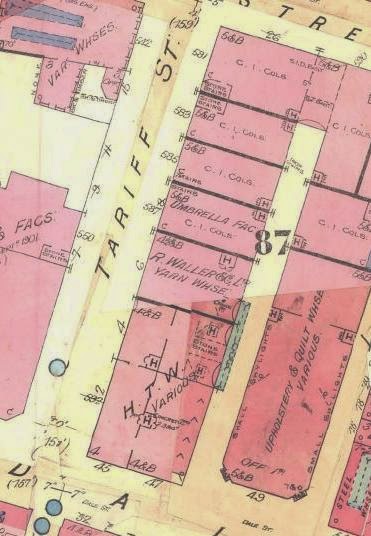
In the late 1840s in to the beginning of the next decade it was a machine shop but sometime around 1858 the building was torn down and redeveloped as the show room and warehouse of Ralph Waller & Co Ltd Cotton Spinners whose factory extended back from number 45 along Tariff Street.

Of course I never made the connection but look closely and the block does show a little of its earlier history.

Not that Mr Waller had begun spinning cotton in Manchester; his first mill was out in Glossop in an 18th century factory which he used for a while in the 1850s before relocating to the city.

Corner of Dale Street and Stanley Street, [Tariff Street], 1849
All of which made sense given that he had set up home in a fine big house in Didsbury and was wealthy enough to contribute a third of the cost of building the new Wesleyan Chapel in Withington.

It replaced an earlier chapel and schoolroom before which “the Wesleyans [had] worshipped God in a cottage.”*

All of which must have made our Mr Waller rather proud and echoes the efforts of other small groups of Methodists in south Manchester at the beginning of the 19th century who were making great efforts to grow their congregations.

Dale Street and Tariff Street, 1901
Most had begun in a similar way with just a handful meeting in a cottage or barn before raising the funds to build their first chapel.

And in one of those odd twists the story of 45 Dale Street, Didsbury and Glossop is also linked to Chorlton.

For like the congregation of Withington and Didsbury the Wesleyans of Chorlton had also met in cottages and barns and built their first chapel just before those of Mr Waller’s congregation.

Nor is that all, because on that August day in 1864 the assembled group went off for a “public tea meeting held in Mr Higginbotham’s barn, and several hundreds were present.”*

Now this might have been Mr Higginbotham who had a farm in Withington or quite equally it could have been old Higginbotham the farmer who lived on Chorlton green, who was himself a staunch Methodist and whose barn had been used for services.

Which in turn is rather neat because 45 Dale Street has become the Tariff and Dale restaurant and bar operated by the team behind The Lead Station in Chorlton.**

45 Dale Street, home to J.P.Hosiery, 1972
But that is as they say in the future, for now I shall return to what was the rest of the story of 45 Dale Street.

Mr Waller died in 1891 and by 1895 the cotton spinning business had shrunk to just part of that building on Tariff Street and while the family retained ownership of the block number 45 had become home to new businesses ranging from a shipping merchant to various manufacturers and by the late 20th century was again a textile warehouse.

Which is almost all there is other than to say like so many of our inner city buildings it did not escape the Manchester Blitz, having taken a direct hit from a fire bomb which resulted in the floor having to be strengthened with new steel supports.

But it is still there and in time I think I will go looking for the chapel Mr Waller helped fund, try and locate the site of his home in Didsbury, and if I feel particularly adventurous go east to Glossop to that first mill of his.

On the other hand I might just wait for the opening of Tariff and Dale.

We shall see.

Pictures; 45 Dale Street, 1972, L Kaye,m01240, m01241, courtesy of Manchester Libraries, Information and Archives, Manchester City Council, http://images.manchester.gov.uk/index.php?session=pass Dale Street, 1844 from the OS Manchester & Salford, 1842-49 and Dale Street. 1901 from Goad’s Fire Insurance Maps, courtesy of Digital Archive Association, http://www.digitalarchives.co.uk/

*Rev Dr Hannah, New Wesleyan Chapel at Withington, Manchester Guardian August 22 1864

** Chorlton's Lead Station to open Northern Quarter restaurant and bar, Emily Heward, MEN February 5 2015, http://www.manchestereveningnews.co.uk/whats-on/food-drink-news/chorltons-lead-station-open-northern-8584538

Tuesday, 1 March 2022

Looking for Mr Waller, wealthy industrialist of Didsbury, benefactor of Withington Methodist Chapel and owner of 45 Dale Street

Groombridge House, 1894
One day I will find an estate agents description of Groombridge House which stood on the site of Christie Hospital.

That said I haven’t yet been able to locate a picture of the place which I guess is not surprising.

It was set back from the main road in spacious grounds with tree lined walks and a fair number of outhouses and was the home of Mr Ralph Waller, wealthy cotton spinner and benefactor of the Wesleyan chapel in Withington.

Now I had promised myself that his would be one of the homes I went looking for ever since I came across his factory and shows rooms which stretched along Tariff Street and on to Dale Street.

I am not quite sure whether Mr Waller built the block but he owned them by 1858 and they were still in the family’s possession over 40 years later.

By then his textile business seems to have shrunk and the showrooms and part of the factory were rented out to other businesses.

But it will have been this textile enterprise which had allowed him to buy and rent out properties in Withington and Didsbury as well as acquiring Groombridge House.

I can’t as yet discover whether he built it or just bought it but it was a striking statement of his prosperity.

It had 19 rooms a rateable value of £230 with an additional assessment of £11 for the surrounding land and dominated the corner of Wilmslow Road opposite the old green.

And it continued to dominate that spot until it was demolished to make way for the Christie Hospital which was “to be built in the grounds of Groombridge House.”*

Withington Methodist Church 2015
All of which means I missed Mr Waller’s house by over 80 years but not to be short changed there is still the church he made a major contribution to.  This is the Methodist Church close by Withington Library which was built in 1865 with a huge contribution from our Mr Waller.

And along with the building there are his reported words made at the laying of the foundation stone in the August of 1864.

His was a long and rather  detailed speech which ranged over all that Britain could be proud of, from the “Queen and our institutions, the civil and religious liberty and impartial administration” down to “our almshouses our infirmaries, our hospitals our mechanical genius our magnificent warehouses and factories” and much more.

But at the heart of the delivery was a strong religious note which focused on “our open bible our Protestant Christianity and the many thousands of places of worship that stud the land.” **

It isn’t perhaps the most fashionable of things to say today but rereading it is to get a sense of the man long after Groombridge House has vanished.

45 Dale Street, 1972
And there are still a few places which bring you close to him.  One is his first textile mill in Glossop which he occupied briefly in the 1850s and is still standing and the other is no 45 Dale Street which for almost40 years was his showroom and warehouse.

I doubt that there is anything left in what was the factory on Tariff Street but I know there could be a few clues in number 45.

And as the building is currently being renovated to reopen later in the year as Tariff and Dale I have the promise of exploring the place while that work is underway.

The owner of the new business who also owns the Lead Station in Chorlton made the offer recently and it will be one I want to take up.

So while I can no longer stand outside his house I might just be able to get a little closer to a bit of history.

Pictures; detail showing Groombridge House 1894, from the OS of South Lancashire 1894, courtesy of Digital Archives Association, http://www.digitalarchives.co.uk/ Withington Church, 2015 courtesy of Withington Methodist Church, http://www.withingtonmethodistchurch.com/ and 45 Dale Street, 1972, L Kaye,m01240, courtesy of Manchester Libraries, Information and Archives, Manchester City Council, http://images.manchester.gov.uk/index.php?

*In Manchester, the Manchester Guardian, May 16 1929.

**New Wesleyan Chapel at Withington, Manchester Guardian, August 22 1864

Sunday, 23 August 2020

Outside the Wellington Inn at Didsbury posing for the camera sometime after 1865


Today I am in Didsbury  outside the Wellington Inn and it is sometime after 1865.

Now I can be fairly certain about the date because 1865 was the year the Manchester Carriage Company was formed from a merger of the two bus companies serving the city and neighbouring townships.

The larger was owned by the Greenwood Company and brought over 500 horses and 33 omnibuses to the merger, while what had been McEwen’s City Omnibus Company contributed the routes to Bell Vue, Rusholme, Longsight and Didsbury.

It is one of those wonderfully staged pictures which says much about the novelty of photography at the time.

They stare back at you with that mix of curiosity and arrogance, and not a woman amongst them.  But for me it is the solitary figure inside that captures my interest.  Had he seen it all before or was just too shy or too indifferent to what was going on?

And just as I can be certain that the date is after 1865 I can be equally sure that it can be no later than 1895 when the old Wellington Inn was torn down and the present large property was built.

It stands on the corner of Wilmslow Road and Barlow Moor Road and there has been an inn here for a long time.

Earlier in the 19th century it had been known as  the Grey Horse and had a bowling green at the rear on the land which is now the library.

In the 1970s it became the Cavalcade and has undergone yet a new name change.

Now the picture and the story was originally posted last year and at the time I thought it was in Withington, but in the course of researching the new book, Didsbury Through Time last year  I realized my mistake.

This is a tad embarrassing because I had chosen to ignore the caption on the postcard which referred to Didsbury.

But when you get it wrong there is no harm in admitting it.

Location; Didsbury, Manchester


Picture; from the Lloyd collection