Showing posts with label Stories of arrival. Show all posts

Tuesday, 4 August 2026

Walkng the streets of Manchester in 1830 in the company of J. T. Slugg and in search of Antonio Preduzzi.


St Ann's Church, 1793
I am on the streets of Manchester in the early 1830s in the company of J T Slugg* and in search of Antonio Preduzzi.

Over the last few days I have been exploring that Italian connection with the city and it has led back from Little Italy in Ancoats at the end of the 19th century  to the Preduzzi brothers who came from Lombardy and settled here in 1810 starting up a series of successful businesses.

They were living in what at the time was reckoned to be one of the most exciting places in Britain and which was talked about  as a model of the new age.

Here could be seem the raw enterprise and keen innovation of the new capitalism reflected in the ever increasing number of cotton mills, dye works and the acres of poorly constructed homes for a workforce which was increasing every day.

And because these men of industry wanted a quicker and cheaper way of transporting their products to and from Liverpool they built a railway which was not just a railway but the first passenger railway using technology which would define how locomotives were built and pretty much set the seal on how a railway would be run.

Of course we all know that behind those smoking power houses of cotton manufacture and great show warehouses there were the mean and narrow streets leading to even meaner and darker courts where little light or fresh air penetrated but which were home to all those who toiled for long hours and little remuneration.

This is that other side of the new way of doing things and was much commentated on by Dr Kay, Dr Gaultier, Frederic Engels and a possession of curious visitors.

And as revealing as these accounts are of the horrors of Manchester they are often paraded at the expense of the more benign descriptions of the city in the 1830s and 40s and for this I have turned to J.T. Slugg who arrived fresh faced and not long out of his teens from Bacup in the March of 1829.

The Infirmary, 1824
Fifty years later he set down his memories of the place which began with a walk up Market Street to Piccadilly and the Infirmary.

Less than a decade before he had arrived in the city this main thoroughfare had still been a narrow way flanked on either side by buildings which dated back a century or more.

These were home to taverns, sweet and bookshops the odd warehouse and a number of coaching offices. And in an age soon to be dominated by the railway it is a fitting reminder that for long distance travel the stage coach was still supreme.

And this was still at a time when “there was a very heavy duty on all kinds of glass, and as a consequence not a single shop-window contained any plate glass, but were composed of small squares of ordinary glass.”**

These would have been the sort of shop fronts that would have been familiar to Antonio and his brother.

He had opened a shop as a picture dealer in Spear Street around 1810, and later moved to Tib Street before settling at 31 Oldham Street. By this time, he was trading as a carver and gilder, and maker of looking glasses and picture frames. Oldham Street in the 1820s was a wide street containing ‘some very elegant shops and houses’.  Antonio's shop was above a confectioner's on the right-hand side from Swan Street.

The Infirmary, 1793
Here he framed and glazed needlework, drawings and pictures; re-gilded and silvered old frames and mirror plates; and made and repaired barometers, thermometers and hydrometers.

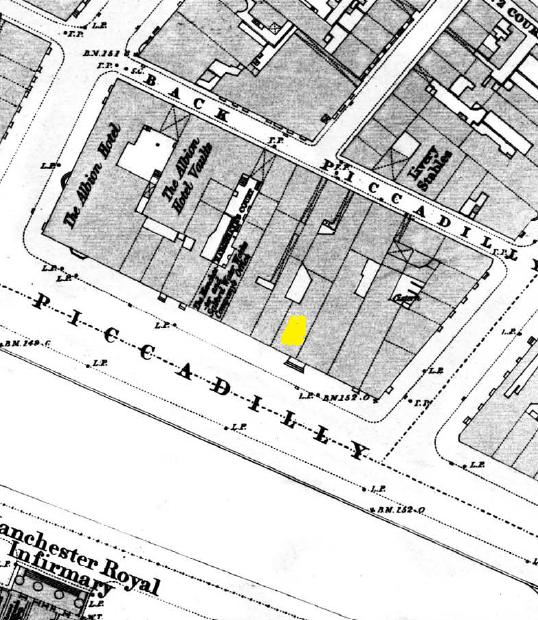
He also had premises at 44 Deansgate in the early 1820s and in 1831, to larger premises at 33 Piccadilly, opposite the Infirmary.

Like his previous shop, this one was on the first floor with a flight of steps leading up to it. The shop extended quite a long way back and had two long counters and a little sitting room beyond. There were also workshops on the premises.“***

This placed him in a prime position  which he shared with a few other shops, some rather fine houses and the offices of the Manchester and Salford Waterworks Company which supplied the town with its drinking water.

33 Piccadilly, the shop of Preduzzi & Co
Directly opposite was the Infirmary which “was a plain brick building  [and also] included the lunatic asylum.  Infrontwas the sheet of water known as the Infirmary Pond, separated from the footpath by palisading.  

At the Infirmary gates stood the public baths, the income arising from them being appropriated to the support of the Infirmary.  

The charge for the cold bath to non subscribers was 1s.; to subscribers of half-a-guinea, 10d.; and to those of a guinea, 9d.  

The price of a vapour bath was 5s; of a vapour and hot bath when used together, 6s.; and of the shampooing bath, 7s.”****


And while we are familiar with the huge show warehouses like S & J Watts on Portland Street which were built expressly to showcase the products of our textile mills, there was not a “single warehouse in either of these streets, Mosley Street, Portland Street, Peter Street, Oxford Road or Dickenson Street” but soon enough they would make their appearance at the cost of hundred of buildings in the neighbourhood which would be destroyed.

I don’t know what Antonio made of these changes which were transforming his adopted city.  When he had arrived in 1810 it was still possible to walk in to open fields just a short way along Oldham Road while to the south all of Hulme, Moss Side and Chorlton on Medlock were pleasant open space.

And yet by his death in the Chorlton Workhouse in 1846 great swathes of these spaces were the preserve of terraced houses, cotton mills and dye works.

Pictures;St Anne's Church and Manchester Infirmary from the Laurent map 1793, 33 Piccadilly and the Infirmary from the 1844 OS of Manchester & Salford, by permission of Digital Archives, http://www.digitalarchives.co.uk/ the buildings opposite the infirmary including the premise of Peduzzi & Co, 1824, m5291, courtesy of Manchester Libraries, Information and Archives, Manchester City Council  

*J.T. Slugg, Reminiscenes of Manchester, 1881
** Slugg, chapter 1
*** Collections Department, Museum of Science & Industry
**** Slugg, chapter 1

Saturday, 4 October 2025

Of Naples in 1961 and Little Italy in Ancoats in 1901


Rosa in Naples 1961
This is one of my favourite pictures of Rosa.

It was taken in Naples when she was just 21 during the summer of 1961 just after she had collected her passport.

Later that year she left Italy with Simone her husband and moved to Cambridge.*

They were two of those economic migrants much derided by some who sought a new life in a new country.

In the same way and just sixty years earlier my father’s parents crossed the border from Scotland and settled in Gateshead while just a little later my maternal grandfather  came home to Derby with his German war bride.

And it carried on.  Dad and mum finally made their way to London where I was born and over the course of twenty years moved around south east London, and just under a decade later I left for Manchester.

All of which reinforces that simple idea that people move around, make new homes in new places and along the way add to the communities they have joined.

Nor is it all one way.  My great uncle left for Canada in 1914 followed by his sister eleven years later. One of my uncles carved out a career in India and east Africa before settling down in South Africa and to close the Italian connection Rosa and Simone finally left Cambridge for Italy returning not to Naples but Varese in the north.  Only for one of their daughters to return to Cambridge, relocate to Manchester and in the fullness of time to set up home with me.

13-15 Blossom Street, 1903
All of which is an introduction to the many who found a home here in Manchester in the 19th and 20th centuries.

Ours was the shock city of the Industrial Revolution and the mills, engineering plants, chemical works and collieries drew in the rural poor from the surrounding countryside, which were added to by those fleeing the famine in Ireland and later still those escaping the persecution in eastern Europe and the grinding poverty of southern Europe.

For some this was the eventual destination while for others it was the half way stage before crossing the Atlantic.

And their presence can still be found in the synagogues and Torah School of the Jewish community of Strangeways and Redbank and in names like Little Ireland and Little Italy.

Most have had their historians who have recorded their presence, ** which is all to the good because these communities have by and large vanished.  Little Ireland which had become one of our worst slums fell victim not to the sweep of town planners but to the railway, which cut through the area.

Not for the first time did a  railway company act as a means for slum clearance.  Much the same happened to sections of Angel Meadow in the north of the city and to parts of London’s slums.

In the case of the Jewish communities of Strangways and Redbank it was that other familiar social development which saw the better off moving out along Cheetham Hill Road to leafy more pleasant places.

Jersey Street, 2011
And so finally to Little Italy in Ancoats which became home to those from Italy who were seeking a better life.

They came from the great cities of the north like Milan, Turin and Genoa from the rural hinterland as well Naples, Sorrento, and Palermo.

It was a small close knit community inhabiting the area behind Great Ancoats Street and primarily located around Jersey Street, Blossom Street, and Henry Street.


Jersey Street, 1908, with No 2 Jackson Court to the left
Now as I often maintain if someone has done the research I have no intention of stealing their thunder, so for those who want to know more about Little Italy there is not only Anthony Rea’s book Little Italy, which was first published in 1988 but his equally fine site where you can find a wealth of information, stories and pictures.***

Added to this there are links to a whole range of other sites which give a comprehensive picture of he life they left and the contribution they made to their adopted city.

Pictures; Rosa in Naples, 1961 from the collection of the Balzano family, 13-15 Blossom Street,  A, Bradburn, 1903, m11033, and Jersey Street, 1908 m10153, courtesy of Manchester Libraries, Information and Archives, Manchester City Council, http://images.manchester.gov.uk/index.php?session=pass and Blossom Street from Great Ancoats Street with Gun Street and Henry Street beyond, 2010 from the collection of Andrew Simpson


*Messy history .......... Part One Migration, http://chorltonhistory.blogspot.co.uk/2011/12/messy-history-part-one-migration.html


** Bill Williams, The Making of Manchester Jewry, Manchester University Press 1976, Jewish Manchester: An Illustrated History, DB Publishing, 2008, and a new book on Manchester’s Pre Black History 1750-1926, Anthony Rea, Little Italy, Neil Richardson, 1988, and of course Little Ireland in Conditions of the Working Classes in England , Friedrich Engels, 1844

***Manchester's Ancoats, Little Italy, http://www.ancoatslittleitaly.com/index.html


Monday, 1 July 2024

A name and a clue to a family from Little Italy in Ancoats in 1881


Your name is a very important part of your identity and for some people in some parts of the world it is an immediate clue to where the family originated from.

So in the case of our Italian family the name suggests two hot spots, one in the north of Italy and the other in the south around Naples.

And that is pretty much spot on, for while they and some of the extended family live outside Milan they come from Naples.

But what if the name is difficult to read as it so often is on old official documents?  Well in my case I have some experts on hand to help out, but sadly the jury is still out on the verdict and so I have to go with my guess.

The name is Fuski and they lived at 43 Gun Street in the heart of Little Italy* in the spring of 1881.  This much I know, and while I cannot be certain of the spelling, there is much I do know about them.

Joseph and his wife Carolina were from Naples and they arrived in Manchester sometime around 1877, with their two daughters.

Now I can be fairly sure about the date because their third child Mary was born in Manchester in 1877.

He was a musician and seems to have attracted other musicians to him.  This may have had a lot to do with the fact that he rented number 43 Gun Street, and as things go found room for three of his cousins in the family home.

But he also found space for another ten people of which six were also musicians, one who worked as a General Servant and two were children.

All but two of this additional large group were also from Naples and both of these like Mary Fuski were children.

It makes for one of those insights into how people settled in a new country.  Here and in three other houses on the street could be found all the Italians, mostly from either Naples or Genova, choosing  to live with people they knew and could rely on to help them out.

In the case of young Joseph Fuski aged just two who was born in Scotland it is a hint that his parents may either have settled first across the border or were performing there when the boy was born and then travelled south to live with their cousin.

Now the Fuski family lived on that stretch of Gun Street which runs from Blossom Street to George Leigh Street and in 1881 it consisted of 20 houses and 125 people.  Of these just over 32% were born in Italy with 43% from Manchester and the rest from Ireland, and other parts of Britain.

This was a young community where over 37% were under the age of 16 and just 5% over 55.

And the degree of its youthfulness is even more marked when you single out those from Italy.

 For here there was no one over the age of 46 and all but 9 were between 20 and 40 years of age.

I guess those in the know would point to this group being the most likely to seek a new life and new challenges in a new country.  Few were married and even fewer had children.

And it follows that most of these young Italians were destined to live as sub tenants in what looks to be very overcrowded conditions.  Of the four Italian households, the numbers recorded in each were 23, 16, 14 and 7, in properties which contained just four rooms.

Not that the level of overcrowding in some of the houses was much better, but that as they say is another story for another time.

As for the Fuski family they disappear from the records but that may at present just be because I have the name wrong, and so I eagerly await help which may allow their story to grow.

*Little Italy is the area behind Great Ancoats Street, and was defined by, Jersey Street, Blossom Street, Georhe Leigh Street, running north and Gun Street, Henry Street and Cotton Street which crossed them on an east west line.  Here from 1865 there was a growing vibrant Italian community.


Pictures; Gun Street by A Bradburn, 1904, m11342, surviving houses on Gun Street, 1962 by T Brooks, m11344, courtesy of Manchester Libraries, Information and Archives, Manchester City Councildata taken from 1881 Census, Enu 4 Ancoats, Manchester, Lancashire

Tuesday, 21 June 2022

Number 3 Jersey Street in the heart of Little Italy


I have tried finding a picture of number 3 Jersey Street but with out success

It has gone now, and the site has been developed as one of those swish inner city set of apartments.

But once it’s three rooms were home to a varied mix of families.  It had stood near to the corner with Great Ancoats Street from the beginning of the 19th century and perhaps a decade into the century before.

In 1851 it was occupied by David and Bridget Maxwell who were from Ireland and their five children who had been born here in Manchester.

They lived in two of the rooms leaving the third to Hannah Johnson, her sister Mary Ann and Mary Ann’s five year old daughter.

Such sub division of properties was quite common and walking down Jersey Street much the same was happening at many of the properties here and in the surrounding streets.

Nor were their occupations out of the ordinary.   David Maxwell was a plumber and glazier while Hannah and Mary Ann worked in a local factory.  Others in the neighbourhood earned their living from joinery, and printing and there were a fair number of labourers, as well as those working in the cotton mills. They would have paid something like 2-3 shillings a week which might have accounted for about a sixth of a weekly wage.

But for a while at least in the 1860s along with its neighbour it passed out of residential use and was turned over to making furniture.  I tried tracking Maxwell Bridges the owner but it proved fruitless and for a while the property disappears from recorded history, only to pop up again in 1891 as the home of the Mowbray family whose six members crammed into the three rooms along with their two lodgers.

This was the period when Jersey Street along with its neighbours was becoming the centre of the growing Italian community.*

And so by 1901 our house was occupied by Gatamo Pelsi, his wife and his four children.  Gatamo like his son and neighbours was an organ grinder, who had arrived in Britain sometime during the previous decade.

For the first time in perhaps half a century number 3 was home to just one family and it was a trend which would continue.

In 1911 Carlo and Gearda Visco lived here with their five children.  He made a living from making barrel organs and they had been in Britain for just around six years.  Their children were all born in Manchester and their eldest married Francesco Testa in 1928 in the north of the city.

*Jersey Street, Gun Street, Henry Street, Cotton Street and parts of Great Ancoats Street

Pictures; courtesy of Manchester Libraries, Information and Archives, Manchester City Council, Jersey Street, by J Jackson,1908 m10154, residents outside Nazaren Bella’s ice cream shop, Jersey Street, 1922, m10086


Monday, 20 June 2022

On Gun Street in Ancoats looking for Little Italy in the spring of 1881


I am back in what was Little Italy in the April of 1881.*  

To be exact I am on the small stretch of Gun Street which runs from Blossom Street down to George Leigh Street

Gun Street is the very narrow street in the centre of this detail from the OS map of Manchester & Salford in 1844

It is pretty much a forgotten place just behind Great Ancoats Street and very much ripe for redevelopment.
There are some new properties going up but they stand beside the relics of the past.

But once it was densely occupied home to a cross section of people who made their living from a range of manual occupations, including street hawking, engineering and textiles.

By the late 19th century and well into the next, it was at the heart of our Italian community and become known as Little Italy**

Here not only could you have heard the accents of the northern sea port of Genova but also the very different dialect of Naples and for good measure in the surrounding houses contained within the space of Blossom Street, Jersey Street, Henry Street and Cotton Street there would have been those who came from Milan, and Turin as well as the rural areas down south.

There were 125 of them on this small stretch of Gun Street living in just 20 houses.

It was a very mixed community.  42% had been born in Manchester, another 11% came from Ireland and the odd few were from as far away as Scotland, London and Birmingham.  The rest and this amounted to nearly a third had come from Italy and mainly from Genova and Naples.

They lived in just four houses.  Some were related others just renting space but in most cases they all came from the same place.

Opposite; Gun Street from Bloom Street, looking towards George Leigh Street, 1901

They were mainly musicians with a few earning a living from making and selling ice cream and most were unmarried and in their early 20s or 30s.  So of the entire working population in our little stretch of Gun Street, 47% were musicians and nearly 8% made and sold ice cream

Walking down Gun Street I am always struck at how narrow the place is but even standing there I am not really prepared for how cramped it must have been or how densely occupied were the properties.  One fifth of the houses contained between 10 and 23 people.


Opposite, Gun Street from Bloom Street, looking towards George Leigh Street, 2010

Location; Ancoats, Manchester


Pictures; Gun Street from the OS map of Manchester & Salford 1844, courtesy of Digital Archives, http://www.digitalarchives.co.uk/ Gun Street from Blossom Street in 1901, A Bradburn, m11341 courtesy of Manchester Libraries, Information and Archives, Manchester City Council, and Gun Street from Blossom Street 2010 from the collection of Andrew Simpson, data for graph from the 1881 census, Enu 4, Ancoats, Manchester


*The area bounded by Gun Street, Blossom Street, Jersey Street, Henry Street and Cotton Street.
**Littele Italy,  http://chorltonhistory.blogspot.co.uk/search/label/Little%20Italy

Sunday, 19 June 2022

A story that has yet to have a conclusion... Simon Robino from Italy


Marshall Street is one of the those places that is ripe for development, and the only puzzle is why it has not yet been filled with prime new flats, show rooms or a well known supermarket.

It joins Oldham Road with Rochdale Road, and is dominated by car parks, some tired looking warehouses and the green tiled entrance to Marsden Harcombe & Company Limited which until recently was home to the Greater Manchester County Records Office.

Great stretches of it lie open on either side and standing on Oldham Road you have a clear view not only all the way down to Rochdale Road but pretty much across to the two parallel roads of Addlington and Goulden Street.

All of which as I said makes it ready for something to happen to it.  The Hat and Feathers which had served beer for more than a century is boarded up and  large parts or are car parks.

But just over a century ago it was a densely packed place which boasted two pubs, a factory, and the Cosy Workman’s Home on the corner with Chadderton Street which had once been a school.

And just around the corner was the huge police station built like a fort and designed to both make a statement about law and order and serve to be easily defended.

There were no windows at street level and the entrance out on to Goulden Street was by a single set of gates.  It had been opened in 1870 and like many of our police stations was also home to the local fire brigade.

And at number 8 Marshall Street lived Simon Robinao, his wife, Toussaintes  and their five children in a four roomed house.

His is a fascinating story and was one that I first came across when my new facebook chum Marie wrote to me from Canada.  He was “my great granddad, who had a business making barrel organs.  He came to Manchester around 1897, was born in Italy but studied music in Marseilles.  He wrote a lot of music.  Sadly despite his music being popular at the time none of it was published.”

So as you do I began to crawl over the records looking for something on the family.  Simon was born in 1866 in Italy. Sometime possibly in the mid 1880s he arrived in Marseilles to study music and this may have been where he met his future wife who had been born in Ajaccio on Corsica.  Now the date of their marriage is a bit of a guess but their first son was born in 1887 so I suspect it will be around that date.

A decade later and the family ha settled in Manchester and Marie’s suggestion of date of “around 1897” fits quite nicely.  Their youngest daughter was born here sometime in the November or December of 1900.

Now I can be fairly certain of that because the 1901 census was taken in April when she was just six months old.

All the older children were born on Marseilles with the last of the four having been born in 1895.

Sometime after that date the family arrived in Manchester and set to work
making barrel organs which was the trade he had been taught by his father and grandfather.  Now the directories list a number of these factories in the area and at present which one he may have worked for is a guess.

The Antonelli family had a factory at 59 Great Ancoats Street and Peter Varetto was making “mechanical organs”at 87 Oldham Road.

By 1911 Simon owned his own business and was doing very well given that he was listed as a “mechanical organ maker, 14 and 16 Portugal Street and 85 Oldham Road, resident 81 Oldham Road.”*

I had thought that by cross referencing the business addresses from earlier in the century there might be a clue as to whether he set up new enterprises or bought in or took over existing ones.  And it does rather seem he set up from scratch.  Just two years earlier the property at number 81 was occupied by a wireman, while number 85 was selling beer.

I have yet come across a picture of either place from the beginning of the last century and so far the best there is dates from 1962 and like so many of the buildings around the area they have long since gone.

Which is pretty much where we started.  Their home at 85 Marshall Street is now a car park and numbers 81 and 85 Oldham Road are underneath the Wing Yip Chinese & Oriental Groceries Supermarket and just about a century separates the Italian family business from the Chinese family business.

Even given the gaps it is a remarkable story and one that I suspect will have more to tell.

In 1901 the family of seven were living in a four roomed house, a decade later and three more children they had moved to a much larger property around the corner.  The rest as they say is yet to be revealed.

Which just leaves me to ponder on the fate of the green tiled entrance to Marsden Harcombe & Company Limited now that the archive has moved to Central Ref.

 Pictures; Corner of Marshall Street and Oldham Road, T.Brooks, 1961, m36668, Cornwall Street, May 1899, m01700, corner of Thompson Street & Oldham Road, J. Jackson, January 1916, m36556, Pump Street which ran off from Oldham Road by number 87, H. Entwhistle 1898, m01700, courtesy of Manchester Libraries, Information and Archives, Manchester City Council, http://images.manchester.gov.uk/index.php?session=pass


* Slater’s Manchester, Salford and Suburban Directory, 1911

Saturday, 27 October 2018

Antonio Peduzzi making what we wanted at 33 Piccadilly in 1824


Antonio Peduzzi was from Lombardy and settled in Manchester around 1810, ran a series of successful businesses, was married twice and ended his days in the Chorlton Workhouse on Stretford New Road where he died in 1846.

It is not much of an obituary for a man who had the courage to leave his native Italy, settle here in Manchester mixing his skill as a craftsman with more than a bit of entrepreneurial verve, loved two women and died insane in the workhouse.

But it is the starting point for a fascinating story which was first revealed by Alex Roe who works in Milan, has a wonderful site offering up all sorts of news about Italy http://italychronicles.com/ and is related to Antonio Peduzzi.

I began thinking about the Italian contribution to the city a few days ago in the story Of Naples in 1961 and Little Italy in Ancoats in 1901 and as you do I was drawn in to the history of those Italians who came over at the beginning of the 19th century, which is the cue for Alex who wrote that

“my very distant relative Antonio Peduzzi died in 1846 after having been certified insane. Antonio’s madness may have been caused in part by the loss of both of his wives. He did not have any children either, poor man.

Prior to his insanity and death, Antonio Peduzzi ran what was by all accounts a successful business which framed and glazed needlework, drawings and pictures; re-gilded and silvered old frames and mirror plates; and made and repaired barometers, thermometers and hydrometers. He had premises in Oldham Street and in Deansgate in the early part of the 19th century.

Antonio Peduzzi’s brother, and my more direct ancestor, was called James. Not a very Italian name, I know. I don’t know whether it was his real name, or one he had chosen to make his life in England a little easier.
James Peduzzi married Elizabeth Ward. The couple had three children, one of whom was Francis who would have been my great, great, great, great, great grandfather. I may have got the number of ‘greats’ wrong! Sorry, but it’s greatly confusing.

James Peduzzi set up in business as a picture frame maker in Spear Street in Manchester and later expanded into the making of thermometers and barometers. After applying for British citizenship, James was able to buy property, which he duly did.

In 1848, James bought a workshop and engine in Foundry Street, off Oldham Road. The property included other small workshops, houses and some shops. James’ business, it seems, flourished which fits in with the family rumour that the Peduzzi’s were quite well-off.

One of James’ sons, born in 1815 was Francis, who along with his younger brother – another James, joined his father in the Foundry Street premises.

Francis left this world in 1866 and his wife took over the business, but, and for reasons unknown, the Peduzzi business ceased trading after Elizabeth’s death in 1870."

33 Piccadilly marked in yellow in 1842
So with Alex’s permission and the help of the Museum of Science & Industry whose collection includes a barometer made by the Peduzzi company I plan to explore more of the life of Antonio and something of the Manchester he knew.

Location; Manchester


Pictures; the buildings opposite the infirmary including the premise of Peduzzi & Co, 1824, m5291, courtesy of Manchester Libraries, Information and Archives, Manchester City Council, http://images.manchester.gov.uk/index.php?session=pass  33 Piccadilly and the Infirmary from the 1844 OS of Manchester & Salford, by permission of Digital Archives, http://www.digitalarchives.co.uk/   and detail of Carvers, Gilders, &c. From Pigot & Dean’s New Directory of Manchester & Salford 1821-22

Tuesday, 23 June 2015

A passenger list ...... a clue to a father's journey to Britain in 1960


Over the last few months I have become more and more interested in the stories of those who came here looking for a new life. 

So as an introduction to the start of a new series I have decided to begin by revisiting the story of our friend Judi's parents.

This was originally posted last January.

Sometimes when you start out on a little research project there is no way of knowing where it will lead, or what you will learn.

So when Judi said she just wanted to know about how her dad got here it was a a research project I couldn't turn down.

It was a text book example of research online, which I know would be sniffed at by more traditional historical researchers.

For them unless you have trekked across the country, from one tiny parish church to busy archive centre, taking in along the way a few gravestones, street directories and vast numbers of census entries then you are not serious about research.

Still online resources are quick, extensive and have the added advantage of allowing you to crawl around the world.

So the task was to find out anything about a young man who had been born in the West Indies and arrived in Britain in 1960 to start a new life.

Some records are of course easier to find than other. Passenger lists for incoming visitors and settlers to The UK are available and there he was sailing from Kingston, Jamaica and arriving in Southampton in the June of 1960. Passenger lists are an invaluable treasure of information, including the occupation of the traveller, and his eventual destination.

And as with family records there were surprises. His occupation was not the one that he pursued during his working life, and the address of his first home in London was the same as a fellow passenger who it turned out was a personal and longstanding family friend.

But the shipping list also revealed so much more which put his journey into a context. Here were also many other young men and women who came from different occupations and age groups and who planned to settle across Britain.

Here in one document was much that summed up the Windrush generation who having been told that they were proud members of the British Empire with access to the “mother country” came to play their part in this country’s economic and cultural life.

 Some had already fought in the armed services in the last war and others would prove vital in many industries and services.


And that of course is not the end, having moved in to first home in London in London he eventually sttled here in Manchester.


I think however what really pleased my friend was the picture of the ship he arrived on and the page of the passenger list which again were there on the net.

Personal history doesn’t get much more personal. And there are plenty of other stories of those who came here from the West Indies some of which can be accessed.*

Picture; passenger list of the SS Begona; reproduced from ancestry.co.uk, and Preswich, courtesy of Manchester Libraries, Information and Archives, Manchester City Council, m16253

*http://www.lbea.co.uk/assets/here-to-stay-booklet.pdf

Monday, 4 February 2013

Memories of Little Italy


Now I have been reflecting on Little Italy in Ancoats.*

And the stories have prompted quite a bit of interest.

Last week I got a series of emails from Marie in Canada who wrote that “my great granddad, Simon Robino, had a business making barrel organs.  

He came to Manchester around 1897, was born in Italy but studied music in Marseilles.  

He wrote a lot of music and there is a lot of information about him in the site run by Anthony Rea.**  He was my nanna's dad and she was called Angelina Robino, she married my granddad, William Henry who was a policeman from Sligo, Ireland."

And more recently David told me that
"I can relate to the Italian quarter in Ancoats as I went to school in Ardwick and the various ice cream men who used to park at the school gates were called Carlo and Sivori etc.   It was unusual for a Tech High School (St Gregory's RC) but it taught Italian as an O level option and various kids took it up as an easy option.. (Lets; see, Ronchetti, Crolla and another lad I remember doing well in it?!)"

Now I chose a picture which comes I hope closest to the memories of Marie and David.  It featured in an earlier story http://chorltonhistory.blogspot.co.uk/2012/07/what-difference-half-century-makes.html
It was taken on a July day in 1958, the sun was shining and the pull of ace cream is all too evident.

Picture; Market Street on a Saturday afternoon in July 1958, A.P. Morris Courtesy of Manchester Libraries, Information and Archives, Manchester City Council m62093

*http://chorltonhistory.blogspot.co.uk/search/label/Little%20Italy
**http://www.ancoatslittleitaly.com/