Showing posts with label Fairfield Street. Show all posts

Thursday, 11 December 2025

A lost pub on Fairfield Street

This is the Bridge Inn on Fairfield Street as it was in 1970.


And it is a pub I will have passed countless times on the bus on the journey to Grey Mare Lane and Ashton.

But despite living for a chunk of time in east Manchester and beyond in the 1970s, I can’t say I ever noticed the pub and certainly never went in it, and that is a shame.

I can track a pub with that name to this spot back to 1840, when it was surrounded by a mix of industrial and residential properties.

According to the 1911 census, the landlord was a Fred Lord, who with his wife Elizabeth managed the pub, assisted by Arthur Dixon who was the waiter and Ethel Jackson who was described as a domestic servant.

And along with these were the Lord’s daughter, young Vera Patricia, aged 3, and Mr. Lord’s widowed mother.


The same census offers both a   glimpse into the pub, and into its occupants.

It had eight rooms, and may already have been familiar to Elizabeth who had been born in Ardwick and to Elizabeth’s mother in law who was born just up the road in Bradford.

What strikes you are the little details.  Ethel Jackson was just sixteen, Mrs. Lord senior was already a widow at 52, and the Lord’s had moved around the city, having been in Gorton in 1908.

And for an official document Fred Lord was less than conscientious about completing the form accurately having, failed to ascertain exactly where his 22 years old waiter had been born, so while I know it was WR, which may have been Whalley Range, the county is shown just as an ?.


Of course, it may also be that Arthur Dixon didn’t know his exact birth place.

Someone I know will be able to supply a date for when it closed, but for now, that is it, other than to say there remain some stories of the surrounding buildings which we will return to.

Location; Fairfield Street

Pictures; the Bridge Inn, 1970, A. Dawson, m49287, courtesy of Manchester Libraries, Information and Archives, Manchester City Council, http://images.manchester.gov.uk/index.php?session=pass and in 2020, from the collection of Andy Robertson


Wednesday, 12 November 2025

Living beside the Medlock in the shadow of railway viaducts in 1851

I am looking at 14 and 16 Victoria Terrace in 1900, and by the time the picture was taken they had been standing for just over 60 years.


They formed a row of properties half of which faced out on to the River Medlock with the rest looking out on to Coronation Square.

All together there were fourteen of them, and along with another ten houses they formed a small enclave behind Fairfield Street, bounded by the river to the east and south, surrounded by textile mills, and in the shadow of a tall railway viaduct.

In all probability they were built sometime around the coronation of the old Queen, and the first recorded reference to them is 1839 in the Manchester Rate Books which records that they were owned by a William Walker.

The houses in Victoria Terrace consisted of four rooms and had been built as back to backs, while the remaining houses on Coronation Square were a mix of two, three and four roomed houses.

In 1841 these 24 properties were home to 120 people, a decade later to 104, and in 1891 there were still 71 residents.


Given the location of this small enclave, most families derived a living from unskilled occupations, of which in the 1840s and 50s was primarily linked to the textile trade.

Just across the river in full view of nos 14 and 16 was the Ardwick Mill on Crane Street and within a few minutes walk there was the weaving shed of the Maskery Mill,and several other textile factories along with a brewery, an iron works, saw mill and timber yard.*

By 1891, reflecting the changes in the area, there had been a decline in the number of residents who worked in the textile trades, and an increase in those who worked for the railway companies, or described themselves as skilled workers.

There was overcrowding, and some properties were sublet, and the worst cases were in the smaller properties of Coronation Square.

And armed with the census returns for 1841, 51 and 91, it is possible to identify the families who occupied each property, and as you would expect there appears to have been a steady change in occupancy.

There is still much to do, including tracking the age profile of the residents and their places of birth, alongside a detailed analysis of just how overcrowded some of the properties were.


But there will be some mysteries which I doubt it will be easy to clear up. 

And of these the one that jumps out at me comes from our picture, for below that precarious looking walkway suspended over the river, there is evidence of a another storey, complete with windows and even a door.  But what is missing, is the means of access to that set of rooms.

Given that these two were back to back properties, there seems no obvious way to get to them.

Other photographs dating from the early 20th century showing them being demolished only serve to add to the confusion.


That said I am sure some will come with a theory and possibly the answer.

In the meantime I shall continue to trawl the census returns, and rate books, looking at the occupations, and ages of our residents with a view to collecting a detailed picture of our little enclave.

Pictures; 14 and16 Victoria Terrace, 1900, m11490, and 1904,  m11495, A Bradburn courtesy of Manchester Libraries, Information and Archives, Manchester City Council, http://images.manchester.gov.uk/index.php?session=pass and the area in 1849, from the OS map of Manchester and Salford, 1848-49, and in 1851 from Adshead map of Manchester, 1851, courtesy of Digital Archives Association, http://digitalarchives.co.uk/


*Maskery Mill Union Street, the Mount Street Dye Works, Mount Street, Pin Mill Cotton Factory, Pin Mill Brow, Ancoats Bridge Print Works, and Ancoats Bridge Mills, Ancoats Hollow. 


Friday, 7 November 2025

Just what did John Duckworth think of no. 5 Victoria Terrace in the spring of 1851?

It is of course a silly question, because we will never know.  


He left no letters expressing his opinions, nor did anyone else leave a record of what he said, and in all there are just a handful official documents which carry his name.

These include two census returns, a marriage certificate, and an entry in the burial records of All Saints Church in Chorlton Upon Medlock.

All of which amounts to slim pickings and clearly offer no insight into what he thought about anything, let alone Victoria Terrace, which was a row of 14 back to back properties set back from Fairfield Street and bordered on two sides by the River Medlock.

Together with another ten houses, they were home to 102 people in 1851, and of these number 5 was rented out to John Duckworth.


He shared the house with his wife, Esther, their son William, and John’s brother.  Both John and his brother were mechanics and on the 1851 census John described himself as a spindle maker.

He had been born in 1821 and was from Chorlton on Medlock, but by the 1840s was living on Travis Street, just a few minutes’ walk from London Road Railway Station.  

Esther, who was from Altrincham had been living on St James Street which was behind Mosley Street when the couple married in 1850.

But number 5 Victoria Terrace,was not their first marital home, the Rate Books show that they had moved in sometime between January and April of 1851, after the previous tenant had moved on.

And here there is a little mystery, because according to the census return their son William was 7 years old, which fits with a record of his baptism from 1845 at the parish church.

Of course, there may have been another John and Esther Duckworth with a son called William.

Either way their stay at Victoria Terrace appears to have been a short one and within two years John had died, and was buried in All Saints Church in Chorlton on Medlock.


Which leaves us none the wiser about what he thought about the small enclave of homes, which consisted of Victoria Terrace and Coronation Square.

The houses date from around the old Queen’s coronation in 1837, and the first record of them appears in the Rate Books two years later when they were owned by William Walker, who sold them on to a Sarah Glossop.

We know that the properties which made up Victoria Terrace each consisted of four rooms and the remaining properties were a mix of four three and two roomed houses.


What might have struck us, would have been the range of different accents of those who lived there, for while over half of the resident had been born in Manchester, Chorlton on Medlock or Hulme, there for those from Ireland, Scotland and Wales, as well  London, Yorkshire and the Lake District.

Added to this, the enclave was young, with over a quarter of the population under the age of 15, and almost another quarter between the ages of sixteen and twenty-four.


And over the course of the next few weeks, we shall look at the occupations of the 102 residents, and just how many of them had been here a decade earlier or indeed ten years later.

For now I will just ponder in a very unhistorical way of what it might have been like to live there, on those cold dark nights with perhaps the occasional noise from the railway viaduct as a train went by, or the distinctive clunk of wagons being shunted around the nearby goods yard.

Or the powerful smell from the river, on a hot and still August day.

But that, like the speculation of what  John Duckworth thought about Victoria Terrace is idle tosh.

Location; Fairfield Street

Pictures; detail of Victoria Terrace and Coronation Square, in 1904, m11492, & nos 14 & 16 Victoria Terrace, July 1900, A. Bradburn, m11490, courtesy of Manchester Libraries, Information and Archives, Manchester City Council, http://images.manchester.gov.uk/index.php?session=pass and in1851, from Adshead’s map of Manchester, 1851, courtesy of courtesy of Digital Archives Association http://www.digitalarchives.co.uk/ 


Monday, 7 April 2025

Living beside the Medlock in the shadow of those tall railway viaducts ……… Victoria Terrace and Coronation Square

 I doubt I would ever have known about a row of terraced houses beside the River Medlock in the heart of the city and certainly would not have begun looking at them in detail if Andy Robertson hadn’t sent over a series of pictures of the Bridge Inn on Fairfield Street.


The pub was doing the business by 1840, and continued into the 20th century, although it is now closed.

But what really caught my interest was Andy’s pictures of the River Medlock which briefly comes out into the daylight as it crosses under Fairfield Street before descending back into a tunnel.

And as you do I went looking for the story of this patch of land between the river and the pub, and was not disappointed.  

In 1848, there were twenty-four properties of which 14 appear to have been back to back houses along with another ten.

Some faced directly onto the river , and the rest were grouped around Coronation Square, which I suspect offers up a possible date for their construction which I am guessing must have been around 1837.  And this I think will be confirmed by the fact that the fourteen back to backs were called Victoria Terrace.


I will  go looking into the Rate Books to see how far back I can trace the houses, but for that I need the names of some of the residents, and sadly back in the middle decades of the 19th century, no one deemed them worth enough to be included in the directories.

And that in turn has made it difficult to unearth the relevant census returns for the period.

However by dint of a tedious trawl of the 1891 census for the Central Enumeration district for 1891 I struck lucky, and found all twenty four.

They were a mix of four, three and two roomed properties, and were home to 71 people.  There was evidence of overcrowding, with the eight members of the Younger family squeezed into four rooms, and Mr. Thomas Nagle sharing his three rooms with his cousin and three lodgers.


Most of the occupants were unskilled workers, ranging from labourers to  street peddlars, although amongst them there were also a tailoress, a shoemaker  an Assistant Mathematical Instrument Maker.

But most were engaged in precarious and heavy work with more than a few heading towards their sixties.  

One of these was Thomas Nagle who at 56, described himself as a Bricklayer’s labourer, although in his case he appears to have left the building trade behind, because in 1895 he is listed as a greengrocer trading from Coronation Square.

There is much more to do, including examining the ages of the residents and working out the balance of adults to children as well as where the 71 came from.


Some at least of the properties were being demolished by the early 20th century and there are two pictures from the Local Image Collection showing some of the houses.

All of which promises to offer up more of the lives of those who lived beside the Medlock in the shadow of those tall railway viaducts, just a step away from Fairfield Street

Location; Manchester

Pictures, detail of Victoria Terrace and Coronation Square, 1851, from Adshead’s map of Manchester, 1851, courtesy of courtesy of Digital Archives Association http://www.digitalarchives.co.uk/ , some of the properties in 1903, A. Bradburn, m11495, and in 1904, m11492, courtesy of Manchester Libraries, Information and Archives, Manchester City Council, http://images.manchester.gov.uk/index.php?session=pass Victoria Terrace and Coronation Square, 2020, from the collection of Andy Robertson

Wednesday, 10 July 2024

Who pinched the park? ……….. Helmet Street Rec

First ….. I am not accusing anyone, and second I think I understand why it went, so perhaps the title is a bit unfair.


Nevertheless, when I went looking for Helmet Street Rec, which was off Fairfield Street by a bend in the River Medlock, to my surprise it had gone.

I am sure it was still there in the early 1970s when I wandered around the area armed with a camera and a bag full of curiosity, but  sadly it is no more.

Today the site is a mix of industrial units, car parks and a pocket of grass which seems to mock the original Recreation Ground.

That said I suspect the original Rec would have had but a bit of green stuff. And I await  someone  knew exactly what it looked like.

It was opened in 1880 and covered just one acre of land, to which by the 1890s had been added a bandstand, lavatories and shelter.*


To the south of the recreation ground where it bordered Raven Street there was a footbridge over the river, and by the 1890s the perimeter running alongside Helmet Street and the bank of the Medlock was bordered by trees.

Now I can see why the Council created the small park in what was otherwise an area of densely packed terraced housing, and factories, sandwiched between the viaducts of the  London Road Railway Station and several railway goods yards.

It was still there in the 1950s, but I suppose the decline in the population of the area made it an underused resource.

But just when it closed I have yet to find out, a task made more difficult in the present circumstances, and which will require trawling newspaper reports and Council meetings.


In the meantime I hope a few people will come forward with a date for its demise, and perhaps offer up stories and memories of playing there.

And may be even, some pictures, because at present a part from the maps of the area I have only two pictures, which were taken in the 1906 and 1955, neither of which shows very much.

Location; Manchester

Pictures, the Rec in 1950 from the OS map of Manchester & Salford, 1950 and the park in 1906, R. Jackson, m57571, courtesy of Manchester Libraries, Information and Archives, Manchester City Council, http://images.manchester.gov.uk/index.php?session=pass

*Helmet Street, Fairfield Street, Public Parks, Official Handbook, City of Manchester, 1927


Saturday, 19 February 2022

Ghost streets …….. and the onward march of the cranes

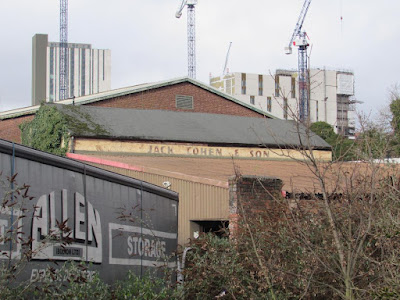
Now it seems everywhere you look there are those cranes which relentlessly march across the city, leaving in their wake a mix of tall residential and commercial towers.

The onward march of the cranes, Travis Street, 2022
You encounter them on the main roads into the city, west into Salford, all over the Northern Quarter and now in ever larger numbers in the shadow of Piccadilly Railway Station.

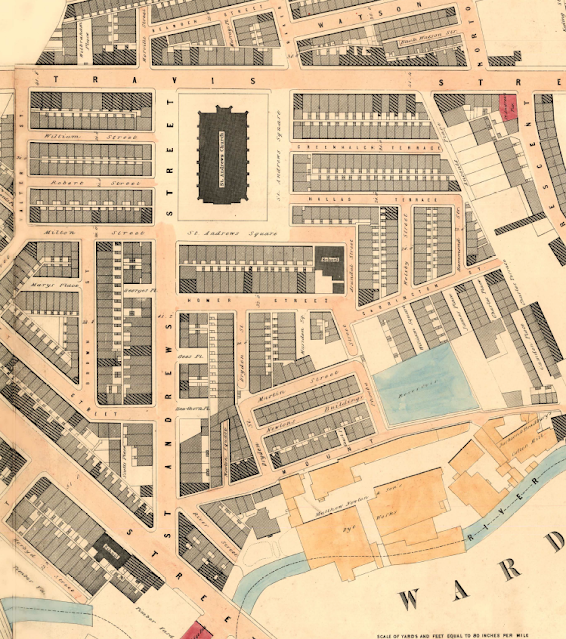
And it is of that area around Fairfield Street, north towards Travis Street and the site of St Andrew’s Church, and south beyond the great railway viaducts that I want to write about.

But before anyone leaps to their keyboard to call down wrath on the cranes and the developers, historically this is but a new round of urbanization which had already covered the area with narrow streets, mean houses and a variety of industrial units from mills to foundries, and dyeworks, interspersed with timber yards.

My copy of Adshead’s map of Manchester from 1851 clearly shows the degree to which 19th century speculative builders had created a densely packed network of streets and courts, which nestled beside those factories and hemmed in by railway lines, canals and the river.

From the river to the Square, 1851

For over four decades I have been fascinated by their history and keep coming back to the stories of the houses and the people who lived there. *

Of course, they have all gone, swept away by a mixture of municipal house clearances over two centuries, further helped by Mr. Hitler’s bombs, along with the grand plans of the railway companies which cut a swathe through those streets with their giant railway viaducts.

To which we can add the deindustrialization of the centre of Manchester which saw the mills, dyeworks and foundries close to be replaced by small businesses, car parks and open spaces.

But with a bit of imagination and armed with old maps of the area it is possible to gain a sense of just how many houses existed because much of the street plan still exists.

When the old jostles with the new, 2022
So there are still a heap of tiny narrow streets branching off Fairfield Street,  St Andrews’ Square and Travis Street.  

They may have lost their buildings but the sheer number of them brings home the density of the area.

So there is the challenge, all you have to do is wander past Piccadilly Railway Station and plunge eastwards, but do so soon, because within a few years the cranes will have done their job.

Location; east of Piccadilly Railway Station

Pictures; between Travis Street and Fairfield Street, 2022, from the collection of Andy Robertson, and in 1851, 1851 from Adshead map of Manchester, 1851, courtesy of Digital Archives Association, http://digitalarchives.co.uk/

*Fairfield Street, https://chorltonhistory.blogspot.com/search/label/Fairfield%20Street

Homer Street, https://chorltonhistory.blogspot.com/search/label/Homer%20Street

St Andrew’s Square, https://chorltonhistory.blogspot.com/search/label/St%20Andrew%27s%20Square


Thursday, 15 October 2020

On Fairfield Street …..…. with a pub, a river, and some mysteries

There is something quite magical about rivers, streams, and canals, and more so when they run through our towns and cities.


Often access to them is made difficult by the surrounding buildings and at some point many disappear into a tunnel and are lost, while a lot of those once busy canals have long ago been drained and their route only indicated by the odd bridge or modern foot path.

 But the deindustrialization of places like Manchester, now offer up the opportunity to get close to our rivers in a way not possible since the Industrial Revolution consigned them to sources of water for steam engines, handy sewers, or in a few cases navigable routes for transporting goods.


 And so, it is with the River Medlock which Andy came across while looking for old pubs on Fairfield Street.

 So, having found what was once the Bridge Inn, he took to looking over the stone parapet at the slow-moving water below.

 In the distance you can just make out the tunnel that takes the river under what is now North Western Street.

 Now, I will take some time out to track the story of the Bridge Inn.  It was serving beer and good cheer under its landlord, a Mr. William Walker in 1840, and eight years later turns up on the OS map,  complete with a brewery situated directly behind it.


The map also reveals a row of properties running along the bank of the Medlock.  In all there were 24 of them, and fourteen were back to back houses, of which seven faced onto the river and the remaining seven onto Coronation Square.

 And while Victoria Terrace consisted of 4 rooms the remaining properties were two and three roomed.

You can still walk  Coronation Square, one side of which runs along the side of the former pub and the other beside a tall brick wall beyond which is a small lorry park.

 But of Mr. William Walker I can as yet find no more.  He is there in the rate books for 1840, and is shown as the owner and occupier of the Bridge Inn which commanded a ratable value of £58, but try as I might I can’t find him on the 1841 census.


All of which will require a lot more detective work, as will locating those 12 back to back houses off Coronation Square.  

Needless to say, given their location beside the river they are too modest to appear on directories of the period, leaving me just to  contemplate the slow tedious job of working my way through the census returns for this bit of Manchester.

 The short cut is usually to pick other people from the rate books, look for them on the census and by degree wander across the pages to Coronation Square, but alas so far I gave drawn a blank with all of them.


But by a happy coincidence, a few days earlier my friend Linda Rigby gave me a slim book by the Greater Manchester Planning Department on “Giving the river valleys a breath of fresh air”.

 It is chatty little document covering five of the river valleys in Greater Manchester, describing each and looking to the future of each.*

 It is an optimistic piece but sadly there is no date, which leaves me falling back on a guess for its publication, sometime between 1974 when the Greater Manchester Council was established and 1986 when it was abolished.


 It is a planning document I shall return to, if for no other reason than to compare the descriptions and forecasts for the future with the way things have turned out.

 But it doesn’t include our bit of the River Medlock as it twists and turns through the area behind Piccadilly Railway Station, so I shall leave it on the table, along with a story of the Bridge Inn in the 20th century, for tomorrow.

 So that is it.

 Location; Manchester

Pictures; Fairfield Street and the Bridge Inn, 2020 from the collection of Andy Robertson, Fairfield Street in 1848, from the OS map of Manchester and Salford, 1848-49, courtesy of Digital Archives Association http://www.digitalarchives.co.uk/ and pages from “Giving the river valleys a breath of fresh air” GMC Planning Department, date unknown, courtesy of Linda Rigby

 *Croad/Irwell valley, Tame valley, Mersey valley, Etherow/Goyt valley, and the Medlock valley, Giving the river valleys a breath of fresh air” GMC Planning Department, date unknown

Sunday, 16 November 2014

Down behind Piccadilly Station waiting for the Northern Hub ....... part 3 stories of of pubs and lost roads

The Star and Garter on Fairfield Street is one of those pubs that most people know even if they have never stepped inside.


The Star & Garter, 2014
Andy Robertson recorded it recently in a new set of photographs.*

It has been a listed building since June 1980 and a popular venue for music.

One source suggests that there was a Star and Garter as early as 1808 just about a hundred yards further along Fairfield Street and “moved brick by brick to its current location in 1877.”**

This earlier site was where today there is a little island on the corner of Baring Street and Travis Street.

The Star & Garter, 1844
The 1842 OS shows it as a substantial building bearing the name of the Star and Garter.

That said there are no references to it in the street directories for the 19th century and as late as 1877 there was only a beer shop close to the present pub continues run by George Clark.

And Mr Clark I found in the rate books for that year renting the property at number 14 Fairfield Street from a Mr Gibson who owned the adjoining two properties and charged an annual rent of £28.

The pub on the corner of Neild Street, 2014
Now I have been drawn into the history of the place, and will have to go off and look at the licensing records in the archives, especially as that date of 1877 is intriguing.

The following year there is no reference to either men on Fairfield Street so just possibly the beer shop closed when the Star and Garter was erected late in 1877.

Six years earlier number 14 had been home to Thomas Shawcross who gave his occupation as a shopkeeper.

Neild Street and Station Street, 1844
For now I shall have to await that research but as you do I wandered off down behind the pub along Neild Street which in its little way presents another small point of interest.

Today it runs for a short distance beside the old railway buildings before petering out in a dead end.

Back when the Star and Garter opened for business in 1877 it took a different route running directly south and is now buried underneath Mayfield Station.

That stretch that now comes to a dead end was before 1910 Station Street and it too came to an abrupt halt in front of the Boiler House and filtering ponds of the Mayfield Printing Works.

Now this may not be the most riveting of stories but it was one that took time in the making.

The site of number 14 Fairfield Street with Neild Street behind, 2014
I had just thought of showing Andy Robertson’s pictures of the pub which his son had suggested he should record as they were by Piccadilly Station.

As Andy said the area will soon be redeveloped with work on the Northern Hub and that of course led to looking up the story of the Star and Garter, and in turn exploring the directories, rate book and census returns along with maps of the area.

All of which revealed that this little bit of the city sandwiched between the two stations has undergone more change than most of us may have known.

Pictures; of the Star and Garter, 2014 from the collection of Andy Robertson and maps of the area from the 1842-44 OS for Manchester & Salford, courtesy of Digital Archives Association, http://www.digitalarchives.co.uk/

*Down behind Piccadilly Station waiting for the Northern Hub ....... part 1 pubs, warehouses and rivers, http://chorltonhistory.blogspot.co.uk/2014/11/down-behind-piccadilly-station-waiting.html

**The Star & Garter, http://en.wikipedia.org/wiki/The_Star_and_Garter