Showing posts with label The Cenotaph. Show all posts

Thursday, 17 November 2022

At the Cenotaph ……….. on the Monday after the Sunday

Now the annual ceremony of Remembrance at the Cenotaph is always a moving event.


But outside that day the memorial and the small plot of land that surrounds it have been a place to sit, reflect on what it represents, and just take time out.

For some the full significance of what is all around them might be lost, but for many thoughts will settle on the sacrifice that is recorded in those monuments.

It is a place that has featured in the blog from the story of "Mrs Bingle and the unveiling of the Cenotaph in July 1924" to the stories of the replicas which were produced and took pride of place in many homes.*

Occasionally I have heard people question its resitting at a busy interchange but that is the point, because it is visible as a permanent reminder.

Location; Manchester

Pictures; At the Cenotaph ……….. on the Monday after the Sunday, 2022, from the collection of Andrew Simpson

*The Cenotaph, https://chorltonhistory.blogspot.com/search?q=the+cenotaph


Friday, 5 November 2021

The Manchester War Memorial ….. and a bit of silly confusion

I don’t have a date for this picture postcard of the “War Memorial and Midland Hotel Manchester”, but I am guessing it won’t be too long after the memorial was erected.


It was sent over by my old “posty” friend David Harrop who has a huge collection of postal memorabilia, along with an equally impressive collection of “things” from both World Wars.

But something caught my eye in the image to the left of the Cenotaph, and it being a slow day I was drawn to it.

It is of course the eastern pillar which is balanced by its neighbour and together stand either side of the main memorial, but for a few brief moments I was confused, and tried to work out what a tall structure beyond the Midland might be.  


I even pondered if it was some photographic accident, but happily didn’t go down the route speculating what trick was being played on me.

Although I did almost go looking for structures in the space between the Midland and Central Station which dated from the 1920s.

Instead I went away, answered the door and when I came back it was obvious what it was.

So that is it.

Location; St Peter’s Square

Picture; “War Memorial and Midland Hotel Manchester”, date unknown, from the collection of David Harrop


Sunday, 11 October 2020

Mrs Bingle and the unveiling of the Cenotaph in July 1924

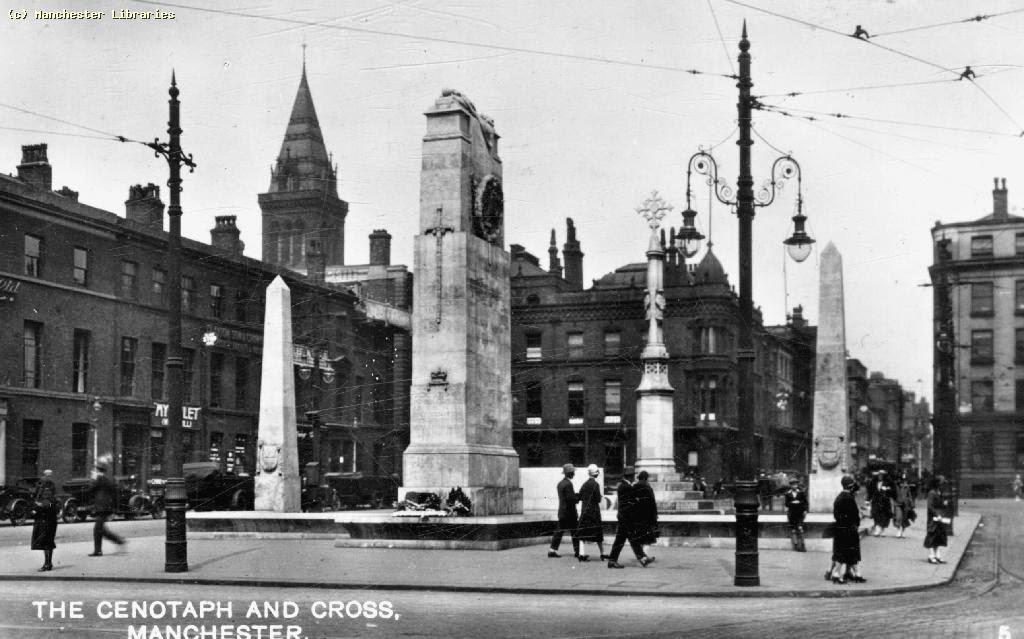
The Cenotaph, 1925
“Before the Manchester Cenotaph was unveiled on Saturday afternoon, the Lord Mayor explained why it was that a great soldier had not been asked to loose the cords.

‘The victorious nation pays as much as the vanquished in the loss of the flower of its population and there are many broken hearts in the conquering country as there are in the conquered.’  

The same idea was uppermost in the character of the ceremony itself.  Mrs Bingle, a citizen of the working class district of Ardwick, whose three sons had been killed in the war assisted Lord Derby with the unveiling”*

All of which I think was a fitting tribute to those who died and to the families left to bear the loss.

Now both of those invited that day to unveil our war memorial are interesting.  Lord Derby had been closely associated with recruiting men for the war and will forever be linked with the Pals battalions which “should be a battalion of pals, a battalion in which friends from the same office will fight shoulder to shoulder for the honour of Britain."**

Rylance Street, 1964
But it will be Mrs Bingle who I think was the more significant choice.

The family were not from Manchester, they came from Stroud in Gloucestershire but had settled in the eastern side of the city by 1899, and in the years before the Great War never seemed to stray far from Rylance Street just off the Ashton Old Road.

Here they brought up eight children in houses ranging in size from 3 rooms up to five.  Mr Bingle was engaged in making umbrellas, their eldest son was a career soldier, another a postman and their youngest son an errand boy.

It was an area of densely packed terraced housing, dominated by the railway depot to the south and surrounded by iron and steel works, the Bradford Colliery and countless smaller enterprises.

In time I will I hope be able to track the lives of Albert and Frances Bingle and their eight surviving children.

The Statue on the "war stone", 1992
But in the meantime it is the loss of their three sons which exercises my thoughts.

History has been capricious with the details of their military careers and so all we know of their eldest son was that he had enlisted by the time he was 18 in 1901 and at his death had reached the rank of sergeant.

 His brother Charles Henry was a gunner and Nelson Allen the youngest of the three was a 2nd Corporal in the Royal Engineers.

That said some of Nelson’s army records have survived and I know that he signed up at Ardwick in the April of 1915 aged 19.

It is so little for what amounted to such a great sacrifice and the enormity of that loss must have been overwhelming, more so because all three died in the final year of the war.

Nelson aged 21 was killed in the March, Ernest Albert the oldest on May 8th and Charles Henry on the 27th.

At the Cenotaph, 1942
Which takes me back to the unveiling when “emotion was gathered up into a sort of climax where state and civic dignitaries stood aside and a stream of women flowed between the obelisks and covered the great expanse of stone with flowers.”***

And that I think this is the moment to close.

But I will return to the story not least to describe the day of the unveiling in more detail perhaps when the Cenotaph is rededicated in its new position in front of the west door of the Town Hall.

And that will also be an appropriate moment to explore the lives of the Bingle family in more detail.

Pictures; The Cenotaph and Cross, St Peter’s Square, Manchester 1925, m52055, Rylance Street where the family were living in 1911, Taken by T Brooks in 1964, m12974, Statue on top of the Cenotaph, St Peter's Square, Manchester Mark Cobley, 1992 m80515, and a service at the Cenotaph in 1942, G Hinks, m09818, courtesy of Manchester Libraries, Information and Archives, Manchester City Council, http://images.manchester.gov.uk/index.php?session=pass

*The Manchester Guardian, July 14, 1924

**Lord Derby speaking in Liverpool in August 1914. The idea had actually been suggested a few days earlier by General Sir Henry Rawlinson  that men would be more inclined to enlist in the Army if they knew that they were going to serve alongside their friends and work colleagues.

He had appealed to London stockbrokers to raise a battalion of men from workers in the City of London to set an example. 1,600 men enlisted in this 10th (Service) Battalion, Royal Fusiliers, the so-called "Stockbrokers' Battalion", within a week in late August 1914.

***ibid The Manchester Guardian, July 14, 1924

Suggested by a story, The Cenotaph is Moving by Ann Beswick, March 17 2014, http://www.manchesterguidedtours.com/blog-news

Tuesday, 25 September 2018

By the Cenotaph watching the buses go by sometime in the 1960s

Now as we move towards the official re dedication of the Cenotaph in its new position outside the Town Hall I think it is appropriate to look back on the site as it was in the 1960s.

It is a scene many of us will remember.

The Ref has yet to be cleaned, the buses still display their Corporation red livery and the tram line and stop are yet to be built.

In fact look closely and behind the Midland Hotel the shape of Central Station can just be made out and for those who like train stories, there was a service that took you direct to Chorlton and onto Didsbury.

And for those with an even keener sense of history, the so called cafe society had yet to happen.

So if you wanted a glass of wine or pint of beer you had to wait till the pubs opened at 11, and remember that last orders was at 3, added to which I doubt that there was much of a choice in wine.

And as for sitting outside and slowly watching the city pass as you sipped your drink that like the metro was not yet how we did things.

What we did do was something which was called coffee, had the colour of coffee,and was a pale imitation of the real thing.

Of course  if you were really unlucky there was Camp Coffee which I have to say I briefly had a flirtation with but would never today share with the Italian side of the family.

Picture; courtesy of Sally Dervan

Monday, 18 December 2017

The full beauty of the Town Hall revealed

Now for pretty much a full century this view of the Town Hall had been obscured by buildings and even with the installation of the Peace Gardens in 1985 it rarely got the same attention as the Albert Square side.

And yet it does have a presence which today has been heighted by the relocation of the Cenotaph to a position just in front of the entrance.

And that I think is all I want to say except that Peter’s painting does the building proud.

Painting; New Cenotaph location and west entrance of Town Hall from a photograph by Andrew Simpson. Painting © 2015 Peter Topping, 
Web: www.paintingsfrompictures.co.uk
Facebook: Paintings from Pictures https://www.facebook.com/paintingsfrompictures

Friday, 14 October 2016

Honouring Manchester’s six VC’s from the Great War

Now I don’t pretend that any of the pictures I took today at the ceremony to honour the six men from Manchester who were awarded the Victoria Cross during the Great War are up to much, but that really didn’t matter.

Today ....... remembering the six
The ceremony and the honour the City bestowed on the six men is the important thing.

The service was attended by the Duke and Duchess of Cambridge, civic dignitaries, MPs and representatives of the families of the six men.

During the course of the ceremony the names and citations for the awards were read out.

It was a moving act of recognition and was attended by a large group of the public.

Location; Manchester

Picture; today at the Cenotaph, 2016 from the collection of Andrew Simpson

Wednesday, 15 October 2014

What's new in St Peter's Square?

I have got to say I am a fan of the new relocated Cenotaph outside the western door of the Town Hall.

Like many I watched the demolition of the sunken gardens and the surrounding square, tried to gain a glimpse of the work being done behind the huge hoardings and wondered about how it would finally turn out.

For me it does work with the added bonus that from the steps of Central Ref north to the Cenotaph and eventually out across towards One St Peter’s Square there is a brand new open space which affords great views of the  surrounding buildings.

Now compared with many Italian and French towns I do not think we do open spaces particularly well.

Like the old Crown Square they can be dismal windy places offering a few uncomfortable seats, a stretch of uneven paving stones and the odd bit of litter interspersed with a few weeds.

The area around St Peter’s Square is still a work in progress and I am not sure if the enlarged metro stop will encroach on the Cenotaph.

But in the mean time the area shows off those buildings along Princess Street in a way you couldn’t have seen them until recently and in the same way provides new views off across the tram lines down towards Oxford Street.

I still haven't made my mind up about One St Peter’s Square but know that I never liked the previous building and think I can remember what was there before that.

The test for all this new open space will be whether people feel comfortable sitting there.

On Saturday there were indeed lots of people taking in the last of the sun while sitting on the benches, and stopping to photograph the Ref, and the Cenotaph .

It will all have changed again in a matter of months, so with that in mind this was what it all looked like on the Saturday that St Helens played Widnes at Old Trafford and the sun briefly came out.

Pictures; St Peter’s Square and the Cenotaph, October 2014 from the collection of Andrew Simpson