Showing posts with label Chorlton in the 1960s. Show all posts

Friday, 11 September 2026

Back in Chorlton in the October of 1961

Pemberton Arcade, Barlow Moor Road

“Just a sixpenny bus ride from Piccadilly, Manchester is Chorlton-cum-Hardy – the little green meadow hamlet that grew and grew into a busy suburb.”*

I came across this opening sentence in a pile of old newspapers passed to me by Oliver Bailey.

The collection is a treasure trove of our recent history including reports, photographs and stories.

Most come from papers which have now vanished like the Manchester Comet, the Manchester City News and the Chorlton edition of the Stretford and Urmston Journal but a few despite looking very dated are still with us.

The Manchester Evening News featured Chorlton in its series on People and Places in the October of 1961.  I guess the approach fitted a template which consisted of some contemporary photographs, conversations with locals and reflections on how the area had changed over time.

The photographs included Oswald Road School, the Library and that row of shops on Barlow Moor Road “known years ago as Pemberton Arcade and still remembered as that by older Chorlton folk, [which] provides cover and room for stalls which give it that market atmosphere.”

Mrs Mehre Usha and Mrs Raj Kumai, "window shopping"
And there were pictures of local residents like Mrs Kathleen Foy at a “her pressing board in her shop on Beech Road,” Keith Hannam, “who went to school in Chorlton and now owns a small butcher’s shop in Chorlton Green” and “Mrs Mehre Usha and her sister in law Raj Kumai” who were out for the day “window shopping.”

All of which is good stuff for any local historian but the paper also reveals more detail on events which have all but been forgotten.

Back in 1961 we still had a railway station, which for three years had been selected as “the tidiest in south Manchester, but new travelling habits have placed the fate of the spotless old station in the balance.”  So “officialdom has now given the station a final reprieve to see if the public really wants its station.  If not it will die.”

Now of course we know it didn’t survive but all too often its closure is recorded in just a sentence with little detail around the debate on its future.

In that respect the article is a wonderful piece of history more so because it includes people who were in the 70s and 80s and who talk of that older Chorlton.

“Old timers will recall Chorlton and Withington joining Manchester at the start of the century, and the first trams to Chorlton in May 1907.  Grey haired Mrs Mary Ford aged 84 has lived in the district all her life [and] for the past 52 years in her present gas lit home.  She remembers a smaller more peaceful Chorlton. ‘It was just a village with lots of green fields and very beautiful.’”

Furniture to buy at Waring & Gillow
This I think marks the article out for here we have in one place the memories of people who can take us back to the late 1870s and 1880s.

So I shall be returning to this snapshot of Chorlton in 1961 and let the residents throw more light on what our township was like over a hundred years ago.

But in the meantime I can  not resist one of those old adverts which more than anything show how far we have travelled in the 55 years since the story was published.

Pictures, by John Featherstone, from my copy of the Manchester Evening News October 20, 1961

*The country cousin who grew and grew .... from GOING YOUR WAY CHORLTON-CUM-HARDY focus on People and Places, Manchester Evening News October 20, 1961

Friday, 29 May 2026

Looking out from Barlow Moor Road in the summer of 1960

There is a singular lack of images of Chorlton during the middle decades of the last century.


Look through the collections and you can find plenty of fine examples of what the township looked like during late 1800s and early 1900s.


Most are from commercial photographers who sold their work on to picture postcard companies, and never missing an opportunity also took plenty of photographs of individual streets, which they then offered up to residents for “a knockdown price”.

But by the 1950s the golden age of picture postcards was drawing to a close, just as cameras became cheaper and more readily available, which ushered in “the snap”.

The snap was usually a very personal image, sometimes a little out of focus and in most cases consigned to a photo album, or the back of a cupboard.


Sometimes the odd one gained pride of place on a fridge or notice board, only to fade with the years and become “tired” from much passing around.

All of which brings me to a set of sketches made by my friend Ann of the Chorlton she knew back in the 1960s.

Ann grew up on Barlow Moor Road at what is now 523 , and as part of various art projects she sketched some of the rooms in the house as well as view out across the back garden.

And include three of Chestnut Avenue, which were made in the summer of 1960 and included “The first house on the right which was an Opticians, when I lived at 523”.

Location; Chorlton

Pictures; Chestnut Avenue, August 1960, from the collection of Ann Love


Thursday, 28 May 2026

Scenes from a lost Chorlton, Claude Road in 1964

Now the old petrol pump stood at the point where Claude Road does a right turn before meeting Reynard Road and running off into the Ville.

For almost all the time I have lived here the space just beyond the pump was waste ground but sometime before 1933 a row of buildings stood on the plot.

Now this I know because they appear on the OS map for 1933-34 as large block stretching east to west with smaller units to the rear.

But I don’t know what they were and until I can look at the directories or rate books for the period I have no idea.

By the 1960s part of the plot was occupied by a garage which can be seen in Ann’s picture.

And that is all I know, but someone will come back with more so I shall just leave it at that for now.

Except to say that these little bits of empty land were all over Chorlton well into the 1980s.

Picture; © Ann Love

Wednesday, 27 May 2026

523 Barlow Moor Road back in 1961

The Stables, 1961
The recent past is a time I take for granted. 

I guess for some of us this is because it really doesn’t seem history.

I was born in 1949, grew up in the 1950s and 60s, came to Manchester in 1969 and began full time work in 1973.

Those decades and the next two are still vivid and familiar periods and I don’t count them as the past, and yet they are and we did do things differently then and this is the starting point for some new stories.

Back in 1961 my friend Ann lived on Barlow Moor Road in one of those large houses facing Chestnut Avenue.  This was number 523 and it was also where her father ran the family undertaker’s business.

The rear of 523 Barlow Moor Road, 1964
At the time Ann was still at school and regularly recorded the house and surrounding streets in a series of pictures for her art classes.

“The ground floor plan was quite unusual, in that there was a very large room on the right at ground level. 

The rest of the house was raised up about 6 feet, so there were steps at the front, back, and inside, above the basement, which stretched under the whole house.

In the garden there were the old stables at the end of the garden which my Dad used as a workshop to make the coffins, and also doubled as a garage.  

Previously it had been numbered 66, and before that 52.”

Looking out on Chestnut Aveneu, 1961
Like so many of our bigger house which has survived being demolished this one has been converted into flats with an extension added at the rear.

I am hard pressed now to remember it as it was which is why I am so pleased that we still have Ann’s painting and line drawings of the property.

They are almost the only record of this bit of Barlow Moor Road from the period and remind me of how things can change without us even noticing.

Over the next few weeks I shall be featuring more of Ann's pictures and it occurs to me that there may be plenty more photographs, paintings and drawings of Chorlton which it would be nice to include.

Pictures; 533 Barlow Moor Road, 1961, © Ann Love

Sunday, 24 May 2026

At the chippy on the green with Mrs Jones and "Chippy Madge"

Now I am always fascinated by those pictures which call up a rich seam of memories that cross the generations.

And this one pretty much does just that.  We are inside Chorlton Green Supper Bar sometime in the late 1960s courtesy of Bob Jones.

Just a few years later it would be one of my regular haunts and later still the chosen chippy of my lads.

And I will not be alone in remembering that tiny room with the tiled counter and steamed up windows with the bright lights and promise of something good to eat.

Even now nothing is quite like going into a chip shop on a cold winter’s evening.

It starts with that wall of heat and then the distinctive smell, along with the noise of the chips in the deep fryer and the rustle of paper.

And there is also the conversations which are a mix of the humorous, the mundane and usually a little of the village gossip.

Of course most of what is said might well be repeated over the counter of the newsagents and in the pub but waiting in line for your supper offers up plenty of time to listen to what is being said and an opportunity to add your own contribution.

Now I am old enough to remember getting your chips in newspaper and then walking home on dark nights with that double pleasure which came not only from eating the chips but from holding the bag which kept your hands warm.

So Bob’s picture is just that bit special, more so because on the right is his mum and on the left “Chippy Madge.”

All too often photographs like this one get lost over time and with it go a tiny but important record of how things were.

And it is the little often trivial things, like the name “Chippy Madge” and “Blind Bob the Barber”, which say something about the time and the place.

The nicknames were rarely meant to be cruel and were just one of those things that you said.

Madge worked in the chip shop and her name was Madge so “Chippy Madge” it was, and more often than not there would be a raft of such names for everyone from the milkman to the chap who came round to sharpen your knives.

I may not get out as often these days or visit as many places but I rather think such names are no longer as common and that is a shame.

Picture; Mrs Jones and “Chippy Madge” circa 1960s courtesy of Bob Jones, and the Chorlton Green Supper Bar 1978 from the collection of Tony Walker.

Saturday, 23 May 2026

Of paddling pools and vanished pastimes in Chorlton Park

Now if you are of a certain age you will remember the paddling pool in Chorlton Park.

Now this is not to be confused with the big open air swimming pool which was a feature of the park when it first opened, and was 50 yards long, 21 yards wide running from 5 feet 3 inches at the deep end to 2 feet and 6 inches at the shallow end.

It is a story for the blog for another time but does appear in that book I wrote with Mr Topping and entitled
The Quirks of Chorlton-cum-Hardy, which came out last year.

So back to the paddling pool.  Until yesterday I only had the one picture of the paddling pool which dates from the 1930s, but yesterday Roger Shelly sent over this one, which he took in the 1960s or 70s.

Leaving me just to include the map from 1933showing all the features of the newly built park.


Location; Chorlton Park


Picture; the paddling pool, circa 1960s/70s from the collection of Roger Shelly, and detail from the OS map of Manchester & Salford, 1933-34

Friday, 22 May 2026

Watching the Meadows change ......... June 1965

I wonder just how many people remember this scene?

We are on the Meadows, and according to the caption this was “June 16, 1965, Clearing Water Street Cleansing Department, View of Hardy Depot”.

It is one of the photographs generated by Neil Simpson who “ worked on the Town Hall Photographer's Collection Digitisation Project, in the Central Library, which currently is Volunteer led and Volunteer staffed.

The negatives in the collection are dated from 1956 to 2007 and there are approximately 200,000 negatives to be digitised at three minutes a scan.


This is an image I have never seen before and I am guessing the building must be Hardy Farm.

That said I am puzzled by the bit of the caption referring to Water Street and am not too arrogant to admit to being stumped by it.

I have never come across the name during all my years in Chorlton, or in the research I have done.

So this is one to turn over to anyone who remembers the scene, walked that bit of Hardy Lane or can offer an explanation to the name.

Of course there might be a clue in the buildings in the distance which don't suggest we are looking at where Hardy Lane runs out on to the Meadows.

I wonder whether were instead on Turn Moss with Stretford in the distance.

And that just leaves me to open up the debate, which no sooner had I posted the story and Bill Sumner replied, with,

"I think the view above is taken from the bottom of Bradley Lane next to the water treatment/sewage works. the line of electric pylons is correct and is still there today, but the gas holder is not the one at Gorse Hill Stretford but the one at Dane Road Sale. 


Looking on Old Maps I cannot find a Water St either. The Dane Roadd Gas Holder was built in 1935 on the old sewage works site and was built as an extension to Stretford Gas Co that also supplied Sale and Ashton on Mersey. 

The gas holder in Stretford would have been out of sight to the left of photo. The old cottage would have disappeared because the Stretford Works was enlarged and a row of staff houses built here in the 1960's, probably the reason this photo was taken. Thanks for the new view"

And quick as a flash Neil also responded with "I can answer some of your questions Andrew. 

This image was in a set taken for Manchester Corporation's Cleansing Department, who were based at a huge site on Water Street near MOSI in Manchester. 

They had a Destructor on that site (is an incinerator) and roughly sorted the refuse collected into 'for burning' or 'tipping'.

Some of the refuse for tipping was taken to Hardy Lane Farm as they were using it to 'reclaim' land.

Bill Sumner was quite right in saying that the Gasholder was the one at Dane Road as I worked that out earlier."

And the final word goes to Ann who spotted the obvious, "have just read your comment, think the quotation should read ' Cleaning water, Street Cleansing Dept' Comma missing. Explains why there isn't a Water Street in Chorlton."

Not much more to say than thank you,  Bill, Neil.and Ann

Location; the Meadows

Picture; June 16, 1965, Clearing Water Street Cleansing Department, View of Hardy Depot, courtesy of Manchester Libraries, Information and Archives, Manchester City Council, http://images.manchester.gov.uk/index.php?session=pass


Thursday, 21 May 2026

Unseen photographs of Hough End Hall and Mrs Annie Elizabeth Roberts

Now the story of Hough End Hall never quite leaves me and I have always been prepared for new pictures and new tales of the lives behind its doors.

Mrs Roberts in the garden, circa 1920s
About a year ago I was given an album of photographs of the last family to live in the hall and farm the surrounding land.

And then more reently I met Mr Stuart Bolton who kindly shared some pictures and newspaper clippings from his great grandmother who worked at the hall.

She was “Annie Elizabeth Roberts, nee Halfpenny; formerly Bateman. I believe she worked at Hough End Hall for about twenty years, from the 1910s to the 1930s.

I think the first one was taken in the 1920s and the second one was taken by the newspaper photographer in the early/mid 1960s.

I am also attaching the clipping from the newspaper which we think it was from the Manchester Evening News from the early/mid ‘60s, unfortunately it’s not dated.”

Mrs Roberts, by the Hall, in 1963
The pictures are just sheer magic and offer up more on the history of the Hall when it was still a working farmhouse.

Until recently there were few images of the building and the family from the early 20th century and these add to our knowledge.

There will be no one now who remembers the garden when it was in its pristine state and pretty soon the memories of the hall in its last sad stage during the 1960s will also fade.

And it is well to remember that from the early 1920s the fate of the Hall hung in the balance.

Newspaper story, possibly the MEN, 1963
There were plans to demolish it for the new road which was planned to run out of the city to and despite more than a few imaginative suggestions for its use during the inter war years it eventually became prey to vandals.

Nor were the developers kind to it.  In the words of one expert they “botched “the job of restoration and then proceeded to hide the hall behind those two ugly office complexes.

Its subsequent use as a restaurant, pub and offices met that all the internal features have long gone, leaving on the original Elizabethan staircase which now resides in Tatton Hall.

So Stuart’s pictures and the story that I know will emerge from them will advance our knowledge and in the process if he is happy I shall tell the story of his great-grandmother.

Location; Hough End Hall

Pictures; Annie Elizabeth Roberts and Hough End Hall from the collection of Stuart Bolton

Wednesday, 20 May 2026

When Mr & Mrs Allendale sold apples at that shop on the corner of Wilbraham and Keppel

That shop having its makeover, June 2015
Never underestimate the power  of memory,

Recently I reflected on the changes to that shop on the corner of Wilbraham and Keppel Road.

But the occupants of the place during the last century were a bit hazy.

That is until I posted the story and then with the help of a shed full of people those long  lost businesses came flooding back.

Back in 1960 with the Allendale's
In the 1980s into the 90s it was the Cheese and Bacon shop which always seemed very busy and operated that old 19th century maxim of offer the customer a wonderful array of good food as they walk in through the door and display much more in the long window.

We went there and I was sad when it closed.

What I didn’t know was that during the 1940's for two decades it was Allendale's the fruit and veg shop.

Now it had been Pauline Kelly who told me about Allendale’s, and Sandra who found the 1960 picture on the digital archive.

And I bet it will bring back a host more stories.

More so because of the cast iron and glass veranda which occupied the Keppel Road side.

Underneath the veranda, 1960
It can’t think it was original to when the shops were built and must have come down in the late 1960's or 70's but what a wonderful addition it must have been allowing the Allendale’s to serve out on the street in all weathers and capturing passing trade.

Added to which it that pre slick marketing age no one thought that trays of fruit on upturned wooden boxes would deter interested customers.

And that is about it, until more stories come flooding in about the Allendale's, and the cheese and bacon shop which they did just minutes after this was posted.

Lesley Smith remembers that the Cheese & Bacon shop was run by a Mr and Mrs Carney whoretired to Wales.

So the stories aren't over yet.

Picture; the shop on a June day in 2015 from the collection of Andrew Simpson and in 1960 by A E Lander’s m18303, courtesy of Manchester Libraries, Information and Archives, Manchester City Council, http://images.manchester.gov.uk/index.php?session=pass

Tuesday, 19 May 2026

Chorlton Office, a pair of boots and a bus stop ................

This is one of my favourite pictures of Chorlton in the 1960s which comes from  George Cieslik’s collection.

I do like those images of the not so distant past, when much of what you can see is almost like today, but not quite.

And this one is no exception.

There in the distance is the old cinema, and in front, the building which over the years has had many different uses, from doctors’ surgery to a café, an antique shop and more recently a DIY centre and discount store.

Back in the 1940s it was still a residential property and out of the blue a few years ago someone contacted me with the story of when they lived there.

The keen observer will spot that the church on the corner of Barlow Moor Road and Sandy Lane had yet to be demolished, while the parade of shops opposite the cinema had yet to lose their stone ornaments.

But for me it is the very little details that make this photograph so fascinating.

It starts with the building which is now the home of diving club but back then was still the Chorlton Office and looks little different from when it was opened in 1915 as part of the terminus for the Corporation trams.

And that raises the question of just when the cast iron and glass veranda was spirited away.

And then for me there are the tiny personal things, starting with the old bus stop sign, with the Corporation logo, which was still in use when I washed up in Manchester in 1969 and the boots the woman beside the lamp post is wearing. 

They will have had a zip up the front, were made of felt with rubber soles, and an imitation fur lining, and were the bees’ knees back in 1962.

Others of my generation will single different things out, from the Belisha Beacons to the Morris Minors, and some like me will remember how the cab of the white lorry looked so modern when compared to others on the road.

And that is, other than to thank George for another slice of 1960s Chorlton.

Location; Barlow Moor Road

Picture; Barlow Moor Road, circa 1962 from the collection of George Cieslik

Monday, 18 May 2026

What did you find in the cellar of Hough End Hall in the summer of 1965?

If you are of a certain age you will probably remember playing in Hough End Hall.

Of course we are talking about the 1960s when the place had long been abandoned as a family home and was yet to become a restaurant.

Back then it was an adventure playground for many of the children roundabout and bit by bit their memories are surfacing of what the Hall was like and what they did there.

Now everyone has their own stories and Ian who would have been about 11 remembered the cellar and what seemed “to be a gigantic set of leather and wooden bellows along with two stone fire places one of which was propped up against the wall and the other resting on the floor.

We tried to get the bellows to work and when that failed wrapped a rope around the tall fireplace and swung from side to side.

There were also big bags of what looked like salt.

And when we tired of the cellar we went on to play in the valleys of the roof.”

Ian is the first to admit that given that it was a long time ago, “my take on what I remember may be different to others, and perhaps the bellows could have been smaller or even larger.”

Either way it is a fascinating glimpse into a period in the Hall’s history which has sat in the shadows for too long.

But more of those memories are now coming to the surface and in time I hope for more.

Location, Hough End Hall, Chorlton, Manchester

Pictures; the Hall in the mid 1960s from the collection of Roger Shelley, https://www.flickr.com/photos/photoroger/


Tuesday, 5 May 2026

Views from a Chorlton window …… sixty years ago

Yesterday I was looking out on Barlow Moor Road in the summer of 1960 in the company of Ann Love.


Now given that Ann lives in France, and I was in London in that summer of 1960, in the strictest sense we couldn’t be together, but she has shared with me some of the pictures she made.


Having sketched the interior of her home along with the roads around Chorlton, she took to capturing the view from a back bedroom window, across the garden  of her home at 523 Barlow Moor Road.

The images are now with the passage of sixty years quite unique given that what was her garden is now a car park. 

Location; Chorlton

Pictures; 523 Barlow Moor Road, 1960, from the collection of Ann Love

Monday, 4 May 2026

523 Barlow Moor Road, captured in a moment in time in 1960

Now I am back at 523 Barlow Moor Road where my friend Ann Love lived during the 1950s and 60s.

It is still there today but has undergone conversion into flats.

Over the last few months Ann has been sharing her memories of growing up in the house providing a vivid account of everything from the kitchen range to her bedroom along with some wonderful sketches of both the inside and exterior of the house.

And now along with more stories her husband has produced a series of detailed models of the property which perfectly create a large Chorlton house in 1960.

"The basement, or cellar as we used to call it, was reached by a door and steps from the kitchen.

It was always cool, and an ideal place for storage.

Half way down the steps was a wide shelf, where cold meats were kept, on a large platter, then continuing down, there were five rooms.

Firstly there was the coal cellar, this could also be reached by a door on the side of the house next to the workshop.

Once or twice a year the coal cart would arrive, with sacks of coal, the cart would stop in the drive, and the coal man would lift the sacks of coal from the cart and empty them down through the doorway into the cellar.

 We would have to count the sacks s they were emptied, because once the coal was in the cellar, it was just a big heap. The coal men were covered in soot from carrying sacks of coal all day.

All through the winter coal would have to be carried up from the cellar in buckets to keep the range in the kitchen alight.


Under the Dining room was a storage area for food – there was a meat safe, with wire mesh to keep out the flies, and jars and big earthenware bowls with preserves, and preserved eggs in isinglass.

The small room under the hall was full of shelves of tinned goods, corned beef and salmon, and pickles.

Under the lounge were coffins, standing on end, which Dad had made during quiet periods, in case of flu epidemics, and bad weather in winter. 

They were in a variety of different sizes, and good places to play when my cousins came over to play hide and seek!

Under the kitchen was where the planks of wood were stored, before being carried down the garden to be made into coffins. When the house was on fire, this could have been a real problem if it had caught fire."

© Ann Love

Models; Howard Love 2014


Sunday, 3 May 2026

Knocking down bits of Wilbraham Road .... in the summer of 1963

Now the next time you are in the Co-op on Wilbraham Road, spare a thought for the buildings that once stood on this spot.

They consisted of two tall residential properties, which like their neighbours stretching up towards Whitelow Road had been converted into shops with living accommodation above.

Our two were replaced by the building rising from the ground in 1963.

And for a long time I had just taken for granted that the whole modern block of shops had been built at the same time.

But not so, as the picture indicates, and taking a walk down Wilbraham Road from Brundrettes Road, it is possible to see the change in design and date.

So you learn something new, all the time.

Location; Chorlton

Picture; Wilbraham Road, 1963, Courtesy of Manchester Archives+ Town Hall Photographers' Collection,  https://www.flickr.com/photos/manchesterarchiveplus/albums/72157684413651581?fbclid=IwAR35NR9v6lzJfkiSsHgHdQyL2CCuQUHuCuVr8xnd403q534MNgY5g1nAZfY

Thursday, 30 April 2026

Looking for a ball of wool, a lb. of apples and much more on Wilbraham Road

I doubt that any one born before 1980 would ever think that the stretch of Wilbraham Road from Albany down to Manchester Road would be populated by a string of fast food outlets, bars and charity shops or that Quarmby’s, Dewhurst’s and Meadow’s would have vanished like snow under a winter sun.

It’s not an original idea I know, but in the space of two decades much traditional retailing has gone.

I miss it, but I recognize that that way of shopping has pretty much gone, and the arrival of the bar culture has at least kept the shops from staying closed.

What follows are two pictures taken some time in the 1950s into the 1960s, of the businesses on Wilbraham Road and Barlow Moor Road.

I could write more, having explored the history of some of the shops, and made comment on the road signs and bus stops, but I won’t.  

However, the challenge is there for anyone what can to trawl their memory and offer up some memories of the shops, or better still some pictures.

Location; Chorlton

Pictures; Wilbraham and Barlow Moor Road’s, circa 1950s/60s. from the collection of Dave King

Tuesday, 28 April 2026

Living on our Meadows ...... stories from the Brownhill family

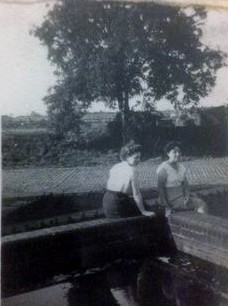
We are on the meadows, when people still worked and lived there.

Now everyone knows about the sewage works which were first established here in the 1870s, continued well into the last century.

Less well known perhaps is that two families of those who worked on the plant lived close by, and their houses stood by what is now the footbridge over the Brook.

The rest as they say belongs to Catherine Brownhill who sent over these pictures and the accompanying story.

“Hi Andrew, Malcolm (my husband) lived at No. 1 Cottage, Withington Sewage Works. Hughie  and Lily Edwards lived next door. Lily was 90 last October and Malcolm & his brother went to visit her. 

He has taken some pictures of photographs from her album. 

Over the next few days I’ll send them to you with as much info as I can. This picture is likely Lily and a friend at the Sewage Works. Ivygreen Road houses are in the background. The 2 cottages would be to the right of this picture. The tree is still there today.

This is the same tree with the ‘cottages’ in the picture. They were sturdy brick built semi-detached houses. 

Malcolm’s Dad, Jack Brownhill can be seen bowling in a game of cricket. 

The cottages were at the end of the cobbled road just where the bridge is. 

Below are the four Brownhill children. Jack and Irene were their parents. 

Over the years Irene worked in the laundry on Crossland Road and in three chip shops, on the Green and Beech Road. She attended the school on the Green. 

Pictured are Jeanette, Malcolm, Graham and Ray with the air gun.

The last one for today. 

These buildings were in front of the cottages and to the left and the buildings behind housed the engine room and various sheds. 


Back to the photo, where the car/van is this was a barn where straw was stored for the sheep in the fields and chickens were kept in one of the rooms to the right. Malc’s Dad had a Morris Minor and all the lads would take turns to drive it, Malc could only just see above the steering wheel. 

It was chopped up at the end of its life and was put over the bank of the brook. 

Bits of it may still be there, though we think that when the banks were reinforced in recent years the motor debris may have been cleared. This would have been to the left of where the bridge is now”.

Location; the Meadows

Pictures; living on the Meadows, circa 1950s-60s, from the Brownhill Collection

Friday, 6 March 2026

Losing Fleming Hall in Chorlton

How easy it is to lose a building.  

1961
In this case it was Fleming Hall which in the 1950s and 1960s was used by various organizations but has long since all but passed out of living memory.

I say almost passed out of living memory but not quite, because my old friend Wendy emailed me yesterday with, “Fleming Hall was on Wilbraham Road and I thought it was where the Post Office now is but the Chorlton Townswomen's Guild held their last meeting in the Hall on the 15 October 1963 according to their Minutes,  but on page 159 of your book, "The Quirks of Chorlton-cum-Hardy" there  is a photograph of ‘The New Post Office 1961’.  

1961
It could have been where Sue Ryder's charity shop is, but it would have covered more land”.

And that set me going, because this spot was the home of the old Chorlton Post Office which was damaged when neighbouring houses were destroyed during the Manchester Blitz in the December of 1940.

Looking at photographs from the period it is possible that Fleming Hall was located in what had been that bit of the Post Office that survived the bombing.

I asked Oliver Bailey for help and it remembered “Fleming Hall on Wilbraham Road, on the left hand side heading towards Barlow Moor Road junction maybe forty metres past where Corkland Rd comes in, almost opposite where Stevensons the hairdressers were, and H T Burt/ Brown Brothers, right next to where the parade of shops started that continues to the traffic lights.

My recollection is that it was used a lot by the Conservatives for various get- togethers, dances, young conservatives, whist drives and so on. 

1959
It might even have been owned by them as I remember on several occasions moving stuff, including chairs and tables from there to one of the fields off Wilbraham Road in the stretch past St Werburghs, beyond Morville Road. 

On one occasion we even had to move an upright piano down the steps of the Fleming Hall and get it into the back of my father's land rover as there was going to be some dancing at one of the Fetes and offload it. All done by muscle power. But young conservatives generally responded well to the whip.

Internal layout; at the end away from Wilbraham road there was a stage for jollifications and speechifying, then the body of the hall and nearest Wilbraham Road a kitchen of sorts, but only for brewing tea and coffee and cutting up cakes. I think there might have been offices above the kitchen and loos, but memory is hazy on that”.

1907
All of which chimes in with the two images from 1959 and 1961, which clearly show the sign announcing the Conservative Party Committee Rooms and an election poster on the side of the building.

And for those with a keen eye for detail, the front of the building matches that of the old post office.
But, and there always is a but, Oliver added, “I don't remember it looking like the old Post Office though clearly someone kept the entrance structure for a while”.

So, there is still more to find out, including who actually took over the bomb-damaged Post Office, converted it into the Fleming Hall, and who was Fleming? Wendy remembers a prominent Chorlton individual named Fleming and I think we can rule out Sir Alexander Fleming.

Finally, I don’t yet have a date for its demolition, although I know it will be before 1969, because in that year the site is listed as the Maypole Grocers, which later became Lipton’s and is now Sue Ryder.

And after 1963 when the Chorlton Townswomen Guild met there.

So that is that, ………… I now just await someone with a story or a picture of the place.

And not long after the post went live, Lawrence commented that "Saw your post on Fleming Hall and in case you didn’t know……

Named after Edward Fleming 1891 - 1950. He was the Tory MP for Withington Constituency 1945 - 1950. He then stood for Moss Side when the boundaries were redrawn and Chorlton was put in that Constituency.
It’s the 1950 General Election and sadly Mr.Fleming died on the 17th February during the campaign. I have got somemore details I can dig out. I think he took a turn for the worse at his sister’s house on High Lane. Anyway polling was immediately suspended by all the local parties. The Tories went on to win the General with Winston Churchill.

Moss Side Constituency voted two weeks later and elected Florence Horsborough. She’d lost in Midlothian and Peebles but got another crack at obtaining a seat. Manchester’s first woman MP, first woman in a Conservative cabinet".

And this I didn't know.

And Anne, responded almost immediately with "Fleming Hall used to be where the Sue Rider shop is, I remember going there for Christmas and Birthday parties in the 1960s" with Margaret adding, "I remember going to a dance there when I was at Whalley Range High School. Probably a barn dance as we had a club after school of country dancing to which boys from Chorlton Grammar attended. That would be about 1955/6/7".

Location; Chorlton

Pictures; Former Post Office, Wilbraham Road, 1959, A.E.Landers, m18242, and in 1961, m18511, courtesy of Manchester Libraries, Information and Archives, Manchester City Council, http://images.manchester.gov.uk/index.php?session=pass and the Post Office in 1907 from the Lloyd Collection

Friday, 27 February 2026

A Chorlton revolution ……….. the self service shop


Now we are so familiar with the supermarket and the convenience store, that it takes a moment to  appreciate just how much self service shopping was a revolution in how we bought our groceries.

I am of that generation, who was part of that revolution, and I can remember just how liberating it felt at the time to wander the isles, and touch and choose which apples, tins of vegetables and packets of biscuits to buy.

Today we can be cynical about it all, not least the way it allowed shops to cut costs, and set the customer doing some of the work, but it was I maintain quite liberating.

Here in Chorlton, there is still a book to write about the arrival of those first self service shops, including which were the first and just what people thought about them.

The Co-op  was the first to embrace the new way of shopping, turning a department of its store in Romford over to self service in 1943 and five years later fully converting its premise in Portsea to selfservice.*

And in 1949, The Manchester & Salford Equitable Co-op  began altering its existing stores the following year, with our own Hardy Lane opening in 1959.

Until this week, I didn’t know that the shop on the corner of Manchester and Ransfield roads, was offering its customers, “Self Service” in 1961 and a quick trawl of the directories should pinpoint when the Mark Down began its new venture.
Leaving that aside, it is the shop window which is equally fascinating, offering up a range of products which are still familiar, but at prices which at first glance appear astonishing.

But those prices must be set against most people’s incomes which were of course much lower than today.
The more pertinent question would be to explore and then compare the average food bill in 1961 with today and its percentage of all house hold bills.

All of which is getting too serious and so instead I shall just leave you pondering on the prices, which are expressed in shillings and pennies, which I suspect will be a mystery to any one born just before we went decimal in 1971.

Our own kids look back at me with sheer bewilderment when I explain that 12 pennies made a shilling, that 20 shillings made a pound and that 240 pennies made a pound.  Added to which there was a coins called a threepenny bit, a sixpence, and a half crown, all of which competed with the farthing and the ha’penny.

Added to which the price of posh objects often came as guineas and not pounds.

And that neatly brings me back to self service shopping which predated our decimal coinage by just a few decades.

Location; Chorlton

Pictures, Manchester Road, 1961, A H Downs, m18078 and current prices, Mark Down No. 93 Manchester Road, 1961, , A H Downs, m18080, courtesy of Manchester Libraries, Information and Archives, Manchester City Council, http://images.manchester.gov.uk/index.php?session=pass, and Spotlight on Self Service, from Co-Op First Self Service UK, http://hardylane.blogspot.com/

*Co-Op First Self Service UK, http://hardylane.blogspot.com/