Showing posts with label Hulme. Show all posts

Tuesday, 2 June 2026

One camera ….. 1965 ….. and a collection of lost scenes

It is 61 years ago that this collection of images was taken.

"Clearance in Hulme", 1965
They cover Manchester, Stretford and out to Chorlton and Wythenshawe and are a mix of industrial scenes, some old historic buildings and more than a few of well-known city centre sites.

What they have in common was the year they were taken and that originally they were colour slides.

The collection was donated to me by the daughter of the photographer, but somewhere along the line their identity was lost, although I am still looking for the letter, email or Facebook message which alerted me to the names of the woman who donated them and the photographer.

"Old Shambles' 1965
I hope by posting them the donor will come forward and I can change the credit from the 1965 collection to a name.

The first two are both of lost Manchester.

I have no idea where in Hulme the clearance area was, and I only have vague memories of the old Shambles.

But they are a unique record of how the City was in 1965 and just how it was about to change.

Location; Manchester

Pictures, “Clearance in Hulme” and “The Old Shambles showing Wellington Inn and Sinclair’s Oyster Bar,” 1965, from the 1965 Collection

Friday, 1 May 2026

Carts …. horses ….. and another busy day …… the lost Hulme and Moss Side .. part 3

This is the third dip into a collection which recorded life in Hulme and Moss Side during the house clearances of the 1960s and 70s.

They were taken by Roger Shelley and they are a powerful visual description of communities who continued to work and play as around them the wrecking ball wiped away a century and a bit of houses and workshops.

I have to say I had almost forgotten “the rag and bone man” who went door to door collecting the broken, the discarded and the out of fashion household goods.

Today it’s a man in a van, often as not only interested in scrap metal and who announces his presence with a bout of loud music and still occasionally with a call for “any old iron” which would have been recognised in the streets by characters from a novel by Charles Dickens.


And Roger captured the scene as it played out in the 1960s.

Location; Hulme and Moss Side


Pictures; from the collection of Roger Shelley, 1960s and 70s.


Thursday, 30 April 2026

The lost Hulme and Moss Side

Now I have been a great fan of Roger Shelley’s photographs for over a decade, ever since he shared a collection of pictures he took of a group of young lads playing in the near ruin of Hough End Hall nearly 60 years ago.

The attention to detail and his ability to capture the moment are skills I wish I had.
And so, I was very pleased when he posted another group of images he took during the house clearances in Hulme and Moss Side.

The pictures are a mix of street scenes, and the people he encountered, including kids at play, men and women at work and the ever present piles of rubble as the grand plan advanced and centuries old houses disappeared under the impact of the wrecking ball.

Like the work of Shirley Baker* his pictures don’t dwell on sentimentality and don’t make judgments of the wholesale clearances of communities.
They just record what he saw.

I don't have exact locations for the images, but some can be traced through the odd street name or feature.


And with his permission I will be working my way through the portfolio, fastening on images which tell their own stories.


Location; Hulme and Moss Side in the 1960s and 70s

Pictures;  from the collection of Roger Shelley, https://www.flickr.com/photos/photoroger/

*Baker, Shirley, Without a Trace, Manchester and Salford in the 1960s, 2018


Wednesday, 15 April 2026

The lost Hulme and Moss Side .....

Now I have been a great fan of Roger Shelley’s photographs for over a decade, ever since he shared a collection of pictures he took of a group of young lads playing in the near ruin of Hough End Hall nearly 60 years ago.


The attention to detail and his ability to capture the moment are skills I wish I had.

And so, I was very pleased when he posted another group of images he took during the house clearances in Hulme and Moss Side.

The pictures are a mix of street scenes, and the people he encountered, including kids at play, men and women at work and the ever present piles of rubble as the grand plan advanced and centuries old houses disappeared under the impact of the wrecking ball.

Like the work of Shirley Baker* his pictures don’t dwell on sentimentality and don’t make judgments of the wholesale clearances of communities.

They just record what he saw.

I don't have exact locations for the images, but some can be traced through the odd street name or feature.

And with his permission I will be working my way through the portfolio, fastening on images which tell their own stories.


Location; Hulme and Moss Side in the 1960s and 70s

Pictures;  from the collection of Roger Shelley, https://www.flickr.com/photos/photoroger/

*Baker, Shirley, Without a Trace, Manchester and Salford in the 1960s, 2018


Friday, 31 October 2025

Vanished Manchester communities ...........

Now I have been a great fan of Roger Shelley’s photographs for over a decade, ever since he shared a collection of pictures he took of a group of young lads playing in the near ruin of Hough End Hall nearly 60 years ago.


The attention to detail and his ability to capture the moment are skills I wish I had.


And so, I was very pleased when he posted another group of images he took during the house clearances in Hulme and Moss Side.

The pictures are a mix of street scenes, and the people he encountered, including kids at play, men and women at work and the ever present piles of rubble as the grand plan advanced and centuries old houses disappeared under the impact of the wrecking ball.

Like the work of Shirley Baker* his pictures don’t dwell on sentimentality and don’t make judgments of the wholesale clearances of communities.


They just record what he saw.

And with his permission I will be working my way through the portfolio, fastening on images which tell their own stories.

Location; Hulme and Moss Side in the 1960s and 70s

Pictures;  from the collection of Roger Shelley, https://www.flickr.com/photos/photoroger/

*Baker, Shirley, Without a Trace, Manchester and Salford in the 1960s, 2018


Thursday, 30 October 2025

Standing amongst the groceries in Hulme ..... sixty years ago

When you look through the collections of pictures of old Manchester, you seldom find many of the interiors of buildings.

I can think of plenty of reasons why that might be so, but the result is to deprive of us a huge slice of our past.

And so, I was very pleased when my old friend Ann shared a picture she drew in the 1960s, while at Art College.

It is of the inside of her aunt’s shop in Hulme, and it takes me straight back to similar shops I remember from my youth.

These were the corner shops, which seemed to stay open all hours, and were prepared to flout the Sunday trading laws.  I can still remember being sworn to secrecy one Sunday morning when I left the local grocery shop with some product which had been double wrapped to disguise what it was.

Stuff was piled high and  bunches of bananas might share a space, with a several tins of salmon, and a pile of newspapers, while somewhere near the front of the counter would be those open boxes of loose biscuits, which always presented a challenge to see how many you could grab while the shop assistant wasn’t looking.

Added to which there was that smell, which was a mix of the competing foods on display and the bare wooden floorboards.

Location; Hulme


Picture;  Ann’s auntie’s shop in Hulme. Early 1960s, from the collection of Ann Love

Thursday, 11 September 2025

The lost Hulme School ……

So, tomorrow I am on the trail of the lost Hulme school.

The Memorial Stone, 2023

On the surface I thought it would be a daunting task given that over the last century and a bit there have been lots of schools in Hulme, most of which disappeared in the transformation of the area in the late 1960s and early 1970s.

The School, 1940
Added to which the redevelopment swept away the old street pattern substituting new roads with different names which are often realigned differently to the old plan.

But after half an hour I located Board School No. 1 which was at the corner of Vine Street and Junction Street.

I have a description of the school just after it was opened in 1874, some photographs from 1940 and 1962 and this remarkable stone inscription, which once would have adorned the exterior of the building.

It now lies on the ground between Old Birley Street and the Brooks Building of the M.M.U.

My old friend Pierre who worked there sent over the picture and I was immediately hooked.

The Manchester Guardian reported that. "Mr Herbert Birley, the chairman of the Manchester School Board, laid yesterday the memorial stone of the first school which the Board have built. 

The site is at the corner of Junction Street and Vine Street, Hulme, on a plot of land of irregular shape and presenting considerable difficulties to the architect. 

The Board selected the designs of Messrs Medland and Henry Taylor, of this city, and the contract has been taken by Mr G Napier for a sum slightly exceeding ,3,000. 

The school, 1962
On the ground floor is a large room 30 feet wide. 

Immediately adjacent, under cover, are convenient offices; and just beyond, through a porch, are the respective playgrounds. The entrance for girls is from St Mary’s Street, and for boys on the opposite side, from Junction Street”. 

On both floors are private rooms for the schoolmistresses, and on the upper floor a room for the pupil teachers, and besides the library, a good book store. 

In the basement is a kitchen, 18 feet by 24 feet, with all appliances for tea parties etc. There are large places for storing fuel, with convenient shoots from the street above, and all the rooms are warmed by open fireplaces and are thoroughly well ventilated. 

The school, 1894
The walls are faced to a certain height with glazed bricks, which can be easily cleaned, and on which writing or other defacement is impossible. 

Round both school rooms run bands of encaustic tile, bearing Shakespearean mottos. The exterior design is simple scholastic architecture but so treated as to present a handsome appearance. 

Besides the children’s entrances there is a good porch for the entrance of the members of the School Board or other visitors. A belfry rises to a height of about 70 feet. 

The unusual irregularity of the site gives occasion for exceptional and picturesque features, particularly in the elevations to Mary Street and Junction Street, and care has been taken that there shall be no 'shabby' back view, though of course the best elevations are to the principal streets”*

The site, 2023
The article is a long one and includes speeches and thought from the dignitaries on the importance of education.

All of which I think will be in part two of the lost Hulme School.

Leaving me just to think I might follow up on the names of the head teachers in 1911, when our school was Vine Street.

The school, 1911

Location; Hulme

The school, 1962

Pictures; memorial stone of Board School No 1, 2023, from the collection of Pierre Grace, and views of the school in 1940, m64821, and in 1962, H. Milligan, m64822, m64824, courtesy of Manchester Libraries, Information and Archives, Manchester City Council, http://images.manchester.gov.uk/index.php?session=pass and the site 1894, from the 1894 OS map of Lancashire and the 1894 OS map of South Lancashire, courtesy of Digital Archives Association, http://digitalarchives.co.uk/ 


*The First Board School in Manchester, Manchester Guardian June 12th 1874 


Part Two; More on the school ......


Tuesday, 9 September 2025

When only the pubs were left ........

It is pretty true that during many of the urban redevelopment schemes of the 1960s and 70s, it was the pubs which remained long after the homes of their customers had been bulldozed down

Now I have been a great fan of Roger Shelley’s photographs for over a decade, ever since he shared a collection of pictures he took of a group of young lads playing in the near ruin of Hough End Hall nearly 60 years ago.

The attention to detail and his ability to capture the moment are skills I wish I had.

And so, I was very pleased when he posted another group of images he took during the house clearances in Hulme and Moss Side.

The pictures are a mix of street scenes, and the people he encountered, including kids at play, men and women at work and the ever present piles of rubble as the grand plan advanced and centuries old houses disappeared under the impact of the wrecking ball.

Like the work of Shirley Baker* his pictures don’t dwell on sentimentality and don’t make judgments of the wholesale clearances of communities.

They just record what he saw.

And with his permission I will be working my way through the portfolio, fastening on images which tell their own stories.

Location; Hulme and Moss Side in the 1960s and 70s

Pictures; from the collection of Roger Shelley, https://www.flickr.com/photos/photoroger/

*Baker, Shirley, Without a Trace, Manchester and Salford in the 1960s, 2018


Monday, 8 September 2025

That iconic Hulme pub ……. The Junction

 It began as a picture.

Faded glory, 2023

And for anyone who knows Hulme, it is that iconic building which is the Junction Hotel.

Today it is a sad looking place on the corner of Rolls Crescent and Old Birley Street.

But for those who remember the area before Hulme’s first redevelopment in the 1970s, the location was 141 Warde Street at the point where it joined Upper Jackson Street and Preston Street.

I can track it back to 1885 when the licensee was a  Jane Grange using the directories and may get an earlier date by visiting the licensing records.  As it is the Manchester Guardian carried reports of various properties in Warde Street being granted a license in 1880 and 1881.

So lots more still to do.

In happier times, possibly 1924
I do know that from 1895 till 1901 it was run by an Edwin Grange, who I am guessing was related to Jane Grange.  A decade later it was in the hands of a Mr. and Mrs. Mager who may have had family links with the Grange family.

Looking at all the records this was a big pub.  The Rate Books record that it had an estimated annual rental value of £300 and paid £250 in rates.

According to the 1911 census the building had 13 rooms and along with Walter and Florence Mager there were five living in staff, four of whom were barmaids and the fifth who was the cook.  

Ten years earlier the number of staff was ten and included a young Walter and Florence who were described as “Hotel Managers” under the direction of Edwin Grange.

The pub must have remained popular as in 1921 along with the licensee and his wife the business employed six staff.

I must confess I never went in, but plenty of my friends and colleagues did, with Ann Portus reflecting that she had “great memories"  of nights in the place.

Waiting for something to happen, 2023
It closed in 2016, although What pub still has a listing for it, with the entry that it is “Owned by Hydes brewery, this is the last traditional pub in an area that used to be a bustling hive of activity with a pub on every corner. 

Now the Junction's distinctive triangular shape stands isolated in an undeveloped area surrounded by a mixture of new build developments and historic buildings like the old Hulme Picturedrome which stands just across the way. 

Rumour has it there was once an underground tunnel between the two so that performers staying at The Junction (there was once accommodation on the long ago removed third floor) could get direct access to the theatre.

Entering via the small lobby at the point of the triangle, there is a short bar directly opposite you. The back room to the left of the bar has a pool table while a door on the left hand side leads to a fenced off paved beer garden”.*

Alas no more and despite a report in the Manchester Evening News in 2020 that “Historic pub set to be 'revitalised' into huge space boasting flats, events room and a ‘natural oasis in the heart of the city', as yet the grand plan hasn’t materilaised."**

Indeed the only planning application was for the “Erection of a canopy at rear of Public House including elevational alterations and erection of a 2 metre high mesh security fencing", but it was rejected***

A grand place, 1924
And that at present is that.

Other than to recommend that excellent book by Bob Potts, “The Old Pubs of Hulme and Chorlton on Medlock."*****

Location; Hulme

Pictures; Faded glory and waiting for something to happen, 2023 from the collection of Andrew Simpson, In Happier times courtesy of Tony Flynn, and A grand place, courtesy of Bob Potts

*What ?ub, https://whatpub.com/pubs/TRA/3787/junction-hulme

**Historic pub set to be 'revitalised' into huge space boasting flats, events room and a ‘natural oasis in the heart of the city', Adam Maidmen, March 12th, 2023, https://www.manchestereveningnews.co.uk/news/greater-manchester-news/hulme-junction-development-community-space-17909968

***Manchester City Council Planning Portal, Erection of a canopy at rear of Public House including elevational alterations and erection of a 2 metre high mesh security fencing, 083702/FO/2007/S1, https://pa.manchester.gov.uk/online-applications/applicationDetails.do?activeTab=documents&keyVal=JKCE9XBC30000

***** Bob Potts, “The Old Pubs of Hulme and Chorlton on Medlock, 1997, and his earlier version “The Old Pubs of Hulme, Manchester, 1983, Neil Richardson

Sunday, 7 September 2025

How we lived …….. the lost Hulme and Moss Side

Now I have been a great fan of Roger Shelley’s photographs for over a decade, ever since he shared a collection of pictures he took of a group of young lads playing in the near ruin of Hough End Hall nearly 60 years ago.


The attention to detail and his ability to capture the moment are skills I wish I had.

And so, I was very pleased when he posted another group of images he took during the house clearances in Hulme and Moss Side.

The pictures are a mix of street scenes, and the people he encountered, including kids at play, men and women at work and the ever present piles of rubble as the grand plan advanced and centuries old houses disappeared under the impact of the wrecking ball.

Like the work of Shirley Baker* his pictures don’t dwell on sentimentality and don’t make judgments of the wholesale clearances of communities.


They just record what he saw.

And with his permission I will be working my way through the portfolio, fastening on images which tell their own stories.

Location; Hulme and Moss Side in the 1960s and 70s

Pictures; an alley and some kids, from the collection of Roger Shelley, https://www.flickr.com/photos/photoroger/

*Baker, Shirley, Without a Trace, Manchester and Salford in the 1960s, 2018

Saturday, 6 September 2025

Fish … chips… Vimto ….. and the abandoned lavatory …… the lost Hulme and Moss Side .. part 2

This is the second dip into a collection which recorded life in Hulme and Moss Side during the houses clearances of the 1960s and 70s.

They were taken by Roger Shelley and they are a powerful visual description of communities who continued to work and play as around them the wrecking ball wiped away a century and a bit of houses and workshops.


Location; Hulme and Moss Side


Pictures; from the collection of Roger Shelley, 1960s and 70s.


Friday, 5 September 2025

Life beyond the front door ........Hyde Street Hulme in 1913

It is not often you get to see into the home of someone from Hulme at the beginning of the 20th century.

And I rather doubt that in the normal course of things the people behind the door of this house on Hyde Street would have agreed to a picture being taken.

But then I bet they were not even aware it had been taken.  Looking through the collection there are no more interior photographs so I guess this was just one of those opportunistic moments when travelling photographer encounters an open door.

What I like is that it takes me back to my own grandparent’s two up two down in Hope Street and for that matter our own house in Lausanne Road.

The lower part of the wall is covered in that thick embossed paper painted brown and varnished, and above it a slightly lighter pattered design off set by pictures of long dead cherished relatives which stare out at you and almost seem to act as door guardians.

And if this were like Hope Street and Lausanne Road then there would be thick lino on the floor, which was cheap to buy, easy to wash and from memory pretty durable.

All of which just leaves the coal hole and the cellar which mark it out as superior to either Hope Street or my own first house in Ashton-Under-Lyne which had no cellars and in the case of my grandparents home lacked any foundations.

So if you lifted the stones in the kitchen there was just bare earth.

But Hyde Street was a cut above that, witnessed by its residents who could count a postman, a coal dealer, baker and undertaker amongst those who lived there.

And if there were some who might describe themselves as unskilled there were plenty of others who had a trade including a safe maker painter and a printer.

So in time I shall return to Hyde Street having done some research from the census returns.  In the meantime I shall thank Sally who showed me the picture in the course of her own family research.

Picture; Hyde Street,1913, m26173, courtesy of Manchester Libraries, Information and Archives, Manchester City Council, http://images.manchester.gov.uk/index.php?session=pass

Sunday, 3 August 2025

The shop that had almost everything ………… Lord’s Wholesale Retail Stretford Road …… 1963

It took a little while to locate just exactly where we are on Stretford Road back in 1963, but I now know the shop on the corner is at the junction with Upper Medlock Street.

And if you were to head down Upper Medlock Street you would cross, Dale Street where the car is parked by the road sign and then Bonsall Street.

Back then it was part of a tight network of streets and terraced housing, all of which was swept away in the wholesale regeneration of the area in the 1960s and again more recently.

So much so that I suspect a time traveller from 1963 would be totally confused and at a loss to find that street corner.

Happily, Stretford Road and Bonsall Street survived and offer up a means of anchoring where the pictures were taken.

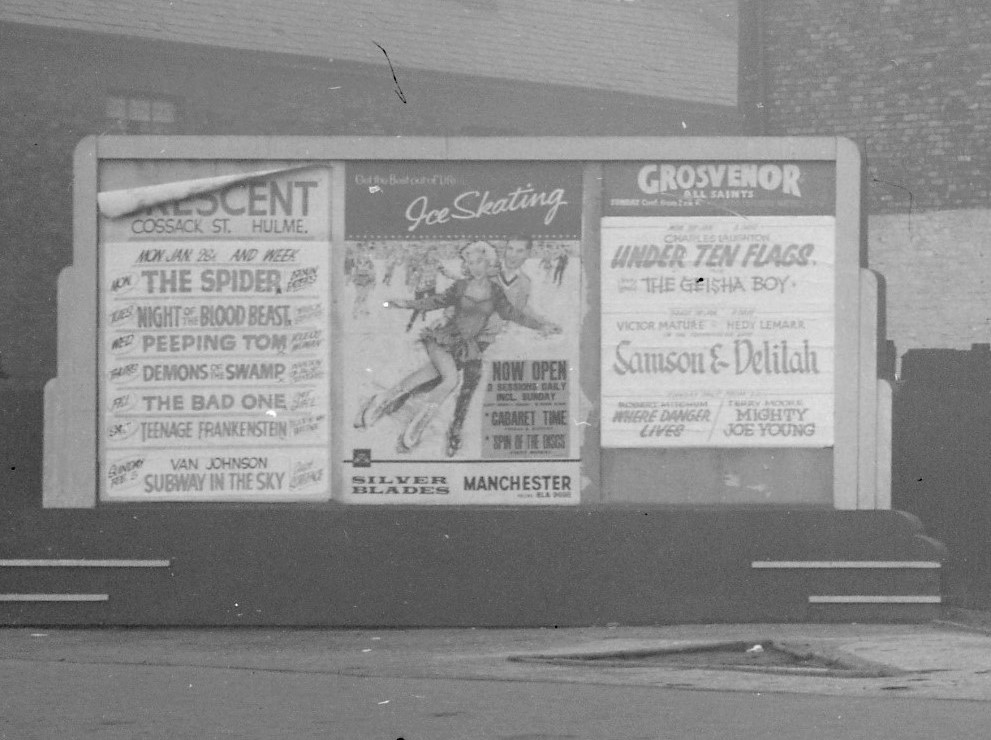
So,  with that sorted the rest of the story will be about that shop and the advertising hoarding.

Lord’s Wholesale and Retail shop was one of those places that pretty much offered everything in the way of clothing, from Donkey Jackets, moleskin trousers , to rubber boots and riding breeches, reminding me of that sign “If we ain’t got it, you can’t get it”.

I do have to wonder what demand there would be for riding breeches in Hulme, although given this was still the age of the sailing ship there might well be people wanting a cabin trunk.

That said there was a full range of things anyone might want to kit themselves out for work.

And having done work for the day, the advertising hoarding on the corner of Dale Street, gives flavour of what was showing at the cinema.  Judging by what the Crescent and the Grosvenor were showing that week, my choice would have been Samson and Delilah with Victor Mature and Hedy Lamar.

But the Grosvenor only held just over 900 seats, while the Crescent had a thousand, added to which Cossack Street was closer than All Saints.*

That said in 1963 I was just 14, and I rather think Night of the Blood Beast, showing on Tuesday, Peeping Tom and Demons of the Swamp, which followed on Wednesday and Thursday would have won over on Victor Mature, but all three, along with The Bad One and Teenage Frankenstein would have been X rated, to which I would have been barred.

But  I would have drawn the line at Subway in the Sky,  which was showing on Saturday.

The film centered on an American soldier in West Berlin who goes on the run after being falsely accused of trafficking drugs. He hides in his wife’s flat where he meets a cabaret singer who helps him prove his innocence.

And after a melodrama like that, there could only be a recourse to some fried bread, and Ovaltine, given that at 14 the joys of Wilson Ales were some years in the future.

At which point I should draw to a conclusion were it not for that beer advert, which has got me a tad confused.

As a south east Londoner, newly arrived in the city in 1969, I picked up the divide between north and south which came not by way of my accent or the dominance of the Home Counties in so many things but simply the shape of the beer glass.

My friends pointed out that those dimpled pint pots were a southern affectation and they would always demand a straight glass.

Such was the chasm between me and them.

Leaving me just to record that the church at the end of row of shops was the Catholic Apostolic Church.

Location’ Stretford Road

Pictures; Stretford Road, 1963, Courtesy of Manchester Archives+ Town Hall Photographers' Collection,  https://www.flickr.com/photos/manchesterarchiveplus/albums/72157684413651581?fbclid=IwAR35NR9v6lzJfkiSsHgHdQyL2CCuQUHuCuVr8xnd403q534MNgY5g1nAZfY

*Kinematograph Yearbook 1947

Thursday, 27 February 2025

On a day in 1969 ……..waiting for the new Hulme.

Now, I am not going into the debate on the regeneration of Hulme in the late 1960s and early 1970s, other than to say, some tired old properties were swept away to be replaced by others which failed the test of time.

Instead I shall reflect on the picture which perfectly captures that a moment in the cycle of city regeneration.

In the distance are some of the flats already erected and beyond them the landscape of the city centre.

But the rest is just an open building site, pretty much cleared of the demolished houses, with few recognizable points of reference.

Location; Hulme

Picture; Regenerating Hulme, 1969,courtesy of Manchester Libraries, Information and Archives, Manchester City Council, http://images.manchester.gov.uk/index.php?session=pass


Sunday, 21 July 2024

Walking through the lost Hulme and Moss Side

 Now I have been a great fan of Roger Shelley’s photographs for over a decade, ever since he shared a collection of pictures he took of a group of young lads playing in the near ruin of Hough End Hall nearly 60 years ago.

The attention to detail and his ability to capture the moment are skills I wish I had.

And so, I was very pleased when he posted another group of images he took during the house clearances in Hulme and Moss Side.

The pictures are a mix of street scenes, and the people he encountered, including kids at play, men and women at work and the ever present piles of rubble as the grand plan advanced and centuries old houses disappeared under the impact of the wrecking ball.

Like the work of Shirley Baker* his pictures don’t dwell on sentimentality and don’t make judgments of the wholesale clearances of communities.

They just record what he saw.

I don't have exact locations for the images, but some can be traced through the odd street name or feature.

And with his permission I will be working my way through the portfolio, fastening on images which tell their own stories.

Location; Hulme and Moss Side in the 1960s and 70s


Pictures;  from the collection of Roger Shelley, https://www.flickr.com/photos/photoroger/

*Baker, Shirley, Without a Trace, Manchester and Salford in the 1960s, 2018