Showing posts with label Chorlton artist Peter Topping in collaboration with Andrew Simpson. Show all posts

Saturday, 1 August 2026

In celebration of Chorlton People ….. at our Library ... in August

I am enjoying the library’s current series of exhibitions under the broad title of “Works of Art By Local People”.


And starting in August their latest exhibition show cases the work of Peter Topping who is an artist, author, poet and now song writer. *


All of which he combines in this presentation which has the lot.

Now, I could paraphrase the content, but where would the fun be in doing that when you can go along and see it all for yourself?

So, I will just share some of the display panels which will be the enticement to go down to the library and view the full exhibition which also highlights his workshops on how he writes his songs which are designed to be a collective experience.

Leaving me to add a mangled version of that well known song, If you go down to the library today, You're sure of a big surprise. **.

And because I am in the mood and can I will finish with that panel celebrating my literary and artistic partnership with Mr. Topping.

It began around 2012 and in that decade and half has brought forth sixteen books, umpteen exhibitions, three street installations including the popular History Walk murals as well as talks and walks.


All of which is a lead into that wonderful film Casablanca, made in 1942 and set in Vichy controlled north Africa, full of sinister Nazi officers, Free French resistance fighters, a lost love affair and some memorable catchphrases.

Of which one of my favourites is uttered by Rick Blaine to the corrupt but slightly endearing Police chief Captain Louise Renault.  It comes at the end of the film, when the nasty Nazi officer is shot dead, and the resistance leader, Victor Laszlo, leaves Casablanca with his wife Isla Lund who was also Rick’s long-lost love.  With nothing left Captain Renault and Rick face an uncertain future and resolve to head to a “Free French Garrison over at Brazzaville”, leaving Rick to say "Louis, I think this is the beginning of a beautiful friendship".

And that has pretty much characterised that Simpson Topping partnership.

*From Poems to Musical Poems, Peter Topping, Chorlton Library, through August 2026

** Teddy Bears' Picnic,  melody written in 1907 by American composer John Walter Bratton, and lyrics added in 1932 by Irish songwriter Jimmy Kennedy

***Casablanca, 1942


Thursday, 25 June 2026

Painting Well Hall and Eltham ....... nu 8 ....... magic days and evenings by the Tudor Barn

An occasional series featuring buildings and places I like and painted by Peter Topping.

The Barn, 2017
I am guessing we all have our favourite memories of the Tudor Barn and the Pleasaunce.

Mine run from wandering around the gardens on warm sunny days with a girl friend enjoying that heady sense of romance mixed with the memories of the sunlight playing on the moat and the orange coloured brick work of the Barn

And if there is one special memory it will be of a Blues and Folk night sometime in the summer of 1966.

I can’t remember who was on but there was something magical about sitting in the small open air theatre listening to the music with all that history as a backdrop.

Junior Showtime in the Pleasaunce, 1967
For years afterwards I cherished the poster of the event which I bought for a shilling  from the entertainments office of the Council, and as you do I pasted it on the wall of my bedroom.

It featured a guitar and a pair of Chelsea boots in black on a white background and always reminded me of the Pleasaunce.

For my sisters one of their special moments might well be those summer entertainments put on during the holidays and featuring all sorts of kid’s entertainers.

By chance one of those Junior Showtime’s was photographed by the local paper and the clipping with our Jill aged about nine staring back at the camera has survived.

And there hangs a perfect moment in time down at the Tudor Barn.

Painting; The Tudor Barn © 2017 Peter Topping from a photograph by Scott MacDonald circa 2013

Web: www.paintingsfrompictures.co.uk

Facebook: Paintings from Pictures; https://www.facebook.com/paintingsfrompictures

Picture; Well Hall courtesy of Scott McDonald and Junior Showtime, August 20 1967 from the collection of Andrew Simpson

Friday, 15 May 2026

Painting Well Hall and Eltham ....... nu 3 Well Hall Cottages

An occasional series featuring buildings and places I like and painted by Peter Topping.

I have always been fascinated by Well Hall Cottages which were demolished in 1923 and  date from at least the mid 18th century.*

They consisted of six properties just north of Kidbrook Lane and  formed a rough L shape with three running west from Well Hall Lane, another two pointing north with a sixth at the rear on the western side.

By 1844 one of the six was occupied by John and Mary Evans. They were in their sixties, he had been born in Wiltshire and she was from Dublin.

Tracking down the other five has been less easy, but judging from the people listed on the census returns for 1841 and ’51 the cottages may have been home to agricultural labourers, a blacksmith and a carpenter.

There are plenty of photographs of the cottages but to my knowledge no paintings of the buildings so it was fitting that Peter should paint them using a coloured picture postcard dating from the early 20th century.

Now I am not a fan of taking a monochrome image and adding colour using a software process, but as Peter has used a postcard which had already been colourized, a very long time ago, my objections fly away.

Painting; Well Hall Cottages © 2015 Peter Topping from a photograph circa early 19th century.
Web: www.paintingsfrompictures.co.uk

Facebook: Paintings from Pictures https://www.facebook.com/paintingsfrompictures

*Well Hall Cottages, http://chorltonhistory.blogspot.co.uk/search/label/Well%20Hall%20Cottages

Friday, 17 April 2026

Painting Well Hall and Eltham ....... nu 7 tram sheds and missing the tram

An occasional series featuring buildings and places I like and painted by Peter Topping.

The Tram sheds, 2017 painted from a photograph, 1977
Now I always took the bus shelters for granted after all they had always been there and had always been bus shelters.

But not so.

They had started off as places to wait for the trams which began coming through Eltham at the beginning of the 20th century and which in turn were only made possible by the extension of Well Hall Road.

Neither of which I found out until recently.

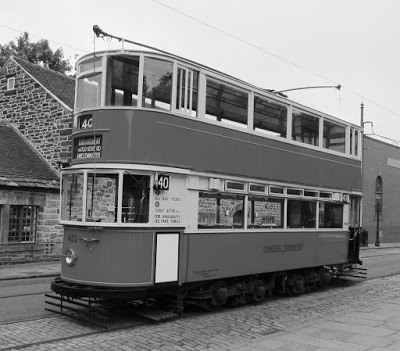
LCC tram 1622, 2015
Of course it made perfect sense to extend Well Hall Road up from Sherard Road making a more direct route from Woolwich to the High Street.

And it made equal sense to start a tram service.

If I travelled on the old trams I have no memory, although Dad told me we made a special trip to see the last one arrive at the New Cross depot in 1952.

Sadly I can’t remember, and nor did he take a picture.

All of which just leaves the shelters as a testament to what had once been.

Location; Eltham, London

Painting; the tram sheds Well Hall Road © 2017 Peter Topping from a photograph by Jean Gammons circa 1977

Web: www.paintingsfrompictures.co.uk

Facebook: Paintings from Pictures https://www.facebook.com/paintingsfrompictures

Picture;  LCC tram 1622, 2015, Crich Tramway Village courtesy of Andy Robertson


Wednesday, 18 March 2026

Posters from the Past ........... no 20 ......... coming home

Now the project is simple, take an image of a building or “thing” we all love and turn it into the style of poster which was popular in the middle decades of the last century.*


Peter and I have been creating such advertising pieces of art for a while.

I source the original image and offer the caption and Peter does the rest.

So here is our take on a series of posters which could have been commissioned by the Eltham Tourist Board celebrating where we live.

Follow the link Posters from the Past, and you can find others from the Friends of Woolwich, the Thames Foot Tunnels Appreciation Society, and Retired Eltham Librarians.

And a thank you to Jean and Richard Low who one day back in 2012 drove around Eltham taking pictures for the blog, one of which Peter used for our poster.

Location: Eltham

Painting; The 161, © 2020 Peter Topping, Paintings from Pictures, from a photograph by Jean Low, 2012

Web: www.paintingsfrompictures.co.uk 

*Posters from the Past, https://chorltonhistory.blogspot.co.uk/search/label/Posters%20from%20the%20Past

Thursday, 27 November 2025

Remembering the Well Hall Odeon with a painting

Now, there has been a lot of talk recently about the cinemas of Eltham.

And like pubs on the High Street people have started championing their favourite, whether it be the ABC by Passey Place or the Gaumont on the hill.

Of course you would have to be pretty old  to remember that there was another cinema in Eltham on the corner of Westmount Road.

I must have seen it countless times on my way to school at Crown Woods but even now it does not register with me.  It opened in 1913 and was demolished in 1968

Like so many of the early cinemas it proved “not fit for purpose” when the newer, plusher and more modern looking picture houses came along later in the century.

For me the best, and the most modern looking of all our cinemas was the Well Hall Odeon.

It was just minutes away from where I lived and was somewhere I visited a lot and some where all my sisters went on a Saturday morning.

So I was pleased when Peter offered to paint the place and here is his painting.

We have been working together for a number of years now on joint ventures which have included the 80 meter History Wall installation, as well as  exhibitions and books.

Now Peter is a Preston lad always keen to tell me “that you can take the boy out of Preston, but never Preston out of the boy” which I guess is how many of us also feel about Eltham.

Work, marriage and just life may have scattered many of us across the country and beyond but this corner of south east London bounded by the river and Woolwich to the north and Kent over the county line will remain home.

So now that Peter has got a taste for Eltham we may have more of his paintings.

In the meantime just talking about Saturday morning pictures reminded him of the song he sang all those years ago.

It began with the refrain

We come along on Saturday morning
greeting everybody with a smile

We come along on Saturday morning
knowing it’s well worth while

And for those that want to return to those Saturdays mixing the noise, the talent contests and the old films here is a link to that lost world.  Saturday Morning Song *

Painting; The Well Hall Odeon © 2014 Peter Topping, Paintings from Pictures,
Web: www.paintingsfrompictures.co.uk
Facebook:  Paintings from Pictures

*We come along on Saturday morning
greeting everybody with a smile

We come along on Saturday morning
knowing it’s well worth while

Members of The Odeon Club we all intend to be
good citizens when we grow up and carriers of the free

We come along on Saturday morning
greeting everybody with a smile, smile, smile,
greeting everybody with a smile.

And as Peter points out even the screen can get it wrong.

NB the words sung by WHO? say
Members of The GB Club we all intend to be
but the words on screen where
Members of The Odeon Club we all intend to be
Found this explanation on Tinterweb as explanation for GB instead of Odeon

This one has the audio for Rank's other cinema chain (Gaumont British) hence the singer singing "GB Club" instead of "OD-EON Club". But it was the same song otherwise.


Wednesday, 29 October 2025

Inside Tommy Ducks one day in 1960 ......... reflecting on where all the pictures went

Now one of the things that continues to puzzle me is the absence of pictures of the inside of Manchester pubs.

I suppose the grand professional photographers never saw it as a suitable subject while everyone else was too busy enjoying themselves to bother.

Of course tucked away in cupboards and family albums there will be a shedful of snaps recording birthdays, nights out and romantic moments but for obvious reasons these rarely get entered in to the archives.

There are exceptions.

I have some fine pictures by Bill Brandt of London pubs in the 1940s and Humphrey Spender’s Bolton pictures from a decade earlier but there must be loads more.

I can think of only a few in the collection from Chorlton and have yet to come across many from elsewhere in Greater Manchester.

All of which made this discovery of these three both a bit of a find and an introduction into a world of pubs which we have pretty much lost.

All three date from 1960 and were taken in Tommy Ducks on East Street, and come from a time long before the coffins or the display on the ceiling.

Back then it was a pub with little in the way of frills.

It served beer, offered companionship and like all pubs of the time, opened at 11, closed at 3 and reopened in the evening till 10.30 with an extension of just half an hour on Fridays and Saturdays.

And woe betide any landlord who infringed those licensing hours because they remained one of the reasons why they could lose their pub.

For most of us back then those time slots pretty much suited our lives.  During the week you were at work and while you might slip in for a pint at dinner time it was usually just the one.

Nor could most of us afford going down the pub every evening and even if you did 10.30 was a sensible time to be turfed out if you had to be at work for 8 in the morning.

And I have to say after a couple of hours I had had enough.  We always went down for the last hour, doubled up at last orders and went away satisfied.

That said it would only be in the morning when you smelt what you had worn the night before that the enormity of what you had inhaled from cigarette smoke really hit home.

Nor did it matter whether it was the vault or the saloon they were full of the stuff.

I can still remember the odd late afternoon in a city centre pub watching the sunlight mingle with the smoke and catching sight of the yellowing ceiling and paintwork which had once been white but was now a darkening yellow.

Added to which if you touched the woodwork it had a slightly sticky feel which clung to your fingers.

Not that I was over bothered back then by such things because  that was just how it was.

In the same way the decor of most pubs I visited was pretty basic.  You might get the odd framed picture which unlike now didn’t trade on nostalgic Manchester.

Instead there would be the tired painting of an elk which competed with an equally faded photograph of a
pub day out to Rhyl and a dozen or so  posters for the breweries best bitter along with a hand written notice of the next four darts fixtures.

All of which brings me back to Tommy Ducks one day in 1960 when Mr H. W. Beaumont took his pictures, none of which I would have come across had I not featured Peter’s painting of the pub sometime before it was demolished in 1993.

Pictures; inside Tommy Ducks, 1960, H W Beaumont, m50721, m50272, and m502775, courtesy of Manchester Libraries, Information and Archives, Manchester City Council, http://images.manchester.gov.uk/index.php?session=pass

Painting; Tommy Ducks © 2011 Peter Topping

Web: www.paintingsfrompictures.co.uk

Facebook: Paintings from Pictures https://www.facebook.com/paintingsfrompictures

Sunday, 19 October 2025

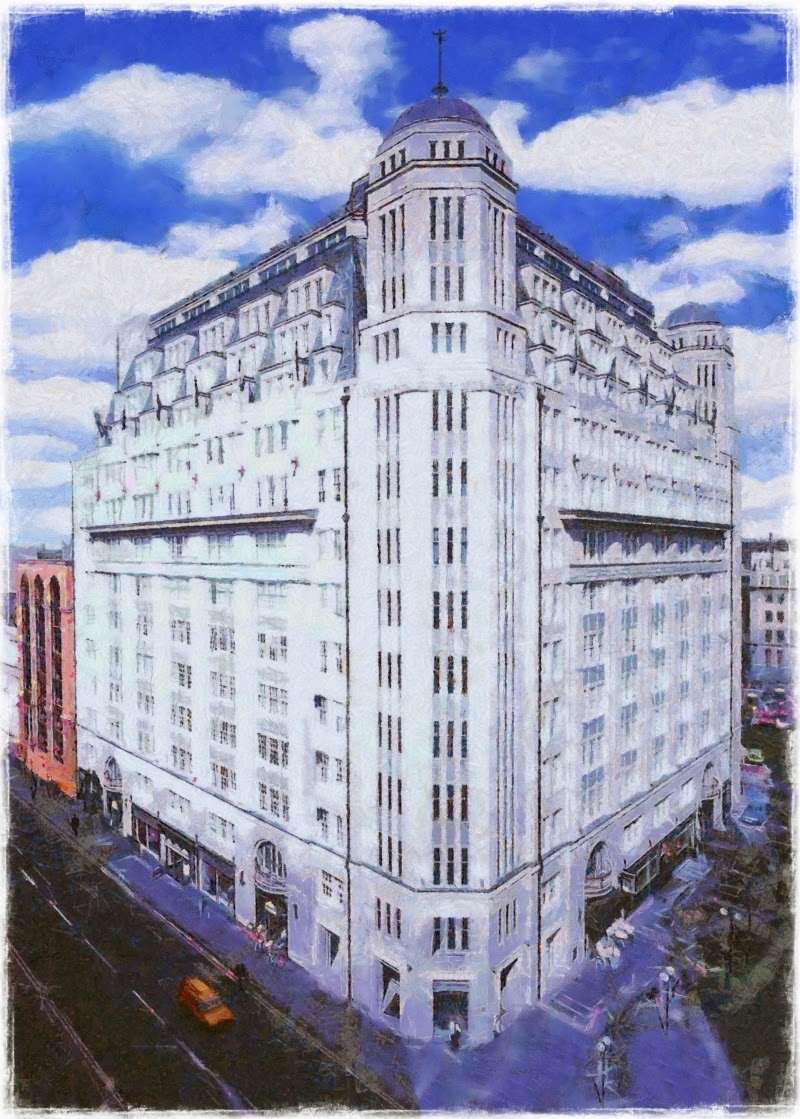
Sunlight House “a modern building with the best of old standards maintained"

Sunlight House, © 2013 Peter Topping
Last month I was on Quay Street with Sunlight House which when it was completed in 1932 was seen as a building which combined “modern conceptions of architecture in its sleekness and in the vertical lines, yet [retained] the best of the old standards of design.”*

It was designed and built by Joseph Sunlight as the headquarters for his business and was a lavish and modern building as befitted a man who claimed to have created more than one million pounds worth of property in the  first fourteen years as an independent architect.

Not that that he had it all his own way.

Just a few years after the building was opened his application for a license to serve alcohol was turned down.

And in 1949 he failed to get planning permission to “build a 35 storey extension to Sunlight House and a new 14-storey building between Peter Street and Jackson’s Row [because] the premises would dominate existing and proposed civic buildings, exceed the appropriate density of the area, injure the amenities of near-by buildings, and prejudice possible development plans.”**

So, even the mighty, wealthy and influential do not always get their way.

On Quay Street in 1911
Nor was his Parliamentary career a long one.  He was elected as the Liberal MP for Shrewsbury in the 1923 General Election only to lose the following year in the subsequent General Election.***

It is one of those interesting little asides of history that had he retained his seat he might well have seen his Brick Bill for the making of bigger bricks pass into law.

It was a private members bill which had survived its reading by one vote but fell by the wayside with the dissolution of Parliament in 1924.
All of which is a long way from Sunlight House and from the properties it replaced.

Now the Manchester Guardian had reported in 1931 that before Sunlight House “was erected the site contained some of Manchester’s worst slums.”

Twenty years earlier these had consisted of a mix of shops and lodging houses and judging from photographs may well have had their time.

*Sunlight House, the Manchester Guardian, May 12, 1931

And some of those who lived on Quay Street
**No extension to Sunlight House, the Manchester Guardian, July 2, 1949

***December 6 1923, October 29, 1924

Maps & pictures, detail of Quay Street from the 1888-93 OS map of South Lancashire, courtesy of Digital Archives Association, http://www.digitalarchives.co.uk/,  and street directory from Slater’s Manchester, Salford and Suburban Directory, 1911

Painting; Sunlight House, © 2013 Peter Topping, Paintings from Pictures,
Web: www.paintingsfrompictures.co.uk
Facebook:  Paintings from Pictures

Thursday, 9 October 2025

Posters from the Past ........... no 11 ........ coming home

Now the project is simple, take a modern image of a building we all love and turn it into the style of poster which was popular in the middle decades of the last century.*

Although in this case it is the ferry, which for many of us will always be special.

As kids it was the start of the adventure that took you across the river to that “other place” and for countless grownups the way you got to work.

The last time I used it was  when we were heading back north from Deal and having lost the M25 I managed to navigate a route that took us in to Eltham past our old house at Well Hall, and always one to seize an opportunity I suggested we make the river crossing at Woolwich.

And that pretty much restored my creditability.  Tina who is Italian just loved the experience.

And yes I know we had had to queue and the journey takes just a few minutes but she found it magic as did I.

All of which just leaves me to adapt that Samuel Johnson comment about London, “the best prospect any of us can see is the ferry crossing at Woolwich that takes us home.”*

Location: on the Thames at Woolwich

Painting; Coming home to Woolwich, © 2017 Peter Topping, Paintings from Pictures,  from a photograph by Andrew Simpson, 2012

Web: www.paintingsfrompictures.co.uk 

*Posters from the Past, https://chorltonhistory.blogspot.co.uk/search/label/Posters%20from%20the%20Past

**“The noblest prospect which a Scotchman ever sees, is the high road that leads him to England!”
Samuel Johnson, A Journey to the Western Islands of Scotland and The Journal of a Tour to the Hebrides

Wednesday, 27 August 2025

Mrs Keal and the mystery of 419 Barlow Moor Road

Leon's, 2015
It has taken sometime but I am closer to solving the mystery behind the date on the wall of  419 Barlow Moor Road.

Most people will know the place as Leon’s the fabric shop but I have long wondered why the building carries the date 1885 when it was built around 1915.

The Leon family began trading there in the 1990s and before that it had been the Addressal  Print Works which is listed in the directories by 1921 and for an even shorter time between 1915-17 it was the Chorlton Laundry owned by Mrs Keal.

Not that this helps with the date of 1885 which appears above the door along with the word Established.

Addressall Printing Works, 1959
Now it is just possible that the date refers to either establishment of the laundry or the printing company but there is no reference to Addressal in any of the directories in the late 19th century and any way the stone lettering looks like it was done when the building went up.

So I rather think we must be with Mrs Keal who was running a laundry business on Beech Road in 1894.

That said there is no evidence that she was trading before that date and in 1881 Mr and Mrs Keal were living in Croydon.

But by 1889 they had settled in Chorlton and were running a business from nu 30 Wilbraham Road.
Mr Keal described himself variously as a brick layer or builder and I suppose it is just possible that the date 1885 refers to the start up of his business.

Either way in1915 Mrs Keal was in that building on Barlow Moor Road operating the Chorlton Laundry.

Now I can’t be exactly sure when she moved in but in the April of that year Mr Keal of “Brookbank Bridge Barlow Moor-road died at Chorlton Laundry Brookbank Bridge.”

London Gazette, February 1917
And just over a year later the business went bankrupt.*

According to Mrs Keal at the bankruptcy hearing in the February of 1917 “the main cause of her coming into court was the shortness of loose working capital when she removed to her new premises in Barlow Moor Road after having carried on a similar business on less extensive lines for many years in Beech Road, Chorlton.

Mrs Keal further stated that after she had expended over £900 on new machinery so that she might undertake the laundry work of the military hospitals in Manchester a large proportion of the work was undertaken from her.”

But the “military authorities had established laundries under their own control.  Difficulties in the way of getting sufficient labour had it impossible for her to get the work done as promptly as the hospitals required [and] she could not overcome these difficulties by paying higher wages.”


She went on to say that “she had taken steps to strengthen the weak point in her business affairs which had been pointed out by her accountant.”

But it seems that was it and she finished up the business and moved to St Annes-on-Sea where she died in 1935 leaving £2625.

It is just possible that the date refers not to Mrs Keal's Laundry but to the building business of her husband which may well date from 1885.

And it t maybe the Leon family can help who could have the deeds to the building which will offer up its history.

Peter painted the picture of the building and while there he spotted the story of the Leon family which is displayed inside the shop.

It is a fascinating account of one family business stretching back across the last century and so by the time I get round to writing their story they may well be able to offer up a missing document.

Well we shall see.

Additional research from Tony Goulding

Picture; Addressall Printing Works (originally built for laundry), House adjoining used as office for printers, RE Stanley, m17530 courtesy of Manchester Libraries, Information and Archives, Manchester City Council, http://images.manchester.gov.uk/index.php?session=pass

Painting; Leon's Barlow Moor Road, © 2015 Peter Topping,
Web: www.paintingsfrompictures.co.uk
Facebook: Paintings from Pictures https://www.facebook.com/paintingsfrompictures

*First Meetings and Public Examinations, The London Gazette, February 16, 1917

**Laundry Proprieters Ill-luck. Failed with a surplus of over £3000, Manchester Evening News March 6 1917

Tuesday, 24 June 2025

Public Hall or Conservative Club?


The Conservative Club remains an iconic local land mark.  

Whatever you think of the politics of the place and there are many I know who refused to step into the building that has dominated the corner of Wilbraham and Manchester Roads for a century and more.

It was opened in 1892, on land granted by the Egerton estate and the building was paid for through an issue of shares.  What is interesting is that the shareholders consisted of the very wealthy  local professionals, tradesmen and farmers as well as domestic servants and warehouseman.

Which I suppose was partly a tribute to the political manoeuvrings of Disraeli with his brand of one nation politics and the astute way his government positioned itself ahead of the Liberals when it extended the franchise to sections of working men in 1867.  It may also have something to do with that old Tory paternalism which in the early decades of the 19th century saw leading Tories attacking factory conditions and the laissez faire politics of successive Whig governments.

But here I conceded I shall have to do more reading.  In the meantime I shall fall back on some research by my old friend Lawrence who has dug deep into the history of the building and points up the role of the Public Hall which was on the upstairs of the Con Club and was accessed by a separate entrance.

The “Public Hall” offered a venue for everything from amateur dramatics to political speakers and campaigns which in some cases ran contrary to the political views of the Con Club. Victor Grayson Socialist MP for Colne Valley spoke in the hall in 1908 and was heckled by members of the public, some I suspect who had made their way up from the Club below.  A number of drama groups also performed here along with a young John Thaw.*

“The architects were Darbyshire and Smith, who very well known especially for building theatres including the Palace in Manchester) and pubs like the Marble Arch on Rochdale Road.   The front entrance went into the Conservative Club and a side entrance on Manchester Road went upstairs to the Public Hall which had a stage.   

The capacity was given variously as 700 to 800. There was a separate entrance to backstage area, a caretakers building at the rear and kitchens in the basement with a lift system to bring food upstairs.

The foundation stone was laid on Saturday April 25th l 1891 by Cunliffe Brooks and Lady Brooks and there was a dinner and speeches in the Lloyds opposite.

A year later the Club was opened on Saturday April 23rd 1892 by Lord and Lady Egerton along with Lord Cross an old Tory grandee, who had been Home Secretary in the Disraeli Government.

And three years later the clock which had been paid for by  subscription was unveiled.  It  was made by William Potts & Sons of Leeds  had three faces was lit by gas.”**

It was the first public clock in Chorlton and takes us back to the fact that the building was more than just a Con Club.  For the best part of a century it had also been a public place and from this seems to have risen the confusion as to the name and purpose of the building.

Many old postcards from the early decades of the 20th century refer to the building as the Public Hall not the Conservative Club leading one local historian to wonder which it was.  I guess for many in Chorlton it depended on who you were and how you visited the place.

Now I could have featured one of the many old photographs but instead have chosen Peter’s painting of the Club shortly after it closed for the last time.  Peter as you know paints the pictures and I tell the stories so it seemed fitting that this should be the image to use, especially given that the future of the building is still in the realms of speculation.

Picture; The Conservative Club, September 2012, © Peter Topping, web: www.paintingsfrompictures.co.uk  facebook: www.facebook.com/paitningsfrompictures

* John Thaw, 1942 –2002) was an English actor, who appeared in a range of television, stage and cinema roles, his most popular being television series such as Redcap, The Sweeney, Home to Roost, Inspector Morse and Kavanagh QC.
** read Lawrence’s blog at http://hardylane.blogspot.co.uk/

Friday, 18 April 2025

Sunlight House a building “which has improved the appearance of the city and given it a dignity”

Sunlight House, © 2013 Peter Topping
Sunlight House is still a pretty impressive building and has been so since it was built in 1932 by the architect Joseph Sunlight.

It stands on Quay Street just down from Deansgate and a little before you get to the Opera House.

It was at the time according to the Manchester Guardian, “the tallest and largest building in Manchester, [standing] on a site of 3,000 square yards and rises 200 feet from the red rock foundations to its roof ridge. 

People who pass it are amazed at its massiveness.  It is a landmark which can be seen on a clear day from the Belmont Hills beyond Bolton, twenty miles distant.” 

Now I rather think I will go looking for what people thought about the building in 1931, and particularly on its impact as a landmark, if only to reflect on the response to that other tall building, which is the Beetham Tower.

The Beetham Tower is the tallest building in the Manchester dominating the sky line and can be seen from miles outside the city.

I do have mixed feelings about this modern giant alternating between that easy and lazy response that it is a blot on the landscape to marvelling at its sheer size and elegance.  But that I guess is how all new buildings are viewed.

Like Sunlight House the Tower sits on a comparatively small plot on Deansgate and is named after its developers.

But this is not about the Beetham Tower so I shall return to that article from the Guardian which writes

“It is shaped almost like a cube and is so proportioned as to be classic in form.  Modern conceptions of architecture are expressed in the sleekness and in the vertical lines.

There are sixteen storeys in the building and about a thousand rooms.  The basement, lofty and with large top-lighted dome is to be used as a restaurant and the ground floor for shops or showrooms and restaurant-café.

The occupants of the top floors will be able to enjoy fresh breezes in a healthy environment, unfamiliar in narrow streets and dark offices.

Every modern aid to cleanliness and efficiency is embodied.  The floors are of polished oak throughout the building.  

An electric vacuum cleaning apparatus draws the dust down to a receptacle in the basement.  

Express lifts are installed to travel at 450 feet per minute.  In every room there is an electric synchronised clock.

The architect has taken particular care to arrange for the most adequate lighting and ventilation.  

By widening the adjoining street to twice its previous breadth he improved the lighting at the same time as he enhanced the building perspective.  

The result is that people in the offices in Sunlight House will work under hygienic conditions.  The heating system of radiators is, further, conducive to cleanliness in the atmosphere.”

And at this point in the article I have almost lost the will to live.

Now I know that the newspaper story is a valuable contemporary account and no doubt the people who worked there were impressed but the piece reads just like a promotional extract from Mr Sunlight’s own notes.

An observation which is confirmed by the claim that

“Before this new pile was erected the site contained some of Manchester’s worst slums, and it is satisfactory to note, in view of the difficulties which Manchester and other places are having in the matter of removing slum populations and providing them with alternative accommodation that private enterprise has helped to transfer successfully the tenants of a congested area and put up a building with a rateable value of “30,000 a year.”

Which is where I shall leave Sunlight House for today, but there is more and I shall return tomorrow with just a little bit more on the building, its architect and his frustrated plans.

*Sunlight House, the Manchester Guardian, May 12, 1931


Photograph; properties on Quay Street, 1910, m68184,courtesy of Manchester Libraries, Information and Archives, Manchester City Council 


Painting; Sunlight House, © 2013 Peter Topping, Paintings from Pictures,
Web: www.paintingsfrompictures.co.uk
Facebook:  Paintings from Pictures

Sunday, 30 March 2025

Chorlton Pubs and Bars ........ the gang of '36 at the Horse and Jockey

Now I like the way that people continue to be generous with both their family pictures and the memories.

So I was very pleased when this one was sent to me by Yvonne.

The Horse and Jockey will always be special to me, not only because as one of our oldest pubs it featured in my first book and was the venue for its launch but also because as the “Pub on the Green” it has been at the centre of much of Chorlton's history.*

But rather than ramble on I will share Yvonne’s description of the picture.

"Hello Andrew!  I enjoy reading your post on the Chorlton Blog.  

I was born there - leaving when I was 8.  I have a photo of my mother and sister with their 'gang' from about 1936 outside the Horse and Jockey.  

It’s of a 'gang' of 'teenagers' just before the War outside the Horse and Jockey. 


My mum Dilys on the left, her sister Gwen on the right. She used to tell us all their names but the only one I can remember is Joe Rook!”

And that is a pretty good start.

Yvonne hopes it will “stir some memories up” and so do I.

In the meantime I will go looking for Joe Rook in the historical records.

All of which just leaves me to thank Yvonne.


Location; Chorlton

Picture; A 'gang' of 'teenagers' outside the Horse and Jockey circa 1936 courtesy of Yvonne Richardson

*The Story of Chorlton-cum-Hardy, 

Saturday, 28 December 2024

Posters from the Past ........... no 7 enjoying a film and a night out at the Grosvvenor

Take a modern image of a building we all love and turn it into the style of poster which was popular in the middle decades of the last century.

It was a bit of fun from Peter which has become the series Posters of the Past.*

And today it is the turn of the Grosvenor which was opened in 1915 to a design by Percy Hothersall and with almost a thousand seats was I think the biggest cinema outside the city centre at the time.

Even now long after its days as a place to see films have ceased it is still a pretty impressive building.

Its green and cream terracotta tiles marked it out on that stretch of Oxford Road which apart from the Town Hall opposite and the old offices of the Poor Law Union on the corner of Cavendish Street was a drab spot.

And I just missed going there.

It closed as a cinema in 1968 and I had to be content with using it as a pub which it had become after unsuccessful stints as a bingo hall and snooker venue.

Still some of the original features still exist including the balcony, vaulted ceiling and much plasterwork although they have not been treated well.

I guess the cinema entrepreneur, H.D. Moorhouse would be less than amused.  Pretty much all his working life was given over to picture houses and the films, having started as an accountant he got drawn in with a parts share on one and later a string of cinemas, across the city.

And now his cinema is a pub.

So instead let’s slide back to a time when the price of admission to a night of dreams, fears and adventure was just 6d.

I think it would have to be the 1930s with that wonderful film Things to Come.  Of course yours will be different but as they say “you can be at my film night if I can be in yours.

Poster; The Grosvenor, © 2016 Peter Topping

Web: www.paintingsfrompictures.co.uk

Facebook: www.facebook.com/paintingsfrompictures

*Posters from the Past  https://chorltonhistory.blogspot.co.uk/search/label/Posters%20from%20the%20Past


Wednesday, 23 October 2024

Painting Well Hall and Eltham ....... Nu 4 our house on Well Hall Road

An occasional series featuring buildings and places I like and painted by Peter Topping.

Now there had to come a time when I decided my bit of Well Hall Road should be recorded.

It came out of a conversation with Peter about the house two doors down which had been bombed in the Great War.

Tricia Lesley discovered the original war time photograph, Daniel Murphy tracked down its location to the same block where I grew up and with Tricia’s help we uncovered the full story.

All of which I have written about* and with that all done I asked Peter to paint the house knowing that in doing so our house would  get a look in.

But modest as I am I was content that part of it would be obscured behind that small tree.

Back in the 1960s when we moved in to 294 the spot was dominated by a tall oak tree which I guess had been planted when the estate was built.

It pretty much hid our house completely and in the fullness of time will do so again, but for now that's my old bedroom very much as I remember it and that will do for me.

Painting; 294 Well Hall Road, © 2015 Peter Topping 

Web: www.paintingsfrompictures.co.uk

Facebook: Paintings from Pictures https://www.facebook.com/paintingsfrompictures

*Zeppelins over Well Hall,
http://chorltonhistory.blogspot.co.uk/search/label/Zeppelins%20over%20Well%20Hall

Monday, 25 March 2024

A little bit of our tiled past on Beech Road above the cocktails and pizzas

John Williams & Sons Ltd 2015
I can’t be exactly sure when this bit of tiled wall disappeared behind the false wall at number 32 Beech Road, but I am guessing it will have been sometime in the 1960s when the grocery shop which was John Williams and Sons became the Maypole Launderette and later still the Soap Opera.

And like many others who sat watching the washing going round and then waited for the clothes to dry in those huge tumble driers I was totally unaware that hidden from view high and close to the ceiling beside the window there was this sign.

The other surprise was that John Williams and Sons were not local traders but in fact owned a chain of grocer shops across the city and beyond which in 1931 accounted for 41 shops of which there were three in Chorlton**, six in Didsbury and another four in Rusholme.

John Williams & Sons, 1932
Back in 1895 they are listed  with five shops in Didsbury and Fallowfield which by 1911 had become 11 with John Williams described as managing director and the head office at 400 Dickinson Road.

Later still although I can’t date it is a wonderful advert for the company which advertises their ‘“Dainty, Delightful Delicious Tea, [from] John Williams & Sons limited, “The Suburban Grocers”, [at] 28 Victoria Street Manchester Stockport & Branches’.

And looking at the interior of one of their shops sometime in the early 20th century there is more than an element of “class” about the place.

So while the shelves groan with tinned produce and between the potted plants are the familiar posters advertising Californian Apricots at 6½d, and Coffee and other things, it is less cluttered, less in your face and far more discreet than some of the grocery chains of the period.

Taking in Beech Road in 1932
Of course we will never be quite sure whether our John William’s was typical of the chain but I rather think it will have been for then as now there was a corporate brand image to maintain.

Certainly the picture of the Beech Road shop in 1932 would suggest as much.

Which brings me back to the tiled bit of the wall.

Now given the way these things work I doubt that there will be many of these left, most will have been painted over covered in a thick skim of plaster or just knocked off the wall.

The closed Soap Opera, 2011
So all credit to the owners of the Launderette who have incorporated this little bit of the buildings past in the present decor.

They of course have also given a nod to the buildings previous use and now also to its time as a grocery store, all of which reminds me that the price of preserving the past is eternal vigilance which I am the first to admit is to misquote what the American Abolitionist and liberal activist Wendell Phillips said in 1852.**

Now that is almost where we came in because I only discovered that bit of tile after yesterdays story on Beech Road in 1932, which prompted Anne-Marie Goodfellow to point out that it had been preserved by the restaurant.

And in turn that led me back to two of Peter Topping’s painting from his series which set out to record how Chorlton was changing.

The Launderette 2014
Late in 2011 Peter had painted the Soap Opera after its last rinse and tumble dry had finished and went back just after the Launderette had opened its doors offering “cocktails and carbs” and much more.

Now I bet there will be plenty of people who also have pictures, memories and the odd bit of memorabilia from a lost Chorlton shop which we would all like to share.

To which John added,    "I used to deliver orders on a real order bike with a big cage on the front, from that very shop on Beech Road, 15/- bob a week, and tips. 1959/60."

Which is a nice way to conclude, given that we started with that tiled sign  for John Williams and Sons, purveyors of all things grocery and end with John the delivery boy.

Pictures; the tiled advert for John Williams and Sons, 2015 from  the collection of Andrew Simpson suggested by Anne-Marie Goodfellow and  Beech Road in 1932 from the Lloyd Collection

Paintings; the Soap Opera, © 2011 and the Launderette, © 2014, Peter Topping, 
Facebook; Paintings from Pictures, Web: www.paintingsfrompictures.co.uk

*32 Beech Road, Wilbraham Road, 211 Upper Chorlton Road.

**“Eternal vigilance is the price of liberty” Wendell Phillips on January 28, 1852, speaking to members of the Massachusetts Anti-Slavery Society.

Saturday, 16 March 2024

Painting Well Hall and Eltham ....... nu 2 the Greyhound

An occasional series featuring buildings and places I like and painted by Peter Topping.

I always remember this as the Greyhound and it will have been one of the first pubs I went into when I was old enough and so I asked Peter to paint it using a photograph taken by Chrissy Rose.

Peter and I have been working together on projects for almost a decade including two books and an 80 meter installation along with various smaller displays and plenty of commissions.

And next time I am home I might book to eat in the restaurant.

Location; Eltham, London


Painting; Ye old Greyhound © 2015 Peter Topping from a photograph by Chrissy Rose 2014

Web: www.paintingsfrompictures.co.uk

Facebook: Paintings from Pictures https://www.facebook.com/paintingsfrompictures

Friday, 15 March 2024

Painting Well Hall and Eltham ....... nu 1 the Library

An occasional series featuring buildings and places I like and painted by Peter Topping.

Like many in Eltham I continue to remember the library with great fondness.  It was a place I used a lot, borrowing books and records from its collection and spending hours in the reference section.

It was also where our Stella worked and for all those reasons it was the first building I asked Peter to paint using a photograph taken by Chrissy Rose.

Peter and I have been working together on projects for almost a decade including two books and an 80 meter installation along with various smaller displays and plenty of commissions.

And that is all I want to say.

Location; Eltham, London

After all I have written about the library already and its history is well known.*

Painting; Eltham Library © 2015 Peter Topping from a photograph by Chrissy Rose 2014

Web: www.paintingsfrompictures.co.uk

Facebook: Paintings from Pictures https://www.facebook.com/paintingsfrompictures

* The Library on the High Street, https://chorltonhistory.blogspot.co.uk/search/label/Eltham%20Library

Thursday, 14 March 2024

Posters from the Past ........... no 12 ......... something is stirring down in Woolwich

Now the project is simple, take a modern image of a building we all love and turn it into the style of poster which was popular in the middle decades of the last century.*

And supposing these figures had been in place in 1946, may be the Tourist and Information Office of the Borough of Woolwich might have used them to draw those who seldom cross the river from the north of the city to see our bit of London.**

Greenwich might have had the Naval College, and the Royal Observatory and later the Cutty Sark but we had the Royal Arsenal, a pretty busy market ,and trams that could take you south to the delights of Shooters Hill, Well Hall Pleasaunce and Eltham Palace.

All of which makes me think I shall nominate some more places for Peter to paint and reproduce as posters from the past.

And of course invite people to submit their own copyright free iconic image

Location: Woolwich

Painting; Coming home to Woolwich, © 2017 Peter Topping, Paintings from Pictures,f rom a photograph by Colin Fitzpatrick, 2012

Web: www.paintingsfrompictures.co.uk 

**Posters from the Past, https://chorltonhistory.blogspot.co.uk/search/label/Posters%20from%20the%20Past

** Assembly, by Peter Burke, Woolwich Arsenal 2001

Tuesday, 13 February 2024

Down on Chorlton Green with the Penny Savings Bank

I like the way stories have a habit of coming around all over again.

And so it is with the Penny Savings Bank.  It was set up in 1887 and according to the bank “any sum may be deposited between One Penny and £50. When the account reached £1 it is transferred to the Manchester and Salford Savings Bank. “

Our branch met every Saturday between 6 and 7 in the old school on the green.

And in placing the Penny Savings Bank on the green “the Trustees and managers” were clear in their own minds that perhaps this area was more likely “to see a large increase in the number of depositors, and cottager’s domestic servants, and parents on behalf of their children.”

After all this was the old centre of Chorlton and still retained something of its rural character including those of meaner means.

All of which was in direct contrast to the new village or New Chorlton which was centred on what we now call the Four Banks but which many will still remember as “Kemps Corner.”

This area grew quickly in the years after 1880 and catered for the new middling people who were moving into Chorlton attracted by its pleasant surroundings but also by the quick rail connection into the heart of the city and later by the extension of the Corporation tram network.

So swift and complete was the development of the area that its old name of Martledge was lost and forgotten in a generation.

And it led to that division of Chorlton in to the “old village” and the new, a division which was still there in the minds of many who were born here.

My old friend Marjorie who had been born in the old village and lived on Provis Road remained a little aloof at that “other bit” which she maintained was all “fancy cakes and silk knickers.”

Now that might have been a tad unfair but from the 1880s that was where the money was in the form of the professional, managerial and clerical classes.

And in turn that was where the banks were leaving us at the other end down by the Green with a post office and a Penny Savings Bank which with the passage of time has now left us with neither.

So I am drawn to both Marjorie’s memories of attending the bank in the 1940s and also by Sandra’s advert she sent me of the Penny Savings Bank dated 1934.

Marjorie remembered depositing money there along with her sister and it was a story I had let slide to the back of my memory.

But Sandra’s ad brought it all back along with that division of the two parts of Chorlton.

Today of course that distinction has pretty much receded in to the past along with Kemp’s Corner and the old school on the green.

And it was yesterday’s story of the conversion of the school and a painting by Peter Topping that prompted Sandra to show me the advert and set off today’s memories

Picture; advert for the Penny Savings Bank, 1934, from the collection of Sandra Hapgood, a Post Office Savings Tin circa 1940, courtesy of David Harrop

Painting; The school on Chorlton Green, © 2012 Peter Topping
Web: www.paintingsfrompictures.co.uk

Facebook: Paintings from Pictures https://www.facebook.com/paintingsfrompictures