Showing posts with label Camberwell. Show all posts

Sunday, 25 August 2024

Mr George Dansie of Barforth Road Peckham Rye ......... currently residing in Manchester

Now recently I came across one of those fascinating links that connected my current city of Manchester with where I grew up in Peckham on Lausanne Road.

George writes home, 1917
And the connection was a Mr George Dansie of Barforth Road Peckham and a picture postcard he sent from Manchester in the November of 1917.

The card was of the Manchester YMCA in Piccadilly which was a temporary wooden building erected in the grounds of what had once been a hospital.*

It was also known as the Khaki Club and although meant for soldiers recuperating from wounds and shell shock was open to any servicemen and became a popular club.

I have yet to find out what Mr Dansie was doing in Manchester but given that he had been born in 1890 it is more than likely that he was stationed in the city.

There are a few men with his name in the military record and one in particular who was in the Royal Army Service Corps could be him.

The Manchester YMCA, 1917
Sadly George doesn’t give too much away in his message home.

He writes that he “will be writing a letter to you tomorrow” and that he had been to two theatres last week and was planning to visit another.

But what caught my eye was a sentence he added as an afterthought and squeezed into the top of the card where he wrote that the Manchester YMCA “is very like the Camberwell hut.”

And that took me on a journey which ended with the Camberwell hut or at least a painting of the building.

The Camberwell YMCA, 1917
The picture is in the collection of the Southwark Local History Library and Archive and according to the background notes was painted in 1917 by "the artist Russell Reeve who was born in Norfolk and lived in Hampstead. 
He studied at the Slade School of Fine Art and the Royal Academy of Art. 

In 1916 permission was granted for the building of a YMCA hut on Camberwell Green for the use of passing troops."

The Camberwell building is not unlike its Manchester companion and leaves me wondering what its fate might have been.

Interior of the Manchester YMCA, 1917
I don’t remember it but then we left Peckham for Eltham in 1964.

The Manchester YMCA was demolished sometime around 1920 when the site was turned into a public park.

So the hunt is now on to discover more of the history of the “Camberwell hut.”

Location; Manchester, Peckham and Camberwell

Pictures; YMCA Hut on Camberwell Green, 1917 Russell Reeve, GA0325, courtesy of Southwark Local History Library and Archive, the Manchester YMCA postcard from the collection of David Harrop and the picture of the interior from the collection of Bill Sumner

* Piccadilly Gardens ....... the early years nu 1 The YMCA Hostel 1917,

** Southwark Local History Library and Archive 

Friday, 29 April 2022

That record shop in Camberwell, ten welfare hints for your 78s ......... and a charity

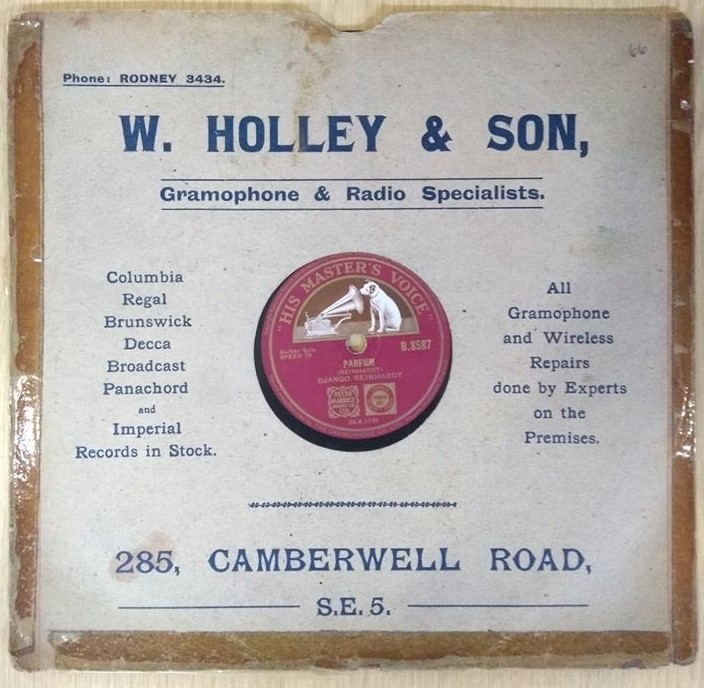
You won’t find the shop on Camberwell Road, that sold Django Reinhardt’s Parfum.*

I have no idea exactly when W. Holley & Son traded from 285 Camberwell Road, or when their shop was demolished or perhaps even destroyed.

Today if I have got this right, the site is occupied by one of those large blocks of Council flats called Lamb House.

But I must confess I am well out of my comfort zone.  As a kid in the 1950s, I seldom strayed to Camberwell from Peckham, and by 1964 had washed up in Well Hall, with no inclination to go back and explore the place.

The only clue I have is that Django Reinhardt recorded Parfum in Paris in April 1937, so perhaps that sort of fixes a date for the shop of W. Holley & Son.  The best way of finding out is trawl the directories, but sadly I don’t have access for those which will include Camberwell, and Manchester is a long way from south east London.

But there is a connection between here and Camberwell, and that is the record collection of which this 78 rpm was part of.

Happily, the collection is quite large, and all the records are still in their dust sleeves.  Their owner had an eclectic taste, with the range running from Django Reinhardt, to South Pacific, Sloppy Joe by Ted Heath and his Music, to Doris Day singing What Ever Will Be.

Nor were all the records bought in London, one came from Walkden in Salford, but most were from Manchester, and were sold by the big department stores, including Kendal Milne on Deansgate and Lewis’s.

What is particularly fascinating is the information printed on the record sleeves.  So, Lewis’s were announced that they “sell everything for everybody to wear and most things for personal use and for the home”.  

And “for ordinary purchases Lewis’s deliver free by their vans, by post, or to the nearest railway station”, and "paid the postage irrespective of the amount of your purchase”.

My favourite sleeve carries an advert for Songster Needles, which also came with a set of helpful hints of which there were ten, and purchasers were urged to “Ask your dealer for the full set, and use only Songster needles for purity and safety”.

In an age of “music streaming” there is something quite attractive about collecting as well as Holding your choice of music, along with reading the sleeve and record label.

All of which just leaves me to thank my friend Neil Simpson who found the collection while working as a volunteer for Wesley Community Furniture*, which provides “household goods to people in need. 

To that end, the Wesley provides the transport and labour to collect donations from people throughout Greater Manchester & N Cheshire. 

These donations are brought to the shop units where they are sorted, assessed for condition, repaired where possible, renovated when feasible and displayed for sale.

Clients either come off the street or are referred by agencies and are helped to choose from stock purchases which can then be delivered to their homes. Collections are free of charge (delivery with small charge).

Referred clients are offered our job lot/home start packages which consist of the basics people need for independent living for less than it would cost if the items were bought individually”.

So, there you have it ……….. a little bit of our music past, from Camberwell to Manchester, from Django Reinhardt to Doris Day, via Wesley Community Furniture.

Location; pretty much everywhere

Pictures; record sleeves, 2020, photographed by Neil Simpson

*Parfum, Django Reinhardt, https://www.youtube.com/watch?v=fijm2NNfyeE

** Wesley Community Furniture, http://wesleycommunityfurniture.co.uk/?fbclid=IwAR2d8XSmHHiZmE05nNx0Rr4R3DgRLfaoRmcmNfYpEWIfT0hFEbRz-rnWrVI


Sunday, 8 July 2018

Now you can go looking for a water trough and five turn up on the same day

My water trough was at the top of St Mary’s Road where it joined Evelina Road.

I remember it from the 1950s and so did Linda and Joan and in the case of Joan she told me that  “you have just given me a memory jolt... I can recall my mum telling me off for trying to get into that trough..... it was all green and slimy inside !!”

I vaguely remember others and said I would set myself the task of looking for them and it is a search which has already been helped by Ros, Linda, Sue, Sharon and Helen who all came up with fresh sites.

So now I know of the one on the Old Kent Road where it joined New Cross Road, the two at the top of Deptford Road, the one at Vassel Road and a fifth outside the Kentish Drovers on Commercial Road where Sue’s mum fell in “and swallowed her false tooth celebrating on VJ night. What a night that must have been” and finally one on Southhampton Way.

There will be others, after all there were lots of horses and other livestock on our streets and all needed watering.

So the project has just started.

I am hoping for more stories and pictures.  Pat has promised one of the tough at Vassel Road.

So as they say watch this space.

Thanks to Linda Barnes,Helen Middleton, Sue England, Joan Griffiths Sharon Wood, and Pat Ross.

Picture. down on Bexley Road 2014, courtesy of Jean Gammons

Saturday, 29 August 2015

Searching the records of two Camberwell cemeteries has just become a bit easier

Now I don’t have any one buried in Camberwell but I bet there will be plenty of people who do so it might be of interest the burial books from two south London cemeteries are available online.

Details of more than 300,000 burials at Camberwell Old and Camberwell New cemeteries have been uploaded to deceasedonline.com where they can be searched by name and year of internment, according to WHO DO YOU THINK YOU ARE? magazine.*

As well as a scan of the page on which the entry appears, each record contains a grid reference and links to a cemetery map, enabling the family historian to determine the exact location of their ancestor’s resting place.

Both sets of digitised records date back to the years in which the cemeteries first opened.

For Camberwell New Cemetery this is 1927 while for Camberwell Old Cemetery users can explore material from as early as 1856.

The release of the new datasets means Deceased Online now holds more than 700,000 records for cemeteries owned by Southwark Council.

Records from Honour Oak Crematorium, situated in the grounds of Camberwell New Cemetery, will be added in the next few weeks.**

Searching is FREE, and can be restricted as required to country, region, county, or individual burial authority or crematorium. If you register with Deceased Online, you will be able to purchase vouchers online, which you can spend to access further information associated with any of the found records. Or you can pay annual subscription of £89.

Pictures; Nunhead Cemetery from the collection of Sue Simpson

* WHO DO YOU THINK YOU ARE?, September 2015,  issue 104, http://www.whodoyouthinkyouaremagazine.com/

** Deceased Online, deceasedonline.com

Monday, 29 June 2015

Standing on Willowbrook Road and wondering about the story behind the stone inscription on the Taylor Bridge

That stone, 1870
Now I just wonder what Edward Dresser Rogers would have made of the state of his foundation stone on Willowbrook Road.

It was laid in 1870 to mark the building of the replacement bridge over the Grand Surrey Canal.

The canal connected Camberwell to the Surrey Commercial docks and it opened in stages with the first stretch reaching the Old Kent Road in 1807, Camberwell three years later and finally arriving in Peckham in 1826.

Now according to my copy of Priestly* “the intended canal and cuts [were] supplied with water from the Thames, and all other rivers, streams, or brooks found in digging the said canal, except the River Wandle.”

But according to Mr Priestly “the work has not yet remunerated the proprietors for their outlay” and he was quite pessimistic it ever would.

That said the canal would still be doing the business until the end of the Second World War, when like so many canals it went into steep decline and was drained and filled in 1960.

So back in 1870 it was everything you would want of a working canal but needed a new bridge.  The old one known as Taylor’s was no longer fit for purpose and was replaced.

Which brings us to that stone foundation much weather worn and vandalised.

The canal making its way through Camberwell, 1830
With the help of that excellent site, Burgess Park and the story that featured the Bridge to Nowhere reflecting back in time** I know that “in 1870 bridge replaced an earlier one, possibly wooden and opening to allow barges through, which had probably begun to cause traffic congestion. 

The local vestry, St Giles Camberwell, provided the funds, and the foundation stone, which may be seen underneath on the old towpath, was laid by Edward Dresser Rogers, Chairman of the General Purposes Committee of the Vestry, in 1869. 

The designer of the new bridge is named in the records as Mr. Dredge, Junior, a civil engineer.”

But if you want more you will have to follow the link and read the full story along with some excellent pictures.

That said I think I want to know more about Edward Dresser Rogers who lived at Hanover-park Rye Lane and left his name on that stone..

So as they say in those old films. and with an apology to Fu Manchu, .......the world has not heard the last of Mr Edward Dresser Rogers.

Pictures; that foundation stone kindly supplied by Constance Marie Gurney, and detail of the Grand Surrey Canal, going through Camberwell, from 1830, The Inland Navigation of England and Wales 
1830, George Bradshaw, courtesy of Digital Archive Association, http://www.digitalarchives.co.uk/

*Historical Account of the Navigable Rivers, Canals, and Railways Throughout The United Kingdom, John Priestly, 1830

** The Bridge to Nowhere reflecting back in time, Burgess Park, http://www.bridgetonowhere.friendsofburgesspark.org.uk/the-story-of-burgess-park-heritage-trail/heritage-trail-m-w/willowbrook-bridge/