Showing posts with label Alternative histories. Show all posts

Wednesday, 30 September 2026

Chorlton's own radical ... Thomas Walker

This is the story of Thomas Walker one time pillar of Manchester society but also a radical politician who campaigned for the abolition of the slave trade, supported the French Revolution and was indicted for treason in 1794.

The family lived at Barlow Hall from the late 18th century spending the summer there before moving back for the winter to their town house on South Parade which faces what is now Parsonage Gardens.
And it was there that a mob attacked Walker who was forced to drive them off by discharging a pistol in the December of 1792.

This was at the height of political debate over the issues of press freedom and the French Revolution.
“Emboldened by drink and fired on by agitators, groups hostile to the radicals began to gather around the city.  Walker was in no doubt that this was pre planned.  
‘Parties were collected in different public houses, and from thence paraded in the streets with a fiddler before them, and carrying board on which was painted with CHURCH and KING in large letters’ 

On four separate occasions a mob gathered outside South Parade, broke the windows and attempted to force their way in.  Supported by friends Thomas Walker was forced to fire into the air to disperse the crowds.

The magistrates did nothing to prevent the events and while a “regiment of dragoons was in town, booted and under arms”    and ready to disperse the rioters no order was given.

As if to add insult to injury the main concern of the magistrates when they finally met Walker was that he should not fire at the crowd again if the mob returned!  These attacks had been matched by similar ones on the home of Priestly in Birmingham and in Nottingham.”*
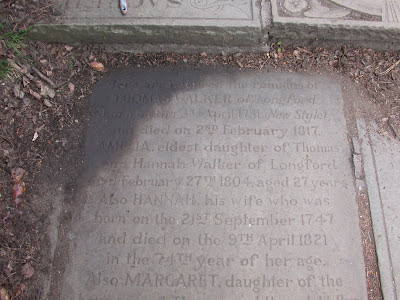
Walker survived both the attacks and was acquitted of treason, after which he retired to the new family home at Longford House where he died in February 1817 and was buried in the parish church on the green.

Location; Chorlton

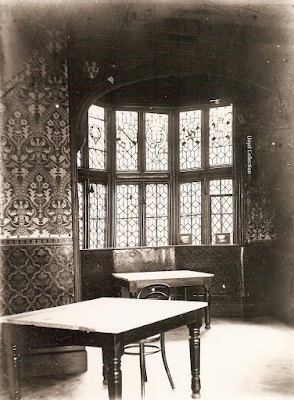
Pictures;  Barlow Hall, circa 1890, from the Lloyd Collection, and the Walker family gravestone in the parish churchyard from the collection of Andrew Simpson, 2011.

Next; Thomas Walker and the campaign to abolish the Slave Trade

* The Story of Chorlton-cum-Hardy, Andrew Simpson, 2012, http://chorltonhistory.blogspot.co.uk/search/label/A%20new%20book%20for%20Chorlton


Tuesday, 29 September 2026

The day I lost a Chorlton Chartist


Well to be more accurate, it was more the day I invented one who never was. 

It all looked so good.  In the June of 1847 Alexander Somerville had walked the lanes of Chorlton looking for evidence of potato blight and discovered a potato called the “radical.”

His autobiography recalled how he had been flogged while in the army for distributing letters arguing that the military should not be used against those groups campaigning for the Reform Bill and there he was being quoted by Engels in The Conditions of the English Working Class.  So as you do I made an assumption and I was wrong.

He did “earnestly desire to see the enfranchisement of the working people” but disagreed with those Chartists who “think they can effect that great consummation by fighting for it.”* “In the first place, there is yet not a national desire for that enfranchisement; there is on the contrary, a general aversion to it among all persons of property.”  

This led him in turn to attack the Chartist leaders because “their practice has been to excite hatred between classes [and] until there is an alliance between classes there cannot be in Britain an act of universal enfranchisement.”

This correctly harps back to the convergence of interests between the reforming elements in the middle and working classes during the campaign for the reform bill in the 1830s but misses the point that by the late 1830s that shared interest did not exist anymore.  The middles class had the vote and could see no reason to share it.

So given the worsening economic situation, and the rejection of the first Charter it is easy to see how some Chartists might be drawn to physical force.

Now despite never being a pacifist Somerville was equally unhappy about the use of violence.  He had after all been flogged for trying to stop force being used against the supporters of reform in Birmingham in 1832, and maintained that the Chartists “avowed belief that they can do physical battle with a few wretched pikes, against the regularly armed military forces, are not likely to obtain sympathy of the people, interested in the preservation of property.”

It was this same opposition to civil insurrection which had led him in 1834 to inform on a plan  to assassinate members of the Cabinet and the Royal family and seize control of Parliament and the Bank of England.  In is autobiography Somerville justifies his actions on the grounds of the strife, loss of life and damage to property which would have ensued had the plot gone ahead.

But there is that other giveaway clue in his comments on the preservation of property, which mark him out as marching on a different path. He was convinced that those Chartists who were hostile “ to the existence of private capital , moneyed or landed” were wrong.  It was this that led him to oppose the Chartist Land Plan as unfeasible.

Equally he could see that “the capitalist, merchants, master manufacturers, and master shopkeepers” by continuing to block reform would not be able to escape the consequences of heightened class conflict.

So if the opposition to widening the franchise was because they believed “the mass of the people to be dangerously ignorant .... I would say educate liberally and universally. There is no middle course; either give schools and votes, or barrack yards and bullets.  I am for schools and votes.”

Now I may be airing a prejudice when I think that class interests might have been the hidden factor in the opposition to extending the vote, but as a principle I am right behind Alexander.

So not perhaps a Chartist who passed through Chorlton but a radical none the less.

*Somerville, Alexander, The Autobiography of a Working Man, 1848, page 509 Google edition page 521

Picture; The Great Chartist Meeting on Kennington Common, April 10 1848, by William Kilburn

Monday, 28 September 2026

A Chorlton Chartist, Alexander Somerville, well almost


I think I am close to finding my Chorlton Chartist.

Or in fact two, although having said that neither was born here or lived here, but one passed through in 1847 and the other one was born in Didsbury and lived just over the Mersey in Northenden.

Perhaps a little tenuous but a link and makes the point that we were not an isolated community but just four miles from the city and would have been alive to all that was going on. Our farmers and market gardeners visited Manchester to sell their farm produce, and in return we got the carriers who transported goods in and out of the township, the itinerant traders and plenty of Sunday visitors.

So all the news, the great debates and issues of the day that occupied the nation would work their way into the village and surrounding hamlets.

The fall of the Bastille, the cry of Liberty Fraternity and Equality, and the great surge of radical demands as well as the agitation for the protection of living standards as time got harder during the 19th century would have been heard here.  And it was a soldier from Manchester walking into the township with friends who brought the message of Methodism.  Added to there was the Duke’s Canal and the railway built in 1849 both of which made us even closer to all that was being done and said in Manchester.

The wealthy businessman Thomas Walker was just one such powerful voice.  He lived at Barlow Hall and later Longford House was buried in the parish church and embraced the ideas of the French Revolution and the abolition of the slave trade.  His life was threatened his home in Manchester attacked by a mob and he was put on trial for sedition*

All of which I have written about but today I want to introduce Alexander Somerville.  He had been persuaded by Richard Cobden to join the Anti Corn Law League in August 1842 and travelled through the countryside arguing the case for free trade and an end to the Corn Laws.

In the June of 1847 he was here in Chorlton and recorded his conversations with local farmers, James Higginbotham, Thomas Holland, and Lydia Brown. He even came across a potato which went by the name “Radical” because it had been introduced by Joseph Johnson who had been active in radical politics.

Alexander Somerville while in the army had been flogged for his support of the Reform Bill in the May of 1832, was quoted by Frederick Engels in the Condition of the Working Classes and his accounts of his travels through rural England were published in three volumes under the title Whistler at the Plough between 1852-53.

And there is much more.  His autobiography published in 1848 gives a detailed account of the passing of the Reform Bill and life in the British army during that period.  In one chilling passage set against the popular agitation against Parliament’s reluctance to pass the Bill he reported that

“It was rumoured that the Birmingham political union was to march to London that night; and that we were to stop it on the road.  We had been daily and nightly booted and saddled, with ball and cartridge in each man’s possession, for three days, ready to mount and turn out at a moment’s notice..  But until this day we had rough sharpened no swords.  The purpose of so roughening their edges was to make them inflict a ragged wound.  Not since before the battle of Waterloo had the swords of the Greys undergone the same process.”**

In this very charged atmosphere Alexander and some of his compatriots debated the possibility that like the Yeomanry at Peterloo in the August of 1819 they would be ordered to “draw swords or triggers on a deliberate public meeting.”

I cannot begin to appreciate the difficulty they were in or the momentums choices that were before them, and in a shining example of courage they stood out against a repeat of the massacre in St Peter’s Field, choosing to write letters “to various parties in Birmingham and London... Some were addressed to the Duke of Wellington, some to the King, some to the War Office, and some were dropped in the streets ... [saying] that while the Greys would do their duty if riots and outrages upon property were committed, they would not draw swords or triggers upon a deliberate public meeting or kill the people of Birmingham for attempting to leave their town with a petition to London.”

It is a powerful insight into a period which many history books pass over as  “popular unrest during the passing of the Reform Bill.” and leads on to Chartism

I rather think Alexander deserves more.  He was after all flogged for his brave stand and went on to record much that was going on during the period, including a firsthand account of a British mercenary army unit that fought in the Spanish Civil War of 1839, and conditions in rural Ireland.

His is a story I knew so little about.  I had read his History of the British Legion, and War in Spain but until Lawrence sent me a copy of the Manchester Examiner for June 1847 I did not know he had been in Chorlton or that he recorded so much of  the story of radical politics.

So he was here, passing through I grant you, but if we have found him I travel in the full expectation that there will indeed be a home grown Chorlton Chartist just waiting to be discovered.

Tomorrow, Joseph Johnson who had been active in radical politics. was on the platform in St Peter’s Field, during the Peterloo Massacre was imprisoned for “assembling with unlawful banners at an unlawful meeting for the purpose of inciting discontent”  and ended his days just across the Mersey.

*http://chorltonhistory.blogspot.co.uk/2012/07/longford-hall-and-our-own-chorlton.html and http://chorltonhistory.blogspot.co.uk/search/label/Alternative%20histories
** Somerville Alexander, The Autobiography of a Working Man, 1850  page244 Google ed page 253

Pictures; The Autobiography of a Working Man, Peterloo, Courtesy of Manchester Libraries, Information and Archives, Manchester City Council, m01563, The Great Chartist Meeting on Kennington Common, April 10 1848, by William Kilburn

See also The Day I lost a Chorlton Chartist http://chorltonhistory.blogspot.co.uk/2012/09/the-day-i-lost-chorlton-chartist.html

Sunday, 20 September 2026

The forgotten story ………. a little bit of squatter history in Alexandra Park

Now the story of how the military buildings in Alexandra Park were taken over by squatters in 1946 has faded from memory.

The squatter movement was a direct response to the shortage of accommodation after the war much of which was because of war damage but also because some properties had been deliberately left unoccupied by their owners.

The campaign was nationwide and in London was co-ordinated by the Communist Party.

Here in Manchester the first successful squat was at “the gun site near Alexandra Park which housed one family at 8 p.m., but by the following day contained a community of over 20 families and all available huts were occupied.  

Among the first to arrive was Mr. E. Brent, a Dunkirk veteran and survivor of the sinking of the Lancastrian.  

Like Mr Herbert Pendleton, who was first on the field he had brought his wife and child from lodgings and was delighted to be in a place of his own.”*

Within a day the occupants "were visited by a butcher and a milkman and while conditions were primitive and the buildings lacked electricity” two huts have running water, one even boasts a bath and for the others there is a tap in the grounds.”

By the following week the occupants had elected a committee to look after the interests of community and collect money against future demands for rates and other charges, preparation were being made to bring in electricity and just eleven days after the squat began the residents were paying the Corporation rent.

For Mrs S. Middleton this amounted “to eight shillings a week for the hut where she lives with her husband now a clerk and their six year-old daughter, Jean.”**

In the great sweep of the park’s history the story of Mr and Mrs Middleton, and the Brent and Pendleton families may not amount to much, but they remain a forgotten episode which may now provoke a series of memories about that event.

And that would be something given that to date all we have are four newspaper reports and three pictures of a family and their home.


Pictures; outside one of the homes, 1946, Walters, m07247, inside the home, 1946, Walters, m07249 and m07248, courtesy of Manchester Libraries, Information and Archives, Manchester City Council, http://images.manchester.gov.uk/index.php?session=pass

*A Sergeant Major ‘scares’ Salford Squatters, Manchester Guardian, August 17, 1946

** Another Squatters ‘ Victory', Manchester Guardian, August 28, 1946

Thursday, 20 August 2026

Joseph Johnson, radical, farmer and almost a Didsbury Radical

The Peterloo Massacre still has the power to shock and ranks alongside the Sharpville Massacre in South Africa in 1960 and the Kent State killings in Ohio in 1970 as a moment when peaceful demonstrations were met with the full ferocity of State power.*

And it is of Peterloo I want to think about today and in particular the part played by Joseph Johnson, one time radical who lived in Northenden and whose political past gave rise to a potato being called the “radical.”

Now as many of you know I am searching for our radical past here in Chorlton, not out of a nostalgic wish make the place politically correct but because it seems to me that there would have been people here with views that ran directly opposite to those of the establishment and the wealthy.

There is evidence that there were people from both Stretford and Urmston present at Peterloo, and this shouldn’t surprise us either.  Both were places where there were significant numbers of weavers and these were a group who had become radicalised as their industry went into decline.  So according to one source 151 of those wounded at Peterloo were weavers, which represents 50% of all casualties whose occupations are known.**  And we had some weavers.

So it is not beyond the bounds of possibility that we made a contribution to that 80,000 strong crowd, but that is where at present we have to leave it, with just a maybe.

His home in 1905
That does still leave me with Joseph Johnson, who was on the platform in St Peter’s Field, during the Peterloo Massacre and was arrested for “assembling with unlawful banners at an unlawful meeting for the purpose of inciting discontent,”  found guilty, and on his release in 1821 settled in Northenden.

He was born in Manchester which some sources narrow down to Didsbury in 1791 and became a successful brush maker.

A strong supporter of universal suffrage and annual parliaments, Johnson joined the Manchester Hampden Club formed by John Knight. In 1818 Johnson helped John Knight, James Wroe and John Saxton to start the radical newspaper, the Manchester Observer. Within twelve months the Manchester Observer was selling 4,000 copies a week. Although it started as a local paper, by 1819 it was sold in most of the large towns and cities in Britain. Henry Hunt called the Manchester Observer "the only newspaper in England that I know, fairly and honestly devoted to such reform as would give the people their whole rights."

In March 1819 Joseph Johnson, John Knight and James Wroe formed the Patriotic Union Society. Johnson was appointed secretary of the organisation and Wroe became treasurer. The main objective of the Patriotic Union Society was to obtain parliamentary reform and during the summer of 1819 it was to hold a meeting here in Manchester at St Peter’s Field.  The rest as we know was a tragic outcome, and one which in its way was no less awful for Johnson.  For after being imprisoned his wife fell ill and died and he was refused permission to attend the funeral. ***

On his release he settled in
Northenden and we can track him in the village from 1841 through till his death in 1872.  During that time he gave his occupation variously as brush maker and later land proprietor and it will be as such that he planted potatoes which became known as “radicals” 

A fact that might have been lost to us had not another radical who described his visit to Chorlton in the June of 1847.  This was Alexander Somerville who having crossed over the Mersey recorded that

‘My companion said-“It was in this way; it was a sort of potato introduced here by Mr Johnson of Northern; and as he was a radical, they called the ‘tatoes radicals too.  Don’t you remember the song that used to be sung?  ‘God Bless Hunt and Johnson, and all who take their part;’ that was the Mr. Johnson, now of Northern, a very good gentleman he is who brought this very good kind of potato here which they call radical.”’

Which should really be the end of the story but I shall close with his will.  On his death he left £2000 and was described as “gentleman.”  I wonder if he would have approved of the description.

Pictures: Courtesy of Manchester Libraries, Information and Archives, Manchester City Council Peterloo, 1819, m77801, Ravenswood home of Joseph Johnson, 1905, m36100, Veterans of Peterloo 1884, m07594

*On an August day in 1819, anything between 60,000 and 80,000 men, women and children had assembled in St Peter’s Field to listen to the case for reforming the representation of Parliament.  Just before 2 in the afternoon a unit of Cavalry charged into the crowd with their sabres.  The deaths resulting from that charge have never been exactly established but sources claimed between 11 and 15 people were killed and up to 700 injured.  At Sharpeville in March 1960, after a day of demonstrations, the South African police opened fire on the demonstrators, killing 69 people. At Kent State University in Ohio, four students were shot and nine wounded by the National Guard during a peaceful protest at US involvement in the Vietnam War.

**Bush, Michael, The Casualties of Peterloo, 2005

*** http://www.spartacus.schoolnet.co.uk/PRjohnson.htm


Tuesday, 18 August 2026

Exploring the butchers of Peterloo ………. The 101 men of the Manchester Yeomanry

The passage of 200 years has not dimmed the horror of the actions of the Manchester Yeomanry on that hot day in the August of 1819.

The Manchester Yeomanry at Peterloo, 1819
The order to charge the crowd, and the reported glee at the way members of the Yeomanry performed their task have quite rightly stood as an awful example of repression, sitting alongside Sharpeville, the Kent Massacre and Tiananmen Square.

And I suppose they are best summed up by the comment “often wrongly described as ‘soldiers’, by amateur historians. These were petty paramilitary thugs, recruited from the ranks of small business, ill disciplined and drunk, out to enforce the ‘will of their betters.’, against the crowds who they saw as scum. One could imagine parallels in today’s troubled times”.

"oh pray Sir, don't kill mammay" 1819
So armed with that observation which pretty much chimed in with my own thoughts, I went looking for the men who rode down the innocent in St Peter’s Fields.

Now I am well aware that academics and those interested in Peterloo will have quarried this topic already, but I haven’t, and having come across a list of the Manchester Yeomanry in the Chartist paper, the Northern Star for August 20th, 1842 I decided to look at these men more closely.

And here I have to offer up the caveat, that I am only using the newspaper’s list and in the course of the research discovered misspellings of names which might hint at bigger inaccuracies.
Still the list is a start.

It lists 101 men, who were drawn from a broad spectrum of backgrounds, 87 of whom have a stated occupation and 74 who we can place in the twin cities of Manchester and Salford or some of the surrounding townships.

There are gaps in the information and some of these have been supplemented by referring to the street directories for the 1820’s and maps which have filled out details of residency, and occupations.

Residency of the 74 of the Manchester Yeomanry, 1819
As you might expect the bulk of the men were from Manchester and Salford with a few more from Broughton, Eccles and Pendleton, and more from Stretford.

Their occupations, pretty much fit the received assumptions with over a third drawn from the “people of plenty”, another 29% who made their living as publicans and shopkeepers, which left the rest as a mix of skilled, and manual workers, with the odd surprises which include a “Professor of Dance” and a quack doctor.

Occupations of the 87 of the Manchester Yeomanry, 1819
In some ways for me, the real find is the names, and the detailed street locations, which offer up the prospect of more research using contemporary maps, and trawling the rate books for the period with a look at the census records for the mid-century which may yield more background.

And for those who like their history in a tangible form which can be visited, many of the Manchester and Salford street locations still exist, and in the of the Briton’s Protection is still standing and still offering up a pint.

"Cut them down" 1819
Other pubs like the Fox, the Hen and Chicken, Crown and Thistle and the Blue Cap in Salford may have gone but we know exactly where they stood.

So, there you have it…………. More to follow in time.

Location; Manchester & Salford

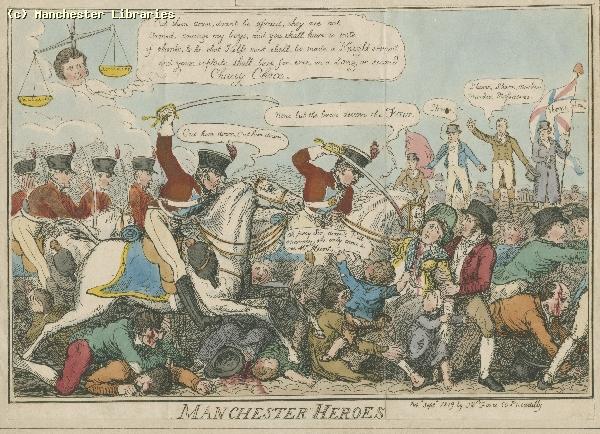
Picture; "Manchester Heroes", Peterloo, print from etching by unknown artist, published by S W Fores, 1819, m07587, courtesy of Manchester Libraries, Information and Archives, Manchester City Council, http://images.manchester.gov.uk/index.php?session=pass, and information drawn from the list of the Manchester Yeomanry published in the Northern Star, August 20th, 1819

Tuesday, 11 August 2026

The mob in Didsbury in 1793 …………… opposing progress and the ideas of the day

January 1793 was an uncertain time across the country.  

Didsbury in 1853
The weather was unseeingly cold, the harvest had been poor, and in France the survival of the monarchy was in doubt.

All of which might explain why a crowd gathered to watch as an effigy of that well-known radical, Thomas Paine was burned on the village green in front of the two village pubs.*

And after the event some of the crowd will have settled down in the Old Cock, and the Ring o’Bells which would be rebuilt as the Church Inn and is now the Didsbury Hotel.

Just how many of those swapping stories in the two pubs, were in favour of Tom Paine, and how many had taken against the man who supported both the American and the French Revolutions, we will never know, but our two publicans may well have been pleased at the turn of events which brought in the customers.

The crowd who assembled to see the event may have been driven by a fear of Paine’s ideas or out of sheer curiosity, but they weren’t alone, because in all that orgy of burning, Bromsgrove in Worcestershire was “the only town in England in which an effigy of Tom Paine was not burned”, leaving the Manchester Guardian to add that there in Bromsgrove, “Democracy predominates.”**

Thomas Paine, 1792
And that leads me to the only description of a burning that we have for Manchester, which was the one carried out on December 17th 1792,
"The inhabitants at top Deansgate, hanged the effigy of Tom Paine, dressed in a Maroon coloured Coat, Striped Waistcoat, and greasy pair of Breeches, a Barber’s Block with a Wig on supplied the Place of a Head, from his Coat Pockets hung shreds of Paper and on the shoulder a Quantity of Thread, emblematical of his deviant Trade, with ‘The Rights of Man’ stitched on his Breast; thus he hung an Hour, amidst the Acclamations of Hundreds of Spectators; he was afterwards dragged through the Streets, and then committed to the flames the Populace singing ‘God Save the King’"***

This event came during a surge of ‘loyalism’ in Manchester where a carefully crafted campaign had been waged against those who had embraced the French Revolution and argued for a Radical ideas.

In the same month, the home of Thomas Walker on South Parade was attacked by an organized mob of Church and King supporters, and Walker was forced to drive them off by discharging a pistol.

Writing later of the event he commented,

“Emboldened by drink and fired on by agitators, groups hostile to the radicals began to gather around the city.  Walker was in no doubt that this was pre-planned.  


Thomas Walker, 1794
Parties were collected in different public houses, and from thence paraded in the streets with a fiddler before them, and carrying board on which was painted with CHURCH and KING in large letters’ 

On four separate occasions a mob gathered outside South Parade, broke the windows and attempted to force their way in.  Supported by friends Thomas Walker was forced to fire into the air to disperse the crowds. 

The magistrates did nothing to prevent the events and while a “regiment of dragoons was in town, booted and under arms” and ready to disperse the rioters no order was given. 

As if to add insult to injury the main concern of the magistrates when they finally met Walker was that he should not fire at the crowd again if the mob returned!  These attacks had been matched by similar ones on the home of Priestly in Birmingham and in Nottingham.” ****


Location; Didsbury and Manchester

Pictures; Thomas Paine, 1792, Thomas Walker. 1794, Didsbury showing the Church Inn and Old Cock, 1853, from the OS for Lancashire, 1841-53, courtesy of Digital Archives Association, http://digitalarchives.co.uk/


*Axon, William, The Annals of Manchester, 1885, page 120

** Bromsgrove, Manchester Guardian, January 20th, 1793

***Manchester Mercury, January 1, 1793, quoted by O’Gorman Frank, Manchester Loyalism in the 1790s from Return to Peterloo Manchester Region History Review, Volume 23 2012

**** Walker, Thomas, A Review of some of the events of the last five years, London 1794 page 23

Sunday, 9 August 2026

Snaps of Chorlton No 11, a badge and a festival in 1984 not bad for one post


An occasional series featuring private and personal photographs of Chorlton.

Cheating really, not so much a snap more a picture of the badge of the event

Pictures; from the collection of Andrew Simpson and Tony Walker

Sunday, 2 August 2026

The story of a strike and of strikes yet to come, part two .... a Chorlton postcard

On Newton street in July 1911
The Carters came out on strike in Manchester at the beginning of July 1911. 

It was the picture of police escorting a strike breaker which first caught my interest.

But they were not the first or the last during the next few years to withdraw their labour to advance a demand for better pay and conditions.

Early in 1912 the miners had come out following a ballot “in favour of giving notice to establish the principle of a minimum wage for every man and boy working underground,”* and at the beginning of March Manchester Municipal workers voted to follow those of Stalybridge, Salford and Stockport and strike for higher pay.

You can get a sense of the mounting conflict from the newspapers of the period. The Manchester Guardian was quick to comment on the concerns over coal stocks in the Greater Manchester area just weeks after the miners had come out, and carried reports that in Nottingham the bakers and painters were about to go on strike while in Manchester there was serious disruption to the rail network.

Leonard's fears
And here in Chorlton on the day the Guardian reported that 60% of trains from one Manchester railway station had been “knocked off” Leonard wrote to a friend of his worries about his mother’s illness and that “all our staff intend to come out on strike this weekend.”

Now it may never be possible to discover the business that he ran or what happened on Friday March 15th when the strike was due to start, but I shall endeavour to try.

He was “busy making arrangements to fill their places” and thought that “this Coal crisis ..... is a terrible affair.” 

All of which rather eclipsed his pleasure that at the Parliamentary bye-election earlier in the year “our man got in (Good old Blue) turned a liberal majority from over 2,000 to a conservative one of 500, great excitement.”

It is a fascinating glimpse on how people here in Chorlton looked out on the mounting political and industrial unrest and sadly represents the only comment we have so far.

As it was the strikes rumbled on through the year, but more about them tomorrow.

Picture; detail of a postcard sent on March 12th 1912 from the Lloyd collection, detail from the Carter's strike, courtesy of the Greater Manchester Police Museum

*Balllot paper issued by the Miner’s Federation of Great Britain, January 1912


Friday, 17 July 2026

Rescuing five Manchester Radicals ……………"from the enormous condescension of posterity”

How easy it is to lose our history, and once lost how much more difficult to retrieve.

Alexander Somerville, 1848
This I know is not an original idea but is one that I have been wrestling with today, as I seek to uncover the lives of five radical working men all of whom were born in the 18th century and died long before Parliament extended the vote to include a section of the male working class.

They were, Peter Rothwell, George Hadfield, George Exley, Henry Parry Bennet, and James Wheeler.

I doubt I would ever have come across any of them, were it not that all five were buried beside the monument to Henry “Orator” Hunt, which stood in the burial ground of the Round Chapel on Every Street.

They were part of the committee responsible for that monument, and I suspect had been at Peterloo along with Mr. Hunt.

As yet, I don’t know what they looked like, the position they took on the reform of Parliament and where they stood on the broad spectrum of opinion within the Chartist movement.

To be honest I don’t even know if they were all Chartists, but I suspect they were.

Off Oldham Road, home to some of the "five", 1851
They may appear in the autobiographies of other radicals like Samuel Bamford and Mr. Hunt, and if I am very lucky, I might turn up a reference to the memorial committee.

I have trawled the database of the Working-Class Museum in Salford and gone looking for any reference in the newspapers to the five, but so far have only found them in the census returns, directories and registers of births deaths and marriages.

But I am confident that I have found all five in the official records, which list their occupations as cotton weaver, tailor, and baker, in fact three of the five were bakers.

Back Prussia Street, 1851
All lived in the northern part of the city in an area which was densely packed with rows of terraced houses which in turn were surrounded by textile mills, iron works and timber yards, bounded by the Ashton and the Rochdale Canals.

In the absence of anything on their politics, and their activities I am forced back on exploring just where they lived.

Henry Parry Bennet who was one of the three bakers lived with his wife on Bradford Street, throughout the 1840s and into the next decade, and died there in 1851.  And as you do, I wondered on the fate of his wife, who was 62.  But like so many working people of the period, she is lost from the records with nothing listed as yet after the date of her husband’s death.

Conversely in the case of Peter Rothwell there is bewildering choice of candidates, one of whom lived in a property which commanded an annual rent of £20 and would have entitled him to a vote in the reformed Parliament and another Mr. Rothwell, who in 1841 described himself as a cotton weaver and lived with his family and assorted others in Back Prussia Street.

Prussia Street, 1904
In all there were ten people sharing the house, four of whom along with Mr. Rothwell and his wife Ann were well past retirement age, but I suspect were still hard at it working in the nearby cotton mills.

Back Prussia Street was, as its name suggests directly behind Prussia Street, which ran from Oldham Road down to Jersey Street, and like the rest of this part of town was a mix of cotton mills, foundries, timber yards with the odd glass making works thrown in.

And to further complicate the picture, a Peter Rothwell in 1844 was listed in the rate books as living in the cellar of a property on Bradford Street which was close to where the Bennet’s lived.

It is all tantalizing and is a bit like looking through a dirty window, which reveals some detail but not much.

I suspect our cellar dwelling Mr. Rothwell will be the same as he that lived on Back Prussia Street and is a reminder that people moved around the city in a way that most of us don’t today.

I continue to trawl the records and might yet turn up the minutes of the committee which erected the monument to Mr. Hunt, and remain confident that there will be some reference to them, but in the meantime, they are just names.

Prussia Street, 1907
But not quite, because we know that the organization that went into the erection of the monument and the subsequent preparations for the day of its unveiling are impressive.

The committee had decided on charging a penny for admission to the event and set up platforms from which spectators could observe the speeches, for which they wee asked to pay an extra 6 pence.

And on the day the committee had to cope with an estimated crowd of 15,000 people, which would have taxed any group of marshals charged with making for a peaceful and dignified day.

So that is it, ………. Not much perhaps, but a step in uncovering the lives of five Manchester radicals who have been pretty much forgotten.

Does it matter?  Yes, I think it does.  In his ground-breaking book, The Making of the English Working Class, E.P. Thompson, wrote "I am seeking to rescue the poor stockinger, the Luddite cropper, the ‘obsolete’ hand-loom weaver, the ‘utopian’ artisan, and even the deluded follower of Joanna Southcott, from the enormous condescension of posterity."*

And if it was good enough for him, who am I to stop digging for my five?

Pictures; cover page of Alexander Somerville's Somerville's autobiography, 1848, Back Russia Street, 1851, from Adshead’s map of Manchester, 1851, courtesy of Digital Archives Association, http://digitalarchives.co.uk/ Harriet Street stables adjoining No.1 Prussia St, near Oldham Road, Bradburn ,A,  1904, m10109 and Portugal Street & No. 3 Prussia Street, near Oldham Road, Jackson, J, 1907, m10411, courtesy of Manchester Libraries, Information and Archives, Manchester City Council, http://images.manchester.gov.uk/index.php?session=pass


*Thompson, E.P. The Making of the English Working Class, 1963, 1968, 1980, page 12 from the 1980 revised edition.  My 1968 Pelican edition is all but falling apart and I suspect it is time for a new copy.

A little bit of our history down at the Co-op

2d token issued by the R.A.C.S., date unknown
It’s so easy to lose so much of our history.

Now the big things like the homes of the great and good, as well as the not so good but still very powerful and rich usually survive, as do their possessions.

In the same way those important papers of State, the letters and records of government from Roman tax records to Magana Carta and much else have come down to us.

Although I do have to concede sometimes it is a dam close thing and often it is down to accident rather than design that these things are still around to tell us something of the past.

Of course in the great sweep of history more rather than less has gone forever.

1£ Co-op book of stamps circa 1970
And amongst all that lost material are the overwhelming majority of everyday objects each with their own unique story.

I could have picked almost anything to explore these vanished objects but in the end choose the humble trading token and its modern equivalent the trading stamp.

It began with a sheet of those Green Shield Stamps posted on facebook which if you are of a certain age will bring back vivid memories of collecting them, then sticking them in books and eventually exchanging shed loads of them for a range of goods.

Co-op stamps, circa 1970
And into the game came the Co-op which had been operating its own reward system since its inception.

This was the dividend which gave every member a share of the stores profits.  All you needed to do was quote your “divi number” and the amount you spent would be recorded.

Talk to many people and they can instantly remember their family number and even quote it back.

Sadly I was never one of them and so for me the introduction of the divi stamp was to be welcomed.  So instead of holding up a line of shoppers down at the Well Hall Co-op opposite the Pleasaunce I could now vanish with the groceries secure in the knowledge that all was well with our divi reward.

A token issued by  Bolden Industrial Co-op, date uknown
“Dividend Stamps were introduced in 1965. 

It was an alternative to the traditional methods of paying the 'divi', and as a response to the adoption of trading stamps by other food retailers like Tesco who adopted the Green Shield stamps scheme. 

Some individual Co-operative societies operated their own stamp schemes but the CWS National scheme was in use from 1969.”*

Running alongside the number and then later the stamps were the old tokens, made of very thin metal.

"Coop members would go into their local society shops to buy the tokens for bread, milk, coal etc. The amount they spent would then be registered for their dividend payments.  The members would then give the token to the milkman, bread man or coal roundsman etc in return for the items they wanted."**

Co-op stamps, circa 1970
In our house some at least never made it back to the Co-op and instead were used as toys and even took the place of playing cards.


So for those who remember them and a lot more who are totally baffled by them here is a selection taken from my friend Lawrence’s blog* and the Bolden History site.*

They were an important part of many peoples' way of budgeting and marked a commitment to a co-operative way of life which I still think is the way forward.

Pictures; Co-op trading stamps, courtesy of Lawrence Beedle, and trading tokens from Boldon History

*Hardy Lane Scrapbook, http://hardylane.blogspot.co.uk/2009/05/co-op-stamps.html

**Boldon History, http://www.boldonhistory.co.uk/Boldon-Colliery-ID11/The%20Co-op-IDI141

Friday, 10 July 2026

As many Prime Ministers as you can count ……

It has become one of those throw away comments much loved by the media that since 2016 we do seem to have had a lot of Prime Ministers, which is often accompanied with a comparison to some of our European neighbours who change theirs with monotonous regularity.*

1979

And it is true that in that decade we have had five, with one lasting just 44 days which occasioned the “Liz Truss lettuce”.

1923
Now none of this is contested but does hide the uncomfortable history that during the last century some governments were almost as short lived.  

The second post war Labour Government which won the 1950 General Election survived with a majority of just five from February 1950 till the October of 1951.  

All the more remarkable when the first post war Labour Government came to power with a huge majority and established the National Health Service. 

Just over twenty years later in 1974 there were two elections in the February and October, while the Conservative Prime Minister, Sir Alexander Douglas- Home who succeeded Harold Macmillan in the October of 1963 lasted just a year.

Of course, there are sound political reasons why those changes of power occurred and once you delve into the history the sleek and shallow observations are just that ….. sleek but shallow.

And if you wanted to go back to almost the beginning of the 20th century that history can offer up a similar set of Prime Ministers who held office for just a short period.

1929
David Lloyd George, Coalition, lasted from 1918 till he was ousted by a Tory Party coup in October 1922.  His successor Andrew Bonar Law, Conservative was replaced by Stanley Baldwin, Conservative in May 1923.

But Baldwin lost the 1924 General Election to the first Labour Government led by Ramsey MacDonald whose administration lasted for just eleven months. 

Baldwin was returned to power and managed a creditable five years before he was defeated in the 1929 General Election by Labour who were derailed by the financial crisis of 1929.  Unable to secure the budget cuts he wanted and in the face of a Labour Party split he formed a National Government winning the 1931 General Election.

All of which means that by my reckoning in the seven years that spanned most of the 1920s we managed to clock up six changes of Prime Minister, starting with the Lloyd George Coalition Government and ending with the Coalition Government of Ramsay MacDonald.

Pictures, Election Posters from 1924-1979

*Theresa May, 2016-2019, Boris Johnson, 2019-2022, Liz Truss, 2022-2022, Rishi Sunak, 2022-2024, Keir Starmer, 2024-2026


Wednesday, 8 July 2026

Silly stories from a tram seat …… and other things wot I was taught

So yesterday afternoon I gave up my seat on the tram to an elderly woman, which prompted the man in front to offer his seat to me.

I declined, we all smiled at the sequence of events and then we got on with the journey.

But not for the first time it made me think of that old practice of giving up your seat to a woman or opening a door for people and taking the kerb side of the pavement when out with my wife.

Old fashioned, sexist or just downright stupid?

All are habits that are deeply ingrained in me, and I suspect are no longer common practice, judging by the number of elderly people I see standing on moving trams while people half their age sit comfortably, gazing out of the window tuned into their phones.

It may even be deemed by some as an insult, suggesting that there is something delicate about the woman and reinforcing my own stereotypical male assumptions about gender.

What of course makes it even a bit more absurd is that at 76 I may have just been older than the woman who graciously accepted the offer of my seat.

But there you are such things run deep in me and were acquired sometime in the 1950s.

Along with that equally powerful taboo of not spitting in the street.

Of course, in that pre antibiotic age when many diseases were far more prevalent and dangerous than today the notion of not spitting in public was both sensible from a hygienic standpoint and just good manners.


It was a custom underlined by those signs on public transport calling on people to refrain from spitting, which long ago were consigned to museums secreted away in the section titled “curious practices from the past”.


To which perhaps I am equally a “curious leftover from the past”.

One of those leftovers who can’t quite get used to total strangers at call centres addressing me by my first name, as if we were long standing intimate friends and not just conducting a conversation about a lost shopping order.

But I should stop before I wax lyrical about queues, waiting your turn at the bus stop or saying thankyou to the bus driver.

Location; the past

Picture; crowded tram bound for town from Cornbrook, 2024, at Market Street, 2018, and standing room only from St Peter's Square, 2023, from the collection of Andrew Simpson


Sunday, 14 June 2026

Piffy on a rock bun …………… and other travels with my past

Now I have always taken those sayings of my youth for granted, and very rarely pondered on their origins or how they have survived from childhood and been passed on to my sons.

Me, 1961-62
Most pop up without any effort and roll off the tongue to fit the occasion.

There will be many that I grew up with, but a few are still regularly in use.  They include “piffy on a rock bun”, “the wreck of the Hesperus”, “black as Newgate’s knocker”, and “like the back of a tram smash”, all of which will be instantly recognized by anyone who was born in the first half of the last century.

They are what they are, instant comments on a situation, instantly used and then forgotten, but yesterday in a family conversation, it became apparent that our Polly had never heard the expression and was fascinated and amused when Joshua used it.

They were leaving to drive back to Leicester, I was on the doorstep watching, and Josh muttered “why is dad standing there ‘like piffy on a rock bun’?”.

Apparently, Polly had never heard Josh use the expression, but like his dad it will be rooted deep in his upbringing.

And that got me thinking about the shed loads of ones that are embedded deep in me.
Some are easier to track than others, and so “like the back of a tram smash” must come from mother and father, while others like Newgate’s knocker are much older.

Record sleeve, 1920s
Along the way there are a few more which I absorbed and can track specifically to a time and place.  Of these “like Reggie Page” is fixed in the years I was with Kay who grew up in the north east in Seaham Harbour and went to school with Reggie Page, who could never quite dress himself.

So, his socks were always at half mast, his shirt buttons wrongly fixed and on a very bad day, he managed to get his jumper on back to front.

And so, the saying was born, which stuck with me and still on occasion tumbles out to fit the moment.

What fascinates me, is that as some of these fade through time and pass out of common usage, others will surface.

In the same way some have a specific place of origin.  “Black as Newgate’s knocker", refers to the door handle of the old Newgate prison in London and will be one I heard from friends and their family, while “like piffy on a rock bun”, is apparently from the northwest, although mum who was from the Midlands and Dad from Gateshead both used it all the time.

Greenwich, 1979
Most I never questioned, and so it has been a surprise to me that “like a lemon” is the southern equivalent of “piffy on a rock bun”.

I suppose for generations many will have stayed local, but the advent of television and soaps like Coronation Street will have taken them in the front rooms of the entire country.

Of course, they sit with many more sayings which derive directly from popular shows on the radio and TV, which were either coined by the scriptwriters or made popular by a celebrity or comedian.

At which point I won’t show my age, or my preoccupation with the wireless over the television by quoting from ITMA, the Goons, or Take It From Here, and instead wonder just how many today will use the expression “the wreck of the Hesperus”, or know that it may originate from a poem by the US poet Henry Wadsworth Longfellow which was  in his collection Ballads and Other Poems, from 1841.

To which someone will mutter “well I’ll go to the foot of our stairs”.

Location; all over

Pictures, from the collection of Andrew Simpson

Tuesday, 21 April 2026

Marjorie Holmes, 1921-2014, a dear friend and historian of Chorlton


Marjorie with her mother, circa 1929 on the lockups by Chorlton Green
Over the years Marjorie had become a close friend, and because she lived just around the corner we saw each other regularly.

She delighted in hearing the news of my four lads and in return I would listen attentively to her stories of growing up in Chorlton.

For Marjorie really was a Chorlton girl, born here in 1921 and an apart from war service this is where she lived.

A letter from Marjorie
And so she was a fund of stories, pictures and memorabilia which I have plundered over the years.

But there was never anything precious about Marjorie and so as I dug deeper in the history of our township she was always wanting to know more, adding my research to her memories and always there to encourage me “to push on, find out more and don’t forget to tell me.”

More memories
From her I have that vivid memory of a young girl entranced at watching the blacksmith on Beech Road performing his “magic of heating and hammering,” which more than once made her late for school.

Or her memories of the old parish church with its blue ceiling and white star, illuminated in the early morning sunshine.

Jasmine Cottage, painted by Marjorie
Hers were I think some of the last living memories of a building closed in 1940 and demolished in 1949 and which had served our community since it was opened in 1800.

And of course I could go on, but it would be wrong just to present my friend as a living piece of history for she was much more, including an accomplished artist a brilliant conversationalist and someone who was not averse to a risque joke.

In later years she would often refer to me as her toy boy and I will value that as much as I valued her friendship and what I learnt from her about the place we both loved.

So on an upbeat note and with the permission of Bernard here is part of a conversation* she recorded for Chorlton Good Neighbours.**


Pictures; from the collection of Marjorie Holmes

*In conversation with Marjorie Holmes, http://chorltongoodneighbours.org/2011/04/26/marjorie-holmes/

**Chorlton Good Neighbours, http://chorltongoodneighbours.org/