Showing posts with label Eltham in the 1870s. Show all posts

Tuesday, 12 May 2026

Racing horses at Middle Park with Mr William Blenkiron in 1861

Now here’s a story that I can’t claim any credit for but which I suspect will be new to many people.

Middle Park, 1873
It started with the chance discovery of horse racing at Middle Park and by degree took me to William Blenkiron.*

To be honest I rather let Mr Blenkiron go by the wayside and it wasn’t till my friend Tricia did the research that I realized that here was indeed and fascinating story.

He had been born in Yorkshire in 1807 and having begun as a farmer moved to London in 1834 “and commenced business as a general agent [and] in 1845 added to his establishment a manufactory of stocks and collars, and three years later retired in favour of his son."**

Leaving him at the still relatively young age of forty to begin a new career as the owner of a racehorse and by degree “wanting more room, removed from Dalston to Middle Park, Kent.  

He brought with him seven or eight brood mares and Neasham the head of the list of Eltham sire.  The establishment now rapidly increased until it was augmented to upwards of two hundred of the highest class and best mares that money and experience could produce.”**

And for those that want to follow his racehorse successes there is an excellent account in thamesfacingeast.***

Poll Book, 1868
Instead I am more fascinated by what Tricia uncovered from the census returns.

In 1851 he was still in Dalston giving his occupation as “Silk Merchant,” but a decade later having settled at Middle Park he described himself as a “Farmer of 500 acres employing 18 workers” and in the April of 1871 was content to be known as a “Breeder of Horses.”

Now we can track him across the electoral registers from the 1835 and even know that in 1868 he voted for the two Conservative candidates for the Kent West Constituency.****

He died in the September of 1871 and is buried in the parish church.

Location; Eltham, London

Research; Tricia Leslie

Pictures; Middle Park, detail from 1858-73 OS map of Kent and extract from the Poll Book Kent West, 1868 courtesy of ancestry.co.uk

*When horses raced on Middle Park Meadows, http://chorltonhistory.blogspot.co.uk/2016/02/when-horses-raced-on-middle-park-meadows.html

**National Biography page 674

*** The Middle Park Stakes: The Eltham Connection, September 11, 2013  thamesfacingeast, https://thamesfacingeast.wordpress.com/tag/william-blenkiron/ 

****Enu 24, 16 Hackney, Hackney, Middlesex, 1851, Enu 1, 1, Eltham, Kent 1861, Enu 1,2, Eltham, Kent, 1871

Wednesday, 29 April 2026

Of letters, and postmasters in the Eltham of the 19th century

Eltham in the 1830s
I am back with the post office in Eltham and in particular two men who straddle the history of letters, parcels and other odd things sent by the postal service.

James Pike and James Lawrence were the postal service in Eltham for a big part of the 19th century and their stories have been unearthed by Jean Gammons and so I shall hand over to her.

“James Pike was Eltham’s postmaster for perhaps forty years.  He was a clockmaker and his house was in the High Street.  

Very little is known of him and the earliest reference is a record of the death of his first wife in the parish records in 1798.  I could find no record of his birth or his marriage to Elizabeth so he may not have been an Eltham man.

He remarried in 1809 when he was 49 to a young woman from Eltham called Ruth Patterson.*

She was some twenty years younger than him and the records show they ran the post office together.

This was on the High Street just up from the old Chequers inn.  They would have conducted the business of the postal service from a room in their house and people waited outside in the street to be served through a window.”
Burial entry of James Pike, June 1837

James died in the June of 1837, and was buried in the parish churchyard.  

His wife Ruth survived him by twenty years, but the business was taken over by James Lawrence whom the Pike’s had taken on as their apprentice in their clock making business.2

He had been born in Eltham in 1819 and we can follow him from the 1841 census when he was listed as watch maker through the next four decades.  By 1871 while he may still have had a connection with the clock business he lists himself simply as postmaster.

This was an important time in the development of the Post Office.

Looking towards the parish church
The year before “the post office had taken over the private telegraph companies and James Lawrence must have been very proud when his eldest son, then a lad of just 13 became one of the Post Office’s first Telegraph messengers.  

In 1876 Eltham’s little post office was upgraded to a Head Post Office and Lawrence was placed in charge of all the smaller post offices in the Eltham district with an overnight salary rise from £31 to £60 a year.

But his office was still at no 54 High Street in the old shop where it had been since the 18th century, roughly where the milkman’s cart is seen in the picture."

The Post Office is roughly where the milkman's cart stands
All of which takes us into a new and bold period in the history of Eltham and its postmasters.

Pictures, of the High Street in the 1830s, and in 1909 courtesy of Jean Gammons and Mr Pike’s burial entry from St John’s parish records, courtesy of ancestry.co.uk, and the City of London Corporation Libraries, Archives and Guildhall Art Gallery Department

*Another Eltham life brought out of the shadows, the story of Ruth Pike, nee Patterson, 1782-1857

Wednesday, 25 March 2026

On the High Street in 1873


I have moved a little south from Well Hall and am wandering the High Street sometime in 1873.

It is a scene we will return to in detail later.

For now what strikes you perhaps more than anything is the absence of Well Hall Road which today runs down from the High Street past the church and off in a straight line down to Well Hall.  This was to be cut much later.

In the 1870s this spot would have been dominated by  St John’s to the west and opposite the vicarage, while beyond this point heading east would have been a collection of fine houses, not so fine houses  and the smithy and National School.

Picture; the High Street from the OS map of Kent, sheet 08, 1858-73, First Edition

Tuesday, 24 March 2026

Snapshots of Well Hall ……….. part 1 …….1873

Now this is Well Hall House in 1873.

And what I like about it is the detail showing the old 18th century house, the gardens to the south and the collection of farm buildings to the north, bounded by what is now Kidbrook Lane and assorted cottages beyond.

What interests me is the small water course which feeds into the moat and back in 1873 required a footbridge to cross it.

I must confess that I had never knew that there was a  watercourse or  given any thought to how the moat would have once been supplied.

Which is a huge omission on my part.

But following the stream east, the map shows it joins the River Quaggy.

And opens up that fascinating bit of speculation as to whether our water course was a feeder for the river, or if it had been dug from the Quaggy to fill the moat.

I rather think I must get in touch with the Environment Agency.

On the other hand, I bet there will be someone who knows and will gently point out the obvious to me.

We shall see.

Location; Well Hall

Picture; Well Hall House and surrounding land, 1873, from the OS map of Kent, 1858-1873, First Edition, six inch to the mile, courtesy of Digital Archives Association, http://digitalarchives.co.uk/


Sunday, 15 March 2026

The case of Mrs Crowfoot's plum pudding ......... dark deeds at Well Hall in January 1870

I don’t often go looking at the Proceedings of the Old Bailey which are now online and cover the period 1674-1913 which is my loss.*


Well Hall Cottages, 1909
They are “a fully searchable edition of the largest body of texts detailing the lives of non-elite people ever published, containing 197,745 criminal trials held at London's central criminal court.”*

So I am indebted to Colin Benford who drew my attention to the case of George Pritchett who broke into the home of Robert and Ann Crowfoot in January 1870.

Mr and Mrs Crowfoot lived in one of the cottages in Well Hall.

Now I have long been fascinated by these houses and have  written about them, and so was intrigued when Colin wrote that the Crowfoot’s were residents in 1851 and were still there in 1870 when George Pritchett broke in.

And that seems an appropriate point to quote from the records.

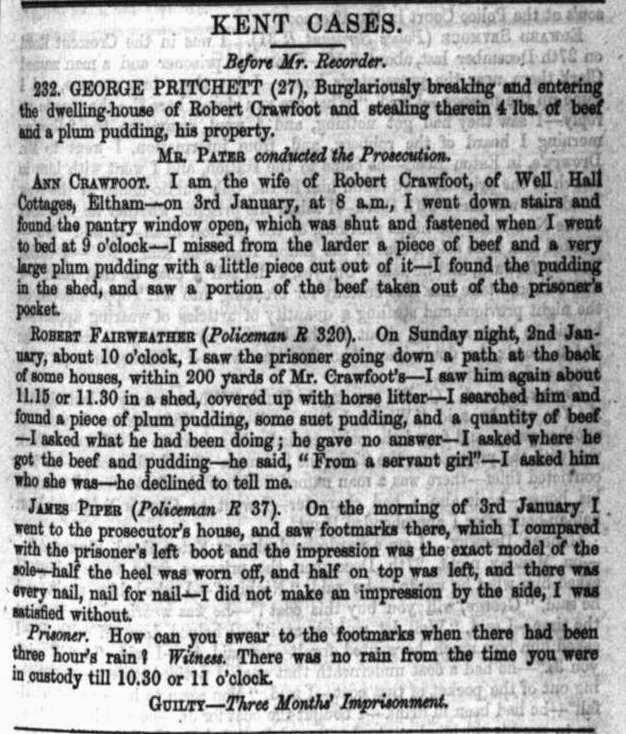
232. GEORGE PRITCHETT (27) , Burglariously breaking and entering the dwelling-house of Robert Crawfoot and stealing therein 4 lbs. of beef and a plum pudding, his property.

MR. PATER conducted the Prosecution.

ANN CRAWFOOT . I am the wife of Robert Crawfoot, of Well Hall Cottages, Eltham—on 3rd January, at 8 a.m., I went down stairs and found the pantry window open, which was shut and fastened when I went to bed at 9 o'clock—I missed from the larder a piece of beef and a very large plum pudding with a little piece cut out of it—I found the pudding in the shed, and saw a portion of the beef taken out of the prisoner's pocket.

ROBERT FAIRWEATHER (Policeman R 320). On Sunday night, 2nd January, about 10 o'clock, I saw the prisoner going down a path at the back of some houses, within 200 yards of Mr. Grawfoot's—I saw him again about 11.15 or 11.30 in a shed, covered up with horse litter—I searched him and found a piece of plum pudding, some suet pudding, and a quantity of beef—I asked what he had been doing; he gave no answer—I asked where he got the beef and pudding—he said, "From a servant girl"—I asked him who she was—he declined to tell me.

The original records 1870
JAMES PIPER (Policeman R 37). On the morning of 3rd January I went to the prosecutor's house, and saw footmarks there, which I compared with the prisoner's left boot and the impression was the exact model of the sole—half the heel was worn off, and half on top was left, and there was every nail, nail for nail—I did not make an impression by the side, I was satisfied without.

Prisoner. How can you swear to the footmarks when there had been three hour's rain? Witness. 

There was no rain from the time you were in custody till 10.30 or 11 o'clock.

GUILTY — Three Months' Imprisonment.***

In the great sweep of history it may not even count as a full stop but it offers up one of those opportunities to touch the past and bring you closer to the people who lived in Well Hall.
And as you do I went looking for the three of them.  Not unsurprisingly George Pritchett pretty much drew a blank.  The records are full of George Pritchett’s but none offered up a clue as to which might have been our man.

Robert and Ann Crowfoot were easier to trace. They were living in the cottage at Well Hall in 1851 and were from Suffolk, at the time of the burglary he was fifty eight and Ann a year younger and given that he was an agricultural labourer and she a laundress the loss of that food must have been serious.

In time I shall find out more if only to sort out the misspelling of their name which appears on the census record as Crowfoot and in the court documents as Crawfoot.

Pictures; Well Hall from the OS map of Kent, showing Eltham, 1858-73, Well Hall Cottages from The story of Royal Eltham,  R.R.C. Gregory, 1909 and published on The story of Royal Eltham, by Roy Ayers, http://www.gregory.elthamhistory.org.uk/bookpages/i001.htm and the original court document from The Proceedings of the Old Bailey

A thank you to Colin Benford who researched the story

Location; Well Hall, Eltham, London

* The Proceedings of the Old Bailey, http://www.oldbaileyonline.org/index.jsp

** A map a photograph and some old records, Well Hall cottages in the spring of 1844, http://chorltonhistory.blogspot.co.uk/2015/05/a-map-photograph-and-some-old-records.html

*** GEORGE PRITCHETT, Theft > burglary, 31st January 1870. http://www.oldbaileyonline.org/browse.jsp?id=t18700131-232&div=t18700131-232&terms=Well%20hall#highlight

Saturday, 14 March 2026

When a pint of Eltham Ale cost 2½d and came from our own brewery ......... Eltham in 1874

I often wonder just what a pint of Eltham Ale would have tasted like.

It was brewed buy our own Eltham Brewery and would have cost 2½d  back in 1874.

According to their advert published in the October of that year they offered  twelve different ales stouts and porter and delivered across south east London and beyond which included Woolwich Charlton and out to Belvedere and Erith, and up to Peckham, New Cross and Brixton.

The old brewery had been up the High Street behind the Carpenters Arms and later moved to a spot just down from St John’s Church.

Eltham Brewery, 1917
Now I might be wrong but there seems to be little written about the brewery.

There is a reference to the old one in Mr Gregory’s book and another in Eltham in the Making and just two pictures which appear in other books.*

All of which is a bit odd given that it must have employed quite a few of our residents and supplied a decent number of pubs.

Of course Greenwich Heritage Centre is bound to to have something on it and in due course I shall go looking in their archives.

That said there will be someone who can put me right on the exact date it moved and more importantly when it ceased business.

It was still there in 1920 and six years earlier had been owned by the Kenward Brothers all of which promises a rich field of research.

Well we shall see.

Pictures, advert Eltham Brewery, 1874, from Grace’s Guide to British Industrial History, http://www.gracesguide.co.uk/Eltham_Brewery, and the brewery in 1917, GRW 215, http://boroughphotos.org/greenwich/ courtesy of Greenwich Heritage Centre, http://www.greenwichheritage.org/site/index.php

*The Story of Royal Eltham, RR C Gregory, 1909, Eltham in the Making, 1990, Eltham, A PIctoral History, John Kennet, Eltham Through Time, Kristian Bedford, 2013 

Friday, 13 March 2026

Wishing you were here.......Eltham in the past, Nu 1 walking up to Shooters Hill in 1873

An occasional series which is short on words and just lets your imagination roam.

This is a section of the OS map for Kent First Edition, 1858-73.

If like me you enjoy looking at maps and plotting journeys, I leave you with it.

Picture; detail from the OS map of Kent 1858-73, sheet 02

Thursday, 17 July 2025

On Shooters Hill in 1872

I am on one of those journeys and I am pretty much going to let the map do the business.  

We are on Shooters Hill in 1872 and we are looking at the OS map of London for that year.

Now maps especially old ones can at first glance be difficult to make sense of.  So to help the Bull Inn is there almost dead centre.

It was a much bigger place than we know today and was built around 1749, although it could be older.  It was demolished in 1881 to make way for the present one.

And dotted around are the fine houses of the rich set back in their own grounds.

What I particularly like are the signs for pumps.

Picture; detail from the OS for London, 1868-72, courtesy of Digital Archives, http://www.digitalarchives.co.uk/

Wednesday, 16 July 2025

When a pint of Eltham Ale cost 4d and was brewed at our brewery.............. Eltham in 1874

Eltham Brewery, 1874
I often wonder just what a pint of Eltham Ale would have tasted like.

It was brewed buy our own Eltham Brewery and would have cost 4 pence back in 1874.*

According to their advert published in the October of that year they offered  twelve different ales stouts and porter and delivered across south east London and beyond which included Woolwich Charlton and out to Belvedere and Erith, and up to Peckham, New Cross and Brixton.

The old brewery had been up the High Street behind the Carpenters Arms and later moved to a spot just down from St John’s Church.

Eltham Brewery, 1920
Now I might be wrong but there seems to be little written about the brewery.

There is a reference to the old one in Mr Gregory’s book and another in Eltham in the Making and just two pictures which appear in other books.**

All of which is a bit odd given that it must have employed quite a few of our residents and supplied a decent number of pubs.

Of course Greenwich Heritage Centre is bound to to have something on it and in due course I shall go looking in their archives.

That said there will be someone who can put me right on the exact date it moved and more importantly when it ceased business.

It was still there in 1920 and six years earlier had been owned by the Kenward Brothers all of which promises a rich field of research.

Well we shall see.

Pictures, advert Eltham Brewery, 1874, from Grace’s Guide to British Industrial History, http://www.gracesguide.co.uk/Eltham_Brewery, and the brewery in 1920, GRW 215, http://boroughphotos.org/greenwich/ courtesy of Greenwich Heritage Centre, http://www.greenwichheritage.org/site/index.php

*All of which is a bit confusing  given that some sources suggest a pint in 1872 was 2½d so perhaps I did the sums wrong when I calculated the numbers of pints in a frkin of Eltham Ale which sold for 15 shillings.

**The Story of Royal Eltham, RR C Gregory, 1909, Eltham in the Making, 1990, Eltham, A PIctoral History, John Kennet, Eltham Through Time, Kristian Bedford, 2013 

Monday, 23 June 2025

In the parish graveyard at Eltham

Eltham Church from the north, 1870
I can’t remember the last time I wandered through the parish churchyard but given that I left for Manchester in 1969 it will have been a long time.

Had I done so in 1851 there would have been plenty of gravestones to read many of which dated back to the 17th and 18th centuries.

Not that I intend to record them here.  Instead I want just to reflect on how the church would have appeared from the northern part of the graveyard.

And I have to agree with Sir Stephen Glynne who in 1830 wrote that it was of “a mean fabric, much patched and modernised; with scarce a trace of anything like good work, and from repeated alterations, the plan has become irregular.”*

But no less a place deep in the affections of many local people.

*Sir Stephen Glynne 1830, Churches of Kent

Picture; from The story of Royal Eltham, R.R.C. Gregory, 1909 and published on The story of Royal Eltham, by Roy Ayers, http://www.gregory.elthamhistory.org.uk/bookpages/i001.htm

Thursday, 29 September 2016

Down on Kidbrook Lane in the April of 1871 ............ a story of dark deeds

Now here is a story that passed me by. 

It’s a story of a police investigation into the brutal murder of a young woman in 1871 in Kidbrook Lane and by degree takes you through the twists and turns of the Victorian legal system and offers up an alternative view of the working conditions of domestic servants in the 19th century.

The young woman was Jane Maria Coulson who worked in the home of the Pook family of Greenwich.

She was just sixteen and pregnant.  Her alleged killer was Edmund Pook the son of the family and the rest as they say is one to read.

But without spoiling it I will reveal that the crime is still unsolved and that the author has gone over the evidence with fresh eyes and draws a conclusion.

Location; London

Picture; cover from the book

*Pretty Jane and the Viper of Kidbrook Lane, Paul Thomas Murphy, 2016