Showing posts with label Peckham in the 1960s. Show all posts

Sunday, 6 July 2025

Planning an adventure across Peckham in the summer of 1960

Now I say Peckham, but the chances are that in the summer of 1960 it could have been anywhere, from Nunhead and on to Dulwich, or via Deptford to Greenwich Park and the River.*

Entrance to the Royal Observatory, 2017

Of course adventures back then were not planned, but pretty much spur of the moment, and relied as much on Jimmy and John Cox’s vague memories of how to get to these places as anything.

Steps down to the River

It being midweek and pocket money spent, a Red Rover was off the cards and like so many adventures it was done by foot, leaving in the morning and getting back in the afternoon in time for tea.

For those born in the first half of the last century such adventures will be as recognizable as Tin Tin, Robin Hood, and I Love Lucy from the telly, and Two Way Family Favourites on the wireless.

If we were lucky our pooled finances might run to a bottle of lemonade and the price of a bag of chips, all supposing we could find a chippy. 

And on the rare occasion we came across a chip shop and a bakery together, there was the meal beyond meals, consisting of a hollowed out bread roll filled with chips, and washed down with warm lemonade.

The promise of an adventure in the park

So, adventures were limited on how far we could walk till we got lost, and whether we were successful in finding the goal of the trip.

But always qualified by that simple rule that once beyond the few streets around Lausanne Road, we were in alien territory where any local gang of lads could take offence at our presence.

This never actually happened, but it was an expectation which was a lesson in always be vigilant.

That said most adventures passed off with out event, but more by accident than design.

Looking back the challenge to walk along the parapet above a disused railway line even then seemed fraught with danger, and the subsequent walk along that railway bed ended when boredom set in.

Not that it stopped us doing it again and again.  It was a walk  where we met no one, found the odd discarded treasure, and were accompanied by the occasional bird, and the lazy buzz of bees and the sight of butterflies.

The Thames, 2017

The only real disaster occurred down by the Thames at Greenwich.  

The tide was out and we had a choice of turning left or right at the bottom of the stone steps hard by the entrance to the foot tunnel.

Right would have taken us by degree to the sandy bit in front of the Naval College.

Left, and we were amongst a collection of beached barges.  These seemed more interesting, but we were unprepared for the oozy, oily river mud in which we slowly sank.  

We weren’t in any real danger, and was rescued by a workman, but walking home to Peckham with shoes and ankles covered in the foul smelly mud was not pleasant, but nothing to the interrogation from mother, and to my eternal shame the speed with which I blamed Jimmy and John.

That long ago summer was interrupted by both of them going off on holiday and left to my own devices I fell on the summer school at Edmund Waller.

And as we all know that summer of 1960, the sun shone every day, and boredom was banished from our activities.

Looking out from the park

But then nostalgia for those long gone holidays can be deceptive, and lead you off into adventures where it was always hot, never rained and there was always an interesting destination.

It was one of the last carefree summers, the following was marked by the transition from junior to secondary school, which offered up new friends, and while Jimmy and John also went to Samuel Pepys, the adventures were over.

Location; out of Peckham 

Pictures; Greenwich, 2017, from the collection of Jillian Goldsmith

*And for those who wonder why all the pictures are of Greenwich in 2017, back in 1960 I didn't have a camera, and a full 57 years later our Jillian retraced many of the Greenwich adventures and took some fine pictures.


Tuesday, 27 August 2024

On being 10 and a bit in Edmund Waller School ........ still living with a humiliation

Some memories just do not go away despite the passage of a full half century.

Edmund Waller School, 2007
This one I have carried for 63 years and goes back to Edmund Waller School and Miss Reeves sometime in 1961.

I was the lad who had been promoted at the end of what now we would call Year 5 into the top class, which I greeted at the time as a mixed blessing.

4A was what passed in Edmund Waller as the top class from which the bright and gifted would have their chance at the 11 plus and all the promise that followed from a grammar school place.

Not that I was one of them, having attained a place in 4A, the following September I joined the lads from 3B along with various other schools in the neighbourhood and began five years at Samuel Pepys Secondary Modern  School for Boys.

In the past I have been harsh about Samuel Pepys but on reflection given that they were afforded less cash than the grammar schools, I had an excellent education from teachers who were committed to giving us the best.

Me, 1961
None of which is relevant to the memory, which at the time confirmed by own low esteem.  Having not cut the muster with Miss Reeves I was made to feel even lower by a group exercise where working in teams of four we were tasked with a project.

I can’t now remember the topic, only the burning humiliation of being told by the other boy in the group that I shouldn’t make contribution.  I remember his name, and found him some years ago on a social networking site,  full of his achievements on this and the other side of the Atlantic.

I do remember one of the girls intervened on my behalf and I think I did add something, but my heart wasn’t in it.

Looking back almost sixty years I chide myself for continuing to harbour the memory, and reflect that many 11 year olds can be cruel, arrogant and self opinionated but even given those caveats, the humiliation burns deep, and will follow me to the grave.

Not that I wallow in that bitter moment, instead it is a permanent reminder that I went through an educational system predicated on the idea of failure, for with every 11 plus achiever there had to be a legion deemed second rate.

Detail of the school
The apologists for that system, then and now, will advance the fatuous argument that we were not failures just not suited for an academic career which is a falsehood, and a falsehood challenged by the many talented individuals who went on to achieve in a full range of activities despite having failed to make the grade at 11.

So I will continue to let that memory bubble to the surface from time to time.

I could have confronted the individual on his social media site, but I doubt that he would remember such a trivial incident, secure in his glittering achievements.

Nor will I name him.

Location; Edmund Waller School

Pictures; Edmund Waller School, 2007, courtesy of Liz &  Colin Fitzpatrick and me in 1961, from the collection of Andrew Simpson

Tuesday, 16 April 2024

The story of one house in Lausanne Road number 33 ............ the works "Jolly" in Brighton, October 1963

Dad and a Glenton's coach circa 1949
The story of one house in Lausanne Road over a century and a half, and of one family who lived there in the 1950s.*

I remember the first time I went to Brighton.

It will have been sometime in the autumn of 1963 and was what has become known as a “jolly” but was officially “the works outing” and amongst my Dad’s colleagues was simply a “Beano.”

Of course these dos weren’t exclusive to work places, many pubs, clubs and institutes would have their day out in the sun with just that right mix of beer, sand, sea and fish and chips.

For Glenton’s it was always the south coast while for Tudor Crisps in Peterlee where I worked briefly it was Whitby or Scarborough and for the countless pubs and factories here in Manchester it was Blackpool.

In many ways the destination didn’t matter, it was the journey which usually involved several pub stops along the way, a “slap up meal” before and after a walk along the front and more pubs and hotels.

Off on a "chara" early 20th century
Most of those on that Glenton’s do were from the garage although there were a few from the office at New Cross and I think a couple more from Saxton’s the estate agents who owned the coach company.

Unlike most our trip was not in the summer but mid October when the season was over and the coaches parked in the garage and the drivers taking a long well earned rest

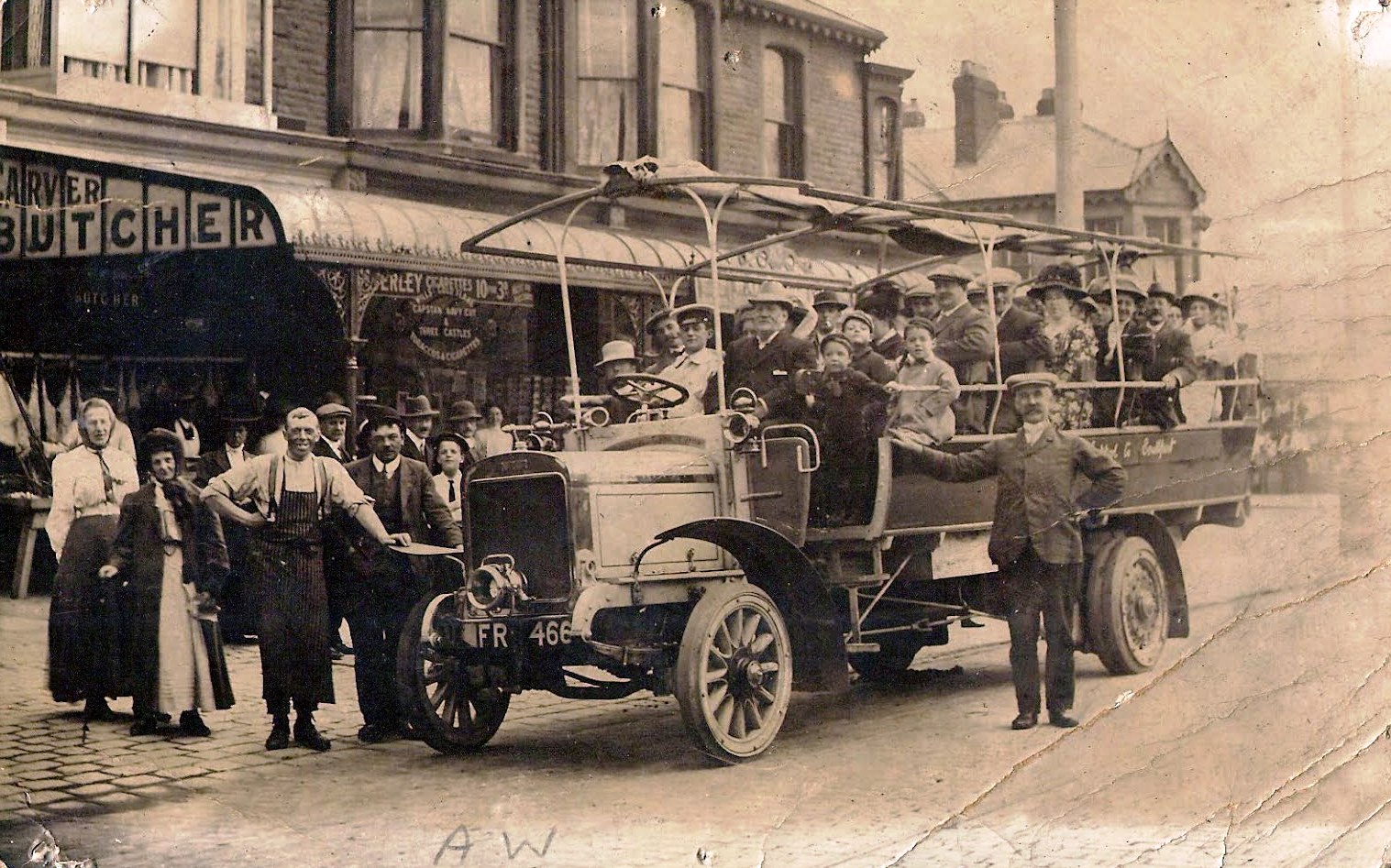
Such trips have a long history stretching back to the charabanc which was a horse drawn vehicle used for sightseeing and works outings usually to the countryside or seaside. They were usually open topped and were common in Britain in the early 20th century.

In time the horse gave way to a motorised version which often had a detachable body so that when the summer season was over the vehicle could be used as a flat bed lorry.

Horse drawn "chara", late 19th century
They were not very comfortable and by the 1920s were being replaced by the coach. These might still have a canvas top but were far more comfortable.

And here there is another connection with Glenton’s because for years back in the 1930s a model of Dad's coach proudly sat in the office window at New Cross, and by degree by the 1950s made its way to the back of the office and finally came home to our house where I played with it for years.

It was a beautifully crafted model which in the untender care of a six year old slowly lost much of its finer detail until all that was left was the chassis and four wheels.

All of which is perhaps a lesson on what a five year old should be given as a toy.

As for that day in Brighton it passed well enough.  Dad I think had gone out of duty and perhaps to fill the numbers I was invited along with my friends Jimmy O’Donnell and John Cox.

For me it was a one off and while I have been on work nights out I have never repeated the “Jolly” and have yet to return to Brighton which has along ago reinvented itself, unlike Blackpool which continues to offer that mix of cheap fun by the sea enlivened by the procession of hen night groups.

All a long way from Brighton and that day out with Glenton’s but thinking about it perhaps not.

Pictures; charabancs from the early 20th century, from the Lloyd Collection.

*The story of one house in Lausanne Road,  http://chorltonhistory.blogspot.co.uk/search/label/The%20story%20of%20one%20house%20in%20Lausanne%20Road

Tuesday, 5 March 2024

Bob a Job …. baked beans…. and an encounter on Kender Street …….adventures in Peckham

This is the building, or more accurately a flat in the building which still 63 years after the event never quite leaves my memory.

Kender House and the scene of the Bob a Job nightmare, 2023
I could be very dramatic about the experience and use words like “a haunting memory”, or “seared into my consciousness” but they would exaggerate what was simply a bit of outrageous exploitation.

It will have been around 1960 and kitted out in my green jersey, yellow scarf and peaked Cub hat and in the company of another I set out to take part in that all important Bob a Job Week.

The scheme of doing a good task which was rewarded with a “bob” or shilling began in 1949 and was supposed to be character building for those who did it, helpful to those who found the job and beneficial to the Cub and Scout group.

The week began well with mother and our adopted aunt providing a series of not too arduous tasks, and finished in this building.

The willing Cub recruit, 1959
I say finished because we never bothered again after knocking on at the door of one of the flats and spending what seemed an hour washing the breakfast plates, assorted pans, forks, spoons and cups. 

Even at the time I reflected that the peals of laughter from the front room which rose in tandem with the columns of cigarette smoke were a sign that we had been “had”.  

The remnants of baked beans were stuck fast to the pan, the grease from the sausages and bacon slid in great congealed lumps from a frying pan which looked as if it had been in constant use since the death of the old King while the teacups were stained brown and stubbornly remained so.

Just how long we laboured was anyone’s guess but eventually we were done.

After that me and the Cubs had a falling out, which was never reconciled.  It was less the unpleasant washing up job, but more what even then I though was bare faced exploitation of two ten year olds.

Never one to learn my lesson three years later I enlisted in the Sea Cadets which met at my old junior school in the hall of Edmund Waller.

Every Friday through the winter of 1963 into the spring of the following year we paraded in our authentic naval uniforms, learned Morse code, tied a variety of “approved” knots and attempted to remember a heap of different flags.

The downside was trying to correctly press the bell bottom trousers and wash off the blue stain from the woollen jumper, while the upside were the misshapen jam tarts made by the caretaker’s wife which we consumed during the break.

Sea Cadets learning to tie knots and splice rope, 1943
Had I stayed I would no doubt have had plenty of trips out, but sadly I only managed one very cold and wet Sunday on the Surrey canal learning or in my case not learning how to row.

By the Easter of 1964 we had moved from Peckham to Eltham, and that was pretty much the end of my adventures with cubs, sea cadets and baked beans.

Eltham and Woolwich offered new horizons, and pretty soon they encompassed the back rows of cinemas, the angst of waiting for that return phone call from that significant date the night before and dreams of guitars and music.

That said I have never quite shaken off the memory of baked beans and greasy frying pans and only last week I wandered past Kender House on Kender Street trying to work out which flat was home to the stuff from that dreadful breakfast.

Odd what still stalks your memory 63 years after the event.

Location; Peckham

Pictures; Kender House, Kender Street, 2023, courtesy of Google maps, the willing Cub conscript, circa 1959,and Sea Cadets learn to tie knots and splice rope at HMS UNDINE at Bowness-on-Windermere, 1943, D 16280 from the collections of the Imperial War Museums.

Tuesday, 30 January 2024

The story of one house in Lausanne Road number 42 ............ the not so rosy glow of memories

The story of one house in Lausanne Road over a century and a half, and of one family who lived there in the 1950s.*

It’s odd what you begin to remember and even more how once you start there seems to be no stopping the memories.

Added to which once they are published they bounce off the collective memory confirming some and bringing forth new ones.

And so it was with The Family of One End Street** which I pretty much devoured at one sitting back in the November of 1961.

It was the story of a dustman’s family set in the late 1930s and told the story of Mr and Mrs Ruggles and their seven children.

Rereading it today bits of it appear a tad sentimental but it struck a chord as a way of life I was familiar with and certainly one my parents would have recognised.

Not that the book or the story is really the point, it is more that this was the year which set me as a serious reader, falling on everything from history to science fiction and the books of Ian Fleming.

I have Mr Rhodes who was my form teacher in my first year at Samuel Pepys to thank for that.

He and later Mr Berry had a simple approach to literature which was let them read what they want and bit by bit they will either move on from science fiction to Shakespeare or they won’t but either way they will have read some books.

In the case of Mr Berry’s class it was a battered old bookshelf at that back of the room filled with whatever he could pick up from second hand book shops.

And in that fourth year of secondary school in Mr Berry's class I worked my way through a lot of science fiction, a couple of ghost’s novels and the odd master piece.

But then not all my reading was the stuff mother would have approved.

For a short while I became hooked by PARADE a magazine I have since seen described “a magazine for men” which at a shilling was a lot cheaper than Playboy but worked on the same principle, mixing pin ups, jokes and “serious” article.  Not that the articles or even the jokes were of much interest to me, nor I suspect to any other young 13 year old back in the 1960s.

Recently I came across some of them on line with their distinctive yellow or blue banner which ran along the top and down the left hand side.

Briefly they had pushed the Eagle comic into touch but it was a short love affair because by the spring of 1964 we were on the move and while some at least of the Eagle collection went with me, Parade with its pin ups and dashing titles like “June is bursting out all over” were not destined to make the journey.

Some ended up behind the garden shed and others were slowly slid one by one through a space into a locked cupboard the key of which I lost.

It is one of the few memories which has never left me and one that even now makes me a tad guilty.

But no one was hurt, and I appear to have got away with it, which is more than I can say for those memories of Edmund Waller School and the class of 4a run by Miss Reeves.

I doubt that either of us would have chosen the other as companion on a desert island and that year of unmitigated failure and humiliation was pretty much laid to rest till Robert posted his school report from 4a at Edmund Waller.

Robert had followed me the following year and like these things are Miss Reeves had taken up the mantle to see another top year 4 class through.

Her signature was there for all to see and for once I rather wish the memory of that year had laid quietly in the past.

Robert went through the year after me but there was that signature of Miss Reeves, which brought back the dismissive words to a mother that "Andrew was not academically minded" a sentence which carried a judgement which had been weighed and delivered but in the long run proved as worthless as those piles of Parade.

Pictures; cover from The Family One End Street, Puffin Edition, 1976, The Great Invasion, Leonard Cotterell, Pan edition 1961and detail from the Eagle Comic, from the collection of Andrew Simpson
.
*The story of one house in Lausanne Road http://chorltonhistory.blogspot.co.uk/search/label/The%20story%20of%20one%20house%20in%20Lausanne%20Road


**The Family of One End Street, Eve Garnett, 1937

Tuesday, 2 January 2024

The story of one house in Lausanne Road number 17 ........ a garden pond and a dustbin,

The story of one house in Lausanne Road over a century and a half, and of one family who lived there in the 1950s.*

Now our pond would not have won any prizes in Home and Garden Magazine, but it was built by my mum and has stood the test of time.

Just why she decided in the summer of 1963 to build it is a mystery but then she was always one for impulsive acts.

The year before she had bought two rabbits from the pet shop in Hither Green fully expecting that within a year we would be making money from selling rabbit meat and fur.

It didn’t happen and the following year they were returned to the said pet shop.

But the pond was different.  She dug it out in the spring, laid the brick walls in the early summer and got the chap from next door who was a plasterer to put a skim of cement over it and in the following March we left for Eltham.

But remarkably it is still there today although like so much of the house and the garden it looks a lot smaller.

What I remember as a long garden full of apple and pear trees has shrunk and is now a mass of interesting bushes flowers and hidden places.

I had always wondered why there were so many fruit trees but given that the area was given over to market gardens before the houses were built it all made sense.

And as the average age of such trees is about 60 to 70 years some of ours must have been coming to the end of their productive life back in the 1950s.

That said some at least would crop so heavily that branches would break under the weight.

Others I now think were showing their age and the fruit was less every year despite their size.

All of which I took for granted as I did the wasps which every year filled the garden drawn by the pears.

We were never scared of them then and still have a healthy respect for them today.

Looking back what surprises me is the lack of a back alley.

Here in the north houses of a certain period were built with an alley and it didn’t matter if they were the basic two up two down with a yard or the homes of more prosperous people who could look out on a garden, there behind was that alley.

They make perfect sense.  Heavy and rather dirty things can be brought into the back of the house without having to be taken through the front door, along the passage and out to the back.

And that of course includes the dustbin.

Today most of us will leave the wheelie bins at the front or the side of house.  But back in the 1950s no one on Lausanne Road would be seen leaving the metal dustbin out the front.

Instead once a week the smelly bit would be humped through the house, and after the dustcart had gone would be taken back after a decent amount of that powered disinfectant had been throw in.

Which brings me back to that pond and the obvious observation that the bricks, the cement and the fish all came though the front door.

Now that is something that the first proud owners might not have been so happy with.

Pictures; the pond and garden in the summer of1963, and in 2012 from the collection of Andrew Simpson.

*The story of one house in Lausanne Road, http://chorltonhistory.blogspot.co.uk/search/label/The%20story%20of%20one%20house%20in%20Lausanne%20Road

Monday, 1 January 2024

The story of one house in Lausanne Road number 51 ............. watching the snow fall

The story of one house in Lausanne Road over a century and a half and of one family who lived there in the 1950s.*

Eagle Annual, 1963
Now most of us will be able to remember where we were when the news broke of some powerful event.

For my generation it will more than likely be the day President Kennedy was shot in Dallas in 1963 or possibly the death of Otis Reading four years later.

For an older generation there is the funeral of Winston Churchill, the death of President Roosevelt or Neville Chamberlain announcing that Britain was at war with Germany while for a younger generation there is that awful car crash in Paris which ended the life of Princess Diana.

But alongside all these for me there is that that day the snow fell from the skies across south east London and ushered in the Great Freeze.

The snow had begun falling on Boxing Day which almost qualified it as a White Christmas, stopped I think the following day and then began tumbling out of the sky on December 29th locking us into nearly four months of ice and snow with the thaw only beginning in March.

Now when you are thirteen you take such events in your stride and after snow ball fights became boring there was always the game of pulling a wooden bench up the hill at Pepys Park and then descending down the slope.

All of which had the added thrill that we might get caught by the park keeper who probably had more sense and was keeping warm in his hut beside a paraffin stove.

Come to think of it I don’t recall ever being challenged by one of the keepers in their brown uniforms as we risked life and limb.

But all of that was in the future, on that day in December I barely gave much of a thought to the snow.
It was late on a Saturday afternoon and already dark which made that swirling storm of snow just that bit more magical.

This I know because I still have the Eagle Annual which I got as a Christmas present and which I was reading in our kitchen as the events unfurled.

Me in 1962
Ours was a big kitchen dominated by the stove in the corner which heated the water as well as the room.

I suspect it was almost as old as the house and had no thermostat which meant that when it had been on all day the water got so hot that dad had to draw some off.

That was a regular occurrence but more than that there was that sizzling noise made from the water in the tank which was one of those reassuring sounds that seemed to guarantee all was well in the house.

That sizzling noise vied with the sound of the wireless which dad would listen to and which marked him off from mum who preferred the front room and the television.

So on cold winter’s nights you could slide down the Arctic like hall into the kitchen and be met by a wall of heat and Dad, which is how I remember that day when the snow began to fall.

Pictures; Eagle Annual 1963 and me in 1962, from the collection of Andrew Simpson

*The story of one house in Lausanne Road, http://chorltonhistory.blogspot.co.uk/search/label/The%20story%20of%20one%20house%20in%20Lausanne%20Road

Wednesday, 29 November 2023

Who remembers those long coach journeys out to Ewell for an afternoon’s sport?

Now if like me you grew up in one of the inner London boroughs the chances are that one afternoon a week you were bused out to Ewell in Surrey during term time.

I did four years and may have done a fifth although I rather think by the time I was in year 11 we could opt out.

And it was a mammoth undertaking, involving transporting a whole year group by coach from New Cross to the leafy outer suburbs which for me also meant a Saturday morning during the winter to play in the school rugby team.

It was not for me the highlight of the week, in fact it was an ordeal brought on by my inability to travel on buses, coaches and cars without feeling ill.

It began with the smell of those green coaches which the school hired which even now brings on that same uneasy feeling.

I suppose they were the newest of models and were pretty much the workhorse of the company ferrying school children to Ewell, works parties down to the sea coast and hired out to other companies.

And then as the journey got underway the heat from the engine and the smell of the leather seats mixed with an overpowering scent was enough to set me off, made no easier by the knowledge that this was it for 40 minutes only to be repeated again later in the day.

I won’t have been alone in feeling like that and I guess it was a small price to pay to get us all out to participate in a range of sporting activities.

But it does point to that simple observation that if you went to an inner city secondary school there weren’t going to be acres of green fields surrounding the school.

Back on home base we had the asphalt playground and another on the roof of the new block and that was it.

It was another of those little things that marked secondary moderns off from grammar schools.

But in that brave post War era the LCC and the Inner London Education Authority set about offering us out at Ewell something others took for granted.

Looking back I can see the wisdom of their actions even if the experience was an ordeal.

Picture; from the collection of Andrew Simpson

Wednesday, 11 October 2023

Wondering about Michael, Philip and the cocoa factory on Kender Street

I wonder what happened to Michael Tickner, Philip Broome and Paul Driver.

They along with Jimmy O’Donnell, and John Cox were part of the class of ‘61 which started at Samuel Pepys in the September of that year.

There were 180 of us, drawn from a selection of junior schools and despite the diversity of our back grounds we all failed the 11 plus, that gold standard of excellence which guaranteed some a grammar school education and the rest of us something else.

I have never quite lost that sense of being judged second best and when I began teaching in the mid 1970s I was the only one from a Secondary Modern.

And for a time I was very hard on Samuel Pepys judging it against Crown Woods in Eltham where I went at 16.

Looking back that was unfair because like many other Secondary Moderns it did its best to offer us as good an education as the grammar school next door putting some of us in for “O” levels while recognising that for some their interests, skills and aptitudes lay elsewhere.

So I do wonder what happened to that cohort of ’61 partly because I am curious but also to prove that the 11 plus gold standard was not the fine measure of who we were or what we could become.

But if I am honest it is also because I am curious.

Some took the option and left at the end of the 4th year and more in the Christmas of my last year.

By then I think from memory the year group had shrunk from seven forms down to two and fewer still stayed on for the sixth form.

For me the die had been cast in the March of 1963 when we left Lausanne Road for Eltham and slowly the familiar ebbed away and sometime around the beginning of 1965 the place I had grown up in just became a place to visit for school.

I guess that is pretty much how it is for all of us who move away.  In most cases the decades roll by with little thought of where it all started and when you do finally go back the landscape has altered out of all recognition.  

At best a few familiar old places still exist but even these look smaller and less inviting.

All of which makes me think about the people I knew. 

Most of the adults I have long forgotten although Mr Rhodes, Mr Payne, Mr Vaughan and Mr Twigg from Samuel Pepys still surface from time to time, as does Miss Prentice and Miss Reeves from Edmund Waller.

But with that passage of time I now do wonder about the lads I sat in class with.  Lads like Phillip Broome the class joker and Paul Driver who fell in the pool after a swimming lesson fully dressed and was for ever known as “Dribble.”

And then there was Michael who for a while at least none of us were kind to and for which I remain ashamed.

Of my closest friends I did make contact with Jimmy a few years ago.  He did fine, got married, raised a family and retired to the West Country.

Others like John I lost touch with and at least one from Edmund Waller I came across on a family history site just a few years ago and I am sorry to say he had lost none of the vain boasting which accompanied his time in Miss Reeves’s class.

I suppose most of when we think back that half century or more think of the buildings and the familiar places which time, the developer and the Council’s plans have done for and less of the friends and acquaintances we passed our youth with.

Pictures; from the collection of Andrew Simpson


Friday, 1 October 2021

Lost in memories of listening to Apache in Woolworths on a warm summers afternoon in 1960

Now I wonder just what eight records we would all take away to that desert island.

It’s not a causal question and if you think about it, it turns out to be pretty hard especially if like me you were born in the first half of the last century.

My seventy one years have been packed with friends and events many of which were happy and a few less so.

So do you go for the music you associate with lost romances or stick with the big events from leaving home, seeing the birth of your children to the very great moments of the last two centuries?

And if you do go for the top eight events, does the death of J. F. Kennedy win over Dr King’s “I have a dream” speech or the release of Nelson Mandela or should the end of a world war stand above the magic of a night spent sitting beside the Thames listening to the barges banging together on a summer’s evening with the girl of your dreams?

I guess it is an impossible task more so because it changes with your age and your outlook and especially the love of your life.

Instead perhaps it should just turn on the eight memorable moments.

My first was walking in to a Woolworth’s store and hearing Apache by the Shadows sometime in the summer of 1960.

This still has the power to take me back to a moment in my life before everything became complicated and grown up.

More than that it puts me right back into that Woolworth’s store with its wooden floor, heavy and solid island counters and the smell of ice cream which came in those circular shapes with matching small round cornets.

Now you can’t get more basic than that, but would I take it on that island?  No I  think not which still leaves me a shedful of moments and songs to work through.

Picture; Cliff Richard & the Shadows arrive at Schiphol Airport, the Netherlands, April 6 1962, Nationaal Archief, This file is licensed under the Creative Commons Attribution-Share Alike 3.0 Netherlands license.

Thursday, 30 September 2021

Down at the New Cross Speedway with Stan Greatrex and the New Cross Rangers in 1939

Now I never went to Speedway even given that while I was growing up the New Cross Speedway Track was not far from where we lived.

Plenty of my friends did go and would sport the black and gold badge with added bits for the different seasons they attended.

But then I get bored with motor car racing and even given the thrill of a live event I doubt it would ever have attracted me.

That and the fact that I would have had to have  been taken by my dad who was no more interested in the sport than I.

But lots were.  The track was not far from New Cross Road and from the 1930s was where a number of teams raced with names like the New Cross Lambs, from 1934-35, the New Cross Tamers in 1936 and from 1937 till 1963 the New Cross Rangers.

And in the collection there are three postcards of riders from the Rangers.  This is Stanley Greatrex who rode for the team in the 1930s, and captained them in 1939 as well as riding for the England team in 1936, ’38 and ’39.

Picture; Stan Greatrex, New Cross Rangers, courtesy of Mark Flynn, http://www.markfynn.com/london-postcards.htm

Wednesday, 29 September 2021

One Friday night in Edmund Waller in the November of 1963

Every generation has that defining moment when a public event triggers a lasting memory of where they were and what they were doing when they heard the news.

For my parents it was the death of President Roosevelt and later the funeral of Winston Churchill while for some just a bit younger than me it was the death of John Lennon.

Most of the events are deaths and most are of world leaders mixed with tragedies like Aberfan or the Munich Air Crash although there can equally be moments of great hope and optimism of which the release of Nelson Mandela, the inauguration of President Obama and Dr King’s "I have a dream speech" sit deep with me.

But all of these are a backdrop to the one that still has the power to take me back to a night in the November of 1963.

I had been at Sea Cadets which was held in the lower hall of Edmund Waller, a school I had left just two years earlier.

We got to wear naval uniform, learned to drill, master Morse code, recognise a multitude of flags used as messages and on windswept and bitterly cold Sundays go rowing at the docks.

And at the half way mark in the evening for the price of a few pennies there was a huge mug of tea and a selection of misshaped jam tarts provided by the caretaker’s wife.

The sessions have pretty much merged into a blur but bits of that Friday on November 23rd have stuck with me of which my total humiliation at failing to tie a reef note are all too vivid.

Of course that memory only sticks because of the bigger picture which was the assassination of President Kennedy.

I was just 14 and politics and current affairs were just beginning to take over from Dan Dare, rugby and Airfix models.  That said like many of my generation I had been scared stiff during the October of 1962 when the Cuban Missile Crisis  seemed to threaten a nuclear war.

But President Kennedy was a remote figure and it was more the stunned reaction of my mother which made the event assume such a powerful significance.

The shooting had occurred at 12.30 Central Standard Time and President Kennedy died half an hour later so with the confusion and time difference I guess the first news of the shooting and then his death would not have been flashed up on the telly until 7 in the evening.

By then I would have set off for Edmund Waller and it would be a full two hours and a bit before I bounced back into the house by which time mum and dad would have had hours to mull over the news and ponder on what it held for the future.

Later I fell asleep listening to the radio in the kitchen.  The scheduled programme had been put to one side in favour of more news and reactions from around the world.

Such is the impact of an event half way round the world on a 14 year old lad in Lausanne Road.

Pictures; President Kennedy, February 20 1961, White House Press Office, and a young Andrew Simpson circa 1963 from the collection of Andrew Simpson


Monday, 27 September 2021

The lost Peckham picture and a story ................

Now I like the way that stories come together, and this one has it all.

Just a few days ago I ran a story of one of favourite guide books to London which was published in Penguin in 1966 and was a quirky account of London by Mr Ian Nairn.*

I came across my copy, here in Manchester in a second hand book shop and fell on it because it described the south east London I knew as a child.

What I was not expecting was for Jacky Debling to get in touch, and ask me if I knew whether there was in the book a picture of her dad who with her uncle ran a stall in Peckham.

I went back to the book found a picture which might be the one and sent it down and the rest is one of those stories best told by Jacky.

“There is a story behind these photos - you may be interested or you may not - but to me it’s quite extraordinary.

Back in 1966 at the Elephant & Castle shopping centre we (Mum, Billy and me) were in WH Smith. Mum showed us a book that had a photo of Dad on his stall/barrow in Rye Lane Peckham. 

The book was a London Guide book. She didn’t buy the book at the time as she couldn’t afford it (I’ve since seen it cost eight shillings and sixpence).

For years afterwards we spoke about the book and we tried hard to track it down, trawling Libraries and various Peckham Facebook groups and Pinterest.

A few days ago a post popped up this Facebook page (posted by Andrew Simpson) about a book written in 1963, published in 1966 - it was a guide book about London and mentioned Rye Lane.

So - worth an ask I thought! And what a surprise I got when Andrew Simpson replied including a photo - and it was only THE photo!

The book was republished 2014 and I was able to get a copy from Amazon!

So there you go Dad (Billy Buster Ellner) - on your 10th Anniversary up you pop! And I know it would make you smile 😍 xx

For those interested I’ve included a photo of what Ian Nairn wrote about Rye Lane in 1963 - I wonder what he would make of it today!"

And I have to agree with Jacky and wonder what her dad and for that matter my mum and dad would make of the place today.

Which just leaves me to credit Mr Nairn and look for the present publishers and tell them of the story.

The book has now been reissued in the Penguin Modern Classics series.

Location; Peckham

Picture; cover of Nair’s London, Ian Nairn and Jacky's dad,  from Nairn's London, 1966

*“unquenchable vitality has pulsed through it for ninety years” ........ walking down Rye Lane in the summer of 1963 or how others saw us, https://chorltonhistory.blogspot.com/2015/08/unquenchable-vitality-has-pulsed.html

Friday, 13 August 2021

The story of one house in Lausanne Road number 24 .................... the missiles of October 1962

The story of one house in Lausanne Road over a century and a half, and of one family who lived there in the 1950s.*

The Atomic bombing of Nagasaki on August 9, 1945
I was 12 when the Cuban Missile Crisis threatened to muck up my life in Peckham in 1962.

It had begun when the Americans  discovered that the Soviet Union was placing missiles in Cuba which could reach a large number of cities in the USA

The options were stark and pretty much seemed no win solutions ranging from bombing the sites to an all out invasion of the island.

Any such moves raised the possibility of a Soviet move on Berlin which in turn would prompt a NATO response and in all probability be followed by an invasion of western Germany by the Warsaw Pact and pretty quickly an exchange of intercontinental ballistic missiles on the major cities of each side.

Even now a full fifty-five years after those days in the October of 1962 I can feel a sense of foreboding and that was nothing to the emotions I felt back at the time.
Some are still all too vivid and the power comes from reliving them through the memory of a twelve year old.

Me in 1962
I was playing rugby out in Ewell and on that Saturday morning I kept looking for that mushroom cloud which I was convinced would appear.

Nor was I alone in picking up on that sense of uncertainty.  My friend Robin who is a year younger was also keenly aware of the events remembering “going into a room and my parents conversations falling away into silence.”

It was a tense moment and one that I was reminded of all over again when I was rereading the sleeve notes of Bob Dylan’s second LP, The Freewheelin' Bob Dylan released in 1962 where he recalled that in writing A Hard Rains A Gonna Fall, "Every line in it is actually the start of a whole new song. But when I wrote it, I thought I wouldn't have enough time alive to write all those songs so I put all I could into this one."**

Of course for those at the centre of events with a great knowledge of just what was going on the future looked no less scary.

Tracking the missiles across the Atlantic, 1962
At a conference in Moscow a few years ago two of those at the heart of the crisis reflected on those few days.

The Russian had quietly phoned his wife and told her to take the children out of Moscow while the American had looked out from a White House window and wondered if would see the sun rise in the morning.

But it is those childhood memories that lock me into the seriousness of that confrontation and by extension to that second Cold War in the late 1970s and 80s.

But by then I had left Peckham and so are stories and memories for another place.

Pictures; Atomic bombing of Nagasaki on August 9, 1945, Charles Levy from one of the B-29 Superfortresses used in the attack, This image is a work of a U.S. Army soldier or employee, taken or made as part of that person's official duties,  Andrew in 1962 from the collection of Andrew Simpson, and a U.S. Navy aircraft  flying over a Soviet freighter, these image  in the public domain in the United States 

*The story of one house in Lausanne Road, http://chorltonhistory.blogspot.co.uk/search/label/The%20story%20of%20one%20house%20in%20Lausanne%20Road

**Which I have to confess loses something from discovering the song had actually been written in the May of 1962.

Sunday, 11 July 2021

Finding my way home on a foggy day in January 1962

This is a fog story.

But not one of those autumnal mist type but the real pea souper sort I grew up with and was really smog which was that ragbag of pollutants which did nothing for your health and added to the grime of my bit of south east London.

I am too young to remember the great smog of 1952 which settled across London on a Friday in December and didn’t go away until the following Tuesday.

It killed thousands made travelling a nightmare and even slid into people’s homes.

But there were plenty of others I do remember.

At the time unaware of the dangers I loved that grey swirling blanket which would get thicker and hid every familiar feature and aside from the adventure of being out in it there was the way it muffled all the sounds and made you feel totally isolated.

Nelson’s Column during the Great Smog of 1952
And as the day wore on it got progressively worse which was always a bonus if it was a school day raising the very real chance that we would be sent home.

Today an army of clerical stuff would carefully check that there was someone at home or ensure an alternative place of safety.

But for us once the decision had been taken we were left to make our own way home through the gloom but this was all just a decade and a bit after the last war when far worse had tumbled out of the skies.

Added to which few homes had telephones and you could pretty much guarantee someone one would be in.

I don’t think we ever got lost but the route from school to Lausanne Road was pretty direct.  Once out of the gates it was down through Pepys park, along Arbuthnot and Dennet’s Roads where Jimmy and John Cox left me leaving just Mona Road and home.

Looking back it is easy to glide over the potential dangers especially when the fog obliterated most  points of reference.

I remember Dad telling me how he had walked around the ruin of St Mary’s church a good dozen times before he was confident enough to set off for the short walk up Belfort Road to the Swiss Tavern.

Oil flare after the fog, 1960
And there is no doubt that it didn't do your lungs any favours.

The bitter cold air mixed with the muck settled on your chest making you cough and left that foul taste in your mouth.

Thinking back it was as if someone had rolled a very cold stone over your chest.

All of that is now a dim distant memory so while I sit here and gaze across at the Rec already the trees on the other side of the park are becoming visible added to which there is no one with a face mask or scarf in front of their faces.

And that is a reminder of how deadly that smog was.

So much so that during one particularly bad smog day Mr Vaughn one of our science teacher’s had left a filter pad outside the lab window which was changed on the hour and as that day wore on the muck on the pads became thicker.

Not that we were over bothered unless that thickening muck meant an early end to the school day which it did.

That I remember well, but those basic things like the oil flares at road junctions and the more serious disruptions to daily life are lost  along with the smog itself.

Pictures; looking out over the Rec November 2015 from the collection of Andrew Simpson, Nelson’s Column during the Great Smog of 1952, N T Stobbs, licensed for reuse under the Creative Commons Attribution-ShareAlike 2.0 license.and oil flare, Wilbraham Road, Chorlton-cum-Hardy, 1960, A L Landers, m18486 , courtesy of Manchester Libraries, Information and Archives, Manchester City Council, http://images.manchester.gov.uk/index.php?session=pass

Tuesday, 6 July 2021

Sounds of the 70s with Johnny Walker …………. a dedication ……….and the memory from 1961

We will all have those tiny childhood memories when the humiliation of a moment still burns, despite the passage of sixty years.

Edmund Waller School, 2007
And in their way, they are as much a comment on the bigger picture as pretty much all the great international events of 1961.

In my case it was class 4A, Edmund Waller School and the group project.

Just what that group project was is lost in time, but I was part of the team of four tasked to do something interesting.

The other three had known each other for years, having effortlessly made their way up together in the top stream since infants.

I, on the other hand was the lad yanked out of three years in the B group to be part of 4A for 1960-61.

Some in the class had high hopes of passing the 11 plus and going on to the glittering prizes of grammar school, while I knew even before the first exam paper was sat, that I was destined for Samuel Pepys Secondary Modern.

But that was in all in the future, and in the January or February, we were tasked with that project, only I was pretty much viewed as surplus to requirements and told so by the other lad, who insisted that I shouldn’t actually even be allowed to write in the book.

The school
It was a humiliation which I took on the chin, said nothing, and marked it down as evidence of my unsuitability for an academic career.  As it turned out I was not to know for a full thirty years that I was dyslexic, only vouched safe when two of my sons were statemented, one when he was seven and the other at University.

In the long run it mattered little, I got a degree, did thirty-five years teaching in inner city schools, and blossomed into a writer.

Still I never forgot that tiny little humiliation set against the backdrop of a system of selective education.

And then on Sunday, listening to Johnny Walker’s Sound of the 70s, there was a request from the very chap, who administered the humiliation.

I doubt he will remember it, but then it is usually only the victim who does.

I would like to think it set me off on making sure that my students were not exposed to a similar humiliation, but that I suspect is more down to the bigger picture of how I thought education should be delivered.

That said for the few seconds the dedication was read out, I was back in that classroom.

Odd the power of a memory.

Location; Edmund Waller School, 1961

Pictures; Edmund Waller School, 2007, from the collection of Liz and Colin Fitzpatrick

Saturday, 15 August 2020

Mama said there'll be days like this ................

Samuel Pepys, 1962
Mama said there'll be days like this, There'll be days like this, my mama said* was not a song I remember back in 1961 when it reached number 4 in the US charts, but it will have marked that slow transition which took the boy from Dan Dare and Airfix to records, long trousers and a healthy interest in girls.

Not that this was a sudden event and bits of the old Andrew lingered on but by the September of ’61 I had consigned the Eagle Comic to the back of the shelf, begun to consider my appearance and discovered all that awkwardness which comes from being a teenager.

The trouble is no one warns you that it’s going to happen and unless you have older brothers and sisters you are pretty much on your own.

After all there is no way that you can confide in friends who themselves are adrift and wouldn’t admit to a moment’s confusion and uncertainty.

So you stumble through it all which was made worse by being at an all boys’ school.

From the age of 5 I had gone to school with girls, sat beside them, worked with them and occasionally were the butt of their jokes but then at 11 when it was important I was yanked away.

All of which meant the opportunities to meet socially were limited and in my case fraught with shyness.

We weren’t religious so the church youth club was a non starter, social media didn’t exist and few of us ever thought that hanging around street corners was the bees knees.

And so there was that uneasy spell when you had given up the trappings of being a kid but couldn’t quite adopt the confidence, or style of Cliff Richard and his friends.

Crown Woods, 1965
There were the endless mucky stories of the fantasist who regaled us all with tales of his Saturday nights on the back row and were matched with equally earnest discussions about what you would do if on  a date you dropped an opened slab of chocolate on the floor.

As for the first we never quite believed Ron while the issue of the chocolate bar was solved by Peter who offered a sliding scale of response.

If the date was the girl of your dreams then you walked from the chocolate bar making a joke of what had happened.

On the other hand if  this was not a serious night out you were permitted to pick it up but even then there was a prohibition on offering her any.  After all as Peter said “you had to look the part and show respect."

For me that existence in limbo land was partially broken when we moved from Lausanne Road to Eltham, pitching me in to the daily routine of travelling from home back to Samuel Pepys by train which gave me confidence and the chance to meet girls.

Not that it all worked.  The golden first date in some park in Brockley left me Billy no mates, sitting on a bench for an hour before making a dignified retreat in the fading sunlight to the station and home.

Later still there was that first time when you had to end the relationship which was something I never did very well partly because looking back it was mainly me who got dumped.

Crown Woods, 1968
But eventually it all settled by which time I had left Samuel Pepys and at the age of sixteen started at Crown Woods in Eltham which was a mixed comprehensive school of 2000 students and had the added advantage that me and my mate Bernard entered the sixth form as unknowns which made us a tad more interesting than all the other lads who the girls had known for five years.

That  journey to self confidence and being at  ease with girls had taken longer than most but in that September of 1966 mama was right.

Pictures; from the collection Anne Davey  and Andrew Simpson

*Mama Said, The Shirelles, https://www.youtube.com/watch?v=L842mz-tNBQ

Monday, 25 December 2017

Losing the Railway Tavern on Gibbon Road and remembering the chip loaf ............... an August day in 1960

Now it’s almost impossible to recreate an adventure you had when you were ten back in the summer of 1960.

But as you do I tried and it was doomed to failure.

That summer had hung heavy and although some of it had been spent with my grandparents  the rest was the usual mix of various parks, the odd long walk and when flush with pocket money a train ride or a Red Rover bus pass which seemed to offer up the world.

Me, I preferred the train but there is no doubting the freedom those Red Rover’s gave you to wander the city for what was just 2/6d.

I never planned my routes just turned up, bought the ticket and went off.  Sometimes you struck gold and others were one of those long journeys to nowhere.

But for now it was that adventure in the August of 1960 which took us out beyond Lausanne Road and up Gibbon Road.

We had planned to spend the morning in the park at Rye Lane but instead of staying on Evelina Road had turned off on to Gibbon Road and by degree discovered the cemetery which was I have to say a bonus.

Once inside it was far more magical than a park, afforded the potential for all sorts of scary and daft things and held out the promise of a return when the conkers had fallen from the trees.

Of course when you do these things for the first time and especially by accident it’s always a bit problematical if the trip can be repeated.

All of which I knew when I set off to recreate that walk, but the passage of  55 years can be hard on the memory and confronted me with more than a few disappointments.

The first was losing the Railway Tavern which has lingered at the back of my mind ever since we came across it because t was here that we had stopped to ask directions.

The pub was closed but the cleaners were in and the doors wide open and that distinctive smell of stale beer and polish permeated the entrance.

And if that wasn’t memorable enough this was where Jimmy dropped the bottle of Tizer which we had carried from home and which still was half full although by now it was warm and a little flat.

So I had good reason to look for the Railway Tavern only to find it had finally shut up shop in 2003 and been demolished three years later, making it another bit of my past that has been taken away from me.

The site is now new housing and comparing it with Adrian’s picture you would be hard pressed to make a match.

Still the old sign has been left although it’s not the picture I remember.

That said there had been one final bonus of the Gibbon Road jaunt and that was the discovery of the chip loaf.  Early on in the trip we had bought those small round loaves, and as walked we ate the inside.

Then at dinner time we filled the inside with chips and sitting down somewhere along the way home ate the lot.

That at least is something I still occasionally do much to the horror of Tina who being Italian thinks the inside should be filled with a mixture of roast vegetables, a few slices of mozzarella cheese and handful of basil leaves all covered with a dash of olive oil.

I can’t disagree with her but point out that in 1960, the inside would be less sun dried peppers and more likely a pickled egg or onion with a sliver of cheddar and a dash of vinegar.

And they say nostalgia ain’t what it used to be.

Which is certainly true in this case because I indebted to Simon Mitchell who has corrected the date of the picture, commenting, "sorry to disagree Andrew, but that photo can't be 1960 as there is an Austin Allegro in the shot and they were not on our roads until 1973."

Not that Simon should apologise I am just pleased we have got it right.  Thank you Simon.

Pictures; the Railway Tavern, 66 Gibbon Road, circa 1970s, from the collection of Adrian Parfitt and a London Transport single deck bus courtesy of Jean Low, 2015