Showing posts with label Chorlton Radicals. Show all posts

Tuesday, 14 October 2025

A Chorlton Chartist, Alexander Somerville, well almost


I think I am close to finding my Chorlton Chartist.

Or in fact two, although having said that neither was born here or lived here, but one passed through in 1847 and the other one was born in Didsbury and lived just over the Mersey in Northenden.

Perhaps a little tenuous but a link and makes the point that we were not an isolated community but just four miles from the city and would have been alive to all that was going on. Our farmers and market gardeners visited Manchester to sell their farm produce, and in return we got the carriers who transported goods in and out of the township, the itinerant traders and plenty of Sunday visitors.

So all the news, the great debates and issues of the day that occupied the nation would work their way into the village and surrounding hamlets.

The fall of the Bastille, the cry of Liberty Fraternity and Equality, and the great surge of radical demands as well as the agitation for the protection of living standards as time got harder during the 19th century would have been heard here.  And it was a soldier from Manchester walking into the township with friends who brought the message of Methodism.  Added to there was the Duke’s Canal and the railway built in 1849 both of which made us even closer to all that was being done and said in Manchester.

The wealthy businessman Thomas Walker was just one such powerful voice.  He lived at Barlow Hall and later Longford House was buried in the parish church and embraced the ideas of the French Revolution and the abolition of the slave trade.  His life was threatened his home in Manchester attacked by a mob and he was put on trial for sedition*

All of which I have written about but today I want to introduce Alexander Somerville.  He had been persuaded by Richard Cobden to join the Anti Corn Law League in August 1842 and travelled through the countryside arguing the case for free trade and an end to the Corn Laws.

In the June of 1847 he was here in Chorlton and recorded his conversations with local farmers, James Higginbotham, Thomas Holland, and Lydia Brown. He even came across a potato which went by the name “Radical” because it had been introduced by Joseph Johnson who had been active in radical politics.

Alexander Somerville while in the army had been flogged for his support of the Reform Bill in the May of 1832, was quoted by Frederick Engels in the Condition of the Working Classes and his accounts of his travels through rural England were published in three volumes under the title Whistler at the Plough between 1852-53.

And there is much more.  His autobiography published in 1848 gives a detailed account of the passing of the Reform Bill and life in the British army during that period.  In one chilling passage set against the popular agitation against Parliament’s reluctance to pass the Bill he reported that

“It was rumoured that the Birmingham political union was to march to London that night; and that we were to stop it on the road.  We had been daily and nightly booted and saddled, with ball and cartridge in each man’s possession, for three days, ready to mount and turn out at a moment’s notice..  But until this day we had rough sharpened no swords.  The purpose of so roughening their edges was to make them inflict a ragged wound.  Not since before the battle of Waterloo had the swords of the Greys undergone the same process.”**

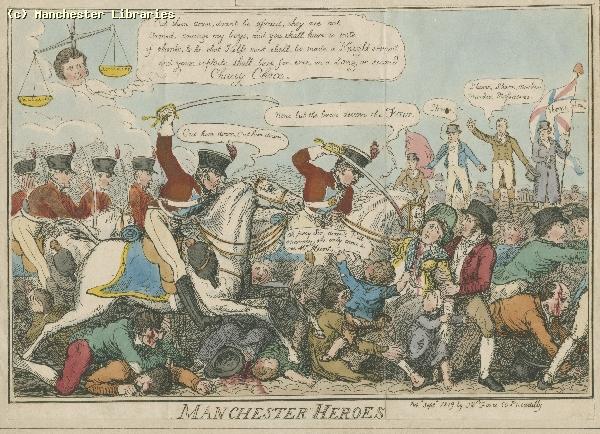
In this very charged atmosphere Alexander and some of his compatriots debated the possibility that like the Yeomanry at Peterloo in the August of 1819 they would be ordered to “draw swords or triggers on a deliberate public meeting.”

I cannot begin to appreciate the difficulty they were in or the momentums choices that were before them, and in a shining example of courage they stood out against a repeat of the massacre in St Peter’s Field, choosing to write letters “to various parties in Birmingham and London... Some were addressed to the Duke of Wellington, some to the King, some to the War Office, and some were dropped in the streets ... [saying] that while the Greys would do their duty if riots and outrages upon property were committed, they would not draw swords or triggers upon a deliberate public meeting or kill the people of Birmingham for attempting to leave their town with a petition to London.”

It is a powerful insight into a period which many history books pass over as  “popular unrest during the passing of the Reform Bill.” and leads on to Chartism

I rather think Alexander deserves more.  He was after all flogged for his brave stand and went on to record much that was going on during the period, including a firsthand account of a British mercenary army unit that fought in the Spanish Civil War of 1839, and conditions in rural Ireland.

His is a story I knew so little about.  I had read his History of the British Legion, and War in Spain but until Lawrence sent me a copy of the Manchester Examiner for June 1847 I did not know he had been in Chorlton or that he recorded so much of  the story of radical politics.

So he was here, passing through I grant you, but if we have found him I travel in the full expectation that there will indeed be a home grown Chorlton Chartist just waiting to be discovered.

Tomorrow, Joseph Johnson who had been active in radical politics. was on the platform in St Peter’s Field, during the Peterloo Massacre was imprisoned for “assembling with unlawful banners at an unlawful meeting for the purpose of inciting discontent”  and ended his days just across the Mersey.

*http://chorltonhistory.blogspot.co.uk/2012/07/longford-hall-and-our-own-chorlton.html and http://chorltonhistory.blogspot.co.uk/search/label/Alternative%20histories
** Somerville Alexander, The Autobiography of a Working Man, 1850  page244 Google ed page 253

Pictures; The Autobiography of a Working Man, Peterloo, Courtesy of Manchester Libraries, Information and Archives, Manchester City Council, m01563, The Great Chartist Meeting on Kennington Common, April 10 1848, by William Kilburn

See also The Day I lost a Chorlton Chartist http://chorltonhistory.blogspot.co.uk/2012/09/the-day-i-lost-chorlton-chartist.html

Friday, 21 February 2025

The day I lost a Chorlton Chartist


Well to be more accurate, it was more the day I invented one who never was. 

It all looked so good.  In the June of 1847 Alexander Somerville had walked the lanes of Chorlton looking for evidence of potato blight and discovered a potato called the “radical.”

His autobiography recalled how he had been flogged while in the army for distributing letters arguing that the military should not be used against those groups campaigning for the Reform Bill and there he was being quoted by Engels in The Conditions of the English Working Class.  So as you do I made an assumption and I was wrong.

He did “earnestly desire to see the enfranchisement of the working people” but disagreed with those Chartists who “think they can effect that great consummation by fighting for it.”* “In the first place, there is yet not a national desire for that enfranchisement; there is on the contrary, a general aversion to it among all persons of property.”  

This led him in turn to attack the Chartist leaders because “their practice has been to excite hatred between classes [and] until there is an alliance between classes there cannot be in Britain an act of universal enfranchisement.”

This correctly harps back to the convergence of interests between the reforming elements in the middle and working classes during the campaign for the reform bill in the 1830s but misses the point that by the late 1830s that shared interest did not exist anymore.  The middles class had the vote and could see no reason to share it.

So given the worsening economic situation, and the rejection of the first Charter it is easy to see how some Chartists might be drawn to physical force.

Now despite never being a pacifist Somerville was equally unhappy about the use of violence.  He had after all been flogged for trying to stop force being used against the supporters of reform in Birmingham in 1832, and maintained that the Chartists “avowed belief that they can do physical battle with a few wretched pikes, against the regularly armed military forces, are not likely to obtain sympathy of the people, interested in the preservation of property.”

It was this same opposition to civil insurrection which had led him in 1834 to inform on a plan  to assassinate members of the Cabinet and the Royal family and seize control of Parliament and the Bank of England.  In is autobiography Somerville justifies his actions on the grounds of the strife, loss of life and damage to property which would have ensued had the plot gone ahead.

But there is that other giveaway clue in his comments on the preservation of property, which mark him out as marching on a different path. He was convinced that those Chartists who were hostile “ to the existence of private capital , moneyed or landed” were wrong.  It was this that led him to oppose the Chartist Land Plan as unfeasible.

Equally he could see that “the capitalist, merchants, master manufacturers, and master shopkeepers” by continuing to block reform would not be able to escape the consequences of heightened class conflict.

So if the opposition to widening the franchise was because they believed “the mass of the people to be dangerously ignorant .... I would say educate liberally and universally. There is no middle course; either give schools and votes, or barrack yards and bullets.  I am for schools and votes.”

Now I may be airing a prejudice when I think that class interests might have been the hidden factor in the opposition to extending the vote, but as a principle I am right behind Alexander.

So not perhaps a Chartist who passed through Chorlton but a radical none the less.

*Somerville, Alexander, The Autobiography of a Working Man, 1848, page 509 Google edition page 521

Picture; The Great Chartist Meeting on Kennington Common, April 10 1848, by William Kilburn

Tuesday, 20 August 2024

Joseph Johnson, radical, farmer and almost a Didsbury Radical

The Peterloo Massacre still has the power to shock and ranks alongside the Sharpville Massacre in South Africa in 1960 and the Kent State killings in Ohio in 1970 as a moment when peaceful demonstrations were met with the full ferocity of State power.*

And it is of Peterloo I want to think about today and in particular the part played by Joseph Johnson, one time radical who lived in Northenden and whose political past gave rise to a potato being called the “radical.”

Now as many of you know I am searching for our radical past here in Chorlton, not out of a nostalgic wish make the place politically correct but because it seems to me that there would have been people here with views that ran directly opposite to those of the establishment and the wealthy.

There is evidence that there were people from both Stretford and Urmston present at Peterloo, and this shouldn’t surprise us either.  Both were places where there were significant numbers of weavers and these were a group who had become radicalised as their industry went into decline.  So according to one source 151 of those wounded at Peterloo were weavers, which represents 50% of all casualties whose occupations are known.**  And we had some weavers.

So it is not beyond the bounds of possibility that we made a contribution to that 80,000 strong crowd, but that is where at present we have to leave it, with just a maybe.

His home in 1905
That does still leave me with Joseph Johnson, who was on the platform in St Peter’s Field, during the Peterloo Massacre and was arrested for “assembling with unlawful banners at an unlawful meeting for the purpose of inciting discontent,”  found guilty, and on his release in 1821 settled in Northenden.

He was born in Manchester which some sources narrow down to Didsbury in 1791 and became a successful brush maker.

A strong supporter of universal suffrage and annual parliaments, Johnson joined the Manchester Hampden Club formed by John Knight. In 1818 Johnson helped John Knight, James Wroe and John Saxton to start the radical newspaper, the Manchester Observer. Within twelve months the Manchester Observer was selling 4,000 copies a week. Although it started as a local paper, by 1819 it was sold in most of the large towns and cities in Britain. Henry Hunt called the Manchester Observer "the only newspaper in England that I know, fairly and honestly devoted to such reform as would give the people their whole rights."

In March 1819 Joseph Johnson, John Knight and James Wroe formed the Patriotic Union Society. Johnson was appointed secretary of the organisation and Wroe became treasurer. The main objective of the Patriotic Union Society was to obtain parliamentary reform and during the summer of 1819 it was to hold a meeting here in Manchester at St Peter’s Field.  The rest as we know was a tragic outcome, and one which in its way was no less awful for Johnson.  For after being imprisoned his wife fell ill and died and he was refused permission to attend the funeral. ***

On his release he settled in
Northenden and we can track him in the village from 1841 through till his death in 1872.  During that time he gave his occupation variously as brush maker and later land proprietor and it will be as such that he planted potatoes which became known as “radicals” 

A fact that might have been lost to us had not another radical who described his visit to Chorlton in the June of 1847.  This was Alexander Somerville who having crossed over the Mersey recorded that

‘My companion said-“It was in this way; it was a sort of potato introduced here by Mr Johnson of Northern; and as he was a radical, they called the ‘tatoes radicals too.  Don’t you remember the song that used to be sung?  ‘God Bless Hunt and Johnson, and all who take their part;’ that was the Mr. Johnson, now of Northern, a very good gentleman he is who brought this very good kind of potato here which they call radical.”’

Which should really be the end of the story but I shall close with his will.  On his death he left £2000 and was described as “gentleman.”  I wonder if he would have approved of the description.

Pictures: Courtesy of Manchester Libraries, Information and Archives, Manchester City Council Peterloo, 1819, m77801, Ravenswood home of Joseph Johnson, 1905, m36100, Veterans of Peterloo 1884, m07594

*On an August day in 1819, anything between 60,000 and 80,000 men, women and children had assembled in St Peter’s Field to listen to the case for reforming the representation of Parliament.  Just before 2 in the afternoon a unit of Cavalry charged into the crowd with their sabres.  The deaths resulting from that charge have never been exactly established but sources claimed between 11 and 15 people were killed and up to 700 injured.  At Sharpeville in March 1960, after a day of demonstrations, the South African police opened fire on the demonstrators, killing 69 people. At Kent State University in Ohio, four students were shot and nine wounded by the National Guard during a peaceful protest at US involvement in the Vietnam War.

**Bush, Michael, The Casualties of Peterloo, 2005

*** http://www.spartacus.schoolnet.co.uk/PRjohnson.htm


Monday, 15 July 2024

Of floods and tourist attractions on the edge of Chorlton


Today I am on the Mersey at the edge of the township.  It is 1910 and judging by the trees we are somewhere in the summer or early autumn.

To the left is the barn of Red Bank Farm and in the distance the tower of Christ Church. It is a photograph I have used before because it perfectly captures the peaceful and benign side of the river l and yet those raised banks are the give way to what the Mersey can become.

Almost without warning it can be transformed into a heavy fast flowing roll of water that can almost over top the high banks along most of its course through Chorlton.  It has always been so and in the past it has broken over those high banks and left a wide lake.

Just what that could all mean for our farmers is there to read in the visit made to Chorlton in the June of 1847 by Alexander Somerville.

He was looking for evidence of potato blight which had destroyed the crops in Ireland and  was in Derbyshire.

And having taken in the township crossed the Mersey at Jackson’s Boat and headed on to Northenden which led him in turn to the Boat House and here

“in the absence of the potato marks, I examined the records upon a wooden post in the Kitchen of the Boat House of the highest Mersey floods since 1709.  In that year the water was a about a yard deep in the kitchen.  It was four feet six inches deep on the 21st of December 1837; it was three feet and some inches on the 31st of August, 1833.  1845 and 1828 were both years of record in the Boat House kitchen.”  

It remains a remarkable account not least because the voices of those he spoke to have been recorded in his newspaper account.

Now I have always made much of the attractions of Chorlton to the Sunday trade out from Manchester for a day in the countryside, and here Somerville did the same for Northenden and Didsbury,

“there were many sweet attractions in the meadows and the shady paths, and on the flowering sward, and by the Mersey’s waterfall, for those to hear that Manchester has many people who seek for and enjoy such delightful places of recreation.  

And I must confess that like many strangers visiting Manchester on business, or passing through it, I have been ignorant that, while it is the centre place of matchless enterprise and industry, it is surrounded with scenery of great beauty- not surpassed even by the beautiful fields, meadows, gardens, and the public pathways through them, lying around London.”

So just perhaps when he passed the banks of the river captured by our photograph he might have reflected on the two sides of our river.

Location; the Mersey

Picture; the Mersey,circa 1900 from the Lloyd Collection


Sunday, 14 July 2024

Chorlton's own radical ... Thomas Walker

This is the story of Thomas Walker one time pillar of Manchester society but also a radical politician who campaigned for the abolition of the slave trade, supported the French Revolution and was indicted for treason in 1794.

The family lived at Barlow Hall from the late 18th century spending the summer there before moving back for the winter to their town house on South Parade which faces what is now Parsonage Gardens.
And it was there that a mob attacked Walker who was forced to drive them off by discharging a pistol in the December of 1792.

This was at the height of political debate over the issues of press freedom and the French Revolution.
“Emboldened by drink and fired on by agitators, groups hostile to the radicals began to gather around the city.  Walker was in no doubt that this was pre planned.  

‘Parties were collected in different public houses, and from thence paraded in the streets with a fiddler before them, and carrying board on which was painted with CHURCH and KING in large letters’ 

On four separate occasions a mob gathered outside South Parade, broke the windows and attempted to force their way in.  Supported by friends Thomas Walker was forced to fire into the air to disperse the crowds.

The magistrates did nothing to prevent the events and while a “regiment of dragoons was in town, booted and under arms”    and ready to disperse the rioters no order was given.

As if to add insult to injury the main concern of the magistrates when they finally met Walker was that he should not fire at the crowd again if the mob returned!  These attacks had been matched by similar ones on the home of Priestly in Birmingham and in Nottingham.”*

Walker survived both the attacks and was acquitted of treason, after which he retired to the new family home at Longford House where he died in February 1817 and was buried in the parish church on the green.

Location; Chorlton

Pictures;  Barlow Hall, circa 1890, from the Lloyd Collection, and the Walker family gravestone in the parish churchyard from the collection of Andrew Simpson, 2011.

Next; Thomas Walker and the campaign to abolish the Slave Trade

* The Story of Chorlton-cum-Hardy, Andrew Simpson, 2012, http://chorltonhistory.blogspot.co.uk/search/label/A%20new%20book%20for%20Chorlton


Friday, 21 June 2019

Campaigning with the Anti Corn Law League in Manchester in 1845

I am back with Alexander Somerville, radical, journalist and by his own admission at one time a police spy.

That earlier campaign in St Peter's Fields, 1819
All of which makes him a fascinating chap to write about and one who fully embodies my idea that history is messy.

Now I have written about his visit to Chorlton in 1847 and explored his stand against using the military to suprpress the popular agitation for the Reform Bill in 1832.*

And later I guess I will cruise along the Spanish coast relating his time fighting for the British Auxiliary Legion during the Spanish Civil War of 1835-38**

But today I want to go back to his time with the Anti Corn Law League which had been set up in 1836 to campaign for the repeal of the Corn Laws which had been introduced in 1815 as a means of protecting British agriculture, but which was judged by many as responsible for keeping bread prices high and preventing the unfettered reign of Free Trade.

So Alexander took on the job of taking the message into the countryside and arguing the case amongst the farming interests.  And it was while he was engaged in this task that he gave us a wonderful description of the headquarters of the Anti Corn Law League here in Manchester.  Match this with two pictures from digital collection of Manchester Libraries and we can almost be in the offices sometime at the height of the campaign.

We are on the corner of Market Street and Cross Street in Newell’s Buildings.  My picture dates from 1867 but judging from the directories was much the same building that Somerville knew.

In 1851 it was occupied by a couple of painters, two engravers, a Music school, share broker, the Manchester Library and the Financial and Parliamentary Reform Offices as well as the National Reform Association.

But just a few years earlier it was completely taken over by what Somerville descibed as “at that extraordinary body the Anti-Corn-Law League.”

And so “having a day in Manchester I determined to get a peep.  Accordingly at ten o'clock I was in Market Street, a principal thoroughfare in Manchester. A wide open stairway, with shops on each side of its entrance, rises from the level of the pavement, and lands on the first floor of a very extensive house called 'Newall's Buildings'. The house consists of four floors, all of which are occupied by the League, save the basement. We must, therefore, ascend the stair, which is wide enough to admit four or five persons walking abreast.

On reaching a spacious landing, or lobby, we turn to the left, and, entering by a door, see a counter somewhere between forty and fifty feet in length, behind which several men and boys are busily employed, some registering letters in books, some keeping accounts, some folding and addressing newspapers, others going out with messages and parcels. This is the general office, and the number of persons here employed is, at the present time, ten. Beyond this is the Council Room, which, for the present, we shall leave behind and go up stairs to the second floor.


Here we have a large room, probably forty feet by thirty, with a table in the centre running lengthwise, with seats around for a number of persons, who meet in the evenings, and who are called the 'Manchester Committee'.

During the day this room is occupied by those who keep the account of cards issued and returned to and from all parts of the kingdom. A professional accountant is retained for this department, and a committee of members of council give him directions and inspect his books. These books are said to be very ingeniously arranged, so as to shew at a glance the value of the cards sent out, their value being represented by certain alphabetical letters and numbers, the names and residences of the parties to whom sent, the amounts of deficiencies of those returned and so on.

Passing from this room we come to another, from which all the correspondence is issued. From this office letters to the amount of several thousands a-day go forth to all parts of the kingdom. While here, I saw letters addressed to all the foreign ambassadors, and all the mayors and provosts of corporate towns of the United Kingdom, inviting them to the great banquet which is to be given in the last week of this month ... In this office copies of all the parliamentary registries of the kingdom are kept, so that any elector's name and residence is at once found, and, if necessary, such elector is communicated with by letter or parcel of tracts, irrespective of the committees in his own district.

Passing from this apartment, we see two or three small rooms, in which various committees of members of the council meet. Some of these committees are permanent, some temporary. Of those which are permanent I may name that for receiving all applications for lecturers and deputations to public meetings. ...

In another large room on this floor is the packing department. Here several men are at work making up bales of tracts, each weighing upwards of a hundred weight, and despatching them to all parts of the kingdom for distribution among the electors. From sixty to seventy of these bales are sent off in a week, that is, from three to three and a-half tons of arguments against the Corn Laws!

Leaving this and going to the floor above, we find a great number of printers, presses, folders, stitchers, and others connected with printing, at work. But in addition to the printing and issuing of tracts here, the League has several other printers at work in this and other towns of the Kingdom. Altogether they have twelve master-printers employed, one of whom, in Manchester, pays upwards of £100 a week in wages for League work alone.”***

So there you have it a vivid description of a campaign and its headquarters in the centre of our city.

Pictures; Peterloo, 1819, m01563, Newall’s Buildings, by James Mudd, 1867, m74665 and the interior, 1860, m56387 Courtesy of Manchester Libraries, Information and Archives, Manchester City Council

* http://chorltonhistory.blogspot.co.uk/search/label/Alexander%20Somerville
** Somerville, Alexander, History of the British Legion, and War in Spain,1839
*** Somerville, Alexander, The Whistler at the Plough, 1852, pp. 79-82

Thursday, 27 September 2012

Chorlton, Australia and an unpopular food tax


It was one of those serendipity moments which brought together my old friend Alexander Somerville, his contribution to the campaign against an unpopular food tax and our township and along the way brought a new pal from Australia.

Now I say my old friend Alexander Somerville but that is stretching a point as he died in 1885 but I have followed his life, read his books and got to feel he was someone I would like to have spent time with.*

And he was a remarkable man who campaigned on a wide range of social issues, was flogged by the British Army for refusing to attack peaceful protesters in 1832 and wrote extensively on Ireland and agricultural matters.

All of which would make him interesting enough but it was the fact that he came here in 1847, wrote about the place and recorded the conversations with some of our farmers that first drew him to me.

Then I discovered he was active in the campaign to repeal the Corn Laws and regularly took the case into rural communities. Now this must have seemed a tall order, given that the Corn Laws had been introduced to protect British farming by barring the import of foreign cereal into  the country until the price of corn reached 80 shillings a quarter thereby ensuring a market for home grown cereals.

But that is what he did and so it is entirely possible that he passed through here before the repeal in 1846.  All of which led me to ponder on the reception he would have got.  This may not have been so frosty, because although we did grow a fair amount of cereal many of our people were market gardeners and were more focused on the production of fruit and vegetables for the Manchester markets.

I have to admit that my knowledge of the degree of support for the Anti Corn Law Leagues in the countryside is limited and I have always promised myself it is something I must brush up on.  So I was intrigued when my new pal from Australia presented me with a list of the women on the Ladies Committee of the National Anti Corn Law Bazaar held in London in the May of 1845.

Given that the Anti Corn Law League had been founded in Manchester and was popular with the manufacturing interests it is no surprise to clock the number of Manchester addresses as well as the surrounding townships and out into Derbyshire and Yorkshire.

But there are also a few from rural areas, like Burnage and Didsbury which may mean something or may mean nothing at all.  There were plenty of business people who chose to settle away from the smoke and noise of their factories and both places were very pleasant and very much in the countryside.

So I suppose here is the new research project.  Single out, identify and track down these “ladies” and in the process see if there is evidence for their background and social standing in these rural communities.  All of which might lead on to how if they were linked to farming.

So far neither Miss Leete of Poplar Grove, Didsbury or Mrs Thomas Bright from Burnage have stepped out of the shadows but we shall see.

All of which just leaves my new pal.  This is June Pound who lives in Australia and who is related to the woman Alexander Somerville married and amongst her family treasures was the list which really goes to show how serendipity works.

Picture; Anti Corn Law Committee  from the collection of June Pound and cover page of Somerville's autobiography

* http://chorltonhistory.blogspot.co.uk/search/label/Alexander%20Somerville