Showing posts with label London in the 1960s. Show all posts

Saturday, 27 June 2026

This Is London ........ a unique guide to the London of 1959

Now I have no idea why I never got a copy of This Is London.*

Cover of This is London
I guess that there are only so many books that you can get for Christmas, and with the Eagle Annual and the odd history book that was enough.

Not that I think I would fully have appreciated it back then when I was only ten all of which is so different now.

It is a witty, informative guide to the London I knew as a child and is full of marvellous images in the style of the period and these alone take me back nearly sixty years.

But it is also the humour which shines through and marks it as something original.

It starts with a page of brown sludge with the occasional splash of yellow accompanied with “Well, this is London. 

 But don’t worry, it is hidden in fog like this only a few times a year in winter. Most of the time it looks- like this!”

And that is the start of a wonderful series of bright colourful and exciting paintings of London with a text to match.

All of which is a riveting read and one that has now become a history book in itself.

So much so that the new edition which was published in 2004** has updated some of the entries,  pointing out for instance that “Today the Billingsgate fish market is located in the Docklands, a rejuvenated section of the London Docks.  It moved there in 1982.”

Now that move passed me by and while I have no doubt it was for the best I have vivid memories of the market, the over powering smell and the debris left on the streets on a Saturday morning only hours after the traders and the fish had left for shops across the city.

Three million passengers are carried daily in Underground trains
It is just one of the moments which bounced out of the past along with those electric milk floats, old Routemasters and a river which was still a working river full of ships from every corner of the world unloading their cargoes under the shadows of tall cranes and massive warehouses.

All of which I remember and for those like my own lads who never knew that London, Mr Sasek’s book has it all.

And so as you would expect I have gone looking for other editions in the same series which included, Paris, Rome, New York, and San Francisco.

In time I might order up the reprints of New York, and San Francisco, but at present I am content to wait for the arrival of This is Rome which was originally published in 1960 and reprinted in 2007.

Like This is London it has an page of updates which will be fun to match with the original text and my own memories of a city we regularly return to.

Now ever one to respect copyright I held off posting and substitute the same story but with images drawn from the collection.

However after contacting the publisher it appears at present no one knows who owns the copyright to the illustrations, so as the blog is no commercial and this is about encouraging everyone to buy read and share the booksof Mr Miroslav I can't think anyone will object, but if they do I shall revert to the original.

And for those intrigued by the books there is a site dedicated to the author and his books.

Picture; cover from This Is London, and Underground train page 42 courtesy of Universe Publishing

*This Is London, Miroslav Sasek, 1959

**Universe Publishing, a Division of  Rizzoli International Publications, New York, www.rizzoliusa.com

***This is M Sasek, http://www.miroslavsasek.com/index.html

Friday, 26 June 2026

Dancing across London …. and on in to Bermondsey ….1965

I like musicals, and so when I saw a trailer for a 1965 film about London and especially Bermondsey, I was hooked and sent off for the DVD.

My River, 1968
For what ever reasons I never saw the film at the time, which might be because it never quite made it to the Well Hall Odeon or the ABC in the High Street

But more probably because back then I didn’t fancy watching Joe Brown, Una Stubbs, Sophie Hardy and Sid James, sing and dance their way around London to an implausible plot, which involved them trying to steal, a bowler hat, Guardsman’s bearskin, and a police helmet.*

But fifty-five years on, having exchanged south east London for Manchester I decided it was worth the £6.

Well I rather think the jury is out on value for money.

I have lots of  time for Joe Brown, Sid James and Una Stubbs, all of whom are superb in their own fields, added to which, the support cast were good, and the backdrops were of a London, long gone.

As for the film, its plot and the quality of the songs, I rather think the writers and producer might have been better employed staying at home.

But a bit of me always wants to be generous to anyone who creates something, and it is easy to be critical.

Looking out from Occupation Lane, 2019
So, forget the story line, along with the songs and some dodgy acting, and instead focus on the bigger canvas, which is that London I grew up with and fondly remember.

The River is still flanked by a forest of cranes, the skyline has yet to be dwarfed by tall nondescript buildings, and there is a mix of touristy London with the sort of places I grew up in.

All of which makes it a piece of history well worth watching, not only for the sights but also for a type of “kids” musical where a group of working-class youngsters make fun and come out OK.

Not that I can empathise with the last bit.  I certainly had fun, but my growing up was more mundane, and ordinary.

Added to which I rather think that Cliff Richard did that style of movie a bit better.

Still, the notes on the back under special features holds out the promise of something good from the image gallery.

We shall see.

Location; London, 1964-5

Picture; The River as I remember it, 1968, and Looking out from Occupation Lane, 2019  from the collection of John King

*Three hats for Lisa, 1965

Thursday, 4 June 2026

When pop music was Saturday Club at home in Well Hall

Saturday Club on the Light Programme still has the power to invoke fond memories.

Now if you are my generation, born in the decade after the last World War who entered their teenage years to the sound of Elvis Presley, Buddy Holly and Cliff Richard and who can still remember listening to “She Loves You” for the first time, Saturday Club was essential listening.

It had begun in 1955 but I suppose I was not really aware of its existence for another five years.

Back then if you wanted to listen to pop music on the radio it was slim pickings.

There was of course Radio Luxembourg which I listened to on my small transistor radio but the adverts for Horace Batchelor* plus the way the signal would fade and wane irritated me.

And on Saturday nights after the football results there was Juke Box Jury and later Thank Your Lucky Stars which showcased the latest singles and passed judgement on them.  But all too often these were shows watched by the whole family and as much as I loved my parents and young sisters there were times when you wanted to listen alone.

Now Saturday Club just fell into that requirement.

It went out after my sisters were at Saturday Morning Pictures and mum and dad were doing things.

It’s only real rival for me was Pick of the Pops the following afternoon, that rapid whizz through a week’s chart ups and downs.

This after all was the time when I was still too young to go to the dance hall above Burton's on Well Hall Road and those other live music venue like the Welcome Inn and the Yorkshire Grey were out of the question.

But then came Radio Caroline in 1964 followed by its rival radio London and things just were not the same again.

All of which is teetering on nostalgic tosh and so to the point.  Saturday Club was one of those programmes which didn’t just play records but offered up live performances with interviews which always appealed to me.

But the attention span of a teenager is fickle and with the arrival of Ready Steady Go with its visual and slightly edgy feel I was pulled in a totally new direction.

Top of the Pops might be required viewing to be shared with the whole house and discussed the following day at school but RSG had me hooked.

So bit by bit Saturday Club faded but has never quite left me, and as I head towards my 77th year I still have Tony Blackburn offering me something of the same on Radio 2 with “Sounds of the Sixties.”

Now that is perhaps the point to close but not before one last observation, which is that I know I am growing old when the music of my youth is now played on Radio 2.

Pictures; of Brian Matthew & Saturday Club, featured on Saturday Club** and Burtons in the mid 1960s


* Horace Cyril Batchelor was as an advertiser on Radio Luxembourg. He advertised a way to win money by predicting the results of football matches, sponsoring programmes on Radio Luxembourg.

**Saturday Club
This site is non profit making and solely for fans of Saturday Club to trade/swap off - air copies of the programme in whatever format eg reel to reel, cassette, cd etc, http://www.saturdayclub.info/


Friday, 6 March 2026

The class of '68 part 5 teachers and possibilities


Poundswick High School Lower School, 1982
Now most of us can look back on teachers who were very special. 

They come in all sorts of shapes and sizes, from the larger than life and eccentric ones who sweep you along to the quiet and thoughtful who radiate calm confidence and bring that out in you. 

And then there are all the variations in between.  True as the critics of state education delight in shouting there are a few who were unsuitable, some who had no idea how to communicate and one I met who was a downright bully.  But they were the real exceptions.  In thirty-five years of teaching in inner city schools and of course those years when I was on the receiving end all but a handful of the people who chose to stand in front of a class were all that you could want from a teacher.

Some of the Class of '68, 1968
I remember Norman Parry, who left elementary school, spent years in the Direct Works Department of Manchester Corporation before becoming a metal worker teacher at Oldwood Secondary School.  He was much loved by generations of students and by us younger teachers who marvelled at the way he drove his motorbike up and down the corridors of the school with little regard for authority.

Many of his generation who made such an impact on me as I began teaching were men and women who had seen active service in the last world war and were determined that they were going make a difference in the post world war. Men like Austen who had flown fighter bombers off aircraft carriers, ran a very successful part time optician’s business but made his main job that of teaching maths in Wythenshawe.

And a generation later we the class of ’68 were fortunate in having so many at Crown Woods.  My  three history teachers, all of my English ones and many others who came my way were excellent communicators, and caring individuals who unlocked the doors to new worlds and above all gave me a love of learning that I have never lost.

I remained in awe of Mrs Hussein whose rapid delivery of events of the 18th and early 19th century left us tired and desperate fearing not to look out of a window lest we lose fifty years of European history.  All of which was in direct contrast the slow delivery of Mr Levine who would sit and throw out the “big idea” about Gladstone or Disraeli and then seek to weave subtle arguments which while they were entertaining were also powerful examples of how to develop A level history essays. And in amongst all this was the equally powerful presence of Mr Naismith who managed to mix style and delivery with a deep knowledge which always ended with a flourish as he tore up his teaching notes at the end, as if to say “here another original and fresh lecture” which would not be brought out for another trip next year.

Michael Marland
And then there was Michael Marland Head of English and later Director of Studies. His was a dominant presence in my years at the school.  His quiet manner was as effective in one of those last classes with a bottom set Year 9 group on a Friday afternoon as when exploring the comic side of Shakespeare’s Henry IV with his lower sixth on a Tuesday before lunch.

Looking back what I treasure most was his sense that all of us were important and that however ungainly we expressed ourselves and “got it wrong” there was merit in what we said and his job was to take us forward and bring out our talents.

It was a quality which on more than one occasion led him to persuade me in to doing something “dramatic” that at best I was uneasy with and at worst just didn’t want to do.  Like the performance of Pinter’s “The Last to Go” which he and I did at one the evenings of prose and poetry hosted by the English Department.  Now being asked to do the five minute conversation between a barman and newspaper seller in front of an audience was daunting enough, but to actually have to do it with Mr Marland made you feel very special.

Some of the Class of '68, 1965
And when you had been chosen to be part of one these events there was a real sense that there was no way of getting out of it.  I well remember another such evening, which was to be a collection of 18th century readings and music performed at Ranger’s House on Blackheath to  invited audiences.

There was the causal enquiry about  becoming involved, followed by an invitation to his office high up in the school.  The part was outlined to me which I politely declined using a variety of excuses all more desperate than the one before. These were listened to and quietly but carefully put aside with a mixture of humour and a little flattery, before I realised that this was truly what I wanted to do, and I left with script in hand, only to see that there on page one already printed out along with the rest of the cast was my name beside the piece Clever Tom Clinch by Jonathan Swift.

It was something I thoroughly enjoyed and one that I will always be grateful that he pushed that raw 17 year old to do.

But the degree of his standing in my profession only became apparent once I began teaching.  His book “The Craft of the Classroom: a survival guide to classroom management in the secondary school” published in 1975, offered me and many other young teachers the practical side to the job.  I was arrogant enough to think that I had as he said that mix of "a spirit compounded of the salesman, the music-hall performer, the parent, the clown, the intellectual, the lover” but it was the “organiser" that I was lacking.  Simple things like keeping a register and how to start and end a lesson were taken as read by my older colleagues but never imparted to me when I started in the September of 1973.

It is a reputation that went deep and so during a meeting with English teachers in the late ‘80s the fact that he taught me was met with a mix of envy and a series of questions about him.  I have to say I was less than modest and let slip he had once told me I featured in the preface to one of his books. 

Now for me that still ranks as something.

Pictures; from the collection of Andrew Simpson and  Anne Davey.  The photograph of Michael Marland courtesy of CATHERINE SHAKESPEARE LANE   PHOTOGRAPHER, http://www.csl-art.co.uk/index2.htm

Thursday, 5 March 2026

The class of '68 part 4 widening horizons and lots of fun

Few of us get the chance to leave a past life with all its associations and disappointments behind and start out a fresh.

This is pretty much what I did in the September of 1966 when I walked into Crown Woods School.  I left behind an indifferent five years in all boys’ secondary modern school and one real friend.

And in its place embarked on a two year spree of new friends amazing academic challenges and a new confidence about who I was and where I was going.

But enough of the indulgent personal stuff suffice to say that when I sat down in that room on the second floor with a dozen or so complete strangers I took control of who I wanted to be.  There was no one to judge me against the untidy, loud 11 year old afraid of his own shadow of five years earlier.

Here I could be a new me, and it started with walking to school with a rolled umbrella.  A piece of sheer affectation, silly in retrospect but it made me feel different.

So here in this new place everything was possible.  The school had a confidence about itself and you came across it at almost every turn.

The year before the timetable had been collapsed for certain year groups and various departments collaborated on a drama production “The Price of Coal.”

Set in the 19th century it examined the conditions in which children worked in the coal mines...  And so while the History department set to research the story the English and music departments worked on the production and Art created the backdrop.

Nor was the school alone in sending out a message that comprehensives were just as good at offering exciting and innovative experiences.  Just down the road at Eltham Green School their staff and 6th Form hosted major conferences each year where 16-18 year olds could take part in workshops, listen to leading writers, historians, and scientists, meet and debate with each other and just have a good time.

I can’t remember the theme for the summer of 1967, but Sgt Pepper had just been released and by one of those rare coincidences the organiser was a Mr Pepper, and so much of the two days was filled with the sounds of that LP.  What I do remember was listening to Arnold Wesker discuss with others the cost of the Arts.

Back at Crown Woods there was a regular slot where well known writers were invited to come, meet and talk to us.  I am not sure what Margaret Drabble thought of the meal with four Sixth Formers in the Domestic Science rooms or the level of our discussion but for me this was something totally beyond what might have been possible just a few years earlier.

And that was the point.  At that critical moment in growing up I had the opportunity to discover a whole new set of experiences.  So within a year into being there as a few passed their driving tests and were trusted with the family car we were off along the country lanes of Kent hunting out old pubs or just going the three miles to sit beside the Thames on late warm summer nights listening as the tide on the river banged the barges together.

Then there were the theatres, concert halls and art galleries.  For a pretentious 16 year old in love with himself as well as half the girls in the 6th form I just couldn’t get enough of all that was there to see and hear.

It might be the Old Vic with Lawrence Oliver, Joan Littlewood’s theatre at Stratford East, or one of countless small rep companies performing across the capital.

We hoovered them up as if there was no tomorrow.  Most were fun a few were dire and some still resonance today, like the visit to see King Lear at Stratford.  Three of us had travelled in Crispin’s car and while he settled into a bed and breakfast Mike and I camped for the night by the Avon within walking distance of the theatre.  How we got away with that I don’t know but we did and that is about as far as you get from a small secondary modern school in Brockley to all that followed at Crown Woods.

Pictures; from the collection of Anne Davey, Wikipedia Common

Wednesday, 4 March 2026

The class of ’68 part 3 a comprehensive school called Crown Woods

Crown Woods wasn’t the only comprehensive school delivering a fine education but it was the one I went to.

So it is a place I can talk about with confidence and a lot of affection. I arrived aged 16 in the September of 1966 having done five indifferent years at a secondary modern school, which if I am honest were a standoff.

The middle years had been troubled and were not happy ones and while I became more settled I was ready to leave. So nothing quite prepared me for Crown Woods.

Here were two thousand students, half of them girls, a building which was less than a decade old and a dynamic, young and talented teaching staff. This was all state comprehensive education was meant to be.

Every night there was something going on ranging from the usual sporting clubs, and music sessions to poetry evenings and the big set concerts and drama performances. And without much effort you got sucked into it. I performed a piece by Pinter with Michael Marland the head of the English Department, joined a mixed bunch hosting an evening of 18th century readings and music in a fine period house in Blackheath and co produced a radio programme on folk music broadcast to the entire school.

It was also the way you were left to take on bigger things. So when after a few months of going to a local folk group I fancied putting on a concert at school one evening all I had to do was ask. The details are now lost in the fog of the past but we did more than one so I guess it all went well. Then there was the teaching. 

Never had learning been so exciting and meaningful before or since. These were the years of discovering Shakespeare, John Donne, and of watching as 18th century literature opened up the history of the period giving it context and depth.

It seems so obvious now but then the idea that before we read the set A level plays of Henry IV and King Lear we would immerse ourselves in the other great Shakespearian histories and tragedies.

Or that in preparation for the prose and poems of Samuel Johnson the 18th century writer we would look at the rhyming techniques of Alexander Pope and gaze over countless buildings of the century to understand the idea of balance and style.

Now for a working class boy who had just about reached his limit with Ian Fleming this was a revelation and a passport to another world.

And it extended out to theatre visits, from the National and Joan Littlewoods’s Stratford East to countless little rep companies across London. We were not just watching live theatre but for the space of two years were living it.

Amongst all this was a gentle assumption that the natural next step for many of us was University, a path which had only been trodden by one distant cousin in our family.

 Finally there were the friends, some of whom have lasted through the last 55 years and of course the girlfriends none of whom sadly lasted more than a few months.

Now I was just 16 and I  guess the cynical will shrug and dismiss it all as hormones. After all this is or should be when we live life in an intense and uncompromising way.

And there is also that creeping fog of nostalgia which makes the past a series of hot sunny days. But on balance for me and I think some of the other class of '68 this was a fine place to spend two years.

Pictures from the collection Anne Davey 

Tomorrow; widening horizons and lots of fun

Tuesday, 3 March 2026

The class of ‘68 part 1 an ending

We were the class of ’68.

Twelve young people from south east London about to leave school for the last time.

It would have been in late June or early July 1968 outside Crown Woods School in Eltham, our exams were finished and we were all preparing for that long hot summer which would end with exam results and the beginning of a new phase in our lives.

Of the twelve sitting on the car I can easily name seven of the young people staring back at me. I’m there fifth from the left, beside me was my girl friend Ann, and on my right was Anne Davey, David Hatch, and Mike Robinson while perched on the car at the edge of the picture was Crispin Rooney and behind us Karen and Richard Woods. I rather think the chap on the end was Keith Bradbury while my dear friend Anne Davey  has informed me that behind us was Jenny Turner and Ian Curle.

We have become that favoured generation, “the baby boomers”. Not for us world wars or bitter trade depressions.

 We were born in to a world our parents were determined would be better and different.

And we grew up against a backdrop of rising prosperity, looked after by a welfare system which confidently planned to care for us from “cradle to grave” and entered adult hood with the promise of full time employment and the opportunity of a university course which for some of us would be totally free.

Now there was a dark side to all this. The Korean War had begun just as most of us were coming up to our first birthday, and the ever present threat of nuclear war hovered in the distance, and as if to round off our child hood by the summer of 1968 there was the awful tragedy of the Vietnam War.

But that summer was a good one, and I have to say truly it seemed the sun shone all the way through.

 Now I was the late comer to the group along with my friend Bernard, we had washed up at Crown Woods Comprehensive in the September of 1966. Me, from a Secondary Modern School and Bernard from a grammar school.

And Crown Woods was  mixed, which pitched both of us into a series of wonderful new experiences and opened up new friendships that have survived the space of over 54 years.

Of course the intervening years have offered up both triumphs and dismal dog days and along the way some of those twelve have disappeared while we have all had to cope with a mix of disappointments as well successes.

Most stayed in the south with only me washing up in the north and never going back. We did the full range of post school careers, with some of us heading off to pursue a degree and others getting down to it directly in offices and factories.

And now most of us are on the cusp of retiring or have done so with all that that will bring. And as I stare back at the class of 68 I ponder on the stories that we made and the people we touched.

Pictures; from the collection of Anne Davey

Tomorrow, part 2, one of the class of '68 and a secondary modern school

Tuesday, 6 January 2026

As others see us ......... Well Hall in the summer of 1966 by Ian Nairn

The thing about guide books is that they date so quickly.  

But that can be what makes them so intriguing and that pretty much sums up Nairn’s London.*

It was published in 1966 and I picked up my copy over 20 years later from Bryan the Book.

And that is a tale in itself given that Bryan’s bookshop on Beech Road in Chorlton-cum-Hardy is 214 miles from Well Hall where I grew up.

Nor is that all for the original cover price was eight shillings and sixpence and I bought it for 40p.

The publisher warned that “some of the entries are already disappearing; so go and see the rest quickly.”

That said it is reassuring that the places in Well Hall and Eltham visited by Mr Nairn are still there, although not all are described in that fulsome and respective manner of most guide books

So in writing about Eltham Lodge he comments, “nothing great, but worth at least a sentimental journey to see this grandfather of all Georgian brick Boxes.”

But I am pleased my own estate fared not only better but also was described with a little affection.

“Well Hall Estate, Eltham Sir Frank Baines and others, 1916

This extraordinary place was designed in seven days as a rush job to house war-workers for Woolwich Arsenal.  It seems an odd recipe for one of the best housing estates near London.  

Perhaps the architects imply did not have time to air their preconceptions, and the local officials their disastrous application of bye-laws.  


Comfortable, cottagey design, slate and stucco, taken out of the rarified atmosphere of the garden cities, always trying to see streets as entities rather than collections of units.  

The best part is Ross Way, running from Well Hall Road at the junction of Rochester Way.  

This curves round a gentle slope with a raised footpath and uses every possible trick of gables and end walls.  

Half way along, footpaths run off under archways as part of a fairy-tale composition which by an irony is more like a German village than anything else.”***

It is a long time since I have looked through the book but with a wet weekend ahead I think I shall spend a few hours crossing London courtesy of Mr Nairn.

And as the publisher promised the book is the first of a series with one planned for the Industrial North, which sadly was never written which is a shame because  having said some nice things  about where I grew up I wondered if he would do the same for where I now live.

Well we shall see.

Picture; cover from Nairn’s London, 1966

*Nairn’s London, Ian Nairn, 1966

**ibid page 207


***ibid page 208

Sunday, 11 May 2025

At the Tower of London in the summer of 1955 and other childhood memories

Outside the Tower with Nana, 1955
I can’t say I remember this day at the Tower of London.

It would have been I think in the summer of 1955 and Nana would have been on one of her all too infrequent visits to London from Derby.

This will have been the first time I visited the place and pretty much set me on a love affair with the Tower which I have never lost.

Within a few years of this picture, I was doing the trip on a Saturday with anyone who would come with me and often on my own.

The journey began at Queens Road railway station which was an adventure all in itself.

The platform was up a tall flight of stairs past a nondescript booking counter which even then seemed past its best, and from the cracks in the wooden boards of the platform you could see down to the ground below.

The train took you into London Bridge past rows of houses, backstreet garages  and warehouses and the unmistakable landmark of the Peak Frean biscuit factory with that overpowering sweet smell which hung in the air even on a cold January day.

And then the terminus at London Bridge, the river and down that dark flight of stone steps to Lower Thames Street and the magical walk past Billingsgate to the Tower.

Peak Frean, 1891
Now Saturday morning was a good time to walk Lower Thames Street, the porters and traders had finished up and the street cleaners were out in force tidying away the refuse from the early morning trading which left bits of fish strewn across the road.

Even now I have not lost the memory of that all pervading fish smell which along with the stone sets in the road and the twisting side streets were almost as they had been a century before and with not much imagination could place you back in the same spot in the time of Pepys.

This of course was just a prelude to the Tower itself, which on a Saturday back in 1959 was free to children which was an opportunity I exploited to the full.

Perhaps it’s one of the down sides of my character that I could and still can revisit a place week after week, do the same tour, stop at the same places and continue to be totally absorbed in all there is to see.

The Tower, circa 15th century
And like most of us it was also the sheer excitement of touching the stones and climbing the narrow spiral staircases of the White Tower that transported me back to some moment in the high Middle Ages.

Then there was that musty cold and sometimes dank smell that came out of the stone work along with the absence of much natural light in some of the towers which added to the sense that here you were walking history.

Now they say you should never go back and on occasion returning to some magical place of my childhood has been a disappointment which somehow spoils what I remember.

Of course I try not to wallow in nostalgia and I am fully aware that the developers, the City of London and the custodians of the Tower were never going to let my childhood memories get in the way of their view of progress.

The River, the bridge and Lower Thames Street, 1872
So the Tower is far busier than I remember, the walk from the station over the river and along Lower Thames Street resembles little of what I saw as a child and the cranes, ocean going ships with the warehouses that flanked the river are now as much a bit of the past as is the swirling fog, costermonger’s cries and the smell of the fish market.

Ah well as they say nostalgia ain’t what it used to be.

Pictures; a young Andrew with Emilie Hall at the Tower, 1955, from the collection of Andrew Simpson, the Peak Frean poster derived from Kennington's painting The Toy Shop, of 1891. Wikipedia Commons, The White Tower, a depiction of the imprisonment of Charles, Duke of Orléans, in the Tower of London from a 15th-century manuscript. The White Tower is visible, St Thomas' Tower (also known as Traitor's Gate) is in front of it, and in the foreground is the River Thames.
late 15th century from a manuscript (British Library, MS Royal, 16 folio 73) of poems by Charles, Duke of Orléans (1391–1465),  Wikipedia Commoms and detail of the River Thames and Lower Thames Street from the OS of London, 1862-72, courtesy of Digital Archives Association, http://www.digitalarchives.co.uk/

Friday, 9 May 2025

Half a century and more with the Tower of London

Now, if I could do the sums I might be able to decide if paying 15p for this guide book to the Tower of London in 1971 matches the going asking price of £4.99 today.


But I suspect it’s as silly as “trying to solve an algebra equation by chewing bubble gum.”*

My copy is a reissue of the original which was published in 1967 and one I “borrowed” from our Stella and never returned.

During the late 1950s and into the early 1960s I regularly visited the Tower, often on my own and usually on a Saturday morning when admission was free to children and the numbers of visitors was still relatively small.

There was a ritual which started at Queens Road Railway Station and the train up to London Bridge, followed by a brief but intense gaze into the model shop under one the arches and the purchase of a packet of toffee Poppets and then the walk over the old London Bridge and down the Lower Road through Billingsgate market.

By 9.30 the frenetic business of selling was over, but the debris still littered the streets including bits of fish and ice and that all powerful smell.

I thought nothing of it and anyway it was soon left behind for the wonders of the Tower, containing the stories of those incarcerated, the graffiti they left in their cells and the heaps of armour on display.

Never underestimate the power of those thick stone walls to work their power on an imaginative ten your old.

I did occasionally go with friends, but it wasn’t the same as doing it on your own, when you could linger in favourite places, check that the displays were as you had left them the week before and just soak up the past.

Back then I didn’t bother with a guidebook which would have eaten into the week’s pocket money and then as now I preferred to find out for myself.  It’s an arrogance which has often led to me losing out on the significance of a place, a statue or a thing.

My 1971 book is filled with black and white photographs, and a dense text which my ten-year-old me would have found heavy going.

But looking through it again I have to confess it is full of interesting information, but it is a product of its time.

So there are 12 pictures of some of the most notable prisoners, but alas nothing on the more humble who found themselves inside the walls.

Nor is there any reference to what it would have been like to live and work there, which even then was a question I would have loved to ask.

Today the guidebooks and some of exhibits on display at many of our historic places will feature the living and working conditions of those who toiled in the kitchens, guarded the gates or just whiled away the hours between sunrise and sun set.

But perhaps I am being harsh and so with that thought I will close.


Leaving me just to reflect on the cover which I like and reminds me of much else of the art work around in the 1960s.

Of course today most of us will have checked out a museum on line either before or after a visit, but then at 10 in 1959 that wasn't an option.

Location; the Tower of London

Pictures; from The Tower of London Guidebook HMSO, 1971

*“Worrying about the future is as effective as trying to solve an algebra equation by chewing bubble gum. The real troubles in your life will always be things that never crossed your worried mind.” Sunscreen, Baz Luhrmann, https://www.youtube.com/watch?v=sTJ7AzBIJoI


Sunday, 20 April 2025

The class of '68, part 2 ..... failing the 11 plus or Andrew and Samuel Pepys Secondary Modern School


The one sure certainty of failing the 11 plus was that you went to a secondary modern school.

Not of course that this over surprised me.  My mother had been told by my year 6 teacher back in the January of 1961 “that I was not academic material.”  A sentence that burned deeply into my mother and condemned my father and me to endless evenings of 11 plus tests by the kitchen stove.

All to no avail.  I failed.  But not before I along with all the other also runs had to endure the class interviews where the hopefuls destined for a bright grammar school future would give a presentation to the rest of us, which were really rehearsals for the real thing in front of the head teachers of the local grammar schools.

To this day I remember my first introduction to Vasco da Gamma that Portuguese sailor who boldly went where no European had sailed before.  Even then I wondered why the cabin boy and cook as well as the man steering the ship never got a look in through the entire talk.

Years later teaching year 8s the European voyages of discovery, plunder and much else I was always pulled up by the mention of the said captain and taken back the twelve years to the upstairs classroom of Edmund Waller Junior School and the talk given by Barry Whatshisname.

But enough of such bitter vituperation.  That was what the 11 plus was supposed to do.  Separate the elite from the rest of us, and while they went on to a bright academic environment we were destined for schools which specialized in more practical things, .......woodwork not Wordsworth, technical drawing not Tennyson and so much more.

Added to that our schools were not as well funded and led to one glorious episode where just before my O level history exam in 1966 we were given a world historical atlas published in 1938 which finished with the wonderfully optimistic comment that “it is hoped the leaders of Germany and Italy will see sense and rejoin the League of Nations in a profound desire to solve issues by peaceful means.”  Now today I can see the dark humour in that, but at the time I pondered how we had to use a thirty year old text book which added to everything else got the next ten years of European history so wrong.

But my secondary modern school and many others across the country strived not to give us a second class education.  They were fully aware that a rigid test at 11 did not mean that those who failed to pass were failures.  And so many of us were entered for 0 level exams that badge of so called academic excellence while class mates were given the practical skills which enabled them to become tradesmen in a whole range of occupations.

And these places attracted the talented and committed teachers.  I can remember many who I would have been happy to work beside when I started teaching in 1973.  Indeed in the years after I started I benefited from the advice, good humour and wisdom of those who had been at Oldwood Secondary School here in Manchester before it was merged with the local grammar school to form Poundswick High School.

But despite all their efforts secondary modern schools were just that.  They were a secondary form of education for those who judged unsuitable for the full academic experience.

Today as then selection at 11 has its supporters who in their advocacy of grammar schools focus on the poor records of some comprehensive schools and on a golden age of grammar school education in the late 1940s and 50s.

Now I can be both objective and generous in my recognition of the opportunities grammar schools gave to children of all classes particularly ones who like me came from a working class background.

But I was under no illusion at the time and since that what we who failed that 11 plus were offered was less than best. Not for us that heady excitement of preparing for a new educational world with like minded bright young things.  In the September of 1961 I assembled with the majority of my male ex classmates from junior school in the playground of Samuel Pepys, and apart from the uniform and an absence of girls there was little to mark this off as any different from what I had already experienced.

It would be five years before I had my opportunity to enter a school of all the talents where money and resources were on offer to all of us.   This was Crown Woods School in Eltham, one of three big shiny and exciting comprehensive schools and the place where I really began to feel valued and above all come to love learning.

Tomorrow, part 3 at the centre of something pretty good, ..........Crown Woods School

Pictures; Andrew Simpson aged 16, 1966, and the badge of Samuel Pepys School from the collection of Andrew Simpson, and Oldwood Secondary Modern School, 1956, courtesy of Manchester Libraries, Information and Archives, Manchester City Council m66278

Tuesday, 2 January 2024

The story of one house in Lausanne Road number 17 ........ a garden pond and a dustbin,

The story of one house in Lausanne Road over a century and a half, and of one family who lived there in the 1950s.*

Now our pond would not have won any prizes in Home and Garden Magazine, but it was built by my mum and has stood the test of time.

Just why she decided in the summer of 1963 to build it is a mystery but then she was always one for impulsive acts.

The year before she had bought two rabbits from the pet shop in Hither Green fully expecting that within a year we would be making money from selling rabbit meat and fur.

It didn’t happen and the following year they were returned to the said pet shop.

But the pond was different.  She dug it out in the spring, laid the brick walls in the early summer and got the chap from next door who was a plasterer to put a skim of cement over it and in the following March we left for Eltham.

But remarkably it is still there today although like so much of the house and the garden it looks a lot smaller.

What I remember as a long garden full of apple and pear trees has shrunk and is now a mass of interesting bushes flowers and hidden places.

I had always wondered why there were so many fruit trees but given that the area was given over to market gardens before the houses were built it all made sense.

And as the average age of such trees is about 60 to 70 years some of ours must have been coming to the end of their productive life back in the 1950s.

That said some at least would crop so heavily that branches would break under the weight.

Others I now think were showing their age and the fruit was less every year despite their size.

All of which I took for granted as I did the wasps which every year filled the garden drawn by the pears.

We were never scared of them then and still have a healthy respect for them today.

Looking back what surprises me is the lack of a back alley.

Here in the north houses of a certain period were built with an alley and it didn’t matter if they were the basic two up two down with a yard or the homes of more prosperous people who could look out on a garden, there behind was that alley.

They make perfect sense.  Heavy and rather dirty things can be brought into the back of the house without having to be taken through the front door, along the passage and out to the back.

And that of course includes the dustbin.

Today most of us will leave the wheelie bins at the front or the side of house.  But back in the 1950s no one on Lausanne Road would be seen leaving the metal dustbin out the front.

Instead once a week the smelly bit would be humped through the house, and after the dustcart had gone would be taken back after a decent amount of that powered disinfectant had been throw in.

Which brings me back to that pond and the obvious observation that the bricks, the cement and the fish all came though the front door.

Now that is something that the first proud owners might not have been so happy with.

Pictures; the pond and garden in the summer of1963, and in 2012 from the collection of Andrew Simpson.

*The story of one house in Lausanne Road, http://chorltonhistory.blogspot.co.uk/search/label/The%20story%20of%20one%20house%20in%20Lausanne%20Road

Sunday, 16 July 2023

The story of one house in Lausanne Road number 7 ............ the wine cellar, Glenton Tours and the vanished garage on Brabourne Grove

The story of one house in Lausanne Road over a century and a half, and of one family who lived there in the 1950s.*

Dad and Glenton's circa 1948
Now I took for granted that we had a wine cellar in our house in Lausanne Road.

It was in the small middle room next to the coal cellar and was filled with bottles of Moët Chandon, some from the French German border and I am sure the odd Italian one.

And the reason was that dad was a coach driver who did the seven and fourteen day trips to France, the Low Countries and the Swiss and Italian Lakes.

These were conducted coach trips with specified stops for places of  scenic beauty and cultural interest.

But the firm allowed the drivers the freedom to call in at the odd winery along the way and the perk for Dad was a bottle of what ever they made from a grateful owner who more that recouped the price of that bottle of champagne.

Dad spent his whole working life in the holiday trade taking people of modest means on sightseeing tours of Britain and mainland Europe.

In the age before cheap air travel this was the holiday for those who didn’t want sun and sand or a week at a Butlin’s.

Selling the holiday in 1965
These were all inclusive trips which offered “Your own reserved seat in a special Glenton touring coach, a tour of your choice, hotel accommodation including dinner and breakfast, gratuities to hotel staff, services of an experienced chauffeur-courier and a specially written guide book.”

The tours lasted for anything between 7 and 15 days. For £45 Tour C7 in 1965 offered nine days to the Swiss and Italian Lakes, leaving London on the Saturday, staying in Brussels on the Sunday night and travelling on to Lake Lucerne on the Monday, then later in the week to Lake Maggiore and then in to Switzerland and back via Burgundy to London.

Of course it is easy today to sneer at an experience where everything was provided and if you failed to look out of the window you might miss a country, but in an age before the internet with television still in its infancy this was a relatively cheap way to see places which would otherwise just be a picture in a book. 

And this was value for money given that the national average wage in 1965 was £26.

There are still plenty of travel companies offering this sort of holiday but back in the late 1940’s and ‘50s this was an experience just opening up for thousands who were beginning to enjoy the first taste of consumer prosperity.

Dad and Glenton's in 1965
They are as much an indication of that new Britain as the washing machine, television and motor car.

Now Dad had worked for Glenton's from the 1920s when Mr Saxton who ran an estate agents business at New Cross settled an outstanding bill by accepting a coach and so Glenton Tours was born.**

For me it meant Friday nights when dad having deposited his passengers would call in briefly at home to collect me on the way up to the garage to drop the coach off for serving before going off again in the morning.

It was just simply a treat which mixed seeing dad again, travelling in the coach to the garage and watching the business of preparing the coaches for the next set of trips.

And as you do I went looking for that garage which of course has long gone.

It was off Brabourn Grove but in its place standing on Glenton Mews is one of those neat little developments which the property company advertised as “12 HIGH SPECIFICATION 3 &4 BED TOWN HOUSES WITH GARDENS.***

Nor is that all for the odd lock up which stood at the entrance was transformed into a smart looking house sometime between 2008 and 12.

I wonder what dad along with Frank the manager and Wishy Washy who cleaned the coaches would have made of that.

Pictures, dad with Glenton Tours coaches, circa 1948, 1965 and the 1965 brochure


***Glenton Mews, www.glentonmews.co.uk


Sunday, 4 December 2022

Looking east along the River …………. past a forest of cranes

This is the view from London Bridge that I remember.

And it was a scene I thought was lost forever, leaving me just a memory of that forest of cranes, and ships that had crossed the oceans to unload goods as varied as fruit, ball bearings and much more.

Now I know there are heaps of pictures of the Thames when it was a busy industrial waterway, but not this view, which was one I saw, as I walked over London Bridge in the late 1950s and 60s.

I regularly travelled up from Peckham and later Well Hall on the train, alighting at London Bridge Railway Station, and by degree making my way over the river, down those stairs at the northern end of the bridge and then along Lower Thames Street, past Billingsgate Market to the Tower of London.

It was a Saturday trip I did quite frequently, almost always on my own, with the aim of submerging myself in the history of this bit of London.

The Tower was always the object of the trip, but there was always so much to see, and in the case of the old Peak Freens factory to smell as well.

And to this day, the equally powerful smell of the fish market bounces back from my memory and reminds me of the image of bits of abandoned ice and fish bits which lay in the gutter before they were cleared away.

On the odd occasion I get home, and equally rarer moment that I retrace my steps over the river at London Bridge, that old scene of the warehouses, ships and cranes is difficult to recreate.

So, I was pleased that John King shared his picture of the Thames from the bridge which he took in 1968, and its companion taken over 40 years later.

Together they encapsulate the changes which have taken place along the river.

And here I am the first to say I don’t do nostalgia.  The Thames could be a cruel place, and those who made their livelihood along it, did back breaking and dangerous work, often for a pittance, while life in the terraced houses and tenements behind the warehouses could be a constant struggle to make a home clean, and safe in buildings which were long past their sell by date.

But given all of that, I miss that view, east over the water to Tower Bridge and the docks.

Location; London

Pictures; the River Thames, 1968 and 2011, from the collection of John King

Wednesday, 29 December 2021

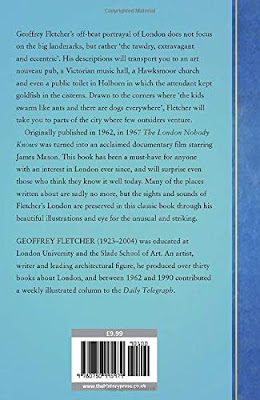
The lost bits of London .... many never knew .... a book and a film

 Now, The London Nobody Knows is one of those books which takes me back to my youth.


It was published in 1962, and describes those parts of London which many tourists, as well as Londoners never knew, and which has now pretty much vanished.


It was written by Geoffrey Fletcher who was an artist, writer, and an architectural commentator.

in the book he roams across that lost city, taking in an art nouveau pub, a Victorian music hall, a Hawksmoor church and even a public toilet in Holborn in which the attendant kept goldfish in the cisterns. 

And because I was an inquisitive kid, armed with a Red Rover, and little concept of what might happen to me, this was the city I discovered for myself. 

Of course aged just 13, I was too young to read or appreciate the book, but reading it now I can see the places I washed up in during adventures away from home.

It will also be one of the books, mother will have read because it would have appealed to her quirky sense of curiosity.

The bonus is that it was turned into a film in 1967 and watching it alongside the book is to be transported into that London which was about to leave the 1950s and its 19th century past for the shiny, modern and in retrospect not so wonderful 60s.

But the film is not just a trip across the grimy London of the early 1960s but makes some telling observations about the poverty which oozed out of the bricks as well as the plight of those left behind and excluded from the march of progress.

Location; London

Pictures, cover of the 2020 edition of The London Nobody Knows, History Press, £9.99, and cover of, The London Nobody Knows, the DVD, £4.99


Friday, 12 July 2019

This Is London ........ a unique guide to the London of 1959

Now I have no idea why I never got a copy of This Is London.*

I guess that there are only so many books that you can get for Christmas, and with the Eagle Annual and the odd history book that was enough.

Not that I think I would fully have appreciated it back then when I was only ten all of which is so different now.

It is a witty, informative guide to the London I knew as a child and is full of marvellous images in the style of the period and these alone take me back nearly sixty years.

But it is also the humour which shines through and marks it as something original.

It starts with a page of brown sludge with the occasional splash of yellow accompanied with “Well, this is London. 

 But don’t worry, it is hidden in fog like this only a few times a year in winter. Most of the time it looks- like this!”

And that is the start of a wonderful series of bright colourful and exciting paintings of London with a text to match.

All of which is a riveting read and one that has now become a history book in itself.

So much so that the new edition which was published in 2004** has updated some of the entries,  pointing out for instance that “Today the Billingsgate fish market is located in the Docklands, a rejuvenated section of the London Docks.  It moved there in 1982.”

Now that move passed me by and while I have no doubt it was for the best I have vivid memories of the market, the over powering smell and the debris left on the streets on a Saturday morning only hours after the traders and the fish had left for shops across the city.

It is just one of the moments which bounced out of the past along with those electric milk floats, old Routemasters and a river which was still a working river full of ships from every corner of the world unloading their cargoes under the shadows of tall cranes and massive warehouses.

All of which I remember and for those like my own lads who never knew that London, Mr Sasek’s book has it all.

And so as you would expect I have gone looking for other editions in the same series which included, Paris, Rome, New York, and San Francisco.

In time I might order up the reprints of New York, and San Francisco but at present I am content to wait for the arrival of This is Rome which was originally published in 1960 and reprinted in 2007.

Like This is London it has an page of updates which will be fun to match with the original text and my own memories of a city we regularly return to.

Now I would like to have used images from the book and even wrote the story using the cover and one of the Underground, but the no one seems to know who holds the copyright and so without permission it is a picture postcard from 1950 and a photograph of a typical 1960s living room.

Such are the joys of being correct about copyright.


Pictures; Trafalgar Square, 1950 from the collection of Tuck & Sons, courtesy of Tuck DB, http://tuckdb.org/  and a living room 1965, © Chris Ridley/Geffrye Museum of the Home, Geffrye Museum, www.geffrye-museum.org.uk

*This Is London, Miroslav Sasek, 1959

**Universe Publishing, a Division of  Rizzoli International Publications, New York, www.rizzoliusa.com