Thursday, 30 October 2025

A Saturday in Salford …… in 1977 ….. the exhibition at The Langworthy Cornerstone Community Centre ... today

Last night I was at an exhibition of photographs of a bit of Salford that was lost and has now been found again.

The pictures were taken by Steve Chapman who on a Saturday nearly 50 years ago wandered down from Langworthy to the Docks recording what he saw.

He was accompanied by Phil Portus, another young photographer and both were aware that with the programme of wholesale house clearance, buildings and a community would soon be lost for ever.

Steve reflected that as a young art student in Manchester he had followed the redevelopment of Hulme which in just a few short years had demolished rows of small terraced houses as well as shops, pubs and small workshops wiping away a close-knit community.

Steve Chapman

And having rediscovered the negatives from that Salford trip he agreed to this exhibition of his work at the Langworthy Corne stone Community Centre.

The event attracted a host of people, from family, friends, and former residence of the area including Jimmy who features on one picture with a group of his friends.

Judging by the comments the display of Steve’s pictures brought back a heap of memories and are an important record of what the area was like and will stand long after that Salford has faded from living memory.

Many will remember that Steve’s companion on the day had an exhibition a few years ago at the Cornerstone where he showcased his images.*

Steve discussing an image


Tony Flynn and Steve


Steve’s fascinating record of that past Salford is on at the Cornerstone Community Centre from  Monday through  to Friday until December.


And because I can, here is a short video made by Tony Flynn talking to Steve, Jimmy and others on the night.*

Location; Langworthy Cornerstone Community Centre

Pictures; of the evening, from the collection of Andrew Simpson, 2025

*Phil Portus, https://chorltonhistory.blogspot.com/search/label/Phil%20Portus

Home thoughts from abroad nu 1 ................. Well Hall Road on a warm spring day in 1965

An occasional series on what I miss about the place where I grew up.

Now I don’t do nostalgia.  It’s over rated and too often offers up a view of the past which at best is deceptive and at worse downright wrong.

But having been away from Eltham for over forty years I have bit by bit been drawn back.

It’s partly those bouts of reflection that come from someone in his seventies but also because it was one of the places I was happiest.

That said for most of that last forty years it is somewhere I only came back to on flying visits.

In the early 70s Well Hall was home between term time, and then a place to catch up with family and friends and later still where we brought the children for short holidays.

During those early visits I have to confess to a mix of feelings.  It was always nice to be back amongst familiar places but when you are 19 it is easy to be over judgemental.  After all I was living in the heart of Manchester which was vibrant and new, offering up a wealth of experiences and Eltham seemed small beer.

But I never entirely lost the pull of Eltham and in the last few years have begun digging deep into its history and remembering so much from my childhood.

So this is the first of those memories and it is nothing more than that walk I took from our house up to the High street.

We lived just beyond the roundabout and so on a warmish spring day it was no hardship to stroll down past the Odeon and the parade of shops taking a detour into the Pleasaunce before going under the railway bridge up past Spencer Gardens and that second parade of shops before reaching Willcox’s and the parish church.

More often than not there was no real purpose behind the trip which meant you could take your time, be delayed by looking in the window of the electrical shop near Wells the Chemist, gaze at one of the guitars in Norman’s before  deciding on a book from Willcox’s.

And then with the whole High Street ahead of you an hour or two could pass just looking at the shops and visiting the library.

Like others I have very fond memories of the library which offered up plenty to do, from digging out those obscure old volumes from the reference section to choosing an LP and a couple of books.

Of course Well Hall Road offered up more than just a route to the library and on other days when the sun shone it was the way up to the woods and on to Woolwich.

Now I know others will have their own favourite road and I have to concede that Court Yard and Colepits Lane had their attractions but sitting here just 4 miles from the centre of Manchester I will go for Well Hall Road.

Location; Well Hall Road, Eltham

Pictures; Well Hall Road, & Eltham Library, 2014 from the collection of Chrissy Rose

Standing amongst the groceries in Hulme ..... sixty years ago

When you look through the collections of pictures of old Manchester, you seldom find many of the interiors of buildings.

I can think of plenty of reasons why that might be so, but the result is to deprive of us a huge slice of our past.

And so, I was very pleased when my old friend Ann shared a picture she drew in the 1960s, while at Art College.

It is of the inside of her aunt’s shop in Hulme, and it takes me straight back to similar shops I remember from my youth.

These were the corner shops, which seemed to stay open all hours, and were prepared to flout the Sunday trading laws.  I can still remember being sworn to secrecy one Sunday morning when I left the local grocery shop with some product which had been double wrapped to disguise what it was.

Stuff was piled high and  bunches of bananas might share a space, with a several tins of salmon, and a pile of newspapers, while somewhere near the front of the counter would be those open boxes of loose biscuits, which always presented a challenge to see how many you could grab while the shop assistant wasn’t looking.

Added to which there was that smell, which was a mix of the competing foods on display and the bare wooden floorboards.

Location; Hulme


Picture;  Ann’s auntie’s shop in Hulme. Early 1960s, from the collection of Ann Love

Wednesday, 29 October 2025

A bit of the Rochdale Canal …. one old building …. and the road that just kept growing

Numbers 44 to 46 Princess Street is one of those grand late Victorian buildings which still speak of the prosperity of 19th century Manchester.

Our building, 1973
It stands on the corner of Princess and Portland Streets, stretches  down to Harter Street and occupies a big chunk of Portland Street consisting of five floors with extensive cellars.

In 1886 it was home to S & C Nördlinger and  a series of other businesses.

Its fortunes have waxed and waned over the 20th century, while in the last two decades parts of the block have been occupied by a nightclub, along with Turkish and Chinese restaurants.

I will have passed it heaps of times and not given it much thought other than that there always seems to be a bit of scaffolding on part of it.

And yesterday was no exception which would have sealed my indifference were it not for the curiosity of my companion who having clocked the open iron gates leading into a courtyard suggested we venture in.

It is as he said an opportunity not to be missed, despite the consideration that a] we might be trespassing and b] someone might just close those gates.

Looking out from the courtyard on to Princess Street, 2025

Neither of which happened and instead we were offered up a heap of photo opportunities, including the tiled walls of the interior building and the landing bays replete with an old and tired looking crane.

In 1886
Looking at my Goad’s Fire Insurance Map of 1886, the original courtyard extended almost the full length of the building with multiple points for unloading goods into the businesses.

And here was the first surprise, because an arm of the Rochdale Canal ran into the eastern side of the building running behind Harter Street.

That arm predated our building and had once suppiled a collection of coal and timber yards, the Portland Street Saw Mill and James Lord's Cotton Mill.

And originally the arm continued all the way to Faulkner Street.

But this last bit had been filled in when Portland Street was extended down to join Oxford Street in the 1870s just as Princess Street was allowed to grow and absorb what had been David Street taking it all the way to Brook Street.

Now that I accept is a tad confusing, suffice to say the real story remains the building.

Once I guess that courtyard would have been a hive of activity, but yesterday we were alone with just the ghosts of past carters and warehousemen for company, not that either of us stopped to let our imagination roam.

That courtyard, 2025

But sitting here today I decided to explore the partnership of S & C Nördlinger, and I glad I did. Mr. Charles Nördlinger was 48 in 1886 and was a"Naturalized British Citizen" having been born in Italy in 1838.  His wife Louise also gave her birth place as Italy and in one of those interesting twisty turney stories, one of her sisters was born in Switzerland and her parents came from Germany.

Lincoln Lodge, 1894
In 1881 the Nördlinger's lived at 120 Plymouth Grove, which was named Linclon Lodge and stood on the corner of Lincoln and Plymouth Groves.

It's gone now and long ago became Swinton Grove Park, but maps from the 1890s show the property as one of a pair of semi detatched houses surrounded by open land, which four decades earlier had been part of a very attractive estate of fine houses large gardens and fields.

Just what their house looked like is lost but some idea of just how grand it might have been can be guauged by its neighbour which was the home of Elizabeth Gaskell.

All of which is a long way from the Rochdale Canal and Princess Street, but that is just where stories go.

The home of Elizabeth Gaskell
Location; Princess Street

Pictures; the interior of the courtyard 44-46 Princess Street, 2025, from the collection of Andrew Simpson, the building in 1886 from Goad’s Fire Insurance Maps, and Lincoln Lodge, 1894 from the OS of Manchester & Salford, 1894, courtesy of Digital Archive, http://www.digitalarchives.co.uk/ and the corner of Princess and Portland Streets, 1973, m05264, courtesy of Manchester Libraries, Information and Archives, Manchester City Council, http://images.manchester.gov.uk/index.php?session=pass and the home of Elizabeth Gaskell, 2020, courtesy of Google Maps

Inside Tommy Ducks one day in 1960 ......... reflecting on where all the pictures went

Now one of the things that continues to puzzle me is the absence of pictures of the inside of Manchester pubs.

I suppose the grand professional photographers never saw it as a suitable subject while everyone else was too busy enjoying themselves to bother.

Of course tucked away in cupboards and family albums there will be a shedful of snaps recording birthdays, nights out and romantic moments but for obvious reasons these rarely get entered in to the archives.

There are exceptions.

I have some fine pictures by Bill Brandt of London pubs in the 1940s and Humphrey Spender’s Bolton pictures from a decade earlier but there must be loads more.

I can think of only a few in the collection from Chorlton and have yet to come across many from elsewhere in Greater Manchester.

All of which made this discovery of these three both a bit of a find and an introduction into a world of pubs which we have pretty much lost.

All three date from 1960 and were taken in Tommy Ducks on East Street, and come from a time long before the coffins or the display on the ceiling.

Back then it was a pub with little in the way of frills.

It served beer, offered companionship and like all pubs of the time, opened at 11, closed at 3 and reopened in the evening till 10.30 with an extension of just half an hour on Fridays and Saturdays.

And woe betide any landlord who infringed those licensing hours because they remained one of the reasons why they could lose their pub.

For most of us back then those time slots pretty much suited our lives.  During the week you were at work and while you might slip in for a pint at dinner time it was usually just the one.

Nor could most of us afford going down the pub every evening and even if you did 10.30 was a sensible time to be turfed out if you had to be at work for 8 in the morning.

And I have to say after a couple of hours I had had enough.  We always went down for the last hour, doubled up at last orders and went away satisfied.

That said it would only be in the morning when you smelt what you had worn the night before that the enormity of what you had inhaled from cigarette smoke really hit home.

Nor did it matter whether it was the vault or the saloon they were full of the stuff.

I can still remember the odd late afternoon in a city centre pub watching the sunlight mingle with the smoke and catching sight of the yellowing ceiling and paintwork which had once been white but was now a darkening yellow.

Added to which if you touched the woodwork it had a slightly sticky feel which clung to your fingers.

Not that I was over bothered back then by such things because  that was just how it was.

In the same way the decor of most pubs I visited was pretty basic.  You might get the odd framed picture which unlike now didn’t trade on nostalgic Manchester.

Instead there would be the tired painting of an elk which competed with an equally faded photograph of a
pub day out to Rhyl and a dozen or so  posters for the breweries best bitter along with a hand written notice of the next four darts fixtures.

All of which brings me back to Tommy Ducks one day in 1960 when Mr H. W. Beaumont took his pictures, none of which I would have come across had I not featured Peter’s painting of the pub sometime before it was demolished in 1993.

Pictures; inside Tommy Ducks, 1960, H W Beaumont, m50721, m50272, and m502775, courtesy of Manchester Libraries, Information and Archives, Manchester City Council, http://images.manchester.gov.uk/index.php?session=pass

Painting; Tommy Ducks © 2011 Peter Topping

Web: www.paintingsfrompictures.co.uk

Facebook: Paintings from Pictures https://www.facebook.com/paintingsfrompictures

Tuesday, 28 October 2025

A new history of Chorlton in just 20 objects number 6, the Garden Village 1911

Today I have chosen the Chorltonville booklet which was issued soon after the estate was opened on October 7 1911. It is a fascinating little publication which was subtitled A Garden Village of Better Planned Houses, and set out to show “how GOOD HOUSES could be built without philanthropy, and how an ESTATE could be developed on SOUND COMMERCIAL PRINCIPLES." The village was part of that Garden Suburb idea and aimed to provide decent affordable homes in pleasant surroundings. So the booklet offers pictures of properties, the facilities available and comments from both residents and the press.  All of which make it a fascinating piece of history.

Picture; front cover of Chorltonville, November 1912

Salford Revisited

 One to do on Wednesday


And as they say ...... its all in the poster.

Buxton ………….. The Holiday Resort of Beauty

Now I have Steve Marland to thank for this poster.

I grew up with these posters which would be on display at railway stations, and added interest and colour to some of the grimy and slightly run down places I knew as child, growing up in the 1950s.

This poster was produced by John Canning who was who a fine commercial artist.

And rather than steal someone else’s research I will just direct you to the link Steve found for me.

Of course I could say something about Buxton, but I think the poster says it all.

Location; Buxton

Picture, “What a lovely place…..!”, circa 1950s, courtesy of Steve Marland

**John Canning, https://www.gwra.co.uk/auctions/poster-br-m-buxton-holiday-resort-beauty-by-john-c-2019mar-0508.html


Monday, 27 October 2025

The Three Austins ….. a herd of elephants …. and a big tent in Peel Park ….. the circus comes to Salford

Now I have to thank Tony Flynn for the memory of the day Mr. Chesterfield and his circus hit town.


Not that I have ever visited one which at 74 must be some sort of record.

Mother disliked the idea of paying to see performing animals which she thought was a cruel form of exploitation and refused even to watch those broadcasts on TV which popped up in the 1950s and 60s.

And that dislike passed to me. 

That said I do like posters and Tony’s example is a fine one, more so because it dates from the year before I was born.

So there is it.

I could go into the history of the travelling circus and even mention the one that regularly came to Chorlton in the interwar years and just after.*

But I won’t …….other than to say I did go looking to find a reference in the newspapers of the week in 1948 when Fiery Jack, Marjorie and her famous Liberty Horses and John’s Dogs, danced, skipped and growled under a Salford moon, but drew a blank.

Instead I found this 1905 picture postcard from Tuck and Sons, the international picture postcard, company but turn away and avert your gaze all those who might get angry at Tuck's mistake.

So, because it is so good I will repost Tony's poster


Location; Salford in 1948

Picture; Chesterfield’s Circus comes to Salford, 1948, courtesy of Tony Flynn and Peel Park, Salford R Tuck and Sons, from the series, Manchester courtesy of Tuck DB, http://tuckdb.org/postcards/122638

*Chorlton and a circus, https://chorltonhistory.blogspot.com/search/label/Chorlton%20and%20a%20circus


Sunday, 26 October 2025

Mrs Crump of Chorlton-cum-Hardy and a piece of broadcasting history

Now this is another of those stories which has much more to offer.

Back on January 1 1947 Mrs Elsie May Crump appeared on Woman’s Hour which had first aired three months earlier in October 1946.

According to the synopsis of that day’s edition which was described as
“a daily programme of information, entertainment, and music for the woman at home “  and sandwiched between  James Laver on ' Why do men dress like that'; Ruth Drew , Jeanne Heal , and Guilfoyle Williams on ' Answering Your Household Problems'; there was” Mrs. Elsie May Crump on What I think of Woman's Hour after three months ' “

And of course the participation of Mrs Elise Crump was something that just had to be followed up.

She described herself as a working woman who worked in her husband’s butcher’s shop.

Now that shop was nu 24 Oswald Road on the corner with Nicholas and according to the directories the business is listed under her name from 1935 to 1969.

The shop is no longer a butcher’s shop but was still selling meat in 1980 under the name of Arnold's, and that of course is an invite to anyone who knows more about Mrs Crump and that shop to send in their memories and perhaps even a picture.

I do have one picture of her taken during the January programme but copyright prevents me from publishing it until I have asked the BBC so for now all I can offer up is an entry in the 1946 telephone directory.and one of Andy Robertson's pictures.who when I asked if he had a photograph of the place went out an hour ago and took this one in the rain.

Now that is a pretty good example of updating a story.

So there you have it a bit of Chorlton’s history along with a big bit of broadcasting history.

Picture; extract from telephone directory, 1946, courtesy of ancestry.co.uk, and the shop from the collection of Andy Robertson, 2014

Additional research by Andy Robertson

Jewish Women in Britain ……. the poster

Now I had quite forgotten the exhibition ……… Jewish Women in Britain, which ran from May 1992 through till the January of the following year.

But then it was a full 33 years ago and so I think I can be excused.

The poster hung for years in the kitchen until steam and age made me take it down with the intention of having it professionally mounted.

But as often happens the plan never happened, and it shuffled around the cellar until I came across it recently.

So for no other reason than I like it, here it is, scanned in two sections, waiting to be skilfully re-joined.


Location; The Manchester Jewish Museum


Picture; Jewish Women in Britain ……. the poster, 1992

Saturday, 25 October 2025

“In Britain and in Germany it is 12 noon" .... One song ….. Two Way Family Favourites ….. and a different way of saying hello

Two Way Family Favourites was one of those radio programmes that was always on in our house on a Sunday during the 1950s.

Most of the time it sat in the background as an accessory to preparing the midday meal and doing heaps of other things.

But even as background you absorbed the family messages sent to servicemen and women abroad, the choice of music and the exchanges between the broadcasters, one here in Britain and the other in Germany.

And it began with that signature tune “With a Song in My Heart” followed by “In Britain and in Germany it is 12 noon so at home and away it is time for Two Way Family Favourites”.

It is perhaps easy to forget that there was a time within living memory that communicating with a loved one was pretty much limited to letters and post cards.

Our first phone arrived only in the 1950s, and the line was shared with another family, but we were lucky because for most people making a telephone call meant a trip to the nearest public phone box while phoning from abroad might involve booking a call-in advance.

And set against this was that in the immediate post war period into the 1950s and 60s, Britain maintained a large standing army, supported by conscription and stationed across the world.

A substantial element of that force was in Germany and so every Sunday the BBC hosted a two-way radio programme of messages and music.

It is of course a bit of my past but for younger generations it will sit with the Age of the Dinosaurs and the Stone Age.

But in that time before  the internet, social media and mobile phones, it was all we had.

And I am always reminded of this little bit of my past when the song Sailor is played with that chorus

Barlow Moor Road, circa 1950s
“As you sail across the sea

All my love is there beside you

In Capri or Amsterdam

Honolulu or Siam To the harbour of my heart

I will send my love to guide you”.

From memory it was a popular choice and the programme played both the Petula Clark and Ann Shelton versions which both came out in 1961, and were a variation on an earlier German song Seemann (Deine Heimat ist das Meer)" "Sailor (Your Home is the Sea)".

I have listened to both and I like them both, but the English version is perhaps a tad more sentimental and so chimed in with Two Way Family Favourites.

Family life, 1953


And that is it.


Location; Britain and Germany,

Pictures; 1950s elegance, News of the World's Household Guide and Almanac, courtesy of Debbie Cameron ,Barlow Moor Road, circa 1950s and Family life from the collection of Andrew Simpson

*Sailor, https://www.youtube.com/watch?v=7k8fzE7UHu8

***Seemann, deine Heimat ist das Meer, https://lyricstranslate.com/en/seemann-deine-heimat-ist-das-meer-sailor-your-home-sea.html


Salford Histories Festival 2025 …….today

So, the poster says it all ….. 


Today at St Thomas’s Church, Ford Lane, Salford, M6 6PE.

10am till 5pm.

N'uff said.

A bold new station for Manchester and the film Hell is A City


This has to be one of my favourite Manchester stations. It is Oxford Road Railway Station.

The original station dates from 1849 and in 1960  was replaced by this one which was listed in 1995 and described by English Heritage as a "building of outstanding architectural quality and technological interest; one of the most dramatic stations in England.”*

I do have to agree with them.  Its glass and laminated wood entrance soars into the sky and on a sunny evening the reflection of the Refuge Building is captured in those high windows.

Now its predecessor was a much more modest affair.  It too was made of wood but was workman like and lacked style and presence.

There are a few pictures of this older station but not many and until recently I had not really given it much thought.

Until I came across a still from the film Hell is a City which was set in Manchester starred Stanley Baker and focuses on the search for a violent criminal.

It was made in 1960 just nine years before I arrived in the city and much of the location shots are ones that I remember well.

And there as Stanley Baker confronts the criminal on the roof tops of the Refuge Building is Oxford Road Station, both the Armadillo roof of the new station, the sweeping concrete wall of the car park and the old station.

It stands at right angles to the new station entrance which was something of a surprise but is logical.

Of course you would have to be over 50 and more likely 60 to have any vivid memories of this building and I doubt that there are that many pictures of the two standing together.

And like all such things the new station has undergone change.

That sweeping concrete wall and the car park it protected has gone.  In its place has come a tall steel structure with stone steps, which on a sunny day are occuppied by those waiting for a train or those catching a bit of sun along with their sandwiches.

And it remains a very busy place both inside and outside the rush hour.


Pictures;Oxford Road Station in 2008 from the collection of Andrew Simpson, still from Hell is a City, 1960, from Graham Gill,


Friday, 24 October 2025

Smoke across Manchester …………1963

Any picture today looking out across the city’s skyline will reveal a forest of cranes.

Back in 1963 there were not so many, but they were there, building a brave new Manchester, some of which arose from bomb sites and others from areas whose Victorian and Edwardian buildings were judged old and beyond their sell by date.

So, here is what became Piccadilly Hotel and its neigbouring buildings boldly climbing into the sky.

But look more closely and for cranes, read tall factory chimneys, marching off into the distance, all still delivering tons of smoke.

Location; Manchester

Picture; a Manchester skyline, 1963,  "Courtesy of Manchester Archives+ Town Hall Photographers' Collection",
https://www.flickr.com/photos/manchesterarchiveplus/albums/72157684413651581?fbclid=IwAR35NR9v6lzJfkiSsHgHdQyL2CCuQUHuCuVr8xnd403q534MNgY5g1nAZfY


One hundred years of one house in Well Hall part 14 ........... the Mission Hall chair and a promise

This is the continuing story   of one house in Well Hall Road and of the people who lived there including our family.*

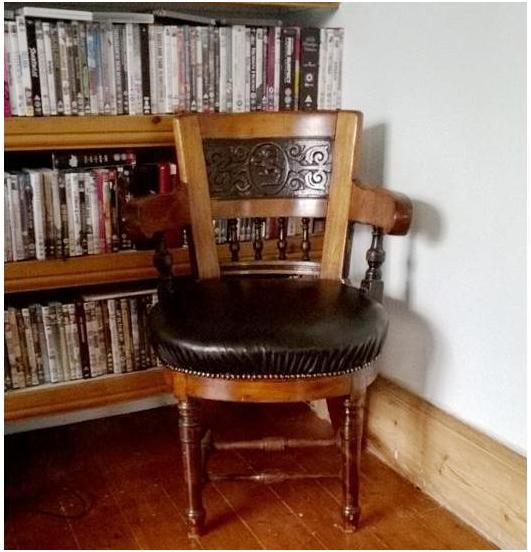
Now I like the way that what seem to be totally random bits of the past come together to tell a story which in this case brings together our family home on Well Hall Road an old chair and a promise.

What connects them is this chair which I am guessing must be at least a century old and in its time has travelled from Peckham to Eltham and on to Manchester and now resides in our dining room.

As far as I know it began life in the Evelina Mission Hall on Evelina Road close to where dad had worked for forty years.

I have yet to discover when the mission hall was built but I know it will be sometime between 1874 and 1914 which I grant is a big dollop of history but it’s a start.

I know it was there by 1914 because the hall is listed in the Post Office Directory for that year.

There were plenty of similar halls in the area but by the mid 1960s if not earlier it was struggling for a congregation and closed.

And Dad always scenting a bargain came away with the chair which from 1964 sat in my bedroom in 294 before eventually coming north.

It is a beautiful chair which always reminds me of my father and as happens has already been promised to one of my sons who got in before the others.

But that is not quite the end of the story because it neatly cements the history of the family home in Eltham with my own house in Chorlton in Manchester.

Both houses were built in 1915 and although they differ in their layout and appearance both have been happy places to live.

I can’t claim that the chair has anything to do with that but it remains a little bit of my history uniting me with Peckham, Eltham and Manchester, and in time will continue to do where ever our Joshua finally settles.

Not bad for one chair.

Location;Well Hall, Eltham, London

Picture; from the collection of Andrew Simpson

*One hundred years of one house on Well Hall Road, http://chorltonhistory.blogspot.co.uk/search/label/One%20hundred%20years%20of%20one%20house%20in%20Well%20Hall


Thursday, 23 October 2025

The painting ... a film ... and correcting an injustice ...... Adele Bloch-Bauer ...and the Woman in Gold

 Now like many people much of what I know about art and literature has come about by a mix of accident and curiosity.


And so it is with the painting of  Adele Bloch Bauer, painted by Gustav Klimt in 1907.

"Adele Bloch-Bauer was a wealthy society woman, hostess of a renowned Viennese salon, art patron, and philanthropist. Her famous portraits by Klimt are historical witnesses to the significance of Jewish patronage during the Golden Era of fin-de-siècle Vienna. Among the famous guests in her salon were composer Gustav Mahler, journalist Berta Zuckerkandl, author Stefan Zweig, and socialist Julius Tandler. She supported socialist causes."*

She died in 1925, and during the Nazi occupation of Austria, her family’s collection of art was stolen, by the German Government.

And in 2015 the story of the painting and the attempt by the niece of Adele Bloch-Bauer to have the art work returned to its rightful heirs was the subject of the film, Woman in Gold, which is where I come in, because having seen the film on a wet Sunday afternoon, I went looking for more.


Like all fictional accounts, the film toyed with the events and in particular underplayed the role of Hubertus Czernin the Austrian journalist and publisher who found the historical documents which allowed the family to the begin the process of reclaiming the collection.

But the film and two earlier documentaries highlighted the part played "by Jewish patrons in shaping Viennese modernism and …. the historical injustice in handling their restitution claims.”*

And led me to explore other such claims for restitution, as well as discovering the work of Gustav Klimt.

Not bad for a wet Sunday afternoon.  

Never being one to lift other people’s research, the full account of Adele Bloch-Bauer, and the attempts by her niece, Maria Altmann, and the lawyer,  E. Randol Schoenberg can be read by following the link.

Location, Austria, and California

Picture; Adele Bloch-Bauer, Gustav Klimt in 1907

* Adele Bloch-Bauer, The Shalvi/Hyman Encyclopedia of Jewish Women, https://jwa.org/encyclopedia/article/bloch-bauer-adele


One hundred years of one house in Well Hall part 11 ........... from the first residents to when we moved in

This is the continuing story  of one house in Well Hall Road and of the people who lived there including our family.*

The estate in 1950
Now the great and the good are able to track their family back through the centuries and can pretty much show which of their relatives lived in the ancestral pile right the way back to when the place was built.

Few of us can do the same but just sometimes with a bit of luck and lot of research it is possible to uncover both the residents and the stories of those who occupied a house from its beginning.

Ours was built in 1915 as part of the estate laid out for workers at the Arsenal in Woolwich and while I knew the names of the first two families to live there the rest were unknown.

But using the directories and the electoral rolls it has been possible to discover the identities of all six families who occupied the house from 1915 through till we moved in during the spring of 1964.

And the importance of such a discovery is that it helps tell the story of Well Hall and of Eltham during the Great War and over the next half century.

The first to move into 294 Well Hall were Mr and Mrs Nunn from Ipswich.  He was a blacksmith by trade and in 1911 had been employed in an engineering works.

And it is perhaps easy to see the attractions of their new home over number 56 Rosebery Road in Ipswich which while it had a garden was one of these older mid terraced properties surrounding by similar drab streets.

But in the end it may have just been the work and the Arsenal, because in 1918 with the end of the war and only three years after they settled in Well Hall they left for Ipswich.

With more research it should be possible to determine how many others of those who moved on to the brand new estate stayed to make Eltham their permanent home or like the Nunn’s left.

And that is where the electoral roll comes into its own for unlike the directories which list just the named house holder the rolls provide the names of all those eligible to vote.

So Mrs Brewer two doors down who I knew only as an old lady  living on her own had been in number 290 since the early 1930s, had lost her husband some time during the war, and shared her home with lodgers, having also lived briefly down at Avery Hill.

What is revealing is that some of the families including those in our house moved out and back in during the course of the 1930s and 50s.  I can’t as yet explain why but of course given that most were still rented it would have been easy enough to do.

Looking north up Well Hall Road, 1950
In time it should be possible to discover more about the six families who inhabited the house, including how they made their living and maybe even what they did with themselves.

And that would have been the end of the story but just as I was finishing I came across what I think is a picture of Mrs Nunn and three of her children.

It dates from a little later than 1918 but there staring back at me is the woman who will have cleaned the windows, looked after the garden and walked up the same flight of stairs as me and that I reckon makes for a powerful continuity.

Location;Well Hall, Eltham, London

Pictures; Well Hall Road in 1950, from Well Hall Estate, Eltham:  An Example of Good Housing Built in 1915, S.L.G. Beaufoy*

*One hundred years of one house on Well Hall Road, http://chorltonhistory.blogspot.co.uk/search/label/One%20hundred%20years%20of%20one%20house%20in%20Well%20Hall

**Well Hall Estate, Eltham:  An Example of Good Housing Built in 1915, S.L.G. Beaufoy, The Town