Showing posts with label Liverpool. Show all posts

Friday, 12 September 2025

Things we did ..... Liverpool .... 1980

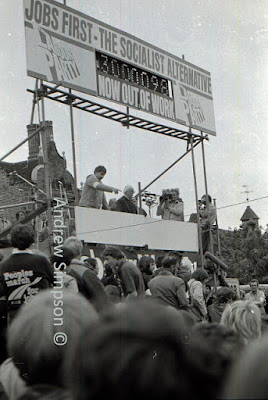
It was the first big demonstration against the newly elected Tory Government.


The year was 1980, and on that day in late November I was there with the Moss Side CLP and its banner.

We had travelled across from Manchester in two double deck buses and were joined by 40,000 from around the country.

I have long lost all the newspaper clippings but today came across a piece by William Border published by the New York Times on November 30th which reported Michael Foot telling us  "You are here stating for the nation that we are not going to tolerate what this Government is doing to us.

We're going to carry this campaign from one end of the country to the other, to mobilize the power and strength of the people to destroy this Thatcher Government and build a real socialism,”*


Needless to say I don't remember the speech, although that may have had more to do with taking pictures.

But along with others I did carry the campaign on from Liverpool to Birmingham and on to London.

All now a long time ago.

But emboldened by Mr. Border's I shall now trawl the Guardian archive for more on the spot reporting.

Location; Liverpool

Pictures; in Liverpool with the Moss Side |CLP banner, 1980, from the collection of Andrew Simpson


*40,000 March In Liverpool to Protest Unemployment; Recalls Marches of the 30's Unemployment at 8.4 Percent, William Borders New York Times, Nov. 30, 1980,https://www.nytimes.com/1980/11/30/archives/40000-march-in-liverpool-to-protest-unemployment-recalls-marches-of.html

Tuesday, 25 April 2023

Standing "on the threshold which leads into the palace of justice”

It was a slow day on Beech Road yesterday, and with little interest in sitting in the garden or watching yet another box set I took to reading a collection of historic speeches.*

Liverpool, 1980
Now, if you want to get out of a low mood, brought on by a combination of the virus, and the political scene, a couple of hours with Dr King, J.F. Kennedy, Betty Friedman, Abraham Lincoln, and Dolores Ibarruri Gomez, [La Pasionaria] and countless others, is guaranteed to set you up.

Of course, you have to be aware of the context in which the speeches were made, and if I am honest I gravitated at first to those whose politics I shared, and remember  watching.

Added to which some of those speeches were made by people who whose political record on certain issues might at times be a little flawed.

And finally, I take the possible criticism that sitting reading a speech is just armchair politics and the real test is going out and making a difference.

But at 70 with a lifetime of political activity which began when I was 16, I think I might be allowed to take the armchair.

What surprised  me were the speeches by politicians who I have always regarded as pariahs, like Enoch Powell who made that infamous “rivers of blood” speech made in Birmingham in 1968, but nine years earlier had condemned the treatment of Mau Mau detainees in the Kenyan detention camp at Hola, insisting that prisoners wherever they were held under British jurisdiction were entitled to the same rights of treatment.

Birmingham, 1983
The beatings of many of the prisoners and the deaths of ten of the men he argued was the responsibility of the Secretary of State, brushing aside the alleged crimes and their place of confinement as not relevant to  justice, concluding “We cannot, we dare not, in Africa of all places fall below our own highest standards in the acceptance of responsibility”.

That said, the speeches which I enjoyed rereading were those of Lincoln, Kennedy and Dr King, and staring with Colonel Rainsborough who in 1647, uttered, the powerful, statement of democratic principle “I think that the poorest he that is in England hath a life to live, as the greatest he; and therefore truly, Sir, I think it's clear, that every man that is to live under a government ought first by his own consent to put himself under that government; and I do think that the poorest man in England is not bound in a strict sense to that government that he hath not had a voice to put himself under”.

His was a contribution to the Putney Debates when the victorious Parliamentarian army sat down to discuss the future.

Manchester, 1984
And while that democratic statement was defeated by the Army Grandees and the forces of the establishment it still rings out.

As does the speech of Gideon Hausner, the Attorney General of the State of Israel at the trial Adolf Eichmann, responsible for the management of the Final Solution.

In a speech which lasted ten hours Mr. Hausner, opened by saying, “When I stand before you O Judges of Israel, to lead the prosecution of Adolf Eichmann, I do not stand alone.  

With me here are six million accusers.  But they cannot rise too their feet and point their finger at the man in the dock with the cry of ‘J’ Accuse on their lips.  For they are only ashes- ashes piled high on the hills of Auschwitz, and the fields of Treblinka and strewn in the forests of Poland. Their graves are scattered throughout Europe.  Their blood cries out but their voice is stilled.  Therefore, will I be their spokesman”.

What marks out many of these speeches is the power of the rhetoric, which makes us remember, the memorable lines, like those  from J.F. Kennedy’s  “The torch has passed to a new generation of Americans", “ask not what America will do for you, but what together we can do for the freedom of man”. “Ich bin ein Berliner”.

Birmingham, 1983
But sleek phrases are themselves not enough, they must arise from a very real need for change which Betty Friedman encapsulated in a speech on women’s rights in 1969 at the first national conference for repeal of abortion rules, when she talked about women being invisible and having to have “a full say in the decisions of their lives and their society”.

And of all the countless ones I read yesterday, and which still sit with me, it must be Dr King’s address on the centenary of Abraham’s Lincoln’s emancipation proclamation, made at a gathering of 210, 000 people at the Lincoln Memorial.

It is a powerfully written speech drawing on the language of the bible, shot through with the injustices of Black Americans and calling for action.

I  tried to pick out key sections, but in truth the whole speech is a mastery of rhetoric, leaving me to fall back on the oft quoted lines,

"I have a dream that my four little children will one day live in a nation where they will not be judged by the color of their skin but by the content of their character.

I have a dream today!

Birmingham, 1983
I have a dream that one day, down in Alabama, with its vicious racists, with its governor having his lips dripping with the words of "interposition" and "nullification" -- one day right there in Alabama little black boys and black girls will be able to join hands with little white boys and white girls as sisters and brothers.

I have a dream today!

I have a dream that one day every valley shall be exalted, and every hill and mountain shall be made low, the rough places will be made plain, and the crooked places will be made straight; "and the glory of the Lord shall be revealed and all flesh shall see it together.

This is our hope, and this is the faith that I go back to the South with".

Pictures from the collection of Andrew Simpson, 1981-87

*The Penguin Book of Twentieth Century Speeches. Edited by Brian MacArthur, 1992, & The Penguin Book of Historic Speeches, edited by Brian MacArthur, 1996

Sunday, 11 April 2021

Saying something is wrong ........ alternative histories .... part 1

Now I can remember the first demonstration I went on in the 1960s and then pretty much all of the others.

Liverpool, 1980
But those I supported during the 1980s have become a blur, and part of that was because there were so many of them which were provoked by a series of developments, none of which many of us thought were good.

There was steadily rising unemployment, a Government intent on curtailing the ability of the Trade Unions to do the business of protecting the work force while pursuing a policy of reducing expenditure for public services.

Along side these, there was the growing fear that a new generation of nuclear weapons and their delivery systems coupled with the hard line leaders in both Washington and Moscow threatened world peace.

Liverpool, 1980
So, many of us marched, firmly believing that in doing so we could express our concern and send a message to those in power.

And from 1978 I documented all of the ones I attended, from Manchester to London and back via Liverpool and Birmingham.

I will leave others to write the history of that decade and to make judgements on the effectiveness of the demonstrations and instead will set about posting some of the pictures.

These have sat in the cellar for nearly four decades, left in a corner because they belonged to old photography, which relied on a dark room, smelly chemicals and an enlarger to bring them to life.

But as many know my Christmas present was one of those whizz scanners which can take a negative and make it into an electronic image.

Birmingham, 1983
I don’t pretend the quality is always the best, but they are a record of how many of us went about expressing our concerns and fears along with working within political parties and the trade union movement to bring about a change.

Liverpool, 1980 was the first national demonstration organised by the Labour Party just a year after the Conservative Government had been elected.

Birmingham was three years later.

Location; Liverpool and Birmingham

Pictures; Liverpool 1980,and Birmingham 1983, from the collection of Andrew Simpson

Wednesday, 13 May 2020

Stories of Nazi persecution, Russian emigres and a wartime crime ............. Nuremberg, Didsbury, Minsk and Liverpool

Now, the thing about researching the past, is that you can never be quite sure where you will end up.

Manchester Guardian, 1940
So, the story of the man from Didsbury, sentenced to six years hard labour in 1940, for contravening the Official Secrets Act, led to  a Jewish refugee, fleeing Nazi persecution and by degree led me to Liverpool and a family of Russian emigres.

Of course, the journey was not as undirected as it seems, because you make choices in the course of the research.

I could have chosen to follow up on the young woman who arrived in Britain in March 1939, and tried to track her early years living in Nuremberg where she was born.

Queens Court, Didsbury, 2020
But instead I chose to follow Mrs. Cashdown of 10 Ducie Street, in Liverpool who gave the young woman a job as a domestic servant in the October of that year.

Just how  long she stayed with Mrs. Cashdown is unclear but by the March of 1940 she was working for a new couple who lived in Queens Court in Didsbury, and as these things sometimes go, fell in love with her employer, who later would be tried and found guilty of breaking the Official Secrets Act.

He left his wife, and they set up home in a house in Old Trafford, and her failure to inform the Police of her change of address, led to her arrest and the discovery that her partner who as an “aircraft examiner” had made copies of classified material.

And there the story goes cold, she may have been interned because of that failure to give notice that she had moved.  If so this in itself was a personal tragedy given that in the October of 1939, a tribunal had judged she shouldn’t be interned because it was decided she was  “a refugee, fleeing Nazi persecution”.

With time I might find out more, but I doubt it.

As for the man, he too pretty much vanishes from history, although there are a few possible candidates in the records who might be him.

All of which led me out of curiosity to Mrs. Cashdan.  She and her husband were from Russia, and arrived in Britain sometime between 1905 and 1908.  In 1911, they were living at 73 Great Newton Street, and he is described in the local directory as a “Poulter”, adding a few months later on the census that he was a "Shocket (Jewish Butcher)” who slaughtered animals in conformity with Jewish religious practices.

Manchester Guardian, 1940
As such he was an important member of the community, and his sons followed his occupation with one of them describing himself as “a Minister of Religion and a Slaughterman”.

Sadly, nether of the two houses they lived in have survived.  73 Great Newton Street is now underneath one of the buildings belonging to Liverpool University, while Ducie Street was demolished sometime between 2009 and 2012.  Looking at pictures predating the demolition, no 10 looks to have been a fine town house.

And back in 1911, the street could boast a “foreign correspondent," a ship owner, a merchant, and a manager, along with a “glass and china merchant”, two “dental manufactures", a brewer, a solicitor and a "coffee merchant”.

Leaving me to reflect that in a short few hours of research I entered the world of the first half of the last century, touching on the war, Nazi persecution, and the lives of a Russian émigré family.

Pictures; headlines from Manchester Guardian, 1940, and Queen's Court, 2020, from the collection of Barbarella Bonvento

Sources; Manchester Guardian, March- July 1949, census records for 1911, the 1939 Register and Internment Tribunal, 1939


Thursday, 4 April 2019

Saying something is wrong ........ alternative histories .... part 3 on the march

Now demonstrations can be noisy, busy and in their own way a bit of fun.

Liverpool 1980
Of course there is always a serious side to the event, and that will always be uppermost in the minds of those who have made the effort to walk the streets, in support of an industrial dispute, or protesting at the actions of a government or events on the other side of the world.

But mixed up with all that earnest stuff, and the serious speeches there are the funny moments.

Sometimes they come from a witty banner, or a repeated chant which snakes its way down the line of demonstrators, and sometimes it is when the set chant goes wrong, which started with the impassioned call to action but stops halfway or is just never picked up by the surrounding people leading to a burst of laughter.

Manchester 1982
And there are the paper sellers which back in the 1970s and 80s when I marched would be everywhere, from those selling the Morning Star and Socialist Weekly to Militant, Red Dwarf and on occasion the journal of the agricultural section of the Communist Party.

The theory always was that the Left never actually generated much revenue from all the sales, because in most cases it involved individuals from one group buying the paper of another, in an act of fraternal generosity or just curiosity.  Either way it always struck me as a fine example of the redistribution of wealth.

Amongst all the paper sellers hurrying “up the line” to get to new potential customers there were the entertainers, who were a mix of the serious and the humorous.

I cannot now remember what the woman in the fur coat was talking about, but given the date was 1980 and Mrs Thatcher was Prime Minister I can only assume the theme was a comic take on Tory policies.

Liverpool 1980
At other times there were those who harangued the marchers.  Some of these were supportive of the event, while others usually from the pavement hurled a mix of abuse and silly comments, which might be applauded or booed by the protesters.

And a side benefit for some was that they got to see the sights of a different city, from grand public buildings to glittering shops and hotels, although in some cases when the route was set to miss the most popular areas the scenery consisted of backstreets, closed warehouses and a line of industrial units.

All of which I rediscovered as I trawled the lost negatives which have sat in the cellar for four decades awaiting the technology to turn them into pictures and remind me of what I so often did during the 1970s and 80s.

And amongst the lost treasures there were the photographs of some of those who walked with me.

I always knew that in the collection there would be pictures of close friends, because of course they would have been on the same demonstration, but others were a complete surprise.

Birmingham 1983
So while I can still recall the Birmingham march with Tom and Keith, I was surprised to see Malcolm walking through Manchester selling papers and smiling back at me.

Such are the bonuses of uncovering that collection of “protest pictures”.

Location; Liverpool, Manchester, and Birmingham


Pictures; Saying something is wrong, pictures from demonstrations, 1979-84 from the collection of Andrew Simpson

Monday, 15 May 2017

Ghost signs in Liverpool

Now the blog hasn’t featured a ghost sign for a while so when Antony sent me this one yesterday I fell on it.

It is, Anthony tells me on a street opposite Everton’s ground and I am intrigued by the sign.

I had hoped that I might find a reference to the company but have drawn a blank.

That said I am convinced someone will be able to offer up some information.

Location; Liverpool


Picture; ghost sign, Liverpool from the collection of Antony Mills, 2017