Showing posts with label Chorlton History Group. Show all posts

Friday, 2 February 2018

When history met art and became a book ....... and then a “happening”

If you recognise the term “happening”, then you will be have had your teen age years during the 1960s, when along with the Beatles, Pop Culture and Woodstock there were “happenings”.

Bernard "warms up" the audience
These, for those not in the know, were instant pop up events, where art, music and politics collided.

And a full half century on, those who might have gone to a “happening” were with us yesterday in the great hall of St Ninian's, courtesy of Chorlton Good Neighbours who had invited me and Peter to talk about the book The Quirks of Chorlton-cum-Hardy and pretty much anything else that took our fancy.*

So 60 Good Neighbours heard us talk about a collaboration which has now produced five books, that 80 meter installation, and exhibitions and history displays which are all over Chorlton.

Modesty prevents us from showing pictures of the two of us in full flow, although in truth that has more to do with the simple fact that we couldn’t take our own pictures while performing in front of the audience.

But I know that Bernard and Helen were taking pictures, so in the fullness of time I am sure we will be posted across social media.

In expectation of the "happening" to start
For now I shall just say that it was a grand afternoon, and according to the organizers the attendance was the best ever.

So, that just leaves me to thank Chorlton Good Neighbours* on behalf of Peter and me, and say we happily accept their invitation to return later in the year for another talk.

Not that this is the last the world and Chorlton will hear from us, because at the end of the month we are invited to talk to the residents of Chorltonville and starting next month, in collaboration with Chorlton Voice (Chorlton Civic Society), we shall be hosting a series of history walks.  The walks will feature some of the more quirky bits of Chorlton’s history and will be fun as well as free.

The programme will be published in the blog and on social media, as well as in shops, pubs and bars across the township.

And because all such events as well as “happenings” need a prize to finish with, the question for walk one is who said “the World has not heard the last of .. ......"?  Two words, a film, the 1960s

Pictures; in the great hall of St Ninian’s, 2018, from the collection of Peter Topping

*The Quirks of Chorlton-cum-Hardy, Andrew Simpson & Peter Topping, 2017. Available from us at http://www.pubbooks.co.uk/ or Chorlton Book shop, 506 Wilbraham Road, Chorlton-cum-Hardy, Manchester M21 9AW. Tel:0161 881 6374

**Chorlton Good Neighbourshttps://chorltongoodneighbours.org/

Thursday, 6 November 2014

All you ever wanted to know about the history of Manchester street names, today at St Ninians, Wilbraham Road


Today at 1.30 Jean Bailo, a Blue Badge Guide, will talk  about the history of street names in Manchester hosted by the Chorlton Good Neighbours at St Ninians Church Hall  on Wilbraham Road

Mary Street and James Leigh Street, 1844
Now we all have our own favourite bit of town and I suppose my is Castlefield.

That said over the years I pretty much wandered all over the city, armed only with my camera, a note pad and heap full of curiosity.

And as you do you can uncover some hidden gems, from buildings tucked away and missed by the developers to lost and bizarre bits of our history.

On one such adventure I found a forgotten and derelict stables in one of the railway arches off Water Street.
It entailed a bit of trespass and more than a bit of careful footwork but there it was from a time when all the railway companies still relied on horse power to deliver goods which had arrived at their stations.

It will have gone I guess by now but more often there are still clues to our past history, and some at least are there in the street names.

I was reminded of this when I turned down New Wakefield Street past the Salisbury and up that flight of stairs to Oxford Road Station.

Now the Salisbury is another one of those old Manchester pubs which seems to offer the past up with your pint.

The Salisbury on the corner of James Leigh Street, 2013
It dates from at least 1841 and can be found on the OS map of Manchester and Salford for 1849 surrounded by mean houses which were packed together in between Oxford Street and the railway line.

In total there were three of these narrow streets consisting of James Leigh Street, Cayley Street and Mary Street, which took in 28 small back to back properties.

And while the back to backs have long gone, the names of the people who built the houses are still there. So James Leigh, and perhaps his wife or daughter Mary left their mark as did Mr William and Mr Frank just round the corner in the streets they built.

And I bet Ms Jean Bailo, will have plenty more names and stories.

Map; New Wakefield Street and the surrounding area from the OS map of Manchester & Salford, courtesy of Digital Archives Association, http://www.digitalarchives.co.uk/

Painting; The Salisbury, © 2013 Peter Topping, 

Facebook; Paintings from Pictures,, Web: www.paintingsfrompictures.co.uk

Thursday, 1 May 2014

So how do you think Chorlton has changed and how fares its future?

Now as someone who is constantly exploring what Chorlton was like I rarely give a lot of thought to what it might become.

Of course the standard way of predicting the future is to start with what we know and build on that.

The ambitious would have us flying around in our own personal machines, holidaying on Mars and communicating by our own pocket size computer.

The less ambitious will merely suggest that it will all be much the same but a little more shinny or a bit more tacky depending on their outlook on life.

And most of us will just assume that it will be just a bit different.

I doubt that we were prepared for the internet, the mobile phone or the computer and even when all these came along I for one was not able to see their full potential.

So for those who want to talk about a future and in particular one that might be how Chorlton could turn out, today the Chorlton History Group offers the chance to do just that.


The discussion will focus on the past, present and future of where we live.

Professor Chris Phillipson and colleagues from Manchester University want to hear your views, to form part of a research project which focuses on growing older in Chorlton.

Chris will present a brief overview of the research project, which looks at the challenges and opportunities involved in developing age-friendly neighbourhoods.

After the presentation, we will form smaller groups to discuss your ideas about the past, present and future of Chorlton. Discussions could include:
•        - Your memories of life in Chorlton
•         -  Changes that have taken place in the neighbourhood, and how they have affected you, or your friends and family
•        -  How you see Chorlton as a place to live now
•         - How would you like to see the neighbourhood develop in the future
For further information contact:  Tine Buffel: tine.buffel@manchester.ac.uk,

And it will all be happening at at St Ninian’s Church,  Egerton Road South, from 1.30 pm

Thursday, 3 April 2014

All you ever wanted to know about what great great grandmother wore to work... “Victorian dress of the middle and working classes”

Now I have often wondered about the clothes of my great great grandparents and I rather think this talk at the Chorlton History Group today will provide answers.

“Margo Singer is the author of “Textile Arts: Multicultural Traditions and Textile Surface Decoration”. Her talk covers the development of fashion and textiles in the mid 19th century during the time of Elizabeth Gaskell’s novels.

The talk covers the mid Victorian tyranny of fashion by examining the origins of corsets and the crinolines and will go on to look at the fabrics and dress of the urban classes in Manchester, both millworkers and seamstresses. 

She will also examine the textiles and fashions of middle class dress, including lots of references to contemporary dress as found in Mrs Gaskell’s novels as well as a wide range of slides, illustrations, contemporary items of clothing and textiles and reconstructed dress."  Bernard Leach

So today at 1.30pm in St Ninians Church on Wilbraham Road

Picture; detail from a photograph in the collection of Alan Brown

Thursday, 6 March 2014

"The Lost Railways of South Manchester"

Now like many of my generation I have always had a fascination for railways and really for the time when they were given over to steam locomotives.*

Chorlton Railway Station, early 20th century
Even now that heady smell of steam, warm oil and smoke take me back to standing on platforms waiting for a train.

It was a love for all things steam that I shared with my father who could never quite accept that the old L.M.S and L.N.E.R had become a division of British Railways.

That said mother had a less romantic take on steam trains pointing out that if you lived close to a railway line the washing  dried with smudges of soot from passing locomotives.

Despite that jaundiced view I shall be going to the talk with Chorlton History Group on "The Lost Railways of South Manchester" by Roy Chapman which will at 1.30pm  today in the  St Ninian's Church, Egerton Road South,

“A lifelong railway enthusiast, Roy has contributed to transport
training material, is a co-author of three railway books, has contributed to a number of reports on transport issues, and is an occasional writer of journal articles on transport and business management. 

Roy is currently Rail Services Planning Officer at Transport for Greater Manchester (TfGM). 

In the talk he will focus on the growth and decline of the railway network around South Manchester.”

Bernard Leach

Picture; Chorlton Railway Station looking east, date unknown, from the collection of Tony Walker

*Chorlton Trains, http://chorltonhistory.blogspot.co.uk/search/label/Chorlton%20Trains

Thursday, 5 December 2013

A Journey in Jazz: From New Orleans to Chorlton with Eddie Little, 1.30 at St Ninian's Church

Charlie Parker, Tommy Potter, Miles Davies, Dizzy Gillespie and Max Roach
Today at 1.30  Eddie Little will be talking on 'A Journey in Jazz : From New Orleans to Chorlton'  including some terrific video clips of classic jazz recordings. 

This is another of those not to be missed talks hosted by Chorlton History Group and will  be held as usual at St Ninian's Church, Egerton Road South, Chorlton. All welcome.

There will be no History Group meeting in January 2014 and the February 6th meeting has not been finalised yet.

However, all being well, the March 2014 talk will be on "the Lost Railways of South Manchester" by Roy Chapman.

Picture; Charlie Parker, Tommy Potter, Miles Davis, Dizzy Gillespie and Max Roach, Three Deuces, New York, circa August 1947 by William P. Gottlieb (1917–2006) from Wikipedia Commons

Wednesday, 6 November 2013

Chorlton History Group, tomorrow, the history of the disabled people's movement in Manchester

It’s that time again for another talk at the popular Chorlton History Group which will be on the  history of the disabled people's movement in Manchester at 1.30pm at Chorlton Good Neighbours.St Ninina's Church, Chorlton, tommorow, November 7th.

Enough said.  If you want to know more in advance of Bernard’s talk then visit, Greater Manchester Coalition of Disabled People http://gmcdp.com/

Picture; the disabled drivers association and a demonstration outside Manchester Town Hall demanding full access for disabled people in 1986.

Thursday, 3 October 2013

Chorlton and the history of the National Health Service, a talk today with Chorlton History Group

Now the National Health Service has always been controversial.  

Even before its inception there were those who branded it as an opportunity for the workshy, and opportunist elements in society to take advantage of a service free at the point of need which would be funded through national taxation.

And in its first full year there was a huge demand seen in the number of free prescriptions issued for medicine and spectacles and in the rise in the cost of the NHS from £327.8 million in 1948-49 to £430.3 million by 1953-54.*

But that I suspect indicated just how much of a need there was from people who had not been able to afford even basic health care.

Moreover when the figures were adjusted for inflation the cost was less alarming and when judged as a % of GNP spending actually fell from 3.51% in 1948-49 to 3.24% in 1953-54

And set against this was the clear improvement in the nation’s health and a reduction in the levels of everyday pain as well as deaths from infectious diseases.

So deaths from TB were down from 25,649 in 1943 to 4,480 in 1958, diptheria from 1,371 to 8, whooping cough from 1,114 to 27 and measles from 773 to 49.

All of which is a backdrop for today’s talk at Chorlton History Group by Martin Rathfelder, Director of the Socialist Health Association, The National Health Service in Manchester: its past, present & future: GPs and Primary Care*

Martin has been “been interviewing and recording older members of Chorlton
Good Neighbours to get their memories of going to the doctor in their
childhood, particularly before the NHS was created. 

And will give some background on how the GP system has changed over the years bringing this up to date by outlining the future shape of primary care with clinical commissioning groups in central and south Manchester.”

The November meeting of the History Group (Thursday November 7th 1.30pm) will be on the  History of the disabled people’s movement in Manchester by
Mark Todd & Bernard Leach

* *Source Report of the Guillebaud Committee Parliament. Report of the committee of enquiry into the cost of the national health service. (Chairman: CW Guillebaud.) Cmd 9663. London: HMSO,  1956, quoted from National Health Service History, Geoffrey Rivett, http://www.nhshistory.net/Chapter%201.htm#Reviewing_the_NHS

Sunday, 22 September 2013

Walking through the history of Manchester’s Jewish Community with Bill Williams, the pictures

Now I knew the walk and talk through Manchester’s old Jewish Community, would be good, and according to Bernard it was.

Sadly I missed it but Bernard posted the pictures on face book and left a commentary of the day.
 And here it is.

"Bill starts the walk outside Chethams and on the spot at 144 Long Millgate where stood the Nathan Brother's house, one of the first places where the itinerant Jewish pedlars first settled in Manchester

Bill talks to the group at the bottom of CheethaM Hill Road, opposite what was the Red Bank district whose poverty was described by Engels in The Condition of the Working Class in England, and in which many of the Jewish immigrants from Eastern Europe settled 

Bill is appalled that no recognition is given to this historically important community and the district has now been renamed the "Green Quarter" to help sell the new blocks of flats — with 


Bill talks to the group opposite what was the Redbank district where many of the first Jewish immigrants from Easter Europe settled

The new synagogue, built almost next door to the Great Synagogue now demolished


Everybody thoroughly enjoyed the walk and talk -many thanks, Bill"

Pictures and words courtesy of Bernard Leech

Thursday, 29 August 2013

Today that walk through the history of Manchester’s Jewish Community with Bill Williams on August 29

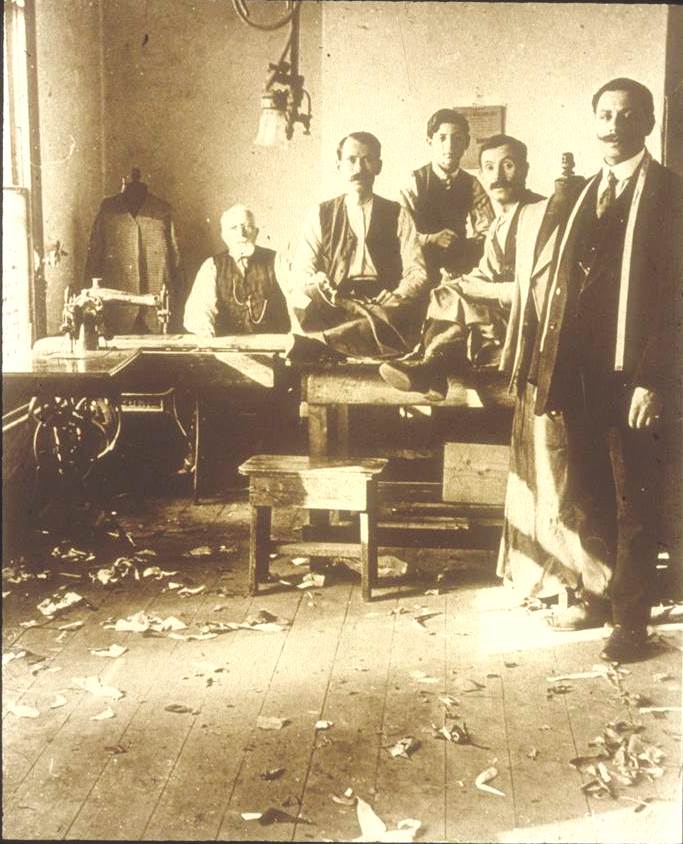
Jewish tailor's shop, circa 1900
Now this should be one not to miss.  

I have heard Bill Williams talk, read his books and been on one of his guided tours so I know it will be good.

It has been arranged by Chorlton History Group and Bernard our convenor writes

"At the last talk by Bill Williams on the early history of the Jewish community in Manchester we mentioned the possibility of a Jewish History walk in Manchester. 

Well this walk, led by Bill Williams is going to happen today  on Thursday 29th August from 2pm to 4.30pm and the weather is currently 
looking good for it. The plan is as follows:

1. Assemble for 2pm outside the gates of Chetham's School of Music in Long 
Millgate, central Manchester,  M3 1SB 
(this is very close to the site of one of the first Jewish settlements in Manchester). The easiest way to get there is via the metro to Victoria.

2. The route of the walk will be via Corporation St and then up Cheetham Hill Road, stopping at various places of interest on Cheetham Hill Road or just off it. Bill will give a commentary at these points. The distance is about 1 mile.

3. Our destination will be the Jewish Museum at 190 Cheetham Hill Road, M8 8LW. This will be kept open for us until 5pm. There is no charge for the walk but entry to the museum costs £3.95 (£2.95 concessions), but this gives you free entry pass until the end of 2013 www.manchesterjewishmuseum.com

5. Bernard's mobile number is 07960 888879 if there are any problems on the day


Bill Williams
For those coming by car, I suggest parking near the Jewish museum in advance, getting the 135 bus back to Victoria and then picking up their car 
later

The aim is to keep this group to around a dozen or so people so it will be first come first served by contacting me to say you would like to go on the 
walk"

So not one to miss then.


Picture; from the collection of the Manchester Jewish Museum, and photograph of Bill by Andrew Simpson

Thursday, 6 June 2013

Bill Williams on "The origins of Jewish Manchester” today at Chorlton History Group

Bill Williams
Bill Williams will be talking to the Chorlton History Group on "The origins of Jewish Manchester.”*

I first met Bill on a guided tour of the Strangeways and Redbank area of Manchester.

It was here that many Jewish families settled in the last quarter of the 19th century.

They were fleeing from Czarist persecution and found a home in the narrow streets and small terraced houses of this part of the city. I then went on to read his book The Making of Manchester Jewry and recently Jewish Manchester: An Illustrated History.*

A Jewish tailoring workshop circa 1910
He was a founder member of the Jewish Museum which I joined I sometime in the 1980s.

The group meets regularly at Wilbraham St Ninian’s Church, Egerton Road South.

For further information about future talks and Chorlton History Group contact Bernard Leach, btleach@gmail.com, or ring Chorlton Good Neighbours on 881 2925

More details at http://wp.me/p2KlLI-oH

Picture; from the collection of the Manchester Jewish Museum, and photograph of Bill by Andrew Simpson


*The Making of Manchester Jewry, Manchester University Press 1976, Jewish Manchester: An Illustrated History, DB Publishing, 2008

Wednesday, 5 June 2013

Bill Williams on "The origins of Jewish Manchester” tomorrow on June 6th

Jewish tailoring workshop, circa 1910
Tomorrow Bill Williams will be talking to the Chorlton History Group on "The origins of Jewish Manchester.”*

The group meets regularly at Wilbraham St Ninian’s Church, Egerton Road South.

"Bill was one of the founders of the Manchester Jewish Museum based in an old synagogue in Cheetham Hill and has been instrumental in documenting and curating the history of the Jewish community in Manchester and has written several books on the topic

This talk will focus on the early years of the Jewish community in Manchester, with the aim of holding a second talk some time later on which will focus on developments in the late 19th and early 20th Century.

And one for the future, ...... the History Group will be holding a history walk around  Jewish Manchester, led by Bill, starting near Victoria Station, walking down Cheetham Hill Road and ending at the Jewish Museum. 

The Manchester Jewish Museum
A date for this walk will be decided at the June 6th meeting and people coming to that talk will have a first opportunity to put their names down for this walk, which we will aim to keep to a small number

As usual the talk will be held at Wilbraham St Ninian’s Church, Egerton Road South, Chorlton, M21 0XJ

For further information about future talks and Chorlton History Group contact Bernard Leach, btleach@gmail.com, or ring Chorlton Good Neighbours on 881 2925"

More details at http://wp.me/p2KlLI-oH

Picture; Jewish tailoring workshop in Manchester circa 1910 courtesy of Bill Williams, the Manchester Jewish Museum, 

Thursday, 7 March 2013

More history from Chorlton’s History Group


Today, at 1.30pm

 Eddie Little: 'The First Flight to Ireland' by a North West aviator.

 At Chorlton Good Neighbours, Wilbraham St Ninian’s Church , Egerton Rd South, Chorlton
£1.50 charge for tea & biscuits  - All welcome


Honouring four Chorlton veterans
"We had a very successful tribute to  Chorlton Good Neighbours World War 2 veterans in February at which over 90 people attended. 

It was featured on ITV's Granada Reports  http://wp.me/p2KlLI-k7 and in the Manchester Evening News 

For those who couldn't make it there is an edited video of the event at http://wp.me/p2KlLI-lq*

In the March meeting of the History group, Eddie Little will be giving a talk on the  'The First Flight to Ireland' by a North West aviator.
Eddie will also sell a booklet on the subject with  proceeds going to Francis House Hospice.

Looking further ahead to the History Group meeting on Thurs April 4th 2013 at 1.30pm,  Janet Bradshaw, who is an historical interpreter at Tatton Park will give a talk entitled: “9 Lives: the story of Tatton Park from Saxon time to World War 2”. This  talk will be enlivened by several  costume changes to give a different slant on the history of this stately home

For further information ring Good Neighbours on 881 2925 or email me at BTLeach@gmail.com"
Bernard Leach

*http://chorltonhistory.blogspot.co.uk/search/label/Chorlton%20war%20veterans

Picture; Chorlton Good Neighbours honouring four World War 2 veterans in February , from the collection of Tom McGrath

Thursday, 7 February 2013

“ordinary lives in extraordinary times” remembering and honouring four from Chorlton


Today was one of those remarkable days when a lot of us came together to honour four people who gave up six years of their lives in the service of their country during the last world war.

One was a fighter pilot, two served on the Atlantic convoys and one drove a petrol lorry across the city during the blitz.

Alan Wood had flown with Coastal Command in the Ship busting squadrons based in Scotland, Bob Cowan and John Mackay saw action escorting convoys of much needed war materials to the Soviet Union and Mickie Mitchell who began as a lorry diver went on to serve in the Fire Brigade in Manchester and later in Germany and Palestine.

As Bernard who organised the presentation said these were ordinary lives lived out in extraordinary times and I think everyone of us was impressed with the calm way they recounted the events they experienced with a mix of stoicism and humour.

As one of them said “it turns your life upside down” but it was what all four had volunteered to do.

It wasn’t a sombre affair and at times there was much laughter as well as genuine warmth for four people who just got on with fighting the war.

And in the course of the afternoon others who had served on the convoys, worked in the munitions factories or just endured the long years of a hard war were remembered.

Arctic Convoys, Spitfires and the Manchester Blitz – celebrating Chorlton’s World War Two veterans was organised by Chorlton Good Neighbours and was held at the monthly meeting of the local history group.

The culmination of the afternoon was the presentation to each of the four of an engraved glass plaque by the High Sheriff of Greater Manchester.

This was followed the presentation to the two Arctic Convoy veterans with “65th Anniversary of Victory" medals by Andrei Makarenko, from the Embassy of the Russian Federation in London.

The Arctic Convoy veterans are still not allowed to receive the Ushakov medal from Russia, but this anniversary medal was an acknowledgement by the Russian government of the high regard they hold for those who helped their country by participating in the perilous Arctic Convoys that got much needed supplies through to Russia during WW2.

There were over 80 people in the room and the along with local councillors there was a team from Granada Reports and a journalist from the Manchester Evening News.

So for those who were unable to attend it will be covered on Granada Reports to night and the MEN tomorrow.

And for those who want to listen to Alan, Bob, John and Mickie discuss their war service there are interviews on the Chorlton Good Neighbours site at http://chorltongoodneighbours.org

Chorlton Good Neighbours Care Group has been active in Chorlton, Manchester since 1967. This blog aims to capture the experiences of our members, many of whom are in their 80's and 90's. It also documents the variety of events and activities that take place in our group each week.

Pictures;  Mickie Mitchell in the centre of the three and Bob Cowan during the war, John, Bob with Mickie and Alan today at the event, and John and son with his plaque and anniversary medal, courtesy of Tom McGrath

Arctic Convoys, Spitfires and the Manchester Blitz – celebrating Chorlton’s World War Two veterans today at St Ninian's Church, 1.30pm


My parents rarely spoke of the last war and only reluctantly would describe their experiences which more often than not were hedged in generalities.

It was a topic which was left to hang in the air.  So my early knowledge was gained mostly from films, ranging from the ultra patriotic produced during the war years and the daring stiff upper lip ones of the 1950s.

The evidence for what had happened was still all around us.  Ranging from the bomb sites to the shelters in people’s gardens and the fading painted signs indicating where to take cover in the event of an araid.  There were also those odd gaps in the middle of a terrace of houses where a bomb had destroyed a home.

But these have all but vanished under the relentless drive of redevelopment which leaves only the oral testimony of those who lived through it.

I thought the other day that just perhaps in the late evening of a November 5th or early the following morning that mix of the smell from bonfires and the thick greyness that comes from the smoke might just provide a tangible sense of the aftermath of an air raid.  But then there would also be the broken glass and the still warm shrapnel underfoot and in the worst hit areas the rubble and broken homes.

All of which leaves only the oral testimony of those who lived through it.

This includes one old friend who told me of the night his wife Margaret went into labour during an air raid and their journey up Barlow Moor Road.  There was no ambulance, and John didn’t have a car so Margaret sat in the pram and he wheeled her through the empty streets from Reeves Road to the hospital.

So I shall be looking forward to today’s Chorlton History group meeting, Arctic Convoys, Spitfires and the Manchester Blitz – celebrating Chorlton’s World War Two veterans

Chorlton Good Neighbours History Group pays tribute to four of our members, all in their 90’s, who served in World War 2 at an event on:

Thursday Feb 7th 2013 1.30pm at Chorlton Good Neighbours,
Wilbraham St Ninian’s Church, Egerton Rd South, Chorlton, Manchester M21OXJ

Bob Cowan, for whom Good Neighbours mounted a successful campaign for an Arctic Convoy medal to be awarded to veterans such as himself and also John Mackay of Chorlton who we recently discovered, is also a veteran of the Arctic Convoys

Alan Wood, fighter pilot, who was once shot down over the North Sea and was adrift in a one-man dinghy for 4 days

Mickie Mitchell, who as a young woman drove army petrol supplies round during the Manchester blitz

Andrei Makarenko, from the Embassy of the Russian Federation in London will be attending to present the two Arctic Convoy veterans with “65th Anniversary of Victory" medals. 

The Arctic Convoy veterans are still not allowed to receive the Ushakov medal from Russia, but this anniversary medal will be an acknowledgement by the Russian government of the high regard they hold for those helped their country by participating in the perilous Arctic Convoys that got much needed supplies through to Russia during WW2

The High Sheriff of Greater Manchester, George Almond, CBE will present all 4 WW2 veterans with plaques from Chorlton Good Neighbours to celebrate the contribution they made to the defence of this country in WW2

Bob, John, Alan and Mickie will all be at the presentation to receive their awards and answer questions

Further information from Bernard Leach m: 07960 888879,  btleach@gmail.com


Pictures; Post war demolition in Manchester, 1945, m75548, Blitz bomb damage, 1941, m8608,8609,courtesy of Manchester Libraries, Information and Archives, Manchester City Council and barrage balloon on the Rec, from the collection of Alan Brown

Thursday, 1 November 2012

Chorlton in the Middle Ages, with Ian Meadowcroft today


I tried finding a picture to go with Ian’s talk on Chorlton in The Middle Ages, but it was difficult.

So this one of the Horse & Jockey is close.  The building dates from circa 1512.

Ian Meadowcroft will be giving a talk on “Chorlton in the Middle Ages” today at the Chorlton History Group

The History Group normally meets monthly on the first Thursday of the month 1.30-3pm at Chorlton Good Neighbours, Wilbraham St Ninian's Church, Egerton Road South. There will be a charge of £1 to cover room hire and tea & biscuits. All welcome

Picture; from the Lloyd Collection

Monday, 8 October 2012

Chorlton on Film

The Chorlton History Groups just keeps on going from strength to strength.

Recently Bernard presentedChorlton on Film” –using the NW Film Archive and other sources, a look at Chorlton and Manchester as seen from old films & newsreels.

Here were family films from the 1960s, documentaries covering the period before and just after the war, the Beegees revisiting Chorlton and reflecting on their first live performance at the Chorlton Gaumont in 1955, as well as scenes from Stretford pageant 1930 & 1931, and the Horse and Jockey in 1949 which featured in a short film Bella's Birthday.

Future talks will include Chorlton in the Middle Ages and the History of Punch and Judy.

The Chorlton History Group meets on the first Thursday of the month at 1.30-3pm Chorlton Good Neighbours, Wilbraham St Ninians Church, Egerton Road South.

Picture; from the Lloyd collection

Sunday, 12 August 2012

On discovering the Picturedrome in Holmfirth and a thriving cinema industry


We were up in Holmfirth recently visiting the winery but that is a story for another time.  

It was while we were there that I came across the Picturedrome, opened in 1912 and in its day offering films and variety.  Now it looks as if it has been much mucked about with over the last hundred years but something of its former grandeur is still there.

It is a big enough to seat a couple of hundred people, has a double set of doors, with a veranda above it and must have made you feel special each time you went to watch that magic of light and moving pictures played out in the dark.

It reminded me of many similar old picture houses I have known but tended to ignore because they had long since passed into other use, closed by the grander cinemas that opened in the 1920s and 30s.
I guess in its time there would not have been many other buildings of its size in the Holmfirth. There was a blue plaque giving a few details but nothing about the enterprising individual or individuals who saw the potential those films as entertainment were going to have.

But then perhaps I should not have been surprised at the opening of a cinema in Holmfirth given that it was a centre of film making in the years either side of the 20th century.  It was the company of Bamforth Ltd capitalising on their magic lantern business which from 1898 made films in this tiny west Yorkshire town.  Between 1898-1900 they made 14 and in the two years 1913-1915 turned out 120 before switching production to London.

Nor were they alone, for across the country and especially here in Manchester there were film companies knocking out films in the years before and after the Great War.  Some survived well into the 2Oth century, which is a neat way of mentioning the History Group again and C.P. Lee who spoke to us about our own cinematic history.

Now, I have a very simple rule when someone has told a story better than I can the best thing to do is point you in their direction, so anyone wanting to know more about should visit
http://www.manchesterfilmhistory.info/ and http://www.itsahotun.com/

But having said that you might also want to read about our own palaces of fun and cinematic magic at http://chorltonhistory.blogspot.co.uk/search/label/Chorlton%20cinemas

Picture; from the collection of Andrew Simpson

Tuesday, 1 May 2012

Manchester's Black Pre-History 1750-1926


Well I knew it would be a good talk.  After all Bill Williams is a superb historian who speaks from a depth of knowledge and has that relaxed skill of presentation that makes you think you are having a conversation with him.

Opposite; the Jubilee Singers in 1873 who regualry performed in Manchester and can be heard on a 1915 recording

In just over an hour he took us through his latest research on Manchester’s Black Pre-History from 1750 to 1926.  I rather think it was one of the highlights of this year’s History Group meetings and gently nudges us away from local history into the bigger world.

Now I was well aware of the contribution the men and women of Africa and the West Indies made in two world wars and of the Windrush generation but had not really been aware of the presence of a black community before 1900.

From the 18th century onwards Bill pointed to the small group who lived in Manchester, campaigned for Britain’s active support for the abolition of slavery during the American Civil War and settled in the Ordsall and Greengate areas of Salford at the beginning of the last century.

And like these things are, members came along with their own memories as well as photographs.  All of which reinforced that simple truth that the study of history should never just be left to the professional.

So a good day.

Opposite; Greengate, Salford

Pictures; from the collection of Bill Williams, and photograph of Bill by Andrew Simpson