Showing posts with label Manchester History. Show all posts

Friday, 16 April 2021

If its Tuesday ……. it must be Castlefield ……. stories from walks through the past

Now I have been doing walks and talks for over 34 years.

Mr. Rothwell's house, Castlefield, 2003

It is one of those things I do because I enjoy talking about the past , love an audience and never tire of tramping the streets of the city in pursuit of a story.

And I fully admit that part of it is simply that I’m a frustrated actor who delights in the dramatic turn of phrase and revels in an audience.

It all started around 1987 with trips to Castlefield which was one of the GCSE History assignments I taught, and they rumbled on through the next two decades getting more comprehensive but always running the gauntlet of Derek the Developer who each year would take out another old and interesting building.

For those thinking of beginning a career doing guided talks, I recommend starting with parties of fifteen and sixteen year old students, who range from the eager and studious, to those looking for a secluded spot for a quick cigarette.

Southern Street, as was, 2003

It sharpens the skill of being both interesting and knowledgeable and encourages the acquisition of more than a few silly stories to lighten the delivery.

All of which are part of any teacher’s skills.

The ground had already been well prepared a decade earlier with impromptu walks through the city centre and along the Rochdale Canal with groups of students when for a variety of reasons the “planned” adventure had fallen apart.

I can happily report that there were no serious upsets, and the worst that I remember was a year seven student who when introduced to a rare Roman coin at Manchester Museum proceeded to bite it in imitation of Long John Silver testing out a “piece of eight”.

Gathering for the walk along Beech Road in 1847, 2014

Most have been done for free, although over the years I have picked up an annual commission from Manchester Library Service, and regular visits to history societies, and a very successful series of talks at the Chorlton Post Box Café.

The key as always is that mix of knowledge, humour and the honesty to admit to not knowing when Hiram from New Jersey asks the unexpected question, which only the “All Seeing” would know.

Sun, spectators and a bit of history, 2010

Added to which it is about never talking down to those who have taken the time to come along, or when as often happens someone wants to know about tunnels between old buildings or headless  ghosts, the response should always be one that leaves the questioner feeling that their opinion is valued.

And for those who want to know how we know, there must always be the willingness to advance the sources, and suggest where to go to follow up the inquiry, which is as much about good manners as it is about professional integrity.

So, there is always a souvenir booklet, with pictures, stories and of course at least one image of an appreciative audience, with links to my books and those I have written with Peter Topping. 
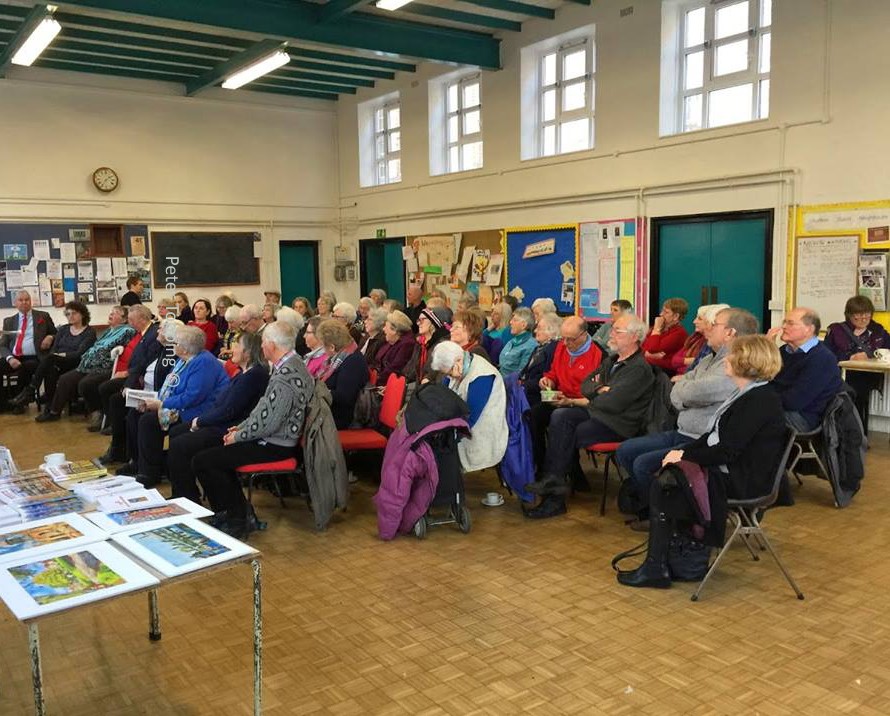
Indoors at Chorlton Good Neighbours, 2018
And now, with Covid restrictions appearing to fade, and the sun making a reappearance I think it may be time to hit the road again.

There are plans for walks through Chorlton and Didsbury, the return of the Library walk for Chorlton Book Week, and in fulfilment of  promises made, a series of talks postponed by the successive lock downs.

Nor does it stop there because the arrival of Zoom and all those "virtual" opportunities have transformed how we go about talks as well as walks.

It is all out there to do.

Along the Rochdale Canal, 1979

Castlefield, 2002

And in the year or more since the last walk and talk, there will no doubt be plenty of changes which makes the research and the walk always more fun. 

Location; everywhere where there is history


Pictures; talks and walks wot I have done, 1979-2018, from the collection of Andrew Simpson, Mr. Rothwell's house, Castlefield, 2003, Liverpool Road, 2003,  The Rochdale Canal, 1979, Castlefield, 2002, from the collection of Andrew Simpson  © Andrew Simpson


Thursday, 11 March 2021

Their story in our history …………..


Now, I came across the line “Their story in our history” in a talk on Chartism and it instantly resonated with me.

We all have our own stories but each feeds into the bigger picture and is particularly relevant in the light of the debate on public statues, and who as a society we choose to remember, and why, and who the history books have chosen to record.

So, when I was at school, history text books were still broadly the story of the “good and the great”, with a heap of Kings, a few nasty people and a sprinkling of clever scientists and inspired generals.


Needless to say, there were few women and those that got on to the pages had walk on parts, causally mentioned as background to the achievements of men.  

There were the few exceptions, which included Boudica, Elizabeth 1 and Queen Victoria, and of course Marie Antoinette, but often they were there to show the perfidiousness of men or as with the French Queen a lesson in not saying to a band of starving Frenchwomen “let them eat cake”.*

And while the 1950s saw the beginnings of a change with children’s history books beginning to focus on social history and the lives of ordinary people, a clutch of standard school text books made in the 1970s still peddled a male Eurocentric interpretation of Britain’s past.

But already there was a growing emphasis on working class history and the important contribution made to “Our Island History” by Black, Asian, and other groups.

In many cases it was not that history had forgotten them, it was more that history had just not seen them as important enough to be included in the story.

And  that was not an accident, but arose from who wrote the books and the dominant political and cultural outlook of the establishment.


All of which is directly relevant to our history here in Manchester.  

So for a century and more, discussion on the Industrial Revolution was dominated by the men who invented the textile machines, developed steam as a means of traction, and designed the canal and early railways, and by extension those who were responsible for the factory system.

Names like the radical Thomas Walker, who spoke in favour of the French Revolution and campaigned for the abolition of the slave trade, and feminists like Annot Robinson in the early 20th century have been largely forgotten, along with figures like Arthur Wharton who “earned the title of the world’s first black professional footballer and is entrenched in Mancunian history after ending his career playing with Stockport County in 1902”.**


Happily the balance is being addressed, so the work of Louise Da-Cocodia MBE, “who arrived in Britain from Jamaica as a 21-year-old in 1955, overcame the overt racism of the time to become the first black senior nursing officer in Manchester, before becoming a dedicated anti-racism campaigner”, has featured in the Manchester Evening News.***

But mossing from these is the almost untold and not very well known story of British Home Children, who were the young people migrated from Britain to Canada, Australia and other bits of the old British Empire during the late 19th century and well into the next.

Slowly their history is becoming known, but ironically while individuals, groups and professional historians in Canada have developed the story into an accepted area of serious historical research, here in Britain this bit of our past remains little studied and not widely known.

And yet the reasons for why they were migrated highlights the level of poverty and inequality in 19th century Britain.

All of which is not stating anything new, but I think does deserve to be revisited.  After all, we all have a story and some of them will break new ground while others will fit seamlessly into that big picture.

So, my family history was less about the “great and the good” but about generations of people who lived out their lives against the backdrop of momentous events, which is an outrageous lift from the Yorkshire poet Ian McMillan who said of his parents, “theirs were little lives lived out in a big century”.

But all of them made a contribution leaving me just to draw on that poem, “Who built the seven gates of Thebes? The books are filled with names of kings. Was it the kings who hauled the craggy blocks of stone? And Babylon, so many times destroyed. Who built the city up each time? ………….. Each page a victory At whose expense the victory ball? Every ten years a great man, Who paid the piper?"****


Pictures; Boudica, drawing  by J.C.B. Knight, from People in History, R.J. Unstead, Volume one, 1955, and the remaining images from the collection of Andrew Simpson, 1979-2021

* “Let them eat cake”, according modern scholarship it is doubtful she said it

** Black History Month: Exploring Manchester’s influential black athletes, The Mancunion, Manchester Media Group, October 5th, 2018, https://mancunion.com/2018/10/05/black-history-month-exploring-manchesters-influential-black-athletes/

*** Black, brilliant and Manc - the groundbreaking pioneers who helped shape our city, Chris Osuh, Manchester Evening News, October 15th, 2019, https://www.manchestereveningnews.co.uk/news/greater-manchester-news/five-ground-breaking-figures-black-13760293

****A Worker Read History, Bertolt Brecht