Showing posts with label Span Court. Show all posts

Wednesday, 18 March 2026

Living in a two roomed cottage in a Manchester court in 1851


You won’t find Span Court I know I tried.  But I do know where it was and where it had been when it was home to hundreds of families from about 1780 till sometime after 1965.

It was one of those bits of infill, the product of speculative builders trying to squeeze as many houses as possible onto a small piece of land.  In this case the plot was off Artillery Street which runs from Byrom Street to Longworth Street behind Deansgate.  Courts like these might hold half a dozen houses which faced each other across an open paved area and in some cases were locked away behind other properties, with access down narrow alleyways.

Many were back to back houses consisting of just two rooms, made from poor quality materials with party walls which were just half a brick thick and floors laid directly onto the bare earth.
My great grandmother grew up in just such a property in Whiteman’s Yard and those in Span Court were little different.  True they had cellars which still in the middle of the 19th century might be occupied by families, but otherwise they resembled the one she was born in.

In 1844 Manchester stopped the building of new houses which did not have running water and a toilet in the house or the yard which meant that no back to back houses or courts were built, although in neighbouring Bradford and Openshaw such properties continued to be constructed.  By 1900 there were only 5,000 back to backs left in the city and these had all been removed or converted  to ‘through’ houses by 1939.*

Span Court consisted of six such properties.  The eastern side of the court backed on to three identical houses fronting Swan Court while the western three were set up against industrial buildings which later became a hospital.

And in those six houses in 1851 lived a total of thirty-three people who made their living from the bottom end of economic pile.  And so while there were 6 power loom weavers and a cooper and dress maker there were also an errand boy, a hawker and one who described himself as a pauper.
Now over the next few weeks I will be delving deeper into Spam Court and trying to tell its story, looking at the people who lived there and the surrounding streets.

*Parkinson-Bailey, John P, Manchester University Press, 2000

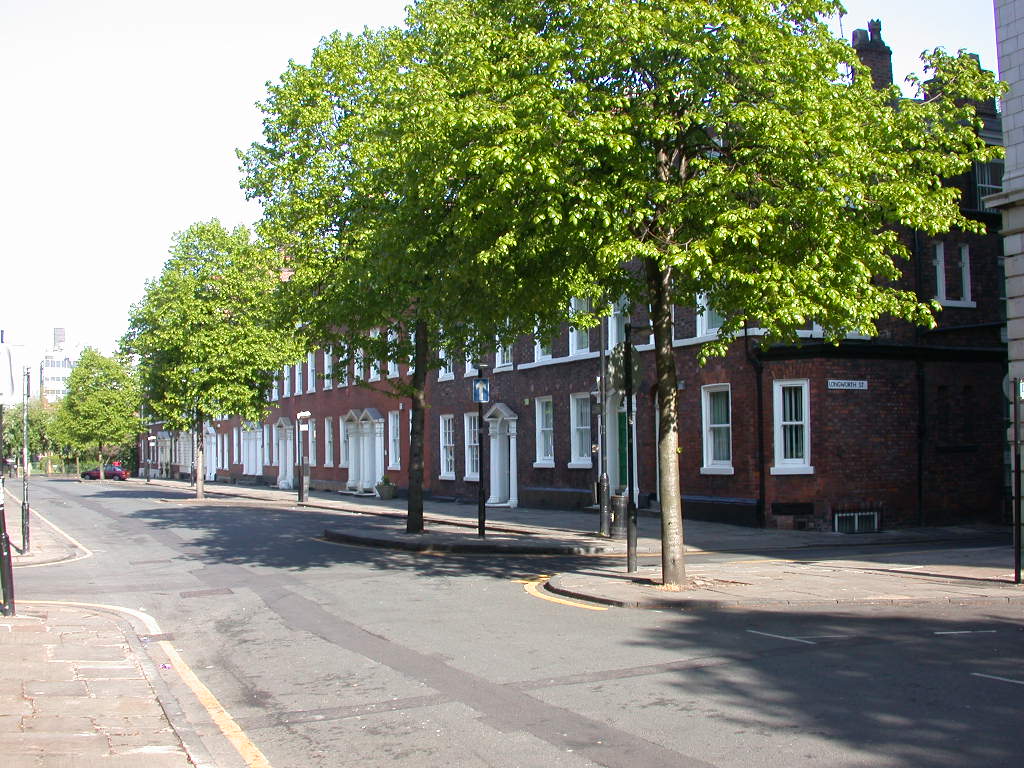
Pictures; Span Court in 1965 J. Ryder, m00211, Courtesy of Manchester Libraries, Information and Archives, Manchester City Council, Span Court from the 1842-44 OS map of Manchester & Salford, courtesy of Digital Archives, http://www.digitalarchives.co.uk/ and Artillery Street looking up from Byrom Street with Span Court off to the right,  from the collection of Andrew Simpson

Wednesday, 5 November 2025

In the midst of great wealth ....Span Court and St John's Street


I have been drawn back to Span Court.

It was a collection of six back to back houses in a partially enclosed court off Artillery Street which runs from Byrom Street to Longworth Street behind Deansgate.

They were one up one down with a cellar and did not rate an entry in the street directories which is not unsurprising given that those who lived here were on very modest means and some on the very margins of poverty.

In 1851 in those six houses lived a total of thirty-three people who made their living from the bottom end of the economic pile including six power loom weavers, a cooper, dress maker as well as an errand boy, a hawker and a pauper.

It is very easy to become blasé at the conditions in Span Court, after all historical empathy only goes so far, but this was living at the precarious end.  I rather think that Ann Cass aged 73 who described herself as a pauper had never had an easy life, and now she and her two daughters in their 30s were reliant on their combined wages as power loom weavers and what they got from Annie Harrison, their 38 year old lodger who was a band box maker.


Nor were they alone in taking in lodgers other families in the court were also doing the same and in most cases having to find space in what was at best two rooms and may even have been less, because the majority of  our houses were sublet.  Of the six, five had two families living in them as clearly defined and separate households.  Now these properties did have cellars and there were plenty of people living in the cellars of houses across the city according to the 1851 census.  But usually the enumerator recorded those who lived in the cellars.   But in this case no such records were made, ** which rather suggests that families and their lodgers were living in just one of the two rooms in each of the houses.

And in the case of John and Catherine Pussy it meant finding space for their five children ranging in ages from 20 down to three as well as their 19 year old lodger in what I guess was one room given that the house was shared with another family of four.

Span Court has gone but Artillery Street is still there and you have to walk it to get some idea of how narrow the street was and then try to picture the 83 people who lived mainly in the three courts off it or the 96 who lived on Longworth Street which ran from Artillery Street to St John Street.  The whole census patch amounts to ten streets and their small courts, most not much wider than Artillery Street and bounded by Deansgate and Byrom Street in which crowded a total of 497 people.

But it would be wrong to run away with the idea that this was just a collection of humble streets housing the least well off.  True the majority as the graph below shows  made their living from unskilled or factory work but there were also artisans, shop keepers small businessmen. And almost acting as an island of wealth was St John Street, then as now a place of fine late 18th and early 19th century houses whose residents included accountants, a silk manufacturer and a retired calico engraver and printer.

And it is this last “calico engraver” who I want to finish with as a contrast to Span Court.  James Holt had set up the family business sometime at the beginning of the 19th century had bought and maybe built his double fronted property on St John Street and in the fullness of time retired to Chorlton, leaving his son to run the business and retain in the family home in the heart of Manchester off Deansgate.  This was John Holt who would later in the 1850s move himself to our township.

But the family never gave up their interest in the area surrounding their town home and so by 1912 they owned seven of the fine houses on St John Street as well as shops cottages and a beer shop on the surrounding streets as well as land and the fine estate of Beech House in Chorlton.*

We have rather come to be conditioned by the rich living in gated communities set apart from the less well off and our wealthy families were no different.  Samuel Brooks had established his own estate which would be developed for the well off on the edge of Chorlton, and in the late 1830s Victoria Park Company was set up to “erect a number of dwelling houses of respectable appearance and condition, with gardens and pleasure grounds attached, with proper rules and regulations against damage an nuisances.”**

But the residents of the houses on the north side of St John’s Street backed on to Span Court while the Holt’s own fine house was not only beside a timber yard but its rear windows overlooked a coal yard and the densely packed court of Holt’s Place which consisted of ten small back to back properties.

So Span Court and the poor were never that far from the rich of St John’s Street which I suppose is an interesting take on that much quoted phrase, “the poor are always with us.”

Pictures;Span Court, J.Ryder, 1965, m00212, Courtesy of Manchester Libraries, Information and Archives, Manchester City Council, detail from 1842-44 OS map of Manchester & Salford, Digital Archives, http://www.digitalarchives.co.uk/, other pictures from the collection of Andrew Simpson


*Camp Street, Holt Place, James Place, Longworth Street, Severn Street, Byrom Street, Great John Street, Gillow Street, Lower Byrom Street, Charles Street, Peel Street and City Road

** A Short Account of the Victoria Park Manchester, Manchester Corporation, 1937

Tuesday, 28 February 2023

What a difference a street makes ... contrasts in wealth and poverty


Today we are on a journey.  It is a short one in terms of distance just the space between two streets, but in almost every other sense it is a huge one.  

I want to walk from Span Court to St John Street and I have chosen 1851 as our point in time.  Spam Court was a collection of six back to back houses in a partially enclosed court off Artillery Street which runs from Byrom Street to Longworth Street behind Deansgate and I have written about them already.

They were one up one down with a cellar and did not rate an entry in the street directories which is not unsurprising given that those who lived here were on very modest means and some on the very margins of poverty.

In 1851 in those six houses lived a total of thirty-three people who made their living from the bottom end of the economic pile including six power loom weavers, a cooper, dress maker as well as an errand boy, a hawker and a pauper. More over in all but one of the six there were two families, one of which may have lived in the cellar or in one of the two rooms.  These were small houses, and the rooms may have been no more than 3.5 m square.

There would have been little in the way of furniture and the only natural light came from single windows that looked out on the narrow court.  They were not the worst of accommodation that the city had to offer and were perhaps slightly better than what could be found in the countryside but they were pretty basic.  Even in 1965 when the properties had been enlarged by extending back into the houses behind to make four rooms, living here would not have been my choice.

And as if to underline just how basic they were their yard was overlooked by the fine homes of St John’s Street, and it is to that place we shall go next.  Here in very grand houses lived accountants, a silk manufacturer and a retired calico engraver and printer.

The latter was John Holt whose father had made his wealth from making the engraving blocks used for calico printing and had eventually retired to a large estate in Chorlton.   John Holt would follow him sometime soon after 1851 but the family retained their interest in the area.*

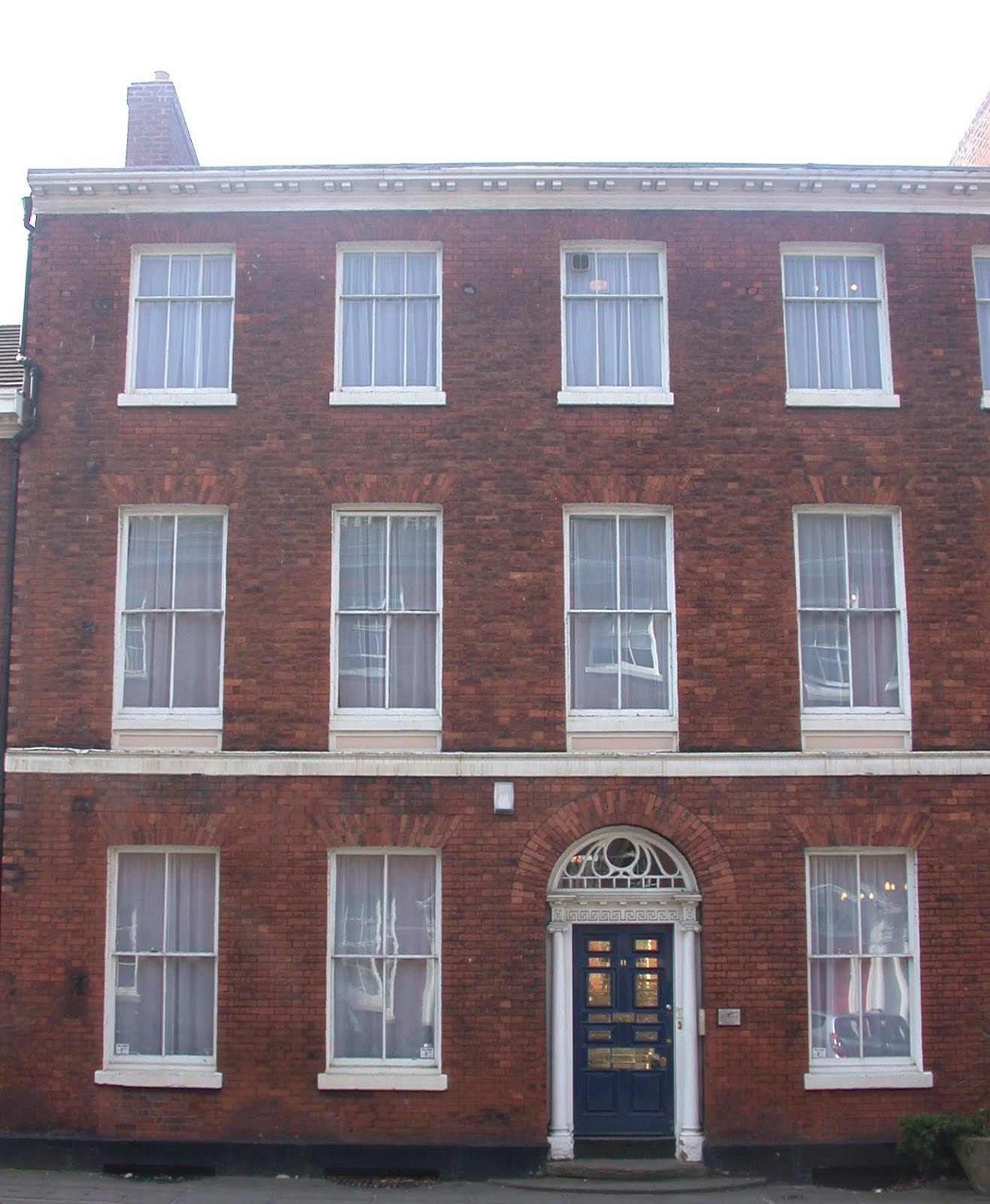
Their home was the finest.  It is the only double fronted one on the street and had a huge and impressive bay window at the rear which extended over two floors.  Even today when the property has been turned into consulting rooms something of the style, comfort and good living is apparent. John and Sarah Holt lived here with their four children mother in law and two servants spread out over three floors.

But that fine bay window would have allowed them to gaze out on plenty more mean and basic cottages, for behind them were three small courts all with their own back to back properties which ran out on to Camp Street.

If the Holt’s however found this a little disconcerting they could console themselves with the thought that they owned all 24 of them.

In the midst of wealth there was indeed poverty but it was a profitable poverty for some.

Pictures; Span Court, J. Ryder, 1965 m00211, Courtesy of Manchester Libraries, Information and Archives, Manchester City Council,  detail from the 1842-44 OS map of Manchester & Salford, Digital Archives, http://www.digitalarchives.co.uk/ photographs of 11 St John Street from the collection of Andrew Simpson


*Camp Street, Holt Place, James Place, Longworth Street, Severn Street, Byrom Street, Great John Street, Gillow Street, Lower Byrom Street, Charles Street, Peel Street and City Road

Thursday, 3 June 2021

Who wouldn't want to live at 11 St John Street?


Now there is no doubting that 11 St John Street in the heart of the city was a pretty impressive address and it was the home of the very wealthy Holt family.*

It had been built around 1794 and despite some very modest cottages on Camp Street and the surrounding streets it was still  open countryside with fields west all the way down to the river, and the same south to the canal basin at Castlefield.  This was very much living on the edge of the city.

True along the river there were some dye works and beyond the Duke’s Canal** a small lime works but that was it.

And even as late as 1819 there was still open land down to the river and across to the canal.  But I rather suspect the writing was on the wall.

The Byrom family had entertained high hopes that the area would be developed along the lines of St John Street with fine late 18th century town houses but it was not to be.

And the coming of the Liverpool and Manchester Railway across the Irwell and part way up Liverpool Road sealed the fate of the area.  Soon it would be warehouses and lots more mean and small cottages which would dominate.

So in a sense it is a surprise that the very wealthy Holt family stayed there as long as they did because they didn’t leave for their very fine estate in rural Chorlton until the mid 1850s, by which time all those fields west down to the river, and south to the canal basin at Castlefield were built over and were either mean small and basic working class cottages or warehouses and timber yards.

Now to be fair, John Holt had to wait till his father died to inherit the pleasant Beech House, but there were other places.

Still when you see the inside of number 11 you can see why perhaps they continued in the heart of the city.

The pictures were taken with the kind permission of the manager, Liz Wilson who actually lived on the top floor back in the 1960s.

Now much of the grandeur has vanished but something of the style and comfort is still apparent and remember from that big bay window which spread across two floors the Holt’s could have views the one up one down properties of Holt’s Place, James’s Place and John’s Place.


Location; Manchester


* Now the contrast is with Span Court and partially enclosed court of six back to back houses in the next street https://chorltonhistory.blogspot.co.uk/search?q=Spam+Court

** The Bridgewater Canal

Pictures; from the collection of Andrew Simpson

Friday, 13 March 2020

On the trail of Martha Roebuck nee Burgess and a series of mysteries

Span Court in 1965
Now usually you start a story with a clear idea of where it will go and pretty much have all the facts sorted.

But not so this one.  To date what I have is very sketchy and amounts to a few certainties, a series of unanswered questions and a line of mysteries.

This is what I do know.  William Roebuck was born on January 13th 1924, at 5 Span Court which was off Artillery Street close to Deansgate.

His mother registered the birth and she was Martha Roebuck nee Burgess aged 35 who gave her occupation as cotton doubler and came from Ireland.

Now there is nothing out of the ordinary about a mother registering the birth, in fact given the likelihood that her husband was working it made sense.

Except that Thomas Roebuck had died in the Great War and so far there is no record of Martha re marrying.

They had married in Salford in 1911.  He was a carter and we can track the family across Salford in the decades back to when he was born.  Most of the streets were those very small ones which look to be infill and seldom get into the street directories.

His father worked for the Corporation as a night watchman and carter and one of his brothers was a labourer while the youngest was a window cleaner.

Martha has proved more elusive, she was born in Ireland but apart from her marriage certificate and parish record of that marriage, all we have is the entry on her son’s birth certificate.

Detail from the parish marriage record
Tantalizingly there are more names, including Alexander Burgess who was Martha’s father and two people who witnessed the marriage. One of these was Samuel Burgess and the other a Margret Kelly.

But again the evidence trail for all three goes nowhere although there is a reference  to a Charles Burgess appears on the street directory for 1911, and at first glance this is promising because he was living in the same street as Martha but at a different house.

As for Margret Kelly, sadly the 1911 census for Salford is full of Margret Kelly’s.

Detail from the birth certificate of William Roebuck
The story has yet one more twist in that William Roebuck grew up Selly Oak in Birmingham with another family but when he was old enough he left and returned north to be reunited with his mother.

What has further puzzled his daughter is that Martha by then owned property in Failsworth which for someone living in Span Court seems exceptional.

Of course there is a long way to go and at present some at least of the most obvious routes to finding him are blocked.

The census returns are not yet available for the decades after 1911; she does not appear on any electoral roll for either Salford or Manchester, which just leaves that slow trawl through the street directories.  The answers are out there but it will involve much more slog.

Pictures; Span Court, 1965, J. Ryder, m00212, courtesy of Manchester Libraries, Information and Archives, Manchester City Council, & detail from the marriage record and birth certificate by courtesy of Suzanne