Wednesday, 30 April 2025

The lost pubs of Chorlton No 2, The Feathers


The Feather’s was another of those lost pubs I rarely drank in which may or may not account for its short existence.

It opened in November 1959 and just about staggered into the 21st century.  Near the end it seemed to have a number of fresh openings followed by swift closures and is now a supermarket.

Its attraction were the small front rooms which were just the right size for a gathering of a few friends or when you fancied escaping from the usual haunts.

It was opposite the cinema but I never remember visiting it after a film.

Picture; December 1959, R.E.Stanley, m49581, courtesy of Manchester Libraries, Information and Archives, Manchester City Council

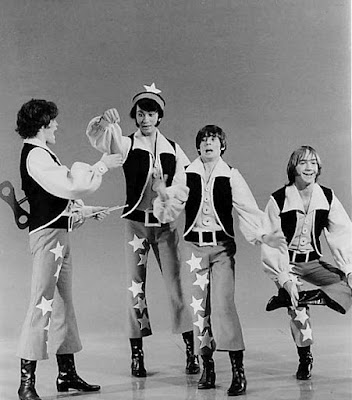
Last Train to Clarksville ....Daydream Believer ..... and a romantic moment accompanied by the Monkees

Now you can be quite sniffy about the Monkees, which were an assembled band for television, and featured as such on NBC television from 1966-1970.

1967
I first saw them sometime around 1966-1967 on the BBC when the show went out on an early evening Saturday slot.

I have to admit to my shame that I publicly followed the line that they were not serious musicians, but secretly I liked them.  Some of the songs have survived the test of time, and are still exciting to listen to while the story lines were funny.

But that is not surprising given some of the songs and scripts were written by accomplished and well known professionals, added to which some of the Monkees themselves became popular musicians.

I suppose my time with them will have been during 1966 and early 1967 when I was dating Jennifer who like me went to Crown Woods.  Jennifer’s father was in the army and she was one of the students who spent term time living in the Lodge which was attached to the school.

1969
So on some Saturday nights we spent a few hours in the common room watching the Monkees and other things before I was banished before lights out ….. or I suspect when she had enough of me.

Such is the twisty turny time of adolescent love.

Even now some of those Monkess songs take me right back to that period of intense emotions with the girl I thought I had fallen in love with in that room.

And in a year and a bit on after we had long parted it was where I sat some of my A levels, and during the efforts to construct an essay on King Lear or Disraeli my mind would wander back to the daft moments with Micky Dolenz, Michael Nesmith and Peter Tork and  Davy Jones of the Monkees and Jennifer.

Location; the 1960s

Pictures, the Monkees, 1967, and 1969, from the collection of NBC


Tuesday, 29 April 2025

Four petrol pumps ….. three concrete stumps ........ and two pizza shops

There will be many who remember the three concrete stumps outside what are now Pizza Hut and Domino’s on Wilbraham Road.

1959
And there may still be some who can recall the four petrol pumps which stood on those concrete plinths.

They are gone now but for almost all of the time I have lived in Chorlton the stumps were there.

At some point when part of the building was the pottery studio, they had been decorated with colourful tiles but I have to confess I thought little about them. 

Only once did I ponder on whether they had been the base for petrol pumps which of course was what they were for here was Wilbraham Garage. 

It wasn’t the first in Chorlton, that was probably Shaw’s on Barlow Moor Road but still it is an indication of how far the motor car had taken over.  The three stumps supported four pumps which stood in front of the shop and garage and like Shaw’s were in a row of conventional shops and houses.

And last night with the help of Anthony Petrie I went looking for the history of the garage, the pumps and the concrete plinths.

He has access to four street directories spanning the early and middle decades of the last century.

Street directories record the residents and businesses street by street, with separate listings in alphabetical and trade order.

2023
The Manchester and Salford directories go back to the late 18th century becoming more detailed during the following two centuries.

The last was published in 1969 and because they were compiled and published annually offer up a record of who and what was where and how in some cases occupants moved around the twin cities.

In 1954 613 Wilbraham Road was home to Wilbraham Garage which is still listed there in 1961, leaving me just to book into Central Ref and go looking either side of 1954 and 1961 to establish when the garage opened and when it closed.

1985
But in the nature of these things, I bet someone will know.

For now I can just record that in 1929 the site was home to the accountant Harry Moorhouse who had diversified into cinemas and owned a chain which stretched across Manchester.

Although I rather think his house was demolished or seriously altered to accommodate the garage.

We shall see.

But that is not quite the end of the tale, because here after perhaps 40s years are two of the tiles made by the Pottery Studio.

For almost four decades they were part of the tiled surround to our bath.  

And when the old bath went and were replaced by a walk in shower only a handful survived.

Perhaps not a petrol pump or concrete stump but a reminder of that spot.

Location; Wilbraham Road

Picture; Wilbraham Road,, A E Landers, 1959, M18423, courtesy of Manchester Libraries, Information and Archives, Manchester City Council, http://images.manchester.gov.uk/index.php?session=pass in 1985 from the collection of Tom McGrath  in 2023, courtesy of Google Maps, and two of the tiles from the Pottery Studio, 2023, from the collection of Andrew Simpson

Find out more about the story on Sunday when you can join me for The short Chorlton History Walk that’s got the lot ……. at 2pm oiutside Benitos on Wilbraham Road, which is part of  Chorlton Get Together; https://chorlton.coop/event/get-together-2023/

The Didsbury mystery …… and “a right pong”

Now I say mystery, but I suspect there will be an avalanche of answers to the simple question, what is it?

The mystery object, 2025

The blog regularly gets requests to search out people, places, and events, as well as being offered pictures and stories, and so I welcomed the message from Dominic Parker who wrote in “Hi Andrew, big fan of your work!  Wondered if you could enlighten as to what this is?

Craigmore Avenue and the Mersey, 2025
It’s in a garden I maintain on Craigmore Avenue West Didsbury.  My own theory is its some sort of ventilation for an old tip or something like that, it kicks off a right pong every now and then”.

Craigmore Avenue is off Princess Road close to where the Mersey does one of its loops and is sited on what was Redbank Farm.

I can’t be exactly sure when the avenue was cut but it will be sometime after 1936.  The OS map for that year shows the farm still there but the 1938-46 version records the presence of the avenue with its houses.

Looking at all the maps going back to 1818 there is no indication of a water course feeding into the Mersey at this spot.

But the City Council conducted widespread controlled tipping which at the time lauded as the new and scientific way was “'controlled tipping'.  Here the rubbish is dumped on low lying land and is spread carefully out and ‘sealed’ by covering with a thick layer of soil. 

Redbank Farm and the Mersey, 1894
Then another layer of waste is put on top, ‘sealed’ and so the land is built up into what becomes in a year or two solid land.  

Just as the clinker obtained from the incineration method is put to good use in road making, the controlled tipping method is usefully applied to filling up waste land, and as you will find on the Mersey Bank at Wythenshawe that a large area of waste land previously liable to floods has been built up by this method into high solid land, grass-grown and suitable for all sorts of purposes, such as playing fields and parks...”

Now just exactly where around Craigmore Avenue the City Council may have undertaken tipping is as yet unclear but with a bit more research and perhaps some anecdotal memories, we may be able to establish if this were so.

I don't think that the Corporation would build on tipped land, and there is no evidence on the maps from the 1930s that the area by Redbank Farm was tipped on, especially given that the farm had existed on that spot from the early 19th if not the late 18th century.

The Mersey and Redbank Farm to the left, 1915
Despite the Mersey’s unpredictable flood record, generations of farmers would bot choose to build and live in a farm so close to the River.

So, it is over to the experts. …. Sorry Dominic.

And just an hour after the story went live we had the suggestion that it was a "Septic tank vent" which has form, but I think all the houses will have been connected to the sewage system, but it will be interesting to hear from local residents.

Location; Close to the Mersey in West Didsbury

Pictures; the mystery object, Dominic Parker, 2025, Craigmore Avenue, 2025, courtesy of Google Maps, Redbank Farm 1894, from the OS map of South Lancashire, courtesy of Digital Archive Association, http://digitalarchives.co.uk/ The Mersey at Red Bank 1915 from the Lloyd collection

*Our City, Manchester 1838-1938, the Manchester Municipal Officer’s Guild, 1938


A little bit of Derbyshire's history .... in the Lake Didstrict

 It has been a while since I inducted an object into the Street Furniture Hall of Fame.


This one comes from the Lake District and was uncovered by a chum last week.

Like all the inductees it comes with a history which in this case starts in two places in north Derbyshire. 

Stanton and Stavely were centres of iron manufacture in the 19th century.

Stanton began making iron products in 1846 and Staveley in 1863. 

They merged in 1960 and were nationalized in 1967, only to be priviatized later, acquired by a French company before the works in both places were closed down in the early 21st century.

I will leave it to someone else to explain the rest of the inscription.

For the very interested, there are various sites for each company detailing their history, their significance to the local econmies and their fate, with heaps of pictures.

Location; the Lake District

Picture; from a chum, 2025

Monday, 28 April 2025

New pubs for old and a disappointed confectioner

I rather think there must have been something in the air in the early months of 1907.

In the February there were two applications in front of the annual licensing meeting for the city of Manchester for new pubs in Chorlton.  Well I say new but in both cases they were for the demolition of existing buildings and their replacement with new ones.

The licensing records for the city are a wonderful treasure trove and I have to say I have trawled them over the years.  Sadly our own records only appear after 1904 when we were incorporated into Manchester and for the records of 19th century Chorlton you have to look elsewhere.

But for today thinking of the 1907 debate on new pub build the details are all here and it makes fascinating reading.

Now we had plenty of places.  Some like the Greyhound, the Bowling Green Hotel, Horse and Jockey, and Royal Oak could trace their history back to the beginning of the 19th century if not earlier, while  the Beech appeared at the beginning of the last century.  Others like the Travellers Rest and Black Horse along with countless unnamed ones were really just beer houses and surfaced and disappeared during the 19th century. Most had very short lives and more than likely existed as a part of a family strategy to make ends meet, opening when things were tight and closing when the family fortunes improved.

The exception is the Travellers Rest at the bottom of Beech Road which was opened in the late 1830s ran through to the early years of the 20th century and for most of that time was run by the Nixon family who could claim to be one of our well established families.  Samuel Nixon senior ran the Greyhound over the Mersey, his son and daughter in law ran the Travellers Rest and their son and grandson ran the stationers and newsagents on Beech Road.

Beer houses had come into existence with the Beer Act in 1830 and were designed to break the hold of the gin shops by permitting individuals to brew and sell beer for the price of a two guinea license.  In some cases like the Black Horse at Lane End and the beer shop run by Brownhill the wheelwright they were closed down when they continued to flout the license.

All of which brings me back to February of 1907. The Royal Oak had been selling beer since at least the 1830s and was the last beer house on the way out of the township to Manchester.  As such it was well placed to cater for farm labourers and the passing trade to and from the city and in its time had seen its fair share of unruly behaviour and worse from its customers.  But it was just a small house and I guess George Henry Kelsey could see the potential.  After all he had managed to get 800 residents to sign a petition “in favour of the new scheme.”* On top of which he was prepared to close his pub, the Sir Ralph Abercrombie in Great Ancoats-street for a newly built Royal Oak.

But the views of 800 residents were caught light in the balance when set against “several owners of property near the Royal Oak who were against the rebuilding.”  And Mr Kelsey may well have judged the wind when one of the licensing committee referred to the 800 as “the poor deluded people” who “in many cases because they were attracted by the prospect of a new building in place of a tumble down structure.”

There may have been more but it has been lost in time and the application was withdrawn but not after a sarcastic exchange where the committee man remarked that the applicant in withdrawing was “a very wise man” to which the reply was “I am sure I feel very gratified by that statement.”

And the same “tide in the affairs of men” was running equally against the tenant of the Bowling Green who wanted to reduce "from 1,335 feet to 1,126 feet the drinking area of the house and to have three rooms instead of ten” by demolishing the old building and putting up a new one.

It was a proposal which was not met with much enthusiasm, foundering on the official line that “there were too many licenses in old Chorlton already."  So I remain surprised that they decided to “visit the place and form our own conclusions on the spot.”

And equally surprised that within the year the old 18th century building was torn down and replaced by a new one.

The politics and workings of the committee remain a mystery to me and looking at previous decisions by earlier bodies the same holds true.

So back in 1893 when the responsibility for granting a license was with JPs, the session granted an application from a Mr Thomas Barrows of 46 Beech Road for an off wine and spirit license was successful while that of Charles Prince Hill confectioner of 28 Wilbraham Road was turned down.  He had wanted a license “to sell beer not to be consumed on the premises” and it was “not his intention to carry on a jug trade, but merely to serve families bottled beer.  The neighbourhood had increased largely and the license would be a great boon.”**

The opposition was limited to a local resident and another from Manchester Road who represented the British Women’s Temperance Association.  So in all “of the 4,700 persons in Chorlton-cum-Hardy only two had come forward to oppose the application.”  And the application was refused.

Perhaps it was because there were two businesses almost directly opposite selling alcohol or that it would be a change of direction for the 31 year old confectioner who had been on Wilbraham Road from at least 1891.


Now in time I might pursue Mr Hill who was still there in his confectioners in 1903 but had moved on by 1909 and it might be that he was successful elsewhere.

*Manchester Guardian February 8 1907
**Manchester Guardian August 23 1893

Pictures; from the collection of Tony Walker

Sunday, 27 April 2025

Adventures in the east .... across three centuries ....from Holt Town to New Cross

The thing about adventures is that they should be spontaneous with only a limited idea of where to go.

Tram spots and the adventure start, Chorlton, 2025

The downside is that you will have not given much thought to what you might want to eat and drink as the day wears on.

Aged 10 and with the whole of London at our fingertips, supplies were usually limited to a bottle of lemonade, which could be supplemented by a hollowed out round loaf of bread, which might be filled with a bag of chips, if we were lucky to find a chippy.

At Central Ref with the library staff, 2025
During the long walk or train ride, you ate the inside of the loaf which later provided the perfect receptacle for the chips, or crisps. It was and remained the perfect adventure meal.

And now aged 75 after decades of work and bringing up the kids the adventures are back although the gigantic chip sandwich is a thing of the past.

All of which is an introduction to the  jaunt across the eastern side of the city through Holt Town, and New Islington which filled my Wednesday.

We had been in Central Ref delivering our latest book to the library’s bookshop. 

It is the third in that popular series telling the story of Greater Manchester By Tram, which explore all ninety-nine metro stops across the eight tram routes.*

Each book is a mix of original paintings, period pictures and stories of the area around each stop, cost £4.99 and are available from Chorlton Bookshop, Waterstones on Deansgate, Central Reference Library, and from us at www.pubbooks.co.uk

Ancoats Mill, 2025
And having discharged that task and with the sun shinning and a full day ahead we jumped the tram at St Peter’s Square and headed out east to the Etihad Stadium.

It was inspired partly to explore the route of the next book but more to look up the place on the edge of Man City’s ground where I had lived for a magical year back in 1973.**

This was Butterworth Street flanked by Grey Mare Lane on one side and Mill Street in the shadow of the recently closed Bradford Colliery in the heart of what was still industrial Manchester.

It was a forlorn quest which I knew was fruitless given the redevelopment of the area and sure enough all that was left was the remnant of Rhyl Street which once gave off on to Butterworth Street from Mill Street and now was buried under Alan Turing Way with our apartment and my memories.

And that same message of what redevelopment means stuck with me as we travelled back via the tram to Holt Town, and onto New Islington.

Holt Town was developed at the end of the 18th century and quickly became a workhouse for the city with plenty of textile mills, gas works, and rows of terraced housing.***

That wooden figure, 2025

In turn bits were redeveloped in the middle decades of the last century and there is promise of a new redevelopment.

Forlorn and forgotten spot, 2025
At present the new social housing sits beside the former mills amongst open spaces and closed pubs. 

And here and there are those small businesses like the car wash firm on the corner of Beswick Street.

There will be plenty of stories like that of the forlorn wooden statue just off the main road, which I vaguely remember fronted a small modern row of shops. They have gone but the surrounding posh red brick walls have also survived, although they are steadily being overtaken by bushes, long grass and trees.

Equally sad looking is the nearby Ancoats Mill which will have its own story, and these I think will be the core of the chapter on Holt Town in that new book which will also include Piccadilly Gardens, Piccadilly Railway Station, and the Etihad Stadium.

For more research we walked into New Islington and found a place to sit and watch the boats on the canal while sipping coffee and indulging in a couple of pastries.

I talked about including New Cross on the corner of Oldham Road and Great Ancoats Street which was a popular meeting place of dissent in the 18th and early 19th centuries along with accounts of the Ashton and Rochdale Canals.

And here we met up with two tourists down from Middlesborough, discussed what might go into the other chapters and marvelled at the transition of the area.

Of course, had we taken a slight diversion we would have come across Tony’s Fish and Chip shop on Piercey Street which would have allowed me to recreate that bread and chippy meal of my youth.

Down to New Islington and the city centre, 2025

But somethings are best left in the past.

Location; Holt Town and beyond

Pictures; different bits of Holt Town, 2025,  from the collection of Andrew Simpson

*A new book on the History Of Greater Manchester By Tram, https://chorltonhistory.blogspot.com/search/label/A%20new%20book%20on%20the%20History%20of%20Greater%20Manchester%20by%20Tram

**Travels through the 1970’s …… via Grey Mare Lane ..... Bradford Colliery and some fireman's flats, https://chorltonhistory.blogspot.com/2025/04/travels-through-1970s-via-grey-mare.html

***Holt Town, https://chorltonhistory.blogspot.com/search/label/Holt%20Town

Saturday, 26 April 2025

Two pictures ….. and more stories

I have Steve Casson to thank for these two picture postcards of the old St Clements’s Church and the Bowling Green Hotel.

St Clememt's Church, date unknown
I don’t have dates for either, but the battered state of the cards suggests we are back in the 19th century.

And that distressed state adds to their impact, offering up heaps of possible stories, of who originally owned them, how they survived and how eventually they passed to Steve.

But there is even more.

So, in the case of the church there are those steps leading up to the rear of the old Bowling Green Hotel.  

I say old because the pub was demolished to make way for the present building which dates from 1908.

All of which suggests that our photographer was standing roughly on the site of the new pub.

I had never realized that the old pub stood on a slight rise.

The image also gives a fine view of the church from an angle I have also never seen, and along with the details of the windows and great east window there is the pipe of the Arnott stove which was used to keep the church warm.

Bowling Green Hotel, date unknown
The picture of the Bowling Green Hotel is one I am familiar with, but never ceases to interest me.

Steve has also passed over a series of newspaper clippings covering the removal of the headstone memorial to PC Cock who was murdered in Whalley Range, and an act of vandalism to the churchyard when gravestones were toppled over.

PC Cook’s story is in itself a fascinating one offering up an insight into how some mistrusted the Irish, after suspicion fell on the Hebron brothers who were agricultural labourers from Ireland.

Luckily for them the real murderer confessed.

Mr. Casson in the former churchyard, 1978
The memorial stone to the policeman was removed in 1956 to the head quarters of the Lancashire Constabulary at Preston, and in its place is a modest stone inscription close to the Lych Gate.

For years there was also a wooden noticeboard above the bar in the Bowling Green which recounted the story of the murder, but alas it disappeared a long time ago.

But at least we now have this collection of material connected to the church and graveyard.

Steve told me that "I would be confident that the photos were at one time in the possession of Fred maybe through his connections as verger". 

Mr. Casson had been a verger at the church from 1930 till its closure in 1940, he served in the Great War in the Lancashire Fusiliers and was the local window cleaner. 

Location; Chorlton graveyard


Pictures; the old St Clements’s Church and Bowling Green Hotel, undated, newspaper clipping from the Journal April 13th 1978 featuring Mr. Casson, courtesy of Steve Casson

The class of ’68 part 7 ……. Ranger's House and a folk concert

Now, a little bit of my past has bounced back into my life in the form pf a program and a folk concert ticket.

'....... all that life can afford', 1967
And what follows is less a bit of vanity and more just a comment on how exciting it was to be at one of our big three comprehensives in the late 1960s.

The three were Crown Woods, Eltham Green and Kidbrook, and I went to Crown Woods.

And in the December of 1967 along with some close friends and lots of other people, I took part in two performances of “all that life can afford” at the Ranger’s House in Blackheath.

The house dates from the 1720s and was a fitting venue for a performance of selected verse, prose and music from the 18th century.

The show lasted for two nights, and drew on the writings of Daniel Defoe, James Boswell, Jonathan Swift, Alexander Pope and John Wesley, along with Voltaire, Bernard de Mandeville and the duc de Liancourt.

From the program, cast, writers and researcher, 1967
And dominating the evening was Samuel Johnson, whose throwaway comment that “He that is tired of London is tired of life, for there is in London all that life can afford”, provided the title for the show.

The sequence was in two parts, the first offering up “pictures of the streets [with] gin drinking, poverty and crime and punishment”, and the second exploring “the intellectual and religious life, as well as entertaining in high society, the military and naval activities of Blackheath and Greenwich and the famous Greenwich Fair.” *

The night concluded with the sonnet Westminster Bridge, September 3, 1802 by William Wordsworth, which is near you will get to the perfect piece of praise for the city of London.

I remember I had been less than willing to participate and had a long conversation with Mr. Marland who was Head of English and put forward a series of reasons why I couldn’t take part, each of which was more desperate and unconvincing than the one before.

When finally, I gave in, and agreed, Mr. Marland gave me the script with my name at the top and the part I was to play already identified.

Some of the class of '68, 1968
The two nights were a great success but were only one of a number of different performances which the school had offered up.

These included, The Causian Chalk Circle by Bertolt Brecht, An Enemy of the People by Ibsen, Billy Liar, Antigone, The Peterloo Massacre, and the sixteenth century play Gammer Gurton’s Needle along with other dramatic and musical anthologies.

All of which sat beside regular evenings of poetry, prose and music performed by the staff and students of the English Department.

Ranger's House and Samuel Johnson, 1967
Now I fully accept that similar events went on at Eltham Green and Kidbrook, and I do remember the annual Sixth Form Conferences attended by schools from across the capital which featured some of the best figures from the sciences and the arts who were invited to speak.

The point is that these were put on by comprehensive schools, and not grammar or public schools and in doing so were proudly asserting that they were the equal and perhaps superior to the older and established “places of education”.

Nor did it stop there, because Crown Woods gave us the opportunity to act independently.


In the winter of 1967 Dave Hatch and I were allowed to do our own radio show, featuring folk music, which went out on the internal radio system.

And a little later, when I asked if I could run a series of folk concerts with local singers in the school library, the answer was yes.


Folk at Crown Woods, 1968
I long ago forgot the details and had just a vague memory of who performed, but here Dave came to my rescue again, by telling me “you said that you couldn't remember many details. 

The names of two performers stuck in my mind; Gordon Giltrap, who you recruited one Friday night at the Tigers Head, and Terry Yarnell, who worked with Anne's father in Silvertown at International Paints”.

All these opportunities could be replicated by countless others, but I think there was something special in being at one of the “big three” in Eltham and Kidbrook back then.

Pictures; Crown Woods School in “……. all that life can afford”, the folk concert ticket, and the picture of some of the class of ’68, program courtesy of Anne Davey who kept them in her scrap book and Dave hatch for sending them up to me

*Crown Woods School in “……. all that life can afford”


Lost and forgotten Streets of Salford Nu 3 .......... Clowes Street

Of the threes streets that stretch from Chapel Street down to the river Clowes Street has fared the worst.

Clowes Street, 2016
True, at the bottom there are some new blocks of flats overlooking the Irwell but the rest is at present a plot of open land waiting development on one side and a car park on the other.

Back in 1850 there were a shed load of properties including some closed courts, the Barley Sheaf pub and the Eagle Foundry.

And the occupations of the street included, a book keeper, beer retailers, skewer maker, button turner, hat box maker and engineer along with a smallware manufacture and Stiffener.

That said not everyone seemed worthy of a mention on the street directory, and quite a few houses are not listed.

Added to which there is the fascinating fact that nine people are recorded at number 21.  All of were male and single.

And as I promised yesterday in the fullness of time I will go looking for the census returns to find out more about Peter Pennington, bookkeeper, Thomas Schofield , beer retailer, Henry Sutcliffe, button turner.

Clowes Street, 1849
Of course nothing stays the same, and that open space will be developed. I might even check out the planning applications to see what will take the place of those small back to backs and closed courts.

Location; Salford 3

Pictures; Clowes Street, 2016 from the collection of Andrew Simpson and in 1849 from the OS for Manchester & Salford, 1842-49 courtesy of Digital Archives Association, http://digitalarchives.co.uk/

Friday, 25 April 2025

April 25th 1945, a day of liberation and now a national holiday


I am looking at a picture posted by an Italian friend on facebook of a man in a train compartment in the rush hour.

Nothing you might think odd about that except that he has a  gun slung over his shoulder.  I missed it when I first came across the image and was drawn back by her comment and the date.

She wrote that she found “it fitting, [and] particularly laden with meaning,” because April 25th is a national holiday in Italy and marks both the end of what was left of Mussolini’s fascist state but also the end of the Nazi occupation of Italy on that day in 1945.

Signor Prigile, August 14th 1944
And so I guess the picture was a posed comment on the events of that day eighty years ago.

I would like to have used it but in the absence of copyright details for the present it will just have to sit on facebook and what ever Italian news agency issued it.

In its place there is this picture of Signor Prigile, an Italian partisan in Florence taken on August 14th 1944.

British troops had been ordered to avoid fighting the Germans in the precincts of the city of Florence but Italian Partisans, occupying the Fortress Di Basso exchanged fire with the German snipers that remained after the German forces evacuated Florence.

Now like many of my generation I was brought up on a diet of national stereo types and given the close proximity of the war the crude picture of Italians was that all they ate was  pasta and were all to ready to surrender.

It was an image much hyped by the propaganda of the war years and ignored the many brave Italians who opposed the Fascists both before and after they came to power in 1922.

It also ignored those that against their will were conscripted into the armed forces, to fight first in Abyssinia and Greece and later in North Africa and on the Eastern Front.  Nor is much said about  those who were held in Soviet prisons long after the war and those who never returned.

This I hasten to add is in no way a defence of the fascist regime which so brutally eliminated parliamentary democracy in Italy and did nothing to prevent the exploitation of working people.

Rather it is recognition that there were many Italians who opposed Mussolini and resisted as best they could.  And some who risked their lives to protect allied prisoners of war who had escaped and were  on the run from the German Army.

Corso Giacomo Matteotti on an April afternoon
And I often think of that opposition when we are in the Corso Giacomo Matteotti which is one of my favourite parts of Varese.

Here you can find posh clothes outlets, elegant cafes and wonderful food shops ranging from the expensive bakery to ordinary fruit and veg shops a fishmonger and a butcher.

It is named after the socialist MP who denounced the fascists in the Italian Parliament for election bribery in 1924 and was murdered by them just 11 days later.

So I shall be talking to our Italian family later this evening and asking them how the holiday has gone.

And no sooner had I posted this story last year, than Barbarella sent me this wonderful story of her grandmother.

"I am the grandchild of partisans. My grandmother was a “staffetta”, which translate into relay. 

Liberation Day, April, 1945
She was relaying messages amongst partisan groups who were fighting and hiding in the hills around Bologna. My grandmother was called Albertina (I gave this name as a middle name to my daughter), she used to put messages inside the metal bar handles of her bicycle, then putting the handle bit on top. 

Transporting messages between groups and risking her life. Sometimes she used to have some freshly made pasta for them, when she could afford to make it.

Memorial to the Partisan, 2018

What I woman, I am so proud of her. Passed away in 2006, at the age of 94. It is such a powerful story."
of courage.

And this year Barbarello added a link to "Bella ciao", or "Goodbye beautiful"* which was originally an Italian protest song from the 19th century but my Wikipedia tells me "was modified  and adopted as an anthem for Italians resistance movement by the partisans who opposed fascism and the occupying German army.**


Location; Italy

Pictures; Corso Giacomo Matteotti from the collection of Andrew SimpsonSignor Prigile, August 14th, 1944. “This image was created and released by the Imperial War Museum on the IWM Non Commercial Licence. Photographs taken, or artworks created, by a member of the forces during their active service duties are covered by Crown Copyright provisions. Faithful reproductions may be reused under that licence, which is considered expired 50 years after their creation and is in the public domain, Wikipedia Commons.",  Liberation day, 1945, courtesy of Barbarello Bonvento, and war memorial to the Partisan, 2018, Intra, from the collection of Andrew Simpson

On encountering Holt Town ……

It was always a given that long after the bulldozers had gone into clear areas which were deemed no loner fit for purpose the pubs would remain standing amongst the rubble.

The Bank of England .... clinging on, 2025

For some they represented a silent testament to what had been a thriving community, and for others reinforced the power of the breweries who were just waiting for the people to return. 

One of Pollard Street Mills, 2025
And that is pretty much what I felt as I walked from Holt Town towards New Islington along Merrill and Pollard Street.

Till now it’s an area I had only read about.

According to that excellent site “Modern Mooch”, Holt Town was established in 1785 “by David Holt and was “described as the only known example of a factory colony in Manchester, that is, an isolated mill complex with housing for the workers” *. 

Which didn’t quite go the way Mr. Holt expected as he went bankrupt nine years later and his mill went up for sale, but the dye was set for Holt Town and to quote Modern Mooch again “The area has seen a transition, in some two hundred years or more, from a leafy rural idyll, to smoke choked industrial hell and back again".

The River Medlock, 2025
So, as we progressed from the tram stop there were vestiges of that old industrial place, along with a former bank and some social housing.  

You can see the River Medlock and walk the City Walk from the Etihad Stadium to Holt Town along a footpath bordered on one side by vegetation and the tram track.

But some of that social housing which was relatively new has gone and the City Council after a period of consulataion has announced  a major regeneration opportunity for Holt Town "to develop a new mixed use neighbourhood, highly sustainable with thousands of new homes of different types and tenures – from family housing through to age friendly and key worker apartments - incorporating high quality green spaces surrounding a 1km play street spine, provision of new local services, cultural opportunities, and significant affordable workspace.  

Situated along the Medlock Valley between the bustling areas of Ancoats and New Islington and the dynamic zones of Sportcity and the Etihad Campus, investment in Holt Town will unlock a missing link.**

All of which looks quite exciting and mirrors the development that had already taken place in New Islington, and replaced the Cardroom Estate of the 1970s.   

Heading towards New Islington and the city centre, 2025

The crossing point is roughly where Carruthers Street meets Pollard Street.  One side of Pollard Street is faced by the Ancoats Mill and a line of former mills, while looking towards the city there is New Islington and that forest of residential towers which dominate the skyline of the centre of Manchester.

Mills, pubs and new apartments, 2025
And the corner is also home to a pub … the Bank of England.  

It didn’t quite survive to greet the return of people now occupying New Islington having closed sometime between the June of 2017 and the May of the following year.

I suppose that does prove the given assumption that pubs always survive redevelopments, so while it does look in a sad state, it is for sale and may yet catch the tide of residential change.

It was called the Bank of England and in a sniffy moment I assumed this was a new name, which was more in keeping with the late 20th century.

But no, The Bank of England was serving beer and cheer from at least 1841and I suspect will prove to be much older.  

In that year it was run by Nathan Wilson who was from Yorkshire and was 48 years old. A decade later he shared the pub with his wife, Margaret, their daughter and two bar staff.

Its estimated annual rent was £35 which put it a head of the nearby properties.

And I suppose it does rather prove the point that pubs do hang on while everything around them changes.

"See better days and do better things", the Bank of England, 2025
The Bank of England out lasted its industrial neighbours as well as the Liverpool and Manchester Bank just back up Merrill Street and was still in business when the estates of publicly owned houses were being demolished.

So I wouldn’t bet on its final demise just yet.

As for now its continued presence offers a backdrop for the less than skilled art of the spray can.

Location Holt Town

Pictures; Holt Town and towards New Islington, 2025, from the collection of Andrew Simpson

*Holt Town Manchester – Part One, February 9, 2017, Modern Mooch, https://modernmooch.com/2017/02/09/holt-town-manchester-part-one/ 

 And 

Part Two, May 1st, 2020, https://modernmooch.com/2020/05/01/holt-town-part-two/

**Major Holt Town regeneration programme proceeds following public consultation January 25th, 2025, https://www.manchester.gov.uk/news/article/9623/major_holt_town_regeneration


A drunken jolly out from Manchester and stone throwing at Stretford........ petty crime in a rural community

Drunkenness violence at the Royal Oak, October 1855

Alcohol related crimes posed a real problem, from both our own and the Sunday visitors who made their way from Hulme and Manchester to drink here.

More than anything it is the sheer numbers that might surprise us.  These appear to have been organised outings and away from their own homes and filled with beer they can only be described as a mob.  

Eye witnesses on one occasion talked of a group of six men playing pitch and toss in the road, vandalising the property of locals and turning to intimidation when they were asked to stop.

Thomas Johnson who lived close by was beaten up and perhaps only saved from worst treatment by the intervention of another group.  To make matters worse the same gang reinforced by another twenty reappeared the following week and attacked property and threatened the inhabitants before fleeing when the police and a group of locals arrived.

The Royal Oak much the same 50 years after the outrage
The beer house was the Royal Oak which was the first on the route in from Hulme and Manchester.  The cottages can be traced to a collection of cottages beyond William Knight’s farm.*

The level of drunkenness in Manchester was a regularly commented on by writers in the 1840s   and there is no reason to believe the same was not true in rural communities.

There were plenty of pubs and beer shops  in the township  all of which stayed open all day and late into the night.

During 1846 and 1848 the farmer Higginbotham recorded many instances where his carters were too drunk to carry on working.  Between April 6th and April 27th George Badcock was drunk on six occasions.  On one of these he had been drinking all afternoon, and on another all day.

His replacement was Thomas Davis who fared little better, having been sent to town to collect dung he spent the day drinking and left the cart in Manchester.  A decision which with hindsight may have been a wise decision, for only a few years previously and on the same road that Davis would have used a carter was killed in a road accident caused by the drunkenness of another driver.


There were similar problems with pubs and beer house in the township. The license of the Black Horse at Lane End was finally withdrawn for breaking the drinking laws as was William Brownhill’s.  Nor should we forget the part played by alcohol in the death of Francis Deakin who had been drinking all day in a local beer shop.

Drunken gang at Stretford in the September of 1832
Finally just over the border the Trustees of the Bridgewater Canal experienced their own drink problem when a drunken group of men threw stones and potatoes at one of the packet boats passing through Stretford on a Sunday evening in the year of 1832 seriously injuring a young child.

Pictures; The Manchester Guardian, October 29, 1855, the Royal Oak circa 1900 from the collection of Tony Walker, and Manchester Times & Gazette September 29 1832

You can read more about the crime in the township in The Story of Chorlton-cum-Hardy http://chorltonhistory.blogspot.co.uk/2011/11/the-story-of-chorlton-cum-hardy.html

Next; Burglaries, robberies and poaching in Chorlton and beyond

*Manchester Guardian October 29 1855

**Engels and others described the level of drunkenness amongst sections of the working classes in Manchester

Reverends Strong, Grogan, and Muzzell …another story from Tony Goulding

 I was going to wait before I composed this follow-up story of Withington rectors. 

However, encouraged by how well the initial story about St. Paul’s Church, Withington was received I have decided to not wait.

Trinity College, Dublin
The first of the three outstanding rectors of St. Paul’s first 100 years was Rev. William Heny Strong. Born in Dublin, Ireland in 1814, William Henry trained for his ministry at Trinity College in that city (1)                                                             

According to the “Alumni Dublinenses”of 1924 he commenced his studies there as a 17-years-old on 20th October 1831 his entry also confirms his place of birth and records that his father, George, was a “Ludimagister” (a schoolmaster). He was awarded his initial B.A. degree in the spring of 1837 later attaining an M.A. 

 William Henry was ordained a priest in 1839 and was given a curacy in the parish of Letterkenny, Co. Donegal, Ireland where he remained until moving to Lancashire in June 1842. (2)   In Lancashire he was initially an assistant minister at St. Peter’s, Preston before being appointed to a curacy in Blackburn in December 1842. Rev. Strong married Grace (née Carr) in Blackburn Cathedral on 25th January 1844 by which time he had become the incumbent of St. George’s Church, Chorley, Lancashire.
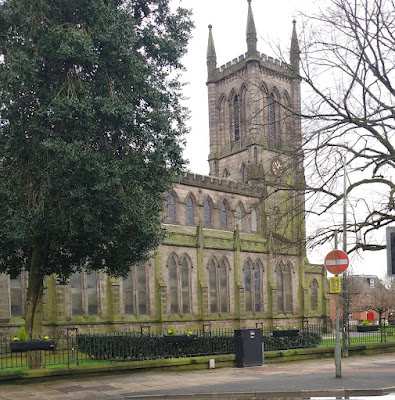
 

St, George's Church, Chorley.
The 1851 census reveals that Rev. Strong had moved to - 35, The Lord Mayors Walk, St. Giles, York.  A letter he wrote to the local paper, “The Yorkshire Gazette” appearing on 11th December 1852 reveals that he was the vicar of St. Olave’s church in the city.  William Henry and Grace had at least 3 children two sons, Charles Thomas  and William Henry (3) and a daughter Frances Mary.  

His daughter was born in York on 15th July 1856 by which time Rev, Strong had returned to Lancashire to the parish of Newchurch Kenyon, Nr. Leigh, Lancashire. In June 1862 he became the fourth rector of St. Paul’s, Withington in what was effectively an exchange of 'livings' with Rev. Robert William Burton M.A. He remained in Withington until 1872, when he resigned and moved to Somerton, Somerset where he was the vicar for more than 25 years. Rev Strong died at “The Lynch”, Somerton on 30th March 1899 finally having retired the previous year. His estate was valued at a modest £50 -10s -7d (= £5,474 today)         which he left to his second wife, a solicitor’s widow, Eleanor Parsons (née Eastment); his first wife, Grace, previously dying on 27th December 1883 at the vicarage in Somerton.

 Rev. Strong was succeeded as Rector of St. Paul’s, Withington by another Irishman, Rev. George William Grogan, a son of John Grogan and his wife Sarah (née Medlicott), who was born in Dublin during 1819.  An older brother, Edward served as the M.P. for Dublin City for more than two decades and was created a baronet in 1859.

George William also attended Trinity College, entering on 4th July 1836. The Alumni Dublinenses also records that his father, John, was a “causidicus” (barrister) and that he obtained his B.A. in spring 1841 and an M.A. in 1849. The following year he was ordained in Norwich Cathedral on Sunday 10th November 1850. An incumbency of nearly a decade at St. Mathew’s, Thorpe Hamlet, Nr. Norwich, Norfolk was followed by a much shorter one in Stoke Newington, London. Then after a brief return to Norfolk, as the vicar of Clenchwarton, Nr. Kings Lynn, Rev. Grogan was appointed vicar of Somerton, Somerset in which parish he remained until December1872 when in yet another link between the incumbents of St. Paul’s Withington he “exchanged livings” with Rev. William Henry Strong.

While he was in Thorpe Hamlet, George William married a fellow clergyman’s daughter, Helen Isabel Maria Graham at St. John’s Church, Bedminster, Bristol on 15th October 1856. The couple had at least nine children, one of whom, Marian Dora, died aged just 15 in March 1878 and is buried in St. Paul’s churchyard, Withington.

Rev. Grogan was the rector of St. Paul’s for nearly twenty years. He resigned in April 1892; retiring from active ministry he moved in retirement to Nr. Cheltenham, Gloucestershire. He died at “The Priory”, Prestbury, Nr. Cheltenham on 14th February 1902.

The final one of St. Paul’s first half-dozen rectors was the very long serving Rev. William Muzzell; incumbent from 12th September 1892 until his retirement in 1938/9.

William Muzzell was born on 7th September 1848 in Kelshall, Hertfordshire. He was the second son of Peter  Muzzell (4) and his first wife Mary (née Allen). Shortly after the 1851 census the family relocated to Yorkshire. William’s mother died while he was still an infant in August 1852; she was buried on 31st August in the parish of The Holy Trinity, Kingston-upon-Hull, Yorkshire (East Riding). Just 9 days after his wife's burial William’s father buried his 2-years-old daughter, Elizabeth. (5)

Soon after this double tragedy the family moved again, this time to the city of York where Peter Muzzell remarried at St. Mary’s Church, Bishophill Junior on 30th July 1855 to Rachel Mercer, a labourer’s daughter working as a maid in a clergyman’s household.

William attended the York Training College Model School (6) from May 1860. After leaving school he initially followed in his father’s footsteps and became a scripture reader; the 1871 census records him as such while lodging with a farm servant John W. Maxey and his wife Betsy at Wistow Gate, Cawood, Selby, Yorkshire (West Riding).

Muzzell family grave in St. Paul’s churchyard, Withington.
Rev. Muzzell later trained for the priesthood at St. Aidan’s Theological College, Birkenhead, The Wirral, Cheshire and was ordained on Sunday 23rd September 1877 in Chester Cathedral by the Bishop of Chester, Rt. Rev. William Jacobson. His first appointment was a curacy in the parish of Ince-in-Makerfield, Lancashire. He moved from there to the St. Philip’s, Bradford Road, Ancoats, Manchester, being appointed as the “curate-in-charge" of a portion of that parish in need of a new church. Initially holding services in a mission hall, Rev. Muzzell was appointed as the first rector of the new church of St. Mark’s, Holland Street, Ancoats. He remained in this post until his arrival in Withington.

 While he was still studying at a St. Aidan’s William married Hannah Johnson by license on 29th October 1873 at Christ Church, Ince, Wigan, Lancashire. William and Hannah had just one child, a daughter, Mary Elizabeth, born on 27thJuly 1874.

Rev. Muzzell died at his home in retirement 111, Wellington Road, Fallowfield, Manchester on 29th August 1940 and is interred in this grave in St. Paul’s Churchyard as is his wife Hannah who pre-deceased him on 27th October 1924. Their daughter, Mary Elizabeth (Lily) died on 22nd June 1947 and joined them in the churchyard.

Pictures; Trinity College, Dublin by John Brady - John Brady local guide works, CC0, 

Muzzell family grave in St. Paul’s churchyard, Withington.
https://commons.wikimedia.org/w/index.php?curid=162739159

Others from the collection of Tony Goulding.

Notes: - 

1) Rev. Strong was the third of four successive rectors of St. Paul’s to do so.

2) On his departure from Letterkenny, Rev. Strong received a gift and a glowing testimonial letter.  

3) William Henry was born on 23rd November 1845 and after an education at Rossall School near Fleetwood, Lancashire and Wadham College, Oxford he mirrored his father and was ordained a priest at Peterborough Cathedral on Sunday 24th September 1871. He served briefly as a curate in Leicestershire parishes Ashby-de la-Zouch cum Blackfordby  (from his time as a deacon) and Bringhurst cum Great Easton. However, during breakfast at the Tuebrook Lunatic Asylum, Liverpool on Tuesday 6th October, 1874, he killed himself by cutting his own throat. A charge of negligence was brought against one of the asylum’s attendants, Mr. James Dent who was subsequently cleared of any criminal behaviour.

4) Peter Muzzell ‘s occupations --- originally in 1851 census described as a “gardener” given he was living in rural Sussex this probably meant he was working in a market garden. His job as a ‘scripture reader’ may have been combined with other work as in the 1881 census he is recorded as Life Assurance Agent.

5) William’s only other full sibling, his elder brother, Jesse James, died during the March quarter of 1862 while one of his half-brothers John Mercer Muzzell also became a church of England vicar in Lancashire. He was for many years in charge of Christ Church, Bolton having previously served curacies at St. Peter’s, Ashton-under- Lyne, and Salford’s Christ Church. While at Ashton he was charged with a sexual assault, the case being dismissed.

6) “Model Schools” were established to provide opportunities for teachers in training to observe “model” classrooms and thereby acquire best practices with the aim of producing a more professional teaching body.