The continuing story of Richard Buxton, working class botanist who record the plants of Chorlton
When the Buxton family arrived in the Ancoats it was just beginning to change from open fields with its own Hall to urban sprawl. The transformation was completed in just a few decades, and the casual visitor who might have once walked through fields in 1770 would have been met with a maze of narrow streets, dark courts, grim workshops and noisy cotton mills twenty years later.
The impetus for this development came with the building of the Rochdale Canal in 1804. It was built on the east side of the area and even before it was finished industrialists had begun erecting cotton mills along its route. In 1815 Ancoats had more cotton mills and the largest number of households than any of the other rating districts in the city. The population, swelled by large numbers of immigrants from Ireland as well as the surrounding area, rose from 11,039 in 1801 to 53,737 by 1861.
It was a crowded and teeming place, which visitors to Manchester either admired or like the Prussian, Johann Georg May thought was a “scene of melancholy.”
A view endorsed by another foreign visitor, who “saw the forest of chimneys pouring forth volumes of steam and smoke, forming an inky canopy which seemed to embrace and involve the whole place ......It is essentially a place of business, where pleasure is unknown as a pursuit, and scarcely rank as secondary considerations. Every person who passes you in the street has the look of thought and the step of haste”
Buxton who lived amongst the grime, smoke and melancholy was far more generous when he wrote “The operative who lives in a large manufacturing town, sees plenty of the handyworks of his fellow-men in the giant steam-engine, the ingenious mule, which rivals the gossamer in spinning threads, the never-tiring power loom, and the countless other contrivances of mechanical skill which have resulted from the fertile brain of man.”
But this paean to industrial Manchester only serves to act as a contrast to the wonders of flowering plants and open fields. The worker might see “the triumphs of science and art but little of the works of nature. This renders him an intelligent, but to a certain extent, an artificial man.”
It is no wonder I suppose that he should hold to the “many delightful walks, by pleasant streams through green woods.” All the more so when faced not only with the dirty industrial waterways, and satanic mills but awful hovels which were home to so many in Ancoats.
Speculators had followed the industrialist in laying out streets and building houses in the area and with no regulations much of the housing was of the worst type. It hadn’t always been so. Working class dwellings erected in the last two decades of the eighteenth century tended to be substantial and used good quality materials. Some of these like those on Lever Street were built in the 1790s and were constructed on three floors with cellars and were at first occupied by artisan families. The uppermost floor would have been used as workshops and some of these surviving on Liverpool Road still have the longer and wider windows designed to admit the maximum amount of daylight.
But under the impact of the growing population, builders responded with cheap poorly constructed buildings which used the cheapest materials. In an effort to maximise the number of houses that could be erected on a given plot speculators began building one up one down houses which were back to back. The outer wall would be one brick thick and internal walls just half a brick. Many would have been built in courts and access from the main road would have been by narrow alleys.
There are some one up one down houses on Bradley Street. The Bradley Street ‘three’ are the last remaining one up one down houses in Manchester. They were redeveloped in the late 90s and nothing is left of the original interior. Similar houses which have been excavated at Greengate in Salford opposite St Mary’s in Manchester reveal the small shoddy nature of this type of house. They had room sizes of less than 3.5 m square with foundations of one brick depth. Each ground floor room had a fireplace but there was no sign of floor covering nor a staircase and it is likely that access to the upper floor was by a wooden ladder.
Picture; One up one down houses, Bradley Street Manchester 1983, Courtsey of Manchester Early Dwellings Group
References
Hartwell Clare, Manchester2001 Penguin page273
May Johann Georg, quoted in Visitors to Manchester complied by L D Bradshw Neil Richardson Manchester 1987 page 25
Cooke Taylor William, Notes of a Tour in the Manufacturing Districts of Lancashire quoted in Visitors to Manchester page 36
Buxton R A page xii
Nevell Michael, Manchester the Hidden History The History Press page 149
Showing posts with label Richard Buxton. Show all posts
Sunday, 5 October 2025
Tuesday, 26 August 2025
" a narrative of the life of a poor man like myself" ................ Richard Buxton
Richard Buxton was born in 1786 and died in 1865. He was one of those remarkable working men who were self taught.*
He became an expert on botany, wrote books and struggled against poverty before dying obscurely. “I am well aware” he wrote “that a narrative of the life of a poor man like myself .... is anything but interesting.” and yet it has proved to be so. **
Buxton was a remarkable man living at a time when Manchester was fast becoming the “shock city of the industrial revolution.”***
During his lifetime the city became the centre of cotton manufacture and a huge sprawling place of overcrowded, mean and shoddy housing.
He witnessed some of the great political events of the nineteenth century as the working class attempted to assert their share of the wealth that their labours had created and yet it appears he remained aloof from it.
He was of a “quiet and retiring disposition” with a “humble opinion of his own great powers.”****
He was born at Sedgley Farm in Prestwich.
In 1788 his father “became much reduced in circumstances and had to leave his farm”, moving the family to Ancoats .
The Buxton’s were not alone. During the late eighteenth century and through the nineteenth century thousands left the countryside for the cities, exchanging open fields for narrow streets.
Buxton did not expand on the reasons for the family move. It may be that they overstretched themselves or were just unlucky. But rural life could be hard and unpredictable. The standard of living was if anything worse than conditions in the fast expanding industrial towns.
They settled in one of those mean narrow streets off Great Ancoats Street, and later he lived on Gun Street.
At week ends he was off "botanizing", and on one memorable day walked from Manchester to Chorlton, and on across the Mersey, recording what he saw, and will no doubt have passed on the old parish church of St Clements on the green before crossing the meadows.
I was introduced to Buxton by David Bishop who is a passionate botanist and has patiently explained nature to me over the years and it was David who lent me the book Buxton wrote in 1849.
For a self taught man, his 'Botanical Guide to the Flowering Plants, Ferns Moses and Algae found Indigenous within Sixteen Miles of Manchester' is both a wonderful record of what there was to see, but also a testament to his interest and tenacity.
In a world where reading and writing are taken for granted, it is easy to gloss over the fact that at the age of sixteen he was illiterate, and had to set himself the task of learning to read.
What is all the more remarkable is that having mastered the spelling book and the narrative of the New Testament he realised he needed to know not only how to pronounce the words but their exact meaning.
And so “by this means I was enabled not only to read, but also to understand the meaning of what I read, and to speak it correctly.”
All the more remarkable given that his working day lasted from six in the morning till eight or nine at night.
The result is a book that has stood the test of time and one that botanists still use as a hand book and sits with those other books of poetry and local history and politics which were written by many who lived on the margins of poverty, and balanced these books against the demands of the day job.
Picture; gravestone of Richard Buxton photograph taken in 1916 by T Badderley, m72545, courtesy of Manchester Libraries, Information and Archives, Manchester City Council, http://images.manchester.gov.uk/index.php?session=pass St Clements Church circa 1860 from the collection of Tony Walker and the meadows as Buxton would not have known it, December 2008. Courtesy of David Bishop, detail from Green's map of Manchester 1794, courtesy of Digital Archives, http://www.digitalarchives.co.uk/
Location, Manchester, Chorlton, Prestwich
*Richard Buxton, https://chorltonhistory.blogspot.com/search?q=richard+Buxton
**Buxton R A, Botanical Guide to the Flowering Plants, Ferns Moses and Algae found Indigenous within Sixteen Miles of Manchester second edition of 1849 page iii
***Briggs Asa Victoria Cities Penguin Books 1963
****‘Death of Mr. Richard Buxton, the botanist’, Manchester Guardian January 5th 1865
![]() |
| Mr. Buxton's grave, Prestwich, 2012 |
Buxton was a remarkable man living at a time when Manchester was fast becoming the “shock city of the industrial revolution.”***
During his lifetime the city became the centre of cotton manufacture and a huge sprawling place of overcrowded, mean and shoddy housing.
![]() |
| Ancoats, 1794 |
He was of a “quiet and retiring disposition” with a “humble opinion of his own great powers.”****
He was born at Sedgley Farm in Prestwich.
In 1788 his father “became much reduced in circumstances and had to leave his farm”, moving the family to Ancoats .
The Buxton’s were not alone. During the late eighteenth century and through the nineteenth century thousands left the countryside for the cities, exchanging open fields for narrow streets.
Buxton did not expand on the reasons for the family move. It may be that they overstretched themselves or were just unlucky. But rural life could be hard and unpredictable. The standard of living was if anything worse than conditions in the fast expanding industrial towns.
They settled in one of those mean narrow streets off Great Ancoats Street, and later he lived on Gun Street.
![]() |
| St Clements's circa 1870-80 |
I was introduced to Buxton by David Bishop who is a passionate botanist and has patiently explained nature to me over the years and it was David who lent me the book Buxton wrote in 1849.
For a self taught man, his 'Botanical Guide to the Flowering Plants, Ferns Moses and Algae found Indigenous within Sixteen Miles of Manchester' is both a wonderful record of what there was to see, but also a testament to his interest and tenacity.
In a world where reading and writing are taken for granted, it is easy to gloss over the fact that at the age of sixteen he was illiterate, and had to set himself the task of learning to read.
![]() |
| Out on the Meadows, 2008 |
And so “by this means I was enabled not only to read, but also to understand the meaning of what I read, and to speak it correctly.”
All the more remarkable given that his working day lasted from six in the morning till eight or nine at night.
The result is a book that has stood the test of time and one that botanists still use as a hand book and sits with those other books of poetry and local history and politics which were written by many who lived on the margins of poverty, and balanced these books against the demands of the day job.
Picture; gravestone of Richard Buxton photograph taken in 1916 by T Badderley, m72545, courtesy of Manchester Libraries, Information and Archives, Manchester City Council, http://images.manchester.gov.uk/index.php?session=pass St Clements Church circa 1860 from the collection of Tony Walker and the meadows as Buxton would not have known it, December 2008. Courtesy of David Bishop, detail from Green's map of Manchester 1794, courtesy of Digital Archives, http://www.digitalarchives.co.uk/
Location, Manchester, Chorlton, Prestwich
**Buxton R A, Botanical Guide to the Flowering Plants, Ferns Moses and Algae found Indigenous within Sixteen Miles of Manchester second edition of 1849 page iii
***Briggs Asa Victoria Cities Penguin Books 1963
****‘Death of Mr. Richard Buxton, the botanist’, Manchester Guardian January 5th 1865
Tuesday, 7 February 2023
Richard Buxton, ............ part four
The continuing story of working class botanist, Richard Buxton
By the middle of the nineteenth century when Buxton was writing his book most of the area had slid into slums through overcrowding and neglect.
And into this warren of dark, dank and dismal streets Richard grew up lived and worked. During most of his life he inhabited just a few streets separated by less than a half a mile.
“About sixty years ago ........I came to live in Bond-street Ancoats; and I now live near the same place, in Gun-street. Being a single man, I have never had a house of my own, but lodged with an elder sister of mine, of the name of Robinson.”
The house in Gun Street brimmed over with people. Not only was there his sister Mary and her husband but along with Richard six other people shared the house.
No records exist of what type of shop Richard Robinson ran so it is impossible to ascertain how well off he was, but a look at the occupations of the others in the house show that they existed at the bottom of the economic ladder. We know that Richard Buxton was a poor man
“who has had the greatest difficulty in procuring the necessaries of life in a worn-out trade, like that of a child’s leather shoe maker, and in delivering a few newspapers on a Saturday” and so were the others in the house. Jobs like charwoman and weaving were low paid occupations.
Overcrowding was quite common at that time and many of the neighbouring houses on Gun Street had similar numbers living in them. Often each family in the house lived in just one room and where there were cellars even these were occupied.
Not far away in John Street could be found the 14 back to back houses of John Street, Back Ashley Lane, Parker Street and Back Irk Street. They were built between 1780 and 1820. Here in 1851 lived 118 people in just these 14 houses. About 40% of the inhabitants had been born in Ireland and this is consistent with other parts of the area. They were one up one downs, with equally awful levels of overcrowding. At number 3 John Street for example, there were 18 people living in the one house. Six lived in the cellar but the remaining twelve lived in the two rooms. There was the Riley family consisting of Martin, Hannah and their son, along with four lodgers, and the Williamson family. While back at Bradley Street In 1851 at number 4 three generations of one family were crammed into this small dwelling place.
The house in Gun Street has long gone and so it very difficult to work out it would have been like. None of the maps of the period are much help. Richard Robinson described himself as a shop keeper and so it is logical to suppose the ground floor might have consisted of a shop and an adjoining room with two more above and two cellars, but this is just speculation at present.
Picture; Gun Street looking from Blossom Street by A Bradman 1901, m11341,Courtesy of Manchester Libraries, Information and Archives, Manchester City Council
References
Buxton R A, Botanical Guide to the Flowering Plants, Ferns Moses and Algae found Indigenous within Sixteen Miles of Manchester second edition of 1849 page iii
1841 census Enu 15 Page 3 Ancoats Manchester, Richard Robinson was also listed as a shopkeeper at 72 Gun Street in Slaters’ Directory of Manchester & Salford for 1841Page 212
Buxton R A, page v
In 1851 Angel Street “was regarded as the spine of the Irish quarter even though only 56.5%were Irish in 1851” Not far away just beyond Angel Meadow was New Town. Here in streets like “School Street and the small courts and alleys off it were over 75% Irish.” Busteed Mervyn, Hindle Paul, Angel Meadow: the Irish and Cholera in Manchester 1998
1851 census
1851 census Enu Page 28 Market Street Manchester Lancashire There were the parents in their late 60s, a son and his family, a grandchild and even a lodger.
By the middle of the nineteenth century when Buxton was writing his book most of the area had slid into slums through overcrowding and neglect.
And into this warren of dark, dank and dismal streets Richard grew up lived and worked. During most of his life he inhabited just a few streets separated by less than a half a mile.
“About sixty years ago ........I came to live in Bond-street Ancoats; and I now live near the same place, in Gun-street. Being a single man, I have never had a house of my own, but lodged with an elder sister of mine, of the name of Robinson.”
The house in Gun Street brimmed over with people. Not only was there his sister Mary and her husband but along with Richard six other people shared the house.
No records exist of what type of shop Richard Robinson ran so it is impossible to ascertain how well off he was, but a look at the occupations of the others in the house show that they existed at the bottom of the economic ladder. We know that Richard Buxton was a poor man
“who has had the greatest difficulty in procuring the necessaries of life in a worn-out trade, like that of a child’s leather shoe maker, and in delivering a few newspapers on a Saturday” and so were the others in the house. Jobs like charwoman and weaving were low paid occupations.
Overcrowding was quite common at that time and many of the neighbouring houses on Gun Street had similar numbers living in them. Often each family in the house lived in just one room and where there were cellars even these were occupied.
Not far away in John Street could be found the 14 back to back houses of John Street, Back Ashley Lane, Parker Street and Back Irk Street. They were built between 1780 and 1820. Here in 1851 lived 118 people in just these 14 houses. About 40% of the inhabitants had been born in Ireland and this is consistent with other parts of the area. They were one up one downs, with equally awful levels of overcrowding. At number 3 John Street for example, there were 18 people living in the one house. Six lived in the cellar but the remaining twelve lived in the two rooms. There was the Riley family consisting of Martin, Hannah and their son, along with four lodgers, and the Williamson family. While back at Bradley Street In 1851 at number 4 three generations of one family were crammed into this small dwelling place.
The house in Gun Street has long gone and so it very difficult to work out it would have been like. None of the maps of the period are much help. Richard Robinson described himself as a shop keeper and so it is logical to suppose the ground floor might have consisted of a shop and an adjoining room with two more above and two cellars, but this is just speculation at present.
Picture; Gun Street looking from Blossom Street by A Bradman 1901, m11341,Courtesy of Manchester Libraries, Information and Archives, Manchester City Council
References
Buxton R A, Botanical Guide to the Flowering Plants, Ferns Moses and Algae found Indigenous within Sixteen Miles of Manchester second edition of 1849 page iii
1841 census Enu 15 Page 3 Ancoats Manchester, Richard Robinson was also listed as a shopkeeper at 72 Gun Street in Slaters’ Directory of Manchester & Salford for 1841Page 212
Buxton R A, page v
In 1851 Angel Street “was regarded as the spine of the Irish quarter even though only 56.5%were Irish in 1851” Not far away just beyond Angel Meadow was New Town. Here in streets like “School Street and the small courts and alleys off it were over 75% Irish.” Busteed Mervyn, Hindle Paul, Angel Meadow: the Irish and Cholera in Manchester 1998
1851 census
1851 census Enu Page 28 Market Street Manchester Lancashire There were the parents in their late 60s, a son and his family, a grandchild and even a lodger.
Sunday, 5 February 2023
Richard Buxton, ............ part two
The continuing story of Richard Buxton
Richard Buxton was born in 1786 and died in 1865. He was one of those remarkable working men who were self taught. He became an expert on botany, wrote books and struggled against poverty before dying obscurely. “I am well aware” he wrote “that a narrative of the life of a poor man like myself .... is anything but interesting.” and yet it has proved to be so.
Buxton was a remarkable man living at a time when Manchester was fast becoming the “shock city of the industrial revolution.” During his lifetime the city became the centre of cotton manufacture and a huge sprawling place of overcrowded, mean and shoddy housing. He witnessed some of the great political events of the nineteenth century as the working class attempted to assert their share of the wealth that their labours had created and yet it appears he remained aloof from it. He was of a “quiet and retiring disposition” with a “humble opinion his own great powers.”
He was born at Sedgley Farm in Prestwich. In 1788 his father “became much reduced in circumstances and had to leave his farm”, moving the family to Ancoats . The Buxton’s were not alone. During the late eighteenth century and through the nineteenth century thousands left the countryside for the cities, exchanging open fields for narrow streets.
Buxton did not expand on the reasons for the family move. It may be that they overstretched themselves or were just unlucky. But rural life could be hard and unpredictable. The standard of living was if anything worse than conditions in the fast expanding industrial towns.
Many farm workers’ homes were little more than hovels with earthen floors, and thin walls. The traditional wattle and daub construction was easy to make and maintain, and if the walls were thick enough gave good insulation, but the porous nature of the material meant that damp was an ever present problem and the crumbling clay needed endless repairs. According to a Parliamentary report “Many of them have not been lined with lath and plaster inside and so are fearfully cold in winter. The walls may not be an inch in thickness and where the lathes are decayed the fingers may be easily pushed through. The roof is of thatch, which if kept in good repair forms a good covering, warm in winter and cool in summer, though doubtless in many instances served as harbour for vermin, for dirt, for the condensed exhalations from the bodies of the occupants of the bedrooms....”
As in Chorlton brick would slowly replace wattle and daub and slate take over from thatch but this would not be until long after Buxton’s family had left Prestwich.
Their food could be monotonous and often scarce. Here in the north things were better, because wages were higher and the locally produced food was more nutritious. There was a greater reliance on an oatmeal diet made more palatable with the addition of milk which was more easily available as were meat and animals fats because of the predominance of pastoral farming. Potatoes too formed a greater part of the diet than in the south. Lastly the farm labourer here in the north benefited from the persistence of the practice of yearly hiring of labour. It was customary with this system to pay the labourer partly in grain or meal irrespective of the fluctuations in market prices. He might also be granted cow pasture, potato ground, or accommodation for pigs and poultry.
And while farm wages in the north were better than the south and east they were lower than some of those in the new industrial trades. In 1824 a survey of agricultural wages in the south and east showed levels of wages as low as 3s a week for a single man and 4s 6d for a married man, and in some parts of Kent they were as low as 6d a day to 1s 6d a day. In the north wages were generally higher because of the need to compete with the opportunities from industrial employment. A brick layer’s labourer in Manchester in 1830 might earn 18s a week and a street labourer 16s. Locally here in Chorlton farm wages a decade and half later were still much lower. Cow men working for James Higginbotham on the Green earned between 4s 6d and 5s. Similar wages were paid to carters and those of farm servants who lived with the farmer ranged from 4s. down to 1s.6d. The lower pay of farm servants reflected the fact that their board and food came as part of their living with the farmer’s family.
William Cobbet in his Rural Rides compiled between 1822-1830 calculated that a family of five needed £62 6s 8d a year merely for bread meat and beer, yet with wage of 9s a week supplemented by an allowance of 7s 6d he could as best afford only half the minimum necessary for basic food. Finally however awful these new towns seemed to be they did as they had since the Middle Ages offered a chance of upward social mobility.
All this paints a very grim picture which the Buxton’s might not have experienced. He was after all born on a farm and farmers would have commanded a better style of life than the farm labourer. But at this stage without more research it is difficult to know the status of the family.
Picture;gravestone of Richard Buxton photograph taken in 1916 by T Badderley, m72545,Courtesy of Manchester Libraries, Information and Archives, Manchester City Council
References
Briggs Asa Victoria Cities Penguin Books 1963
‘Death of Mr Richard Buxton, the botanist’, Manchester Guardian January 5th 1865
Gauldie Enid Country Homes, page 531 The Victorian Countryside Vol 2 Rouledge & Kegan Paul 1981edited by Mingay G. E
British Parliamentary Papers 1893-4 XXXV V,1, page 103 qouted by Gauldie page532
Burnett John, Country Diet , The Victorian Countryside page 556
Burnett John, page 554 & Higginbotham’s Farm Accounts 1816-1849 Simpson A
Richard Buxton was born in 1786 and died in 1865. He was one of those remarkable working men who were self taught. He became an expert on botany, wrote books and struggled against poverty before dying obscurely. “I am well aware” he wrote “that a narrative of the life of a poor man like myself .... is anything but interesting.” and yet it has proved to be so.
Buxton was a remarkable man living at a time when Manchester was fast becoming the “shock city of the industrial revolution.” During his lifetime the city became the centre of cotton manufacture and a huge sprawling place of overcrowded, mean and shoddy housing. He witnessed some of the great political events of the nineteenth century as the working class attempted to assert their share of the wealth that their labours had created and yet it appears he remained aloof from it. He was of a “quiet and retiring disposition” with a “humble opinion his own great powers.”
He was born at Sedgley Farm in Prestwich. In 1788 his father “became much reduced in circumstances and had to leave his farm”, moving the family to Ancoats . The Buxton’s were not alone. During the late eighteenth century and through the nineteenth century thousands left the countryside for the cities, exchanging open fields for narrow streets.
Buxton did not expand on the reasons for the family move. It may be that they overstretched themselves or were just unlucky. But rural life could be hard and unpredictable. The standard of living was if anything worse than conditions in the fast expanding industrial towns.
Many farm workers’ homes were little more than hovels with earthen floors, and thin walls. The traditional wattle and daub construction was easy to make and maintain, and if the walls were thick enough gave good insulation, but the porous nature of the material meant that damp was an ever present problem and the crumbling clay needed endless repairs. According to a Parliamentary report “Many of them have not been lined with lath and plaster inside and so are fearfully cold in winter. The walls may not be an inch in thickness and where the lathes are decayed the fingers may be easily pushed through. The roof is of thatch, which if kept in good repair forms a good covering, warm in winter and cool in summer, though doubtless in many instances served as harbour for vermin, for dirt, for the condensed exhalations from the bodies of the occupants of the bedrooms....”
As in Chorlton brick would slowly replace wattle and daub and slate take over from thatch but this would not be until long after Buxton’s family had left Prestwich.
Their food could be monotonous and often scarce. Here in the north things were better, because wages were higher and the locally produced food was more nutritious. There was a greater reliance on an oatmeal diet made more palatable with the addition of milk which was more easily available as were meat and animals fats because of the predominance of pastoral farming. Potatoes too formed a greater part of the diet than in the south. Lastly the farm labourer here in the north benefited from the persistence of the practice of yearly hiring of labour. It was customary with this system to pay the labourer partly in grain or meal irrespective of the fluctuations in market prices. He might also be granted cow pasture, potato ground, or accommodation for pigs and poultry.
And while farm wages in the north were better than the south and east they were lower than some of those in the new industrial trades. In 1824 a survey of agricultural wages in the south and east showed levels of wages as low as 3s a week for a single man and 4s 6d for a married man, and in some parts of Kent they were as low as 6d a day to 1s 6d a day. In the north wages were generally higher because of the need to compete with the opportunities from industrial employment. A brick layer’s labourer in Manchester in 1830 might earn 18s a week and a street labourer 16s. Locally here in Chorlton farm wages a decade and half later were still much lower. Cow men working for James Higginbotham on the Green earned between 4s 6d and 5s. Similar wages were paid to carters and those of farm servants who lived with the farmer ranged from 4s. down to 1s.6d. The lower pay of farm servants reflected the fact that their board and food came as part of their living with the farmer’s family.
William Cobbet in his Rural Rides compiled between 1822-1830 calculated that a family of five needed £62 6s 8d a year merely for bread meat and beer, yet with wage of 9s a week supplemented by an allowance of 7s 6d he could as best afford only half the minimum necessary for basic food. Finally however awful these new towns seemed to be they did as they had since the Middle Ages offered a chance of upward social mobility.
All this paints a very grim picture which the Buxton’s might not have experienced. He was after all born on a farm and farmers would have commanded a better style of life than the farm labourer. But at this stage without more research it is difficult to know the status of the family.
Picture;gravestone of Richard Buxton photograph taken in 1916 by T Badderley, m72545,Courtesy of Manchester Libraries, Information and Archives, Manchester City Council
References
Briggs Asa Victoria Cities Penguin Books 1963
‘Death of Mr Richard Buxton, the botanist’, Manchester Guardian January 5th 1865
Gauldie Enid Country Homes, page 531 The Victorian Countryside Vol 2 Rouledge & Kegan Paul 1981edited by Mingay G. E
British Parliamentary Papers 1893-4 XXXV V,1, page 103 qouted by Gauldie page532
Burnett John, Country Diet , The Victorian Countryside page 556
Burnett John, page 554 & Higginbotham’s Farm Accounts 1816-1849 Simpson A
Tuesday, 1 February 2022
"over the Mersey at Jackson’s Boat and on to Baguley Moor and Hale Moss and after having botanized there ....returned to Manchester at dusk, all pleased with our day’s excursion” Richard Buxton in Chorlton
Call me lazy but I have chosen to return to the amazing story of Richard Buxton who was born into a poor rural family, grew up and lived in the equally poor area of Ancoats in the early 19th century and died in very humble surroundings in the shadow of London Road Railway Station.
He was self taught and wrote what still stands as one of those remarkable books on botany. The original posts appeared over seven stories and are all still there to see.
"one of the hottest and driest summers that I can remember, and there had been no rain in the neighbourhood for two or three months; but on the day appointed for our meeting, very heavy rain came on about five in the morning.
I should not have thought of stirring out of doors; but, having made the appointment, I thought it just possible that my friends might come, and I would not on any account disappoint them. We all went in the rain, through Manchester to Chorlton-cum-Hardy.
After staying at the last named place sometime the weather changed and a fine day ensued then over the Mersey at Jackson’s Boat and on to Baguley Moor and Hale Moss and after having botanized there ..... returned to Manchester at dusk, all pleased with our day’s excursion”
It is almost impossible to know when Richard Buxton walked the meadows of Chorlton and botanized the day away with his friends.
But I guess it must have been sometime in the 1820s. We were still a very rural community and there would have been plenty to see and record.
And record Buxton did, for he was one of those remarkable working men who were self taught, became an expert on botany, wrote books and struggled against poverty before dying obscurely. “I am well aware” he wrote “that a narrative of the life of a poor man like myself .... is anything but interesting.” and yet it has proved to be so.
Which is why over the next brace of weeks I want to tell his story. He was born in rural Prestwich grew up in Ancoats just as Manchester was becoming the “shock city of the Industrial Revolution” and died as he had lived in poverty.
I was introduced to Buxton by my old pal David Bishop who is a passionate botanist and has patiently explained nature to me over the years.
It was David who lent me the book Buxton wrote in 1849.
For a self taught man his Botanical Guide to the Flowering Plants, Ferns Moses and Algae found Indigenous within Sixteen Miles of Manchester is both a wonderful record of what there was to see but also a testament to his interest and tenacity.
In a world where reading and writing are taken for granted, it is easy to gloss over the fact that at the age of sixteen he was illiterate, and had to set himself the task of learning to read.
What is all the more remarkable is that having mastered the spelling book and the narrative of the New Testament he realised he needed to know not only how to pronounce the words but their exact meaning. And so
“by this means I was enabled not only to read, but also to understand the meaning of what I read, and to speak it correctly.” All the more remarkable given that his working day lasted from six in the morning till eight or nine at night.
The result is a book that has stood the test of time and one that botanists still use as a hand book.
Picture; Junction of Gore Brook and River Mersey J Montgomery 1963 based on an earlier picture, m8014, courtesy of Manchester Libraries, Information and Archives, Manchester City Council, http://images.manchester.gov.uk/index.php?session=pass St Clements Church circa 1860 from the collection of Tony Walker and the meadows as Buxton would not have known it, December 2008. Courtesy of David Bishop
Location; Chorlton-cum-Hardy
*Richard Buxton, http://chorltonhistory.blogspot.co.uk/search/label/Richard%20Buxton
![]() |
| Close to where Mr Buxton crossed the brook, the meadows, 1963 |
"one of the hottest and driest summers that I can remember, and there had been no rain in the neighbourhood for two or three months; but on the day appointed for our meeting, very heavy rain came on about five in the morning.
I should not have thought of stirring out of doors; but, having made the appointment, I thought it just possible that my friends might come, and I would not on any account disappoint them. We all went in the rain, through Manchester to Chorlton-cum-Hardy.
![]() |
| St Clement's, circa 1860 |
It is almost impossible to know when Richard Buxton walked the meadows of Chorlton and botanized the day away with his friends.
But I guess it must have been sometime in the 1820s. We were still a very rural community and there would have been plenty to see and record.
And record Buxton did, for he was one of those remarkable working men who were self taught, became an expert on botany, wrote books and struggled against poverty before dying obscurely. “I am well aware” he wrote “that a narrative of the life of a poor man like myself .... is anything but interesting.” and yet it has proved to be so.
Which is why over the next brace of weeks I want to tell his story. He was born in rural Prestwich grew up in Ancoats just as Manchester was becoming the “shock city of the Industrial Revolution” and died as he had lived in poverty.
![]() |
| The meadows, 2008 |
It was David who lent me the book Buxton wrote in 1849.
For a self taught man his Botanical Guide to the Flowering Plants, Ferns Moses and Algae found Indigenous within Sixteen Miles of Manchester is both a wonderful record of what there was to see but also a testament to his interest and tenacity.
In a world where reading and writing are taken for granted, it is easy to gloss over the fact that at the age of sixteen he was illiterate, and had to set himself the task of learning to read.
What is all the more remarkable is that having mastered the spelling book and the narrative of the New Testament he realised he needed to know not only how to pronounce the words but their exact meaning. And so
“by this means I was enabled not only to read, but also to understand the meaning of what I read, and to speak it correctly.” All the more remarkable given that his working day lasted from six in the morning till eight or nine at night.
The result is a book that has stood the test of time and one that botanists still use as a hand book.
Picture; Junction of Gore Brook and River Mersey J Montgomery 1963 based on an earlier picture, m8014, courtesy of Manchester Libraries, Information and Archives, Manchester City Council, http://images.manchester.gov.uk/index.php?session=pass St Clements Church circa 1860 from the collection of Tony Walker and the meadows as Buxton would not have known it, December 2008. Courtesy of David Bishop
Location; Chorlton-cum-Hardy
*Richard Buxton, http://chorltonhistory.blogspot.co.uk/search/label/Richard%20Buxton
Tuesday, 11 September 2018
"over the Mersey at Jackson’s Boat and on to Baguley Moor and Hale Moss and after having botanized there ....returned to Manchester at dusk, all pleased with our day’s excursion” Richard Buxton in Chorlton
“one of the hottest and driest summers that I can remember, and there had been no rain in the neighbourhood for two or three months; but on the day appointed for our meeting, very heavy rain came on about five in the morning. I should not have thought of stirring out of doors; but, having made the appointment, I thought it just possible that my friends might come, and I would not on any account disappoint them. We all went in the rain, through Manchester to Chorlton-cum-Hardy. After staying at the last named place sometime the weather changed and a fine day ensued then over the Mersey at Jackson’s Boat and on to Baguley Moor and Hale Moss and after having botanized there ..... returned to Manchester at dusk, all pleased with our day’s excursion”
It is almost impossible to know when Richard Buxton walked the meadows of Chorlton and botanized the day away with his friends. But I guess it must have been sometime in the 1820s. We were still a very rural community and there would have been plenty to see and record. And record Buxton did, for he was one of those remarkable working men who were self taught, became an expert on botany, wrote books and struggled against poverty before dying obscurely. “I am well aware” he wrote “that a narrative of the life of a poor man like myself .... is anything but interesting.” and yet it has proved to be so.
Which is why over the next brace of weeks I want to tell his story. He was born in rural Prestwich grew up in Ancoats just as Manchester was becoming the “shock city of the Industrial Revolution” and died as he had lived in poverty.
I was introduced to Buxton by my old pal David Bishop who is a passionate botanist and has patiently explained nature to me over the years. It was David who lent me the book Buxton wrote in 1849. For a self taught man his Botanical Guide to the Flowering Plants, Ferns Moses and Algae found Indigenous within Sixteen Miles of Manchester is both a wonderful record of what there was to see but also a testament to his interest and tenacity.
In a world where reading and writing are taken for granted, it is easy to gloss over the fact that at the age of sixteen he was illiterate, and had to set himself the task of learning to read. What is all the more remarkable is that having mastered the spelling book and the narrative of the New Testament he realized he needed to know not only how to pronounce the words but their exact meaning. And so “By this means I was enabled not only to read, but also to understand the meaning of what I read, and to speak it correctly.” All the more remarkable given that his working day lasted from six in the morning till eight or nine at night.
The result is a book that has stood the test of time and one that botanists still use as a hand book.
Picture; Junction of Gore Brook and River Mersey J Montgomery 1963 based on an earlier picture, m8014, Courtesy of Manchester Libraries, Information and Archives, Manchester City Council
Saturday, 28 July 2012
Richard Buxton, "all pleased with our day’s excursion” part eight
This will be the last post on Richard Buxton, who I have been writing about since January, http://chorltonhistory.blogspot.co.uk/search/label/Richard%20Buxton
His was a great achievement. From a humble background dogged by poverty and self taught he spent a life time identifying and collecting the “flowering plants, ferns, mosses and algae around Manchester” and publishing them in a book with contemporary poems. It was as he said intended “for working men, the cultivators of the soil, and young people of both sexes.” And in this he seems to have succeeded. Botanists still read his book and use it to identify plants which he first saw. In a spot where Chorlton (Gore) Brook runs into the Mersey David Bishop has seen the same plants first observed by Buxton one hundred and sixty years ago.
He was to set off with other botanists at seven in the morning from Hunts Bank. It had been he remembered “one of the hottest and driest summers that I can remember, and there had been no rain in the neighbourhood for two or three months; but on the day appointed for our meeting, very heavy rain came on about five in the morning.” With great honesty he continued, “I should not have thought of stirring out of doors; but, having made the appointment, I thought it just possible that my friends might come, and I would not on any account disappoint them. We all went in the rain, through Manchester to Chorlton-cum-Hardy. After staying at the last named place some time the weather changed and a fine day ensued ” encouraging them to push over the Mersey at Jackson’s Boat and on to Baguley Moor and Hale Moss “and after having botanized there ..... returned to Manchester at dusk, all pleased with our day’s excursion”
To the north of the city lies Kersal Moor. Buxton often visited the moor, a place which was rich in mosses, heathers, grasses and ferns as well oak rown and cherry trees. Here in June 1826 he “happened to see a person engaged in the same pursuits as myself ........... This was no other person than John Horsefield, hand-loom weaver of Whitefield the President of the Prestwich Society; and now president of the General Botanical Meeetings”. Three years later an amateur insect collector named Robert Cribb, collected a series of about fifty small yellow and brown moths which turned out to be a previously unknown species of moth. It was also the scene of the largest Chartist demonstration in the north. On September 24th 1838 anything between 30,000 and 300,000 met to listen to speakers from all over the country. Buxton does not record whether he was on the moor, nor what he felt about the Government stationing troops there ten years later in the face of further Chartist demonstrations. As ever his autobiography records only his interest in the plants of the Moor and the work of Horsefield.
And it was from the Moor that he must have gazed back at the city and contrasted the peace and tranquilly of the place with noise, dirt and bustle of Manchester. Just thirty-one years later, the artist William Wyld captured the scene in his painting A View of Manchester from Kersal Moor.
In a literate world where reading and writing are taken for granted, it is easy to gloss over the fact that at the age of sixteen he was illiterate, and had to set himself the task of learning to read. What is all the more remarkable is that having mastered the spelling book and the narrative of the New Testament he realized he needed to know not only how to pronounce the words but their exact meaning. And so “By this means I was enabled not only to read, but also to understand the meaning of what I read, and to speak it correctly.”
All the more remarkable given that his working day lasted from six in the morning till eight or nine at night.
He does represent that strand of the urban working class who battled against poverty and an unfair system to improve himself not by money but by learning. His goal was to better understand the world he lived in and share that understanding with others. In that sense he was very remarkable. In a few more generations compulsory state education would make his achievements of self learning a thing of the past.
And likewise the very method by which he made a living would soon also be consigned to the past. Having been apprenticed to a craft trade in a city increasingly dominated by machines and new ways of doing things his trade would soon be eclipsed. Shoes with leather tops would be replaced by cloth and later machines would replace the skilled worker altogether.
I suppose the other great achievement was Buxton’s acceptance by other naturalists and his invitation to join the Manchester Mechanics' Institution natural history class, where, he largely compiled the Flora Mancuniensis (1840).
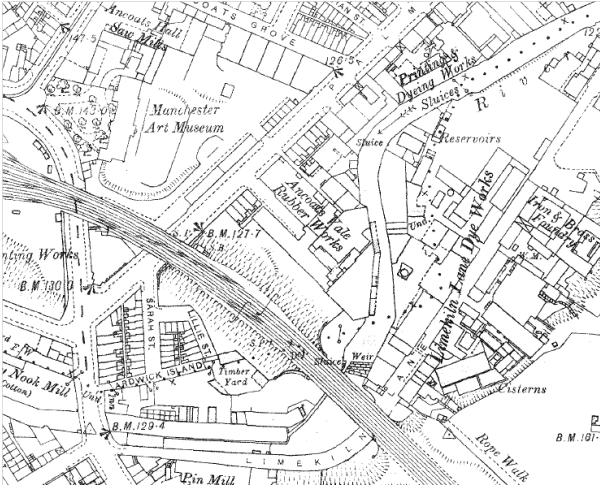
In 1861 Richard and his sister Mary had moved just about a mile away to Martin Street which was off St Andrews Street behind Piccadilly Railway Station. Mary was by then aged 81 and a widow and he was 76.He died in January 1865 in Limekiln Lane, which seems a grim place. The 1884 OS map shows the lane bounded by the river and reservoir and surrounded by an iron forge, lime kiln, printworks, a dye works and a rubber works. Only a few houses existed in 1884 and today the area is empty. A dismal place for what by then must have been a lonely end.
But there is something powerfully uplifting about his life. He may have lived his life in what Engels described as a place which was “coal black and stinking” and have toiled for very little but he could write about “the cool shade of the woods, the bust insect world all alive and found an abundance of wild flowers.”
Pictures; our parish church circa 1860 from the collection of Tony Walker, Kersal Moor, By William Wyld 1859, Lime Kiln Lane, detail from 1880 OS for South Lancashire, courtsey of Digital Archives, http://www.digitalarchives.co.uk/
Saturday, 21 July 2012
Richard Buxton part seven .......Peterloo
Earlier in the month I wrote about Richard Buxton the working class botanist and his “quiet” life set against the backdrop of Revolution, war and trace depressions. http://chorltonhistory.blogspot.co.uk/search/label/Richard%20Buxton
In the early decades of the 19th century Revolution it was thought was in the air, and the Government responded with the Gag Acts, the suspension of Habeas Corpus and the rounding up and imprisonment of political suspects.
Mindful of any potential protest the authorities acted equally promptly. When thousands of Manchester men set out on March 10th 1817 to petition the King, the army stooped them near Stockport. One hundred and sixty-seven were arrested, several received sabre wounds and one was shot dead.The unrest stretched on into the 1830s and 40s, and Buxton would have been well aware of the Chartist demands of manhood suffrage. In 1839 the local papers were full of a group of Chartists arrested for allegedly drilling with weapons, thousands had demonstrated at Kersal Moor for the vote and across the north the military sat and waited for what the propertied classes feared would be social unrest at best and revolution at worst.
But the one event that stands out and which defined the politics of his early middle years was the massacre at Peterloo. In August 1819 a peaceful demonstration at St Peters’ Field calling for the vote was broken up by the military. Units of cavalry charged the crowd and soldiers of the 89th Infantry fired into them. Thousands were wounded and eleven were killed.
Eye witness accounts still have the power to shock
”As the cavalry approached the mass of people used their utmost efforts to escape, so closely were they pressed in opposite directions by the soldiers, the special constables, the position of the hustings, and their own numbers that immediate escape was impossible..... The people were in a state of utter riot and confusion, leaving the ground strewn with hats and shoes.... During the whole of the confusion, heightened by the rattle of some artillery crossing the square, shrieks were heard in all directions..... Some were seen bleeding on the ground and unable to rise; others less severely injured but faint with loss of blood were retiring slowly.”
“The hustings remained with a few broken and hewed flag staves erect, and a torn or gashed banner or two drooping whilst over the field were strewed caps, bonnets, hats, shawls and shoes, and other male and female dress trampled torn, and bloody ...”
Buxton would have been aware of the demonstration and may even have seen the Oldham contingent of 6000 strong heading into Ancoats from the north and the 2000 from Ashton streaming in from the east of the city. More importantly he would have known neighbours from the close warren of streets bounding Gun Street who went to hear Orator Hunt. Many of those who made their way to St Peters Field went as family units, community groups or just f friends and work mates. And many who returned as casualties came from those same streets. Eighty alone who gave their address lived in Ancoats, and the streets they inhabited were minutes walk from Buxton’s home. Five came from Buxton’s street. James Weir or Ware from number 11 had been bruised and trampled another had gone with his wife and child and was badly hurt.
Nor was this the end of the horror. For the remainder of the day the military and the local police patrolled the streets like some occupying force, and in the early evening with tensions still high a large crowd gathered at New Cross. This was a popular meeting place for people from both Ancoats and Collyhurst and was just minutes from Gun Street. Some of the crowd began throwing stones at the police and soldiers opened fire.
Before the crowd had dispersed, Joseph Ashworthy had been killed and several others lay injured. Not surprisingly many of those injured in this event also came from that close network of streets close to Buxton’s home. He may even have shared the anticipation that “In that paralysis of terror anything might happen”
Nothing did but the memory of what happened on that August day survived well into the last quarter of the nineteenth century. In the 1870s one weaver looking at a newspaper picture of Henry Hunt on the workshop wall could still express anger at an event which happened sixty years before. And others were prepared to pose of a photograph sixty-five years after the event.None of these or the other great events which he lived through are referred to in his autobiography and the nearest he came to a social comment was his regret that ordinary people were unable to fully walk the fields, “To the poor, as a class, it is to be feared that the possession of land in this country is not generally attainable ....[but] I hope the lords of the soil will yet allow the pent up dwellers in the crowded city to walk and view the beauties of creation” But this was a request and not a demand and is limited to the use of old footpaths.
But Buxton was operating in a world where he was dependant on charitable donations and his work as a botanical collector. The 1840s were increasingly difficult financially and made worse by the failure of the second edition of his book to make much money.
Picture; Peterloo, 1819 by Richard Carlile, m01563, Peterloo, 1819, m07589, and Veterans of Peterloo from a photograph taken in 1884, m07594, Courtesy of Manchester Libraries, Information and Archives, Manchester City Council
Sunday, 15 July 2012
Richard Buxton part 6 when revolution was in the very air
I am back with my old friend Richard Buxton, the working class self taught botanist who compiled one of the most important books on the botany and fauna of south Manchester.
He is some someone I have written about already http://chorltonhistory.blogspot.co.uk/search/label/Richard%20Buxton and I promised to come back to him.
He lived and worked for most of his life in the mean little streets off Great Ancoats Street in the heart of this fast growing part of Manchester. And today I want to explore his life set against the events of the time.
His was one of those “little lives lived out in a big century" and it encompassed the French Revolution and the long wars with France, unrest at home including trade union activity, demands for the vote and the great Chartists Petitions along with machine breaking, and food riots.Very little in his autobiography gives a clue to whether he held political views or made comment on the great events of the day. As a young man he might have known those who rejoiced at the news of the Revolution in France, and listened to calls for better pay, union solidarity and a halt to the factory machines. He would have rejoiced himself at the news of the victory at Waterloo, and shared the despair as the trade cycles plunged many into unemployment and poverty.
Food riots were not infrequent and he may well have observed the riot that broke out in April 1812 in Oldham Road, New Cross when a food cart carrying food for sale at the markets in Shudehill was stopped and its load carried off. Nearby shops were also attacked and looted. The mob was eventually dispersed by soldiers but only as far as Middleton.
There they met with an assembly of handloom weavers, miners and out of work factory operatives gathered to protest against the introduction of power loom machinery at Barton and Sons weaving mill. The mob which had grown to 2000, was dispersed by “ A party of soldiers , horse and foot, from Manchester arriving, pursued those misguided people, some of whom made a feeble stand; but here again death was the consequence, five of them being shot and many severely wounded.”
Revolution it was thought was in the air, and the Government responded with the Gag Acts, the suspension of Habeas Corpus and the rounding up and imprisonment of political suspects. Here in Manchester radicals were arrested and some like John Night were thrown into the New Bailey prison before being sent on to London, others like William Ogden were just “roughed up”.
Picture; Peterloo, 1819, m07589 Courtesy of Manchester Libraries, Information and Archives, Manchester City Council
Wednesday, 29 February 2012
Friends of Chorlton Meadows
It is a long time since I last referred to my old friend David Bishop’s excellent blog about Chorlton Meadows. http://friendsofchorltonmeadows.blogspot.com/ David introduced me to Richard Buxton the working class botanist. I have been featuring his life in a series of instalments and would recommend his stories on Buxton and the other working class botanists at http://friendsofchorltonmeadows.blogspot.com/2012/02/historical-background-to-study-of.html
Picture; Snow storm on the meadows from the collection of David Bishop
Subscribe to:
Posts (Atom)