Showing posts with label Barlow Moor Road. Show all posts

Monday, 26 October 2026

Relics …….

In this age of the wireless, the internet, and streaming from multiple platforms, it’s worth remembering that once upon a time we relied on just two terrestrial television channels delivering a limited choice of programmes.

Rooftops in the olden days, Reeves Road, 1979

And the visible testimony of all that was the forest of rooftop TV aerials that clung to the side of chimneys.

Barlow Moor Road, Chorlton 2022
Now there are still plenty still pointing skywards but many will now be relics, replaced first by cable and now satellite dishes.

We have had both and can count three dishes over the last two decades, the last of which delivered multiple channels with live music, drama, news broadcasts and current affairs documentaries from Italy.

All of which meant that our three aerials have not been pressed into service for years.  Each was added to as the others failed and two years ago the last gave up the ghost.

They remain on the roof and are as much a relic of the recent past as the telephone box many of which still adorn street corners but long ago lost their duty to communicate with the world.

Location; Chorlton

Pictures; Rooftops in the olden days, Reeves Road, 1979, and Relics, Barlow Moor Road, Chorlton 2022


Saturday, 24 October 2026

The Chorlton cinema story that went elsewhere ……

This was our first purpose-built cinema which was opened in 1914, in what had once been part of the large garden owned by the Holt family.

The Palais De Luxe cinema, circa 1928
The image was taken by the local photographer Charles Ireland in 1928 for the Lion Foundry Company.

Mr Ireland had studios in Manchester, lived briefly on High Lane in what is now the Buddhist Centre before removing to a large mansion on the corner of Edge Lane and Kingshill Road.

And the cinema, along with Mr. Ireland and the Holt’s often feature on the blog and yesterday I followed Charles Ireland and snapped a series of pictures of the former cinema being demolished and posted onto social media with the caption “Goodbye, cinema, repair shop and supermarket ... you served us well”.

It followed on from an earlier blog story, Goodbye Hanbury’s …. the Palais de Luxe .... and .... 408 Barlow Moor Road .... heaps of Chorlton change.*

Shopping at Hanburys, circa 1988

I expected memories of the Palaise de Luxe, Radio Rentals and the supermarket Hanbury’s which occupied the Picture House after the cinema went dark.  

I reasoned there might even have been the odd memory from those who remembered it when it was a Tesco.

What tumbled from the comments was a series of observations about the proposed new development.  Some were speculation about what might be built with others perhaps having done their homework becoming quite irate about more apartments in Chorlton.**

Now as someone who washed up here in 1976, I have no problem with “newcomers”, after all, historically Chorlton has always been a go to place since the early 19th century through to the great building boom of the 1880s into the 1900s, and again in the 1970s onwards.

Goodbye, cinema, repair shop and supermarket, 2023
Like many I question the quality and density of the new build and to my mind how pedestrian and ugly they look.  

Added to which despite the environmental issues most do not offer sufficient car park spaces which inevitably will mean a squeeze on street parking.

One development I recall argued in its planning application that because this was Chorlton the new residents would relinquish the car for the bike and public transport.  

All of which reads well and ticks the box of environmental concerns but is not always realistic.

So there you are, stories don’t always go as planned, and a fresh debate on housing provision has burst forth

Location Barlow Moor Road

Pictures; the Palais De Luxe cinema, circa 1928, Charles Ireland, GD10-07-04-6-13-01 courtesy of East Dunbartonshire Archives, Hanburys shopping bag, courtesy of Catherine Brownhill, “Goodbye, cinema, repair shop and supermarket ... you served us well”, 2023, from the collection of Andrew Simpson

*Goodbye Hanbury’s …. the Palais de Luxe .... and .... 408 Barlow Moor Road .... heaps of Chorlton change, https://chorltonhistory.blogspot.com/2023/08/goodbye-hanburys-palais-de-luxe-and-408.html

**097667/FO/2011/S1, Erection of a part 3/part four storey building to form a commercial use on the ground floor and 13 self-contained flats above, with associated car parking (5 spaces) and cycle storage, following demolition of existing property, Manchester City Council Planning Portal,  https://pa.manchester.gov.uk/online-applications/applicationDetails.do?keyVal=LTKO3CBC06N00&activeTab=summary

Friday, 23 October 2026

A lost house, an old bridge ..... and a scene that has passed out of living memory, Barlow Moor Road in the summer of 1909


Barlow Moor Road Bridge, 1909
We are looking at a stretch of Barlow Moor Road that has now passed out of living memory.  The picture was taken in 1909 and captures a time when we were still a little rural.

Away to our right across the Brook and over the fields is  half hidden by the trees is Lime Bank Cottage.

Sadly the building to our left has not survived which is a shame because it is one of those that would have unlocked a bit of our history.

It was built sometime between the late 1780s and 1818 and was a fine nine  roomed house set in a large garden and orchard with views across the fields. 

Brook Bank House
In the 1840s it commanded a rateable value of £58 which put it amongst one of the most expensive properties in the township.  And throughout its history the occupants appear to have been well heeled.

In 1841 Elizabeth Whitelegg described herself as of “independent” means, while her son was a cotton dealer.  

A decade later the Heywwod brothers and sisters were also able to rely on an inherited income, and at the time of our picture, William Henry Foxwell owned his own engineering export business.

This makes Brook Bank important in the story of Chorlton.  There were only handful of these comfortable properties in the township and today only two have survived of which one lies empty with half its roof missing.

And given that all the homes of working people from the first half of the 19th century have also vanished this just leaves a few of the farm houses of which only two come close to resembling the originals.

Across the fields with Hough End Hall in the distance
Which leaves us just this tantalizing glimpse through the trees of Brook Bank on a summer’s day in 1909.
But that is not quite the end of the story.

We are on Barlow Moor Road just before the bridge was rebuilt and for all its idyllic appearance the road and the surrounding land was about to be transformed.

Already the developers and builders had been busy. Just behind our house and only partly hidden by a green house and out houses were the semi detached properties of Claude and Reynard Road, while to the north a line of tall houses stretched up to Beech Road and beyond the Brook plans were a foot to construct Chorltonville.

Picture; Barlow Moor Road Bridge, J Jackson, 1909, m17447, courtesy of Manchester Libraries, Information and Archives, Manchester City Council

Thursday, 22 October 2026

Catching the 81X from Barlow Moor Road in the summer of 1961

At the bus terminus, July 1961
We are at the bus station on Barlow Moor Road in the summer of 1961, and in front of us is the 81X which ran from Southern Cemetery to Hightown via Albert Square.

Now I can be fairly certain of that because beside me I have the Corporation Maps of Manchester and District for 1963.

With the 81X
Of course there is just the outside possibility that the route of the 81 had changed during the time the picture was taken and the map with its bus routes was published.

And I have no doubt that someone will point out that the 81X had a slightly different route to the 81 but until then I shall continue to assume that our bus followed the 1963 route travelling along Barlow Moor Road, Manchester Road and Upper Chorlton Road into town.

At which point I might just be accused of being a little obsessed by a Manchester bus in the 1960s.

But not so for the picture and the bus map offer up a rich source of history.

It starts with the bus livery which is the red of Manchester Corporation and is a reminder that back then both the cities of Manchester and Salford and the surrounding local authorities ran their own public transport services.

Bus routes through Chorlton in 1963
So on reaching town our passengers could be confronted with the blue and cream buses of Ashton-under-Lyne, the green of Salford, and the green of the Stalybridge, Hyde, Mossley and Dukinfield Joint Transport and Electricity Board along with the maroon and cream colours of Oldham.

What is more these different Corporation buses ran along the same roads and for some way at least shared similar routes.

And like that bus timetable there is much history in the picture.

A lost scene
Those telephone kiosks may have lingered on into the end of the century but most have now gone as have the old style bus sign with its Manchester logo.

That said the small police station has yet to be built and there is a clear view across to the houses on Beech Road which in turn points to the absence of those first two houses on the even side of Beech Road.

So not perhaps a story that encompasses the great dramatic sweep of history but one that lots of people will relate to, and that is good enough for me.

And within a few hours of posting the story, Steven commented

" Lovely! The X usually suggests a shorter route than normal.

 In 1960 the 81 only ran to Albert Square so the extension beyond must have been quite recent. I suspect the bus terminating at Hightown is the reason for the X as the whole route went to Crumpsall Green."

And a late correction to the story Annette Roberts has written in that "the police station was there when I lived in Claude Road from the 1950s. 

My dad was a police constable based for a while at the station and the first few houses on Beech Road behind the station were police houses. 

I used to play with the children who lived there. The station had an air raid siren on the roof which they used to test once in a while. 

Think the picture is N awkward angle as the station would definitely be there in 1961 as I used to go there."

So another piece of collective history.  I just love it.

Location; Chorlton-cum-Hardy, Manchester

Pictures; Chorlton-cum-Hardy bus terminus, 1961 from the collection of Sally Dervan  and Maps of Manchester and District, Manchester Corporation, 1963, courtesy of David O’Reilly 


*Manchester Buses, http://chorltonhistory.blogspot.co.uk/search/label/Manchester%20Buses


Wednesday, 21 October 2026

So …. where in Chorlton-cum-Hardy was Victor Stapleton Ashby in 1921? ……..

Now as questions go this is not as daft as it reads, nor is it a candidate for The Twilight Zone.*

Barlow Moor Road, circa 1920s
Victor Stapleton Ashby made motor cars and briefly from 1921 till later in the decade he made them on Barlow Moor Road in Chorlton.

Just where is still unclear but made them he did, and such was my surprise that we were the automobile centre of south Manchester that a few days ago I wrote about Mr. Ashby, his father and the Ashby motor cars.**

To be accurate they were “a two-seater light car powered by a 970 cc 8 hp engine, three-speed gearbox or four-ratio friction drive, continued until 1924”.***

The family were based in Towcester in Northamptonshire and look to have made the transition from traditional coach building in to cycle and motor engineers by the beginning of the last century.

In 1901 they patented an experimental motor car, applied for an international patent, and went into a partnership with Short Brothers the aircraft manufacturers in 1919, employed six Ashby staff members, and the car was known as the Short-Ashby in 1921.

But owing to poor sales Short Brothers withdrew their support in 1922 and the Ashby’s then moved to Chorlton-cum-Hardy.

Barlow Moor Road, date unknown
And here comes the mystery because Victor’s father and mother remain in Towcester, but he does not show up on the 1921 census, so it is reasonable to suppose he moved with the business.

That said I can find no reference to him or his wife and daughter.  They married in 1915, and by the following year he was serving in the London Motor Boat Section as a “motor engineer” until he was demobbed in 1919.

Twenty years later they are living back in Towcester but so far for those missing few years in the early 1920s there is nothing.

All of which means it will be one of those old fashioned searches involving the street directories and electoral rolls for the period which are on microfilm in the Central Ref in town and the slow laborious hunt for a name and an address.

Looking for Victor
In the meantime someone might have an idea where they lived in Chorlton.

We shall see.

Location; somewhere in Chorlton

Pictures; Barlow Moor Road circa 1920s from the collection of Allan Brown and Barlow Moor Road, date unknown, from the Lloyd Collection

* The Twilight Zone (marketed as Twilight Zone for its final two seasons) is an American science fiction horror anthology television series created and presented by Rod Serling, which ran for five seasons on CBS from October 2, 1959, to June 19, 1964. https://en.wikipedia.org/wiki/The_Twilight_Zone_(1959_TV_series)

**When Chorlton made cars ………..https://chorltonhistory.blogspot.com/2023/01/when-chorlton-made-cars.html

*** ***Graces Guide to British Industrial History, https://www.gracesguide.co.uk/Victor_Ashby_and_Son


Saturday, 17 October 2026

When Chorlton made cars ………..

It is a story I have twice come back to having had a stab at finding out where and when a firm set up here in Chorlton making cars.

Shaw's Motor Garage, date unknown
First time round I tried following up a request about Ashby Cars, but only got as far as learning that they relocated from Towcester sometime after 1921 and ceased production later in the decade.

Then after a conversation with Ian Henderson who thought they might have been based on Edge Lane my interest was reignited.

And as before I turned to Graces’ Guide to British Industrial History who offered up “Pioneer Motor Works, of Towcester and Barlow Moor Road, Chorlton-cum-Hardy.”  The business was run by Victor James Ashby and his son Victor Stapleton Ashby.

The history of the firm is a bit sketchy, and there is a gap between them producing an experimental car in 1901 and 1919 when they commenced production of about 50 "Ashby Cars" before going into partnership with the aeroplane makers Short Brothers.

According to the Grace database, “After returning from the First World War Victor Stapleton Ashby designed a cyclecar that came to the attention of aeroplane makers Short Brothers. 

Short Brothers employed six Ashby staff members, with the car being known as the Short-Ashby in 1921. 

Short Brothers withdrew their support in 1922 owing to poor sales. The Ashbys then moved to Chorlton-cum-Hardy, where production of a two-seater light car powered by a 970 cc 8 hp engine, three-speed gearbox or four-ratio friction drive, continued until 1924.

After which they introduced a 2 hp / 550 rpm engine in1925”.*

Site of Shaw's Motor Garage, circa 1990s
And that pretty much is that.  Grace mentions a garage workshop in Towcester but I very much doubt I will be able to find it, although I did trawl Brackley Road where they were still living in the May of 1921 but drew a blank.

As for the location on Barlow Moor Road that is still to be found, but my money might be on that stretch of the road from the old cinema/Co-op to High Lane which in the early 20th century was home to Charles Shaw’s garage which was still trading in the mid-1950s at 483 Barlow Moor Road.

It is just possible he rented space out.

Alternatively there was a an industrial unit on what is now the Marks and Spencer's store which might have briefly been our motor car factory.

My Facebook pal Tony has access to the directories for the 1920s and I have asked him to go looking, while I will search the local newspapers.

So, we may be in luck.

We shall see.

Ian has found an image of Short Ashby car and it wil appear once I can check out the copyright.

Location; Towcester and Chorlton

Pictures; Charles Shaw’s Garage, 483 Barlow Moor Road, date unknown and again circa 1990s  

*Grace's Guide to British Industrial History, https://www.gracesguide.co.uk/Victor_Ashby_and_Son


Friday, 16 October 2026

Mrs Keal and the mystery of 419 Barlow Moor Road

Leon's, 2015
It has taken sometime but I am closer to solving the mystery behind the date on the wall of  419 Barlow Moor Road.

Most people will know the place as Leon’s the fabric shop but I have long wondered why the building carries the date 1885 when it was built around 1915.

The Leon family began trading there in the 1990s and before that it had been the Addressal  Print Works which is listed in the directories by 1921 and for an even shorter time between 1915-17 it was the Chorlton Laundry owned by Mrs Keal.

Not that this helps with the date of 1885 which appears above the door along with the word Established.

Addressall Printing Works, 1959
Now it is just possible that the date refers to either establishment of the laundry or the printing company but there is no reference to Addressal in any of the directories in the late 19th century and any way the stone lettering looks like it was done when the building went up.

So I rather think we must be with Mrs Keal who was running a laundry business on Beech Road in 1894.

That said there is no evidence that she was trading before that date and in 1881 Mr and Mrs Keal were living in Croydon.

But by 1889 they had settled in Chorlton and were running a business from nu 30 Wilbraham Road.
Mr Keal described himself variously as a brick layer or builder and I suppose it is just possible that the date 1885 refers to the start up of his business.

Either way in1915 Mrs Keal was in that building on Barlow Moor Road operating the Chorlton Laundry.

Now I can’t be exactly sure when she moved in but in the April of that year Mr Keal of “Brookbank Bridge Barlow Moor-road died at Chorlton Laundry Brookbank Bridge.”

London Gazette, February 1917
And just over a year later the business went bankrupt.*

According to Mrs Keal at the bankruptcy hearing in the February of 1917 “the main cause of her coming into court was the shortness of loose working capital when she removed to her new premises in Barlow Moor Road after having carried on a similar business on less extensive lines for many years in Beech Road, Chorlton.

Mrs Keal further stated that after she had expended over £900 on new machinery so that she might undertake the laundry work of the military hospitals in Manchester a large proportion of the work was undertaken from her.”

But the “military authorities had established laundries under their own control.  Difficulties in the way of getting sufficient labour had it impossible for her to get the work done as promptly as the hospitals required [and] she could not overcome these difficulties by paying higher wages.”


She went on to say that “she had taken steps to strengthen the weak point in her business affairs which had been pointed out by her accountant.”

But it seems that was it and she finished up the business and moved to St Annes-on-Sea where she died in 1935 leaving £2625.

It is just possible that the date refers not to Mrs Keal's Laundry but to the building business of her husband which may well date from 1885.

And it t maybe the Leon family can help who could have the deeds to the building which will offer up its history.

Peter painted the picture of the building and while there he spotted the story of the Leon family which is displayed inside the shop.

It is a fascinating account of one family business stretching back across the last century and so by the time I get round to writing their story they may well be able to offer up a missing document.

Well we shall see.

Additional research from Tony Goulding

Picture; Addressall Printing Works (originally built for laundry), House adjoining used as office for printers, RE Stanley, m17530 courtesy of Manchester Libraries, Information and Archives, Manchester City Council, http://images.manchester.gov.uk/index.php?session=pass

Painting; Leon's Barlow Moor Road, © 2015 Peter Topping,
Web: www.paintingsfrompictures.co.uk
Facebook: Paintings from Pictures https://www.facebook.com/paintingsfrompictures

*First Meetings and Public Examinations, The London Gazette, February 16, 1917

**Laundry Proprieters Ill-luck. Failed with a surplus of over £3000, Manchester Evening News March 6 1917

Sunday, 11 October 2026

Looking down on Chorlton in 1927

I like aerial photographs of Chorlton and this one has the lot.

Looking down on my bit of Chorlton, circa 1930s-40s
My friend Bill sent it over  and it comes from Britain from Above.

And what makes it particularly special is that there,  to the left is Beech Road, the Rec and our house.

It was taken in 1927, and the picture offers up some interesting detail.

There is a  tram cruising down Barlow Moor Road, and there is still some open at the top of Beech Road by the tram terminus.  That land I think was built on sometime in the 1950s or 60s.

Beech Road, a lost farm, the Rec and a bowling green

And looking carefully at Beaumont Road, it is just possible to see the old farmhouse set back from Beech Road, which Scott the builder didn’t demolish until sometime in the 1930s.

Its replacement I am fairly confident was not built until after the war in 1945.

Which just leaves the eagled eyed to spot that to the north of Rec, there is still the bowling ground belonging to the Masons.

This would not become a carpark until the early 1960s.

And the photograph clearly shows the farmyard of what had once been Bailey’s Farm, and would not become Ivy Court until the late 1970s.

On Barlow Moor Road

I could go, but that would spoil the fun, so I shall close by pointing to the buildings on Barlow Moor Road, just south of Beech Road.

The Chorlton Ballroom is still looking splendid, and it would be many decades before it became a series of nightclubs, before being knocked down for a fast food outlet.

And beyond the ballroom, there is Lime Bank, which dates from the late 18th century.

So I shall just thank Bill Sumner who found and sent the image over to me.

Location; Chorlton

Picture; aerial photograph of Chorlton, 1927, Britain from Above, EPW 017620

Monday, 21 September 2026

One more bit of the jigsaw ….. the mysterious secret of the hidden Chorlton fourteen

Some stories just keep giving and the hidden fourteen photographs found in a house in Chorlton just  keeps giving. *

I was first alerted to them by Peter Armistead who has been developing   515-521 Barlow Moor Road and converting the old properties into a range of one to three modern apartments. **

They are mix of images all of which I guess date from the middle decades of the last century and were in a discarded box at 515-521 Barlow Moor Road.

They are a mix, ranging from images of smart cars, and equally smart “young people” on holiday to a group of men in uniform and the Grand Hotel Oceanic. 

If there is a connection between all fourteen it is hard to discern what that might be, but cars and holidays seem crop up in a few of them.  

The quality varies and while some are fuzzy and indistinct others are sharp and look to have been taken by a professional or at least on a good camera.

That consistent theme of smart cars and equally smart “young people” dating to the early 1960s might tell us something and they were clearly special to someone having been left in a finely decorated box.


That could have been the end of the journey in telling their story, because there is no apparent connection to Chorlton.

So, am I staring at a collection of once special images which were just abandoned perhaps in a moment of forgetfulness or on the death of the owner?

Not so because the box was not found in a random part of the house gathering dust but deliberately concealed inside a wall cavity which had then been plastered over.

And that takes the mystery to a new level because the simple act of concealment raises so many fascinating questions.

Why were they hidden and not thrown away?  What made them so special that they had to be disposed of in that secret way?

Now throughout time and across various cultures “things” have purposefully been hidden away in walls, under floorboards, and at the threshold of houses under the sill.

They range from coins and tokens to iron objects, as well as bottles, shoes, boots and even small animals. 

All seem to relate to the belief that the “thing” will ward off curses, bad luck and other malevolent forces or alternatively bring wealth and good fortune.

At which point I make no claim that our “random 14” pictures were part of some half understood primitive ritual but buried away they were with the intent that they would never see the light again.


I doubt that we will ever know that last part of the story, but Mr. Armistead may display some of the restored pictures in the public parts of the complex.

And I like that idea of letting the lost photographs come out into the light and take their place in the continuing life of No. 515-521 Barlow Moor Road.

Location; No. 515-521 Barlow Moor Road

Pictures, Fourteen random pictures in search of a story

*No. 515-521 Barlow Moor Road,  https://chorltonhistory.blogspot.com/search/label/No.%20515-521%20Barlow%20Moor%20Road

**Armistead Property, https://www.armisteadproperty.co.uk/

Chorlton Brook


It winds its way across Chorlton from the border with Withington, having traversed the city, taking on different names in that journey, and runs out into the Mersey.*


In its time it was an important source of water to the people of the township, and by the late 19th century was notorious as a polluted waterway.

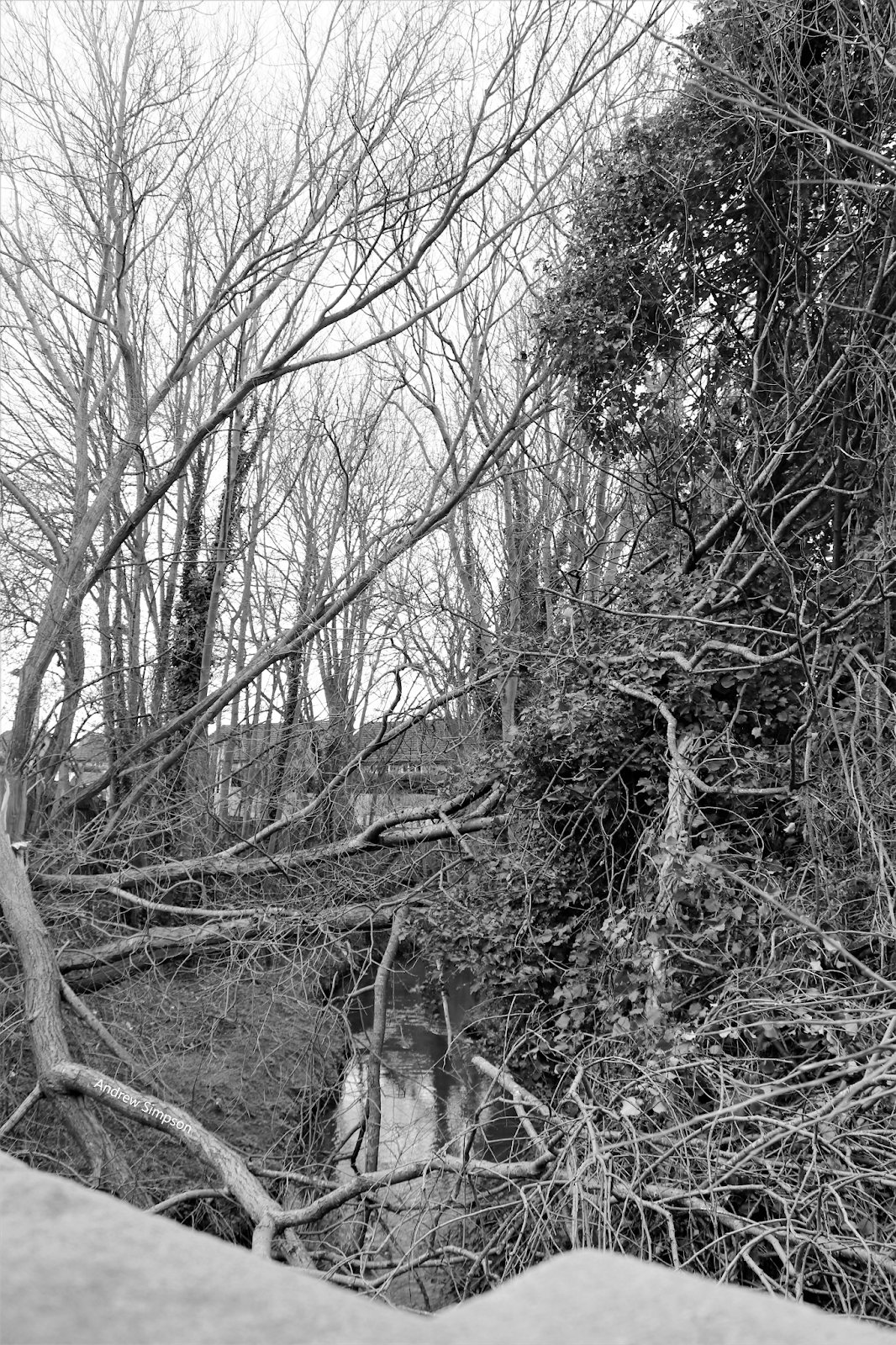
This is one of those views most people seldom see, and requires the curious and members of The Friends of Chorlton Brook, to peer over the Brook Bridge on Barlow Moor Road without falling in.

Location; Chorlton

Pictures; Chorlton Brook, 2020, from the collection of Andrew Simpson

Thursday, 17 September 2026

That lost picture of the Royal Oak in 1902 with young Thomas Kelsey

This is a picture of the old Royal Oak I have never seen before.

The caption gives a date of 1902 and refers to “the boy Thomas Kelsey, son of the landlord of the inn at the time.”

Now it is very unusual to be able to name a person in a Chorlton photograph from the early 20th century.

Usually we are just presented with a sea of faces whose identities are lost in time.

But this is different.

Thomas was born in 1893 in Salford and his parents ran the Duke of York pub at 186 Regent Road, before moving in 1895 to the Royal Oak here in Chorlton.

The pub trade ran deep in the family, Thomas’s father was working in the Glass House on Regent Road by 1881 when he was 18 years old and his parents had run a beer shop just off Regent Road.

But what makes this picture all the more interesting is the detail which it reveals about the pub.

The Royal Oak was originally a beer shop which dated back to the early 1830s and consisted of little more than four rooms.

But what intrigues me is the building behind which seems to have been added on by the 1890s.

The OS map for 1894 and 1907 show that pub had been enlarged and the 1911 census return records that there were eight rooms.

Nor is that all because George Kelsey appears to have been more than just a publican because the sign to our right announces that he was also in the business of “CABS, HANSOMS” and offered a LIVERY STATION.”

By 1921 the secondary business had morphed in "Kelsey Brothers" with Thomas describing himself as a "motor mechanic", a job he was still doing in 1939, by which time he was living with his wife Muriel and daughter at 6 Rippenden Avenue.

And  the premise had relocated to  what had been Renshaw's Buildings which had once been entirely residential but at some time the front had been converted into a garage.

This building was demolished sometime in the late 1920s or early 1930s and replaced by the present Royal Oak Pub, but in one picture the name Kelsey Brothers appears over the garage.

His father and family were still in the old Royal Oak serving up beer and cheer in 1921.

And like so much of the early 20th century the Kelsey family have progressed with the times, so while George Kelsey had run a beer shop his son had moved into the "motor trade" and his granddaughter was a clerk dealing with W

That said there is that finger print just below the sign, now that would be a real detective story.

Picture, the Royal Oak, 1902, m50447, courtesy of Manchester Libraries, Information and Archives, Manchester City Council, http://images.manchester.gov.uk/index.php?session=pass and Barlow Moor Road circa 1920s from the collection of Rita Bishop

Monday, 14 September 2026

Fourteen random pictures in search of a story …. photographs from a Chorlton house

I am looking at a collection of photographs found in a house.

They are mix of images all of which I guess date from the middle decades of the last century and were in a discarded box at 515-521 Barlow Moor Road.

And they are a mix, ranging from images of smart cars, and equally smart “young things” on holiday to a group of men in uniform and the Grand Hotel Oceanic. 

If there is a connection between all fourteen it is hard to discern what that might be, but cars and holidays seem crop up in a few of them.  

The quality varies and while some are fuzzy and indistinct others are sharp and look to have been taken by a professional or at least on a good camera.

So, the question then becomes what can I make of them?

There are no names, inscriptions or comments on the pictures, and the people stare back at me offering no clue to their identity.

Nor at first glance is it possible to make anything of the places.  In some we could be anywhere in the country and while there is a bus, half a pub and a shop they are not yielding up their secrets.

But we do have The Béout cable car and according to one local site worked the mountain called "Le Béout”, which is “southwest of the town of Lourdes. 

The Béout cable car (on the left bank of the Gave River) was somewhat of a counterpart to the Pic du Jer funicular (located on the right bank). 

Built around the 1930s, the cable car ceased operation in the 1990s and was permanently dismantled in 2000 (one of the cabins was once on display in the Pic du Jer parking lot)

Operated by the municipality, the cable car was shut down because it no longer met the new safety standards. The necessary upgrades would have been too costly (the Pibeste cable car suffered the same fate). The residents of Lourdes are nostalgic for this cable car, as it was free for them. 

Young people from Lourdes at the time remember the wooden floor of the cabin where you could see the drop through the slats”.

Our picture shows a group of tourists and amongst them are a couple who show up on at least three other pictures.

And as one of them is sitting in a smart car there is that possible link to the other picture of cars.

These include an E Type Jaguar and a sporty Triumph.

And the cars offer up our first series clue, because two of them display their registrations plates.  

Neither shows up in any searches, which would suggest the vehicle had been scrapped or exported but in the case of 7834VM it was issued by Manchester City Council between late 1961 and early 1963, while WCA574 can be tracked to Denbighshire in Wales and may date from the 1950s and early 1960s.

A date in the early sixties does also seem to chime in with the fashionable hair and clothes of one woman and confirmed by the presence of that E Type Jaguar which started rolling off production lines in 1961.

Now there will be an “expert” which can place the E Type and Triumph in their right year, but I am not one of them.

And I would have liked to have fixed the fourteen in the story of the house where they were found and in the bigger story of Chorlton.

But so far that is not to be.


Maybe someone will come forward and identify some of the individuals or knows who owned the pictures.  

In the meantime, I will continue to release the images but am well aware that the owner may long ago have left the area or just decided the pictures weren’t worth keeping.

All of which is sad, but the present owner of the property is thinking of displaying some of the photographs when the development is finished and the pictures can take pride of place as part of the story of 515-521 Barlow Moor Road.**

Location; at 515-521 Barlow Moor Road

Pictures; Fourteen random pictures in search of a story

*The Béout chasm in Lourdes; http://lieux.loucrup65.fr/gouffredelourdes.htm

**Armistead Property, http://www.armisteadproperty.co.uk/

Wednesday, 9 September 2026

On Barlow Moor Road at the Macfadyn Memorial Church sometime in 1929 with a postcard from mother


Recently I was at the Macfadyn Memorial Church on Barlow Moor Road, sometime between 1903 and 1913.

And today I am back again at almost the same place this time in the 1920s.  

Now I can be fairly certain of that because the postcard was sent in the September of 1929 and while the picture might be older I doubt that it will stretch beyond the beginning of that decade.

It is fairly recognisable but of course today the church has gone, replaced by a block of flats and trams haven’t run up Barlow Moor Road since the late 1940s.


Judging by the coats and the leaves on the trees we may be in late spring when a turn in the weather can still produce a cold spell.

By contrast the postcard was sent on a day when “we are still having summer here, today is lovely.”

What intrigues me about the postcard is that it was not sent through the post.

There is no address to which it should be delivered and no stamp so I guess it must have either been taken by hand to Morris and Marie or perhaps was inside a letter or parcel.

Now this is a bit of a shame as the couple were on holiday somewhere and Marie’s mother was concerned that they liked the apartments but was reassured that the holiday weather was equally good.

And that little comment reminds me that this was still the age of the postcard, and that people regularly sent them, not only as a greeting but for the more mundane business of arranging a meeting.

So on another card in the collection Lena had apologised for not being able to meet Miss Taylor that evening but would arrange to do so for Tuesday.

The card had been sent from Oldham on Monday afternoon with every expectation it would arrive that evening in advance of the time they were to meet.

In the same way Marie had sent her own holiday postcard to her mother at 43 St Anne’s Road and might well receive a reply the same day.

Picture; from the Lloyd collection.

Tuesday, 8 September 2026

Past Kemp's Corner and up to Redgate Farm in the summer of 1900


Looking across the Isles, 1882
This is another one of those walks I would like to have taken if only to set the contrast from what I would have seen just fifty years earlier in the summer of 1853.

Now I have been writing about a series of walks that you could have made along what was then called Barlow Moor Lane north from the junction with Chorlton Row up past Lane End, and on into Martledge.*

We would have seen a few fine houses, a couple of farms, and a mix of more humble dwellings along with a pub and beer shop all surrounded by fields and the meandering Rough Leech Gutter.
But by 1893 the fields had all but gone, as had two of the farm houses, and the old wattle and daub cottages.

There was still a little of that old Chorlton to see.  Up where the Library now stands was Redgate Farm and just before it Renshaws Buildings which dated from the early 1830s and lasted well into the 1920s.

And tucked away in splendid isolation in their own grounds and hidden behind high walls were Beech House and Oak Bank.  These two dated back to the early decades of the 19th century and both in that summer of 1893 would soon also be demolished.

Renshaws Buildings circa 1900
In their place would be the houses that still line Barlow Moor Road and Manchester Road.

These were the product of the housing boom from the 1880s and were the homes of the professional, business and clerical families, many of who used the newly opened Chorlton station to get into the heart of the city in just ten minutes.

Now although I fight it I am an old romantic and I don’t think I would have made much of this stretch of Chorlton in that last decade of the 19th century.

So what would we have seen from what is officially known as Chorlton Cross but is more now popularly called Four Bank Corner, or just the Four Banks?

The simple answer is not that different from today.  What is now the HSBC would soon become Kemps the Chemist and Harry Kemp’s name would be what this corner would be called well into the 1960s.

Sunwick House, circa 1900
Opposite was Sunwick House which is still there but is now the Royal Bank of Scotland and beyond down towards Redgate Farm there was a row of large detached houses set back from the road, while on the north side there were Renshaws Buildings and the old Royal Oak.

This dated back to the beginning of the 19th century and was pretty much just a beer house serving the local population, the thirsty farm labourers and the Manchester trade who had come out from the city for the walk and a drink in the countryside.

The present pub would not be built until the mid 1920s and would replace Renshaws Buildings.  It is still possible to see the kerb and bit of pavement beside the pub which once fronted the old property.

But all of that is a little in the future and so back in 1893 our walk would have taken us north of Sunwick past Warwick and Selbourne Roads up to the farm.

Sedge Lynn, 1885
We probably would not have really noticed the home of Aaron Booth which went by the name of Sedge Lynn.

It stood where Nicholas Road joins Manchester Road. Back.

In the 1890s Nicholas Road had yet to be cut and our little section was still part of Manchester Road which ran off down through what is now the car park of the precinct and over Wilbraham Road. And for those of a tidy mind I might just add that Wilbraham Road was still quite recent having been cut in the 1860s.

Now I have written about Sedge Lynn, Mr Booth and his fascination for amateur photography and it is his pictures which more than anything shows the dramatic transformation of this bit of Chorlton in the decade before our walk.

Looking across Manchester Road towards the station , 1882
In 1882 he took a series of pictures just after he had moved in looking west across the Isles into the area which is now Oswald Road and across Manchester Road towards the station.

Stand on the site of Sedge Lynn today and look towards the station and the view is obscured by the houses of Warwick, Albany and Keppel Roads, which is pretty much what you would have seen in 1893, but a decade earlier this was still open farm land.

Pictures; of Martledge in 1882 courtesy of Miss Booth, Sunwick from the Lloyd Collection and the corner of Barlow Moor Road and Wilbraham Road from the collection of Marjorie Holms

*Chorlton Row is now Beech Road, Lane End is the junction between Sandy Lane, High Lane and Barlow Moor Road, and Martledge was the area north of the former Four Banks.