Showing posts with label Salford in the 1960s. Show all posts

Sunday, 19 March 2023

Travelling the Salford way …………. buses from the Museum of Transport Greater Manchester

Now there will be plenty of people who will have travelled on one of these, during the 1960s into the following decade.

And befitting their importance both are now happily part of the collection at the Museum of Transport Greater Manchester. *

The first is a Leyland Atlantean Double deck bus, and the second a Leyland Atlantean Double deck bus, from 1972, operated by SELNEC.**

Andy Robertson’s recorded the two on a recent visit to the museum, and I am indebted to their database for the details of each bus.***

Location; Museum of Transport Greater Manchester

Pictures; 2019 from the collection of Andy Robertson

*Museum of Transport Greater Manchester, http://www.gmts.co.uk/index.html

** 214 - DBA 214C - PDR1/1 - Double deck bus, from 1965, Salford Corporation Transport 7001 - VNB 101L - Leyland Atlantean AN68/1R - Double deck bus, from 1972, SELNEC

***The full collection, http://www.gmts.co.uk/vehicles.html

Sunday, 5 December 2021

Manchester and Salford in the 1960s ……… Christmas presents ….. no. 2

Now, here is a book which will become a classic because it contains 126 images of a Manchester and Salford which has vanished.

The book is, Without a Trace by Shirley Baker who set out to record the “working class communities during the 1960s slum clearances”.*

It is easy with hindsight and a huge dollop of misguided nostalgia, to criticize those clearance programs which while they wiped away thousands of unfit properties, also destroyed vibrant communities.

For many who had been part of those close-knit communities, the forced move away was a sad experience.

Some felt marooned on new estates, which in some cases were on the edges of the twin cities and had little history or communal spirit.

But that is to ignore the simple truth that many of those houses were in the shadow of factories, iron works and power stations and were long past their sell by date.

Some will argue that with a bit of tender care and attention, the terraces could have been saved, but many were just no longer fit for purpose.

That said, within a decade of being built some at least of the new properties were equally unfit to live in, and the vision of homes in the sky, connected by walkways and views across the two cities failed to create a sense of community.

And so, the pictures in this book, are important in chronicling what was being lost and stand beside the work of contemporary observers and in its way the comedy series the Likely Lads** as a source for what has gone.

Many of the images are familiar, while others I had never seen before and I spent a smashing few hours on Christmas Day reading through the book.

My only criticism is that locations are by and large just described as Manchester or Salford, which is a pity, but it is a minor one, and in no way detracts from a powerful piece of collective history.

Location; Manchester and Salford, the 1960s

* Without a Trace by Shirley Baker, Manchester and Salford in the 1960s, 2018

*The Likely Lads, was a British sitcom created and written by Dick Clement and Ian La Frenais, and produced by Dick Clement in three series, between 16 December 1964 and 23 July 1966, and the follow up, Whatever Happened to the Likely Lads, which ran between 9 January 1973 and 9 April 1974

Saturday, 2 May 2020

Back with the two pubs on Liverpool Street …………. and a collection of rare pictures

Yesterday I was exploring the two pubs on Liverpool Street, and the mystery of the two houses which became one beer shop and then separated again, before becoming the Royal Albert which at some stage was joined by the Union Tavern.

I never got to the bottom of the mystery, but the story generated a lot of interest, including a message from Una Denton Mayall, who wrote, “There was also a small cottage in the middle of the Royal Albert and the Union.


A lovely old couple used to live in it, they had a little back yard where they had a little garden and only one door 

On the side of the Royal Albert was a door which which led into the vault and the gents was on the left, behind a partition. 

I lived there from early 60s till early 70s”

Now that “small cottage” will be one of the two separated houses, and adds wonderfully to the story.

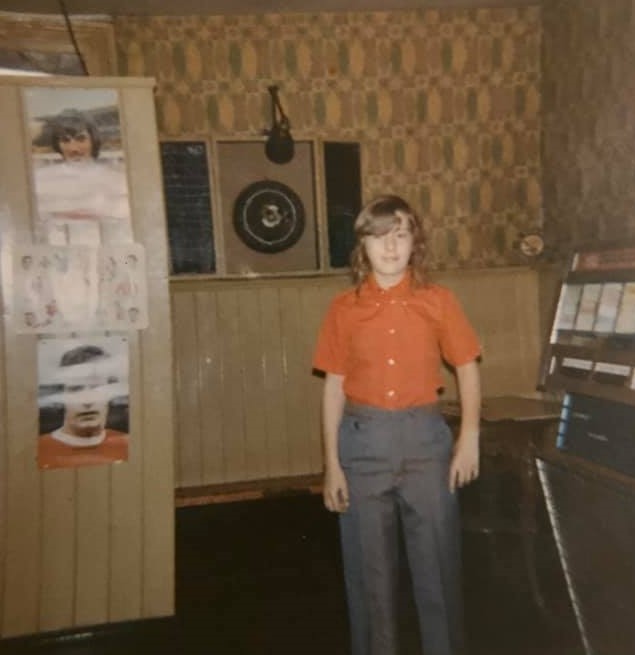
But Una also sent over a collection of pictures which are themselves a fascinating glimpse of the Royal Albert, and especially of the inside of the pub.

For reasons I have never fully understood, pictures of the  insides of pubs are quite rare.

So while there are always plenty of the outside, few of the interiors seem to get published.

Perhaps it is just that taking photographs gets in the way of serious drinking and conversing with family and friends, or maybe its just because if you were a regular, why take a picture of somewhere you knew so well?

Added to which until the 1970s cameras were still relatively expensive.

Or maybe its just that pictures of the inside were taken during a family do and so sit in an album and rarely come out into the public gaze.

All of which make’s Una’s pictures quite unique, and I thank her for sharing them.

Leaving me only to add that she points out that “on this last photo, you can see the back gate of the little cottage”.

Location; Salford

Pictures; The Royal Albert; circa 1960s-70s, from the collection of Una Denton Mayall

* The mystery of the two Salford beer shops on Liverpool Street
 https://chorltonhistory.blogspot.com/2020/05/the-mystery-of-two-salford-beer-shops.html

Friday, 26 July 2019

Tuesday, 16 April 2019

It’s not every day you get a telegram from Buckingham Palace

Well not me any way but perhaps in the course of their civic responsibilities the Mayor of Salford might expect the odd visit from the telegram boy.

And so it was in 1963.  I trawled the Guardian on line but couldn’t find a reference to a royal visit so I guess it will be either Central Ref or Salford’s Local Studies Centre and a day of routing through their collections of newspapers.

Of course someone out there will know and in the interest filling in the historical details will get in touch, and perhaps even up a story and a picture.

Not that this is just a quick response to a the telegram sent over by David Harrop who has an extensive collection of postal material as well as memorabilia from both world wars.

Added to which he knows his stuff.

But the bigger point is that we don’t send telegrams anymore, and in fact don’t do letters of picture postcard much either.

And however quick the text, or the message with its picture sent via social media is, it robs us of a bit of our future history.

In a decade I doubt that a future historian will have as much paper sources to start off a trail of investigation.

Unless like me you print off all your messages and file them away.

Location; Salford

Picture; the telegram to the Mayor of Salford, 1963 from the collection of David Harrop.