Showing posts with label the 1920s. Show all posts

Friday, 10 July 2026

As many Prime Ministers as you can count ……

It has become one of those throw away comments much loved by the media that since 2016 we do seem to have had a lot of Prime Ministers, which is often accompanied with a comparison to some of our European neighbours who change theirs with monotonous regularity.*

1979

And it is true that in that decade we have had five, with one lasting just 44 days which occasioned the “Liz Truss lettuce”.

1923
Now none of this is contested but does hide the uncomfortable history that during the last century some governments were almost as short lived.  

The second post war Labour Government which won the 1950 General Election survived with a majority of just five from February 1950 till the October of 1951.  

All the more remarkable when the first post war Labour Government came to power with a huge majority and established the National Health Service. 

Just over twenty years later in 1974 there were two elections in the February and October, while the Conservative Prime Minister, Sir Alexander Douglas- Home who succeeded Harold Macmillan in the October of 1963 lasted just a year.

Of course, there are sound political reasons why those changes of power occurred and once you delve into the history the sleek and shallow observations are just that ….. sleek but shallow.

And if you wanted to go back to almost the beginning of the 20th century that history can offer up a similar set of Prime Ministers who held office for just a short period.

1929
David Lloyd George, Coalition, lasted from 1918 till he was ousted by a Tory Party coup in October 1922.  His successor Andrew Bonar Law, Conservative was replaced by Stanley Baldwin, Conservative in May 1923.

But Baldwin lost the 1924 General Election to the first Labour Government led by Ramsey MacDonald whose administration lasted for just eleven months. 

Baldwin was returned to power and managed a creditable five years before he was defeated in the 1929 General Election by Labour who were derailed by the financial crisis of 1929.  Unable to secure the budget cuts he wanted and in the face of a Labour Party split he formed a National Government winning the 1931 General Election.

All of which means that by my reckoning in the seven years that spanned most of the 1920s we managed to clock up six changes of Prime Minister, starting with the Lloyd George Coalition Government and ending with the Coalition Government of Ramsay MacDonald.

Pictures, Election Posters from 1924-1979

*Theresa May, 2016-2019, Boris Johnson, 2019-2022, Liz Truss, 2022-2022, Rishi Sunak, 2022-2024, Keir Starmer, 2024-2026


Wednesday, 16 August 2023

How we did holidays in the 1920s ………..

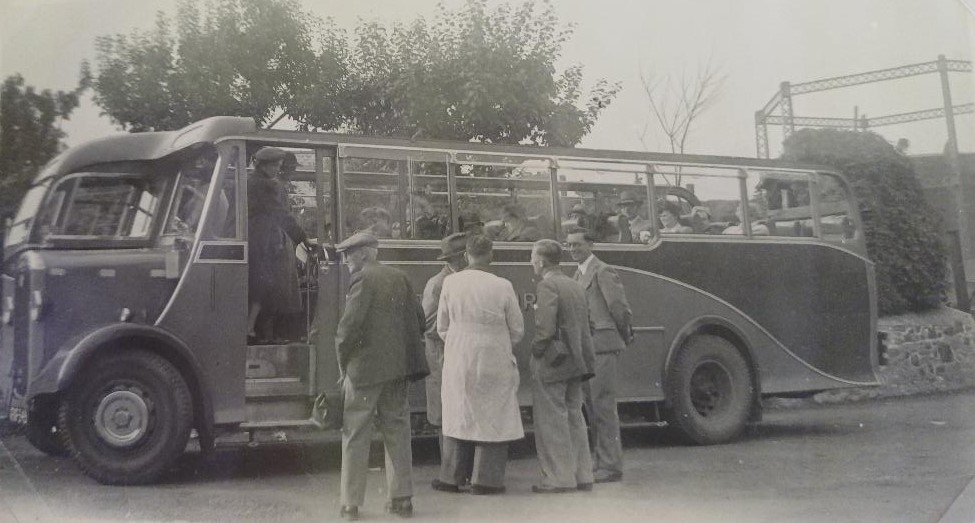
It is easy to forget that for many people in the 1920s a holiday was something which might be limited to a day or two at the seaside.

Dad with two passengers, date unknown

It would not be until 1938 that “after pressure from the unions and the International Labour Organisation, the government passed the Holidays with Pay Act. It finally gave some workers (those whose minimum rates of wages were fixed by trade boards) the right to one week of paid holiday per year.” *

Ready for the off with dad, date unknown
So, for most working people the holidays that our dad offered were far beyond their means.

He was a coach driver and for most of his career he worked for Glenton Tours of New Cross in southeast London.

After a series of jobs in the motor trade, first in Newcastle and Yorkshire he moved to London in the mid 1920s and started with the company he stayed with till he retired in 1982.

Glenton Tours offered luxury guided trips around Britain and the Continent, with hotel accommodation and full board, taking in the sights as far north as Scotland and down across Europe to the Alps. **

Happy passengers and dad, date unknown
For middle class families they were a good way to see new places, and along the way get to know the history of where they visited.

By the 1930s Dad was one of the two drivers in the fleet who worked the Continent, and apart from the interruption of the last world war did so until the 1980s.

His work, the trips he did, and the cost is something I have regularly written about including the economics of the business.

But I have always concentrated on the period from the 1950s through the 60s when I remember him coming home on a Friday night only to be off again the following morning.

Unknown passenger, unknown location, and unknown date

So, for now I shall just reflect on those earlier years with photographs from his “work album” some of which will be nearly a hundred years.

There are a lot of them, and so far, I haven’t been able to locate where any of them were taken, and the identities of the passengers are lost forever.

Boarding the coach, date unknown
A few of the passengers pose with dad and some women crop up on their own and while it is tempting to speculate on a romantic connection we will never know.

What is remarkable is that in a pre mobile age, all these pictures would have been taken, commercially developed and then they would have been sent to dad.

This I know because we do have some letters from passengers thanking him and commenting on what a wonderful holiday they had had.

Leaving me just to enjoy a collection of pictures of how we did our holidays long ago.

Location; the 1920s straying into the next decade

Pictures; dad, some coaches and a heap of happy passengers, 1920s and 1930s, from the Simpson collection.

Posing for the camera, date unknown
*Campaigning for paid holiday for everyone, TUC 150, https://tuc150.tuc.org.uk/stories/campaigning-for-paid-holiday-for-everyone/


Saturday, 15 January 2022

Two picture postcards ... two operas ........ and two young singers .......

Now I am indebted to Tony Goulding for finding these two picture postcards and sending them over to me.

Aileen Davies, circa 1920s
They are of singers in the D’Oyly Carte Opera Company, which my Wikipedia tells me "is a professional British light opera company that, from the 1870s until 1982, staged Gilbert and Sullivan's Savoy operas nearly year-round in the UK and sometimes toured in Europe, North America and elsewhere. The company was revived for short seasons and tours from 1988 to 2003, and with Scottish Opera it later co-produced two productions”*.

And apart from their names and the company that published the cards that is about it.

But a trawl of the internet offered up the biographical details for one of the singers and I travel in hope that I will find out something about the other.

So as yet Aileen Davies remains in the shadows.  

I know she was born in Cornwall in 1902, and died in Edinburgh in 1981, that her father was listed as a Master Mariner and she was married and had a daughter. She appears on several picture postcards, is in National Portrait Gallery and has a brief biography on the D’Oyly Carte Opera Company which records she joined the company in 1923 and performed with them till 1928.**

Aileen Davies, in The Gondoliers 1920s

Ms Winifred Lawson has left more in the way of a digital footprint, including a Wikipedia entry and another in D’Oyly Carte Opera Company.***

Winifred Lawson in Patience, 1920s
She too was active with the company in the 1920s, and again in the 1930s, went on to become Vice President of the Gilbert & Sulivan Society in 1944, and published her autobiography "A Song to Sing-O!," with foreword by Sir Malcolm Sargent, 1955.

I could write more about both of them, but that would only be by lifting my research from other people’s work, so if you want more follow the links.

I am off to search for the post card company, secure now in the knowledge that they date from the mid 1920s.****

Location; 1920s

Pictures; Aileen Davies , and Winifred Lawson from Parksle Pictures, 1920s, courtesy of Tony Goulding

* D’Oyly Carte Opera Company,  https://en.wikipedia.org/wiki/D%27Oyly_Carte_Opera_Company

** Aileen Davies, D’Oyly Carte Opera Company, https://www.gsarchive.net/whowaswho/D/DaviesAileen.htm

***Winifred Lawson, D’Oyly Carte Opera Company https://www.gsarchive.net/whowaswho/L/LawsonWinifred.htm

****Parkslee Postcards, https://www.gsarchive.net/postcards/pksle151.htm

Tuesday, 8 June 2021

Now and then ..........The Roaring Twenties ...... and post Covid Britain

I am a great fan of the Radio 4 series the Long View, which seeks to explore comparisons with events today and similar ones in the past.

Entertainment, 1926, Josephine Baker, Paris

Today's programme turns on the expected burst in activity across the economy, politics, and the world as we move out of the stagnation which was Covid.

And for some that leads to that decade following the Great War when there was an explosion of new ways of doing things, from the Charleston to the age of the cinema.

"Break-neck technological innovation, a realignment in both British politics and the global order, a decade of economic boom and bust. Jonathan Freedland and his guests ask if the post-pandemic 1920s deserve their golden reputation and whether we're now on the brink of a second 'Roaring Twenties'.

Joining Jonathan to look back at the 1920s and forward to the 2020s are the historian Dr Luke Blaxill of the University of Oxford, the economists George Magnus and Dr Linda Yueh and journalists Tim Stanley of The Telegraph and John Harris of The Guardian. The actor is Beattie Edmondson.

Manchester, 2021 as Covid regulations are relaxed

Producer Julia Johnson"


Pictures; Josephine Baker dancing the Charleston at the Folies-Bergère, Paris, 1926, Walert, partying in Stevenson Square, 2021 from the collection of Andrew Simpson

*The Roaring Twenties, The Long View, Radio 4, https://www.bbc.co.uk/programmes/m000wrjs

Tuesday, 10 December 2019

The Disillusion of Peace ……. the years after the Great War …. on the wireless all this week


Armistice Day, Manchester
I came across The Disillusion of Peace, on Radio 4 this morning and instantly got drawn into the fifteen minutes of one person’s story of the years immediately after the Great War.*

Then went back listened to episode one on life during the war.

It is a fascinating account of growing up in the early decades of the last century.

Sadly, the book appears out of print, leaving me just to treasure the five episodes.

“Diana Quick reads the autobiography of Lucy Malleson, a detective writer of the 1930s and 40s who wrote under the name Anthony Gilbert.

First published in 1940, it’s a book which is valuable now for its sharp social history of working life in the early decades of the 20th century, and particularly for its focus on what it was like for women at work in offices.

At the end of the First World War, Lucy becomes a secretary in the newly created Health Ministry, desperately trying to draft in enough doctors to cope with the flu epidemic.

“The influenza scourge was ravishing the country, and we had to get as many doctors as possible back from France in record time. Conditions in the country were unspeakable; corpses lay for days unburied because there was no doctor to sign the necessary certificates. Doctors themselves contracted the disease and died on their feet.”


A clippie, circa 1918
Having grown up during the War, peace time comes as a shock, and brings with it a strong sense of disillusion. At the age of 20, Lucy must earn a living in a labour market crowded with men returning from the front. She’s not the only woman now forced to compete for jobs:

“The War had brought women all those privileges that the Suffragettes had fought for so fiercely. The army of women who had flooded into offices during the War could not be shooed back to their homes, like a flock of hens…”

Lucy gets a job, and a good one – earning four pounds a week. But in her new role, she sees, and has to turn away, all the men who come to her office desperately hoping for work.

Astonishingly modern, though a hundred years old, Lucy Malleson’s sharp and humorous account of working life is vividly brought to life by Diana Quick.

Reader: Diana Quick
Producer: Elizabeth Burke

A Loftus Media production for BBC Radio 4”

Pictures, Armistice Day in Manchester November 11, 1918, and “the Clippie”, date unknown, from the collection of David Harrop

* The Disillusion of Peace, Lucy Malleson, Radio 4,  https://www.bbc.co.uk/programmes/m000c4tt

Friday, 24 March 2017

Stories of Empire, and a context for one British family

A shipping list of the hopefuls
Sometimes you can just lose perspective when researching a family relative.

I always told myself that in telling their stories I wanted to put them into the bigger picture.

As intriguing as the life of my great uncle might be it is nothing unless you place him in the context of where he lived, when he lived and what was going on around him.

He was a British Home Child, and understandably his life and the difficulties of tracking down a man born in 1898 who spent his early years in institutions and then left for Canada in the May of 1914 can become so absorbing that you don’t see the wood for the trees.

Laura Hall

Now all of us who have researched BHC are aware of the social and economic background that led well meaning organisations and individuals to sweep up children in Britain and relocate them to Canada, Australia and the other colonies of the former British Empire.

And I guess we have all come across those back in the home country with an eye to empire. For them these children were also about putting down a population in a colony still being built, who in time with family, a farm and a flag would bind these new territories to the mother country. Barnado himself is reputedly to have talked about the children he sent as “bricks for empire.”

Of course the bigger picture helps place BHC in a context. We had been sending our criminals and unwanted children to North America, the West Indies and later Australia since the 17th century while in the 1840s the Poor Law Commissioners and local land owners connived a scheme to send the unemployed across the Atlantic.

A testimonial
So I suppose I should have not been surprised to read about the Free Passage Scheme which at the end of the First World War offered a “Free Passage Scheme for ex-servicemen, ex-servicewomen and their dependants to emigrate to the colonies and dominions of the Empire,”* and was followed by the larger, Empire Settlement Act of 1922 to emigrate large numbers of British women as domestic servants.

Now I knew vaguely about the Empire Settlement Act, but it was her article in the  BBC History Magazine “Our Excess Girls” which drew me into the story.

It has been written by Lucy Noakes  and was a curtain raiser to her book From War Service to Domestic Service: Ex-Servicewomen and the Free Passage Scheme 1919–22, OUP, 2010.

It is a fascinating story and fits well with the idea of the mother country populating the outposts of Empire.

There were she writes a “complex network of interlinked beliefs and policies concerning both the relationship between the metropole and the Empire, and the perceived necessity for social stability in Britain and in the dominions and colonies.” 

But in the case of over 4, 000 young women it was the opportunity for a new life often in domestic service.

Laura Pember, nee Hall, 1947
And like so much in history there is a direct echo with my own family.

My great aunt who had been born in the Derby Workhouse in 1902 and like my great uncle had spent her early years intuitions before being sent into service at the age of nine went across to Canada in 1925.

She was one of the beneficiaries of the many schemes for the settlement of people in Canada.

I guess she was part of the program providing transportation assistance and guaranteeing standard wages and transition support for more than 22,000 domestic workers between 1919 and 1930.

Hers is a story I have yet to tell. Great aunt Dolly had planned to stay in Canada just a short while, and took only a few clothes in a suitcase.

She had been encouraged to go by her brother who was my BHC. The plan was for her to meet him in British Columbia but she got no further than Ontario where she stayed, married and raised a large family.

Put their two life stories together and I begin to have something more than just a family history.

Add in another uncle who spent his entire working life in Africa and great uncles who plied the oceans as ships engineers and it is the start of my family and an Empire.

Pictures; Laura Pember nee Hall, and letter from C. Dould, from the collection of the Pember family, shipping records from the collection of Andrew Simpson 

*Lucy Noakes, BBC History Magazine “Our Excess Girls” March 2012