Showing posts with label Chorlton in the 1860s. Show all posts

Monday, 26 January 2026

Picking up on Chorlton's story at The Oaks ..... Edge Lane

I am the first to admit that it is lazy history to claim that one house  can reflect the story of Chorlton-cum-Hardy from the mid 19th century onwards.

22 Edge Lane, 1907 shown in red
But if I did, 22 Edge Lane is up there amongst the list.*

It was built in 1865, was home to a succession of wealthy families, and during the last century went through a transformation into multi-occupancy and is now being renovated and redeveloped.

Now, there are plenty of those big houses which fit into that category, but 22 Edge Lane is the one I am focusing on.

The Haselgrove family were the first to own and occupy the property, giving it the name of the Oaks and were typical of the “new people” who were moving into Chorlton-cum-Hardy, when the area was still a rural community.

But already by 1865 the township was changing.

The arrival of the railway sixteen years earlier at the bottom of Edge Lane, along with improvements to the supply of water and sanitation began to make Chorlton an attractive place to live.

22 Edge Lane, entrance, date unknown
And so during the 1860s through the next two decades, there was residential creep along Edge Lane, which was replicated by similar developments following the Egerton estate’s decision to cut Wilbraham Road through Chorlton and onto Fallowfield.

The building of these big properties pre dated the much bigger housing boom which began in 1880 in the area once known as Martledge which was the strip of land around the junction of Barlow Moor and Wilbraham Roads.

These tended to be smaller properties, and were home to the “middling people” who were mainly drawn from the professional and clerical occupations.

But while they may have been the future of Chorlton, those big houses were part of that history as were the people who lived in them.

And that is the link to the Mr. Nicolai Christian Schou, and his family who had made 22 Edge Lane their home in 1871.

Edge Lane, 2019, before redevelopment began
He was a “shipping agent” with offices at 38 Cooper Street which was on the corner with Bootle Street.

The building and his stretch of Cooper Street vanished when Central Ref was built in the 1930s, but was still there at the beginning of the 20th century when it was occupied by Overman and Co., which earlier had operated in partnership with Mr. Schou. 

Just when the two got together is yet to be discovered, but the records show that during the 1860s well into the following decade the company was listed just as N. C. Schou.

Sadly he left very little in the way of a paper trail.  I know he was born in 1834, and was buried in the St James’s Birch-In-Rusholme, in 1881.

But the parish burial records do contain a touching reference to the family, listing the deaths of his wife, and two of his children.  “In memory of Frances Mary wife of Nicholi Christien Schou, died 28th April 1869, aged 36 years also Constance Mary their daughter died 21st November 1863 aged 3½ months also Nicholi Christian Schou born 22nd April 1834 died 2nd December 1881 also Oscar Henry their second son born 6th March 1859 died 2nd August 1892”.

20 Edge Lane, next door to no. 22, 1959
That pretty much is all there is so far, other than the census return for 1871 which lists him living at Edge Lane, with his five children and four servants who included the housekeeper, a cook, housemaid and charwoman.

We may today be surprised at the number of servants, but his neighbours employed almost as many, which again marks number 22 out as typical of the time and place.

Location; Chorlton-cum-Hardy

Picture, 22 Edge Lane, 2019, courtesy of Armistead Property**, Edge Lane and entrance to 22 Edge Lane, date unknown, Lloyd Collection, OS map 1907, and 20 Edge Lane, 1959, A E Landers, m17780, courtesy of Manchester Libraries, Information and Archives, Manchester City Council, http://images.manchester.gov.uk/index.php?session=pass


*At 22 Edge Lane, https://chorltonhistory.blogspot.com/search/label/At%2022%20Edge%20Lane

**Armistead Property Ltd, http://www.armisteadproperty.co.uk/


Tuesday, 20 January 2026

Waltham House ............. another of the lost houses of Edge Lane

Waltham House, 1959
This is Waltham House in the spring of 1959 and it was coming up for its 96th birthday but like many of those grand houses stretching along Edge Lane it had seen its best years.

It had been built in 1863 and was the home of Frederick Townley who a decade or so later had moved up the road to Stockton Range opposite the new church.

By then Waltham House was home to the Mr and Mrs Fowler, their three daughters, three servants and Mr Fowler’s brother.

Mr Fowler and his brother were “provision merchants” with a business on Corporation Street.

And in the fullness of time I will come back to the Fowler’s but for now it is their twelve roomed house which interests me.

Waltham House was one of the more impressive properties along that bit of Edge Lane which runs from  High Lane up to the junction with Wilbraham Road.

It was a big detached property standing in extensive grounds, set back from Edge Lane and approached along a curving drive.

And it would have been one of those properties you couldn’t have missed given that it had two entrances from the lane and before Wilbraham Road had been cut in the late 1860s would have commanded fine views north across open land up to Longford Brook and south to Turn Moss.

Not that the curious passerby would have seen much of the house as the front and rear were screened by rows of trees and  the northern boundary hidden by a line of green houses.

Waltham House 1893
That said it appears on the OS maps by name all of which I suspect would have gratified its owners who no doubt lived comfortable lives secluded behind those trees and that long stone wall which still runs along the lane.

Their neighbours might not have had their homes recorded on the OS map but were still proud enough of their properties to bestow fine sounding names on them.

West of Waltham House was Edgecombe Mount, Waterford, Hascombe, the Oaks and Thornlea, all built by the 1870s.

But these splendid names did not save them and most went during the 20th century.  Too big and too uneconomic to run their very size along with their grounds made them perfect for late 20th century redevelopment.

And now pretty much all that is left are the stone walls that fronted Edge Lane and the odd gate post with a lost name carved on it.

Waltham House, 1907
That said Thornlea has survived as the name of the flats that now occupy the site.

All of which brings me back to Waltham House which lasted longer than most and which during the last war was used by the Civil Defence, according to A E Landers who took the photograph of the house back in 1959.

It is an intriguing little story which needs following up but for now I am racking my brains to see if I can remember it.

In 1969 it appears not to have been occupied and may have been demolished when Belgravia Gardens was developed sometime in the 1990s, which means I should remember it.

Sadly I don’t and that more than anything reinforces that simple observation that you should never take anything for granted.

Pictures; Waltham House, nu 14 Edge Lane, A E Landers, 1959 m17783, courtesy of Manchester Libraries, Information and Archives, Manchester City Council, http://images.manchester.gov.uk/index.php?session=pass and detail of Edge Lane in 1893 from and the OS map of South Lancashire, 1893, courtesy of Digital Archives Association, http://www.digitalarchives.co.uk/ and Waltham House from  1907 OS map

Friday, 28 February 2025

Chorlton-cum-Hardy Vestry …… Disgraceful Proceedings

The world is full of breaking news, most of it grim.

The old Parish Church, circa 187o
So, here is what passed for breaking news in the March of 1865 across our own township.

“Last evening a meeting of the vestry was held  in St Clements School room, Chorlton-cum Hardy.

Before the proceedings commenced Mr. Charles Clark walked up to the table and took the chair.  He said  that the meeting was one adjourned from the vestry at which he had been elected chairman.  He was soon followed by the Rev. J.E. Booth, the rector of the parish , who taking a seat next to that of Mr. Clark, said he took the chair ex-offico”.

At which point one of the churchwardens got up and insisted that the Reverend take the chair, which was followed by competing shouts supporting and objecting to the suggestion, which in turn was followed by both Mr. Clark and the Rev. Booth attempting to speak at the same time.

Circa 1890
Mr. Clarke asserting, he would “not relinquish the chair , if he had to remain in the room till the next morning”, while the Reverend Booth replied that he “would take the chair legally or not”.

In the subsequent shouting and heckling from the meeting Mr. Clark could not be heard.

Happily order was restored and the meeting progressed, with an attempt at a resolution to the dispute which sought to end the great Church division, between those who wanted a new parish church and those who wanted to retain the old place of worship beside the village green.

This older church had begun as a chapel of rest, dating from the 1500, and was rebuilt in 1800 as the parish church.

But by the 1860s despite extension it had become too small, and there was a move a new one, on a site very close by.

All looked to be going well until Lord Egerton offered an alternative site on Edge Lane, which divided the congregation between the traditionalist and those who not only favoured Egerton’s offer but proceeded to raise money and begin building a new church.

1933
That church was completed in stages but while it could only carry out “divine worship”, leaving the task of baptisms, marriages and burial services to the much smaller and older church on the green.

A state of affairs which lasted until 1940 when it was closed because of frost damage, and all services passed to the new church.

But that was way into the future, when Mr. Clark and the Reverend Booth clashed in the old school hall.

The upshot of that tussle was that the meeting resolved to maintain the primacy of the old church, but it had been a fight to the end.

The modernists tabled a resolution calling on the bishop to side with them and transfer the funding from the Church of England to  the new church, but an amendment which recognized the new church but asserted that service should be retained in the old, and more importantly that the official funding should also remain with the old church was carried, “on a large majority in favour which was carried amid cheers and groans”.

Location; Chorlton-cum-Hardy

Pictures; the old parish church circa 1870, from the collection of Tony Walker, and circa 1890 from the Lloyd Collection, and 1933, by F. Blyth, from A Short history of Chorlton-cum-Hardy by J.D. Blyth, 1933

Leaving me just to say that the full story can be found in The Story of Chorlton-cum-Hardy, and Chorlton-cum-Hardy Churches, Chapels, Temples, A Synagogue and a Mosque.**

* Chorlton-cum-Hardy Vestry …… Disgraceful Proceedings, Manchester Guardian, March 9, 1865

** The Story of Chorlton-cum-Hardy, Andrew Simpson, 2012, and Chorlton-cum-Hardy Churches, Chapels, Temples, A Synagogue and a Mosque, Andrew Simpson & Peter Topping, 2018**


Saturday, 10 April 2021

Oswald Field, five cottages, a slice of rural Chorlton, and a bit of a mystery part 3


I think this will be the last of the stories on Oswald Field.

Over the last few days I have walked its field boundary, explored the five cottages and tried to discover something of the people who lived there.

But I am content to end with the man who owned the five cottages and just over three acres of land, most of it at Oswald Field but a little on the Row* close to the blacksmith just before the road ran into the green.

And here is the mystery that I have alluded to for despite owning property which qualified him to vote in parliamentary elections he appears not to have owned his own house living instead as a lodger in several homes and variously described himself as a cordwainer [shoemaker], and retired gardener while on his will he is called a labourer and left effects of under £200.

He was born in Great Warford in Cheshire in 1783.  There were Bracegirdle’s in Great Warford in the 1840s and 50s.  One was a farmer, another a book seller and another was a weaver.  Now the place was small enough for him to be related but at present it is an avenue of research I shall leave to someone else.

More promising is his connection with Methodism.  He was at one point superintendant at the Sunday school and some at least of the people he lodged with were Methodists as were two of the men who proved his will.

And it may be that this also gives a clue to when he arrived here in the township.  He is not mentioned as part of the early Wesleyan congregation during the 1820s and the first documented mention of him is 1840 but we may just be able to push that date back.  John Hall who had owned the five cottages on Oswald Field died in 1838 and like Charles was a Methodist.  If the properties passed to Charles on John Hall’s death then either he was already here or settled here around that time.

The income from all the properties and land amounted to £54 a year which is not a substantial amount and will explain why he worked variously as a cordwainer, gardener and labourer.

I doubt that we will ever know his prime occupation and it maybe that some were seasonal or dictated by circumstances.  In the June of 1841 he had been lodging with Joseph Brundrett who was a shoemaker and a decade later he gave his occupation as the same while in 1861 when he was living at Clough Farm he described himself as a retired gardener.

And yet as a man with a vote he was one of a small and significant section of the community.  There were only 27 of them entitled to vote in 1840 out of a total adult population of 341 and given that only men could vote this marked him out as one of only 18% eligible to participate in Parliamentary elections.

And as a Methodist he made up a large proportion of those who could vote in all the elections from 1832 through to 1854. In 1835 just over a quarter of the electorate were Methodists.

They were a close knit group who married into each other’s families lived close together and no doubt discussed the issues of the day.

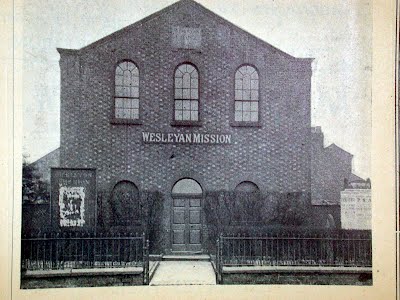
Sadly nothing that Charles said or thought has survived, but we do have his likeness.  It was published in the Wesleyan Church Souvenir Bazaar Handbook for 1908.

It shows a man with a mass of white hair, but even this presents a mystery.  The name below the picture is of a James Bracegirdle, which I take to be Charles.  Again I might be wrong, but there is no record of a James in the township either in this period, or for the rest of the 19th century.  So I guess this must be he, or it may just be another mystery to add to the rest.

Picture; Charles Bracegirdle & the Wesleyan Chapel from Wesleyan Church Souvenir Bazaar Handbook for 1908, courtesy of Philip Lloyd 

*The Row is now Beech Road and his acre of pasture land is today the site of the gated poperties

Friday, 9 April 2021

Oswald Field, five cottages, a slice of rural Chorlton, and a bit of a mystery part 2

Oswald Road

 I  recently walked the field boundary of Oswald Field and today I want to think about the cottages.

There were five of them and they might have looked something like Grantham’s Buildings which stood on High Lane from the 1830s through to the late 1970’s.

I think we can date them from sometime after 1832 and maybe more exactly to around 1835 because in that year a John Hall qualified for a Parliamentary vote here in Chorlton on the strength of owning freehold houses on Oswald Croft.

Five years later the properties appear to have passed to Charles Bracegirdle who is listed in the electoral register for 1840 and with the changed ownership has come a slight change in the name from croft to field.

Red Gates farm, 1845
Now at this point I become a little pedantic.

It is possible that Oswald Croft and Oswald Field are not the same place, but there are no similar properties close by, and the boundary between Oswald Field and High Meadow was in the 1840s known as Oswald Lane, a name it retains till this day.

So I think we can be pretty sure they are one and the same.

But I am not sure of what these five cottages would have been like.

They might like Grantham’s Buildings on High Lane and Brownhill’s Buildings on what is now Sandy Lane have been two up two down properties, but it is equally likely that they consisted of just a single ground floor room with another on top.  There were plenty of one up one down cottages and rows of such across the township.

What I think we can be certain is that they were made of brick.  In the 1840s there were still upwards of fifty wattle and daub cottages but all the new build does seem to have been in brick.  Now I have written about our cottages  and perhaps it is enough to say that they would have been fairly basic, with a brick or slab floor resting directly on the bare earth, a privy and a communal well.

There was a wide disparity in the rents that were paid on the five, with one commanding an annual rent of £16, another £13 and two at £6 and the last at £4.

But I am not sure that this had anything to do with the houses themselves but more to do with the accompanying land.  The higher rented two were described as houses with land while the remaining three were with either “house and garden” or just “house”.

And this fits with the occupations of the tenants.  So Peter Langford who paid an annual rent of £13 in 1845 described himself as a gardener which may mean he derived some of his income from growing food for the Manchester markets.

Certainly he was perceived as a notch up from his neighbours because it is his name which appears as the lead tenant in the properties which allowed Charles Bracegirdle a Parliamentary vote in 1854.

And indeed three years earlier he had described himself as a market gardener on an acre of land.  While others living in the block described themselves as labourers.

Assuming then that the properties were all much the same it might be possible to get some idea of what they were like by comparing rents across the township.

At £6 a year a tenant would have paid 2s 3d or 11p a week while the lower rent of £4 would have worked out at 1s 6d or 7½p a week.  This put them broadly in the middle of the rented properties in 1845.

Rents as % of the total in 1845

Of course this still might hide enormous differences in the quality and repair of the houses but it is a start, and I guess means that our people on the edge of the township were living in homes which were much the same as their neighbours across the township.

And like all our people the length of tenancy seems mixed, some like Peter Langford stayed on Oswald Field for twenty years while others upped and move on in a fairly short space of time which I suspect is another area for some interesting research.

The rate books begin in 1845 and detail landlord and tenant throughout the rest of the century so it should be possible to plot tenancy times.

The last part of the story is still unclear.  Charles Bradshaw died in October 1864 his will was published in the following January and the houses did not them come to auction until the September of 1865.

I don’t know who bought them but I do know they were gone by 1871. I have yet to find out what happened to the tenants or an exact date for their demolition, but that is all possible.  The rate books for the 1860s will reveal when the date of their going and a trawl of the later census returns will show where the tenants settled.

But that is for another time.  Tomorrow I want to pursue the mystery of Charles Bracegirgdle.

Pictures; Grantham’s Buildings High Lane,  m17675, courtesy of Manchester Libraries, Information and Archives, Manchester City Council, http://images.manchester.gov.uk/index.php?session=pass detail from the 1847 Tithe map of Chorlton-cum-Hardy, advert for the auction of the five cottages and land, Manchester Guardian 1865

Wednesday, 13 November 2019

Uncovering 154 years of the history of one house ……. 22 Edge Lane

Now I doubt few people have ever seen number 22 Edge Lane as it would have looked back in 1865 during its construction.*

I suppose its owner, a Mr. John Muffet Haselgrove, might have just popped in, along with the architect, and perhaps a curious trespasser might have chanced their arm and climbed in.

But leaving these aside, it will have been the workmen, who labourered on the property, completing each of the stages, until the house was ready to become a home.

And now, after 154 years Mr. Haselgrove’s house has reverted to bare brick, devoid of virtually every feature we would call home comforts.

In the process, all the subsequent additions, and alterations are there to see, including wood and concrete lintels used to create new openings, windows that were never part of the original plan, and partition walls added to create new living spaces.

Nor is this everything, because deep down in what were the cellars are some very odd things, including openings that seem to lead nowhere, and lots of Victorian earth back filled into some of the rooms.

All of this meant that I felt quite privileged to be invited in to see, number 22 in its raw state.

A few bits of the past have survived including the elegant staircase and the solid front door, but of the fireplaces, the plaster cornices, and picture rails, nothing remains.  Most of them will have vanished long ago, being judged “unmodern” by owners who wanted to embrace the simplicity of 20th century design.

Or were sacrificed when this once proud family home was divided up into flats.

But that does mean that the place is a blank canvas, for Armistead Property Ltd, who are beginning to redevelop the property, creating two bedroomed apartments in this mid nineteenth building.


The historian in me always welcomes the sympathetic redevelopment of a property, which in its long history has been much knocked about and is in danger of being demolished for a pedestrian block of flats, or worse still lingers on, with its glory days far in the past.

Not so 22 Edge Lane, which along with the redevelopment of its interior will be restored to what it might have looked like back in 1865.

This will include cleaning the brickwork, picking out other exterior features and creating landscaped open spaces in keeping with the building.

And I am pleased that the development will retain its original name of The Oaks, which was bestowed upon it by Mr. Haselgrove shortly after he moved in, and echoes the name of an earlier house he lived in.

So, in the fullness of time The Oaks, will again stand proud on Edge Lane, and be a focus for the stories of its long history, which includes the Haselgrove family and a long line of other Chorlton residents.

Some of these I have already written about including Julia Shevloff, whose father and mother arrived in Britain in 1874, from the Russian part of Poland and settled in Whitechapel.

Her husband  was also from Imperial Russia, and was naturalized in 1909 having married Julia nine years earlier.

In 1901 they had set up home in Sheffield and moved into The Oaks sometime in the early 1920s, and here they stayed.

Both are buried in Southern Cemetery and there are some people who remember shopping in Mr. Shevloff's premises in the heart of Manchester.

Location; Chorlton;

Pictures; the original interior, 2019, from the collection of Andrew Simpson


*At 22 Edge Lane, **https://chorltonhistory.blogspot.com/search/label/At%2022%20Edge%20Lane

**Armistead Property Ltd, http://www.armisteadproperty.co.uk/

Wednesday, 23 October 2019

Discovering more of Chorlton's history .......... with that house on Edge Lane

Now,the story of how Chorlton was transformed from small rural community to suburb of Manchester is a fascinating one.

No. 22 Edge Lane, 2019
And part of that story are those grand properties which were built along Edge Lane from the 1860s onwards.

Some were demolished in the middle decades of the last century to make way for “functional” blocks of flats.

But enough remain to hint at how impressive Edge Lane once was.  Most were occupied by families of business, who listed themselves as merchants, shipping agents and above all employers of others.

The coming of the railway with its station at Stretford will have been an attraction to the residents as was the  fact that Chorlton-cum-Hardy was still a rural spot with fields bordering the fine gardens of these houses.

Added to this, in the mid1860s, the Egerton’s had cut Wilbraham Road from its junction with Edge Lane all the way to Fallowfield, affording more opportunities for development.

All of which brings me no 22 Edge Lane and a story which sheds light on how Chorlton was changing.

I can’t say I ever really noticed the place, but then it was tucked away behind a wall and hedge and easily missed.

In 1907
And that is a shame because there are plenty of stories here, ranging from its first owner, who appears to have sold it, only to buy it back, and later the Jewish family who occupied the property in 1939, and felt compelled to change their surname.

The house was built in 1865.

Now I can be fairly sure of that because there is no reference to the property in the rate books before that date, and the stables which were at the rear let out on to Wilbraham Road which was cut sometime in the 1860s.

The first owner was a John Murfet Haselgrove, who had a business in Manchester dealing in flock and waste material at Robert Street in Strangeways. He appears in various directories.  In 1869 running a “wholesale flock and waste business at 10 Walton Buildings New Brown Street”.  In 1873 as a “manufacturer of lamp wicks, spinner of candle wick, manufacturer of engine waster, cotton & woolen flocks, engine packing & patent sponge cloths, at 21 Robert Street, Strangeways”.  And in 1879 still at 21 Robert Street trading as “Murfet & Nephew manufacturers”.

Over the next century and a half it was home to other wealthy families, before being converted in to flats, and now it is being redeveloped by Armistead Property, who have a record of saving old Victorian and Edwardian properties and creating imaginative and exciting developments, which retain much of the original building, while making apartments which sit comfortably in the 21st century.

Next; the twisty tale of different owners, and mystery conversion and the family from Russia

Location; Chorlton

Picture, 22 Edge Lane, 2019, courtesy of Armistead Property

* Armistead Property, http://www.armisteadproperty.co.uk/

Following the history of Chorlton …………….with that house on Edge Lane

Now,the story of how Chorlton was transformed from small rural community to suburb of Manchester is a fascinating one.

No. 22 Edge Lane, 2019
And part of that story are those grand properties which were built along Edge Lane from the 1860s onwards.

Some were demolished in the middle decades of the last century to make way for “functional” blocks of flats.

But enough remain to hint at how impressive Edge Lane once was.  Most were occupied by families of business, who listed themselves as merchants, shipping agents and above all employers of others.

The coming of the railway with its station at Stretford will have been an attraction to the residents as was the  fact that Chorlton-cum-Hardy was still a rural spot with fields bordering the fine gardens of these houses.

Added to this, in the mid1860s, the Egerton’s had cut Wilbraham Road from its junction with Edge Lane all the way to Fallowfield, affording more opportunities for development.

All of which brings me no 22 Edge Lane and a story which sheds light on how Chorlton was changing.

I can’t say I ever really noticed the place, but then it was tucked away behind a wall and hedge and easily missed.

In 1907
And that is a shame because there are plenty of stories here, ranging from its first owner, who appears to have sold it, only to buy it back, and later the Jewish family who occupied the property in 1939, and felt compelled to change their surname.

The house was built in 1865.

Now I can be fairly sure of that because there is no reference to the property in the rate books before that date, and the stables which were at the rear let out on to Wilbraham Road which was cut sometime in the 1860s.

The first owner was a John Murfet Haselgrove, who had a business in Manchester dealing in flock and waste material at Robert Street in Strangeways. He appears in various directories.  In 1869 running a “wholesale flock and waste business at 10 Walton Buildings New Brown Street”.  In 1873 as a “manufacturer of lamp wicks, spinner of candle wick, manufacturer of engine waster, cotton & woolen flocks, engine packing & patent sponge cloths, at 21 Robert Street, Strangeways”.  And in 1879 still at 21 Robert Street trading as “Murfet & Nephew manufacturers”.

Over the next century and a half it was home to other wealthy families, before being converted in to flats, and now it is being redeveloped by Armistead Property, who have a record of saving old Victorian and Edwardian properties and creating imaginative and exciting developments, which retain much of the original building, while making apartments which sit comfortably in the 21st century.

Next; the twisty tale of different owners, and mystery conversion and the family from Russia

Location; Chorlton

Picture, 22 Edge Lane, 2019, courtesy of Armistead Property

* Armistead Property, http://www.armisteadproperty.co.uk/

Tuesday, 2 April 2019

Pits Brow, and the third St Clement's Church part 2


Pits Brow which was at the  corner of Edge Lane and Manchester Road was reckoned to be one of the most beautiful places in the township. 

Here lived William Chesshyre, market gardener, clerk to the parish church and census enumerator for 1841 and 1851.

There were two cottages here which variously went under the name of Pits Brow Cottages or the Glass Houses. Set back from the road they commanded a fine view south to the village and green and were surrounded by gardens and orchards.

This spot caught the attention of the farmer innkeeper and property developer George Whitelegg.  In1860 he built Stockton Range on the site of the Glass Houses.

 This was Lloyd land and before Stockton Range was built, George Lloyd built a new house for the Chesshyre’s on Manchester Road all but facing their old home.

The building is still there today and sits in a garden protected by tall stone walls and iron railings.
Stockton Range which is actually two houses is also still there.  It too has impressive gardens and in its way marks part of the transition in the history of the township.

When these two houses were built, the provision of water was still a problem.  Most houses either had access to a well or pump which they may have shared or relied on the brooks and ponds.  Stockton Range had its own well which was inside the house.

 But within four years Manchester Corporation had built a water main to supply Chorlton.  This ran along Edge Lane and down St Clements on to the green.

The very idyllic setting may have also been the reason why this was the site of the parsonage.  In 1847 it was home to the Rev William Birley and his family.

It was a large impressive building but one not easily seen from the road.

The long garden and screen of trees isolated it from all but the most persistent of observers.

Had we ventured in to the garden we would have been met by a brick building on three floors.  The ground floor had tall windows looking out east across the garden with smaller windows on the remaining levels.  As befitting a parsonage with pretensions the front door was entered through a tall stone porch. It had been built by subscription collected through the exertions of William Birley who had until then been living on Upper Chorlton Road at the corner with Wood Road.

No doubt the Rev William Bailey was pleased with it, but it was by all accounts a gloomy, damp and cold place which finally fell to wet rot, its huge size and the sheer impracticability of running such a large house in the middle of the 20th century.   It lasted but a century and when it was demolished for something smaller the then incumbent was not sorry to see it go.    The cellar of the old rectory is still visible in the garden and has often been mistaken for a sunken garden.

Pits Brow remained an attractive location and by the end of the century the rectory and Stockton Range had been joined by more and even grander houses which stretched all the way from the church down Edge Lane to the station at Stretford.

These were big properties set back from the road in their own grounds with names like Alton Towers, The Hollies, Waltham House and Meadow Bank.  Most survived into the 20th century but proved too big and the first were demolished only decades after they had been built.

Most of them on the southern side of Edge Lane still backed onto fields and open land as did the church and the school.  This more than anything was what continued to make Chorlton a magnet for people looking for a place to live.  The railway stations at Stretford and Chorlton could whisk the city worker into the heart of Manchester in less than fifteen minutes, and on their return the same commuters might well walk past fields on their way home.

Not perhaps the view that would have greeted William Chesshyre as he looked from his cottage towards the village and the green.  His view would have been interrupted only by an orchard while today all is lost behind the church and houses.

But there is one link with William Chesshyre and that is the Edge Lane lake which can form across this bit of the road in the winter and is in all probability caused by a blockage in the culvert that carries the Rough Leech Gutter which flows from Sandy Lane across the old township before going off to Turn Moss.

Not much I grant you as a link to the past, but wait till it floods again.

Pictures; Pits Brow from the OS map of Lancashire 1841-53, courtesy of Digital Archives,  http://www.digitalarchives.co.uk/and photographs from the collection of Tony Walker and the Lloyd collection

Friday, 15 March 2019

Making their home in Chorlton, nu 2 the Clarke Family

The sales transaction, 1860
The Clarke family arrived on Chorlton in 1860 and worked the smithy on Beech Road for nearly 100 years.

I know this because I have a copy of the sale transaction he made between himself and the widow Elizabeth Lowe. He paid £55 for the “Goodwill, fixtures about the forge. Also the pig sty and wooden shed.....”

It is a remarkable document for many reasons. Not only does it shed light on what was in the smithy but it is in Clarke’s own handwriting which makes it one of only two dozen or so personal records from the period to have survived. But there is more.

This was a time when many were still illiterate and Elizabeth Lowe was one of these. Just a decade before in 1851, 45% of the women who were married gave a mark rather than a signature on the marriage certificate.

The Clarke family were to remain on the Row well into the 20th century, and their shop would have been at the heart of the rural community.

John Clarke and before him William Davis supplied the needs of the village, repairing broken tools, forging new ones and shoeing horses.

Charles Clarke, date unknown
When he was hammering and heating at his forge on the Row he acted as a magnate for people. Some coming to collect a repaired tool or bringing a horse which was in need of a new shoe would stop and pass the time of day.

And there were always requests to personalise a farm tool. This might mean making a left handed scythe or widening or narrowing hoe blades used to chop out weeds. Then there would be the endless procession of labourers needing tools sharpened from bill hooks and scythes to axes and all the other types of edged tools.

In the process William might well replace the broken or split staves

And all the time, gangs of children attracted to the smithy by the red hot metal and frequent shower of sparks would stand and stare rooted to the spot. Marjorie Holmes remembers being late for school in the 1930s because she, like countless young people before her had been lost in the magic of the smithy.

But as busy as they were they could still pose for a photograph, and so sometime in 1913 John’s son Charles stood outside the smithy and had his picture taken.

He was 55 and still lived beside the forge. He had been married for over 26 years and he and his wife Sarah had five children.

The two boys had followed their father into the trade. In the 1911 census John described himself as a plumber, and Charles the younger son as a blacksmith striker.

Lillian the eldest of the daughters described herself as a machinist while Ethel worked in a laundry and Florence was still at school...

Charles Clarke Junior, 1893
One of the boys was also active in the Chorlton Brass Band and in the summer of 1893 was also photographed when the band played at Barlow Hall. Sadly he was to die in Gallipoli in June 1915 aged 23.

Pictures; sale of the smithy October 1860, picture of Charles Clark, 1913 Courtesy of Manchester Libraries, Information and Archives, Manchester City Council, picture of Charles Clark, DPA 328.18, 
Courtesy of Greater Manchester Archives, and photograph of Charles Clarke junior 1893 from the collection of Alan Brown

Monday, 11 March 2019

Falling into the Workhouse ...part 2 the Chorlton Union and Chorlton-cum-Hardy

Reflecting on the New Poor Law and how it impacted on one small rural community 4 miles from Manchester

The Meadows on the edge of Chorlton-cum-Hardy, 1979
Hated as these Poor Law Bastilles were many people accepted that circumstance might force them to seek relief at some point in their lives.

One such inmate was Thomas Taylor who was in the Withington workhouse in the April of 1861 but later was living with his daughter.

After a lifetime of hard work, struggling with low wages punctuated by periods of unemployment and ill health, many were forced into the workhouse as a last resort.

So it was for Ellen Warburton who in that April of 1861 was 98 years old and seeking assistance inside the walls of the workhouse.

Sutton's Cottage, 1750-1894
Her story may be typical. She was born in the township in 1776 and retained her independence well into her 60s, running a home which she shared with her teenage grandson.

By 1851 the situation had changed, and Ellen aged 75 was living in the home of her now married grandson.

A decade later the family had moved to Manchester and Ellen was in the workhouse.

She was by now a very old woman, and the new home in John Street, Chorlton on Medlock was a one up one down terraced house inside the loop of the River Medlock, hemmed in on all sides by chemical works, timber yards, and a brewery.

Ploughing Row Acre, 1894
But it is only when we peel back the figures and begin to follow the Guardian’s own policy of segregating the inmates by gender that the full picture of who carried the biggest burden emerges.

In the summer of 1841 the single largest group were adult women who as we have seen often entered the workhouse with children.

Many may have been there as a direct result of the emigration of their husbands. In the June of 1842 the Morning Chronicle reporting on the slump in trade wrote that “Chorlton Workhouse is filled with the wives and families of men going or have gone to America in quest of employment......Emigration is going on extensively.” 

The village green, 1979
This was a policy that was actively pursued by the Poor Law Commissioners with parochial aid or assistance from local landlords. The Commissioners reported that over 2, 000 had gone to Canada in 1841 which was an increase on the year before, and that assistance was also being given to move to Australia and New Zealand.

But there was also a trend of “men quitting England and procuring a passage to the United States, leaving their families to be forwarded to the country by the parish officers or private individuals.” Not unsurprisingly the Commissioners’ expressed “our strong opinion of the inexpediency of rendering the assistance to the families of persons so circumstanced which is the object of the parties to obtain the desertion of their families.” 

Extract from The Story of Chorlton-cum-Hardy, Andrew Simpson, 2012

Picture; The meadows & the village green, 1979, from the collection of Andrew Simpson, ploughing Row Acre, 1894, courtesy of Mr Higginbotham from the Lloyd Collection, Sutton’s Cottage, Chorlton Row, Barri Sparshot, 2011 from a photograph, 1894

Friday, 8 March 2019

Pits Brow and the third St Clement's Church Part 1


This is the story of Pits Brow and of course of the church which has stood here since 1866.

Now if you want to read the history of St Clements you only have to turn to  Ida Bradshaw’s excellent booklet,* which was published to celebrate “500 years of Faith, Past, Present and Future.”

The old parish church by the green had served the community since it was opened as a chapel in 1512.  

There is no doubt that this earlier place of worship fitted much better the idea of a village church.  It was half timbered with walls of wattle and daub and large irregular spaced windows.

But by the end of the 18th century was too small and feeling its age and as replaced in 1799.

By comparison the new one was less than attractive.  It was built of red brick with a tower at the western end and a rounded apse to the east.  To the casual observer it did rather resemble a rectangular box, which was not improved by the addition of two aisles on the north and south side in 1837 which just added to the impression of a building too short in length but over tall in height.

But this description does not do it justice.  There was a sense of permanence and purpose about the place.  Parishioners approached the church from the north through the graveyard and at this point the building dominated the view.  The sheer height of the building combined with the tall windows and soaring tower were as forceful a reminder of the power of religion as any great cathedral.   And well into the 20th century was still regarded by those who lived around the green with affection.

But “it was in a poor state of repair and the growth of the village made increased accommodation necessary.  Lord Egerton was approached and he offered a piece of Pigot Hey (anciently known as the Pingot) at the corner of St Clements Road and Edge Lane for a church and churchyard with a subscription of £500, on the understanding that the endowment was transferred from the old church.”**

Building on the third church began in 1860, but not without some drama which saw opposition to the new church from parishioners of the old, at least one acrimonious meeting and a six year wait from the beginning of the building till its opening in 1866.  According to Ida despite a start being made on the new church in the early 1860s when the money ran out and with “no clear cut approval of the parish [building ceased] leaving an empty shell.”

But churches are more than just buildings and in those early years there were those who worked    tirelessly achieve the new church.  One such group were the “Bazaar Ladies” who at the Easter of 1862 organised a bazaar at the Royal Exchange to raise money for the building fund.  

Here were the genteel, good and well off of Chorlton.  They included Mrs Booth from the Rectory, and “the Misses Holt of Beech House, the Misses Morton from Lime Bank, and the Misses Dean of Barlow Farm” along with a collection of married women from some of the grandest houses in the township.  It was according to one report a great success.

Likewise the subscription for the building fund came from across the community and while a few gave large sums many more made modest donations added to which more was raised on cards and at church collections.

Nevertheless the “old church was to remain the parish church until its closure in 1940 as a result of frost damage,” which meant that we had two churches serving the needs of the community.

Pictures; Pits Brow, courtesy of Digital Archives, http://www.digitalarchives.co.uk/  from the Lloyd collection

*A Short History of St Clement’s Church Chorlton cum Hardy
**Ida Bradshaw