Showing posts with label The 1850s. Show all posts

Tuesday, 26 April 2022

What they tried to sell us in 1850 part three


I just wonder if some of the raspberries used by Gadsby & CO "At Albert Bridge" were sourced  from here in Chorlton.

Many of our farmers and market gardeners grew fruit for sale in the Manchester Markets, and when the contents of Red Gates farm was auctioned in the November of 1855 the advert stressed the

“Sale of Very Rich Meadow Hay, Wheat, Oats, Potatoes, Swede Turnips, Mangle Wurzel, Raspberry, Currant Trees, &c.”

It was

"The Whole of the Very Excellent Produce of Fruit Trees comprising of 45 tons of very good well got hay, about 120 thraves  Of wheat, about 170 thraves of oats, about 100 loads of potatoes  about 25 tons of swede turnips, about 20 tons of mangol wurzels, a large quantity of raspberry and currant trees and a quantity of rhubarb plants.  Sale to commence at one o’clock."  Further particulars may be had by applying to the Auctioneer, Patricoft; or 18 Cooper street, Manchester”

So the advert from Slater’s Directory of Manchester & Salford intrigues me, but I guess we will never actually know.  The auction was occasioned by the departure of the farmer, William Whitelegg who had been farming at Red Gates from at least 1841 and probably much earlier.

The story of the farm crops up quite a lot in the blog and lasted into the 20th century before becoming the site of the library in 1914.

I have also wondered the fate of William M’Ferran the “Practical Chronometer & Lever Watchmaker at 7 Victoria Street Four Doors from the Exchange Manchester.”  Now I could trawl the trade directories and hunt the census records but I think I will let William M’Ferran rest.  Suffice to say his price list is an wonderful introduction into world of Practical Chronometers with his “Lady’s Gold Pattern Lever, gold dial, beautifully engraved back” at £11 and the “Elegant London Made Ladies and Gentlemen’s GOLD CHAINS” weighing four sovereigns and selling at £4."  In contrast to a police constable’s weekly wage of £1 a week or a teacher’s annual salary of £55.

Now I have no doubt that Mr William Whitelegg had his own chronometer which might just have been paid for in part by his raspberry and currant trees.

Picture; from Slater’s Directory of Manchester and Salford 1850

Thursday, 3 June 2021

Mourning a loved one in 1850


It is easy to forget just how big was the business of catering for bereavement in the 19th century.

There were very clear guide lines about the length of mourning and the clothes one should wear.

And like all matters to do with appearances the new as well as the prevailing fashions in mourning attire were closely followed by some social classes.

I don’t know if any of our people here in Chorlton ventured to use Mr Beddoe’s but there would have been some who could have afforded him and if they did not already know he would have been able to provide “every Article for Deep or Slight Mourning of the Newest and Most Fashionable Styles.”

A far cry from the simple coffin ordered by the Bailey family of Ivy Farm on the Row* in 1854 from Richard Pearson Joiner & Builder which cost £2.  But perhaps more in line with the one ordered thirty years earlier from Mr John Renshaw who charged "£3 13s 10d for a coffin lined with flannel.”

And in these things I do not pretend to be an expert so it was something of a surprise when I came across an explanation for those broken burial pillars in parish graveyards.

We have one, and for years I supposed it had been the target of vandals or suffered from neglect.  But no the broken piece reminded those who passed that here was a life which had ended abruptly and which had not run its full course.


* The Row or Chorlton Row is now Beech Road

Pictures; from Slater's Directory of Manchester and Salford 1850 and the monument to Philip Ree in the parish graveyard from the collection of Andrew Simpson

Sunday, 12 April 2015

Of Victorian scandals, the fog of morality and the unequal status of women


There is something about the great mid Victorian moralistic paintings which I like.

They tell a story and while I don’t always like what they say there are nevertheless a wonderful insight into a period I write about a lot.

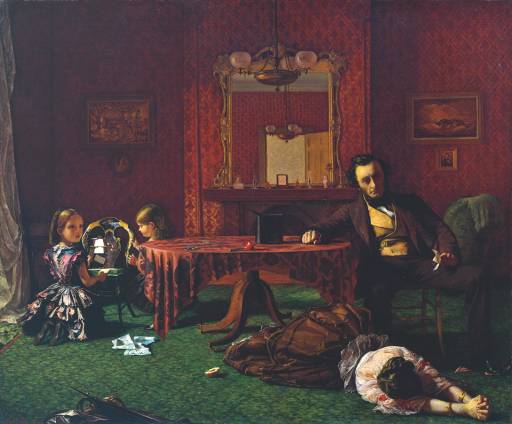
So to the painting or strictly speaking the triptych, painted in 1858 by Augustus Leopold Egg.

It tells the story of a wife’s infidelity and the repercussions on her, her husband and their children.

The title uses an imaginary diary entry, August the 4th - Have just heard that B— has been dead more than a fortnight, so his poor children have now lost both parents.

I hear she was seen on Friday last near the Strand, evidently without a place to lay her head. What a fall hers has been!

The central panel is the moment that the affair comes out into the open while to the left is the fate of the mother and youngest daughter under the arches by the Thames, and to the right the scene of the older children alone in a room consoling themselves in prayer.

Here then are the three key episodes with Misfortune in the centre, Despair to the left and Prayer to the right.

And all three are rich with symbolism if you know what to look for and can make the links.  So while the drama unfolds, two girls are momentarily distracted from the fragile house of cards they are building balanced on a book by the French novelist Honire de Balzac.

A half-eaten apple that emblem of temptation lies near the wife and the remaining half sits on the table by the husband  stabbed through with a knife.  And there is much more on all three paintings.

Now I do not pretend to have picked these details up and came across the references in Mrs Robinson’s Disgrace The Private Diary of A Victorian Lady* which I am rereading after a break of a few years.

It is my beach book for the week and tells the story of woman’s brief affair with a younger man who then runs a mile when the case the aggrieved husband sues for divorce using the new divorce laws.

The 1850s were still very much a period when married woman had few rights. .

 She had “no legal existence, her being is absorbed into her husbands.”**"

She could not undertake legal proceedings or keep her earnings or spend her own money, and “has no legal right even to her own clothes or ornaments; her husband may take them and sell them as he pleases.”***

Divorce had been made easier in 1857 and the new Divorce Act included provisions for the protection of married women’s property, allowed wronged wives to keep their earnings and relaxed the standard of proof for adultery.

It was a step forward and in the first five months of 1858 180 petitions were brought before the Divorce Court. The Lord Chancellor announced himself pleased and commented that “Now all classes of people are placed upon the same footing.”

All of which might have been fine for the Brighton solicitor, but was of little use for the factory hand in Manchester or the agricultural labourer here in Chorlton.

And there is the rub.  The new law continued to reflect the needs and interests of the propertied and moneyed classes.

Not only was a recourse to law still expensive but it remained weighted I favour of men.  “The new law stipulated that to secure a divorce, a husband needed to establish just his wife’s infidelity, where as a woman needed to prove that her husband was not only unfaithful but also guilty of desertion, cruelty, bigamy, incest, rape, sodomy or bestiality.  

Because she might bear another man’s child, the unfaithful wife threatened certainties about paternity, kingship, succession and inheritance, the underpinnings of bourgeois society.”****


Now I will not tell you what happened, mainly because I haven’t finished it but it is as they say a good read.

And for me it is full of references to life in mid Victorian Britain, so in the course of the story you are taken down the medial theories about sexual health, the fad with water cures and much more.  Added to this there are rich references from the writers of the period including Darwin.

And for me it is a perfect balance to the work I have done on the history of our own rural township at the same time.

Pictures; from the triptych, Past and Present by Augustus Leopold Egg, 1858

*Summerscale Kate Mrs Robinson’s Disgrace The Private Diary of A Victorian Lady, Bloomsbury 2012,
**Mrs Norton, Letter to the Queen, 1855
***ibid Mrs Norton
**** ibid, Summerscale, page 123

Thursday, 24 May 2012

What they wanted us to buy in 1850 part two

In an age before the National Health Service with no antibiotics, those that could afford it looked for any means by which they could stave off illness and remain healthy.

 Here from 1850 is a delightful advert for Mrs Holland’s Hydro-Vapour and Medicated Baths.

Picture; Slater’s Directory of Manchester and Salford 1850

Thursday, 10 May 2012

What they wanted us to buy in 1850 part one


Now I have been posting adverts from the year of my birth, and have decided to go one better and reveal ones from the 19th century.  

They were all taken from Slater’s Directory of Manchester & Salford 1850, which was just 101 years before I was born.

In age when few could afford a doctor or even a visit to the chemist, there were always the pills which were often offered as a cure for almost anything and everything and which were sold by agents to pubs, grocers, butchers as well of course as chemists.

Picture; Slater’s Directory of Manchester & Salford 1850