Showing posts with label Didsbury in the 1840s. Show all posts

Thursday, 27 March 2025

A history of Didsbury in just 20 objects ... number 19 ……. the tourist’s tale ….

The story of Didsbury in just twenty objects, chosen at random and delivered in a paragraph or more.

I doubt that Alexander Somerville was the first tourist to fall in love with Didsbury.

He was a journalist and in the June of 1847 had come over to Chorlton looking for potato blight, moved across the Mersey by the Greyhound pub at Jackson’s Boat and ended up in Didsbury.

A place he wrote “of great beauty- not surpassed even by the beautiful fields, meadows, gardens, and the public pathways through them, lying around London.” *

And went on to revel in the place, stating boldly, “Let the traveller, passing out of Cheshire into Lancashire by the Northern Ferry, who loves to loiter on the road, and see sights, come at the hour of summer sunset.  

Let him approach Didsbury, and look back suddenly through the trees, the traveller will see the houses standing on the brow of eminence, and the gardens with them, and the people looking out of opened windows, the very houses gazing, as it were, with wonder; and the old church, with its graveyard, and the dead of a thousand years around it, standing in the very brink of the eminence.”*

And yes I know Ford Lane, 1933, is not Alexander Somerville in 1847, but try finding an appropriate image.

Location; Didsbury

Picture; Ford Lane, from the collection of A.H. Clarke, 1933

*Somerville, Alexander, A Pilgrimage in search of the Potato Blight, The Manchester Examiner, June 19th, 1847


Monday, 10 March 2025

A history of Didsbury in just 20 objects no. 5...... the tithe map

Today I went walking the lanes of East Didsbury in the summer of 1845.

Now as daft as that might sound it is possible to recreate such a walk using the census returns, the OS map for the period and the tithe documents.

And it is the tithe document and more especially the tithe map which has helped me with this imaginary stroll along the Wilmslow Road, past Parrs Wood House and on to the parish church, the village green and the two pubs.

It was based on a survey undertaken by Mr. J Tinker of Hyde in the February of 1845, and details the ownership of the land, the tenants who worked it, and the use the land was put to, as well as the size of each field and its rateable value, along with who owned or rented the properties spread out across the township.

So armed with the map I know that as I made my way along Wilmslow Road I would have passed a mix of meadow and arable land, with the odd little orchard before reaching the village green which had yet to be enclosed by Mr. Bethell as his own personal garden in front of his pub.


 And then if I so chose, I could have wandered off west across the township, all the way to the border with Chorlton.

Later I may return with stories of some of the people who lived along Wilmslow Road, but that will be for another time.

Leaving me just to explain that the numbers on the map refer to an entry in the  schedule which listed the owners of each parcel of land, and properties, the names of the tenants, and the values of the land as well as the use it was put to.

Location; Didsbury

Picture; detail of the 1845 tithe map for East Didsbury part of the tithe survey, undertaken,in 1845, by Mr. Tinker, Joseph Townsend, and Charles Robert Brandy and redrawn by Frank and Teretta Mitchell, 1978


Tuesday, 20 August 2024

Joseph Johnson, radical, farmer and almost a Didsbury Radical

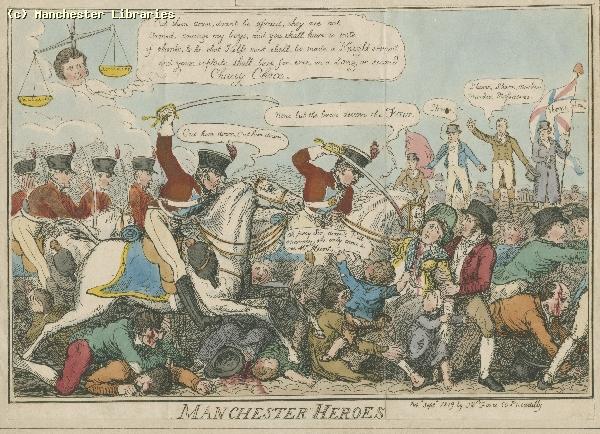
The Peterloo Massacre still has the power to shock and ranks alongside the Sharpville Massacre in South Africa in 1960 and the Kent State killings in Ohio in 1970 as a moment when peaceful demonstrations were met with the full ferocity of State power.*

And it is of Peterloo I want to think about today and in particular the part played by Joseph Johnson, one time radical who lived in Northenden and whose political past gave rise to a potato being called the “radical.”

Now as many of you know I am searching for our radical past here in Chorlton, not out of a nostalgic wish make the place politically correct but because it seems to me that there would have been people here with views that ran directly opposite to those of the establishment and the wealthy.

There is evidence that there were people from both Stretford and Urmston present at Peterloo, and this shouldn’t surprise us either.  Both were places where there were significant numbers of weavers and these were a group who had become radicalised as their industry went into decline.  So according to one source 151 of those wounded at Peterloo were weavers, which represents 50% of all casualties whose occupations are known.**  And we had some weavers.

So it is not beyond the bounds of possibility that we made a contribution to that 80,000 strong crowd, but that is where at present we have to leave it, with just a maybe.

His home in 1905
That does still leave me with Joseph Johnson, who was on the platform in St Peter’s Field, during the Peterloo Massacre and was arrested for “assembling with unlawful banners at an unlawful meeting for the purpose of inciting discontent,”  found guilty, and on his release in 1821 settled in Northenden.

He was born in Manchester which some sources narrow down to Didsbury in 1791 and became a successful brush maker.

A strong supporter of universal suffrage and annual parliaments, Johnson joined the Manchester Hampden Club formed by John Knight. In 1818 Johnson helped John Knight, James Wroe and John Saxton to start the radical newspaper, the Manchester Observer. Within twelve months the Manchester Observer was selling 4,000 copies a week. Although it started as a local paper, by 1819 it was sold in most of the large towns and cities in Britain. Henry Hunt called the Manchester Observer "the only newspaper in England that I know, fairly and honestly devoted to such reform as would give the people their whole rights."

In March 1819 Joseph Johnson, John Knight and James Wroe formed the Patriotic Union Society. Johnson was appointed secretary of the organisation and Wroe became treasurer. The main objective of the Patriotic Union Society was to obtain parliamentary reform and during the summer of 1819 it was to hold a meeting here in Manchester at St Peter’s Field.  The rest as we know was a tragic outcome, and one which in its way was no less awful for Johnson.  For after being imprisoned his wife fell ill and died and he was refused permission to attend the funeral. ***

On his release he settled in
Northenden and we can track him in the village from 1841 through till his death in 1872.  During that time he gave his occupation variously as brush maker and later land proprietor and it will be as such that he planted potatoes which became known as “radicals” 

A fact that might have been lost to us had not another radical who described his visit to Chorlton in the June of 1847.  This was Alexander Somerville who having crossed over the Mersey recorded that

‘My companion said-“It was in this way; it was a sort of potato introduced here by Mr Johnson of Northern; and as he was a radical, they called the ‘tatoes radicals too.  Don’t you remember the song that used to be sung?  ‘God Bless Hunt and Johnson, and all who take their part;’ that was the Mr. Johnson, now of Northern, a very good gentleman he is who brought this very good kind of potato here which they call radical.”’

Which should really be the end of the story but I shall close with his will.  On his death he left £2000 and was described as “gentleman.”  I wonder if he would have approved of the description.

Pictures: Courtesy of Manchester Libraries, Information and Archives, Manchester City Council Peterloo, 1819, m77801, Ravenswood home of Joseph Johnson, 1905, m36100, Veterans of Peterloo 1884, m07594

*On an August day in 1819, anything between 60,000 and 80,000 men, women and children had assembled in St Peter’s Field to listen to the case for reforming the representation of Parliament.  Just before 2 in the afternoon a unit of Cavalry charged into the crowd with their sabres.  The deaths resulting from that charge have never been exactly established but sources claimed between 11 and 15 people were killed and up to 700 injured.  At Sharpeville in March 1960, after a day of demonstrations, the South African police opened fire on the demonstrators, killing 69 people. At Kent State University in Ohio, four students were shot and nine wounded by the National Guard during a peaceful protest at US involvement in the Vietnam War.

**Bush, Michael, The Casualties of Peterloo, 2005

*** http://www.spartacus.schoolnet.co.uk/PRjohnson.htm


Sunday, 18 June 2023

A Didsbury weaver, a housemaid and lots more …………………

This was to be the story of Mary Dean of Didsbury and her time as a housemaid in the very big house of Sir Ralph Pendlebury, who lived at Heaton Bank in Heaton Mersey.

Mersey Bank House, Heaton Mersey, 1854
Sir Ralph described himself as the employer of 75 hands, and his house was recognized as a grand one, with a large “spacious entrance hall, with stone staircase, and dome light, a dinning room, breakfast room and study, five bedrooms, water closet and bathroom fitted up with a bath and hot and cold water”.


Added to which there was a wash house and laundry, sundry outhouses “with an excellent coach house and good stabling for five horses harness room and hayloft …… and a large conservatory heated by hot water”  and finally a large south facing garden, well stocked with fruit trees, [and] commands a delightful and picturesque view of a great part of the county of Chester”.*

All of which meant that Mary Dean who along with a cook was the only domestic servant, must have had her work cut out.

Sadly, we will never know what she thought of the job, as the only reference to her time there comes from the 1851 census, which had been taken in the April of that year.

Just when she started and indeed when she left is unclear, but I know she was back in Didsbury by 1860 for the birth of her daughter, Elizabeth Jane.

The sale of Mersey Bank House, 1843
Back then “service in a big house” remained one of the prime means for a young woman to earn a living, and it was usual for employers to recruit from outside the district, which ensured that the secrets of the family were less likely to become common gossip.

I doubt we will ever get to know how she got the job, but there was an informal arrangement by which clergy would write to neighouring parish churches, alerting them of vacancies in the big houses.

Barlow Moor, Didsbury, 1854, with the cottages stretching north
And for Mary, Heaton Mersey was close enough to her family in Didsbury to mean that the occasional visits home were easy enough.

I suspect she would have walked, although there were always itinerant traders and even carriers plying the route from Manchester through Didsbury and the Heatons to Stockport who might have offered her a lift and perhaps even for free.

I would like to know more of her time as a housemaid, but as sometimes happens, there is no more.

Not that this is the end of the story of Mary, who I know was born in 1826, and spent her early life in Barlow Moor.

And at this point the story takes a surprising turn, because at her baptism in the parish church, her father gave his occupation as a weaver, a job he had been pursuing since at least 1821 when he married Mary Thompson.

Barlow Moor, pre 1880
Even using the rate Books and census returns it is difficult to pinpoint exactly where in Barlow Moor he lived, but I rather think it will have been one of the cottages which stretched north along Wilmslow Road from the junction with Barlow Moor Road.

I do know that he was paying three shillings a week, and his may be one the cottages which appear in a series of photographs, taken before 1880.

His name was Henry, and he is one of only a handful of Didsbury weavers that appear in the official records.

And his was a declining industry.

Handloom weaving was conducted in a wide arc both north and south of Manchester and in the areas bordering on northern Cheshire, Derbyshire, and the West Riding of Yorkshire.

By the mid-18th century cotton had replaced wool as the main textile material and across the county areas specialized in such things as cambrics, muslins and ginghams. Just over 5 miles to the east near Gatley they had been growing flax and weaving linen from at least the mid-17th century.

Possible cottages lived in by the Dean family, pre 1880
But exactly what and how it was produced in the township is unclear. It may be that Henry and his family delivered each of the processes from carding and spinning to weaving but it is more likely with the mechanization of spinning and its concentration in the factories of Manchester that he may have been involved just in weaving.

At one stage our weavers may also have been involved in dyeing, because there are large numbers of crocuses that grow locally. In the past they were used for dyeing clothes alongside their culinary and medical uses.

In Stretford in 1826 there were 302 looms providing employment for 780 workers supporting 151 families,**  and as late as the 1840s there were still seven, while in Withington there were nineteen cotton weavers, mostly concentrated in Lady Barn and Fallowfield where they specialized in “weaving checked handkerchiefs and ginghams.”  ***

Nationally weavers had been the largest single group of industrial workers, and at any one time during 1820s, 30s and 40s, and they came third in the list of occupations after agricultural labourers and domestic servants.

Possible cottages lived in by the Dean family, pre 1880
The estimate of the Select Committee of 1834-5 reckoned that 800,000 to 840,000 were wholly dependent on one of the branches of weaving.****

But the onward march of mechanization and factory production in al three processes of making textile, meant that Henry and his fellow weavers were on borrowed time.

And so while we find him listing his occupation as a weaver during the 1820s through to 1841, in the following decade he described himself as a “Porter” and by 1861 as a “labourer”, while the numbers of weavers across Burnage and Didsbury fell between 1841 to 1851.

All of which points to the very personal tragedy of the collapse of weaving locally, and leaving me with just the observation that his granddaughter worked briefly in a Manchester cotton factory before returning to Didsbury and becoming a tailoress, which I suppose is the closest we get to her grandfather’s trade.

Location; Didsbury, Heaton Mersey

Pictures; Heaton Mersey and Barlow Moor, 1854, from the OS map of Lancashire, courtesy of Digital Archives Association, http://digitalarchives.co.uk/

*Sale by Auction, The Manchester Guardian, December 16th, 1843

** Leach, Sir Bosdin, Old Stretford, Privately Printed, 1910, page 23

***Williamson, C, Sketches of Fallowfield, John Heywood, Manchester, 1888 page 34

**** Thompson, E.P., The Making of the English Working Class, Pelican Books edition 1968 page344


Wednesday, 24 June 2020

The house, a field and the stories of Mr. Nathan Slater and Henry Hawkins ……… 175 years of Didsbury’s past


Now, you just never know where a story will go, and I was not prepared for the twisty turny tale that started with a request for information on a big house on the corner of Lapwing Lane and Wilmslow Road.

The house of Mr. & Mrs Hawkins, 2019
Today it consists of six apartments, but for most of its existence it would have been home to one of the more comfortably well-off families of Didsbury.

It was built in 1896 and was owned and ocuppied by Henry Herbert Hawkins who was still there in 1911.  

He listed himself as an export brewer and in 1894-5 had offices in no 5 Cross Street which is just along from Market Street towards Albert Square. 

He was born in 1852, and married Florence Elizabeth Foster in the Methodist Wesleyan Chapel on Stockport Road.  They had two children and employed three servants.

They were clearly on the way up because in the late 1880s and early 90s they were in Chorlton in a semi on Barlow Moor Road and later still in Victoria Park.

Their new home had ten rooms and was situated at spot which had still been fields in the early 1890s commanding uninterrupted views south to Parkfield Road and on down past the railway line to the tennis courts and North Street.

The fields of Mr. Slater opposite Fog Lane
And it was the field that interested me, because in 1845 this had belonged to a Nathan Slater who also owned land across Didsbury.

He is a shadowy figure, who only appears in the rate books for Didsbury in the 1840s, but there is a Nathan Slater resident in Manchester in Booth Street in 1841 who is listed in the census return and several directories, who reappears as a merchant in Withington in 1852.

Back in 1841 he owns the Crown Inn on Booth Street and here the mystery deepens, because the property is occupied by fourteen people, one of whom is Mr. Slater, and what might be his mother, and twelve others of whom one is an Isaac Thorniley who nine year later is himself listed as the landlord of the pub.

The Crown Inn, 1851 facing Booth Street
The building is large and so could accommodate all fourteen, but on the maps of the period it is situated on the corner of Fountain Street and Nicholas Street, directly opposite Booth Street.

So, it is a tad confusing, which leads me back to that field and Mr. Slater, who might have inherited the land or given that he styled himself a “wine spirit merchant” he may have decided to diversify during the 1840s.

There are no records in the rate books that he owned the land before 1845, but that might just be one of the records that have been lost.

But I will still go on looking for him and just where he lived in Withington and trawl the documents for more on the family that came to live in the house which was built on his land.

Location; Didsbury


Pictures; Mr.& Mrs. Hawkings house, 2019, from the collection of Andrew Simpson, and the field belonging to Mr. Slater in 1845, from the OS map for Lancashire, 1854, and Booth Street, Nicolas Street and Fountain Street, 1851, from Adshead's map of Manchester, courtesy of Digital Archives Association, http://digitalarchives.co.uk/

Saturday, 20 April 2019

What was lost is found .........down in Didsbury with a forgotten house and a team of archaeologists

Another story from 2015.

I doubt that there are that many people today who will remember the two houses buried under the car park in the old Didsbury College

Down in Didsbury with cellars, archaeologists and lots more
They date from at least the 1840s, and were demolished sometime in the 1960s and have been brought out of the shadows by an exciting archaeological dig by a team from CgMs who are working on behalf of P.J. Livesey the company which will be developing the site now that the college has moved down to Birley.

When the dig began no one was quite expecting what was found.

It began as it always does with a trial trench, stretched to two and by degree an extensive set of stone flagged cellars, some bits of marble fireplace the odd bit of electrical equipment and a gas fitting have been revealed.

The site in 1844
All of which suggests that one of our two houses was fairly high status.

So now I am off on a bit of a hunt to find out more.

The archaeologists will be finished by the end of the week and their report on the site and the finds will follow in due course but I can’t wait and so have begun trawling the census returns and street directories looking at clues for who lived there.

And as so often happens it was a chance conversation with Noel who was walking his dog that offered up a tantalising first clue in the form of a picture which may exist of the house and his memory of its demolition sometime in the 1960s.

So in the fullness of time I shall go looking for the story behind the houses, and close with a thank you to Robert and Pascal who are two of the archaeologists who took us round and to P.J. Livesey who allowed us down there and supplied the pictures.

The site today

And today, two years on from 2017, there are new buildings where in the picture opposite, there were trenches, builder's spoil and heaps of mud.

Pictures; the dig down at Didsbury, courtesy of P.J. Livesey and detail of the area in 1853 from the 1841-53 OS for Lancashire, courtesy of Digital Archives, Association, http://www.digitalarchives.co.uk/

* P.J. Livesey http://www.pjlivesey-group.co.uk/

**CgMs, http://www.cgms.co.uk/page/Home_1/1.html