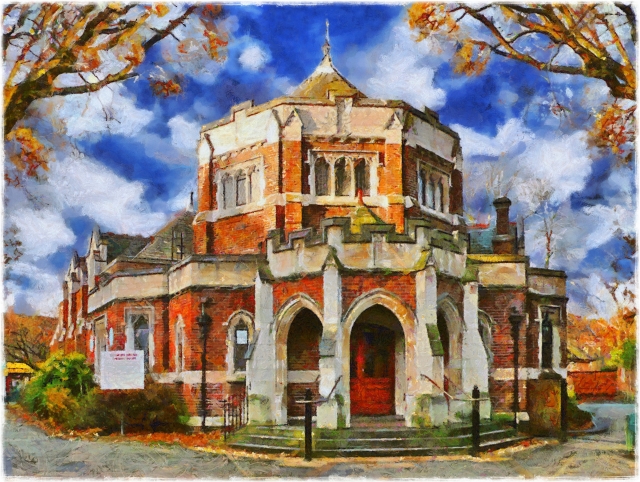
Showing posts with label Didsbury in the 1950s. Show all posts

Monday, 24 March 2025

Looking for pictures of Didbury’s oldest cinema

The cinema on Elm Grove was Didsbury’s oldest picture house and it saw out all its rivals.

The Tudor in 1959
In its time it had many names from the Didsbury Picture House, and the Didsbury Theatre through to the Tudor which it adopted in 1951 and retained till its closure in 1967.

And there will be many in Didsbury who will remember it as the Tudor and may even recall that they were there on the last night on August 12 when it showed Julie Christie in Fahrenheit 451.

By then it had outlived the bigger and more showy Capitol on School Lane which had opened in 1931 with a blaze of publicity as the Union and was partially destroyed by a fire the following year, reopening in 1933.*

Advert 1914
The Tudor was always the smaller neighbour.

It was open for business by 1913 when it was called the Bijou Electric Theatre, seating 350 and run by H Merryweather.**

Looking at the picture from 1959 it may be that the cinema went through either an extension or rebuild.

And that just leaves me to make an appeal for pictures if the Tudor cinema or better still when it was the Bijou.

Location Didsbury

Picture; Elm Grove, 1959, J F Harris, m2333, courtesy of Manchester Libraries, Information and Archives, Manchester City Council, http://images.manchester.gov.uk/index.php?session=pass and advert, from The Kinematograph Year Book, 1914

*The Golden Years of Manchester Picture Houses Derek J Southall, 2010

** The Kinematograph Year Book Program Diary and Directory 1914

Sunday, 16 June 2024

Stepping back 65 years ………..Parrs Wood as most people will not have seen it.

Now, I know it’s a cheap bit of history, not to say very lazy, but here on a warm summer’s day is that bit of Parrs Wood beside the Gateway pub.

Today, the spot is dominated by that huge footbridge, which I am the first to concede is entirely appropriate in the interests of safely crossing the road, but how ugly it is.

And how it sets the scene for the surrounding area, which is dominated by entertainment complex, that plethora of road signs and of course the incessant whiz of traffic.

I have been trying to date the footbridge which was not there when I would wander down from Didsbury to sit in the small island of tranquility which was the small park.

But back then there was still a bus garage, the old high school was still new, and the Kingsway was less busy.

So, for all those that share my memory, and for everyone else who might yearn for a quieter Parrs Wood, here is what it was like a full 61 years ago ……. Nothing more nothing less.


Location Parrs Wood

Picture; road works at Parrs Wood, 1959, Courtesy of Manchester Archives+ Town Hall Photographers' Collection  
https://www.flickr.com/photos/manchesterarchiveplus/albums/72157684413651581?fbclid=IwAR35NR9v6lzJfkiSsHgHdQyL2CCuQUHuCuVr8xnd403q534MNgY5g1nAZfY

Thursday, 4 January 2024

Looking for the Didsbury street they stole ……

Well, a bit deceptive as the street in question is still there it’s just its name they stole.

Northgate Street, 2021
All of which will prompt the party poopers to exclaim “what an outrageous and silly bit of nonsense”.

And so it is, although that said there is a serious story here which revolves around the comprehensive city-wide policy of eliminating certain street names which I guess was to do away with duplications.  

I suppose it has always gone on, but I know that in the 1960s and 70s plenty of old names vanished.

Many of them were in Chorlton, but now I have come across the first in Didsbury and it was North Street which ran off Wilmslow Road close to the clock tower.

North Street, 1957

Today it is Northgate Street and for anyone still a tad puzzled as to where it is, just look for the Station pub which remains a delightful little place to pass the time.

The Station on North Street, 1959
I first came across it in 1978 on a night spent in the company of John Cordwell who lived in Wolseley Place, and always maintained that he was the man who shouted out “Judas” at the Bob Dylan concert in Manchester in 1966.  

John and I had worked together at a high school in Wythenshawe, and while I had stayed, he moved on to a post at Didsbury College of Education.  

We kept in touch, and more than once squeezed into the pub which at weekends was always heaving.

Just when John confided the Dylan story to me, I have long ago forgotten, and if I am honest I only half believed him, given that he did recount amusing and sometimes impossible tales, which were always  told with a slight smile and a twinkle in the eye, as if to say challenge me if you dare. 

That Dylan concert, 1966
Moreover, while I knew him as John, many of his older friends knew him as Nigel, and later still I rather think he reverted to Nigel.

It is a memory I long cherished and just when I began to think that I had dreamed it up, the confirmation came in an article in the Independent by Andy Kershaw, leaving me to tell friends that not only had I known the man that shouted out Judas to Bob Dylan, but it predated the national revelation by thirty years.

And that takes me back to Mr. James Edward Smallpage who was confident that his new beer shop on the corner of Wilmslow Road and North Street would be a success.

It started selling beer in 1879, and with an eye to the future, was directly opposite the new railway station which opened in the January of the following year.

And by 1881 it was trading as the Station Hotel, which rather cornered the market in railway names, given that his two nearest rivals were the Wellington and the Dog and Partridge.

He might even have adopted the name earlier, but sadly the rate books for the years 1880-81 for Wilmslow Road are missing.

North Street, and Wilmslow Road, undated
Before his entry into the world of beer, he was variously a cashier, and clerk and later reverted to this occupation, having given up the Station Hotel in 1885.

Thereafter the Station Hotel had a series of owners and managers and in 1911 the man pulling the pints was a William Wrightman who was 45 years old and a widow, who shared the pub with an Annie Elizabeth Robinson who described herself as “housekeeper”.

Cabs and people looking towards North Street, undated
Now this maybe the same William Wrightman who is listed as a cab driver at 40 Wilmlslow Road, which was just a few doors down the road in the row beside Saints and Scholars and is now the small open piece of land adjoining the library.

The romantic in me has often speculated on the relationship between Mr. Wrightman and Ms. Robinson.  

Both were from Lincolnshire and she was working as a cook in one of the big houses on Wolseley Place, a decade earlier, so their paths could have crossed many times.

She may even have encountered him in the cab office which stood directly opposite the railway station and the Station Hotel.

And after a few pints of Marstons in their old pub my imagination runs to the idea that he might be one of the figures caught in an old photograph of the railway station and the cab shelter.

And that is pretty much it except to own up that the search for North Street was not prompted by me, but by a request from someone who looking for what is now Northgate Street.

I wasn’t alone in offering up an answer, nor was I the first but I was the one with time on my hands to go looking for a story, and as you do found heaps of them.

In time I will trawl the rate books and find out when the houses fronting the street were built and maybe pick one to explore the histories of its occupants.

For now, I will leave you with the revelation that in 1921 the five properties on the southside were occupied by a mix of people including a clerk, salesman, engineer, florist, and “Crumpet Baker” along with the woman who described herself as “Domestic at the Poor Law Guardian Rhodes Memorial Homes”, which I suspect I will have to revisit.

As well as that outrageous plug for the book on Didsbury Pubs, available from www.pubbooks.co.uk

Location; Didsbury

Pictures; Northgate Street, 2021, courtesy of Google maps, North Street, 1957, from the OS map of Manchester and Salford, 1957, the Station 1959, m42646, courtesy of Manchester Libraries, Information and Archives, Manchester City Council, http://images.manchester.gov.uk/index.php?session=pass, and Wilmslow Road undated

Tuesday, 23 May 2023

A different Parrs Wood …… 1959

Now I am not a great fan of what has happened to Parrs Wood.

The small recreational ground is surrounded by fast moving traffic and dominated by the entertainment complex along with all those road signs.

But I can remember a quieter Parrs Wood which still existed in the 1960s.

True there was the bus depot and the large Parrs Wood Court, but there was also open land, which was occupied by the High School and the Rural Studies Centre.

Back then the recreational area still felt it had a presence and coming across it, after going under the railway bridge was always a pleasure.

So, with that in mind, here are two pictures of that long gone Parrs Wood.

They date from 1959, just ten years before I washed up in the City and first discovered East Didsbury.

Location; Didsbury,

Pictures; Parrs Wood, 1959, "Courtesy of Manchester Archives+ Town Hall Photographers' Collection", https://www.flickr.com/photos/manchesterarchiveplus/albums/72157684413651581?fbclid=IwAR0t6qAJ0-XOmfUDDqk9DJlgkcNbMlxN38CZUlHeYY4Uc45EsSMmy9C1YCk 

Thursday, 10 June 2021

The Parsonage in Didsbury by Derrick A. Lea


This is another of the drawings  of our local artist Derrick A. Lea for a while.

He lived here in Chorlton from the late 1940s till the 1970s, produced many fine woodcuts and has been pretty much forgotten.  Of the ten pictures in the collection six are of Chorlton and all but two of these have featured in the blog.*

But this one is the Parsonage in Didsbury and given that other people have written about the place with far more knowledge than I here is an extract from the site of The Didsbury Parsonage Trust.

“The Didsbury Parsonage (Old Parsonage) is a Grade II listed building situated opposite St James' Church, adjacent to the original village green of Didsbury, Manchester. The building and gardens were left to the citizens of the City of Manchester by Alderman Fletcher Moss in his will following his death in 1919.

The building is probably the second oldest one in Didsbury after St James' Church. It may have been built, at least in part, around 1650 ‘for the use of the minister’.  

The most famous and influential resident was probably Fletcher Moss


In 1864, Fletcher Moss, then aged 22, moved in with his parents and subsequently bought the house in 1885. He died in 1919 after an active life of public service and was renowned for his in depth writing on local history, flora and fauna and local people.

Alderman Moss bequeathed the house and gardens to the City of Manchester on his death in 1919 because he wanted the house and its contents to remain, as far as possible, intact 'to show what a comfortable house of the olden times was like'. Unfortunately, the house became difficult to maintain and in 1922 many features, including stained glass and fireplaces were removed.

In due course the house became an art gallery, containing much of the Fletcher Moss Collection, which included several Turner paintings (now in the National Collection). The emphasis of the displays was on items made in or associated with Manchester.


As an ‘economic measure’, the City of Manchester closed the gallery in the 1980's.  In the fine gardens can be seen the graves of several of Fletcher Moss’s dogs, under the yew tree in the shrubbery fronting the house.”**

Picture; The Old Parsonage, Didsbury, Derrick A. Lea


* http://chorltonhistory.blogspot.co.uk/search/label/Derrick%20A%20Lea
** The Didsbury Parsonage Trust, http://didsburyparsonagetrust.org.uk/history/

Tuesday, 9 June 2020

A ghost sign in Didsbury, a cabinet maker and the disappearing coal yard

Ghost signs are by their very name hard these days to find.  

They are the painted signs of businesses which have long since gone leaving only a fading record of what was once traded from the premises.

This one is in Didsbury on the corner of Wilmslow Road and School Lane and advertised the cabinet making business of Thomas Spann who operated from numbers 35 and 37 Wilmslow Road, which are now a coffee shop and bookmakers.

Originally the sign read TEL, 234 DIDSBURY, SPANNS, BLINDS, REMOVING, CARPET LINOLEUM & BEDDING WAREHOUSE.

The Spann’s were here from the early part of the 20th century and what we see now was not what Thomas Spann would have been familiar with.

In 1911 in front of the gable end which fronts what is now the side of School Lane was the coal yard and offices of the Bridgewater Collieries and our ghost sign extended down almost down to street level.

I am not sure when the coal yard went but it may have been when what was then Hardman Street was widened.

This may also have been when the road was renamed School Lane and coincided with the decision to eliminate duplicate street names which I suppose caused a degree of confusion.

But like all good stories this has further twists, for back in 1959 the shrunken space on the corner of School Lane had become the offices of the National Coal Board, who in turn had added a tall chimney to the gable end of what had been Spann’s shop and may also have been responsible  for painting out the sign.

And with the passage of time, the NCB offices are now the Costa Coffee outlet which has extended into number 35 Wilmslow Road and offers their customers the opportunity to sit on the roof gazing down on Didsbury with the ghost sign as a backdrop.

Now in time I might well explore the history of Thomas Spann, starting with the census returns and trawling the directories to fix the moment he arrived and when he ceased trading.  But that I think is for another day.

Loation; Didsbury, Manchester


Pictures; of the corner of Wilmslow Road and School Lane today from the collection of Andrew Simpson, and from 1959, courtesy of Manchester Libraries, Information and Archives, Manchester City Council, Wilmslow Road, D Oakes, m42375, http://images.manchester.gov.uk/index.php?session=pass


Monday, 25 May 2020

Stepping back into Didsbury's past at the Old Cock in 1954

We are in Didsbury by the Old Cock Inn and the year is 1954.

Just twenty or so years later I would use it as a dinner time haunt, but by then it had changed almost beyond recognition.

The shop and the garage doors had gone and  that magnificent porch by the front door reduced in size.

Go back another fifty years and those garage doors didn’t exist instead the shop extended across to the end of the building.

All of which makes this photograph a nice period piece.

In the distance just popping above the tree line is what was once the chapel for the Methodist college but which had long since been converted into a library and lecture rooms first for the Methodist students and then for those young men and women training to be teachers.

The car parked outside clearly dates the picture as does the partially hidden sign for Emergency Water Supply.

The letters EWS could be found all over the city and date from the last war when extra water might be needed to fight fires during an air raid and when the water mains had been damaged.

Most have long since been painted over or have faded with age and when I went looking for this one it too had gone.

It might still have been there in 1974 but I can’t remember, that said I can date the picture to 1954 because it was one of a series produced by the Valentine Company in that year and while the photograph might be a tad earlier it won’t be much.


Location; Didsbury


Picture; the Old Cock in 1954 

Friday, 22 May 2020

Thoughts on a Didsbury just 60 years ago

Now I have featured this picture of the War Memorial and Library at Didsbury in an earlier story but I think it deserves to come out again. 

It dates from 1959 and at first glance it does not look that much different but that is to ignore the huge changes that have occurred in just the last few decades.

When Tuck and Son distributed this picture postcard, there was still a railway station opposite with a regular service in to the heart of the city and the Jones family having returned their overdue library books had a choice of shops to visit.

Unlike today where almost everything you want is under one roof they could have wandered from the station up towards School Lane calling in at grocery shops, a newsagents, Smith’s the dry cleaners and Tiny Tots (Outfitters) Ltd, along with Rushton’s the shoe repair service and BSM Radio.

Inside they would have been greeted with that old fashioned style of shop with wooden and glass counters, high shelves and a lack of background music and customer announcements.

And if that was not enough there was the cafe on the corner of Warburton Road along with the Conservative Club above R Dunn’s and the Liberal Party Offices beside The Paint Shop selling Capital Wallpapers on School Lane.

Today the same stretch is dominated by cafes, and restaurants with a few independent traders which is not to pass judgement on the changes only to reflect that there will be many stories and even pictures of the time just 56 years ago when Tuck and Sons sold their picture postcard of the War Memorial and Library with its uncluttered pavement and parked scooter.

All of which is a prelude to an appeal for memories, stories and pictures of this not so distant Didsbury and an outrageous plug for the book Didsbury Through Time.

Didsbury Through Time is available in Didsbury from Morten’s Bookshop on Warburton Street, Didsbury, and of course from all other bookshops.

Picture; War Memorial and Library from the series, Didsbury, Lilywhite, issued by Tuck & Sons, 1959, courtesy of TuckDB http://tuckdb.org/history

Saturday, 18 April 2020

A chip shop, a posh block of flats and stories of a haunted house .......... all down in Didsbury

I was talking to one of my Canadian cousins last week and the conversation got around to fish and chips as of course it would do.

Chris was the one who sent me a parcel of Canadian maple syrup products ranging from a bag of tea, to biscuits and sweets.*

And in return I offered to treat them when they were over to a fish supper.

What intrigued him most were the mushy peas so with that in mind we will do the business.

Now the chip shop has moved on somewhat from when I first ventured into one in New Cross.  I could only have been about 9 and we had been out somewhere.

I can’t remember ever having been in one before.

Both mother and nana always cooked their own food and a part from the occasional cake and glass of lemonade eating out was something we just didn’t do.

The shop was small and steamy with that smell of fried food which hung in the air, along with the banter and gossip from the customers, the old newspapers and the line of vinegar bottles and salt dispensers.

I don’t think there was even a space to sit and eat the fish and chips, you just queued, waited and quickly walked out into the night, eating them straight from the paper on the way home with that added bonus that on cold evenings the bag kept your hands warm.

I was reminded of those old chip shops when Peter showed me his painting of Fosters in Didsbury with its big picture windows and large presence in Lansdown House.

Lansdowne House with its shops is one of those solid properties that look as if it has been part of the landscape for a long time but it only dates from the middle decades of the last century.

It takes its name from the house which had stood on this site.

This was a fourteen roomed property set in its own grounds and bordered by South Road, Wilmslow Road and Ford Lane.

It was there by the 1820s when according to Fletcher Moss it “was the haunted Swivel House now grown into Lansdowne House.”

In 1935 the estate was pretty much as it had been a hundred years earlier.  The garden extended down to a tree lined boundary with another large house and in the grounds to the west was a large greenhouse.
Dean Road had yet to be cut through part of its garden and Ford Lane ran out to join Wilmslow Road as it had done for centuries.

Not that the modern block has stayed the same.

When the shops were new they had a uniformity of appearance that has in recent years been lost to individual shop fronts.

And that brings me back to the painting and in turn to reflections on the transformation of the chippy.

Back into the early 20th century the proprietors invariably listed themselves as “fried fish dealers” and like so many other businesses had benefited from the coming of the railway which made possible the bulk transportation of sea fish which combined with the potato offered up a cheap and quick meal.

In London there were a bewildering range of fish that you could buy along with saveloy and no chip shop today worth its salt would be without a selection of pies and halloumi steaks and a choice of curry sauce or mushy peas.

All of which I guess will give our Chris a hard set of choices.

Painting; Fosters Chippy, Didsbury, © 2015 Peter Topping, Paintings from Pictures,
Web: www.paintingsfrompictures.co.uk
Facebook:  Paintings from Pictures

Picture; Lansdown House circa 1950,  featured in Didsbury Through Time, by Andrew Simpson and Peter Topping

*Food parcels from the New World and thoughts on family far away, http://chorltonhistory.blogspot.co.uk/2015/08/food-parcels-from-new-world-and.html


Sunday, 9 February 2020

Travels through the village ………… part 1

The idea is very simple, select almost the same spot along Wilmslow Road through the village, and throw in a series of picture post cards taken from almost the same place over the last century.*

So here are the first two, from the 1960s and 1950s.


Location; Didsbury Village

Pictures; the Village, the 1950s and 60s


*The location of the village green  was down by the Didsbury Hotel and Old Cock.


Thursday, 5 September 2013

Didsbury in the summer of 1959 and an exciting new project

It is a familiar enough scene.

The War Memorial and Llibrary in 1959
We are looking across at the Library and War Memorial in Didsbury in the summer of 1959.

And a decade later when I began to explore this part of south Manchester I can’t say it looked that different.

Nor for that matter does it today.  The tree behind the War Memorial has matured and another stands in front of it which wasn’t there in 1959 and there is now a telephone kiosk on our left.

That said there is something very dated about our picture which has less to do with it being monochrome and more to do with the people and that scooter.

The Library
Picture postcards from a century ago show us a landscape which looks old and different, but here it’s almost now but not quite.

And that brings me to the new project and collaboration with my old pal Peter Topping.  For over two years we have been working together with Peter painting pictures and me telling the stories behind them.

It took us from our first exhibition at the Big Green Festival in 2011 to the history trails in local venues and most recently the History Wall down at Albany Road which told the story of Chorlton across an 80 metre display, allowing people to walk the history of the township.The display will soon be relocated at Chorlton High School.

And now Amberley Press have invited us to produce a book on Didsbury recent past.

Sitting in the sun by the memorial
The format is the well tried and tested one of 180 images divided between the past and the same scene today.

But to spice up the format Peter will be doing the initial research, taking the new photos, and converting some of the scenes into paintings while I am working on the people and stories that bring the old and new images together.

We are grateful to all those who have already contributed picture postcards from their collection, but would welcome more.

From the very beginning we decided that the picture post card was one of the most powerfu ways we could record that old Didsbury.

But we also decided that we would not restrict ourselves to those of the late 19th and early 20th centuries.

Didsbury's more recent past is just as important and with this in mind we hope to includ others from the middle decades of the last century.

The Library today, © 2012 Peter Topping
So our 1959 Tuck postcard has its own story to tell and is as much a part of Didsbury’s history as plenty from an earlier period.

But I will leave you with a preview of one of Peter's painting which will be included in the book.

I rather think it makes for a nice contrast with the photograph from 1959.

Picture; War Memorial and Library from the series, Didsbury, Lilywhite, issued by Tuck & Sons, 1959, courtesy of TuckDB http://tuckdb.org/history and Painting of Didsbury Library © 2012 Peter Topping
web www.paintingsfrompictures.co.uk facebook Paintings from Pictures