Showing posts with label High Lane. Show all posts

Tuesday, 3 February 2026

Under the gas lamp on High Lane in the summer of 1905


I can see why Cissie decided to send this postcard to her young brother in the August of 1905.

He was staying at the delightfully named Gas Works cottage, Ambleside in Westmoreland and it is more than likely that some of the children staring back at us were known to him.

On the other hand Cissie mentions her uncle so it is just possible the she was just staying in Chorlton at Richmond Road* and choose a picture which she thought would appeal to him.

And there is a lot here which I think would appeal to anyone looking at the postcard today.

We are at the point where St Clements Road, and Manchester Road join High Lane and Edge Lane and the children are gathered underneath one of original gas lamp posts which had been set up in 1875 by the Urban Sanitary Authority which within a year would become the Withington Board of Health with its own administrative headquarters on Lapwing Lane.

And for those really interested, our first domestic gas had been provided by the Stretford Gas Company in 1862 who piped their supplies along Edge Lane, while the following year Manchester Corporation extended its main from Seymour Grove.

All of which is more than a piece of historical trivia because on the promise of cheaper gas supplies from Manchester in 1904 turned the vote for our incorporation into the City.

This was part of “an attractive package” which the Withington Amalgamation League set up in 1902 argued would mean a fall in the rates, bring “libraries, baths, reduction in water and gas rates, lower cemetery charges, music in recreation grounds better fire and police protection more deliveries of letters, technical classes, shares in tramway and electricity profits and the prospect of Ship Canal and School Board rates decreasing.”**

This was for many an offer to good to refuse and one that was shared by the City Council.  At their October meeting in 1903, much was made of the assets that Withington would hand over to the Corporation, including the newly built “hospital to which attracted 20-30 acres of land, ....[and] beyond that land for a smallpox hospital, a field for the extension of the tram services and the sewage farm, 80 acres in extent.”

And as Fletcher Moss pointed out amalgamation would bring Alexandra Park “that large park into the hands of the Council” and furthermore “the Corporation was the largest ratepayer in the Withington district and by far the largest owner of freehold estate with the possible exception of Earl Egerton” which meant they would be no longer paying out rates to Withington UDC.

And it seemed only to get better.  Under the terms of amalgamation all existing staff of the Withington UDC were taken on by the Corporation and “the price and conditions of supply of gas, water and electricity to the inhabitants of Withington shall be the same as those of the citizens of Manchester.  That all future tramways in the district of Withington shall be laid as double lines along carriage ways not less than 32 feet wide between curbs.  That two free libraries and two swimming baths to be established in different parts of Withington within five years..... that for a period of twenty years the rate shall not exceed 4s in the £.”

This was a set of promises which proved enough to clinch the vote for incorporation by 4,086 to 805.

So in the summer of 1905 our children had been residents of the city for just under a year.

Now whether they were out from school at dinner time or a weekend gathering is a bit difficult to say, but the picture looks to have been taken in the morning so maybe it was just that usual gathering of children drawn by the magic of a camera.

But not everyone is that bothered at the presence of the photographer.  To our right the work of loading the carriage outside Stockton Range goes on unabated. I would like to know if the carriage belonged to the residents of number 2.  The property did have both a coach house and a stable, so it is possible that Mr Charles Edwards who lived there may have been planning a journey.

Meanwhile in the distance sitting in the sun in front of the church are a mix of what I take to be a mother, grandmother assorted children and babies in prams.  It is a detail I might have missed if it were not that one of the prams looks remarkably familiar and is very similar to the one that just under 90 years later we would use for our own children.

And all that form Cissie’s postcard.

Location; Chorlton-cum-Hardy

Picture; from the Lloyd collection and Courtesy of Manchester Libraries, Information and Archives, Manchester City Council, Withington Town Hall, October 16th 1906 m52133, http://images.manchester.gov.uk/index.php?session=pass


*Richmond Road ran from Manchester Road to Oswald Road
**http://chorltonhistory.blogspot.co.uk/2012/05/heres-offer-you-cant-refuse.html

Wednesday, 24 December 2025

Looking for stories ………. from one house in Chorlton

Now, it has become popular to take a pretty ordinary house and trace its story back in time.

The house, 1959

I have to confess it is something I have done with three of the houses I have lived in over the last seventy years, and more recently the idea has become a successful television series.*

All of which is an introduction to Bamburh House on High Lane.

It featured yesterday on the blog when I began to explore its history.

And I have returned today with part two.  It was to be the story of some of the domestic servants who toiled away in the background rarely recognized, but essential to the well being of the family who employed them.

The idea was partly prompted by my own interest in those “who toiled”, and also from a comment by Sarah, the present owner that “When we bought the house we opened up the attics and there was a bedroom for a maid up there. 

I will dig out the pictures just for your interest because although the staircase carried up to her room she would’ve had to bend  double to get under the roof to enter”.

But as so often happens their stories are harder to piece together, and despite an afternoon wandering the records the four I chose led almost nowhere.

I had started in 1871 when the house was built, with a Miss Taylor aged 23, and young Agnes who was just 14 and employed as a “nurse”, but the enumerator’s handwriting was almost undecipherable, and my best shots led nowhere.

And while a decade later I could at least identify a Sarah A Edwards and John Strawbridge, they too remain in the shadows.

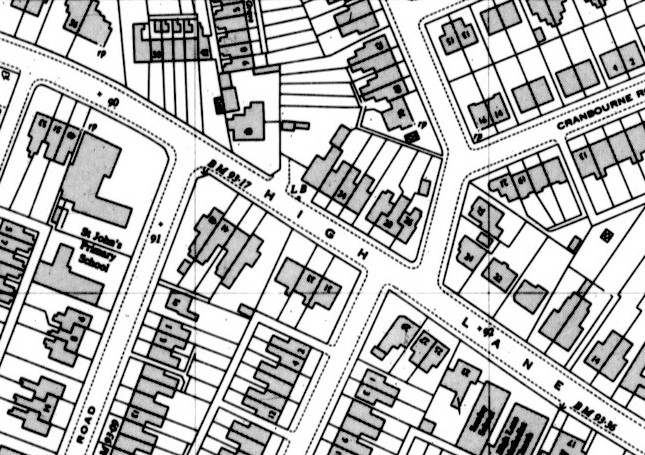
High Lane, 1881, the house marked with an X

Still there are plenty more to look for, and in time I will go looking.

All of which leaves me falling back on the house and exploring a little bit more of its past, which begins with an interesting mystery concerning John Strawbridge who in 1881 is described as a groom, suggesting the then owners had a horse and carriage.  Maps of the period show outbuildings behind the house on the west side, but later census returns make no reference to a groom.

The last census records that in 1911 Mr. Robert Newberry West, who was a surgeon, employed Elizabeth Parker as “cook-domestic” who was charged with maintaining the elven rooms and cooking for Mr. West, his mother and his two siblings.

The house, 1881, marked with an X

I have to say I have been drawn to Robert West, partly because he was born  in Camberwell,  close to where I was born and grew up in south east London and because we can track his progress from London to Chorlton-on Medlock where his father was the vicar at St Stephens and on to Southport where he lived with his widowed mother.  

He married in 1920 at the grand old age of 47, living on Upper Chorlton Road and finally Barlow Moor Road where he died in 1924.


Nor is that quite the end of the story, because like many bigger properties in south Manchester,  Bamburh House finally succumbed to multi occupancy.

Just when this happened is unclear.  

In 1929 the directories show that it was occupied by the Morris family, but a decade later the house was divided in to five flats of which two were unoccupied.  The remaining three were occupied by a sales manager and sales assistant, neither of whom were married, and Mr. and Mrs. Bond and their young daughter. Mr. John Bond was a sales manager for a tobacco and drugs company, his wife Doris was “an assistant hospital nurse” and Rita, their daughter was just 2 years old.

After which the house continued its long association with multi occupancy.  In 1954 it was home to three tenants, and in 1962 to four, and it remained so until Sarah bought the property and returned it to family use, which of course has been a trend across Chorlton.

With thanks to Sarah for allowing me to profile her house and Tony Petrie who supplied the street directories for 1929, 1959, and 1962.

Location; Chorlton-cum-Hardy

The house, 1956

Pictures; the house in 1959, A. E. Landers, m17886, courtesy of Manchester Libraries, Information and Archives, Manchester City Council, http://images.manchester.gov.uk/index.php?session=pass High Lane in 1881, from the 1881 Withinton Board of Health map, courtesy Trafford Local Studies Centre, https://www.artuk.org/visit/venues/trafford-local-studies-centre-6551 and in 1956 from the OS map of Manchester & Salford, 1956

*The story of a house, 

One hundred years of one house in Well Hall 

The story of one house in Lausanne Road

The house on Harrow Road in Leicester

Monday, 11 August 2025

What was lost is found ……… and the race is on to save this bit of our history

 Now I fully appreciate that for some the story of convents, churches and even redundant pubs do not catch the imagination but each in their way make up our past.

The beautiful mosaic scheme 2025
One such bit is Carlton House on High Lane.

In it’s time it was a private residence, and then a convent, finishing as the Manchester Islamic High School for Girls, and is now part of a new development which spans High Lane, one side of Acres Road and a short stretch of Stockton Road.

And I have written about all its various stages, culminating in that mosaic of Our Lady on Stockton Road*.

I remember the mosaic and often wondered if it had survived underneath the big black and gold sign for the Islamic School and it has, which in itself is a rescue project, but now I understand from Bronwen O'Donoghue that “a beautiful mosaic scheme has just been uncovered. It was hidden beneath layers added in the 1980s when the Islamic school took over the site.

Our Lady, 2024
And there will be many former students of the convent who will remember them and want them preserved, to which I think there will be many who like me see those mosaics as an important story wanting to be recorded and kept.

The convent comes from that time in Chorlton’s history when there were many small and not so small schools catering for the growing middle class who were moving into Chorlton from the 1880s.

Convent of the Sisters of the Christian Retreat, 1959
They included private infant and junior schools as well as  “crammers” designed to offer quick paths to business and professional qualifications.  

One such was Mr Dadley's Grammar School on High Lane which occupied the two properties making up what was and is again Denbiegh Villas.

These schools occupied what had been private residences which is where Carlton House comes in and the story of the convent.

They stand in direct line to smaller private schools running back into the early nineteenth century which coexisted with the church school on the village green.

All of which makes the project of recovering and preserving the mosaics important as part of that continuous story of how our children were taught.

For those who want to read  about the development of the site just follow the link.**

So, it is all to work for.

Pictures; The beautiful mosaic scheme, uncovered 2025, courtesy of Bronwen O'Donoghue, Our Lady, 2024 from the collection of Andrew Simpson and Convent of the Sisters of the Christian Retreat, 1959, A.E. Landers, m17917, courtesy of Manchester Libraries, Information and Archives, Manchester City Council, http://images.manchester.gov

*Carlton House, https://chorltonhistory.blogspot.com/search/label/Carlton%20House

**Manchester City Council Planning Portal, Manchester Planning Portal, 37994/FO/2023. Erection of 12 no. 2.5 storey dwellinghouses; a pair of three storey semi-detached dwellinghouses; a three storey building comprising 6 no. apartments; the retention and change of use of the existing mansion house together with the erection of a two storey side extension to form 2 no. dwellinghouses; creation of vehicular access points, associated landscaping, car parking and boundary treatment following the demolition of the other existing buildings and structures. https://pa.manchester.gov.uk/online-applications/applicationDetails.do?activeTab=documents&keyVal=S0IQG9BCMGC00

Saturday, 19 April 2025

Leaving your mark on that house in Chorlton …….. John Burns Storey

Now I can’t quite make my  mind up about leaving your name on a house.


The historian in me likes the idea that there is a permanent link with a previous owner, but that is shot through with a sense of the overwhelming arrogance and self pride in placing your initials on the side of a house.

It smacks of hubris and reminds me of that line “Look on my Works, ye Mighty, and despair!”*

But then perhaps I am going over the top.

Yesterday Sarah from High Lane got in touch asking if I knew whether there was a connection between her house and St John’s because “Friends and neighbours from St John’s think that our house might originally have been the priests house for the church due in part to the insignia “IHS” on the roofs apex”.

So far I haven’t made a connection, but then having trawled the 19th century I stopped at 1911, leaving another hundred years to plod through.

What I do know is that the house dates from 1871 and was built by Mr. John Burns Storey, who was from Northumberland, which may explain how Sarah’s house came to be called Bamburgh.

He was a builder and was responsible for a number of the houses on High Lane all of which were built in the early 1870s, in advance of the big housing boom which started a decade later.

Nor was he alone in beginning the transformation of the township.  


There had been urban creep up Edge Lane and along Wilbraham Road, after it had been cut in the late 1860s, as well as High Lane.

Several of the builders and speculators engaged in building  these houses for the “middling people” are known and a few were local.

But despite his interest in Chorlton-cum-Hardy, Mr. Storey may not have lived here for long, because while he and his family were on High Lane in 1871 they had moved to Barton Upon Irwell ten years later, and at death in 1897 he is recorded as living in Brooklands.

And his death presents a mystery, because he left just £44 8s. 4d.  Just why his effects are so small maybe a mystery we will never solve.

So, I shall leave Mr. Storey,  his wife, Emma, and four children along with their 13 years old servant on High Lane in 1871 in what I expect were happier times.

Despite emblazoning his initials on Sarah’s house the evidence so far is that the Storey’s never inhabited the property, which I suppose could be another mystery.

There will be more to discover about John Burns Storey which I have promised Sarah I will look for along with another search for that connection with St John’s.

Next; Mary Butcher ....domestic servant from Belper, aged 13 and working for the Storey family

Location; Chorlton-cum-Hardy

Pictures; the initials of J.B.S, 2021, courtesy of Sarah Hudson Jones, and the house in 1959, A. E. Landers, m17886, courtesy of Manchester Libraries, Information and Archives, Manchester City Council, http://images.manchester.gov.uk/index.php?session=pass

* Ozymandias, Percy Byshhe Shelley 


Tuesday, 26 November 2024

76, High Lane – Part 2 ... another story from Tony Goulding

For those readers who were waiting for the second instalment of the history of 76, High Lane, Chorlton-cum-Hardy, Manchester, your wait is over – here it is!

Head and Wrightson & Co. Offices 1959
My friend Joyce, who prompted the story, will be pleased that the house’s use as a music school has been reached. The 1948 street directory shows it to be occupied by Ronald George Mortimer and described as “a school of music”.  He apparently ran this with his wife Edith (otherwise “Edythe) née Fairhurst. The couple married in South Manchester during the September quarter of 1935. 

    Mr. Mortimer was born Ronald George Mautterer in the Islington area of London on 11th May 1914. His parents were George Barnes Mautterer and his wife Ivy May (née Butcher). Soon after his birth Ronald George’s father, who was in 1911 a publisher's assistant living with his widowed aunt and four cousins in the Hoxton area of Shoreditch, London, moved to 92, Copenhagen Street, Barnsbury, London where he had a grocery shop. On September 25th, 1916, he was admitted to the British Army’s Honourable Artillery Company and later served in the Highland Light Infantry. The electoral rolls show the family remained in London until at least 1924, an electoral roll of that year lists George Barnes and Ivy May at 19, Moor Lane Chambers in the polling district of “Cripplegate Without”, City of London. The family had settled in Manchester, possibly via Sheffield, Yorkshire about 1930 as they are recorded in both the rate books and electoral roll of 1931 living at 218, School Grove, Withington, Manchester. By this time, they had started using “Mortimer” as their surname although Ronald George retained “Mautterer” as a third initial name. The 1933 Kelly’s Directory of Lancashire, Manchester, Salford & Suburbs shows them still at the address in Withington, however by 1939 they were in Chorlton-cum-Hardy. George Barnes, a commercial traveler, and Ivy May were living with Ivy May’s widowed mother, Anne Butcher at 5, Napier Road. Ronald George Mautterer Mortimer and Edith were at 4, Cavendish Road. (1) Ronald George’s occupation was recorded as the Chief Stores Clerk for an electrical engineering company while “Edythe” was a music mistress (pianoforte).  The Mortimers ran their music school on High Lane from at least 1948 until the middle of the next decade. (2)  

After its use as a music school ended 76, High Lane became design offices of Head, Wrightson & Co Steel Foundries and Geneal Engineers, (3) The Manchester Evening News during the month September 1956 carried extensive wanted ads for design and layout draughtsmen to work in the firm’s “new offices opening shortly in Chorlton-cum-Hardy". This company vacated the premises around 1964; it then became the headquarters of The United Road Transport Union for the next 4 decades.

The World Peace Cafe - November 2024

In 2008 the building became home to a Manchester-based Buddhist Meditation Group, Vairochana, with the World Peace Cafe first opening its doors in 2012 at which time also the group became an official Kadampa Meditation Centre.

 The building in 2016

Pictures: Head Wrightson & Co. Offices, 1959 by A.E. Landers m17897 Courtesy of Manchester Libraries, Archives, and Information, Manchester City Council, http://images.manchester.gov.uk/index.php?session=passMeditation Centre and World Peace Cafe – November 2016 from the collection of Tony Goulding

Notes: - 

1) Cavendish Road is now Corkland Road. Both the Mortimers' house and the adjacent No 2, the home of a local dentist Stephen Laurence Wilson were destroyed during the Manchester Blitz of Christmas 1940.

2) They were still recorded at the address in Kelly’s 1954 Directory of Lancashire, Manchester, Salford, and Stretford.

3) With origins dating back to the 1840s, this company began trading under the name of Messrs. Head Wrightson since 1867. They were an iron foundry and heavy engineering company manufacturing a wide range of products for the railway, coal mining and latterly electricity production industries as well as the ironwork for individual civil engineering projects including two combined rail and foot bridges crossing the River Thames in London, at Fulham and Barnes as well as several high-profile bridges for Indian Railways.


Monday, 4 November 2024

OBAN HOUSE …. another story from Tony Golding

Oban House, otherwise, 2, Manchester Road, Chorlton-cum-Hardy, Manchester is a fine building on the corner of High Lane and Manchester Road and is largely hidden from view. Hence it has always aroused a fascination in me. 

Oban House 2024 
Prompted by its inclusion in the recent story concerning its neighbouring house on High Lane I have embarked on an investigation of its history. 

The rate books show that it was built by William Mee, the farmer of Hobson Hall and is one of the properties he built across swathes of the township and beyond. William was the son of Joseph Mee of Moss House Farm, Whalley Range and became the son-in-law of John Mee who farmed Hough Farm, Withington, when he married Elizabeth, his eldest daughter, at St. John’s Church, Manchester on 12th January 1860. 

Whether this alliance provided the wherewithal to finance William’s house building activity is a matter of conjecture. What can be established though is that William became a very wealthy man. When he died at Bryncliffe Lodge, Llandudno, North Wales on 25th October 1898 he left an estate valued at £41,579- 10s-10d equivalent to £4, 541, 368 today. The first record, I have found, of William Mee owning property on Manchester Road in Chorton-cum-Hardy is in the rates book of 1886. The entries are a little confusing as there are several alterations, however they do point to William having two tenants in property he owned. Mrs. Mary Ann Hughes and James Williams. The census returns show that Mrs. Hughes, a widow who kept a boarding house, and James Williams, a cotton spinner, occupied adjacent houses further along Manchester Road; between The Liberal Club and The Lloyd’s Hotel. This means that Mr. Lachlan McLachlan, the photographer, from my recent story of 76, High Lane would have been the first tenant of “Oban House”.

Oban House 1959

Following Lachlan’s death on 16th June 1891 both his widow, Elizabeth, and his unmarried daughters, Ada and Florence continued to live in the house. Elizabeth died 23rd November 1891 after which the two sisters were able to remain in residence for the next two decades by taking in boarders. Florence died on Monday 8th January 1912 and was cremated, at the Manchester crematorium on Barlow Moor Road, the following Friday 12th January.  Shortly thereafter, Ada moved away from Manchester; she died on 17th April 1920 at Llandrillo yn Rhos, Nr. Colwyn Bay, Denbighshire, North Wales. 

    Oban House was next briefly the home of a German born “textile engineer” Waldemar Kellner and his family. Waldemar was born in Bavaria, Germany in 1869 and in 1901 was living as a lodger in the house of a fellow German, John Breland, a “Foreign Correspondent” and his family at 42, Temple Road, Sale, Cheshire. He later moved to Stretford where in the June quarter of 1910 he married Helen the former wife of ex-landlord John Breland and the following year’s census records him at 1, Botanical Gardens, Old Trafford with Helen and five school-age stepchildren. 

The outbreak of the First World War severely impacted this young family, who by then had re-located to Oban House. As Germans both Waldemar and his eldest stepchild, Herman, who was born in Hamburg, were interned in camps on the Isle of Man; Waldemar in Douglas and Herman in Knockaloe.

Knockaloe Camp, 1915-1919
With this disruption of family life (added to when her second son, Waldemar, enlisted in the Royal Army Medical Corps) Helen Kellner left Oban House and moved firstly to 3, Salsbury Road, Chorlton-cum-Hardy before later, according to her son’s army record, living in a boarding house, 25, Bath Road, Buxton, Derbyshire. I could find little more on the Kellner / Breland family post World War One. As a response to anti-German feeling it is possible they emigrated or perhaps changed their surnames as many with German names did, taking a lead from the Royal Family altering their name from Saxe-Coburg-Gotha to Windsor. One child Edgar Gustave Breland, born in Sale, Cheshire in the June quarter of 1900 does appear in later records. The London Gazette of 1930 published his change of name by Deed Poll to henceforward be known by the surname Kellner. His address is included: 35, Kamitsutsui-Dori, 6 Chome, Kobe, Japan. Edgar Gustave remained in Japan for a time as the birth of a son also named Edgar was recorded in Kobe and appears in the index of consular births 1931-5. There are two further records, one indicates that the son married Greta M. Greenland in Mere, Wiltshire during the September quarter of 1951 whilst the other reveals a little more about the father. This is a Swissair air passenger manifest for a flight from Zurich to New York (via Shannon in Ireland) on 19th January 1952 which states he was an engineer headed for The Commodore Hotel, New York. 

     In September 1916, following the departure of Helen Kellner and her remaining family, Oban House became the home of Edmund William Horobin, a commercial letter press printer who was born on 3rd July 1871 in     19 G, Blackwell Street, Kidderminster, Worcestershire. His parents were William, a Grocer/ Commercial traveler and Fanny Matilda (née Midgeley) He wasn’t baptized until 23rd June 1878 in Dudley, Worcestershire where his father was then the manager of a galvanized iron works. The 1881 census reveals that the family had moved again, this time to West Yorkshire at 17, Key Street, Horton, Bradford. William had established himself as a coal merchant while Fanny Matilda opened “The Excelsior Washing Liquor Co.” drysalters and washing liquor manufacturers, initially with a partner but after 25th October 1883 on her own account.  1891, saw the family moved once again to 68, Hope Street, Stoke-on-Trent, Staffordshire with William recorded as a “commission agent”. Finally in 1901 they had arrived in Manchester, curiously their entry in the census of that year uses Fanny Matilda’s maiden name of Midgely at 27, Albion Road, Fallowfield. Fanny Matilda died at 466, Great Cheetham Street East, Higher Broughton, Salford on 26th June 1902. In the December quarter later that year Edmund William married Bertha Harris Taylor. Edmund, like his parents, shows definite signs of wanderlust, the couple’s first child, Roger Henshaw, was born at 99, Heaton Moor Road, Heaton Norris, Stockport during the January quarter of 1905. Two daughters followed, both born in Bramhall, Cheshire, Florence Fanny in the December quarter of 1906 and Berth Phyllis, during 1908’s December quarter. A second son Frederick Duncan was born 13th July 1910 in Chorlton-cum-Hardy 14, Albermarle Road. Finally, Nancy Horton was born on 12th July 1912 also in Chorlton-cum-Hardy. Before moving into Oban House in 1916 the Horobin family lived in a succession of houses across South Manchester: 14, Davenport Avenue, Withington, 121, Burton Road, Didsbury, and lastly 15, Manchester Road, Chorlton-cum-Hardy. They remained in Oban House until 1921 before vacating it on 11th October that year and being replaced, on 25th March 1922, by George Black. The Horobins later to moved to addresses in Sussex before the 1939 Register shows (a retired) Edmund William and Bertha Harris living with his married daughter Nancy Horton at 1, The Briary, Lower Erith Road, Torquay, Devon. 

George Black and his wife, Margaret (née Glenesk) can be seen in the previous year’s census living at 41, Albany Road, Chorlton-cum-Hardy, Manchester with their son, also named George who was born on 11th August 1906. All three were born in Scotland, father in Eastwood, and son in Cathcart, both areas of Glasgow and the mother in Bourtie, Aberdeenshire. George Black senior was working as a sales representative for the Glasgow-based biscuit manufacturers MacFarlane, Lang, & Co. The Black family left the house in the second half of 1925 as the spring electoral roll shows Arthur Howard and Elizabeth Fanny Frisby at the address. The unusual surname enabled me to easily locate them on the 1921 census and in other records. In 1921 they were living at 2, Richmond Villa, Ashton Grove, Ashton upon Mersey, Cheshire together with his daughter, Dorothy Edith Gertrude, and son-in-law, John Austin Baker. Leicester-born Arthur Howard was 49 and worked as a repairs store clerk for Ford Motor Co. In Trafford Park, Manchester. His son-in-law, born in Southport, Lancashire was the technical assistant to the rolling stock engineer of Manchester Corporation Tramways, whose later career saw him move to South Shields where he was the General Manager and Engineer of that corporation’s tramways and buses. John Austin and Dorothy Edith Gertrude were divorced at Newcastle Assizes on Friday 22nd February 1935; both remarrying by the end of that year.

   Arthur Howard Frisby’s wife Elizabeth Fanny (née Cavell), who he married at St. George’s Church in Deal, Kent on 4th April 1895, died on 15th February 1928 by which time the couple had moved to 31, Regent Road, (1) Chorlton-cum-Hardy. Arthur Howard later moved to Eccles in Salford where the 1939 Register indicates he had sadly gone blind.

Salvation Army Logo
The occupants of Oban House for the next decade and more were the Tomlinson family. The patriarch was William Henry Tomlinson, a Salvation Army Officer born in Chesterfield, Derbyshire in the December quarter of 1864. He married Nottingham-born, Lily Girling in Belfast, Antrim, Ireland during the December quarter of 1892. The couple travelled widely around the UK (2) before settling in Manchester, initially as per 1911, census at 27, Meadow Street, Moss Side then later at 46, Grange Road, Whalley Range. William Henry died shortly after moving into Oban House, most probably during the March quarter of 1931. His widow continued to live in the house together with her son, Albert Hadleigh and his wife Elsie Washbourne (née Sims) who were married during the December quarter of 1921 in the Aston area of Birmingham. Albert Hadleigh was a partner in a wholesale confectionary business “Duffy & Tomlinson” of Coupe Street, Beswick, Manchester which failed in 1931. In 1939 he was recorded as a “technical salesman/clerk” for Stretford Gas Board and an A.R.P.

Pictures: - Oban House 2024 from the collection of Tony Goulding. Oban House 1959 by A.E. Landers m18009 Courtesy of Manchester Libraries, Information and Archives, Manchester City Council, http://images.manchester.gov.uk/index.php?session=pass Knockaloe Internment Camp. Painting by George Kenner. This photograph Art.IWM ART 17053 comes from the collections of the Imperial War Museums. IWM Non Commercial Licence. Salvation Army Logo. From my photograph of clothing collection bin outside Hardy Lane, Co-Op store, Chorlton-cum-Hardy.

Notes: -

1) Regent Road is now Reeves Road.

2) The family’s travels are indicated by the birthplaces of the children, Arthur Henry in Nottingham in 1894, William John in Burton-on-Trent, Staffordshire in 1895, Albert Hadleigh, also in Nottingham on 11th June 1900 then Gilbert in Cardiff during the September quarter of 1904. In between the last two births the 1901 census shows the family living at 8, Nursery Terrace, Hadleigh Rochford, Essex, where the Salvation Army had recently purchased a farm to provide training opportunities to the destitute of the East-End of London. The 1911 census reveals that William John had died. 

Wednesday, 9 October 2024

76, High Lane … another story from Tony Goulding

This impressive building opposite Our Lady and St. John’s Roman Catholic Church on High Lane, Chorlton-cum-Hardy, Manchester has a fascinating history. 

In a story of 2016, I had written of its initial use as a school; following a recent remark by a friend I have had occasion to revisit its history.

I previous believed it was built as an Art School in 1896 by Thomas E. Mostyn; now, however, having conducted more research I found it dates from 1888-9 and was constructed by Lachlan Mc Lachlan (1). 

He had recently become the tenant of the adjacent Oban House, 2, Manchester Road, and the new building was to serve as his photographer’s studio, only for him to die on 16th June 1891.  It now houses a Buddhist Meditation Centre and “The World Peace Cafe” In the interim it has had a wide variety of uses.      Its use as an art school and from 1904 until 1909 as Chorlton-cum-Hardy's first municipal school run by the Manchester Corporation Education Department were covered in the story referenced above. (2)

The 1911 census records it as the residence of a police constable, John Cannon Blenkharn, his wife Bertha Mary (née Faulkner) and three young children. 

 P.C. Blenkharn was born on 17th November 1881 in the small Westmorland village, Grayrigg where his father and grandfather (both also Johns) were farmers. His mother died in childbirth when John was born; his second name being given in remembrance of her, being her maiden name. His father remarried a Jane Robinson when John was 5 years old. Originally following his forebear's occupation on the land, in 1903 he moved South and on 4th February joined the Manchester City Police Force. Later in 1903 he returned to Westmorland to marry Bertha Mary Faulkner

His residence in this large house on High Lane with its 7 rooms is intriguing as 2 years previously the 1909 Slater’s Directory of Manchester records him at the much smaller 9, Kathleen Grove, Rusholme, Manchester.  It is possible he was living there in the capacity of a caretaker while the owner found a new tenant/purchaser. In any case by 1916 the Blenkharns had moved out to 1, Higson Avenue off Beech Road, Chorlton-cum-Hardy. (3)

The census of 1921 shows John Blenkharn at this address, by then a detective constable with 6 children.

   Later in his career in the police force John achieved the rank of Detective Sergeant. In this capacity he was involved in a desperately sad case in 1931 which was a sensation in Manchester at the time. On the morning of Wednesday 23rd September in the company of two police superintendents he witnessed the discovery of an 8-year-old child's body in the Victoria Park district of Rusholme, Manchester. 

Later that day he detained a man, George Alfred Rice, at his lodgings on nearby Dickenson Road. After further enquiries Mr. Rice was subsequently charged the following day with the murder of Constance Inman. After a two-day trial at Manchester Assizes George Alfred Rice was found guilty of the girl’s murder and sentenced to death on Tuesday 15th December 1931. An appeal against his conviction and sentence was lodged at which in mitigation it was stated that Rice, an unmarried, unemployed hotel porter, was of limited mental capacity, was illiterate and only had one eye.  

A consequence of this appeal meant the initial date for his execution, 4th January 1932, was postponed. The appeal was dismissed on 18th January and after a further plea to the Home Secretary of the day (Sir Herbert Samuel) was also unsuccessful; George Alfred Rice was executed at Strangeways prison, Manchester on the morning of Wednesday 3rd February 1932.

John Blenkharn retired as a Detective Sergeant. The 1939 Register shows him having made the short move to 2, Belgrave Road (now Belwood Road) also in Chorlton-cum-Hardy.

 It also reveals that his seventh child was born in 1922. He died on 26th March 1966 just 3 months after his wife, Bertha Mary who died on Boxing Day 1965.

  The next occupant of 76, High Lane after P.C. Blenkharn’s departure was Charles Ireland who was a photographer with a studio at 25, Lower Mosley Street, and others elsewhere in Manchester. He is shown as renting a studio at the property in the Manchester rate books of 1916. By 1921 he was listed as the owner of the property. The photography business he inherited from his father, Edward was obviously a hugely profitable one as together with the house on High Lane by 1930 he also owned properties on St. Clement’s Road and Whitelow Road, both in Chorlton-cum-Hardy, Manchester as well as the studio on Lower Mosley Street of which his late father, Edward had acquired the title.  Before moving to High Lane Charles lived in the family home “Highfield” 11, Edge Lane, Chorlton-cum-Hardy prior to which the 1902 electoral roll records him at 5, Wilbraham Road also in Chorlton-cum-Hardy.

    Charles Ireland died at the Manchester Royal Infirmary on 21st May 1930 and is buried in the family grave (U 1587) in the consecrated (i.e. Church of England) section of Southern Cemetery, Manchester.


There is much more detail of Charles ‘s life and work on this blog by both Andrew Simpson and Eric Krieger.

    With the death of her husband his widow, Edith May (née Hindley) (4) opted to move to another of the family’s houses on St. Clement’s and let out 76, High Lane. Her tenant from at least 1933 was Mrs. Edna Elizabeth Walls who used the building as a dancing school, running the business, “Apryl’s Danse-Salon” under her maiden name of Allan. Edna Elizabeth Allan was born in Stretford, Lancashire on 17th July 1907. In 1921 she was living at 880 Chester Road, Gorse Hill, Stretford where her father, Norman Currie Allan, had a boot repair shop. Prior to setting up in Chorlton-cum-Hardy, it appears that “Apryl” worked for the Cadman School (of dance), Stretford.

  Edna married Alexander Wilson Walls during the June quarter of 1933 in the South Manchester registration district. How long Edna ran the Salon in High Lane is unclear as her and Alexander moved to Oswaldtwistle, Lancashire where their first child, a daughter, was born in the March quarter of 1936. There is some evidence the business continued under the same trading name but with a different proprietor. The 1936 rate book shows Edna’s name crossed through and James Howley entered above it. However, The Manchester Evening News on 19th January 1937 included an item detailing an event at the salon the following day and the Manchester Directory of 1938 also has Apryl’s Dance Salon at 76, High Lane.

Whatever, the 1939 Register records the house as an empty property. The rate book of 1941 is very informative but as is often the case raises as many questions as it provides answers! Originally the occupier is shown as Winifred Driver, but her name was then crossed through as was the property’s use as a Dancing School. The added notes reveal more of the story; above the crossed through Dancing School the word “Billets” was added and in the rate assessment section was written “Exempt Crown Property”. Further intrigue originates from the entry in the “Arrears from previous years” column which shows a W. Driver owing £8 - 0s – 9d and an M. Jones with a debt of £20 - 11s –6d.

   Mrs. Ireland was listed as the owner although her name was also crossed out but then added again later. In the 1939 Register she is recorded at 23, St. Clement’s Road, Chorlton-cum-Hardy with her 4 children. (5) She died on 24th September 1948 leaving an estate of £4,003 -13s- 2d and was buried alongside her husband.

Who was billeted in the house, and who Winifred Driver and “M. Jones” were I have yet to discover.

Now in reaching 1945 is a convenient point to pause the story of 76 High Lane. (For a house with such a rich vein of history it is a shame it appears to have never been given an individual name) There is more to reveal however, from its post-war story including its use as a music school; the substance of my friend’s remark which prompted this story.

 Not to worry all will be revealed in a follow-up piece – WATCH THIS SPACE!

Pictures: -   All from the collection of Tony Goulding

Notes: -  

 1) The Schools of High Lane. https://chorltonhistory.blogspot.co.uk/2016/08/the-schools-of-high-lane-another-from.html

  2) Lachlan McLachlan was a prominent Manchester photographer and engraver of some fame and notoriety. He was born in Oban, Argyllshire, Scotland in 1824 but by 1849 was in Manchester where, in the December quarter, he married Elizabeth Murgatroyd, a Yorkshire girl from York, at the recently created Manchester Cathedral. Working initially as a cabinet maker he later turned his hobby of photography into a business. His “masterpiece” which took years in the making was “The Royal Family at Windsor” which became the subject of prolonged and very expensive litigation. He was also an advocate for reform of the Lunacy Laws after his friend Alice Hadfield Petschler had been forcibly and unfairly committed to an asylum in Macclesfield, Cheshire.  Mrs. Petschler was a fellow photographer and the widow of Helmuth, a German from Mecklenburg, a pioneering photographer who prior to his failing health had a studio on Market Street, Manchester. Coincidentally, her case was the subject of a recent  Chorlton Good Neighbours history talk I attended earlier this year given by the historian Joanna Williams.

 3) Wonderfully these dry records also reveal the intimate detail that P.C. Blenkharn also kept an allotment in the gardens at the end of Cleveleys Avenue, off Sandy Lane, Chorlton-cum-Hardy.

 4) The wedding of Charles Ireland and Edith May Hindley took place in the September quarter of 1913 in St. George’s Church, Manchester


Monday, 16 September 2024

Lost Chorlton Churches nu 2 .......... the Macpherson Memorial Primitive Church High Lane

I just missed the Primitive Methodist Church on High Lane.

It closed  two years before I came to Manchester in 1969, and had been demolished by the time I settled in Chorlton.

Now I have been interested in the place since I discovered James McPherson who was closely involved with the church since it was founded in 1896.

“The Primitive Methodist church was early 19th century secession from the Wesleyan Methodist church and was particularly successful in evangelising agricultural and industrial communities at open meetings. 

In 1932 the Primitive Methodists joined with the Wesleyan Methodists and the United Methodists to form the Methodist Church of Great Britain.”*

Mr Macpherson was an undertaker and lived next door at number 23 High Lane from 1901 and possibly earlier.

In 1894 this stretch of land was still open but it may well be that when the first church building went up in 1898 the McPherson family moved to the large ten roomed house beside the church.

Mr McPherson died in 1901 but his two daughters, Sophie and Jessie were still in the family home a decade later and show up on the census return sharing the house with three boarders.

Isabella Russell Kay was aged 80, and a widow, Mary Florence Jeffery, 35, was married and her daughter Mary Taylor Jeffrey was.  Mrs Jeffrey had married ten years but there is no indication of where her husband was on the night of the census.

Sophie died in 1912 and this may have been when her sister moved because she died five years later in Lancaster.

And that pretty much is all I know at present.

Their house is still there but only one of the church buildings survives.  This was the school built in 1896, which was enlarged in 1908 and is now the  "Manchester Centre for Buddhist Meditation."

The church stood to the left of the school and was opened in 1902, but declining numbers and the reorganisation of the Methodist Church in 1932 meant that it closed in 1967.

All that is left to do is some digginging into the rate books and directories and we may be able to pinpoint exactly when the family moved to Chorlton and when Jessie left for Lancaster.

Pictures; the Macpherson Memorial Primitive Church High Lane, circa 1920s from the Lloyd Collection and the school today from the collection of Andrew Simpson

*High Lane Primitive Methodist, Chorlton cum Hardy, http://www.genuki.org.uk/big/eng/LAN/ChorltoncumHardy/HighLanePrimitiveMethodist.shtml

Wednesday, 19 July 2023

So goodbye to Carlton House on High Lane ……… well almost

Carlton House is that building on High Lane and Acres Road.

Carlton House, 2022
For well over a century, it has been in the business of education, starting out as a convent school and then becoming the Islamic High School for Girls.

But all that is about to change as the Islamic High School is relocating to West Didsbury and the site is about to be redeveloped.

Cube Homes propose to build “22 high quality, energy efficient and sustainable new homes comprising 14 four bedroom townhouses, 6 two-bedroom apartments, and the retention and refurbishment of Carlton House, which will be converted into 2 homes”.*

We are at the early stage where Cube Homes have bought the land, had preliminary discussions with the Planners at the City Council and have floated a “Preapplication” statement and consultation.

The Convent, 1959
All of the details are available online and make for an interesting read, particularly because the developer amended the plans in the light of conversations with the City Planning Department.

One of which was the retention of Carlton House.

It is a building I have passed countless times but never once gave it much thought.

For most of the time I have lived in Chorlton it was the Convent School before becoming the Manchester Islamic Grammar School For Girls.

But it started as the home of Thomas and Catherine Harrison who I suspect were pleased with their impressive property which consisted of 10 rooms with a garden which stretched down towards Beech Road and included stables, a greenhouse and heaps of ancient fruit trees.

I have written its story and always intended to go back.  That first story set off a heap of memories from those who attended the convent school and no doubt the second will bring forth more from its time as the Islamic High School.**

Carlton House and garden, 1894

Now the historic records offer up heaps of possible avenues of research including the cottage which  stood on the site in the 1840s and 50s, when this strip of land was owned by William Brundrett.

But also highlight just how twisty turny historical research can be, because I came across Carlton House almost by accident as I was looking for the story behind 97 Beech Road which if I have got it right dates back to 1886, and has in its time sold many different things

Carlton House dates from 1866 and may have been sold in 1898 when Mrs Harrison died.  Either way sometime between 1903 and 1909 her grand house became the Convent. The 1911  census records it was home to the Principal, six teachers, one pupil teacher and the house keeper.  

Walking the garden wall, 2020
They ranged in age from 49 down to 18 years old, all were single, and were drawn from across the country and beyond.  So, while four were from Ireland, one was from Dorset and the remaining three had been born in Woolwich, Hackney and London.

And now that link with education has come to an end.

I could at this point reflect on the proposed plans, or the bigger issue of new homes in Chorlton but I won’t, suffice to say the proposals recognises that despite real  environmental concerns provision has been made for more than one car per house hold, which in turn may prevent the squeeze on on road parking.

Added to which Acres Road is to be widened, which clearly makes sense.  The historian in me acknowledges that this will alter the historic character of what was popularly known as “Acres Crack” and originated as a small watercourse covered over sometime before the 1880s, but the trade off is the retention of Carlton House.

That said the scale of the development does seem over large for that corner of Acres Road.

So, the rest are stories yet to come.

Location; High Lane

Pictures; Carlton House, and the line of what was once the garden, 2022,  from the collection of Andrew Simpson, Carlton and house and grounds 1894, from the OS map of South Lancashire, 1894, courtesy of Digital Archives, https://digitalarchives.co.uk/  and Convent of the Sisters of the Christian Retreat, 1959, A.E. Landers, m17917, courtesy of Manchester Libraries, Information and Archives, Manchester City Council, http://images.manchester.gov.uk/index.php?session=pass

*Cube Homes High Lane Consultation, https://www.cubehomeshighlaneconsultation.co.uk/?fbclid=IwAR0RpY4WJSNMpEm-cSD6fIFNrQfHjnh9M1Dhccez1k9WCISxdPBYZTNpfyA

**Carlton House …… the convent on High Lane and …….. the trail that led back to a Beech Road bar

https://chorltonhistory.blogspot.com/2022/10/carlton-house-convent-on-high-lane-and.html


Wednesday, 5 April 2023

Carlton House …… the convent on High Lane and …….. the trail that led back to a Beech Road bar

This was Carlton House on High Lane which was the home of one family from 1866 to the early years of the 20th century.

Carlton House, 2022
And it is a building I have passed countless times but never once gave it much thought.

For most of the time I have lived in Chorlton it was the Convent School before becoming the Manchester Islamic Grammar School For Girls.

But it started as the home of Thomas and Catherine Harrison who I suspect were pleased with their impressive property which consisted of 10 rooms with a garden which stretched down towards Beech Road and included stables, a greenhouse and heaps of ancient fruit trees.

Just how long that garden was can be gauged by walking down Acres Road from High Lane and following the brick wall of the present school.

Carlton House, 1894

I have yet to find out when Thomas died but I know it will have been before 1871 when Catherine was recorded as a “Widow” at the age of 44.  

She died in 1898 leaving £29,511, and sometime between 1903 and 1909 Carlton House  became the Convent.

Walking the garden, Acres Road, 2022
Two years later the census records it was home to the Principal, six teachers, one pupil teacher and the house keeper.  

They ranged in age from 49 down to 18 years old, all were single, and were drawn from across the country and beyond.  So, while four were from Ireland, one was from Dorset and the remaining three had been born in Woolwich, Hackney and London.

Now the historic records offer up heaps of possible avenues of research including the cottage which  stood on the site in the 1840s and 50s, when this strip of land was owned by William Brundrett.

But also highlight just how twisty turny historical research can be, because I came across Carlton House almost by accident as I was looking for the story behind 97 Beech Road which if I have got it right dates back to 1886, and has in its time sold many different things

Some will remember it as Marcelle’s Fabric shop, and later briefly when it sold “interesting things” before settling on a succession of bars and cafes.

 Convent of the Sisters of the Christian Retreat, 1959
And here is the connection with Carlton House, because 97 Beech Road had been built and owned by William Henry Acton who was the son in law of Thomas and Catherine Harrison. 

In 1871 he was living at Carlton House along with his granddaughter and at 28 was already a widower. 

So, the project turns on where next?  

I know that Mr. Acton was still on High Lane in 1901 but along with other members of the family had retreated to the delights of a large hotel or guesthouse in Bournemouth, having described himself as a “Wood carver” in 1871, forty years later was styling himself “retired builder”.

Or equally fascinating might be a study of the Convent which I am sure will elicit plenty of memories, or the cottage on High Lane before Carlton House.

Beech Road Tap House, 97 Beech Road, 2020

We shall see.

97 Beech Road, 2023

And an anonymous contributor reminded me that "No 97, I remember after Marcelle's was 'Jean Genie', a card / gift shop, and also that 'interesting things' shop you mention, before becoming 'the Library', the 'Tap House' and latterly the short-lived 'Seb's Bar'".

Which reminded me that I had passed the latest "happy" venue to occupy 97 Beech Road, which is appropriately named 97.

Location; Chorlton


Pictures; Carlton House, and the line of what was once the garden, 2022, Beech Road Tap House, 2020,and (7 Beech Road, 2023,  from the collection of Andrew Simpson, Carlton and house and grounds 1894, from the OS map of South Lancashire, 1894, courtesy of Digital Archives, https://digitalarchives.co.uk/  and Convent of the Sisters of the Christian Retreat, 1959, A.E. Landers, m17917, courtesy of Manchester Libraries, Information and Archives, Manchester City Council, http://images.manchester.gov.uk/index.php?session=pass


Wednesday, 14 September 2022

A gate in search of a story ………

 I guess I must have passed this gate on High Lane heaps of times, but today I stopped to look in.


That wasn’t as easy given that nature seems to have reclaimed the orderly borders, and neat paths creating a pile of disorderly green.

It is the sort of scene that lends itself to all sorts of stories, from fantasy to a forgotten romance, along with more than a few essays on the art of gardening.

The house has a Scottish name and was once occupied by Ada McLachlan who gave her occupation as “artist and photographer”. * 

It stands at the start of a slight incline which for centuries was called Scotch Hill. This may derive from a brief stop over by a section of the Pretender’s Highland army on its way to Derby full of expectation of a swift advance to London, or equally it could be during the Jacobite retreat back to Scotland and defeat at Culloden.

So perhaps that could be the story.

Location; Chorlton

Picture; A gate in search of a story, 2022, from the collection of Andrew Simpson

*Oban House, Slater's Directory, 1895

Monday, 25 January 2021

Occupants of Bamburgh House .......High Lane ... a story from Tony Goulding

 Bamburgh House on High Lane, Chorlton-cum-Hardy is almost exactly 150 years old and has been the home during that time of a number of interesting individuals. 

Bamburgh House, 2018

Some of them have already had their stories told in Andrew’s recent posts on this Blog, below are a few others. Most were gleaned from instances where Bamburgh House residents featured in press reports I found in “Find My Past’s” newspaper archive. 

The earliest reports are dated 15th & 16th May, 1874 from the Manchester Courier and Lancashire General Advertiser which record Henry Marshall winning the first prize (£10 and a silver cup or plate) at the International Horse Show being held in the Royal Pomona Gardens in Cornbrook, Manchester. His victory came courtesy of his black pony “Tommy” in the “pony, under 12 hands, to carry children” class. Henry Marshall seems to have been the house’s first tenant, appearing in both the 1871 census and that year’s Chorlton-cum-Hardy rate book.

 After an interval of a quarter of a century another resident of Bamburgh House shows up in the archive; Will Willis is shown in several issues of “Stage” the journal of the theatre industry. The issue of 10th August, 1899 carried an entry from Mr. Will Willis in which he is touting for work describing himself as a comedy and character (actor). Later editions indicate that he did successfully follow his chosen career path as in January, 1910 at Liverpool, Pavillion, February, 1910 Manchester’s, Queen’s Park Hippodrome, and in the Chorley Hippodrome in January, 1915.

Queens Park Hippodrome, Harpurhey

The 1900 rate book for Chorlton-cum-Hardy township has an entry for the property giving the owner as John S(quire) Diggle,1 who had also occupied the house for the previous decade before moving to Southport. The occupier was recorded as Berth Barcroft, who for the present remains a bit of a mystery. Mr. Diggle was born in 1869 in Radcliffe, Lancashire; intriguingly, none of his census entries show him following any occupation, in 1891, 1901, and 1911 he is shown as “living on own means” He died on 11th March and cremated on Wednesday 13th March, 1940. In the previous year’s register, he is shown as “retired” born on 11th February, 1868 and living at 222, Clarendon Road, Whalley Range, Manchester. John Squire Diggle was a well-known breeder of Collie dogs during the 1890’s. On the 4th October, 1893 at the Scottish Kennel Club’s Dog Show in Edinburgh he won the President’s Challenge Cup in the collie bitch class with his “ Chorlton Precilla”. He also won prizes at the Cheshire Agricultural Show in Stockport in September 1891 and the Oban Dog Show in December 1895 when his tricolour “Ringleader” was placed first in the Collie open dog category.

 One of the residents of Bamburgh House in 1939 was Margaret Heathcote Jack2 whose former occupation was given as a kennel maid. The following year she married George William Kenneth Savage a very colourful individual who appears in the press archives on three or four separate occasions. He was born in London on the 17th December, 1911 as shown in his papers on joining the Merchant Navy ship Helder in September, 1939. (these also record he had brown eyes, fair hair & complexion, a scar on his forehead and stood 5’ 91/2” tall. In February, 1933 several papers carried a Reuters account of an epic 30,000 mile “hike” he had been on for 2 years. His adventures included being attacked on an African river boat, wandering in the desert for 23 days, spending a week in jail in Egypt after entering that country without a permit. Later after returning to Europe he hiked through the Brenner Pass between Austria and Italy in such intense cold that he walked continuously for 16 hours for fear of freezing to death.

  On arriving back in Manchester, he set up in business as “Kenneth Savage Boarding Kennels Riding Master” The business soon got into some financial difficulty and he was made bankrupt. His bankruptcy was finally discharged in August, 1946. 

 The Liverpool Daily Post on the 4th September, 1945 carried a report that he, his wife, and 31/2 -years-old son, David, were rescued, the previous morning, by the coastguard at Cemaes Bay and the Holyhead lifeboat when his small yacht was spotted drifting on to the dangerous Skerries reef of Anglesey. 

 On the 13th October, 1948 Mr. Savage also featured in a story in the Manchester Evening News after appearing in court charged with smuggling 30,000 cigarettes from Switzerland. He said he bought them to “use-up” his winnings from a cassino in the South of France. He was found guilty and fined the not insignificant sum of £400 (which equates to almost £15,000 today)

George William Kenneth Savage died on the 9th September, 1961 at 13, Avenue deo Broursailles, Cannes, Alpes Maritimes, France while he was residing on Avenue Font de Veyre, Cannes Le Bocca.

Pictures; Bamburgh House - 2018 from the collection of Tony Goulding, Queens Park Hippodrome, Harpurhey m06605 courtesy of Manchester Libraries, information and Archives, Manchester City Council, http//images.manchester.gov.uk/index.php?session=pass 

 Notes: -

1) John S Diggle was married to Harriet Eleanor (née Oakes). The baptismal register of St. Clement’s, Chorlton-cum-Hardy has an entry for the baptism of the couple’s daughter, Violet, on the 27th January, 1892, she was born on the 29th October, 1891. The father’s occupation is recorded as “Gentleman”.

2) Margaret Heathcote Jack was born on the 24th January, 1920 in Cheadle Hulme, Stockport, Cheshire. Her father Thomas Alexander was a ladies’ skirts and costumes manufacturer. Her mother was Elsie (née Heathcote) was born on the 15th November, 1885 in the Sefton Park area of Liverpool.