Showing posts with label Canada and the Great War. Show all posts

Tuesday, 2 December 2025

The 1917 Manchester exhibition l wish l had seen

 wonder if there are any of the pictures still in circulation which made up an exhibition of Canadian War Photographs which were shown in the October of 1917 at the Whitworth Art Gallery?

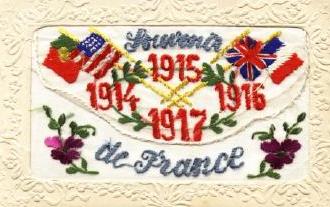
Silk postcard, undated
I came across the story of the exhibition in an article by Madeline Alberta Linford which was published in the Manchester Guardian on September 29th, 1917.

Ms. Linford was a remarkable journalist who was the first woman on the Editorial Board of the Manchester Guardian, and worked for the newspaper from 1913 till 1953.  Her contributions covered theatre, film and book reviews as well as articles on a wide range of subjects.

So impressed was the editor of the paper with her work that she was sent to France, Austria and Poland to report on the efforts of the Friends’ Relief Mission to countries badly effected during the Great War.

And from 1922 was the first editor for the newly created Woman's page for which she wrote regularly until 1939, then becoming picture editor through the 1940s.*

Of the 1917 exhibition she wrote, "In the whole collection there is scarcely a photograph which is not fresh and interesting, while some are so moving in their humane appeal, and so impressive in their simpicity that to linger before them is impossible, and to hurry past an irreverance".**

All of which has made me want to explore the images.

I have contacted the Whitworth to see if they retain any records.

Picture, Silk picture postcard, undated from the collection of David Harrop

We shall see.

*Madeline Alberta Linford, https://chorltonhistory.blogspot.com/2025/09/poverty-gas-masks-going-to-flicks-and.html

**Canadian War Photographs, Ms. Linford, Manchester Guardian, September 29th, 1917


Wednesday, 22 March 2023

In the trenches with My Dug Out Dream and other pictures and stories

Now I wonder if my great uncle Roger read the book Oh Canada which was “a medley of stories, verse, pictures and music contributed by members of the Canadian Expeditionary Force.”

The Byng Boys, 1916-
He served with the C.E.F., from 1915 untill the duration.

On balance I think not, partly because of what I know about him and mainly I suspect because the book was meant for an audience living in Canada.

I can’t be sure until I have done some more research but I think it will be one of those patriotic productions aimed at keeping an interest in the war by featuring stories from men of C.E.F. who were on active service on the battle fronts.

And I expect there was a fund raising element, but all that will have to wait for more research.  At present the title “Oh Canada” has only thrown up references to Canada’s national anthem.

My Dug Out Dream
The book has just been acquired by my old friend David Harrop, and in time I hope to see the original.

It is a first edition and was published in 1916.

But for now I shall just leave you with some of the images he has taken from the book which looks to be a fascinating insight into Canada at war.

My favourites are My “Dug Out” Dream, from an original drawing by Captain R.G. Matthews, C.E.F., and  “The Byng Boys are here.”

“The Bing Boys Are Here, styled ‘A Picture of London Life, in a Prologue and Six Panels,’ is the first of a series of revues which played at the Alhambra Theatre, London during the last two years of World War I. 

The series included The Bing Boys on Broadway and The Bing Girls are There. 

The music for them was written by Nat D. Ayer with lyrics by Clifford Grey, who also contributed to Yes, Uncle!, and the text was by George Grossmith, Jr. and Fred Thompson based on Rip and Bousquet's Le Fils Touffe. 


Other material was contributed by Eustace Ponsonby, Philip Braham and Ivor Novello.

The Bing Boys Are Here opened in 1916 in the West End and ran for 378 performances. 

It was one of the three most important musical hits of the London stage during World War I”*


Location; Canada

Pictures; from Oh Canada, 1916, courtesy of David Harrop.


* The Bing Boys Are Here, https://en.wikipedia.org/wiki/The_Bing_Boys_Are_Here

Friday, 1 July 2022

Reflecting on a past Canada Day.... 2016 ...... with the memory of the “Canadian 26”

Today is Canada Day.

Honouring those who participated in two world wars
It is day which has grown in significance for me as I have uncovered more of my Canadian family history and can count on a growing number of Canadian friends and colleagues.

Two of my direct family migrated to Canada, one in 1914 who was taken over by the MIddlemore charity on behalf of the Derby Workhouse and a great aunt who made the same journey nine years later on an Empire assisted scheme.

In the case of my great uncle having arrived in Canada in 1914, he volunteered for the Canadian Expeditionary Force the following year and in summer of 1916 was back in Britain before going on to the Western Front.

He like the other six men of my family who went off to war came back, but many others didn’t and it is of the 26 Canadian soldiers buried in Southern Cemetery along with others from Australia and New Zealand which today are exercising my thoughts.

C S Asllop ....... of the "26"
All died of complications to wounds they had sustained in the fighting or from illnesses they contracted, and most died in the nearby hospital.

Back in 2016 to mark their deaths on what was the anniversary of the first day of the Battle of the Somme as well as Canada Day a special service attended by Major Charron of the Canadian army took place in the cemetery.

He was accompanied by parties of school students, civic signatories including the local MP and veterans organisations.

Many of whom then visited the permanent exhibition in the Remembrance Lodge which features memorabilia from the Great War.

The exhibition is run by David Harrop and this year like last there will be items directly related to the Canadian armed forces.

Location; Southern Cemetery

Pictures; the service of Remembrance, July 1, 1916 from the collection of Andrew Simpson

Wednesday, 29 September 2021

In Brooklands Cemetry with Samuel Edgar Walker of the 67th Pioneer Battalion

Now I know there is much more to discover about Samuel Edgar Walker who is recorded on the family’s gravestone in Brooklands Cemetery.

He was the youngest son of Samuel and Margaret Walker of Sale, and was born in 1889 and was killed in action during the Great War.

What marks him out as a little different from other the young soldiers commemorated in the cemetery is that he served with the 67th Pioneer Battalion of the Canadian Expeditionary Force.

According to his Attestation Papers he enlisted in Vancouver on September 28 1915 giving his occupation as “musician” which may suggest he was on a tour of Canada at the time but could equally mean he was a resident.*

At the moment his full military records have not yet been digitalized but I do know that he was 5 ft 7 in height had a “ruddy” complexion, with blue eyes and dark hair and was judged “fit for the Canadian over Seas Expeditionary Force.”

And that for now is it.

I am indebted to Antony Mills who came across the gravestone and has also photographed those of other Canadian soldiers who in due course I will research.

Location; Brooklands Cemetery


Picture, from the collection of Antony Miller, 2017

*Library and Archives Canada, Personnel Records of the First World War, http://www.bac-lac.gc.ca/eng/discover/military-heritage/first-world-war/personnel-records/Pages/item.aspx?IdNumber=293490

Saturday, 25 September 2021

Surviving a century ........... the silver inscribed watch

Now it always fascinates me how cherished items end up on eBay.

The watch
Some will be family treasures passed down, while others are just a simple holiday snap and yet all of them will have once marked a significant moment in someone’s life.

And so it is with this watch which was awarded to Earl C Duffin.  I have no idea when he received it but the inscription on the back refers to a Masonic Lodge in Winnipeg.

It now belongs to David Harrop who told me that Earl C Duffin served with the Canadian Expeditionary Force and with the help of that excellent site Library and Archives Canada, it has been possible to follow his army career.*

I know he was born in 1886, enlisted in  December 1914, and sailed for Europe the following August and by the April of 1916 he was in France.  He was demobbed in August 1919, having attained the rank of L. Col.

The watch and its inscribed sentiment
In time I shall try and find out more.

I know he married a Miss Shirley Calder on July 20 1921 and the Winnipeg Tribune carried a wedding picture.

It is more than likely that he will have returned to his earlier occupation as a merchant.

And he may even have revisited his old homes in Winnipeg at Harvard Avenue and later in Main Street.

All of which betokens a man with money and influence and begs the question of how his watch left Canada.

That said it will feature in David’s exhibition at Southern Cemetery commemorating the Battle of the Somme and is one of a number of items reflecting the stories of the twenty-six Canadians from the CEF who are buried in Southern Cemetery.

C H Hill of the "26"
They have become part of a research project to chronicle the lives of all the twenty six. **

So far I have discovered something on two of the men one of whom was a British Home Child, and before July 1 I hope to have found out something about them all.

Now that would be a fitting way to mark the day which was not only the first day of the Somme but also Canada Day, and this year the High Commissioner of Canada along with our Lord Mayor will be at a service of remembrance in Southern Cemetery.

Pictures; watch of Earl C Duffin, from the collection of David Harrop

*Library and Archives Canada, http://www.bac-lac.gc.ca/eng/discover/military-heritage/first-world-war/first-world-war-1914-1918-cef/Pages/search.aspx

**Canada's 26 of the CEF in Southern Cemetery, https://chorltonhistory.blogspot.co.uk/search/label/Canada%27s%2026%20of%20the%20CEF%20in%20Southern%20Cemetery

Thursday, 15 October 2020

From the 98th Battalion to Miss Marion Dilnuth of Bermonsey

Now I know I will never find the identity of Rex.

He sent this postcard to Miss Marion Dilnut of 280 Bermondsey Street, south east London and on a whim I went looking for the address.

I grew up not far from Bermondsey but if I walked past Miss Dilnuth’s house I have no memory, added to which this bit of London has changed much and the site of her home looks to be a modern block of flats.

Some of the original residential properties still exist.  They are tall two story properties fronted with shops and it may be that hers was one of these

Her father described himself as a store dealer in 1911 and a decade earlier refers to a shop on the census return.

But for now that is about it.

In 1916 when the card was sent Marion was 17 and still living in the family home and possibly still living with her brother, three sisters and widowed father.

So Rex could be a sweetheart or just a friend but I am confident he wasn’t a brother.

The card suggests he had been with the 98th Battalion, of the Canadian Expeditionary Force, but he says he is no longer with the unit, which leaves many questions.

Some in time I am sure will come to light but others I fear are lost.

Location, Folkestone & Bermondsey

Picture; picture postcard, 1916 from the collection of David Harrop

Wednesday, 26 June 2019

Discovering the story of one British Home Child, born in London, migrated to Ontario and buried in Manchester

Now I doubt I will ever come across a photograph of young Thomas John Loveland.

Southern Cemetery, 2015
He was buried in Southern Cemetery in 1918 and was just 21 years old.

Not of course that there is anything unusual in that.  Plenty of people still died young in the early 20th century and not everyone could afford to have their picture taken in a photograph.

But in the course of the last few days I have come to know a lot about him.

He is one of the 26 men of the Canadian Expeditionary Force who are buried in a neat line in the cemetery.

Each will have a story and it was only by chance I settled on his grave.  He enlisted in the August of 1915 and was in the First Battalion of the Canadian Machine Gun Corps, and here the story becomes a little personal.

Like me he was born in London not that far from where I grew up and was a British Home Child like my great uncle who also enlisted in the August of 1915.

I had suspected he was a British Home Child because his Attestation Papers showed that his next of kin was an Eliza Loveland living in London and she was his sister..

Thomas John Loveland
Their father who had been a gas labourer had died in 1903 at the age of 35 leaving his wife Eleanor to bring up five children on her own.

The eldest who was Eleanor was eleven years old and the youngest was just two.

By 1911 they were living in a four roomed house at number 4 George Street at Walsoken in Cambridgeshire.

But only Eliza and her mother are in the property which they share with a William Fearis and his daughter who was 18 months old.

Both Mr Fearis and Mrs Loveland give their status as widowed and she describes herself as “Domestic housekeeper.”

In time I am minded to explore the story of Mr Fearis but for now I am content just to record that on the night of census Mrs Loveland’s youngest son was visiting.

He was eleven years old, is described as a “scholar” and this offers up the possibility that he too was in care.
I doubt that he could have been living with either of his elder siblings because they were only sixteen and fourteen.

And with the help of friends it seems I was right.  Liz Sykes who is the Archivist at the Together Trust thought that he may have been a Barnado boy and Catherine West and Dawn Heuston dug into the archives of the Library and Archives Canada and confirmed it.

from his Attestation Papers, August 1915
He arrived in Canada on board the SS Dominion in 1907 and had been migrated by the Barnardo Charity.

Like my great uncle he was the only one of the direct family to have been sent to Canada.

Somewhere there will be the records of how that migration came about and the decisions which led him to Canada but his siblings to stay in the UK.  Some of these will be locked away in the Barnardo records and as I am not a family family I will never get to see them.

That said I am in contact with a relative via ancestry and so maybe they will be able to get permission to reveal what happened.

Later I will also try and find his siblings.  One of his brothers I know was killed on the Western Front in the August of 1917.  He was Edward Loveland who was 27 when he died and he is buried atLijssenthoek Military Cemetery  in Belgium.

All of which underlines the enormity of the Great War, and like Private Thomas Loveland and his brother Bombardier Edward Loveland my family made a huge contribution.

Along with my great uncle in the CEF the family roll of honour includes my grandfather, another great uncle, two uncles and my great grandfather, and some who served in the German armed forces.

In honour of the Canadian Expeditionary Force
I hadn’t expected when I first came across his grave that Private Loveland would take me on my own personal journey which will for now conclude with a visit to his resting place in Southern Cemetery which is just ten minutes away from where we live.

And I intend to go on July 1 which is timely given that it is the centenary of the first day of the Somme and of course Canada Day.

I will also call in at the special exhibition in the Remembrance Lodge devoted to the Battle of the Somme.  It is maintained by David Harrop who in honour of the men of CEF buried here has included a special item of remembrance to those Canadians.

Nor should we forget that the cemetery also holds the graves of men of the ANZAC forces as well as the British army.

And something of the story of Southern Cemetery and the history of Manchester during the Great War is revealed in Manchester Remembering 1914-18 published today.

Location; Southern Cemetery

Research; Liz Sykes, Catherine West and Dawn Heuston

Pictures; Southern Cemetery 2013 from the collection of Andrew Simpson, grave of Private Thomas John Loveland, courtesy of David Harrop and Maple leaf from Lori Oschefski

*Manchester Remembering 1914-18


Thursday, 6 December 2018

Remembering two men who died in the Great War

Now I was not prepared for the picture of Private James Biddle’s war grave.

He was just 27 years old when he was killed in the closing stages of the Great War.

His name appears on the war memorial in Didsbury, and his father was on the committee that oversaw the erection of the memorial in 1921.

That should almost have been the end of the story, but for the picture which was taken today, by Régine Verguier of the grave stone in Buqouy Road Cemetery, near Arras in France.

I was prepared for the white headstone and the details of Private Biddle’s life, but not for the inclusion of Lieutenant R.J. Rawlinson of the Canadian Infantry.

He too was aged 27 and died of wounds on September 30th.

What drew me, in were the badges of the Manchester Regiment and the Maple Leaf at the head of the stone.

And that led me to want to know more about Lieutenant Robert John Rawlinson who was born in 1891 in Furness.

He had enlisted in the Canadian Expeditionary Force on September 23, 1914, at Val Cartier military training camp nine miles north of Quebec City.

He had already done four years in the 4th Battalion of the Kings Own Regiment based at Lancaster.

With more research I might be able to discover what he was doing in Canada in 1914, given that his wife was still in Furness.

But the little I know is remarkable enough.

In 1916 he was promoted to the rank of corporal, and in December of the following year to sergeant and at his death was a Lieutenant, added to which he was awarded the Military Medal in October 1916.

Unlike Private Biddle his army records have survived and will offer up more of his life.*

But for now, that is it.

Location France

Picture; the gravestone of Private James Biddle, and Lieutenant R.J. Rawlinson, 2018, Buqouy Road Cemetery, courtesy of Régine Verguier


*Library and Archives Canada, https://www.bac-lac.gc.ca/eng/discover/military-heritage/first-world-war/personnel-records/Pages/item.aspx?IdNumber=595612

Sunday, 11 November 2018

Arthur Wisdom Ervine a British Home Child .......

This is the gravestone of Arthur Wisdom Ervine and he is one of the thirty-one men of the Canadian Expeditionary Force buried in Southern Cemetery in the south of Manchester.


All of the men died of wounds they sustained on the Western Front during the Great War.

Of those thirty-one men two were British Home Children and both were Barbados’s Boys.

I had uncovered the story of Thomas John Loveland who had enlisted in 1915 and was killed in 1918 by sheer chance having chosen him simply because someone had left a small Canadian flag by his gravestone.

And now I am researching all of the thirty-one.  I hadn’t intended too but this year is the centenary of the Somme and is also Canada Day.

Here in the cemetery there will be a special ceremony of Remembrance on July 1 at at which there will be the Lord Mayor and the High Commissioner for Canada.

So it seemed fitting to look for the stories of these men buried far from home.

It took an afternoon to complete the basic database which revealed that Private Arthur Wisdom Ervince of the 2nd Battalion of the Canadian Infantry had been born in Dorset in 1898.

The evidence trail for his life here in the UK is sparse and there may more be information on the BHC databases all of which means I know more about him once he enlisted than before.

His Attestation Papers show that he gave his next of kin as the Barnado’s Home on Peter Street in Toronto.

I know also that he left Halifax for Liverpool in the June of 1917 and arrived in France the following January.

He seems to have missed the vicious fighting when the Germans staged their last counter offensive but was part of the allied counter attack.

He was wounded on October 17th, evacuated to Britain five days later and died on November 15.

Now I shouldn’t be surprised that both his final resting place is a cemetery I know well or that Salford Royal where he died is a hospital I have visited on several occasions..

But  it does still  make for a powerful connection.

Location; Southern Cemetery

Picture; gravestone of Private Ervine from the collection of David Harrop


Saturday, 22 July 2017

“The Canadians are holding their own” .......... and nor were they alone .......making a bob from the troops in the Great War

Now if you were far from home sending a regular picture post card was away of keeping in touch with the family.

Add caption
And over the four years of the Great War millions of cards must have been sent from army camps ships of the line and from all the battle fronts.

All of which will have been good news for the commercial postcard companies whose commercial considerations meant that when they had a good picture it would be daft not to use it over and over again.

Before the war this meant using the same comic image and altering the name of the seaside resort or in the case of Tuck and Son marketing the same Edwardian “belles” on a series of postcards changing only the city they were from and altering the rhyme extolling their beauty and charms.

So had you been in the south west you could have read “Of all the girls’ it’s nice to meet Torquay girls are hard to beat”, which had become “The prettiest girls it is well known Are mostly found in London Town” and had variations for pretty much everywhere else.

So when the Great War broke out what better than market a winning image with a different regiment.

All of which meant that the romantic card, “The Canadians are coming,” with its picture of a nurse in the arms of a soldier had with a stroke of a pen become “The Manchesters are ‘holding their own’ at Hayward’s Heath.”

Both cards were made by the same company and sold in the same area.

Our Canadian one was posted on September 12 1915 at to a young woman who lived at Norbury Park Farm in Surrey at 9.15.

The farm is still there and with a bit of detective work we may be able to uncover more about the young woman who received the card and along the way whether the Canadians were in the area the postcard was sent from.

We shall see.

Pictures; from the collection of Davis Harrop

*More of "Our Belles" from Tuck & Sons in 1908 and a bit of commercial sharp practice, https://chorltonhistory.blogspot.co.uk/2016/07/more-of-our-belles-from-tuck-sons-in.html

Thursday, 22 June 2017

Reflecting on the forthcoming Canada Day and its significance for Southern Cemetery

We are just a week away from Canada Day.

Major Charron
It is day which has grown in significance for me as I have uncovered more of my Canadian family history and can count on a growing number of Canadian friends and colleagues.

Two of my direct family migrated to Canada, one in 1914 who was taken over by the MIddlemore charity on behalf of the Derby Workhouse and a great aunt who made the same journey nine years later on an Empire assisted scheme.

In the case of my great uncle having arrived in Canada in 1914, he volunteered for the Canadian Expeditionary Force the following year and in the summer of 1916 was back in Britain before going on to the Western Front.

He like the other six men of my family who went off to war came back, but many others didn’t and it is of the 26 Canadian soldiers buried in Southern Cemetery along with others from Australia and New Zealand which today are exercising my thoughts.

Honouring those who participated in two world wars
All died of complications to wounds they had sustained in the fighting or from illnesses they contracted, and most died in the nearby hospital.

Last year to mark their deaths on what was the anniversary of the first day of the Battle of the Somme as well as Canada Day a special service attended by Major Charron of the Canadian army took place in the cemetery.

He was accompanied by parties of school students, civic signatories including the local MP and veterans organisations.

Many of whom then visited the permanent exhibition in the Remembrance Lodge which features memorabilia from the Great War.

The exhibition is run by David Harrop and this year like last there will be items directly related to the Canadian armed forces.

Location; Southern Cemetery

Pictures; the service of Remembrance, July 1, 1916 from the collection of Andrew Simpson


Monday, 3 April 2017

Remembering Vimy Ridge .................. April 1917

The Great War is now a century away,  but the anniversaries continue to roll on, from the outbreak of hostilities through to the battles on land and sea and those event on the Home Front that marked the growing transformation of a country engaged in “total war.”

And it is easy to become absorbed in the British dimension ignoring the experiences of our allies and even our enemies.

Verdun after all was  truly a tragedy for many who had sons fighting in German field grey or under the French tricolour and while we quite rightly remember the sacrifice of British, Australian and New Zealand soldiers in the Gallipoli Campaign there were huge losses sustained by the Ottoman Empire.

So with all that in mind I want today to remember the Battle of Vimy Ridge which took place between April 9 and 12 in 1917 and was fought by the four divisions of the Canadian Corps against three divisions of the German Sixth Army. The corps suffered 10,602 casualties with 3,598 killed and 7,004 wounded.

The German Sixth Army suffered an unknown number of casualties with approximately 4,000 men becoming prisoners of war.

To mark that event and in particular to honour those Canadian’s who were sent from Britain as child migrants, this month’s edition of British Home Children is devoted to their story.*

You can read it by following this link

Location France, Canada Britain

Picture; cover of The Battle of Vimy Ridge, British Home Children, Advocacy & Research Association

* British Home Children, Advocacy & Research Association, http://www.britishhomechildren.com/

**The Battle of Vimy Ridge, British Home Children, Advocacy & Research Association, http://media.wix.com/ugd/186d15_50edaeee745d400f94ade0a159ed6890.pdf


Monday, 21 November 2016

The silk postcard from France, and a museum in British Columbia

Now a few days ago I featured one of the silk embroidered postcards from the Great War.


Souvenir de France, 1917
I have been a fan of them ever since I began the book on Manchester and the Great War and my friend David Harrop showed me a new one which carried the name of the RMS Melita.*

And as you do I went looking for the ship which I found along with quite a bit of interesting history, but what really caught my eye was an article by Annette Fulford who had written about the Canadian War Brides some of whom went over in the Melita after the war.**

The nuseum in 2015
It was a fascinating story and pointed up that I knew nothing about these war brides.

Of course most of us will have heard of the GI Brides from the Second World War who left a drab and tired Britain still recovering from the war.

And grim it was.

Rationing didn’t stop until the early 1950s, there continued to be shortages of all kinds and for a kid like me growing at the time, bomb sites were a natural place to play.

But it never occurred to me that there should be Canadian War brides and certainly not from the Great War.

Thus is ignorance challenged and what a story it is.

Inside the museum, 2015
And that led me to a conversation with Ms Fulford who shared an article about another Canadian silk which simply carried the message Souvenir de France, and the dates 1914, 1915, 1916 and 1917.***

On the reverse Private A Wildgoose,  nu 234719 of the 52 Battalions, Canadians had written to his mother in November 1917.

The message is short, reassuring but records that “I have had no mail for over a week.”

Annette went on to research the story behind Private Wildgoose, but for that you will have to follow the link to the article which was published in the Family Newsletter of the Maple Ridge Historical Society which is in British Columbia.

The Phonograph, 1950 on display at the museum
All of which means that by degree not only have I met someone new, learnt a bit about a Canadian soldier but have “bagged” another historical society.

And so while other people collect stamps, bottle tops and those small picture cards with came in packets of cigarettes and tea, I hoover up historical societies.

I don’t join them all but I read their newsletters revel in what they have to say about the history of their locality and pass on the link to friends.

So I shall just close with the description of their museum which tells me that is “located in Maple Ridge between the Lougheed Highway and Haney Bypass at 22520 116th Ave.

Silk with the regimental badge of the Manchester's circa 1916
The museum is housed in the former Manager’s home for Port Haney Brick & Tile. 

We are a community museum featuring First Nations Prehistory, history of settlement and prominent families and feature a world-class model railway diorama of the Port Haney area at the height of the railway logging era..”****

All of which leaves me to reflect just how far you can travel with one silk postcard.

Location; Maple Ridge BC

Pictures; silk postcard, 1917 courtesy of Annette Fulford, the Maple Rdige Museum, 2015 courtesy of  Maple Ridge Museum & Community Archives and remaining silk postcards circ 1916-1918 from the collection of David Harrop

*Manchester Remembering 1914-18 by Andrew Simpson will be published by the History Press in February 2017

**Canadian War Brides of the First World War

***Capturing a moment in time Souvenir Postcard from WW1

****Maple Ridge Museum and Community Archives, 

Saturday, 19 November 2016

The silk postcard that spans the ocean

Now I have been meaning to write about this postcard for a long time.

It belongs to my old friend David Harrop and comes from his huge collection of memorabilia from both world wars.

Embroidered silk postcards predate the Great War and continued into the 1920s but they seem to come into their own during the conflict.

Many were made in France and Belgium and were sent back from troops serving on the Western Front.

Some carry sentimental messages or references to towns behind the lines, but many use regimental badges and come also with a selection of the flags of the allies.

And this one from RMS Melita is a favourite of mine.

The ship did the Canada run from the end of the war through the 1920s before being sold in 1935 to an Italian shipping company and was scuttled off the Libyan coast in 1941.

All of which has prompted the start of a search to see what the connection might be between the Melita and British Home Children.

I know other ships of the shipping line were involved and it may be that there are people who can confirm that one of their BHC travelled the ocean on board the Melita.

And in the course of starting the investigation I came across an excellent blog on Canadian War Brides of the First World War which pointed to the fact that  our ship was involved which offers new  insights into the connection between Britain and Canada.*

All of which brings me back to my own great uncle who arrived in Canada in 1914 only to enlist in the Canadian Expeditionary Force the following year and find himself by degree on the Western Front via his home country.

It was a journey replicated by many other British Home Children some of whom are buried here in Manchester having died of their wounds in the local military hospital.

They lay in graves besides those of British, Australian and New Zealand soldiers and some at least feature in the new book on Manchester and the Great War.**

Location; Britain, Canada

Pictures; embroidered silk postcards, RMS Melita, 1918, To My Daughter, 1918, and Souvenir from France, 1917, from the collection of David Harrop

* Canadian War Brides of the First World War

**Manchester Remembering 1914-18 by Andrew Simpson will be published by the History Press in February 2017

Thursday, 23 June 2016

The story of Private John William Ingham of the CEF and a thank you to all those in Canada who helped in the research

Now the story of John William Ingham of the 46th Battalion of the Canadian Expeditionary Force has taken yet another unexpected twist.*

The family grave of Mr & Mrs Ingham
He enlisted in 1916 was wounded at Vimy Ridge the following year and was buried in Southern Cemetery in south Manchester.

But he had died of his wounds in Sheffield at the Wharncliffe War Hospital and was brought back to Manchester because his wife lived in Longsight.

The Wharncliffe War Hospital was established in April 1915 from what had formerly been the South Yorkshire Asylum. 37,000 patients were to pass through the hospital during the war, and over 200 are commemorated on its Roll of Honour.

And there is an entry for John William Ingham, which I came across on that excellent site Wharncliffe War Hospital.**

What I was not prepared for was when I followed the link I came across his gravestone which is in Southern Cemetery and sits away from those of his comrades in the CEF.

I have Dean Hill and Stuart Reeves to thank for the image and it does help take the story a little further.**

I now know from the research by Linda Wisking and Melisa Dolan that he settled in Canada in 1910 giving his previous occupation as a “carter” and his intended one as “farmer.”

That said I am puzzled by the 1916 census which has him and all those on the page as living on Front Street, Yorkton, Saskatchewan. But I am sure someone in Canada will be able to shed light on my confusion.

Southern Cemetery, 2014
And this co-operation is what has made possible the story and points to the willingness of people to follow up leads and dig deep into the records.

It would seem that Private Irving had also been regarded by the authorities as a valuable asset given that his papers are stamped “British Bonus Allowed” which was commission paid by the Canadian government's Immigration Branch to steamship booking agents in the United Kingdom for each suitable immigrant who purchased a ticket to sail to Canada.”***

Not that the immigrants saw the bonus.

Detail of the Irving family gravestone
.But at least I have cleared up why he enlisted in the CEF and did not return to volunteer for the British armed forces because by the April of 1916 he was a Canadian national.

There is still the issue of why his family did not join him but perhaps they would have had not the war intervened.

Location; Southern Cemetery, and Saskatchewan

Picture; the grave of Private Ingham © Dean Hill and Stuart Reeves and Southern Cemetery from the collection of Andrew Simpson

* Looking for more British Home Children in Southern Cemetery, https://chorltonhistory.blogspot.co.uk/2016/06/looking-for-more-british-home-children.html

**Wharncliffe War Hospital, http://www.wharncliffewarhospital.co.uk/Wharncliffe6.html

*** Terminology and Abbreviations, Library and Archives Canada, http://www.bac-lac.gc.ca/eng/discover/immigration/Pages/terminology-abbreviations.aspx

Thursday, 16 June 2016

Remembering them ...... 100 years after the Battle of the Somme part 1 Southern Cemetery and Claude Alsop

As we approach the centenary of the Somme preparations across the city are well in hand to mark the Battle which began on July 1 1916.

Claude Simpson Alsop, 1890-1916
There will be a service in the Cathedral, events at Heaton Park and an act of remembrance in Southern Cemetery attended by Major David Charron of the Royal Canadian Army.

And it is the ceremony in Southern Cemetery which will be the first of a series of events I want to feature.

July 1 is also Canada Day and there are twenty-six men of the Canadian Expeditionary Force buried in the cemetery.

Recently I wrote about one of these men, and today I am looking at another.*

By chance I chose the grave of C S Alsop.  I was drawn to his grave because of the small Canadian flag someone had left beside it.
Claude Simpson Alsop had been born in 1890 in Bristol, enlisted in the CEF in May 1915 and left for Europe the following March.

He was wounded in June and died of those wounds at 8.15 pm on July 25 in the Royal Infirmary in Manchester.

Just before he died he made his will leaving everything to his half sister who lived in Balham in London.  The house which is still there is a fine late 19th century end terrace.  His his father’s home at Claremont Crescent, Weston super Mare has also survived although now a little run down it was once a very impressive property.

Canada in Khaki, 1917
I had wondered if Claude Simpson Alsop was a British Home Child like Thomas John Loveland, who is also one of the twenty six.*

But not so. In 1911 he was 21 years old still living at home with his parents and six siblings.  He described himself as a “Drapery assistant” and his father ran a business making furniture.

I haven’t yet found any records of when he left for Canada but it will be after the April of 1911.

I do know that before enlisted he was working as a salesmen and lived at 298 Grey street, London Ontario.

The house or its successor is still there and is a typical timber clad building.

The probate details of his will confirms that he left everything to Almira Dorothy Alsop which amounted to £1417.

At the time she was 23 years old and had moved to Balham, and there the trail stops, although if she didn’t marry there may be a record of her on the electoral register somewhere but as she doesn’t appear on the registration of deaths I can only assume she changed her name by marriage.

J William Montgomery, 1892-1918
All perhaps a long way from Southern Cemetery and even further from Ontario. In time I will try looking for their siblings and there is a descendant listed on ancestry who I will contact.

In the meantime I will be there on July 1 in the cemetery.

The service starts at 10 in front of the memorial and afterwards I will join David Harrop in the Remembrance Lodge with his exhibition commemorating the Somme which to mark Canada Day he has included memorabilia from the CEF.

It will be a special day for me.  Not that I think there is a direct family connection between me and Claude Simpson Alsop, but more because as many know my great uncle was a British Home Child who also enlisted in the CEF in 1915 and saw action on the Western Front.

His sister later migrated to Canada and that side of our family still live not that far from Grey Street, in London.


So despite a century and another continent there will be something which connects me to that young Canadian soldier.

Location; Southern Cemetery

Pictures; graves of some of the twenty-six men of the Canadian Expeditionary Force Southern Cemetery, 2016 from the collection of David Harrop

*Discovering the story of one British Home Child, born in London, migrated to Ontario and buried in Manchester, https://chorltonhistory.blogspot.co.uk/2016/06/discovering-story-of-one-british-home.html